

Feed aggregator
Spin-Reversing Comet May Face Self-Destruction
Comets are known for providing breathtaking observations of their long and shiny tails when they travel too close to the Sun. This happens because comets are made of ice and primarily orbit far from the Sun, but as their icy core heats up it evaporates, resulting in the aforementioned breathtaking observations. But while evaporating comets make for great public photos, scientists who study comets are focused on these snowballs of gas and dust and how they are remnants of the origins of the solar system about 4.6 billion years ago.
Should Scientists Have Research "Reserves" on the Moon?
The worlds of the Solar System offer up exciting and (so far) mostly pristine places for planetary scientists to study. As space missions continue to travel to Mars, Europa, asteroids, and other worlds, questions keep coming up about keeping them safe for continued exploration and observations.
Curiosity Blog, Sols 4954–4960: Celebrating Our Rover Engineers Past and Present
- Curiosity Home
- Science
- News and Features
- Multimedia
- Mars Missions
- Mars Home
3 min read
Curiosity Blog, Sols 4954–4960: Celebrating Our Rover Engineers Past and Present In this image acquired by NASA’s Mars rover Curiosity, the relatively light-toned bedrock in the foreground gives way to darker-toned rocks in the middle of the image, along what could be an erosional surface. Curiosity acquired the image using its Right Navigation Camera on July 15, 2026 — Sol 4955, or Martian day 4,955 of the Mars Science Laboratory mission — at 05:51:59 UTC. NASA/JPL-Caltech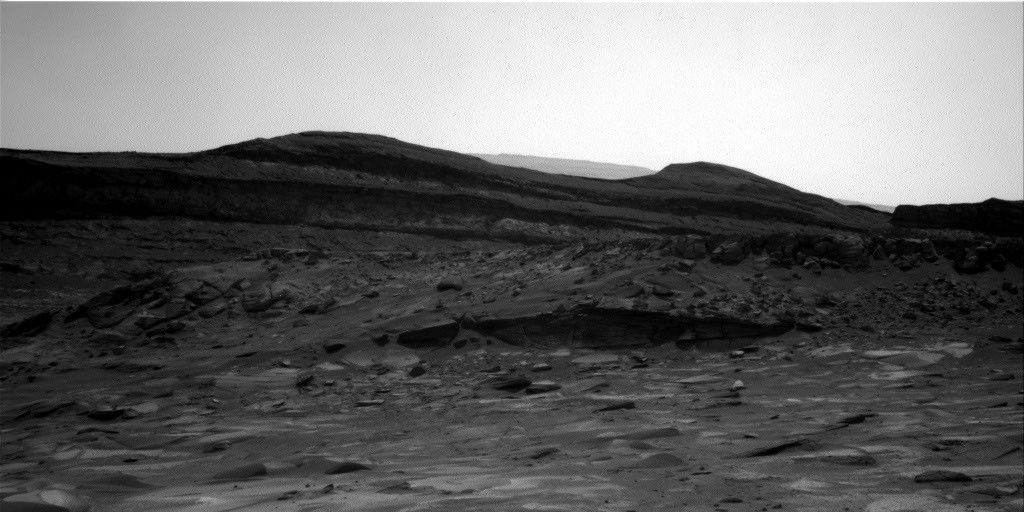
Written by Lucy Thompson, Senior Research Scientist, University of New Brunswick, Canada
Earth planning date: Friday, July 17, 2026
As an APXS uplink lead and strategic planner, I have the privilege of working with the rover engineers most days that I am on operations. The APXS instrument measures the chemistry of rocks, unconsolidated materials and the atmosphere, and is situated on the end of Curiosity’s robotic arm. This means that any target of interest that we wish to analyze has to be safe to deploy the arm, APXS, and MAHLI (the closeup imager) to. We therefore rely on the rover engineers for their assessment and to sequence the arm moves to place us safely on the targets. Recently, our workspaces have been dusty with varied relief, but the rover engineers have successfully found areas that they have been able to brush and deploy APXS and MAHLI. This week was no exception, despite some of our workspaces appearing less than ideal upon initial observation. The team managed to find rock targets of interest (x5), which the rover engineers were able to safely place the arm on and brush so that we could analyze them with APXS and MAHLI. This ensures that we acquire high-quality compositional data and images as we continue our ascent of Mount Sharp, through rock layers of varying tone and texture, tracking potential changes in chemistry, and the depositional and alteration environment.
The rover engineers are also responsible for safely driving Curiosity to the areas of interest identified by the science team. They must assess the terrain for potential hazards such as large resistant blocks that could damage the rover wheels, sand/soil patches where we could get stuck, and high slopes that the rover could slip on. Despite unexpected damage to the wheels early in the mission and getting a little bogged down in some soil/sand just as we started to climb Mount Sharp, the engineers have successfully navigated us safely along more than 23 miles (37 kilometers) of drive distance and more than 4,400 feet (about 1.35 kilometers) of elevation gain. We recently requested to drive to specific locations in order to image what the team thinks could be an erosional surface within the Mg-sulfate/carbonate-bearing unit (see the image accompanying this post). Of course, the engineers were able to accommodate our desires, with the first stop crossed off in Monday’s plan, and the drive that is being planned this weekend taking us toward the next stop.
The rover engineers also ensure that our drilling activities execute safely and successfully, and are responsible for sequencing the arm motion required to deliver the drilled samples to our internal CheMin and SAM instruments. This required completely reconfiguring how we drill after a motor failed back in 2016, with extensive behind-the-scenes work at JPL for nearly a year and a half before we resumed. Curiosity has since drilled more than 20 rock targets.
So, thanks to the rover engineers and all the engineers and scientists on Curiosity’s team, we have had another full week of activities at Gale crater. We continue to track the chemistry, textures, tone and sedimentary structures of the sulfate/carbonate unit as we climb Mount Sharp and get ever closer to the Yardang unit with APXS, ChemCam, MAHLI and Mastcam. Curiosity continues to also monitor the local environment within Gale and the atmosphere in general.
-
Want to read more posts from the Curiosity team?
-
Want to learn more about Curiosity’s science instruments?
Article
2 weeks ago
4 min read Curiosity Blog, Sols 4941-4947: (Pin)Stripes on the Fourth of July
Article
2 weeks ago
2 min read Curiosity Blog, Sols 4934-4940: In the Land of the Polygons
Article
4 weeks ago
Keep Exploring Discover More Topics From NASA Mars
Mars is the fourth planet from the Sun, and the seventh largest. It’s the only planet we know of inhabited…
All Mars Resources
Explore this collection of Mars images, videos, resources, PDFs, and toolkits. Discover valuable content designed to inform, educate, and inspire,…
Rover Basics
Each robotic explorer sent to the Red Planet has its own unique capabilities driven by science. Many attributes of a…
Mars Exploration: Science Goals
The key to understanding the past, present or future potential for life on Mars can be found in NASA’s four…
Curiosity Blog, Sols 4954–4960: Celebrating Our Rover Engineers Past and Present
- Curiosity Home
- Science
- News and Features
- Multimedia
- Mars Missions
- Mars Home
3 min read
Curiosity Blog, Sols 4954–4960: Celebrating Our Rover Engineers Past and Present In this image acquired by NASA’s Mars rover Curiosity, the relatively light-toned bedrock in the foreground gives way to darker-toned rocks in the middle of the image, along what could be an erosional surface. Curiosity acquired the image using its Right Navigation Camera on July 15, 2026 — Sol 4955, or Martian day 4,955 of the Mars Science Laboratory mission — at 05:51:59 UTC. NASA/JPL-CaltechWritten by Lucy Thompson, Senior Research Scientist, University of New Brunswick, Canada
Earth planning date: Friday, July 17, 2026
As an APXS uplink lead and strategic planner, I have the privilege of working with the rover engineers most days that I am on operations. The APXS instrument measures the chemistry of rocks, unconsolidated materials and the atmosphere, and is situated on the end of Curiosity’s robotic arm. This means that any target of interest that we wish to analyze has to be safe to deploy the arm, APXS, and MAHLI (the closeup imager) to. We therefore rely on the rover engineers for their assessment and to sequence the arm moves to place us safely on the targets. Recently, our workspaces have been dusty with varied relief, but the rover engineers have successfully found areas that they have been able to brush and deploy APXS and MAHLI. This week was no exception, despite some of our workspaces appearing less than ideal upon initial observation. The team managed to find rock targets of interest (x5), which the rover engineers were able to safely place the arm on and brush so that we could analyze them with APXS and MAHLI. This ensures that we acquire high-quality compositional data and images as we continue our ascent of Mount Sharp, through rock layers of varying tone and texture, tracking potential changes in chemistry, and the depositional and alteration environment.
The rover engineers are also responsible for safely driving Curiosity to the areas of interest identified by the science team. They must assess the terrain for potential hazards such as large resistant blocks that could damage the rover wheels, sand/soil patches where we could get stuck, and high slopes that the rover could slip on. Despite unexpected damage to the wheels early in the mission and getting a little bogged down in some soil/sand just as we started to climb Mount Sharp, the engineers have successfully navigated us safely along more than 23 miles (37 kilometers) of drive distance and more than 4,400 feet (about 1.35 kilometers) of elevation gain. We recently requested to drive to specific locations in order to image what the team thinks could be an erosional surface within the Mg-sulfate/carbonate-bearing unit (see the image accompanying this post). Of course, the engineers were able to accommodate our desires, with the first stop crossed off in Monday’s plan, and the drive that is being planned this weekend taking us toward the next stop.
The rover engineers also ensure that our drilling activities execute safely and successfully, and are responsible for sequencing the arm motion required to deliver the drilled samples to our internal CheMin and SAM instruments. This required completely reconfiguring how we drill after a motor failed back in 2016, with extensive behind-the-scenes work at JPL for nearly a year and a half before we resumed. Curiosity has since drilled more than 20 rock targets.
So, thanks to the rover engineers and all the engineers and scientists on Curiosity’s team, we have had another full week of activities at Gale crater. We continue to track the chemistry, textures, tone and sedimentary structures of the sulfate/carbonate unit as we climb Mount Sharp and get ever closer to the Yardang unit with APXS, ChemCam, MAHLI and Mastcam. Curiosity continues to also monitor the local environment within Gale and the atmosphere in general.
-
Want to read more posts from the Curiosity team?
-
Want to learn more about Curiosity’s science instruments?
Article
2 weeks ago
4 min read Curiosity Blog, Sols 4941-4947: (Pin)Stripes on the Fourth of July
Article
2 weeks ago
2 min read Curiosity Blog, Sols 4934-4940: In the Land of the Polygons
Article
4 weeks ago
Keep Exploring Discover More Topics From NASA Mars
Mars is the fourth planet from the Sun, and the seventh largest. It’s the only planet we know of inhabited…
All Mars Resources
Explore this collection of Mars images, videos, resources, PDFs, and toolkits. Discover valuable content designed to inform, educate, and inspire,…
Rover Basics
Each robotic explorer sent to the Red Planet has its own unique capabilities driven by science. Many attributes of a…
Mars Exploration: Science Goals
The key to understanding the past, present or future potential for life on Mars can be found in NASA’s four…
Hubble Discovers the First "Missing" Black Hole in this Famous Star Cluster
Combining over 20 years of archival data from Hubble with new data from the James Webb Space Telescope, a team of astronomers has found the first of the "missing" black holes.
Ancient geology could insulate Iran’s nuclear centrifuges under Pickaxe Mountain from bombing
Iran’s Pickaxe Mountain, or Kuh-e Kolang Gaz La in Persian, is part of a volcanic arc that formed tens of millions of years ago and is made of a tough-to-penetrate rock
Transplanted testicular tissue grew sperm in an infertile patient
The history of testicular transplants is long and often sordid, but this successful procedure offers hope for survivors of cancer and other diseases that affect fertility
Look for NASA+ Now Streaming on Amazon Fire TV
Continuing agency efforts to bring space closer to home, NASA+ is heading to more streaming platforms. On Thursday, NASA announced its programming is on Fire TV Channels. Fire TV customers can easily access this content by asking Alexa+ on compatible devices.
Future programming on Fire TV may include science mission launches, a test flight for rendezvous and docking with human landing systems, robotic lunar deliveries, the first crewed mission to the Moon under Artemis, and more. As always, NASA+ also remains available for free, with no ads, through the NASA app and on the agency’s website.
“The National Aeronautics and Space Act of 1958 calls on us to share our story of space exploration with the broadest possible audience, and our streaming partners help us accomplish that,” said Rebecca Sirmons, general manager of NASA+ at the agency’s Headquarters in Washington. “Artemis II captured the hearts and minds of viewers globally, inspiring the Artemis generation. As we work toward building humanity’s first Moon Base, we will continue to provide transparent, engaging content coverage every step of the way.”
Earlier this year during its Ignition event, NASA shared plans for a bold path forward for the agency, including increasing its cadence of Artemis missions to the lunar surface, and building the first Moon Base, among other agency priorities. This distribution partnership is another step in executing NASA’s promise to the public for a greater look into the agency, making mission and educational content available on multiple devices for viewers on their preferred channels.
For more about NASA’s missions, visit:
-end-
Cheryl Warner
Headquarters, Washington
202-358-1600
cheryl.m.warner@nasa.gov
Look for NASA+ Now Streaming on Amazon Fire TV
Continuing agency efforts to bring space closer to home, NASA+ is heading to more streaming platforms. On Thursday, NASA announced its programming is on Fire TV Channels. Fire TV customers can easily access this content by asking Alexa+ on compatible devices.
Future programming on Fire TV may include science mission launches, a test flight for rendezvous and docking with human landing systems, robotic lunar deliveries, the first crewed mission to the Moon under Artemis, and more. As always, NASA+ also remains available for free, with no ads, through the NASA app and on the agency’s website.
“The National Aeronautics and Space Act of 1958 calls on us to share our story of space exploration with the broadest possible audience, and our streaming partners help us accomplish that,” said Rebecca Sirmons, general manager of NASA+ at the agency’s Headquarters in Washington. “Artemis II captured the hearts and minds of viewers globally, inspiring the Artemis generation. As we work toward building humanity’s first Moon Base, we will continue to provide transparent, engaging content coverage every step of the way.”
Earlier this year during its Ignition event, NASA shared plans for a bold path forward for the agency, including increasing its cadence of Artemis missions to the lunar surface, and building the first Moon Base, among other agency priorities. This distribution partnership is another step in executing NASA’s promise to the public for a greater look into the agency, making mission and educational content available on multiple devices for viewers on their preferred channels.
For more about NASA’s missions, visit:
-end-
Cheryl Warner
Headquarters, Washington
202-358-1600
cheryl.m.warner@nasa.gov
Why environmental groups are suing over SpaceX’s land swap deal
If approved, this deal would give SpaceX hundreds of acres that are currently part of the Lower Rio Grande Valley National Wildlife Refuge in exchange for private land
Why don’t insects live in the ocean?
Nobody knows why insects aren't found living in the ocean. Scientists just eliminated one theory
Humans may have spoken 10 times as many languages 2,000 years ago
During a lost ‘golden age’ of language, humans may have spoken tens of thousands of different tongues, a new study suggests
The First Confirmed Exo-satellite Challenges Our Definitions of Planets and Moons
What do you call a Jupiter-like object that orbits the brown dwarf companion of a star? Is it a planet, a moon, or something new?
Why Tom Hiddleston finds Pompeii so haunting—and so human
Actor Tom Hiddleston reflects on the first time he visited Pompeii as a teenager and explains why the ancient city’s preserved tragedy continues to shape his understanding of history and humanity
Chandrasekhar and the Limits of Physics, Part 4: Vindication
The collapsing stars Eddington swore couldn't exist turned out to be everywhere, and half a century later the world handed Chandrasekhar his Nobel. How the 1.4 solar mass limit became one of the most important numbers in modern astronomy.
China’s Kimi K3 and the rise of open-weight AI models
Moonshot AI’s Kimi K3 shows how opening a model to outsiders can turn other companies’ computing power into a competitive advantage
Crews Move Artemis IV Liquid Hydrogen Tank
Crews Move Artemis IV Liquid Hydrogen Tank

Crews at NASA’s Michoud Assembly Facility in New Orleans transport the 130-foot-tall Artemis IV liquid hydrogen tank out of a production cell inside the main factory building into a detached test building on a separate portion of the 829-acre site on May 15, 2026. The liquid hydrogen tank will form part of the core stage for the SLS (Space Launch System) rocket, providing thousands of gallons of super-cold propellant to one of four RS-25 engines.
Image credit: NASA/Michael DeMocker
Crews Move Artemis IV Liquid Hydrogen Tank
Crews at NASA’s Michoud Assembly Facility in New Orleans transport the 130-foot-tall Artemis IV liquid hydrogen tank out of a production cell inside the main factory building into a detached test building on a separate portion of the 829-acre site on May 15, 2026. The liquid hydrogen tank will form part of the core stage for the SLS (Space Launch System) rocket, providing thousands of gallons of super-cold propellant to one of four RS-25 engines.
Image credit: NASA/Michael DeMocker