
Feed aggregator
An Ancient Stellar Passage Altered the Orbits of Comets We See Today
A recent study out of the Planetary Science Institute notes that the close passage of the star HD 7977 may have triggered a cascade, sending long-period comets sunward. What’s more, the same uptick in long-period comets may still be underway today. The study was recently presented at the American Astronomical Society Division on Dynamical Astronomy.
Fans of the Arctic
- Earth
- Earth Observatory
- Image of the Day
- EO Explorer
- Topics
- More Content
- About
Curiosity Blog, Sols 4941-4947: (Pin)Stripes on the Fourth of July
- Curiosity Home
- Science
- News and Features
- Multimedia
- Mars Missions
- Mars Home
4 min read
Curiosity Blog, Sols 4941-4947: (Pin)Stripes on the Fourth of July NASA’s Mars rover Curiosity acquired this image of the “Cerro Castillo” bedrock outcrop with target “Hornillos” at the bottom center. Curiosity used its Left Navigation Camera on July 1, 2026 — Sol 4942, or Martian day 4,942 of the Mars Science Laboratory mission — at 23:50:44 UTC. NASA/JPL-Caltech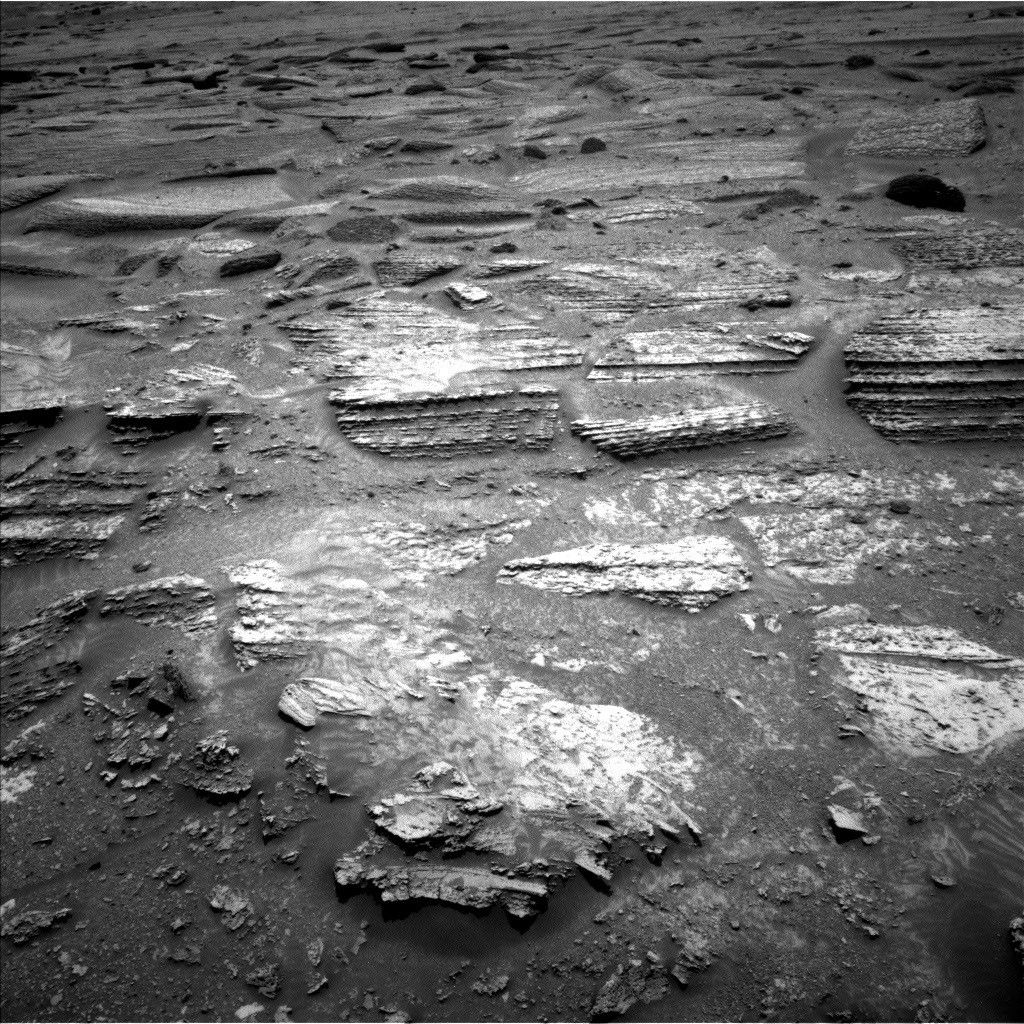
Written by Deborah Padgett, MSL Operations Product Ground System Task Lead at NASA’s Jet Propulsion Laboratory
Earth planning date: Thursday, July 2, 2026
Curiosity spent the week leading up to the Fourth of July holiday approaching a geologic boundary between a very smooth but somewhat sandy region and a rougher bedrock unit.
Leaving the polygonal terrain behind, the rover arrived at the first location of the week on Sol 4939 and, on the following sol, 4940, looked for dust devils with Navcam and performed an AEGIS ChemCam laser-spectroscopy observation and Mastcam imaging of a target selected onboard the rover. Unfortunately, there were no large rocks appropriate for brushing with the DRT at this rover stop.
On Sol 4941, the MAHLI camera imaged “Malpartida” and “Pico del Tunari,” which are both light-colored rock fragments, and APXS performed X-ray spectroscopy on them to determine their composition. ChemCam used active laser spectroscopy to zap the “Kunturiri” light-colored bedrock fragment, while “Mecoyita,” a dark-toned “float” rock, which appears to have been transported into this area from elsewhere, was observed passively. ChemCam also used its telescopic RMI camera to study sedimentary layers at the base of the Cordillera butte. Mastcam obtained several image mosaics on a ridge of sand and rock fragments dubbed “Sitajana.”
On the following sol, 4942, Mastcam continued its study of “Sitajana,” and ChemCam RMI obtained more views of Cordillera butte. Navcam took a suprahorizon cloud movie and dust-devil movie. Finally, ChemCam obtained laser spectroscopy of the dark bedrock fragment “Toconce” with documentation imagery from Mastcam. Mastcam also imaged “Sierra Vicuña Mackenna” to study a partially uncovered rock shedding sand in an area of small dune ripples.
On the afternoon of Sol 4942, Curiosity drove about 36 feet (about 11 meters) to the edge of the geologic contact and took post-drive panoramic mosaics with Navcam and Mastcam. These images revealed a field of exposed bedrock outcrops with beautiful pinstriped layers. A Navcam AEGIS observation was taken for onboard selection of a ChemCam laser spectroscopy target. This soil and rock target was observed by ChemCam with Mastcam documentation on Sol 4943. In addition, Navcam performed a dust-devil movie, and Mastcam took an atmospheric dust observation.
For Sol 4944, two adjacent light bedrock targets “Laguna Fea” and “Laguna Lejia” were selected for DRT brushing, MAHLI imaging, and APXS X-ray spectroscopy to determine composition. ChemCam laser spectroscopy will target the darker ledge of bedrock “Hornillos,” with accompanying Mastcam documentation. The investigation of “Hornillos” will include detailed imaging by MAHLI, but it was determined to be too rough for DRT brushing. Mastcam will take a large mosaic of images on the field of striped bedrock outcrop “Cerro Castillo,” as well as a smaller mosaic of a nearby trough. The ChemCam telescopic RMI camera will target a dark layer on butte Cordillera, which appears to be shedding dark boulders. Navcam will take a dust-devil movie and suprahorizon cloud movie.
On Sol 4945, ChemCham will do laser spectroscopy of “Laguna Lejia” with Mastcam image documentation, and the ChemCam RMI telescopic camera will study another area at the base of butte Cordillera where the location of large stones on the slope suggests that ice processes may have played a role. A Navcam dust-devil survey and Mastcam dust-imaging study will also be done. In the afternoon, there will be a Navcam dust-devil survey, zenith observation, and suprahorizon cloud movie, as well as a Mastcam dust observation and 20×4 mosaic image of butte Mishe Mokwa. Overnight, there will be an APXS atmospheric observation lasting many hours.
During Sol 4945, ChemCam will perform laser spectroscopy of target “La Puntilla” with accompanying Mastcam imaging, followed by a ChemCam passive-sky observation. Curiosity will then drive about 56 feet (17 meters) towards a large, dark boulder in the distance, which may be a meteorite, and do post-drive imaging and Navcam sky flats.
On the following morning, there will be an atmospheric observation including a Navcam zenith movie, suprahorizon cloud movie, and line-of-sight dust observation, as well as a Mastcam dust “tau” observation.
-
Want to read more posts from the Curiosity team?
-
Want to learn more about Curiosity’s science instruments?
Article
2 weeks ago
4 min read Curiosity Blog, Sols 4927–4933: Let’s Drive to That Smooth Area
Article
3 weeks ago
3 min read Curiosity Blog, Sols 4920-4926: Surveying the Bands
Article
4 weeks ago
Keep Exploring Discover More Topics From NASA Mars
Mars is the fourth planet from the Sun, and the seventh largest. It’s the only planet we know of inhabited…
All Mars Resources
Explore this collection of Mars images, videos, resources, PDFs, and toolkits. Discover valuable content designed to inform, educate, and inspire,…
Rover Basics
Each robotic explorer sent to the Red Planet has its own unique capabilities driven by science. Many attributes of a…
Mars Exploration: Science Goals
The key to understanding the past, present or future potential for life on Mars can be found in NASA’s four…
Curiosity Blog, Sols 4941-4947: (Pin)Stripes on the Fourth of July
- Curiosity Home
- Science
- News and Features
- Multimedia
- Mars Missions
- Mars Home
4 min read
Curiosity Blog, Sols 4941-4947: (Pin)Stripes on the Fourth of July NASA’s Mars rover Curiosity acquired this image of the “Cerro Castillo” bedrock outcrop with target “Hornillos” at the bottom center. Curiosity used its Left Navigation Camera on July 1, 2026 — Sol 4942, or Martian day 4,942 of the Mars Science Laboratory mission — at 23:50:44 UTC. NASA/JPL-CaltechWritten by Deborah Padgett, MSL Operations Product Ground System Task Lead at NASA’s Jet Propulsion Laboratory
Earth planning date: Thursday, July 2, 2026
Curiosity spent the week leading up to the Fourth of July holiday approaching a geologic boundary between a very smooth but somewhat sandy region and a rougher bedrock unit.
Leaving the polygonal terrain behind, the rover arrived at the first location of the week on Sol 4939 and, on the following sol, 4940, looked for dust devils with Navcam and performed an AEGIS ChemCam laser-spectroscopy observation and Mastcam imaging of a target selected onboard the rover. Unfortunately, there were no large rocks appropriate for brushing with the DRT at this rover stop.
On Sol 4941, the MAHLI camera imaged “Malpartida” and “Pico del Tunari,” which are both light-colored rock fragments, and APXS performed X-ray spectroscopy on them to determine their composition. ChemCam used active laser spectroscopy to zap the “Kunturiri” light-colored bedrock fragment, while “Mecoyita,” a dark-toned “float” rock, which appears to have been transported into this area from elsewhere, was observed passively. ChemCam also used its telescopic RMI camera to study sedimentary layers at the base of the Cordillera butte. Mastcam obtained several image mosaics on a ridge of sand and rock fragments dubbed “Sitajana.”
On the following sol, 4942, Mastcam continued its study of “Sitajana,” and ChemCam RMI obtained more views of Cordillera butte. Navcam took a suprahorizon cloud movie and dust-devil movie. Finally, ChemCam obtained laser spectroscopy of the dark bedrock fragment “Toconce” with documentation imagery from Mastcam. Mastcam also imaged “Sierra Vicuña Mackenna” to study a partially uncovered rock shedding sand in an area of small dune ripples.
On the afternoon of Sol 4942, Curiosity drove about 36 feet (about 11 meters) to the edge of the geologic contact and took post-drive panoramic mosaics with Navcam and Mastcam. These images revealed a field of exposed bedrock outcrops with beautiful pinstriped layers. A Navcam AEGIS observation was taken for onboard selection of a ChemCam laser spectroscopy target. This soil and rock target was observed by ChemCam with Mastcam documentation on Sol 4943. In addition, Navcam performed a dust-devil movie, and Mastcam took an atmospheric dust observation.
For Sol 4944, two adjacent light bedrock targets “Laguna Fea” and “Laguna Lejia” were selected for DRT brushing, MAHLI imaging, and APXS X-ray spectroscopy to determine composition. ChemCam laser spectroscopy will target the darker ledge of bedrock “Hornillos,” with accompanying Mastcam documentation. The investigation of “Hornillos” will include detailed imaging by MAHLI, but it was determined to be too rough for DRT brushing. Mastcam will take a large mosaic of images on the field of striped bedrock outcrop “Cerro Castillo,” as well as a smaller mosaic of a nearby trough. The ChemCam telescopic RMI camera will target a dark layer on butte Cordillera, which appears to be shedding dark boulders. Navcam will take a dust-devil movie and suprahorizon cloud movie.
On Sol 4945, ChemCham will do laser spectroscopy of “Laguna Lejia” with Mastcam image documentation, and the ChemCam RMI telescopic camera will study another area at the base of butte Cordillera where the location of large stones on the slope suggests that ice processes may have played a role. A Navcam dust-devil survey and Mastcam dust-imaging study will also be done. In the afternoon, there will be a Navcam dust-devil survey, zenith observation, and suprahorizon cloud movie, as well as a Mastcam dust observation and 20×4 mosaic image of butte Mishe Mokwa. Overnight, there will be an APXS atmospheric observation lasting many hours.
During Sol 4945, ChemCam will perform laser spectroscopy of target “La Puntilla” with accompanying Mastcam imaging, followed by a ChemCam passive-sky observation. Curiosity will then drive about 56 feet (17 meters) towards a large, dark boulder in the distance, which may be a meteorite, and do post-drive imaging and Navcam sky flats.
On the following morning, there will be an atmospheric observation including a Navcam zenith movie, suprahorizon cloud movie, and line-of-sight dust observation, as well as a Mastcam dust “tau” observation.
-
Want to read more posts from the Curiosity team?
-
Want to learn more about Curiosity’s science instruments?
Article
2 weeks ago
4 min read Curiosity Blog, Sols 4927–4933: Let’s Drive to That Smooth Area
Article
3 weeks ago
3 min read Curiosity Blog, Sols 4920-4926: Surveying the Bands
Article
4 weeks ago
Keep Exploring Discover More Topics From NASA Mars
Mars is the fourth planet from the Sun, and the seventh largest. It’s the only planet we know of inhabited…
All Mars Resources
Explore this collection of Mars images, videos, resources, PDFs, and toolkits. Discover valuable content designed to inform, educate, and inspire,…
Rover Basics
Each robotic explorer sent to the Red Planet has its own unique capabilities driven by science. Many attributes of a…
Mars Exploration: Science Goals
The key to understanding the past, present or future potential for life on Mars can be found in NASA’s four…
Researchers Prove Black Theory in a Laboratory Setting
Researchers at the Advanced Science Research Center at the CUNY Graduate Center have demonstrated a new approach to wave amplification through interaction with rotating bodies. Rather than mechanically rotating matter, however, the team engineered a radio-frequency device with properties modulated in space and time to mimic spinning.
We finally know the name of a Maya mathematician
The signature of Sak Tahn Waax, or “White-Chested Fox,” was found inscribed in a 1,000-year-old chamber beneath present-day Guatemala
Rebooting a Spacecraft, 140 Million Kilometres From Home.
Engineers have just upgraded the software running a spacecraft 140 million kilometres away, then held their breath through two full reboots with an eight minute delay on every command. The prize for getting it right is a close up look at an asteroid humanity has already changed forever, and the answer to a question nobody has been able to answer since 2022, what did we actually do to it?
NASA Study Points to Smoother Air Taxi Rides
3 min read
Preparations for Next Moonwalk Simulations Underway (and Underwater) Matt Kamlet, an employee at NASA’s Armstrong Flight Research Center in Edwards, California, sits atop the virtual reality passenger ride quality simulator during a study of air taxi motion Monday, Dec. 15, 2025. NASA recently completed a multi-year study to understand how large, sudden air taxi motion affects ride comfort.NASA/Christopher LC Clark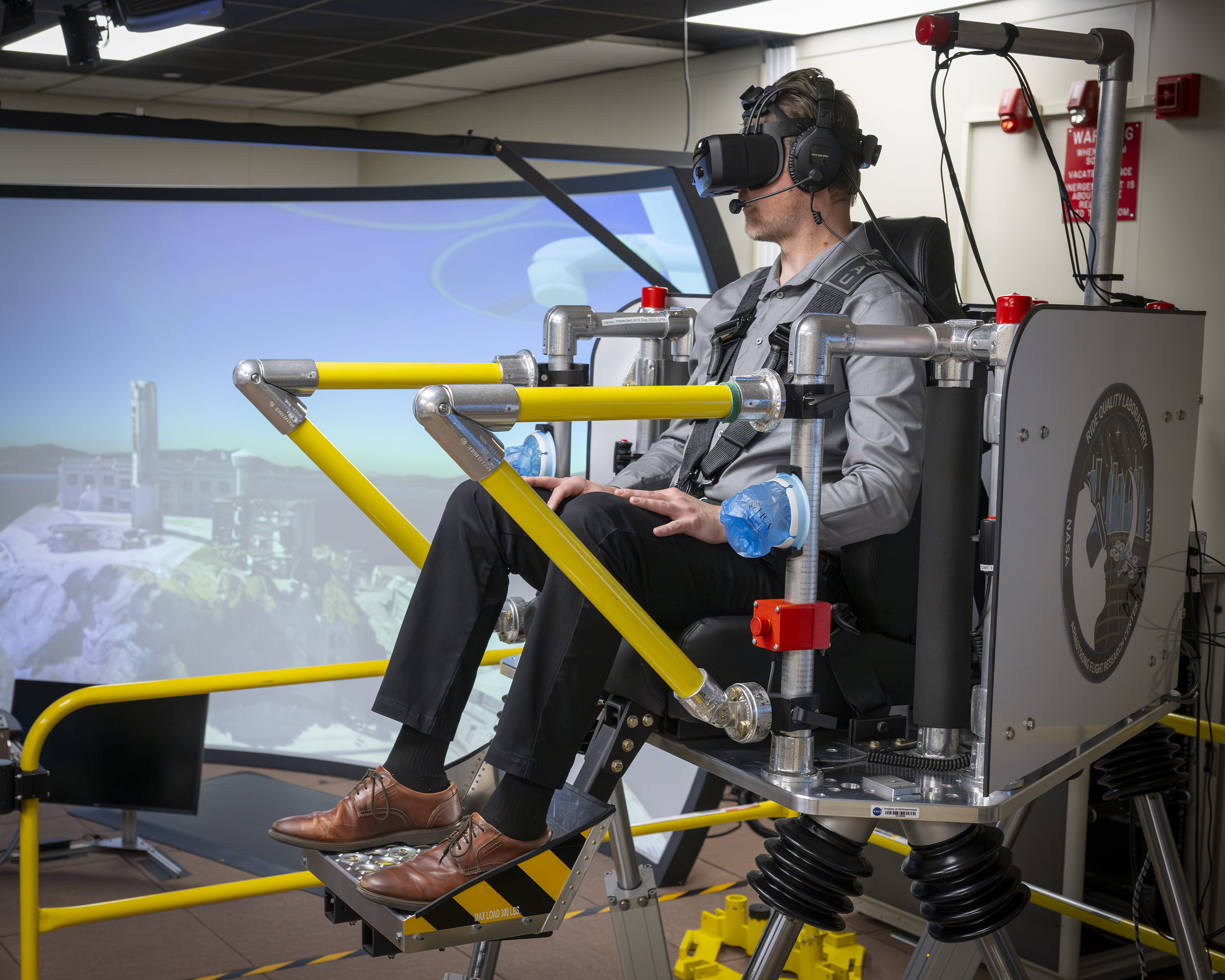
No one wants to get into an uncomfortable aircraft. NASA research could help the emerging industry of air taxis —small, vertical-takeoff-and-landing aircraft meant for short trips — understand the relationship between comfort and willingness to fly.
That’s where NASA comes in, with data that can help identify how to plan air taxi rides that can keep travelers feeling good.
NASA was able to gather that data by putting its own employees through some rough virtual flights. At the agency’s Armstrong Flight Research Center in Edwards, California, volunteers have been strapping into a virtual reality motion simulator to experience the sudden shifts and tilts that tomorrow’s air taxis could encounter, showing researchers those moments feel from a passenger’s point of view.
Their reactions are giving NASA new insight into how aircraft motion influences comfort and confidence in flight — for instance, that certain kinds of large, sudden motions can be especially bothersome. Using that data, the team developed new models linking those sudden motions to passengers’ willingness to fly. The models can help guide future aircraft design and flight operations, letting producers know what maneuvers will be too jarring for future air taxi riders.
Large, sudden movements can also come from gusting winds or landings. The NASA data allows researchers to estimate when passengers may begin to feel uncomfortable as motion increases, giving them the ability to shape aircraft designs and operations to minimize the impact of those situations.
“Through this study and others, we are starting to identify passenger comfort thresholds for aggressive flight motion,” said Curtis Hanson, NASA Armstrong lead researcher for this effort. “We can begin to make predictions about how air taxis should fly so that most passengers will find the experience enjoyable and want to ride again, which will benefit the public and the industry.”
In the simulator, each participant experienced four levels of their aircraft pitching up and down, tilting from side-to-side, rotating, or accelerating quickly into a climb or a dive during flights from downtown San Francisco to Alcatraz Island in California. Even moderate changes in these motions reduced comfort for some participants, while others remained comfortable at higher levels. Participants rated each flight on a five-point scale and identified which motions felt uncomfortable.
Participants were asked whether they would take a real air taxi flight with motion they find uncomfortable. Their answers suggested that today’s travelers may be less tolerant of rough motion than airline passengers 50 years ago, based on comparisons with earlier NASA ride-quality research.
This latest feedback builds on a multiyear NASA study to better understand air taxi passenger comfort. The overall research effort found clear relationships between specific aircraft motions and how comfortable people feel during flight.
This work is currently led under the Subsonic Vehicle Technologies and Tools project in NASA’s Research and Technology Mission Directorate and contributes to the agency’s advanced air mobility research.
Share Details Last Updated Jul 13, 2026 EditorDede DiniusContactTeresa Whitingteresa.whiting@nasa.govLocationArmstrong Flight Research Center Related Terms Explore More 3 min read A Day of Flight Testing at NASA Armstrong Article 2 weeks ago 5 min read NASA’s Newest Wind Tunnel Builds on Legacy of Innovation Article 2 weeks ago 3 min read This is How NASA Flight Tests New Technology Article 3 weeks ago Keep Exploring Discover More Topics From NASAArmstrong Flight Research Center
Aeronautics
Drones & You
Flight Research Innovation
NASA Study Points to Smoother Air Taxi Rides
3 min read
Preparations for Next Moonwalk Simulations Underway (and Underwater) Matt Kamlet, an employee at NASA’s Armstrong Flight Research Center in Edwards, California, sits atop the virtual reality passenger ride quality simulator during a study of air taxi motion Monday, Dec. 15, 2025. NASA recently completed a multi-year study to understand how large, sudden air taxi motion affects ride comfort.NASA/Christopher LC ClarkNo one wants to get into an uncomfortable aircraft. NASA research could help the emerging industry of air taxis —small, vertical-takeoff-and-landing aircraft meant for short trips — understand the relationship between comfort and willingness to fly.
That’s where NASA comes in, with data that can help identify how to plan air taxi rides that can keep travelers feeling good.
NASA was able to gather that data by putting its own employees through some rough virtual flights. At the agency’s Armstrong Flight Research Center in Edwards, California, volunteers have been strapping into a virtual reality motion simulator to experience the sudden shifts and tilts that tomorrow’s air taxis could encounter, showing researchers those moments feel from a passenger’s point of view.
Their reactions are giving NASA new insight into how aircraft motion influences comfort and confidence in flight — for instance, that certain kinds of large, sudden motions can be especially bothersome. Using that data, the team developed new models linking those sudden motions to passengers’ willingness to fly. The models can help guide future aircraft design and flight operations, letting producers know what maneuvers will be too jarring for future air taxi riders.
Large, sudden movements can also come from gusting winds or landings. The NASA data allows researchers to estimate when passengers may begin to feel uncomfortable as motion increases, giving them the ability to shape aircraft designs and operations to minimize the impact of those situations.
“Through this study and others, we are starting to identify passenger comfort thresholds for aggressive flight motion,” said Curtis Hanson, NASA Armstrong lead researcher for this effort. “We can begin to make predictions about how air taxis should fly so that most passengers will find the experience enjoyable and want to ride again, which will benefit the public and the industry.”
In the simulator, each participant experienced four levels of their aircraft pitching up and down, tilting from side-to-side, rotating, or accelerating quickly into a climb or a dive during flights from downtown San Francisco to Alcatraz Island in California. Even moderate changes in these motions reduced comfort for some participants, while others remained comfortable at higher levels. Participants rated each flight on a five-point scale and identified which motions felt uncomfortable.
Participants were asked whether they would take a real air taxi flight with motion they find uncomfortable. Their answers suggested that today’s travelers may be less tolerant of rough motion than airline passengers 50 years ago, based on comparisons with earlier NASA ride-quality research.
This latest feedback builds on a multiyear NASA study to better understand air taxi passenger comfort. The overall research effort found clear relationships between specific aircraft motions and how comfortable people feel during flight.
This work is currently led under the Subsonic Vehicle Technologies and Tools project in NASA’s Research and Technology Mission Directorate and contributes to the agency’s advanced air mobility research.
Share Details Last Updated Jul 13, 2026 EditorDede DiniusContactTeresa Whitingteresa.whiting@nasa.govLocationArmstrong Flight Research Center Related Terms Explore More 3 min read A Day of Flight Testing at NASA Armstrong Article 2 weeks ago 5 min read NASA’s Newest Wind Tunnel Builds on Legacy of Innovation Article 2 weeks ago 3 min read This is How NASA Flight Tests New Technology Article 3 weeks ago Keep Exploring Discover More Topics From NASAArmstrong Flight Research Center
Aeronautics
Drones & You
Flight Research Innovation
Why have their been so many record-breaking heat waves this summer?
Record-breaking heat waves are beginning to blur together—here’s why and what’s making them so unbearable
Chemistry Reveals the Origins of an Interstellar Comet
Somewhere in the Milky Way Galaxy is an old star that has lost one of its comets. By some quirk of orbital mechanics, that frozen nucleus of ice and dust got kicked out of its home system and into a long and winding trajectory across space. It entered our Solar System sometime in the distant past and traveled somewhat near to Earth on October 30, 2025, on its way through the system.
How the SKA Will Use Fast Radio Bursts to Decode the Universe
There are parts of the universe that are extremely hard to see, even for our most advanced telescopes. Gas and dust don’t emit any light, and are only visible by the light that they happen to block from stars and galaxies. Magnetic fields are even harder since regular light typically passes right through them. However, according to a new paper available in pre-print on arXiv, by Manisha Caleb of the University of Sydney and their co-authors, we’re currently commissioning a potentially game-changing new tool that could use a particularly violent astronomical phenomenon to provide new insight into these hard to see places.
Scientists overwhelmingly against rule change that would give political appointees say over science grants
Hundreds of thousands of scientists, including Nobel laureates, warn that changes to the way federal grants are approved would greatly damage American science