
Feed aggregator
Astronomers spot best-yet example of a wandering supermassive black hole
Giant black holes adrift in deep space are normally invisible—unless they’re dining on stars
NASA Webb Explores Family Tree of Newly Discovered Distant Objects
- Webb
- News
- Overview
- Science
- Observatory
- Multimedia
- Team
- More
Image: NASA, ESA, CSA, STScI, Pierluigi Rinaldi (Steward Observatory); Image Processing: Alyssa Pagan (STScI)
Since their discovery by NASA’s James Webb Space Telescope in 2022, little red dots (LRDs) have been the subject of great interest to astronomers. Understanding the nature of these extremely distant, compact red sources has been a puzzling scientific endeavor.
One popular theory is that little red dots are supermassive black holes known as active galactic nuclei, although they display characteristics unlike nearby active galactic nuclei. While they appear abundant at high redshift early in the universe, they rapidly decrease in number at lower redshifts. (The higher the redshift, the greater the distance the light has traveled across the universe.) This perplexing shift in number raises the question: What happens to little red dots as the universe matures?
A team of researchers led by Pierluigi Rinaldi of the University of Arizona’s Steward Observatory, now at the Space Telescope Science Institute (STScI) in Baltimore, has built upon their previous research in a new study published on July 29 in The Astrophysical Journal and proposed one pathway LRDs can follow as the universe ages: Though they may look like a unique galaxy population, these dots are affected by observational bias — some features just don’t appear at higher redshifts with current technology.
Image: Saguaro in GOODS-North Field (NIRCam) Scientists have proposed one pathway little red dots can follow as the universe matures based on their analysis of spiral galaxy WISEA J123635.56+621424.2, nicknamed the “Saguaro.” They suggest little red dots may be a temporary phase of highly active supermassive black holes. Image: NASA, ESA, CSA, STScI, Pierluigi Rinaldi (Steward Observatory); Image Processing: Alyssa Pagan (STScI)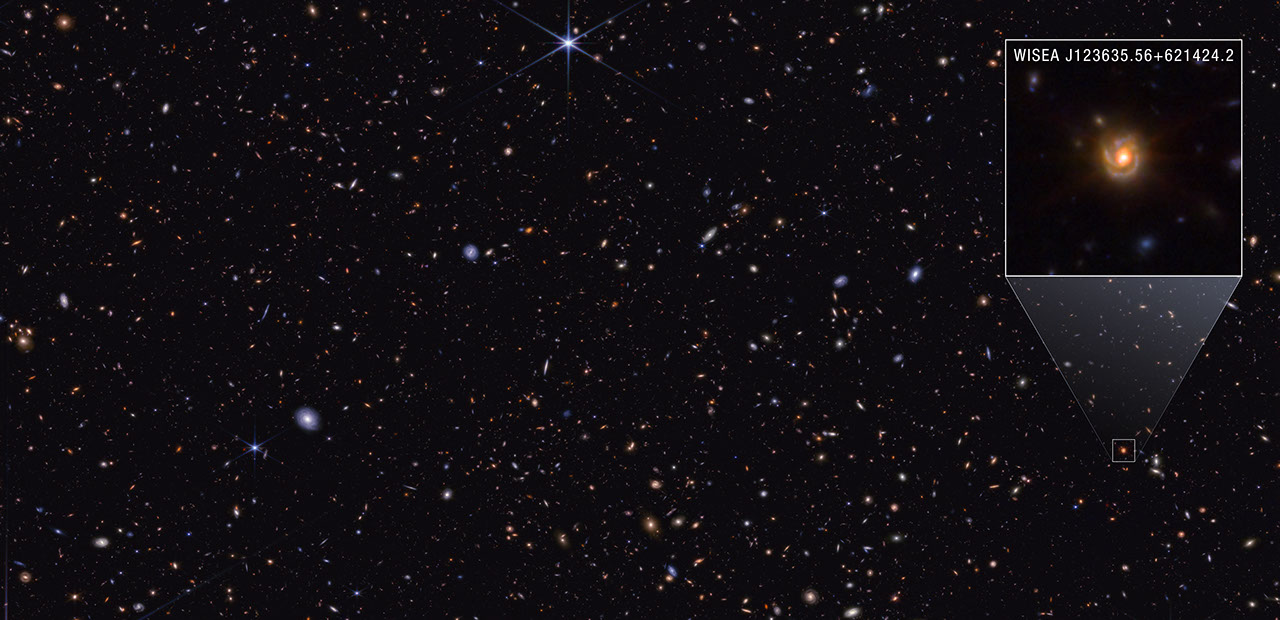
Their conclusions are based on their analysis of lower-redshift spiral galaxy WISEA J123635.56+621424.2, nicknamed the “Saguaro” for its prominent arms, like the cactus native to the Sonoran Desert in the Southwestern United States. A particularly intriguing feature of this redshift 2 galaxy, which corresponds to approximately 3.3 billion years after the big bang, is its little red dot-like center that is reminiscent of the ruby red fruit produced by the desert plant.
“Everything created in the early universe must evolve into something around us. We have had little idea of what LRDs become, but these results finally show us how to find their progeny,” said co-author George Rieke of the University of Arizona. Previous studies by NASA’s retired Spitzer Space Telescope provided the first hint of the dust-obscured, compact galaxy population in the lower-redshift universe that the Saguaro belongs to, paving the way for NASA’s Hubble and James Webb space telescopes’ high-resolution analyses.
“The Saguaro is important because it’s a prototypical little red dot and is one of the few we have found at lower redshift. It can be used to study the pathway of these dots throughout cosmic time,” said Fabio Pacucci of the Harvard-Smithsonian Center for Astrophysics in Cambridge, Massachusetts, and a co-author of the study.
Among the thousands of sources Rinaldi looked at across several surveys, the Saguaro was an example of the right place — with one of Webb’s microshutter arrays perfectly framed over the galaxy’s core to take spectroscopic data — and right time — being at lower redshift. To get as broad a view of the spiral galaxy as possible across the electromagnetic spectrum, the team used Hubble’s ultraviolet- and Webb’s infrared-imaging and spectroscopic archival data, respectively.
“Because the Saguaro is at lower redshift, we can see the very beautiful and bright host galaxy in high resolution and detail with Webb and Hubble,” said Zihao Wu of the Harvard-Smithsonian Center for Astrophysics, and a co-author of the study. “Webb’s observations can help us understand how the galaxy and its little red dot-like nucleus are connected.”
The team took multiple approaches to verify that the Saguaro’s compact red nucleus matched the characteristics of a prototypical LRD. In particular, the Hubble and Webb data showed that the nucleus is brighter in both ultraviolet and infrared light than in visible light, just like distant LRDs. The team also carefully disentangled the light emitted from the host and nucleus, and considered the presence of X-ray emission from the source.
Although the majority of little red dots at high redshift are not detectable in X-ray light, NASA’s Chandra X-ray Observatory detected weak X-ray emission from the Saguaro.
“What the X-ray light observations show is that this galaxy has an active galactic nucleus, and a very obscured one at that,” said Carys Gilbert, a Master’s student at the University of Cape Town in South Africa and a co-author of the paper. “It’s not only obscured but also X-ray weak. That kind of combination could explain the lack of X-ray emission that we see from all other little red dots. It fits the puzzle of little red dots nicely.”
In addition to demonstrating how the Saguaro’s central compact red source fits the little red dot criteria, the team synthetically shifted the galaxy to a higher redshift to explore how this galactic environment would appear to observers if located in the early universe. As expected, the Saguaro’s surrounding galactic structure fades so that only the bright, LRD-like source at its center is visible.
“Our theory is that most of these distant sources are affected by this cosmological effect, creating an observational bias,” said Rinaldi. “We simply are not able to sample the immediate environment of high-redshift little red dots because their surroundings are just too faint to be observed even with Webb. Little red dots are far more complex than just being a dot. They’re just the tip of the iceberg — of a supermassive black hole interacting with its nearby surroundings.”
Image: Little Red Dot at Redshift 2: Real and Simulated Graphic Scientists synthetically shifted the Saguaro, a lower-redshift spiral galaxy, to a higher redshift to find out how it would appear if it was in the early universe. Its compact red appearance suggests that little red dots are a phase of highly active supermassive black holes. Image: NASA, ESA, CSA, Pierluigi Rinaldi (Steward Observatory); Image Processing: Alyssa Pagan (STScI); Illustration: Leah Hustak (STScI)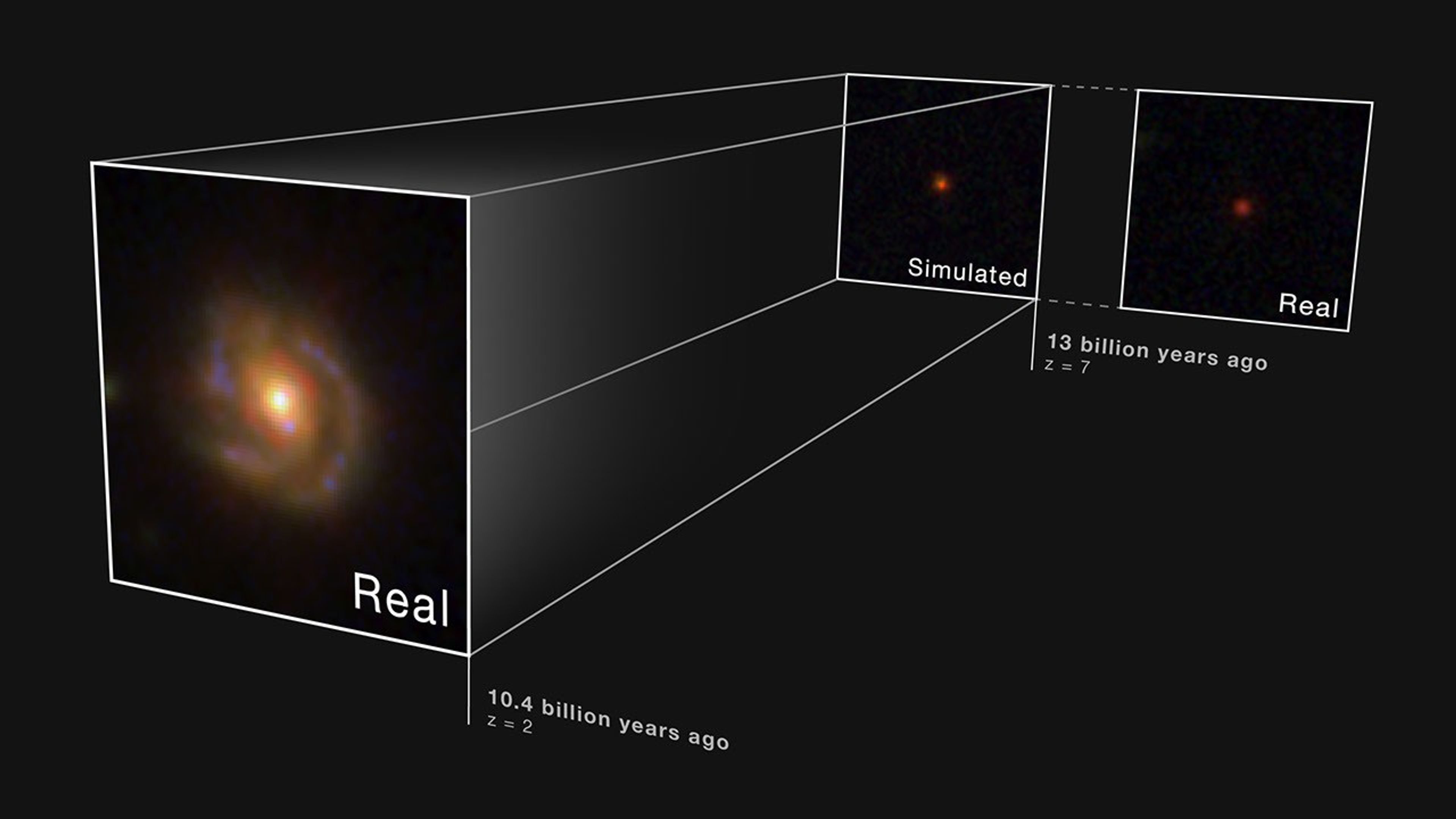
Considering the Saguaro case study, the team believes that LRDs may not be a unique galaxy population, but instead a temporary phase of highly active supermassive black holes. Could this theory be the link between the populous high-redshift little red dots seen by Webb and the local universe?
While the Saguaro is not representative of all LRDs, the team proposes that this is one phase of these compact red sources. To build more confidence, further study of the Saguaro is necessary, as well as seeking other Saguaro-like galaxies at lower redshift. The team also intends to comb through Webb’s bountiful archival data to build a census of little red dots to study how their environments may impact how they mature. These different approaches are all geared to helping uncover the family tree of little red dots.
The James Webb Space Telescope is the world’s premier space science observatory. Webb is solving mysteries in our solar system, looking beyond to distant worlds around other stars, and probing the mysterious structures and origins of our universe and our place in it. Webb is an international program led by NASA with its partners, ESA (European Space Agency) and CSA (Canadian Space Agency).
The Hubble Space Telescope has been operating for over three decades and continues to make ground-breaking discoveries that shape our fundamental understanding of the universe. Hubble is a project of international cooperation between NASA and ESA (European Space Agency). NASA’s Goddard Space Flight Center in Greenbelt, Maryland, manages the telescope and mission operations. Lockheed Martin Space, based in Denver, also supports mission operations at Goddard. The Space Telescope Science Institute in Baltimore, which is operated by the Association of Universities for Research in Astronomy, conducts Hubble science operations for NASA.
To learn more about Webb, visit:
To learn more about Hubble, visit:
https://science.nasa.gov/hubble
Downloads & Related InformationThe following sections contain links to download this article’s images and videos in all available resolutions followed by related information links, media contacts, and if available, research paper and Spanish translation links.
Related Images & Videos Saguaro in GOODS-North Field (NIRCam)Scientists have proposed one pathway little red dots can follow as the universe matures based on their analysis of spiral galaxy WISEA J123635.56+621424.2, nicknamed the “Saguaro.” They suggest little red dots may be a temporary phase of highly active supermassive black holes.
Little Red Dot at Redshift 2: Real and Simulated Graphic
Scientists synthetically shifted the Saguaro, a lower-redshift spiral galaxy, to a higher redshift to find out how it would appear if it was in the early universe. Its compact red appearance suggests that little red dots are a phase of highly active supermassive black holes.
Related Links
Read more: Webb Science: Galaxies Through Time
Read more: Galaxies Over Time
Explore more: ViewSpace: Connecting Little Red Dots
Watch: Sonification of Gas Velocity Around a Supermassive Black Hole
Watch: JWST Science Simulations: Galaxy Formation
More Webb: News | Images | Science | Home Page
Contact Media
Laura Betz
NASA’s Goddard Space Flight Center
Greenbelt, Maryland
laura.e.betz@nasa.gov
Abigail Major
Space Telescope Science Institute
Baltimore, Maryland
Hannah Braun
Space Telescope Science Institute
Baltimore, Maryland
Related Terms Keep Exploring Related Topics James Webb Space Telescope
Webb is the premier observatory of the next decade, serving thousands of astronomers worldwide. It studies every phase in the…
Galaxies
Galaxies Stories
Universe
NASA Webb Explores Family Tree of Newly Discovered Distant Objects
- Webb
- News
- Overview
- Science
- Observatory
- Multimedia
- Team
- More
Image: NASA, ESA, CSA, STScI, Pierluigi Rinaldi (Steward Observatory); Image Processing: Alyssa Pagan (STScI)
Since their discovery by NASA’s James Webb Space Telescope in 2022, little red dots (LRDs) have been the subject of great interest to astronomers. Understanding the nature of these extremely distant, compact red sources has been a puzzling scientific endeavor.
One popular theory is that little red dots are supermassive black holes known as active galactic nuclei, although they display characteristics unlike nearby active galactic nuclei. While they appear abundant at high redshift early in the universe, they rapidly decrease in number at lower redshifts. (The higher the redshift, the greater the distance the light has traveled across the universe.) This perplexing shift in number raises the question: What happens to little red dots as the universe matures?
A team of researchers led by Pierluigi Rinaldi of the University of Arizona’s Steward Observatory, now at the Space Telescope Science Institute (STScI) in Baltimore, has built upon their previous research in a new study published on July 29 in The Astrophysical Journal and proposed one pathway LRDs can follow as the universe ages: Though they may look like a unique galaxy population, these dots are affected by observational bias — some features just don’t appear at higher redshifts with current technology.
Image: Saguaro in GOODS-North Field (NIRCam) Scientists have proposed one pathway little red dots can follow as the universe matures based on their analysis of spiral galaxy WISEA J123635.56+621424.2, nicknamed the “Saguaro.” They suggest little red dots may be a temporary phase of highly active supermassive black holes. Image: NASA, ESA, CSA, STScI, Pierluigi Rinaldi (Steward Observatory); Image Processing: Alyssa Pagan (STScI)Their conclusions are based on their analysis of lower-redshift spiral galaxy WISEA J123635.56+621424.2, nicknamed the “Saguaro” for its prominent arms, like the cactus native to the Sonoran Desert in the Southwestern United States. A particularly intriguing feature of this redshift 2 galaxy, which corresponds to approximately 3.3 billion years after the big bang, is its little red dot-like center that is reminiscent of the ruby red fruit produced by the desert plant.
“Everything created in the early universe must evolve into something around us. We have had little idea of what LRDs become, but these results finally show us how to find their progeny,” said co-author George Rieke of the University of Arizona. Previous studies by NASA’s retired Spitzer Space Telescope provided the first hint of the dust-obscured, compact galaxy population in the lower-redshift universe that the Saguaro belongs to, paving the way for NASA’s Hubble and James Webb space telescopes’ high-resolution analyses.
“The Saguaro is important because it’s a prototypical little red dot and is one of the few we have found at lower redshift. It can be used to study the pathway of these dots throughout cosmic time,” said Fabio Pacucci of the Harvard-Smithsonian Center for Astrophysics in Cambridge, Massachusetts, and a co-author of the study.
Among the thousands of sources Rinaldi looked at across several surveys, the Saguaro was an example of the right place — with one of Webb’s microshutter arrays perfectly framed over the galaxy’s core to take spectroscopic data — and right time — being at lower redshift. To get as broad a view of the spiral galaxy as possible across the electromagnetic spectrum, the team used Hubble’s ultraviolet- and Webb’s infrared-imaging and spectroscopic archival data, respectively.
“Because the Saguaro is at lower redshift, we can see the very beautiful and bright host galaxy in high resolution and detail with Webb and Hubble,” said Zihao Wu of the Harvard-Smithsonian Center for Astrophysics, and a co-author of the study. “Webb’s observations can help us understand how the galaxy and its little red dot-like nucleus are connected.”
The team took multiple approaches to verify that the Saguaro’s compact red nucleus matched the characteristics of a prototypical LRD. In particular, the Hubble and Webb data showed that the nucleus is brighter in both ultraviolet and infrared light than in visible light, just like distant LRDs. The team also carefully disentangled the light emitted from the host and nucleus, and considered the presence of X-ray emission from the source.
Although the majority of little red dots at high redshift are not detectable in X-ray light, NASA’s Chandra X-ray Observatory detected weak X-ray emission from the Saguaro.
“What the X-ray light observations show is that this galaxy has an active galactic nucleus, and a very obscured one at that,” said Carys Gilbert, a Master’s student at the University of Cape Town in South Africa and a co-author of the paper. “It’s not only obscured but also X-ray weak. That kind of combination could explain the lack of X-ray emission that we see from all other little red dots. It fits the puzzle of little red dots nicely.”
In addition to demonstrating how the Saguaro’s central compact red source fits the little red dot criteria, the team synthetically shifted the galaxy to a higher redshift to explore how this galactic environment would appear to observers if located in the early universe. As expected, the Saguaro’s surrounding galactic structure fades so that only the bright, LRD-like source at its center is visible.
“Our theory is that most of these distant sources are affected by this cosmological effect, creating an observational bias,” said Rinaldi. “We simply are not able to sample the immediate environment of high-redshift little red dots because their surroundings are just too faint to be observed even with Webb. Little red dots are far more complex than just being a dot. They’re just the tip of the iceberg — of a supermassive black hole interacting with its nearby surroundings.”
Image: Little Red Dot at Redshift 2: Real and Simulated Graphic Scientists synthetically shifted the Saguaro, a lower-redshift spiral galaxy, to a higher redshift to find out how it would appear if it was in the early universe. Its compact red appearance suggests that little red dots are a phase of highly active supermassive black holes. Image: NASA, ESA, CSA, Pierluigi Rinaldi (Steward Observatory); Image Processing: Alyssa Pagan (STScI); Illustration: Leah Hustak (STScI)Considering the Saguaro case study, the team believes that LRDs may not be a unique galaxy population, but instead a temporary phase of highly active supermassive black holes. Could this theory be the link between the populous high-redshift little red dots seen by Webb and the local universe?
While the Saguaro is not representative of all LRDs, the team proposes that this is one phase of these compact red sources. To build more confidence, further study of the Saguaro is necessary, as well as seeking other Saguaro-like galaxies at lower redshift. The team also intends to comb through Webb’s bountiful archival data to build a census of little red dots to study how their environments may impact how they mature. These different approaches are all geared to helping uncover the family tree of little red dots.
The James Webb Space Telescope is the world’s premier space science observatory. Webb is solving mysteries in our solar system, looking beyond to distant worlds around other stars, and probing the mysterious structures and origins of our universe and our place in it. Webb is an international program led by NASA with its partners, ESA (European Space Agency) and CSA (Canadian Space Agency).
The Hubble Space Telescope has been operating for over three decades and continues to make ground-breaking discoveries that shape our fundamental understanding of the universe. Hubble is a project of international cooperation between NASA and ESA (European Space Agency). NASA’s Goddard Space Flight Center in Greenbelt, Maryland, manages the telescope and mission operations. Lockheed Martin Space, based in Denver, also supports mission operations at Goddard. The Space Telescope Science Institute in Baltimore, which is operated by the Association of Universities for Research in Astronomy, conducts Hubble science operations for NASA.
To learn more about Webb, visit:
To learn more about Hubble, visit:
https://science.nasa.gov/hubble
Downloads & Related InformationThe following sections contain links to download this article’s images and videos in all available resolutions followed by related information links, media contacts, and if available, research paper and Spanish translation links.
Related Images & Videos Saguaro in GOODS-North Field (NIRCam)Scientists have proposed one pathway little red dots can follow as the universe matures based on their analysis of spiral galaxy WISEA J123635.56+621424.2, nicknamed the “Saguaro.” They suggest little red dots may be a temporary phase of highly active supermassive black holes.
Little Red Dot at Redshift 2: Real and Simulated Graphic
Scientists synthetically shifted the Saguaro, a lower-redshift spiral galaxy, to a higher redshift to find out how it would appear if it was in the early universe. Its compact red appearance suggests that little red dots are a phase of highly active supermassive black holes.
Related Links
Read more: Webb Science: Galaxies Through Time
Read more: Galaxies Over Time
Explore more: ViewSpace: Connecting Little Red Dots
Watch: Sonification of Gas Velocity Around a Supermassive Black Hole
Watch: JWST Science Simulations: Galaxy Formation
More Webb: News | Images | Science | Home Page
Contact Media
Laura Betz
NASA’s Goddard Space Flight Center
Greenbelt, Maryland
laura.e.betz@nasa.gov
Abigail Major
Space Telescope Science Institute
Baltimore, Maryland
Hannah Braun
Space Telescope Science Institute
Baltimore, Maryland
Related Terms Keep Exploring Related Topics James Webb Space Telescope
Webb is the premier observatory of the next decade, serving thousands of astronomers worldwide. It studies every phase in the…
Galaxies
Galaxies Stories
Universe
Contractor to Civil Servant: NASA Welcomes Ray Williams
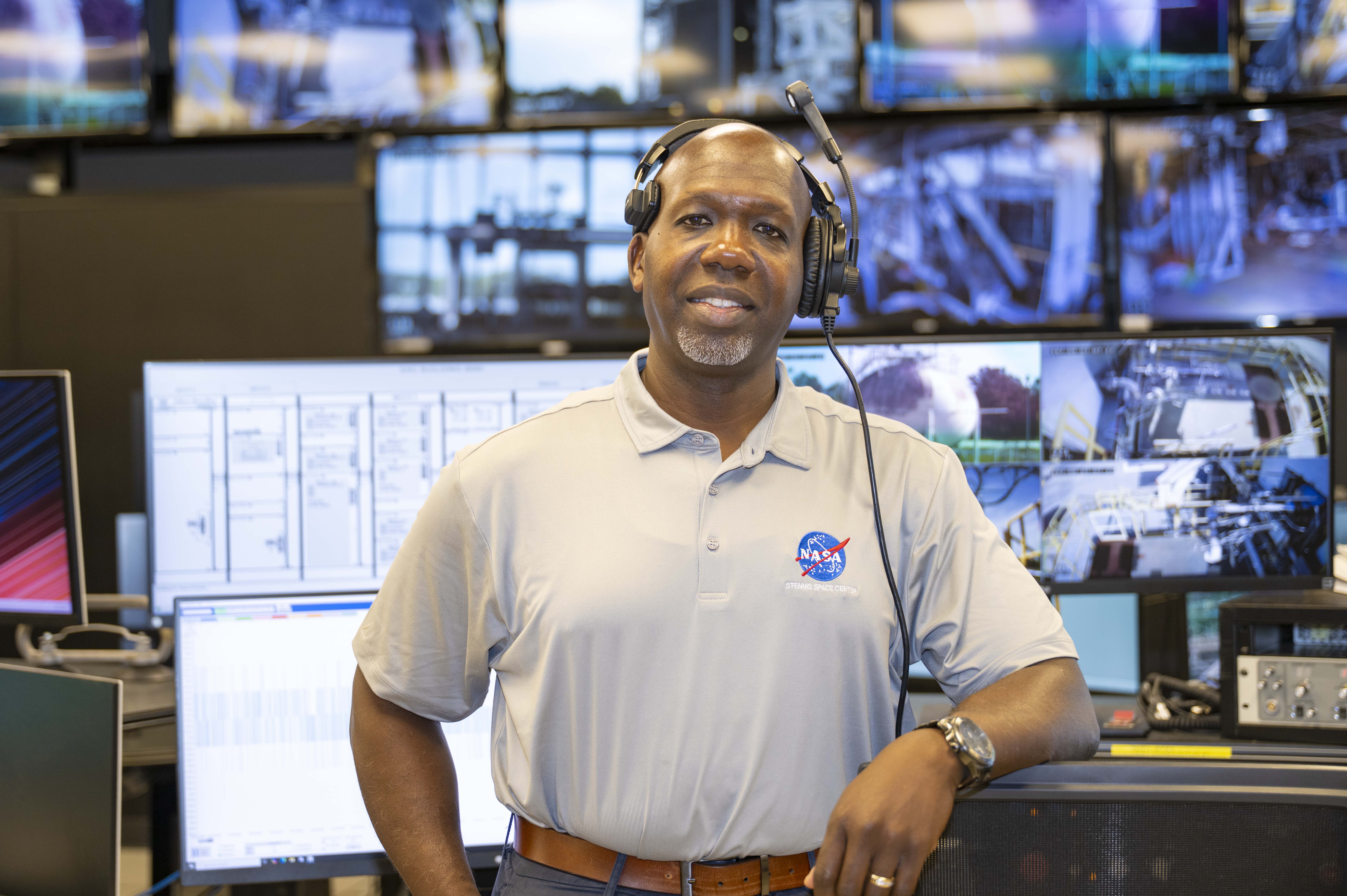
Ray Williams’ progression at NASA’s Stennis Space Center near Bay St. Louis, Mississippi, has uniquely prepared him for his new role.
As part of NASA’s plan to restore core competencies by converting contractors to civil service, the New Orleans native and Grambling State University graduate now works as a supervisor for test operations support at the agency’s E-Complex.
This propulsion testing facility provides mission-critical engineering capabilities to NASA. Through the use of high- and low-pressure propellant systems, engineers are able to focus on development testing of propulsion system components before integration into complete engine systems. Thanks to the versatility of its infrastructure and test team, the complex is uniquely equipped to support projects for the growing commercial aerospace industry and is capable of supporting a wide range of component, engine, and stage test activities.
“Ultimately, my goal is to continue to grow within my own abilities as an engineer and as a supervisor, and to help grow those that I have the opportunity to lead,” said Williams. “I want to align myself with the agency’s goals as a whole to continue to utilize our unique skillset to grow, build, evolve, and innovate.”
Williams began his career at the E-Complex in 1998 as an electrical technician contractor during the facility’s design and build phase. He quickly became familiar with the facility layout, the various systems under development, and the requirements involved in designing, building, and integrating those systems. He later advanced to the role of instrumentation and electrical engineer, gaining extensive institutional knowledge while developing expertise in the principles and importance of data validation.
In total, he brings 28 years of experience to NASA, along with an intimate understanding of the daily challenges his team of technicians faces.
Williams’ primary work location is the E-1 test stand, which is able to handle extremely high pressures and massive flow rates of super cold cryogenics.
Unlike the A and B test complexes at NASA Stennis, where a fully built engine or stage can be installed, fueled, and fired, the E-Complex is highly adaptable.
When commercial partners need to validate large, complex components, they provide specific requirements. The team then customizes the test facility to replicate the exact extreme conditions the hardware is expected to encounter during operation. NASA collects and analyzes data from these precisely controlled test conditions to validate design predictions and determine whether design modifications are needed throughout the development process, from subscale testing through full-scale testing.
Whether validating valve timings, ensuring facility instrumentation is properly calibrated, supporting ultra-high pressure pumping and cryogenic transferring operations, or troubleshooting electrical and mechanical support systems, Williams and his team must execute each task with precision. By retaining Williams’ facility specific expertise in-house as a civil servant, NASA reduces long term operational risk.
Williams describes the opportunity to perform this mission critical work in public service as a dream come true, a dream that began decades ago during an elementary school field trip to NASA Stennis. Today, he finds himself working at NASA just as the agency returns to the Moon to stay through Artemis missions and builds a Moon Base, humanity’s first lunar outpost.
“Having the opportunity to play a role at NASA means a lot,” said Williams. “To this day, I am still a kid at heart looking out at the sky and the galaxy. Being a part of the mission and doing things I know we are capable of doing is an amazing, but also humbling, opportunity.”
Share Details Last Updated Jul 29, 2026 EditorBo BlackLocationStennis Space Center Related Terms Explore More 2 min read NASA Drains 66-Million-Gallon Reservoir to Upgrade Critical Water System Article 2 months ago 5 min read How NASA is Collecting Explosion Data for Next Generation Rockets Article 4 months ago 3 min read NASA Marks Milestone in Preparation for Artemis IV Testing Article 6 months ago Keep Exploring Discover More Topics From NASA StennisNASA’s Stennis Space Center History
Employers and Careers at NASA Stennis
NASA Stennis Fact Sheets
Doing Business with NASA Stennis
Contractor to Civil Servant: NASA Welcomes Ray Williams
Ray Williams’ progression at NASA’s Stennis Space Center near Bay St. Louis, Mississippi, has uniquely prepared him for his new role.
As part of NASA’s plan to restore core competencies by converting contractors to civil service, the New Orleans native and Grambling State University graduate now works as a supervisor for test operations support at the agency’s E-Complex.
This propulsion testing facility provides mission-critical engineering capabilities to NASA. Through the use of high- and low-pressure propellant systems, engineers are able to focus on development testing of propulsion system components before integration into complete engine systems. Thanks to the versatility of its infrastructure and test team, the complex is uniquely equipped to support projects for the growing commercial aerospace industry and is capable of supporting a wide range of component, engine, and stage test activities.
“Ultimately, my goal is to continue to grow within my own abilities as an engineer and as a supervisor, and to help grow those that I have the opportunity to lead,” said Williams. “I want to align myself with the agency’s goals as a whole to continue to utilize our unique skillset to grow, build, evolve, and innovate.”
Williams began his career at the E-Complex in 1998 as an electrical technician contractor during the facility’s design and build phase. He quickly became familiar with the facility layout, the various systems under development, and the requirements involved in designing, building, and integrating those systems. He later advanced to the role of instrumentation and electrical engineer, gaining extensive institutional knowledge while developing expertise in the principles and importance of data validation.
In total, he brings 28 years of experience to NASA, along with an intimate understanding of the daily challenges his team of technicians faces.
Williams’ primary work location is the E-1 test stand, which is able to handle extremely high pressures and massive flow rates of super cold cryogenics.
Unlike the A and B test complexes at NASA Stennis, where a fully built engine or stage can be installed, fueled, and fired, the E-Complex is highly adaptable.
When commercial partners need to validate large, complex components, they provide specific requirements. The team then customizes the test facility to replicate the exact extreme conditions the hardware is expected to encounter during operation. NASA collects and analyzes data from these precisely controlled test conditions to validate design predictions and determine whether design modifications are needed throughout the development process, from subscale testing through full-scale testing.
Whether validating valve timings, ensuring facility instrumentation is properly calibrated, supporting ultra-high pressure pumping and cryogenic transferring operations, or troubleshooting electrical and mechanical support systems, Williams and his team must execute each task with precision. By retaining Williams’ facility specific expertise in-house as a civil servant, NASA reduces long term operational risk.
Williams describes the opportunity to perform this mission critical work in public service as a dream come true, a dream that began decades ago during an elementary school field trip to NASA Stennis. Today, he finds himself working at NASA just as the agency returns to the Moon to stay through Artemis missions and builds a Moon Base, humanity’s first lunar outpost.
“Having the opportunity to play a role at NASA means a lot,” said Williams. “To this day, I am still a kid at heart looking out at the sky and the galaxy. Being a part of the mission and doing things I know we are capable of doing is an amazing, but also humbling, opportunity.”
Share Details Last Updated Jul 29, 2026 EditorBo BlackLocationStennis Space Center Related Terms Explore More 2 min read NASA Drains 66-Million-Gallon Reservoir to Upgrade Critical Water System Article 2 months ago 5 min read How NASA is Collecting Explosion Data for Next Generation Rockets Article 4 months ago 3 min read NASA Marks Milestone in Preparation for Artemis IV Testing Article 6 months ago Keep Exploring Discover More Topics From NASA StennisNASA’s Stennis Space Center History
Employers and Careers at NASA Stennis
NASA Stennis Fact Sheets
Doing Business with NASA Stennis
Rescue mission to save NASA’s Swift space telescope is imperiled in orbit
A private spacecraft launched to boost the decaying orbit of NASA’s Swift Observatory is now suffering from potentially mission-ending malfunctions
Neuroscientists pinpoint how smells bring back childhood memories
Smell can bring back vivid childhood memories—the so-called Proust’s madeleine phenomenon—and neuroscientists now think they know why
Avocado flowers switch sex daily—now we know why
New work explains how avocado trees coordinate a complex reproductive strategy, switching every day between male and female
The ultimate science summer reading list
SciAm books editor Bri Kane shares her favorite science books for every summer mood
Math’s acclaimed ‘einstein tile’ finds a new home among physicists
Discovered by an amateur mathematician in 2022, this strange construct can tile an infinite surface without repeating. But can it be useful in the real world?
Sizing Up the Sargassum Belt
- Earth
- Earth Observatory
- Image of the Day
- EO Explorer
- Topics
- More Content
- About
Sizing Up the Sargassum Belt
- Earth
- Earth Observatory
- Image of the Day
- EO Explorer
- Topics
- More Content
- About
A Wandering Black Hole Meets a Wandering Star
What happens when a black hole and a star meet in the middle of nowhere in a galaxy? It sounds like it could be a dramatic science fiction backdrop, with some hapless starship caught in the crunch. Actually, such encounters in real life are pretty rare. They happen maybe once every 100,000 years. But, when they do occur, the immense gravity of the supermassive black hole tears the star apart. It's an eerie-looking process. The star gets "spaghettified" — that is, pulled on one side by the black hole. That rips out a stream of gas from the star which eventually forms a disk around the black hole.
Samples of Lunar Rock Are Leading Scientists to Rethink the Moon's History
Based on a new analysis of the Chang'e-6 lunar samples, scientists are again questioning the timing and intensity of the Late Heavy Bombardment period.
Astrobiology Offers Crucial Window Onto Earth’s Distant Past And Future
The search for extrasolar rocky planets circling other stars is more than mere science. It offers researchers a chance to gain crucial insight into how our own planet functions.
Galaxy Mergers May Not Stifle Star Formation After All, According to Illustris TNG
In recent years, the idea that galaxy mergers are responsible for quenching galaxies has grown in importance. This paradigm says that galaxies merge, their black holes form a powerful quasar, and that quasar stifles star formation. But new results from the IllustrisTNG simulations shows that this paradigm may not be accurate.
Why Einstein's theories of relativity make time travel possible
Physicists, mathematicians and philosophers have been exploring the possibility of going forward to the future or back to the past
A Distant Primordial Object May Be a Newborn Little Red Dot
Little Red Dots are among the most intriguing discoveries made to date by the infrared-sensitive James Webb Space Telescope (JWST). They are distant, small objects that appear red in the JWST observations and they've only been known since 2024. More than 300 of them have been found as part of JWST's infrared surveys of the early Universe.
Into Totality: Our Guide to the August 12th Total Solar Eclipse
Where will you be on August 12th? Many an eclipse chaser and the ‘eclipse curious’ will make the journey to stand in the Moon’s shadow on that fast-approaching Wednesday date. This unique eclipse sees the pencil-thin shadow of our Moon curl around the Earth’s pole, before arcing across Greenland, Iceland and the Iberian peninsula towards a dramatic sunset over the western Mediterranean.