
Feed aggregator
Curiosity Blog, Sols 4893-4899: Drilling at Campo Marte and a Visit From the Psyche Spacecraft
- Curiosity Home
- Science
- News and Features
- Multimedia
- Mars Missions
- Mars Home
3 min read
Curiosity Blog, Sols 4893-4899: Drilling at Campo Marte and a Visit From the Psyche Spacecraft NASA’s Mars rover Curiosity acquired this image, as the rover used its APXS instrument to measure the composition of the “Campo Marte” block in preparation for drilling. Curiosity captured the image using its Front Hazard Avoidance Camera (Front Hazcam) on May 14, 2026 — Sol 4895, or Martian day 4,895 of the Mars Science Laboratory mission — at 16:29:02 UTC. NASA/JPL-Caltech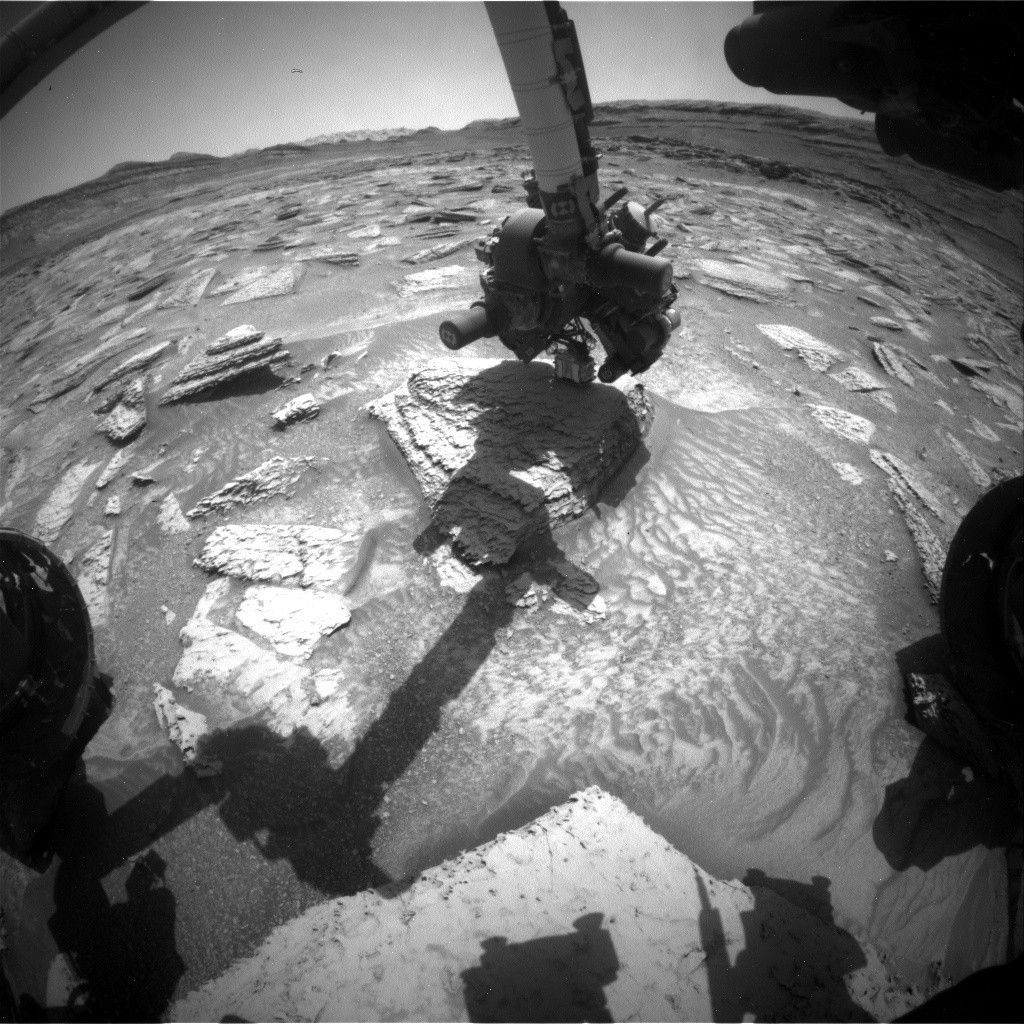
Written by Lucy Lim, Planetary Scientist at NASA Goddard Space Flight Center
Earth planning date: Friday, May 15, 2026
After freeing the rover’s arm from the “Atacama” block, we are ready to drill again! The new drill target will represent the same geologic stratum as Atacama, which is the layered sulfate unit above the boxwork structures. We’ve named the new block “Campo Marte” after a natural red sandstone feature in Bolivia, following the theme of choosing target names in this Martian quadrangle from locations near the Uyuni region in South America. The name can be literally translated from Spanish as “Field of Mars” or “Mars Field,” appropriate for a target on Mars. In preparation for drilling, we measured the composition of Campo Marte with the ChemCam LIBS and the APXS as well as obtaining close-up imaging with MAHLI. Additional LIBS rasters provided geochemical data on nearby blocks, including a couple of vein and nodule-like features. As we’ve seen in several rover stops in this unit, the “Paso Malo” block and several others are covered in a prominent polygonal texture.
We’ve also imaged the Campo Marte block from several angles and determined that it’s substantially thicker than the Atacama block, so we’re hoping that its greater mass will keep it on the ground after drilling so that we can withdraw the drill bit normally this time. The team did get some interesting data on the volume and density of the Atacama block from our little adventure but we don’t feel the need to repeat that particular experiment.
In the meantime, we had a chance to support another solar system exploration mission as the Psyche spacecraft flew close by Mars in order to pick up a gravitational boost on its way to the main asteroid belt.
The Psyche spacecraft’s eventual destination is the asteroid 16 Psyche, one of the largest members of an unusual spectral category of asteroids that hasn’t yet been visited by a spacecraft. Although 16 Psyche is expected to be quite different from Mars as a science target (for example, it is too small to maintain a Mars-like atmosphere) this flyby was still a valuable opportunity to exercise the spacecraft’s instruments and data analysis pipelines, and validate their calibration. Because of this the Curiosity team planned an extra set of atmospheric observations timed to coordinate with the Psyche flyby: a zenith movie with Navcam to document clouds and a Mastcam solar observation to measure atmospheric opacity. The Mastcam was also supported by a fresh set of calibration data. Together with other coordinated observations from the Mars orbiters and Perseverance rover, these are intended to contribute to the Psyche instrument validation effort.
-
Want to read more posts from the Curiosity team?
-
Want to learn more about Curiosity’s science instruments?
Article
7 days ago
3 min read Curiosity Blog, Sols 4879-4885: Struggle at Atacama
Article
2 weeks ago
2 min read Curiosity Blog, Sols 4873-4878: Welcome to the Atacama Drill Target
Article
3 weeks ago
Keep Exploring Discover More Topics From NASA Mars
Mars is the fourth planet from the Sun, and the seventh largest. It’s the only planet we know of inhabited…
All Mars Resources
Explore this collection of Mars images, videos, resources, PDFs, and toolkits. Discover valuable content designed to inform, educate, and inspire,…
Rover Basics
Each robotic explorer sent to the Red Planet has its own unique capabilities driven by science. Many attributes of a…
Mars Exploration: Science Goals
The key to understanding the past, present or future potential for life on Mars can be found in NASA’s four…
Mystery of the ancient giant stone jars of Laos may have been solved
Mystery of the ancient giant stone jars of Laos may have been solved
A Brief-ish History of SETI. Part V: The First Interstellar Messengers
During the 1970s, the first interstellar probes were launched, carrying messages specifically designed to be intelligible to extraterrestrial species. The messages were essentially a "message in a bottle" intended for an advanced civilization, should they find the probes someday.
Johnson Photographers Honored for Award-Winning Portraits
Three photographers at NASA’s Johnson Space Center who inspire the world through visual storytelling earned top honors in the portrait category at the 2025 NASA Imagery Experts Program Annual Awards.
“Congratulations to all three on this impressive achievement and for capturing such breathtaking imagery,” said Johnson Director Vanessa Wyche. “Their work represents the collaboration, precision, and creativity that drive human space exploration forward.”
David DeHoyos, Josh Valcarcel, and Bill Stafford were recognized during the award ceremony held April 20, 2026, in Las Vegas.
From engineering tests to astronaut training to mission control operations, these photographers document the people and work central to NASA’s human spaceflight mission.
First place: David DeHoyos ESA (European Space Agency) astronaut Sophie Adenot pauses for a pensive moment during her official NASA portrait session at Johnson Space Center in Houston.NASA/David DeHoyos Sophie is so kind and friendly with a beautiful presence. Being around her made everyone feel good, which allowed my creativity to flow.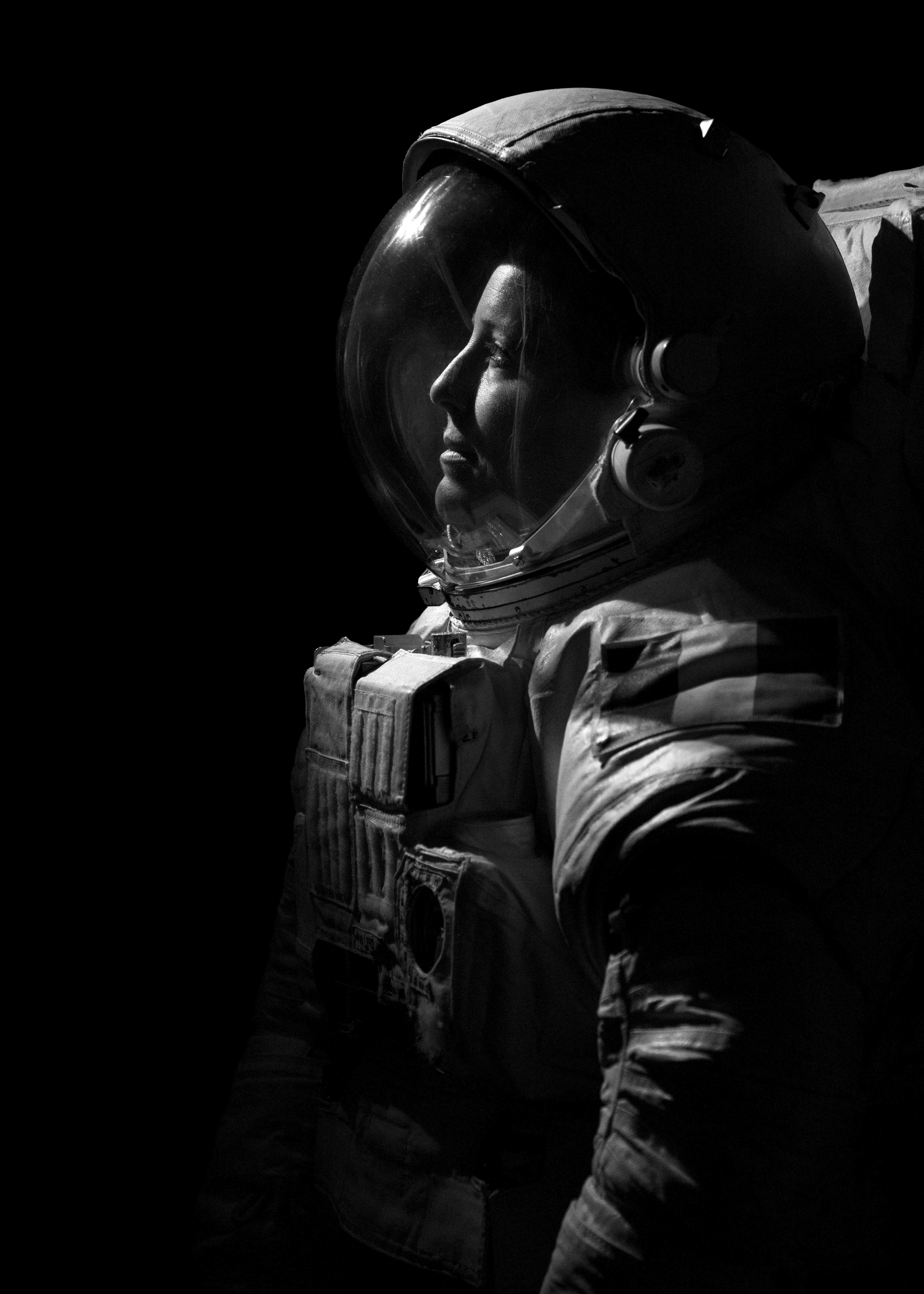
David Dehoyos
NASA Photographer
Portrait of NASA photographer David DeHoyos.
A Houston native, born in 1963, David DeHoyos’ life has been deeply shaped by the city’s dual legacy of arts and aerospace.
DeHoyos graduated from Houston’s High School for the Performing and Visual Arts in 1981 with a specialization in photography. After spending a decade refining his technical craft in photo labs, he joined Johnson’s photography department in 1991.
“This opportunity represented the fulfillment of a lifelong ambition,” said DeHoyos. “Growing up during the fervor of the Apollo era, I always dreamed of contributing to NASA’s mission. I am so honored and blessed to be amongst a team of wonderful people and, more importantly, friends.”
Second place: Josh Valcarcel NASA astronaut Jessica Meir poses with an Extravehicular Mobility Unit (EMU) spacesuit during an official portrait session.NASA/Josh Valcarcel Jessica’s quiet presence reflects years of preparation, passion, and responsibility. She understands, more clearly than most of us ever will, the fragility of the body, the precision of systems, and the narrow margins within which exploration unfolds.Josh Valcarcel
NASA Photographer
Portrait of NASA scientific photographer Josh Valcarcel.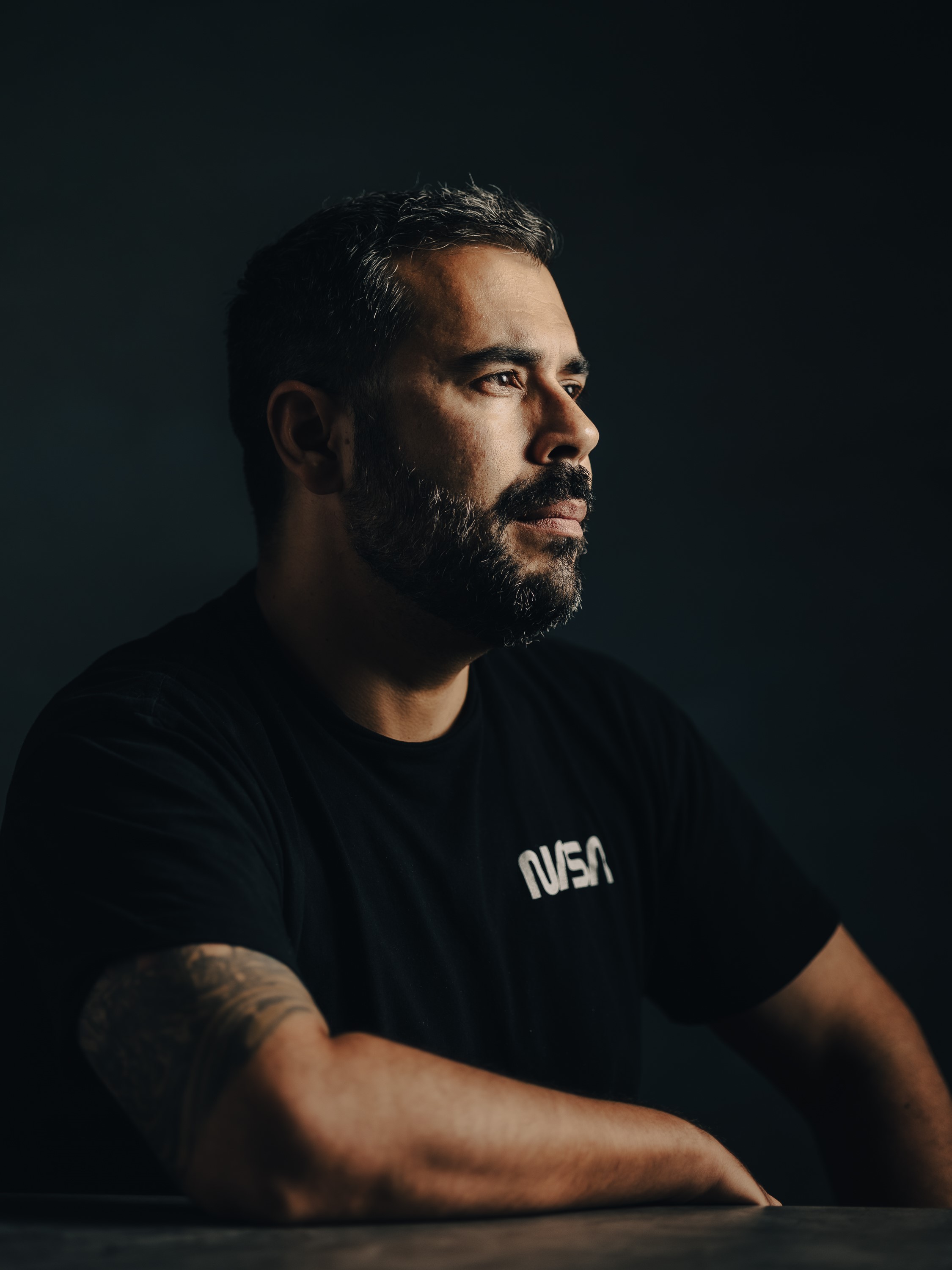
Josh Valcarcel has worked as a professional photographer and videographer for over 20 years and has been a scientific photographer at Johnson since 2017. He previously served as a staff photographer and photo editor at WIRED magazine and as a mass communication specialist in the U.S. Navy, capturing stories from flight deck operations to remote island nations across the Pacific.
“As a NASA photographer, I’ve had the privilege of witnessing impossible dreams become reality every day,” said Valcarcel. “That experience has shown me that with the right vision, culture, and trust, what once seemed impossible can become part of everyday life.”
Third place: Bill Stafford Expedition 74 crew member Christopher Williams in an EMU spacesuit.NASA/Bill Stafford There’s a stillness and quiet resolve in Chris’ expression that says everything about who he is and what he’s about to do.
Bill Stafford
NASA Photographer
Portrait of NASA scientific photographer Bill Stafford.
A Texas native and 1999 graduate of East Texas A&M University, Bill Stafford has served as a photographer and videographer for NASA since graduation, documenting over two decades of the nation’s space exploration milestones.
In addition to his work with NASA, Stafford teaches photography at the Gilruth Center. He is passionate about sharing his expertise and helping others develop their skills behind the lens.
“Photography is how I find meaning in the moments around me, and working at NASA has given me a front-row seat to some of the most remarkable stories of our time,” said Stafford. “My job is to slow things down long enough to find the moment inside the moment: the small details that tell the bigger story.”
Explore More 2 min read Nicholas Houghton: Engineering Crew Safety for NASA’s Artemis Missions Article 1 week ago 3 min read Industry Moon Lander Training Cabin Lands at NASA for Artemis Article 2 weeks ago 2 min read Blue Origin Moon Lander Completes Testing at NASA Vacuum Chamber Article 2 weeks agoEbola outbreak triggers U.S. ban on travelers from three African nations
At least six Americans are believed to have been exposed to the Ebola virus, and one person who appears to have contracted the virus has been evacuated to Germany
Iron and Ice: Earth's Passage Through the Interstellar Cloud
Our Solar System is currently passing through the Local Interstellar Cloud, a region of highly diluted gas and dust between the stars. On its path, Earth continuously accumulates iron-60, a rare radioactive isotope of iron produced in stellar explosions. This has now been confirmed by an international research team led by the Helmholtz-Zentrum Dresden-Rossendorf (HZDR) through the analysis of Antarctic ice tens of thousands of years old. From the steady but time-varying influx, the researchers conclude that the radioactive isotope has been stored within the cloud since a long-past stellar explosion.
How scientists developed a hantavirus PCR test in a weekend
Researchers at the Nebraska Public Health Laboratory worked round the clock to develop a test for the Andes virus at the center of the deadly cruise ship outbreak
Asteroid 2022 OB5 Spins Too Fast For Current Prospectors Highlighting the Divide Between "Accessible" and "Exploitable"
Asteroid mining seems simple in theory. A spacecraft flies up to a giant rock in space, scoops out some material, and either processes it on site or returns it back to a huge central processing facility. But in practice, it is certainly not that simple, and a new paper from some Spanish researchers, available in pre-print form on arXiv, showcases one of the reasons why - many small asteroids are spinning ridiculously fast.
Hidden copy of the oldest known poem in the English language leaves researchers ‘speechless’
Researchers discovered the copy of the 1,300-year-old poem lurking inside a historical text in an Italian library
NASA’s MAVEN Makes 1st Discovery of Atmospheric Effect at Mars
In December 2023, scientists looking at Mars data stumbled across something completely unexpected — observations of an atmospheric effect never before seen in the Red Planet’s atmosphere. Using instruments aboard NASA’s MAVEN (Mars Atmosphere and Volatile Evolution) mission, scientists identified a phenomenon known to occur in Earth’s magnetosphere, where charged particles are squeezed like toothpaste coming out of a tube along magnetic structures called flux tubes. This so-called Zwan-Wolf effect aids in the deflection of solar wind around Earth and has been observed and studied there for decades. Now, a new study published in Nature Communications provides the first comprehensive observations of the same effect in Mars’ atmosphere.
An artistic representation of the Zwan-Wolf effect at Mars, as observed by NASA’s MAVEN (Mars Atmosphere and Volatile Evolution) mission. While this effect typically helps to deflect the solar wind at Earth, at Mars it is shown to “squeeze” the atmosphere and have implications on how space weather interacts with the planet. The yellow arrows represent the movement of the effect in the Martian atmosphere. LASP/CU Boulder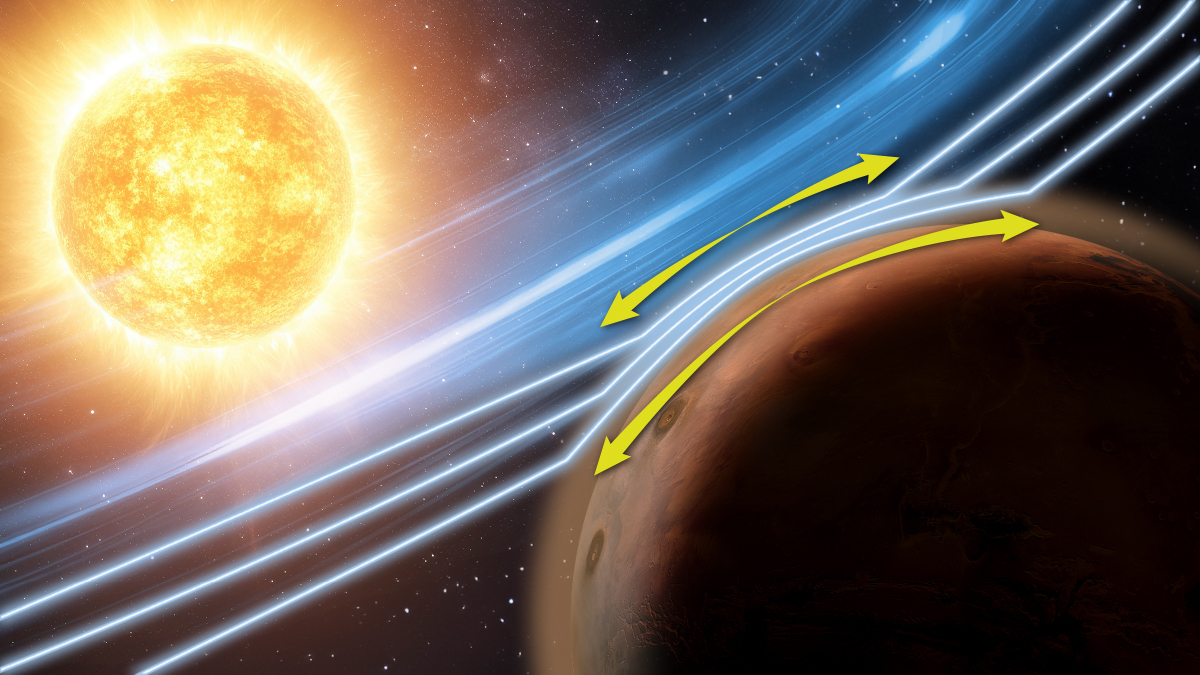
“When investigating the data, I all of a sudden noticed some very interesting wiggles,” said Christopher Fowler, a research assistant professor at West Virginia University in Morgantown and lead author of the study. “I would never have guessed it would be this effect, since it’s never been seen in a planetary atmosphere before.”
The Zwan-Wolf effect was first discovered in 1976, and until now has only been observed in planetary magnetospheres, not their atmospheres. Unlike Earth, Mars is not protected by a global magnetic field, affecting how it interacts with the solar wind and space weather. In this new study, the Zwan-Wolf effect was observed in the ionosphere — deep within the Martian atmosphere below 200 km — which contains significant numbers of electrically charged particles. The data showed that these charged particles were being squeezed and distributed around Mars’ atmosphere.
Although Mars has an induced magnetosphere, a magnetic field generated by the solar wind interacting with the Martian ionosphere, it can greatly change in size and shape with large solar wind and space weather events. That is what Fowler and his team saw in the MAVEN data when a large solar storm hit Mars. Based on their findings, the Zwan-Wolf effect may be occurring constantly in the Martian ionosphere but at levels undetectable by MAVEN’s instrumentation. The impact of the space weather event appears to have amplified the effect, allowing the scientists to observe it in the data.
In the beginning, Fowler and his team came across some interesting-looking fluctuations in measurements of the magnetic field as the spacecraft flew through the atmosphere. To explain this, they dug into observations made by several instruments on MAVEN, including measurements of the charged particle environment in the ionosphere. Their sleuthing uncovered even more weird and interesting features in the data. After ruling out several other possibilities, the team was able to identify the culprit as the Zwan-Wolf effect, which explained all the features they were seeing.
“No one expected that this effect could even occur in the atmosphere,” said Fowler. “That’s what makes this even more exciting. It introduces interesting physics that we haven’t yet explored and a new way the Sun and space weather can change the dynamics in the Martian atmosphere.”
Understanding the Zwan-Wolf effect at Mars will further our understanding of how space weather affects the planet and provides new insight into how this effect might occur at similar unmagnetized bodies, such as Venus and Saturn’s moon Titan. Observations like this also highlight the importance of knowing how large space weather events can lead to changes in the environment at and around the Red Planet and potentially affect assets on or near Mars.
“Knowing how space weather interacts with Mars is essential,” said Shannon Curry, the principal investigator of MAVEN and research scientist at the Laboratory for Atmospheric Space Physics at the University of Colorado Boulder. “The MAVEN team continues making new discoveries with our datasets and finding these links between our host star and the Red Planet.”
The MAVEN spacecraft launched in November 2013 and entered Mars’ orbit in September 2014. The mission’s goal is to explore the planet’s upper atmosphere, ionosphere, and interactions with the Sun and solar wind to explore the loss of the Martian atmosphere to space. Understanding atmospheric loss gives scientists insight into the history of the Red Planet’s atmosphere and climate, liquid water, and planetary habitability. The MAVEN spacecraft, in orbit around Mars, experienced a loss of signal with ground stations on Earth on Dec. 6, 2025. In Feb. 2026, NASA launched an anomaly review board to assess the probable current state of the spacecraft and the likelihood of its recovery.
The MAVEN mission is part of NASA’s Mars Exploration Program portfolio. The mission’s principal investigator is based at the Laboratory for Atmospheric and Space Physics at the University of Colorado Boulder, which is also responsible for managing science operations and public outreach and communications. NASA’s Goddard Space Flight Center in Greenbelt, Maryland, manages the MAVEN mission. Lockheed Martin Space built the spacecraft and is responsible for mission operations. NASA’s Jet Propulsion Laboratory in Southern California provides navigation and Deep Space Network support.
By Willow Reed
Laboratory for Atmospheric and Space Physics, University of Colorado Boulder
Media contacts:
Karen Fox / Alana Johnson
Headquarters, Washington
240-285-5155 / 202-672-4780
karen.c.fox@nasa.gov / alana.r.johnson@nasa.gov
Sarah Frazier
Goddard Space Flight Center, Greenbelt, Md.
sarah.frazier@nasa.gov
NASA’s MAVEN Makes 1st Discovery of Atmospheric Effect at Mars
In December 2023, scientists looking at Mars data stumbled across something completely unexpected — observations of an atmospheric effect never before seen in the Red Planet’s atmosphere. Using instruments aboard NASA’s MAVEN (Mars Atmosphere and Volatile Evolution) mission, scientists identified a phenomenon known to occur in Earth’s magnetosphere, where charged particles are squeezed like toothpaste coming out of a tube along magnetic structures called flux tubes. This so-called Zwan-Wolf effect aids in the deflection of solar wind around Earth and has been observed and studied there for decades. Now, a new study published in Nature Communications provides the first comprehensive observations of the same effect in Mars’ atmosphere.
An artistic representation of the Zwan-Wolf effect at Mars, as observed by NASA’s MAVEN (Mars Atmosphere and Volatile Evolution) mission. While this effect typically helps to deflect the solar wind at Earth, at Mars it is shown to “squeeze” the atmosphere and have implications on how space weather interacts with the planet. The yellow arrows represent the movement of the effect in the Martian atmosphere. LASP/CU Boulder“When investigating the data, I all of a sudden noticed some very interesting wiggles,” said Christopher Fowler, a research assistant professor at West Virginia University in Morgantown and lead author of the study. “I would never have guessed it would be this effect, since it’s never been seen in a planetary atmosphere before.”
The Zwan-Wolf effect was first discovered in 1976, and until now has only been observed in planetary magnetospheres, not their atmospheres. Unlike Earth, Mars is not protected by a global magnetic field, affecting how it interacts with the solar wind and space weather. In this new study, the Zwan-Wolf effect was observed in the ionosphere — deep within the Martian atmosphere below 200 km — which contains significant numbers of electrically charged particles. The data showed that these charged particles were being squeezed and distributed around Mars’ atmosphere.
Although Mars has an induced magnetosphere, a magnetic field generated by the solar wind interacting with the Martian ionosphere, it can greatly change in size and shape with large solar wind and space weather events. That is what Fowler and his team saw in the MAVEN data when a large solar storm hit Mars. Based on their findings, the Zwan-Wolf effect may be occurring constantly in the Martian ionosphere but at levels undetectable by MAVEN’s instrumentation. The impact of the space weather event appears to have amplified the effect, allowing the scientists to observe it in the data.
In the beginning, Fowler and his team came across some interesting-looking fluctuations in measurements of the magnetic field as the spacecraft flew through the atmosphere. To explain this, they dug into observations made by several instruments on MAVEN, including measurements of the charged particle environment in the ionosphere. Their sleuthing uncovered even more weird and interesting features in the data. After ruling out several other possibilities, the team was able to identify the culprit as the Zwan-Wolf effect, which explained all the features they were seeing.
“No one expected that this effect could even occur in the atmosphere,” said Fowler. “That’s what makes this even more exciting. It introduces interesting physics that we haven’t yet explored and a new way the Sun and space weather can change the dynamics in the Martian atmosphere.”
Understanding the Zwan-Wolf effect at Mars will further our understanding of how space weather affects the planet and provides new insight into how this effect might occur at similar unmagnetized bodies, such as Venus and Saturn’s moon Titan. Observations like this also highlight the importance of knowing how large space weather events can lead to changes in the environment at and around the Red Planet and potentially affect assets on or near Mars.
“Knowing how space weather interacts with Mars is essential,” said Shannon Curry, the principal investigator of MAVEN and research scientist at the Laboratory for Atmospheric Space Physics at the University of Colorado Boulder. “The MAVEN team continues making new discoveries with our datasets and finding these links between our host star and the Red Planet.”
The MAVEN spacecraft launched in November 2013 and entered Mars’ orbit in September 2014. The mission’s goal is to explore the planet’s upper atmosphere, ionosphere, and interactions with the Sun and solar wind to explore the loss of the Martian atmosphere to space. Understanding atmospheric loss gives scientists insight into the history of the Red Planet’s atmosphere and climate, liquid water, and planetary habitability. The MAVEN spacecraft, in orbit around Mars, experienced a loss of signal with ground stations on Earth on Dec. 6, 2025. In Feb. 2026, NASA launched an anomaly review board to assess the probable current state of the spacecraft and the likelihood of its recovery.
The MAVEN mission is part of NASA’s Mars Exploration Program portfolio. The mission’s principal investigator is based at the Laboratory for Atmospheric and Space Physics at the University of Colorado Boulder, which is also responsible for managing science operations and public outreach and communications. NASA’s Goddard Space Flight Center in Greenbelt, Maryland, manages the MAVEN mission. Lockheed Martin Space built the spacecraft and is responsible for mission operations. NASA’s Jet Propulsion Laboratory in Southern California provides navigation and Deep Space Network support.
By Willow Reed
Laboratory for Atmospheric and Space Physics, University of Colorado Boulder
Media contacts:
Karen Fox / Alana Johnson
Headquarters, Washington
240-285-5155 / 202-672-4780
karen.c.fox@nasa.gov / alana.r.johnson@nasa.gov
Sarah Frazier
Goddard Space Flight Center, Greenbelt, Md.
sarah.frazier@nasa.gov
NASA Selects Next Class of Space Health Postdoctoral Fellows
The NASA-funded Translational Research Institute for Space Health (TRISH) has selected two early‑career scientists for its next class of postdoctoral fellows. The new fellows will begin their projects in May, focusing on space food systems and astronaut eye health.
The TRISH Postdoctoral Fellowship Program supports independent research that advances biomedical, behavioral, and technological approaches relevant to human space exploration. The selected projects should aim to reduce spaceflight-related health risks and improve human health on Earth.
The selected fellows are:
Dr. Baiyang Liu
Institution: Columbia University in New York City
Project: Developing a Diazotrophic and Nutritionally Optimized Spirulina Strain for Extended Space Missions
Mentor: Dr. Harris Wang
Dr. Dylan Pham
Institution: Texas A&M University in College Station
Project: Impact of Simulated Microgravity and Aging on Ocular Artery and Neural Retina Function
Mentor: Dr. Travis Hein
“Our postdoctoral fellows bring new ideas, technical expertise, and energy to some of the most complex challenges in human spaceflight,” said Dr. Dorit Donoviel, executive director of TRISH and associate professor at Baylor College of Medicine in Houston. “By investing in the next generation, we are building the capability required to achieve a sustained presence on the Moon and extend human exploration deeper into space.”
A virtual institute, TRISH is empowered by NASA’s Human Research Program to help solve challenges of human deep space exploration. It pursues and funds research to deliver scientific and technological solutions that advance space health and help humans thrive wherever they explore, in space or on Earth.
____
NASA’s Human Research Program
NASA’s Human Research Program pursues methods and technologies to support safe, productive human space travel. Through science conducted in laboratories, ground-based analogs, commercial missions, the International Space Station and Artemis missions, the program scrutinizes how spaceflight affects human bodies and behaviors. Such research drives the program’s quest to innovate ways that keep astronauts healthy and mission ready as human space exploration expands to the Moon, Mars, and beyond.
Explore More 3 min read NASA’s Simulated Mars Mission Marks 200 Days Inside Habitat Article 2 weeks ago 4 min read NASA’s SpaceX Crew-12 to Study Adaptation to Altered Gravity Article 3 months ago 5 min read Out of This World Discoveries: Space Station Research in 2025 Article 4 months ago Keep Exploring Discover More Topics From NASALiving in Space
Artemis
Human Research Program
Space Station Research and Technology
NASA Selects Next Class of Space Health Postdoctoral Fellows
The NASA-funded Translational Research Institute for Space Health (TRISH) has selected two early‑career scientists for its next class of postdoctoral fellows. The new fellows will begin their projects in May, focusing on space food systems and astronaut eye health.
The TRISH Postdoctoral Fellowship Program supports independent research that advances biomedical, behavioral, and technological approaches relevant to human space exploration. The selected projects should aim to reduce spaceflight-related health risks and improve human health on Earth.
The selected fellows are:
Dr. Baiyang Liu
Institution: Columbia University in New York City
Project: Developing a Diazotrophic and Nutritionally Optimized Spirulina Strain for Extended Space Missions
Mentor: Dr. Harris Wang
Dr. Dylan Pham
Institution: Texas A&M University in College Station
Project: Impact of Simulated Microgravity and Aging on Ocular Artery and Neural Retina Function
Mentor: Dr. Travis Hein
“Our postdoctoral fellows bring new ideas, technical expertise, and energy to some of the most complex challenges in human spaceflight,” said Dr. Dorit Donoviel, executive director of TRISH and associate professor at Baylor College of Medicine in Houston. “By investing in the next generation, we are building the capability required to achieve a sustained presence on the Moon and extend human exploration deeper into space.”
A virtual institute, TRISH is empowered by NASA’s Human Research Program to help solve challenges of human deep space exploration. It pursues and funds research to deliver scientific and technological solutions that advance space health and help humans thrive wherever they explore, in space or on Earth.
____
NASA’s Human Research Program
NASA’s Human Research Program pursues methods and technologies to support safe, productive human space travel. Through science conducted in laboratories, ground-based analogs, commercial missions, the International Space Station and Artemis missions, the program scrutinizes how spaceflight affects human bodies and behaviors. Such research drives the program’s quest to innovate ways that keep astronauts healthy and mission ready as human space exploration expands to the Moon, Mars, and beyond.
Explore More 3 min read NASA’s Simulated Mars Mission Marks 200 Days Inside Habitat Article 2 weeks ago 4 min read NASA’s SpaceX Crew-12 to Study Adaptation to Altered Gravity Article 3 months ago 5 min read Out of This World Discoveries: Space Station Research in 2025 Article 4 months ago Keep Exploring Discover More Topics From NASALiving in Space
Artemis
Human Research Program
Space Station Research and Technology
Flotation tanks deployed to combat PTSD after devastating wildfires
Flotation tanks deployed to combat PTSD after devastating wildfires
Floatation tanks deployed to combat PTSD after devastating wildfires
Floatation tanks deployed to combat PTSD after devastating wildfires
Gazing Into the Past With TIME
How can astronomers observe ancient galaxies when they're so challenging to resolve? By looking at a whole bunch of them at once in a single spectral line and seeing how it changes over time. That's what a new instrument called the Tomographic Ionized-carbon Mapping Experiment (TIME) does.