

Feed aggregator
What time will SpaceX launch NASA's Roman Space Telscope on Aug. 30? (Full mission timeline)
A huge SpaceX rocket is just days away from launching NASA's next great observatory into space: the Roman Space Telescope. But if you're hoping to watch it live online, you'll have to get up pretty early on Sunday (Aug. 30) or you'll miss it.
NASA's Roman Space Telescope, named after the late NASA astronomer Nancy Grace Roman, will launch no earlier than Sunday on a mission to map the galaxy like never before. Liftoff is set for 7:26 a.m. EDT (1126 GMT) from a NASA pad in Cape Canaveral, Florida. You can follow the mission in real time with our Roman Space Telescope live updates.
"Roman’s deep, sweeping surveys will help investigate dark energy and dark matter, discover and characterize planets beyond our solar system, map billions of galaxies, study black holes and share enormous amounts of data with both scientists and the public," NASA said in an update Friday (Aug. 28), after clearing Roman for launch.
Here's a look at what time NASA's Roman Space Telescope will launch atop a SpaceX Falcon Heavy rocket, as well as how to watch online.
What time is SpaceX's Roman Space Telescope launch?NASA's Nancy Grace Roman Space Telescope is encapsulated in the payload fairing of its SpaceX Falcon Heavy rocket. (Image credit: SpaceX)SpaceX is currently targeting the launch of NASA's Roman Space Telescope for no earlier than 7:26 a.m. EDT (1126 GMT) on Sunday, Aug. 30.
The company will launch Roman into space atop a Falcon Heavy rocket from Launch Complex 39A at NASA's Kennedy Space Center in Florida. A launch livestream will begin about one hour before liftoff.
While SpaceX hopes to launch Roman on time, the company can try again on Monday, Aug. 31, if needed. A launch on that day would lift off a few minutes earlier, at 7:22 a.m. EDT (1122 GMT), SpaceX has said.
Starship Die Cast Rocket Model Was $47.99 Now $39.99 on Amazon.
Even if you can't see SpaceX's Starship in person, you can score a model of your own. Standing at 13.77 inches (35 cm), this is a 1:375 ratio of SpaceX's Starship as a desktop model. The materials here are alloy steel and it weighs just 225g.View Deal
Can I watch SpaceX's Roman Space Telescope launch?Yes, of course, you'll be able to watch SpaceX launch the Roman Space Telescope, and you have some options regarding where to tune in.
NASA will provide a launch webcast early Sunday morning. That livestream begins Aug. 30 at 6:20 a.m. EDT (1020 GMT) and will run through the launch and a post-launch briefing. That livestream can be found on the NASA website here, as well as all of NASA Social channels (Facebook, Instagram, X), and streaming channels like Twitch, Discovery+, Amazon Prime, NASA+, and of course YouTube.
Our Space.com livestream can be found on our VideoFromSpace YouTube channel, and will feature NASA's livestream simulcast.
SpaceX will also host its own launch livestream via its X account, which will begin about an hour before liftoff.
As mentioned above, SpaceX aims to launch Roman for NASA at 7:26 a.m. EDT (1126 GMT), with the flight lasting about 31 minutes and 31 seconds — the time post-liftoff at which Roman is expected to deploy into space.
A post-launch press conference is scheduled for 9:30 a.m. EDT (1330 GMT) and will include comments from the experts listed below.
- NASA Administrator Jared Isaacman
- Nicky Fox, associate administrator, Science Mission Directorate, NASA Headquarters
- Jackie Townsend, Roman telescope project manager, NASA Goddard
- Julie McEnery, Roman telescope senior project scientist, NASA Goddard
- Denton Gibson, launch director, NASA’s Launch Services Program, NASA Kennedy
SpaceX's Roman Space Telescope launch for NASA will last just over 31 minutes (31 minutes and 31 seconds, to be exact), in order to send Roman on its way into deep space.
After liftoff, the Falcon Heavy rocket's core booster and twin side boosters will fire for just under 2.5 minutes, after which the side boosters will separate and return to Earth. If all goes well, they should land about 7 minutes, 23 seconds after liftoff.
"This is the first and third flight for the two first stage side boosters supporting this mission, which previously launched the GOES-U and Viasat-3 F3 missions," SpaceX wrote in a mission overview. "Following stage separation, Falcon Heavy’s two side boosters will land on SpaceX’s Landing Zones 2 and 40 (LZ-2 and LZ-40) at Cape Canaveral Space Force Station in Florida." SpaceX does not appear to be planning a core first-stage landing off shore for this flight.
The three first-stage boosters of the Falcon Heavy rocket that will launch NASA's Nancy Grace Roman Space Telescope on Aug. 30, 2026. SpaceX shared this photo via X on Aug. 26. (Image credit: SpaceX)Here's a look at the launch and flight timeline from SpaceX.
SpaceX Roman Space Telescope Launch TimelineTIME (Hr:Min:Sec)
EVENT
T-0:53:00
Flight director polls for fueling
T-0:50:00
1st stage RP-1 (rocket grade kerosene) loading begins
T-0:45:00
1st stage liquid oxygen loading begins
T-0:35:00
2nd stage RP-1 fuel loading begins
T-0:18:30
2nd stage liquid oxygen loading begins
T-0:07:00
Falcon Heavy engine chilldown begins
T-00:00:59
Flight computer commanded to begin final prelaunch checks
T-00:00:45
Launch Director GO for launch poll
T-00:0:20
Propellant tanks pressurized for flight
T-00:00:06
Engine controller commands engine ignition sequence start
T-00:00:00
Liftoff
SpaceX Roman Space Telescope Post-Launch TimelineTIME (Hr:Min:Sec)
FLIGHT EVENT
T+00:00:00
Liftoff!
T+00:01:08
"Max Q"
T+00:02:24
Side boosters' engines shut down
T+00:02:27
Side boosters separate
T+00:02:32
Side boosters flip
T+00:02:43
Side boosters' boostback burn begins
T+00:03:48
Side boosters' boostback burn ends
T+00:03:51
1st stage main engine cutoff
T+00:03:54
1st stage separation from upper stage
T+00:04:00
2nd stage engine ignition
T+00:04:15
Payload fairing separation
T+00:06:19
Side boosters' entry burn begins
T+00:06:29
Side boosters' entry burn ends
T+00:07:23
Side boosters' landing burn begins
T+00:07:40
TOUCHDOWN! Side boosters land
T+00:08:28
2nd stage engine cutoff (SECO-1)
T+00:24:33
2nd stage engine restart (SES-2)
T+00:26:33
2nd stage engine cutoff (SECO-2)
T+00:31:31
Roman Space Telescope deploys
The upper stage of the Falcon Heavy will continue firing its engine through the 8-minutes-and-28-seconds mark, when it will shut down for a 16-minute cruise period. Just over 24 minutes into the flight, the second stage will reignite its single Merlin engine for about three minutes before shutting down for good.
The Roman Space Telescope will then deploy from its carrier at the 31:31 minute mark. It is expected to deploy its solar panels and sunshade shortly after liftoff, then spend the next few days unfolding its antenna and aperture cover, while also performing a mid-course correction burn on its way to its final destination: a stable point in space called Lagrange Point 2, about 1 million miles (1.5 million kilometers) from Earth, opposite the sun.
"The Roman team will complete a carefully orchestrated series of deployments, calibrations, and tests in the three months following launch before the observatory reaches its final orbit," NASA has said of the steps that will follow.
What if the Roman Space Telescope can't launch?If SpaceX can't launch the Roman Space Telescope on Aug. 30, the company and NASA have at least one backup day to try again.
A second launch window is available on Monday, Aug. 31, at 7:22 a.m. EDT (1122 GMT), according to SpaceX. Both SpaceX and NASA are watching the weather closely to determine if Roman can fly on Aug. 30.
"Meteorologists with the U.S. Space Force’s Space Launch Delta 45 Weather Squadron are predicting a 60% chance of favorable weather conditions for launch, which is targeted for 7:26 a.m. EDT on Sunday, Aug. 30 from Launch Complex 39A at Kennedy," NASA wrote in an update Friday (Aug. 28).
Whichever day Roman launches, you'll be able to follow the mission live on Space.com. Be sure to return to Space.com on launch day for complete Roman Space Telescope launch coverage.
NASA’s Artemis II Crew Receives Congressional Space Medal of Honor
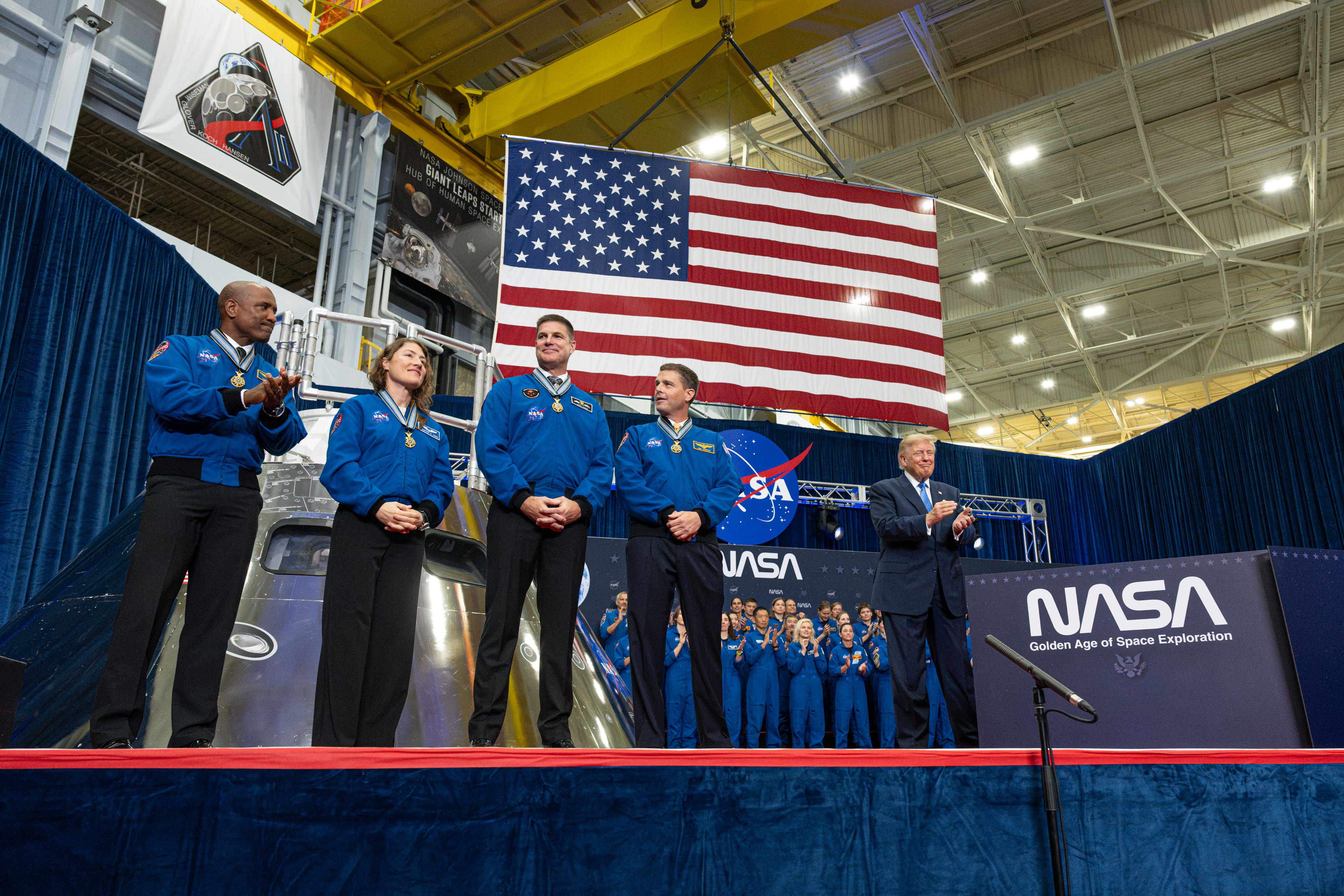
From left to right: NASA astronauts Victor Glover and Christina Koch, CSA (Canadian Space Agency) astronaut Jeremy Hansen, and NASA astronaut Reid Wiseman receive the Congressional Space Medal of Honor from President Donald J. Trump on Aug. 28, 2026, for their service during the Artemis II mission.
The Congressional Space Medal of Honor was authorized by Congress in 1969 to recognize an astronaut who in the performance of duties has distinguished himself or herself by exceptionally brave and meritorious efforts, and contributions to the welfare of the nation and humanity. There now are 34 recipients of the award since the beginning of the space program, including the crews of Apollo 1, Challenger, and Columbia who received the award posthumously.
Image credit: NASA/John Kraus
NASA Awards First Prize in Phase 2 of Agency’s LunaRecycle Challenge
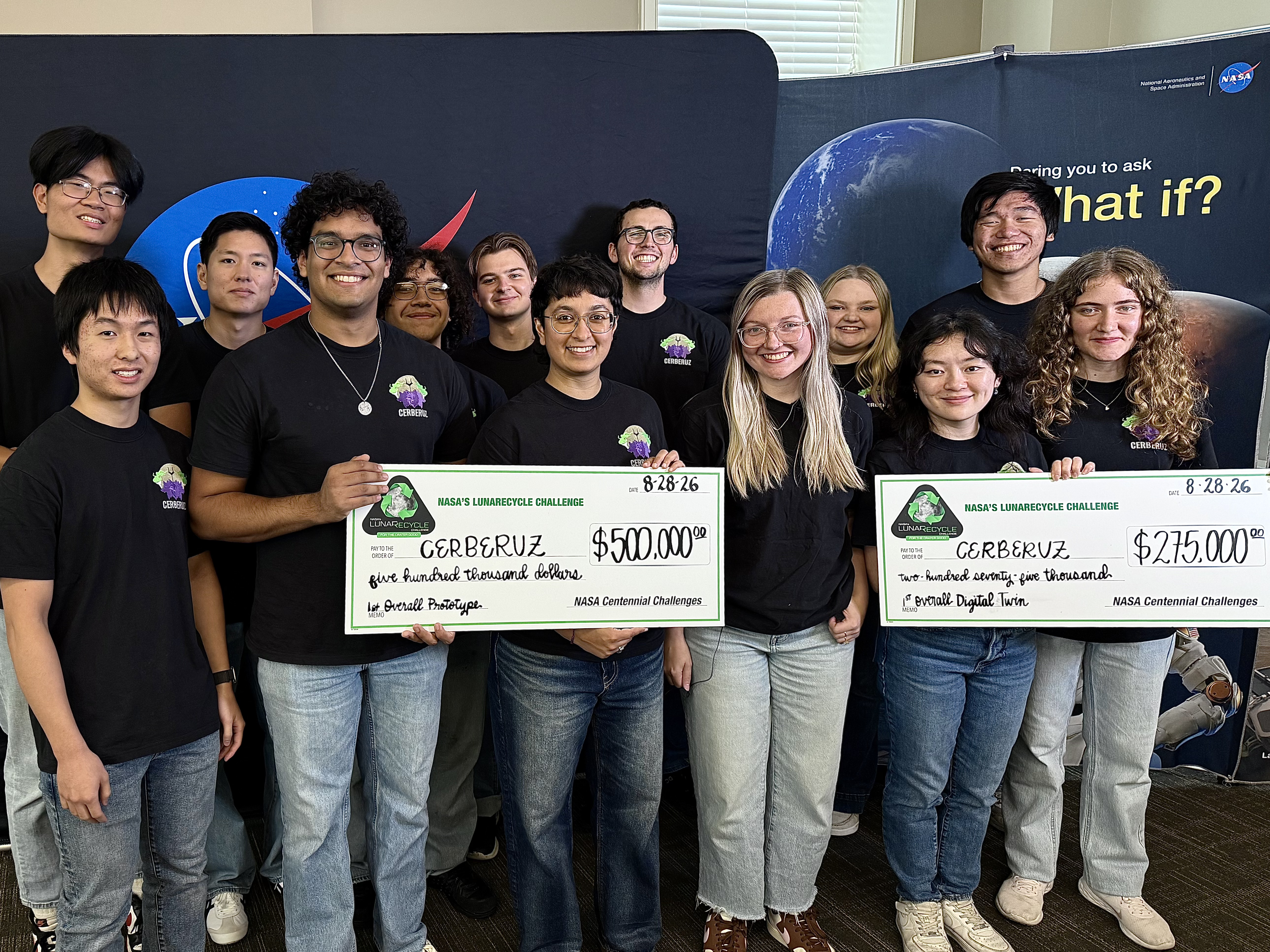
NASA named a team from the Massachusetts Institute of Technology (MIT) as the first prize winner for Phase 2 of the agency’s LunaRecycle Challenge, which focused on developing solutions for reducing waste during missions to the Moon or deep space by recycling common materials, like fabrics, plastics, foam, and metals.
The Composites for Extraterrestrial Recycling By Engineering the Reuse and Upcycling of Zotek (CERBERUZ) team, comprised of undergraduate, graduate, and doctoral students at MIT, received a total of $775,000 in awards.
The technology grinds mixed trash into a fine powder, repurposing materials such as Zotek foam as reinforcement rather than treating it as contamination that needs to be sorted out. The powder becomes feed for use as injection-mold finished parts or 3D-printing filament. The MIT team won in both the competition’s prototype development track and in the track focused on developing virtual models, known as “digital twins,” of recycling systems.
“The LunaRecycle Challenge finale is the culmination of two years of innovation spurred by this competition,” said Jennifer Edmunson, program manager for Centennial Challenges at NASA’s Marshall Space Flight Center in Huntsville, Alabama. “It’s incredible to see these technologies go from concept to prototype and digital twin demonstrations in that time. Driving rapid and creative innovation is what NASA challenges are all about.”
LunaRecycle is a $3 million, two-phase competition in partnership with The University of Alabama Lee J. Styslinger Jr. College of Engineering. Phase 2 of the competition required U.S. teams to submit a prototype, with an optional digital twin serving as a virtual model of it.
For Phase 2, 14 finalist teams from across the United States gathered at The University of Alabama’s Lee J. Styslinger Jr. College of Engineering, in Tuscaloosa, from Aug. 24 to Aug. 28 to demonstrate their technology prototypes. The digital twin models submitted by some teams were also presented alongside their respective prototypes.
The competitors’ backgrounds ranged from university students and faculty to entrepreneurs and space technology enthusiasts. Teams were encouraged to envision solutions that not only addressed recycling in deep space, but that also could have applications on Earth.
Along with the first prize winner, nine teams received prizes:
Prototype track winners:
- Second place overall ($225,000): Terasynth from Orlando, Fla. with Lunar Re-Forge System
- Most Innovative ($50,000): RECLAIM from Penn State University with the Resource Extraction and Conversion from Lunar Anthropogenic Inputs with Microwaves (RECLAIM) system
- Highest Mass Efficiency ($50,000): Cislune from Rosemead, Calif. with the Carbon Recovery and Feedstock Transformation for Extraterrestrial Reuse (CRAFTER) system
- Most Trash Types Recycled ($50,000): Team Lovegrove from Bob Jones University in Greenville, S.C. with LunaBrix
Additional digital twin track winners:
- Second place overall ($125,000): Moon Made from Boulder, Co. with Fiber Forge
- Most Innovative ($25,000): RECLAIM from Penn State University with the RECLAIM system
- Best Visualization ($25,000): Waste Parrot Technologies from New York, N.Y.
People’s choice winner ($25,000):
- Terasynth from Orlando, Fla. with Lunar Re-Forge System
“This competition highlights how collaborations can lead to incredible solutions,” said Chris Frangione, who manages the LunaRecycle Challenge in support of NASA Centennial Challenges contracted through Amentum Space Exploration Division. “Between the solver teams, The University of Alabama, and NASA, this finale showcases what can be achieved when we bring together resources and great ideas towards a common goal.”
The Phase 2 awards follow the success of the competition’s Phase 1, which received record-breaking interest from the global innovator community with more than 1,200 registrations – more than any competition in the 20-year history of NASA Centennial Challenges. For Phase 1, which concluded in 2025, participants from around the world could submit designs in either or both of the prototype or digital twin tracks. A panel of 50 judges evaluated nearly 200 Phase 1 submissions, selecting 17 teams representing five countries and nine U.S. states as winners. Phase 2 entries were required to be unrelated to Phase 1.
The LunaRecycle Challenge is managed at NASA’s Marshall Space Flight Center by Centennial Challenges, part of the Prizes, Challenges, and Crowdsourcing program within NASA’s Research and Technology Mission Directorate. NASA’s Centennial Challenges have a legacy of more than 20 years engaging the public to solve complex problems that benefit NASA’s broader initiatives. Past challenges have spurred advances in robotics, additive manufacturing, power and energy, textiles, chemistry, and biology.
LunaRecycle is also supported by subject matter experts at NASA’s Kennedy Space Center in Florida, NASA’s Ames Research Center in California’s Silicon Valley, and NASA’s Langley Research Center, in Hampton, Virginia.
To learn more about LunaRecycle, visit:
Our choice as one of the best budget telescopes now has 17% off — this telescope deal is worth grabbing fast
The Celestron StarSense Explorer DX 130AZ is one of the best telescopes for beginner-to-intermediate stargazers who want to view deep-sky objects and appreciate assistance in manually locating the targets.
Right now, the Celestron StarSense Explorer DX 130AZ is 17% off, down to just $414.99, its cheapest since Prime Day in June.
In our Celestron StarSense Explorer DX 130AZ review, our expert tester Damian Peach awarded it an impressive 4 out of 5-star. Damian noted that it was an exquisite telescope for the beginner and added that the StarSense Explorer telescope was fully equipped, supplied with just about everything the skywatcher needs for a successful observing session under the stars.
It only missed out on the perfect score as Damian felt it would benefit from additional high-powered eyepieces to achieve more detailed views. However, at this discounted price, it's one of the best beginner-friendly telescopes you could ever want to own.
StarSense Explorer DX 130AZ Telescope: was $499.95 now $414.99
Save $84 The StarSense Explorer DX 130AZ is our best telescope for deep-space observing in our best budget telescopes guide. While a great choice for viewing nebulas and galaxies, it's also a great choice for viewing distant planets. We awarded it four stars for its crisp views and user-friendliness with the StarSense app that helps you locate your chosen night sky target easily. The 5.1-inch (130 mm) aperture can gather plenty of light for a bright and detailed image, no matter what you are observing.
Check our in-depth Celestron StarSense Explorer DX 130AZ review.View Deal
- We've got you covered with reviews and rankings of the best telescopes, binoculars, star projectors, cameras, drones, Lego, streaming and more.
Ideal for entry-level stargazers, the Celestron StarSense Explorer DX 130AZ uses its clever StarSense smartphone app to streamline finding targets in the night sky. While it lacks the fully automated GoTo tracking found on some of the best smart telescopes, its substantial 5.1-inch aperture gathers plenty of light—delivering brighter, sharper, and more detailed views than most automated competitors.
One of its standout features is the clever mount-integrated smartphone dock, which takes the hassle out of locating faint deep-space targets. Fueled by real-time GPS tracking and your phone's camera, the StarSense app generates a live sky map that leads you straight to any celestial object. By replacing tedious star charts with turn-by-turn guidance, it lets you spend your time actually observing the universe rather than searching for it—earning it a top spot in our best budget telescope guide for astronomers of all experience levels.
Key features: Newtonian reflector design, 5-inch (130 mm) aperture, 25-inch (650mm) focal length, f/5 focal ratio, 307x highest useful magnification, 18 lbs (8.16 kg) weight, Starsense smartphone-powered technology, two-year warranty.
Launched: January 2020
Price history: Before today's telescope deal, the best price we've seen on the Celestron StarSense Explorer DX 130AZ telescope was $379 during the Prime Day sales in June. The MSRP is $499.95, which makes the current on-sale price of $414.99 a significant saving on what is a seldom-discounted model.
Price comparison: Amazon: $414.99 | Adorama: $449.99 | Walmart: $499.95
Reviews consensus: In our Celestron StarSense Explorer DX 130AZ review, we awarded this telescope four stars for its user-friendly interface and impressive views, making it an ideal choice for beginners who want a modern and simple way to explore the night sky.
Space: ★★★★½ | Digital Camera World: ★★★★½
✅ Buy it if: You want a user-friendly telescope for beginners that uses smartphone technology to help you navigate the night sky to observe planets and deep space objects
❌ Don't buy it if: You want a fully automated smart telescope or prefer a more traditional method of navigating the night sky.
Check out our other guides to the best telescopes, binoculars, cameras, star projectors, drones, Lego and much more.
The night we nearly saw a 'blood moon' (and why I love near-misses in astronomy)
Stargazers have trigger words — total, bright, peak, maximum, best. But observing the sky is often more interesting when something seems neither one thing nor the other.
A case in point was the almost-total partial lunar eclipse we just witnessed. From where I watched, early on Aug. 28, Earth's shadow reached its maximum across the lunar surface, covering 96.2% of it, as the moon began to sink in the west. A thin part of the lunar surface remained outside the darkest part of Earth's shadow, and the surface never did quite go red. At maximum eclipse, the moon looked like a sliver — totally unlike a crescent moon, and something very odd to behold — and came within a fingernail of becoming a totally eclipsed "blood moon."
Astronomy and stargazing are full of this sort of near-miss. A comet that nearly becomes bright enough to tell your neighbors about, but ultimately becomes nothing more than a smudge in binoculars that few can even find, let alone be impressed by. A meteor shower that's hyped as the strongest for years that doesn't live up to expectations. Or the worst kind — a cloud deck that clears a few minutes after a total solar eclipse comes to an end. We pretend these moments are failures because they do not match the headline version of the sky. But it's often the "almost" part that keeps the imagination alive.
Beyond the headline actA total lunar eclipse happens only when the entire moon passes into Earth's dark umbral shadow. On Aug. 27-28, the deep partial eclipse missed totality, but the bright uneclipsed sliver made the shadow easier to see and appreciate. Its almostness gave the event an unusual tension.
During a total lunar eclipse — also called a "blood moon," which gets headline writers very excited — the red color comes from sunlight filtering through Earth's atmosphere. Shorter blue wavelengths scatter more efficiently, while longer red and orange wavelengths are bent into the shadow and onto the moon. In other words, the totally eclipsed moon is lit by the combined glow of sunrise and sunset around the rim of Earth. That sounds like a poetic exaggeration, but it's just physics.
A partial lunar eclipse is equally just physics. With the headline act of totality not on the agenda, I watched Earth's curved shadow creep across the lunar surface, almost reach across the entire orb, then gradually retreat. You could see the geometry working. You could see the moon move through a circular shadow — our planet's shadow. A lunar eclipse always gives you time to think because it unfolds slowly, but this gave me a chance to focus on the one thing we all ignore when we obsess over the "blood moon" moment — the moon moving through Earth's giant shadow in space.
Almost, but not quite — near-totality during a deep partial lunar eclipse. (Image credit: Giovanni Bortolani via Getty Images)Grazing occultations and weird eclipsesNear-misses in astronomy occur when things do not perfectly align as seen from Earth. A good example is a grazing occultation, in which the moon almost crosses a bright star or planet, but not quite. Instead of seeing it disappear and re-emerge, the planet or star winks as it's skimmed by the mountains on the rugged edge of the moon. Spectacular examples include July 10, 2018, when red giant star Aldebaran blinked along the lunar limb, as seen from North America, and Aug. 24, 2023, when Antares played hide-and-seek behind the moon. It's proof that the moon has no atmosphere, though it's location-specific because the moon's apparent position in the sky varies by about two degrees depending on where you are. There are some good occultations (which all have grazing zones) coming up:
- Sept. 8: lunar occultation of Jupiter (visible across the U.S.)
- Sept. 14: lunar occultation of Venus (visible across Europe and the Middle East)
- Sept. 17: lunar occultation of Antares (visible in southwest Australia)
However, my favorite type of celestial near-miss is a solar eclipse, which comes in so many shapes and sizes that it's tough not to start collecting observations of them once you've started. If you like big partial eclipses — when the central shadow of the moon, the umbra, passes just above the planet, but never quite makes land to cause totality — get Jan. 14, 2029 and Dec. 5, 2029 in your calendar.
An extremely similar event, celestially speaking, but with a vastly different effect, will occur on April 9, 2043. On that day, a total solar eclipse will be seen from almost nowhere on the planet. Instead of a long, narrow path of totality across the globe, the cone of the moon's dark shadow just grazes Earth's edge. Most of the shadow misses the planet and falls into space. What does touch Earth will create an ellipse of totality over the far north of Russia. That makes it the 21st century's sole non-central total solar eclipse. How many eclipse chasers will be in Tymlat, on the east coast of Kamchatka, for 59 seconds of totality just minutes after watching a partially eclipsed sunrise? Most will miss it for a much simpler reason — it's not a place you can easily travel to, if at all.
Near-misses and oddities are, of course, not rare nor unusual; they're just abnormal from our point of view during a human lifetime. Astronomy is often about being close to seeing extraordinary things without fully experiencing them, and very often it's clouds that are to blame. If that sounds frustrating, it shouldn't — most of life works the same way.
Stargazer's corner: Aug. 28—Sept. 3, 2026Saturn through a 14-inch Schmidt-Cassegrain telescope. (Image credit: Jamie Cooper/SSPL/Getty Images)With the moon just past full, it remains bright for much of the night all week, so we'll struggle to see galaxies, nebulae and the Milky Way. However, Saturn, rising in the east, is now becoming more convenient in the late evening sky and is worth a look through binoculars — and particularly a small telescope if you have one. It will be in conjunction with the moon on Aug. 30. Venus remains bright just after sunset, low toward the west, though horizon haze can make it less crisp than its brightness suggests.
Constellation of the week: CapricornusCapricornus, the "Sea Goat," is now visible in the south after dark. (Image credit: E. Slawik/NOIRLab/NSF/AURA/M. Zamani)Autumn is coming to the night sky. One of the telltale signs is the presence of Capricornus, a constellation that looks more convincing on a chart than in the sky. From the northern hemisphere, it sits low in the south on late summer evenings, east of Sagittarius and south of bright star Altair, the lowest star in the iconic Summer Triangle. Its stars are modestly bright, so suburban observers will need patience and a clear southern horizon. As Capricornus emerges into the evening sky, the bright center of the summer Milky Way is on the wane, beginning to lean west, and autumn is approaching.
'It's going to be beautiful': President Trump signs order to create US Space Academy
The United States will soon have a new service academy — or something like it, anyway.
President Donald Trump today (Aug. 28) signed an executive order creating the U.S. Space Academy, an institution of higher learning that will train students for a career studying, exploring, exploiting or helping to protect the final frontier.
"It'll serve both the United States Space Force as well as NASA and the civilian spaceflight industry, and it'll attract, train and graduate the very very best of our nation," Trump said today during a ceremony at NASA's Johnson Space Center in Houston, at which he awarded the Artemis II moon astronauts the nation's highest space honor.
President Donald Trump awarded the four astronauts of NASA's Artemis II moon mission the Congressional Space Medal of Honor at Johnson Space Center on Aug. 28, 2026. They, in turn, gave him a flight jacket. (Image credit: Kent NISHIMURA / AFP via Getty Images)Trump compared the new school to the academies for the U.S. Army, Navy, Air Force and Coast Guard. But it appears that the U.S. Space Academy won't be so militarily focused.
"President Trump's vision for a new academy is a transformational step to educate the engineers, scientists, technicians, operators and even the astronauts who will be necessary for the inspiring future we are pursuing in space," NASA Administrator Jared Isaacman said in an agency statement today.
"In the years ahead, we will return NASA astronauts to the lunar surface, build the Moon Base, get underway on nuclear power, ignite the orbital economy and launch more missions of science and discovery," he added. "I have no doubt that so much of the future talent that will graduate and contribute to these exciting endeavors will be educated at the United States Space Academy."
Isaacman is involved in the new project. He chairs the Presidential Commission on the United States Space Academy, which will help flesh out the new school.
Within the next 120 days, the commission will submit a report "with recommendations on governance framework, service obligations for graduates, physical location of the academy, legislative requirements and more," NASA officials wrote in today's statement.
Artemis II astronaut Jeremy Hansen, left, watches as President Donald Trump awards Artemis II commander Reid Wiseman with the Congressional Space Medal of Honor ceremony at NASA's Johnson Space Center in Houston Friday, Aug. 28, 2026. (Image credit: Melissa Phillip/Houston Chronicle via Getty Images)Trump may weigh in during the design phase. He certainly has expectations for the academy, saying that "it's got to be top line."
"Even architecturally, it's got to be — it's going to be beautiful," the president added. "It's going to be the top. It's going to be as good as it can get. You know, doing a bad building doesn't cost a lot less than doing a great building. I've always said it: Doing great architecture, doing something really great that's also practical — it doesn't cost much more than doing some of the bad stuff that you see all over the place. But we're going to make this so good and so exciting."
'Silo' season 3: Common and Alexandria Riley talk shocking truths and writers tearing their on-screen marriage apart (interview)
Warning: Potential "Silo" Spoilers Ahead! Get back in the Silo if you aren't up to date!
Apple TV's "Silo" season 3 is nearing its final two episodes, depicting the Before Times’ doomsday silo project as well as the shakeup inside Silo 18 with Juliette’s memory returning. The ongoing tempest includes Camille Sims (Alexandria Riley) having to prevent a Safeguard extermination as the new Head of IT this year, and the revelation of ex-security chief Robert Sims (Common) regarding Bernard (Tim Robbins).
With the married couple of Robert and Camille Sims careening off onto very different moral trajectories, Camille must confront troubling truths as her conscience plummets into the pits of Hades, while Robert is on a profound journey of salvation.
"The writers are incredible on this show, and we were so excited when we first saw what they were going to do," Riley tells Space. "It was said to us in a harsh way. They said, 'We’re going to tear you apart.' As an actor, for both of us, it was so fun to play with.
"We see a whole roller coaster of emotions that these two go through," continues Riley. "I think it's interesting as an audience because we’ve come from such a stable unit where we’ve been the most level and the most tactical. So to shake that up and splinter them off has been a real trip for me. We sat with it quite a bit."
Alexandria Riley as Camille Sims in Apple TV's "Silo"season 3 (Image credit: Apple TV)Her better half is steering away from his murderous past towards enlightenment, which is bright news to fans who hoped his character would find a sense of peace.
"Camille is in a difficult place," Common adds. "Robert is in a difficult place. It is redemptive, but it's scary too, because as a character he doesn't know where he is right now. He's spent his whole life with judicial, like for the government, and that was because he believed it was good for the people of the silo. But now that trust is dispersed. It's gone. He doesn't believe that's the truth, so now he’s trying to find the truth; I love that they’ve given our characters this much of a journey.
"People used to always approach me and say, 'Man, you’re the bad guy. I like you'. Or 'I don’t like you'. And I was like, 'This dude is not a bad guy.' Now in season 3 you'll get to see the different colors of who Sims is, or Camille is, and you can make a decision."
Riley's scenes as the Head of IT, having to interact with The Algorithm’s voice piped in from Silo 1 delivering demands and ultimatums, were incredibly engrossing.
"The voice was there so I could act off that emotion, which was nice," she notes. "But in terms of visuals, there was nothing. They were really intense scenes. I loved being in that room. It reminded me of doing almost like a one-woman show sometimes. It was just you in a stark domed theater. And we’d often run the scenes together, so it was like once you’re on the train you couldn’t get off. You were going through the turmoil constantly, take after take. It was sublime. It was a challenge, but I absolutely loved it."
Common as Robert Sims in Apple TV's "Silo" season 3 (Image credit: Apple TV)In one quiet scene in the "Farewell" episode, Sims has a poignant moment with Bernard, just before the former Head of IT is forced out into the toxic external environment. The on-set chemistry in this scene is among the best the series has to offer.
"Tim Robbins and I discovered that at this moment in time, Sims and Bernard are two of the closest people in the silo," Common explains. "Bernard was somebody who I actually really cared about. Tim expressed to me through one of the scenes we did that he realized Robert Sims was a person Bernard loved.
"I think all our history and journey as people in the silo, in that moment when he was leaving, I felt like we were able to express that without saying anything. Just a look and an acknowledgement and an honor and respect and a love. I was kinda nervous about that moment, to be honest. But Tim did some things in it that kept it so alive and real."
"Silo" season 3 is currently airing exclusively on Apple TV.
Watch Silo on Apple TV+:
Apple TV+: $12.99/month (7-day free trial)
Apple TV & Peacock Premium: $14.99/month
President Honors NASA’s Artemis II Crew with Highest US Space Award
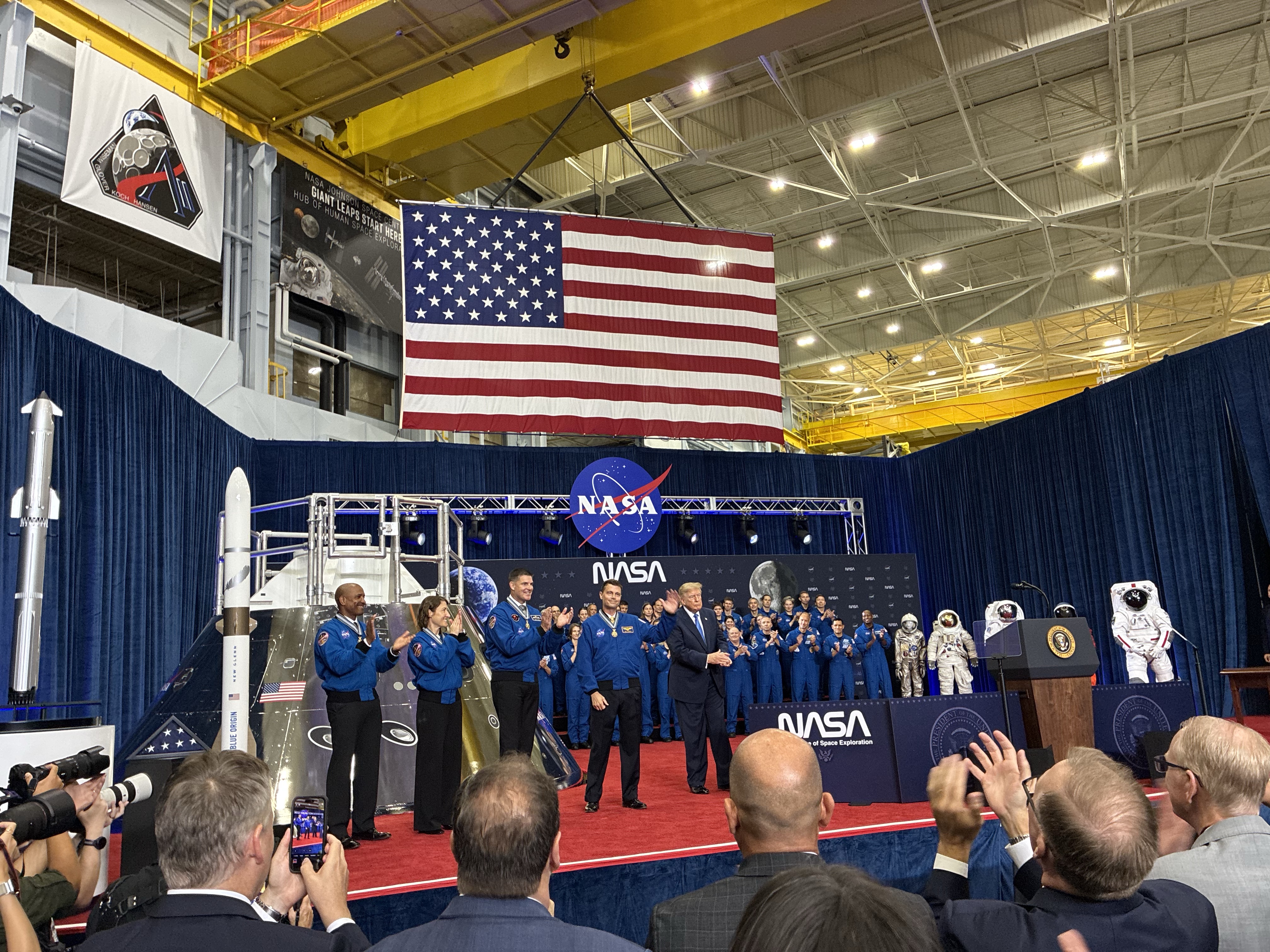
President Donald J. Trump awarded NASA astronauts Reid Wiseman, Victor Glover, and Christina Koch, and CSA (Canadian Space Agency) astronaut Jeremy Hansen with the Congressional Space Medal of Honor Friday for their service during the Artemis II mission. He presented the awards during a ceremony at NASA’s Johnson Space Center in Houston, honoring the first medal recipients since 2023.
NASA’s historic Artemis II mission launched on April 1, and splashed down safely in the Pacific Ocean on April 10. The crew members were the first astronauts to launch on the agency’s SLS (Space Launch System) rocket, flying aboard NASA’s Orion spacecraft, which the crew named Integrity. During their record-setting mission, the astronauts traveled 252,756 miles from Earth, farther than any humans have traveled before, surpassing a previous record set by Apollo 13 astronauts in 1970. In total, they flew 695,081 miles, including a lunar flyby.
“We gather on these historic grounds to celebrate the immense courage of four intrepid space heroes whose sense of daring and adventure led them further from Earth than anyone has ever traveled ever before,” said President Trump. “Today we’re proudly awarding the Congressional Space Medal of Honor to the remarkable crew of Artemis II. These astronauts did not do it alone. I want to salute all of the engineers, and scientists, launch and landing specialists, everyone at NASA who helped make this mission a great success.”
The Congressional Space Medal of Honor was authorized by Congress in 1969 to recognize an astronaut who in the performance of duties has distinguished himself or herself by exceptionally brave and meritorious efforts, and contributions to the welfare of the nation and humanity. There now are 34 recipients of the award since the beginning of the space program, including the crews of Apollo 1, Challenger, and Columbia who received the award posthumously.
“President Trump’s leadership has put America back on a path to lead the world in space, from creating the Artemis program to giving NASA the resources and mandate to win this new space race,” said NASA Administrator Jared Isaacman. “The Artemis II crew answered that call with extraordinary skill and courage, showing the world the Moon again and what American leadership and exploration look like at their best. Their achievement was made possible by the exceptional NASA workforce, alongside our industry and international partners, who showed once again what can be accomplished when we commit to big, bold endeavors. We will build on this success as we return to the lunar surface and establish an enduring presence on the Moon.”
The first crewed mission under NASA’s Artemis program paved the way for the 2027 Artemis III test flight in low Earth orbit to demonstrate rendezvous and docking capabilities between Orion and commercial human landing systems, and the Artemis IV mission in 2028, which will return American astronauts to the lunar surface.
“It was the honor of my lifetime to fly on Integrity around the Moon with Victor, Christina, and Jeremy. Having President Trump here at the agency’s Johnson Space Center to honor NASA and my crew underscores the significance of what our teams accomplished,” said Wiseman, who served as commander of the mission. “I can’t wait to see my friends continue this legacy on Artemis III.”
Glover served as pilot of the Orion spacecraft.
“Piloting Orion for the first time in space was a profound honor, made possible because of the years of hard work, dedication, and expertise by countless individuals dedicating their time and talents to the mission,” said Glover. “We share this recognition with the thousands of people who launched us around the Moon and brought us safely back to Earth.”
Koch served as a mission specialist.
“The response to our mission here on Earth was beyond anything we ever imagined and all we ever hoped for. We are grateful every time we hear from people who followed along with our journey. As team members on this shared mission, we accept this award to honor those who made it happen, from factory floors to clean rooms and mission control rooms,” said Koch.
Hansen also served as a mission specialist.
“It is a privilege to receive the Congressional Space Medal of Honor alongside my Artemis II crewmates,” said Hansen. “I share this recognition with the dedicated teams in Canada, the United States, and our international partners who made the mission possible. Artemis II showed what we can accomplish for humanity when we set ambitious goals and work together. For Canada, the mission and the Artemis program as a whole are about much more than just going back to the Moon. It is about the pursuit of excellence and collaboration.”
As part of a Golden Age of innovation and exploration, NASA will send Artemis astronauts on a series of challenging missions to explore more of the Moon and establish a Moon Base on the lunar surface for long-term exploration. These missions will set the stage for sending the first astronauts — Americans — to Mars. Learn more:
-end-
Bethany Stevens / Cheryl Warner
Headquarters, Washington
202-358-1600
bethany.c.stevens@nasa.gov / cheryl.m.warner@nasa.gov
Brandi Dean / Chelsey Ballarte
Johnson Space Center, Houston
281-483-5111
brandi.k.dean@nasa.gov / chelsey.n.ballarte@nasa.gov
President Trump Signs Executive Order to Create US Space Academy
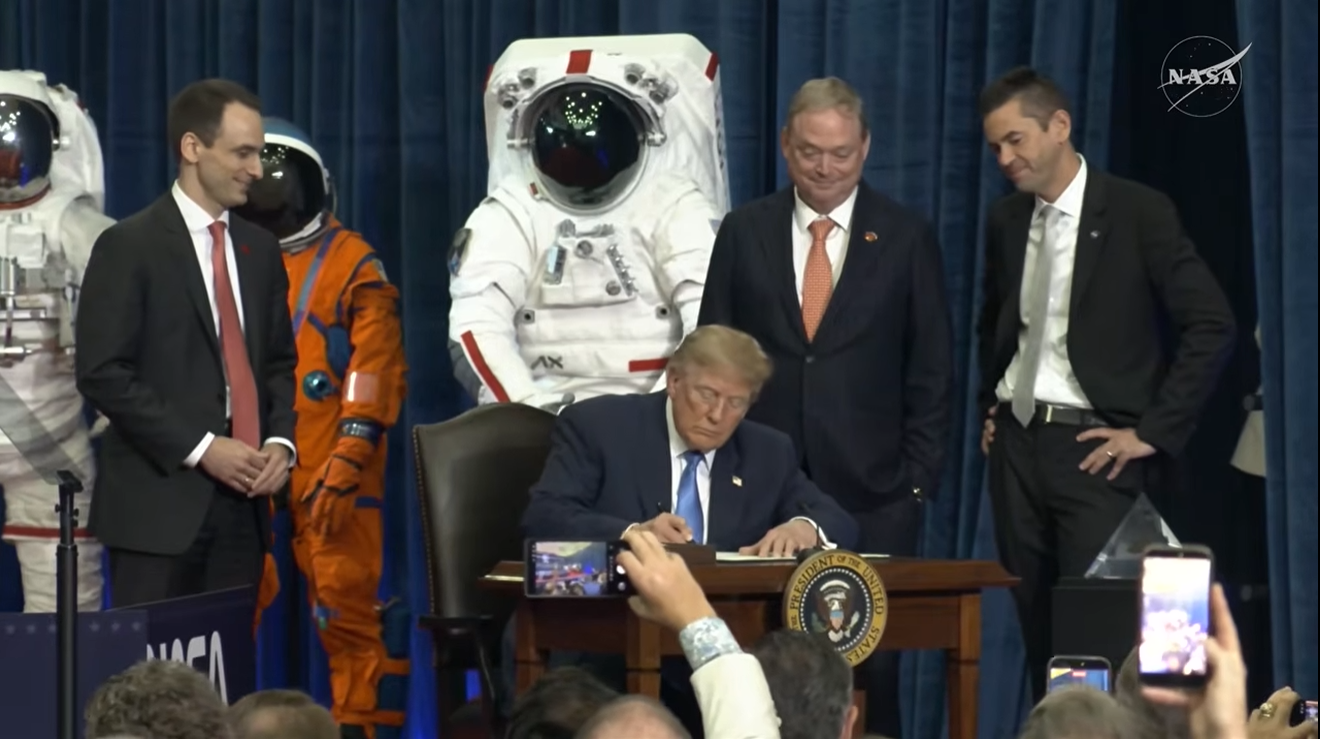
To strengthen the nation’s space workforce and develop the next generation of space leaders, President Donald J. Trump signed an Executive Order on Friday to establish the nation’s first U.S. Space Academy.
The order highlights how space is a critical domain for American national security, economic growth, scientific discovery, and technological innovation. The proposed academy would focus technical education with leadership development, discipline, and a commitment to public service, helping ultimately advance U.S. interests in space.
“Given the rapid growth of the U.S. Space Force and commercial space industry, and the expansion of our ambitions to the Moon and far beyond the Moon, it’s clear we will need to educate and train an entire generation of skilled service members, engineers, and civil operators,” said President Trump. “That’s why I will sign an Executive Order to begin the process of creating a new a national academy called the U.S. Space Academy.”
The order also calls on NASA Administrator Jared Isaacman to serve as the chair of a new Presidential Commission on the United States Space Academy, and NASA Deputy Administrator Matt Anderson to serve as the executive director. They will work with vice chairs — Assistant to the President for Science and Technology, Michael Kratsios, and Assistant to the President for Economic Policy, Kevin Hassett — and other representatives from the White House and the interagency on the commission.
“President Trump’s vision for a new academy is a transformational step to educate the engineers, scientists, technicians, operators and even the astronauts who will be necessary for the inspiring future we are pursuing in space. In the years ahead, we will return NASA astronauts to the lunar surface, build the Moon Base, get underway on nuclear power, ignite the orbital economy and launch more missions of science and discovery,” said Isaacman. “I have no doubt that so much of the future talent that will graduate and contribute to these exciting endeavors will be educated at the United States Space Academy.”
A report from the commission to the President is due within 120 days of the signing with recommendations on governance framework, service obligations for graduates, physical location of the academy, legislative requirements, and more.
The signing of “Establishing the United States Space Academy Executive Order,” took place at NASA’s Johnson Space Center in Houston where the President also presented the Artemis II crew members with the Congressional Space Medal of Honor.
The Executive Order is the latest from President Trump that demonstrates his commitment to maintaining U.S. leadership in space and advancing NASA’s Golden Age exploration and innovation. In December 2025, he signed the Ensuring American Space Superiority, and recently, a new National Space Transportation Policy memorandum on Aug. 20.
Read the full Executive Order on The White House website:
https://www.whitehouse.gov/presidential-actions/2026/08/establishing-the-united-states-space-academy
-end-
Bethany Stevens / Cheryl Warner
Headquarters, Washington
202-358-1600
bethany.c.stevens@nasa.gov / cheryl.m.warner@nasa.gov
Relive private Chinese rocket's explosive 1st landing attempt (video)
LandSpace's first attempt to land a rocket was quite a spectacle, as newly released video footage reminds us.
The Beijing-based company's Zhuque-3 launcher reached orbit successfully during its debut mission on Dec. 3, 2025 — quite a feat for any rocket.
But Zhuque-3 couldn't pull off the twofer. Its first stage experienced problems during the latter stages of its return to Earth, ultimately exploding in a violent fireball near its designated landing pad.
The first stage of LandSpace's first Zhuque-3 rocket crashes while trying to land on Dec. 3, 2025. (Image credit: CCTV)We recently got some up-close looks at that failed return to Earth, thanks to CCTV. On Aug. 20, the state-run Chinese broadcaster released dramatic footage of the landing attempt, which includes video captured from a camera on the booster itself.
Those selfie shots highlight the rocket's resemblance to the paragon of reuse, SpaceX's Falcon 9. For example, we see the rapidly approaching ground through the metal mesh of two hypersonic grid fins, attitude-control devices the Falcon 9 pioneered and popularized.
The CCTV video also shows that Zhuque-3 was in trouble before it hit the ground: The booster suffered a mini-explosion during descent and was already a flaming wreck when it reintroduced itself to terra firma.
LandSpace apparently learned some important lessons that day because Zhuque-3's second mission, which occurred on Aug. 18, was a complete success. The 216-foot-tall (66 meters) rocket delivered a satellite to orbit, and its first stage stuck the landing.
It was the first-ever touchdown by a private Chinese orbital rocket, and just the second by a Chinese orbital launcher of any description. The first was pulled off on July 10 by the first stage of a Long March 10B rocket, which nestled softly into a net-like apparatus installed on a ship at sea.
On Cloud 9: Have astronomers discovered the first starless galaxy?
Scientists are closer than ever before to confirming that a galaxy known as "Cloud 9" is the first "starless" or "failed" galaxy ever discovered by humanity.
A starless galaxy is one with virtually no stars despite possessing a wealth of gas and dust that would normally serve as the building blocks of stars. The dominant element of a starless galaxy would be dark matter, the mysterious "stuff" that remains effectively invisible because it doesn't interact with light.
Located 14 million light-years away near the spiral galaxy Messier 94 (M94), Cloud 9 is currently the best candidate for a starless galaxy humanity has discovered to date. It contains a vast cloud of hydrogen gas with an estimated mass of 1 million times that of the sun, and dark matter with around 5 million solar masses. Yet, the Hubble Space Telescope discovered in January this year that Cloud 9 emits virtually no starlight.
"But the most striking aspect of our research was the absolute emptiness of the image at the location of Cloud 9. When you look at an image reaching those depths and see nothing where a structure containing a million solar masses of gas should be, it is genuinely remarkable," team leader Ignacio Trujillo of the Instituto de Astrofísica de Canarias, Spain, told Space.com.
"Most objects in the universe leave some trace of light. Cloud 9 does not. That silence is, in its own way, the most compelling result we could have obtained."
On the hunt for a failed galaxyTrujillo explained that despite having enough raw material to build a small galaxy, Cloud 9 seems to have never formed any significant stellar population.
"That combination — gas but no stars, sitting in a relatively normal environment — makes it one of the most compelling candidates for what theorists call a 'dark' or starless galaxy," Trujillo added. "The concept has been theoretically predicted for decades, but observationally confirmed cases remain elusive.
"The difficulty is obvious: if there are no stars, there is no visible light to detect, and the only way to find such objects is through their gas emission — typically neutral hydrogen observed at radio wavelengths — combined with extremely deep optical imaging to rule out the presence of even a faint stellar component."
Trujillo and colleagues set about investigating Cloud 9 using the HiPERCAM camera on the Gran Telescopio Canarias, the world's largest optical telescope. This led to them obtaining the deepest images ever taken of the Cloud 9 region, approximately ten times deeper than any previous optical imaging of this object. "Honestly, the depth we achieved with HiPERCAM in just 2.36 hours of integration was striking," Trujillo said. What they saw left no questions about the nature of this galaxy.
"The result was clear: we detected absolutely no stellar emission within the region corresponding to the location of Cloud 9," Trujillo said. "Assuming an old, metal-poor stellar population — which would be the hardest kind to detect — we can set an upper limit on the total stellar mass of just 16,000 solar masses.
"Cloud-9 appears to be, within the limits of our observations, genuinely starless."
Why do some galaxies 'fail?'Though starless galaxies are on the verge of escaping the realms of the purely theoretical thanks to this investigation of Cloud 9, how they form is still something of a puzzle.
However, scientists do have a pretty solid idea of how a galaxy could take shape without birthing stars.
"The leading theoretical explanation involves the ultraviolet background radiation that permeates the universe," Trujillo said. "After the epoch of reionization, this radiation field heats the gas in low-mass dark matter halos to temperatures high enough that the gas cannot cool efficiently and collapse to form stars."
The researcher added that simulations of this period of the cosmos predict that dark matter halos below a certain mass threshold, around 5 billion solar masses, should remain essentially starless.
"Cloud 9 has a halo mass consistent with this regime. In this picture, starless galaxies are not exotic anomalies but a natural and abundant prediction of standard cosmological models," Trujillo explained. "The challenge has simply been finding them."
An illustration of a dark starless galaxy dominated by dark matter and gas. (Image credit: Robert Lea (created with Canva))As impressive as these results are, the jury is still out on Cloud 9 as a starless galaxy. Further investigation will be needed before scientists can firmly declare they have discovered the first starless galaxy.
"On the stellar side, deeper space-based imaging would be particularly valuable because resolving individual stars avoids many of the problems associated with diffuse-light measurements," Trujillo concluded.
"Hubble has already provided extremely strong evidence, and future facilities such as the James Webb Space Telescope (JWST) could potentially push the search further, although the optimal filters and stellar tracers would need to be carefully chosen."
The team's research is available on the paper repository site arXiv.
Stellafane or Bust
The legendary Stellafane Convention has been blowing away expectations for a century, and plans are in place to make sure it continues to do so for another 100 years.
The post Stellafane or Bust appeared first on Sky & Telescope.
Grants
The Payment Management System (PMS) is currently experiencing issues affecting Federal Financial Report (FFR) generation. Impacted NASA grant recipients will not be considered noncompliant. NASA is working with PMS to resolve the issue. Updates will be posted here. Grants Status Requests
To submit a request, visit NASA General Information Request Form and complete the form. You will receive an automated email with the most commonly requested grant status information.
Important Instructions:
- Ensure you enter a valid email address, as replies will only be sent via email.
- The confirmation email may take a few minutes to arrive in your inbox.
How to Fill Out the Form:
- Category: Select “Procurement including Grants & Cooperative Agreements.”
- Procurement Area: Choose “Grants/Agreements.”
- Grants/Agreements Activity: Select “Grant Status.”
- Required Information: Provide either a Grant Number, Purchase Requisition Number, or both.
Guidance Regarding OMB Memorandum M-25-14 and Recent Temporary Restraining Orders
Update on Diversity, Equity, Inclusion, and Accessibility (DEIA) Executive Orders – January 29, 2025
On January 23, 2025, NASA’s Office of Procurement (OP) released a memorandum for the NASA contractor and grant community regarding Executive Order “Initial Rescission of Harmful Executive Orders and Actions” and the Office of Personnel Management’s (OPM) memorandum “Initial Guidance Regarding DEIA Executive Orders.”
Per OP’s memo, NASA grant and cooperative agreement recipients shall immediately cease and desist all DEIA activities required for their grant. This work may include but is not limited to: DEIA plan requirements, training, workshops, reporting, considerations for staffing, or any other direct or indirect grant activity related to DEIA. All grant recipients shall notify their cognizant Grant Officer if they identify requirements within their grants that are in violation of this guidance. Your Grant Officer’s contact information can be found on your NF 1687, Notice of Award for Grant and Cooperative Agreement (NOA).
Thank you for your work and partnership with NASA.
In FY2025, NASA separated the Terms and Conditions from the GCAM to create a standalone document. This document outlines both the general and specific terms and conditions and applies to all awards issued under 2 CFR 1800 (NASA’s adoption of 2 CFR 200.)
NASA Grant and Cooperative Agreement Terms and Conditions 7-15-2026
Administrative Supplement Requests Templates :
No Cost Extension (NCE) Request Form
Other Administrative Supplement Request Form
Principal Investigator (PI) Change Request Form
Period of Performance (POP) Change Form
Submit via email to NSSC-ADMIN-SUPPLEMENT REQUEST
PI Transfer Requests:
Submit via email to NSSC-Grants-PI-Transfer
NASA Insignia GuidelinesGrantees are strongly encouraged to use the NASA Insignia Format identified in the guidelines at NASA Insignia Guidelines for NASA Grantees. These guidelines aim to increase awareness of NASA’s mission activities via Grantee partnerships for a broader and more diverse population.
Payment Management SystemNASA uses a service provider, currently the Department of Health and Human Services (HHS) Payment Management System (PMS), to provide Federal funds to recipients. PMS will provide instructions to the recipients for registering and requesting funds through the system.
NASA is responsible for routine post-award monitoring on all awards, regardless of the award’s risk determination. At a minimum, routine monitoring includes reviewing award recipients’ annual performance reports, semi-annual Federal Financial Report (FFR), and Transactions Testing Review.
All NASA award recipients must submit annual performance reports. Annual reports are due to NASA 60 days prior to the annual anniversary of the award’s POP start date (e.g., if the POP of an award is October 1 – September 30, the report would be due 60 days prior to October 1.)
- Final Performance Reports: Submit via email to NSSC-CloseOut@mail.nasa.gov
- Performance Reports: Submit via email to NSSC-Grant-Report@mail.nasa.gov
Recipients will submit their semi-annual FFRs in PMS:
Period 1 (October 1 – March 31): Due by April 30 each year.
Period 2 (April 1 – September 30): Due by October 30 of each year.
Final FFRs are due 120 days after the end of the POP
Additional information and training are available on the Payment Management System website at https://pms.psc.gov/. The PMS help desk number is 1-877-614-5533.
FormsPost-Award Certifications and Representations
Current and Pending Support (CPS) Form
NASA Pre-Award and Post-Award Disclosure Requirements
- Title 2: Grants and Agreements
- 14 CFR 1274: Cooperative Agreements with Commercial Firms (Rescinded January 2021)
- 14 CFR 1275: Research Misconduct
NASA Grant and Cooperative Agreement Manual (GCAM): NASA’s Grant Manual for Proposers and Recipients
The NASA Grant and Cooperative Agreement Manual (GCAM) provides pre and post award policy guidance to NASA proposers and award-managing personnel and award recipients to implement government-wide and NASA-specific regulations for applying for, awarding and administering grants and cooperative agreements with educational and non-profit organizations; State, local, and Indian tribal governments; and for-profit organizations.
NASA Grant and Cooperative Agreement Terms and ConditionsIn FY2025, NASA separated the Terms and Conditions from the GCAM to create a standalone document. This document outlines both the general and specific terms and conditions and applies to all awards issued under 2 CFR 1800 (NASA’s adoption of 2 CFR 200.)
NASA implemented the Federal-wide research terms and conditions for all research and research-related grant and cooperative agreement awards issued under 2 CFR 1800 (NASA’s adoption of 2 CFR 200). The Research Terms and Conditions implement the requirements of the Uniform Guidance and includes three companion documents:
RTC Appendix A: Prior Approval Matrix, RTC Appendix B: Subaward Requirements, and RTC Appendix C: National Policy Requirements).
The Research Terms and Conditions and companion documents are accessible on the NSF website.
NASA Office of Inspector GeneralTo file a complaint regarding denial of equal opportunity or discrimination based on race, color, national origin, sex, disability, or age; go to
https://oig.nasa.gov/hotline.html
1-800-424-9183
300 E Street, S.W. Suite 8V39
Washington, DC 20546-0001
NASA OIG Hotline
http://missionstem.nasa.gov/filing-a-complaint.html
Grants.gov
NSSC Grants Payment Package
NASA Research Opportunities Online (NSPIRES)
System for Award Management (SAM)
Grants
The Payment Management System (PMS) is currently experiencing issues affecting Federal Financial Report (FFR) generation. Impacted NASA grant recipients will not be considered noncompliant. NASA is working with PMS to resolve the issue. Updates will be posted here. Grants Status Requests
To submit a request, visit NASA General Information Request Form and complete the form. You will receive an automated email with the most commonly requested grant status information.
Important Instructions:
- Ensure you enter a valid email address, as replies will only be sent via email.
- The confirmation email may take a few minutes to arrive in your inbox.
How to Fill Out the Form:
- Category: Select “Procurement including Grants & Cooperative Agreements.”
- Procurement Area: Choose “Grants/Agreements.”
- Grants/Agreements Activity: Select “Grant Status.”
- Required Information: Provide either a Grant Number, Purchase Requisition Number, or both.
Guidance Regarding OMB Memorandum M-25-14 and Recent Temporary Restraining Orders
Update on Diversity, Equity, Inclusion, and Accessibility (DEIA) Executive Orders – January 29, 2025
On January 23, 2025, NASA’s Office of Procurement (OP) released a memorandum for the NASA contractor and grant community regarding Executive Order “Initial Rescission of Harmful Executive Orders and Actions” and the Office of Personnel Management’s (OPM) memorandum “Initial Guidance Regarding DEIA Executive Orders.”
Per OP’s memo, NASA grant and cooperative agreement recipients shall immediately cease and desist all DEIA activities required for their grant. This work may include but is not limited to: DEIA plan requirements, training, workshops, reporting, considerations for staffing, or any other direct or indirect grant activity related to DEIA. All grant recipients shall notify their cognizant Grant Officer if they identify requirements within their grants that are in violation of this guidance. Your Grant Officer’s contact information can be found on your NF 1687, Notice of Award for Grant and Cooperative Agreement (NOA).
Thank you for your work and partnership with NASA.
In FY2025, NASA separated the Terms and Conditions from the GCAM to create a standalone document. This document outlines both the general and specific terms and conditions and applies to all awards issued under 2 CFR 1800 (NASA’s adoption of 2 CFR 200.)
NASA Grant and Cooperative Agreement Terms and Conditions 7-15-2026
Administrative Supplement Requests Templates :
No Cost Extension (NCE) Request Form
Other Administrative Supplement Request Form
Principal Investigator (PI) Change Request Form
Period of Performance (POP) Change Form
Submit via email to NSSC-ADMIN-SUPPLEMENT REQUEST
PI Transfer Requests:
Submit via email to NSSC-Grants-PI-Transfer
NASA Insignia GuidelinesGrantees are strongly encouraged to use the NASA Insignia Format identified in the guidelines at NASA Insignia Guidelines for NASA Grantees. These guidelines aim to increase awareness of NASA’s mission activities via Grantee partnerships for a broader and more diverse population.
Payment Management SystemNASA uses a service provider, currently the Department of Health and Human Services (HHS) Payment Management System (PMS), to provide Federal funds to recipients. PMS will provide instructions to the recipients for registering and requesting funds through the system.
NASA is responsible for routine post-award monitoring on all awards, regardless of the award’s risk determination. At a minimum, routine monitoring includes reviewing award recipients’ annual performance reports, semi-annual Federal Financial Report (FFR), and Transactions Testing Review.
All NASA award recipients must submit annual performance reports. Annual reports are due to NASA 60 days prior to the annual anniversary of the award’s POP start date (e.g., if the POP of an award is October 1 – September 30, the report would be due 60 days prior to October 1.)
- Final Performance Reports: Submit via email to NSSC-CloseOut@mail.nasa.gov
- Performance Reports: Submit via email to NSSC-Grant-Report@mail.nasa.gov
Recipients will submit their semi-annual FFRs in PMS:
Period 1 (October 1 – March 31): Due by April 30 each year.
Period 2 (April 1 – September 30): Due by October 30 of each year.
Final FFRs are due 120 days after the end of the POP
Additional information and training are available on the Payment Management System website at https://pms.psc.gov/. The PMS help desk number is 1-877-614-5533.
FormsPost-Award Certifications and Representations
Current and Pending Support (CPS) Form
NASA Pre-Award and Post-Award Disclosure Requirements
- Title 2: Grants and Agreements
- 14 CFR 1274: Cooperative Agreements with Commercial Firms (Rescinded January 2021)
- 14 CFR 1275: Research Misconduct
NASA Grant and Cooperative Agreement Manual (GCAM): NASA’s Grant Manual for Proposers and Recipients
The NASA Grant and Cooperative Agreement Manual (GCAM) provides pre and post award policy guidance to NASA proposers and award-managing personnel and award recipients to implement government-wide and NASA-specific regulations for applying for, awarding and administering grants and cooperative agreements with educational and non-profit organizations; State, local, and Indian tribal governments; and for-profit organizations.
NASA Grant and Cooperative Agreement Terms and ConditionsIn FY2025, NASA separated the Terms and Conditions from the GCAM to create a standalone document. This document outlines both the general and specific terms and conditions and applies to all awards issued under 2 CFR 1800 (NASA’s adoption of 2 CFR 200.)
NASA implemented the Federal-wide research terms and conditions for all research and research-related grant and cooperative agreement awards issued under 2 CFR 1800 (NASA’s adoption of 2 CFR 200). The Research Terms and Conditions implement the requirements of the Uniform Guidance and includes three companion documents:
RTC Appendix A: Prior Approval Matrix, RTC Appendix B: Subaward Requirements, and RTC Appendix C: National Policy Requirements).
The Research Terms and Conditions and companion documents are accessible on the NSF website.
NASA Office of Inspector GeneralTo file a complaint regarding denial of equal opportunity or discrimination based on race, color, national origin, sex, disability, or age; go to
https://oig.nasa.gov/hotline.html
1-800-424-9183
300 E Street, S.W. Suite 8V39
Washington, DC 20546-0001
NASA OIG Hotline
http://missionstem.nasa.gov/filing-a-complaint.html
Grants.gov
NSSC Grants Payment Package
NASA Research Opportunities Online (NSPIRES)
System for Award Management (SAM)
SpaceX Falcon Heavy rocket launching NASA's Roman Space Telescope on Aug. 30: How to watch it live
NASA's next great space observatory is about to lift off, and you can watch it live.
The Nancy Grace Roman Space Telescope is scheduled to launch atop a SpaceX Falcon Heavy rocket from NASA's Kennedy Space Center in Florida on Sunday (Aug. 30) at 7:26 a.m. EDT (1126 GMT).
You can watch it live here at Space.com, courtesy of NASA, beginning at 6:20 a.m. EDT (1020 GMT). You don't have to wait that long for a Roman fix, actually; there's stuff to watch on Saturday (Aug. 29) as well. Here's a rundown of this weekend's Roman action.
SpaceX's Falcon Heavy rocket launches NASA's Europa Clipper mission from Florida on Oct. 14, 2024. (Image credit: SpaceX)Saturday: Prelaunch briefingsThings kick off at on Saturday at 9 a.m. EDT (1300 GMT) with NASA's Roman Space Telescope mission science briefing. This should be quite eventful, for Roman's science goals are ambitious; it will likely discover thousands of exoplanets, for example, and reveal intriguing new information about mysterious dark matter and dark energy.
Participants are:
- Shawn Domagal-Goldman, director, Astrophysics Division, NASA Headquarters
- Julie McEnery, Roman telescope senior project scientist, NASA Goddard Space Flight Center
- Vanessa Bailey, Roman Coronagraph Instrument scientist, NASA Jet Propulsion Laboratory
- Kristen McQuinn, Roman Science Operations Center lead, Space Telescope Science Institute
- Lee Armus, Roman Science Support Center lead, Caltech/IPAC
Next up is the prelaunch press conference, which will discuss the mission's launch readiness. It will start at 10:30 a.m. EDT (1430 GMT) and feature the following folks:
- Nicky Fox, associate administrator, Science Mission Directorate, NASA Headquarters
- Lucas Paganini, Roman telescope program executive, NASA Headquarters
- Jackie Townsend, Roman telescope project manager, NASA Goddard
- Denton Gibson, launch director, NASA’s Launch Services Program, NASA Kennedy
- Julianna Scheiman, director, NASA Science and Dragon Programs, SpaceX
- Justin McReynolds, launch weather officer, 45th Weather Squadron, U.S. Space Force
Then, at 11:45 a.m. EDT (1545 GMT), NASA Administrator Jared Isaacman, an accomplished pilot and private astronaut, will put on a mini air show of sorts.
Isaacman "is expected to fly past the Nancy Grace Roman Space Telescope and Falcon Heavy rocket on the launch pad in his jet," NASA wrote in an Aug. 24 media advisory. "The flyby will be shown live on the same stream as the prelaunch news conference, with a view of the launch pad during the transition. The flyby is subject to weather and operational considerations."
Sunday: Launch dayAnd there's more to watch on Sunday than the launch itself. At 9:30 a.m. EDT (1330 GMT), NASA will hold a post-launch briefing featuring Isaacman, Fox, Townsend, McEnery and Gibson.
They'll likely discuss the next steps for Roman, which include a 30-day journey to its deep-space home, the sun-Earth Lagrange Point 2. This spot lies about 930,000 miles (1.5 million kilometers) from Earth in the direction of Mars. It's gravitationally stable, meaning Roman will be able to stay put without expending much fuel.
Mission team members will spend the next few months checking out the observatory's systems and science gear. It should be ready to begin its five-year science mission in early 2027.
This Week's Sky at a Glance, August 28 – September 6
Venus and Spica finally have their conjunction just as they sink way down in twilight. After dark, Boötes and the Big Dipper have assumed their late-summer pose.
The post This Week's Sky at a Glance, August 28 – September 6 appeared first on Sky & Telescope.
On this day in space! Aug. 28, 1993: Galileo spacecraft flies by asteroid Ida on the way to Jupiter only to find a tiny moon!
On Aug. 28, 1993, NASA's Galileo spacecraft flew by the asteroid Ida while on its way to Jupiter.
Galileo was the first spacecraft to fly by an asteroid in the asteroid belt. Ida was actually the second one it visited after another flyby of the asteroid Gaspra in 1991.
Galileo whizzed by asteroid Ida going almost 28,000 mph and came within 1,500 miles of the asteroid's surface. During the encounter, Galileo actually discovered a tiny moon orbiting Ida! This was the first confirmed satellite of an asteroid. The International Astronomical Union named the moon Dactyl after a group of mythological beings who lived on a sacred mountain called Mount Ida.
Why it matteredThe Galileo spacecraft, on its way to the Jupiter system, captured this mind-blowing image of asteroid 243 Ida and its moon, Dactyl. (Image credit: NASA/JPL)Asteroid 243 Ida was actually the second asteroid ever to be visited by a spacecraft (Galileo previously flew by the asteroid Gaspra in October 1991), but this flyby clinched the theory that asteroids could have moons.
Until the Galileo spacecraft photographed Ida and Dactyl, astronomers suspected some asteroids could have their own moons, but Galileo proved it once and for all. During the flyby, Galileo approached within 1,500 miles (2,400 kilometers) of Ida as it made its way to Jupiter.
"It was previously thought that natural satellites of asteroids could form, but they probably weren't common," Torrence Johnson, Galileo's project scientist, once said of the flyby in a NASA statement. "Having found one fairly quickly, we can say that they're probably more common than previously thought."
Ida is an S-type asteroid made mostly of silicate rock and sits in the main asteroid belt. Astronomers suspect it is what's known as a Koronis asteroid, leftover debris from an ancient crash of two much larger objects, according to NASA. It was discovered on Sept. 29, 1884 by Austrian astronomer Johann Palisa at the Vienna Observatory.
Galileo imaging team member Ann Harch actually discovered Ida's moon Dactyl on Feb. 17, 1994, months after the flyby, while reviewing data, NASA said.
Galileo did not stop to study Ida and Dactyl. As with its Gaspra flyby, the probe zoomed by to continue its trip to Jupiter. NASA launched the Galileo mission on Oct. 18, 1989 and it arrived at Jupiter on Dec. 7, 1995, orbiting the giant planet for nearly 8 years. The mission ended on Sept. 21, 2003, when Galileo intentionally crashed into Jupiter.
Want more space history? Check out our full On This Day In Space Story archive and watch our On This Day In Space videos on YouTube.
Curiosity climbs to new heights on Mars | Space photo of the day for Aug. 28, 2026
One of NASA's intrepid Mars rovers has notched another impressive milestone during its exploration of the Red Planet.
What is it?NASA's Curiosity Mars rover used its Mastcam camera to capture a panorama made up of 323 individual images. The images were taken on Aug. 1 and Aug. 2, 2026, the 4,972nd and 4,973rd Martian days (or sols) of the rover's mission, just as Curiosity notched a total of 1 kilometer (0.6 miles) of elevation gain throughout its now 14-year exploration of the Red Planet.
The images show the wide expanse of a broad valley nicknamed "Valle Grande," a depression on the side of Mars' Mount Sharp, the 3-mile-tall (5-kilometer) mountain the rover has been climbing since 2014. The valley's floor and northern rim can be seen in the distance.
Why is it incredible?A panorama of Mars' Mount Sharp, captured by NASA's Curiosity rover from the floor of Gale Crater, on Aug. 1 and Aug. 2, 2026, the 4,972nd and 4,973rd Martian days, or sols, of the rover's mission. (Image credit: NASA/JPL-Caltech/MSSS)Curiosity's mission has been incredible for a number of reasons. For one, the daring "sky crane" maneuver that NASA and the Jet Propulsion Laboratory used to land the SUV-sized robot on the Red Planet changed Mars landings forever.
Since then, Curiosity has discovered clues that liquid water once flowed across the surface of Mars and has found tantalizing evidence of complex organic molecules on the Red Planet, including some that scientists consider to be the "building blocks" of life.
And even after 14 years of traveling across the Red Planet and suffering considerable damage to its wheels, NASA says Curiosity has plenty of exploration and science left to conduct.
Another one of NASA's Mars rovers, Perseverance, recently notched a travel milestone of its own when it surpassed 26.2 miles (42.2 km) of travel — the length of a marathon — across the Martian surface.
Week in images: 24-28 August 2026
Week in images: 24-28 August 2026
Discover our week through the lens
Ariane 6 launch with MTG-I2 – highlights
The Meteosat Third Generation-Imager2 (MTG-I2) satellite, has been launched on board an Ariane 6 launcher from Europe’s Spaceport in French Guiana. Liftoff was on 27 August 2026 at 22:11 CEST (17:10 local time).
MTG-I2 is part of the MTG constellation for Eumetsat – two are already in orbit – and it will produce images for weather forecasting in Europe in unprecedented detail. This mission provides completely new data products and capabilities for European weather services, especially suited to nowcasting of severe weather events.
The MTG-Imager satellites carry two instruments, a Lightning Imager and a Flexible Combined Imager. The Lightning Imager offers completely new capabilities for European meteorological satellites by continuously monitoring for lightning. By doing this from geostationary orbit, at an altitude of about 36 000 km above the equator, it can scan more than 80% of Earth’s surface seen from that viewpoint.
The Flexible Combined Imager, on the other hand, builds a picture of fast-evolving weather systems and can be used to issue timely weather warnings. It is particularly relevant for air traffic safety. It is able to scan its view of Earth in just 10 minutes and can scan Europe and northern Africa every 2.5 minutes.
When MTG is fully operational, it is expected to produce at least 50 times more data than the previous Meteosat Second Generation (MSG) satellites.
This was the ninth launch of Europe’s heavy-lift rocket Ariane 6. For this launch, Ariane 6 was configured with two P120C-based solid-propellant rocket motors to launch MTG-I2 to a geostationary transfer orbit. This was the first mission to this destination for Ariane 6 and the farthest the rocket has flown so far. ESA manages the Ariane 6 development programme, ensuring autonomous access to space for the benefit of European citizens. Arianespace was the launch service provider for flight VA270.