

Feed aggregator
NASA to Compete Contract for Jet Propulsion Laboratory Management

NASA announced plans Friday to compete the next contract for managing and operating the agency’s federally funded research and development center (FFRDC) in Southern California at the Jet Propulsion Laboratory (JPL), to ensure continued accountability and strong value for U.S. taxpayers.
The California Institute of Technology (Caltech) has managed the laboratory since its inception in the 1930s, and previous NASA contracts for its management and operations have been awarded sole source to the university since the facility was transferred from the U.S. Army to NASA in 1958.
The rapid growth of the U.S. space economy indicates there may now be a viable competitive market for programmatic and institutional elements of the FFRDC operations.
Conducting a competition for this contract enables NASA to assess the potential benefits of alternative management approaches to the FFRDC, including opportunities to enhance mission performance, innovation, and overall cost and operational efficiency, consistent with federal competition requirements.
This decision is part of a broader governmentwide and agency effort to find efficiencies, strengthen performance, and drive mission outcomes faster and more affordably.
“The Jet Propulsion Laboratory has delivered some of the most extraordinary scientific and engineering achievements in NASA’s history,” said NASA Administrator Jared Isaacman. “As America’s space economy evolves, we have a responsibility to the American people and the scientific community to evaluate how we can execute faster, operate more efficiently, and continue to deliver world-class science and engineering at the highest level. The decision to compete this contract reflects NASA’s commitment to strong stewardship of taxpayer resources and positions Jet Propulsion Laboratory to continue driving world-changing scientific discovery and technological innovation for decades to come.”
The work conducted at JPL remains critically important to the agency, and NASA is committed to maintaining continuity for active and future missions throughout the procurement process. NASA also is committed to maintaining the FFRDC’s existing physical location.
This approach is consistent with broader government practices, including at the Department of Energy, which has held full and open competitions for five of its 16 FFRDC management and operations contracts over the past 10 years.
The current contract with Caltech began Oct. 1, 2018, and runs through Sept. 30, 2028, with a potential maximum value of $30 billion, if all options are exercised. NASA has initiated the procurement process to compete the contract. Beginning this process now allows the agency sufficient time to conduct a comprehensive competition and award cycle while maintaining continuity for ongoing missions and laboratory operations.
For information about NASA and agency programs, visit:
-end-
George Alderman / Cheryl Warner
Headquarters, Washington
202-358-1600
george.a.alderman@nasa.gov / cheryl.m.warner@nasa.gov
NASA to Compete Contract for Jet Propulsion Laboratory Management
NASA announced plans Friday to compete the next contract for managing and operating the agency’s federally funded research and development center (FFRDC) in Southern California at the Jet Propulsion Laboratory (JPL), to ensure continued accountability and strong value for U.S. taxpayers.
The California Institute of Technology (Caltech) has managed the laboratory since its inception in the 1930s, and previous NASA contracts for its management and operations have been awarded sole source to the university since the facility was transferred from the U.S. Army to NASA in 1958.
The rapid growth of the U.S. space economy indicates there may now be a viable competitive market for programmatic and institutional elements of the FFRDC operations.
Conducting a competition for this contract enables NASA to assess the potential benefits of alternative management approaches to the FFRDC, including opportunities to enhance mission performance, innovation, and overall cost and operational efficiency, consistent with federal competition requirements.
This decision is part of a broader governmentwide and agency effort to find efficiencies, strengthen performance, and drive mission outcomes faster and more affordably.
“The Jet Propulsion Laboratory has delivered some of the most extraordinary scientific and engineering achievements in NASA’s history,” said NASA Administrator Jared Isaacman. “As America’s space economy evolves, we have a responsibility to the American people and the scientific community to evaluate how we can execute faster, operate more efficiently, and continue to deliver world-class science and engineering at the highest level. The decision to compete this contract reflects NASA’s commitment to strong stewardship of taxpayer resources and positions Jet Propulsion Laboratory to continue driving world-changing scientific discovery and technological innovation for decades to come.”
The work conducted at JPL remains critically important to the agency, and NASA is committed to maintaining continuity for active and future missions throughout the procurement process. NASA also is committed to maintaining the FFRDC’s existing physical location.
This approach is consistent with broader government practices, including at the Department of Energy, which has held full and open competitions for five of its 16 FFRDC management and operations contracts over the past 10 years.
The current contract with Caltech began Oct. 1, 2018, and runs through Sept. 30, 2028, with a potential maximum value of $30 billion, if all options are exercised. NASA has initiated the procurement process to compete the contract. Beginning this process now allows the agency sufficient time to conduct a comprehensive competition and award cycle while maintaining continuity for ongoing missions and laboratory operations.
For information about NASA and agency programs, visit:
-end-
George Alderman / Cheryl Warner
Headquarters, Washington
202-358-1600
george.a.alderman@nasa.gov / cheryl.m.warner@nasa.gov
Is Dust the Best Thing in the Universe? Part 3: Tiny Chemistry Labs
Two hydrogen atoms can't form an H2 molecule on their own in empty space. They need a surface. The universe has only one surface available, and it's something I have just spent two articles complaining about.
NASA Announces Realignment to Accelerate Mission Delivery
Editor’s Note: This advisory was updated May 22, 2026 to include a retirement.
NASA announced Friday an agencywide realignment to increase mission focus and move out on the National Space Policy. These changes position the agency to better deliver on the nation’s highest‑priority objectives with speed and efficiency.
During the Ignition event in late March, NASA Administrator Jared Isaacman and agency leaders outlined the most pressing objectives to deliver on the next chapter of American leadership in space. President Trump’s Executive Order Ensuring American Space Superiority, otherwise known as the National Space Policy, directed NASA to focus talent and resources on objectives including accelerating the Artemis program, establishing a Moon Base, developing a nuclear space reactor, igniting the orbital economy, and expanding missions of science and discovery.
To support the agency’s ambitious short- and long-term goals, NASA is taking action to increase specialization at centers and integrate mission directorates, elevating delivery of technically excellent work. Some of these actions include:
- Center directors will continue reporting to Associate Administrator Amit Kshatriya, empowered to foster the unique capabilities of each center, and strengthen investments in infrastructure and the health of their workforce.
- Mission directorates will now report directly to the administrator, ensuring focus on the mission and enabling them to leverage resources across centers, industry, and international partnerships with greater speed and efficiency.
- The associate administrator also now serves as NASA chief engineer, reinforcing the agency’s technical backbone and ensuring continuity and autonomy in critical engineering decisions.
- The agency continues to focus on rebuilding core competencies, insourcing contractors to civil servants where appropriate, strengthening the intern pipeline, and leveraging the agency’s joint recruitment initiative with the U.S. Office of Personnel Management, NASA Force, to build a strong, sustainable workforce for generations to come.
“This initiative reflects NASA’s extreme focus on executing the mission in direct support of the National Space Policy. We are focusing resources on the most pressing objectives only NASA is capable of undertaking and liberating the workforce from unnecessary bureaucracy and obstacles that impede progress. We aim to rebuild competencies and instill a culture that attracts the best and brightest capable of pursuing the most demanding engineering challenges and moving safely and urgently,” said Isaacman. “There will be no reduction in force, no program cancellations, no closures, but we will achieve cost savings through more efficient execution and taking an active role in delivering the outcomes the world has been waiting for from NASA. This is how we deliver on the mission, meet the moment, and continue to make history on behalf of the American people.”
Mission directorate realignment is as follows:
- Human Spaceflight Mission Directorate (HSMD): With human spaceflight operational to both low Earth orbit and the Moon, the Exploration Systems Development Mission Directorate and Space Operations Mission Directorate will unify as HSMD.
- Research and Technology Mission Directorate (RTMD): NASA will integrate the Aeronautics Research Mission Directorate and Space Technology Mission Directorate into the new RTMD. As a combined research, space technology, and aeronautics organization charged with nuclear power and propulsion development, RTMD will ensure NASA has the capabilities needed for the mission of today and the future.
- Science Mission Directorate (SMD): Remains unchanged and continues to provide the foundation for NASA’s world‑leading scientific discovery.
Additional leadership roles, in alphabetical order, include:
- John Bailey, associate administrator, Mission Support Directorate
- Kevin Coggins, director, SCaN (Space Communications and Navigation), RTMD
- Wesley Deadrick, director, Katherine Johnson IV&V Facility
- Jamie Dunn, director, NASA’s Goddard Space Flight Center
- Carlos García-Galán, program manager, Moon Base, HSMD
- Dr. Lori Glaze, associate administrator, HSMD
- Laurie Grindle, director, Aeronautics Division, RTMD
- Marvin Horne, deputy assistant administrator for Procurement
- Brian Hughes, director, NASA’s Kennedy Space Center
- Kathleen Karika, associate administrator, Office of International and Interagency Relations, OIIR
- Dr. James Kenyon, associate administrator, RTMD
- Kelvin Manning, deputy associate administrator, HSMD
- Meredith McKay, deputy associate administrator, OIIR
- Dave Mitchell, special assignment lead for NASA Headquarters Relocation
- Joel Montalbano, deputy associate administrator, HSMD
- Bradley Niese, associate administrator for Procurement
- Eli Ouder, acting deputy associate administrator, Mission Support Directorate
- Jeremy Parsons, program manager, Artemis, HSMD
- Bob Pearce to retire as head of ARMD after an amazing 36-year career at NASA
- Wanda Peters, deputy associate administrator, RTMD
- Dawn Schaible, director, NASA’s Glenn Research Center
- Cynthia Simmons, deputy director, NASA’s Goddard Space Flight Center
- Steve Sinacore, acting director, Space Reactor Office; program manager for SR-1, LR-1, RTMD
- Adam Steltzner, chief engineer for Special Projects
- Greg Stover, director, Advanced Research and Technology Division, RTMD
- Dana Weigel, program manager, Low Earth Orbit, HSMD
Leadership at unlisted centers remains unchanged.
For more, please visit:
https://www.nasa.gov/nasa-leadership
-end-
Bethany Stevens / Camille Gallo
Headquarters, Washington
202-358-1600
bethany.c.stevens@nasa.gov / camille.m.gallo@nasa.gov
NASA Announces Realignment to Accelerate Mission Delivery
Editor’s Note: This advisory was updated May 22, 2026 to include a retirement.
NASA announced Friday an agencywide realignment to increase mission focus and move out on the National Space Policy. These changes position the agency to better deliver on the nation’s highest‑priority objectives with speed and efficiency.
During the Ignition event in late March, NASA Administrator Jared Isaacman and agency leaders outlined the most pressing objectives to deliver on the next chapter of American leadership in space. President Trump’s Executive Order Ensuring American Space Superiority, otherwise known as the National Space Policy, directed NASA to focus talent and resources on objectives including accelerating the Artemis program, establishing a Moon Base, developing a nuclear space reactor, igniting the orbital economy, and expanding missions of science and discovery.
To support the agency’s ambitious short- and long-term goals, NASA is taking action to increase specialization at centers and integrate mission directorates, elevating delivery of technically excellent work. Some of these actions include:
- Center directors will continue reporting to Associate Administrator Amit Kshatriya, empowered to foster the unique capabilities of each center, and strengthen investments in infrastructure and the health of their workforce.
- Mission directorates will now report directly to the administrator, ensuring focus on the mission and enabling them to leverage resources across centers, industry, and international partnerships with greater speed and efficiency.
- The associate administrator also now serves as NASA chief engineer, reinforcing the agency’s technical backbone and ensuring continuity and autonomy in critical engineering decisions.
- The agency continues to focus on rebuilding core competencies, insourcing contractors to civil servants where appropriate, strengthening the intern pipeline, and leveraging the agency’s joint recruitment initiative with the U.S. Office of Personnel Management, NASA Force, to build a strong, sustainable workforce for generations to come.
“This initiative reflects NASA’s extreme focus on executing the mission in direct support of the National Space Policy. We are focusing resources on the most pressing objectives only NASA is capable of undertaking and liberating the workforce from unnecessary bureaucracy and obstacles that impede progress. We aim to rebuild competencies and instill a culture that attracts the best and brightest capable of pursuing the most demanding engineering challenges and moving safely and urgently,” said Isaacman. “There will be no reduction in force, no program cancellations, no closures, but we will achieve cost savings through more efficient execution and taking an active role in delivering the outcomes the world has been waiting for from NASA. This is how we deliver on the mission, meet the moment, and continue to make history on behalf of the American people.”
Mission directorate realignment is as follows:
- Human Spaceflight Mission Directorate (HSMD): With human spaceflight operational to both low Earth orbit and the Moon, the Exploration Systems Development Mission Directorate and Space Operations Mission Directorate will unify as HSMD.
- Research and Technology Mission Directorate (RTMD): NASA will integrate the Aeronautics Research Mission Directorate and Space Technology Mission Directorate into the new RTMD. As a combined research, space technology, and aeronautics organization charged with nuclear power and propulsion development, RTMD will ensure NASA has the capabilities needed for the mission of today and the future.
- Science Mission Directorate (SMD): Remains unchanged and continues to provide the foundation for NASA’s world‑leading scientific discovery.
Additional leadership roles, in alphabetical order, include:
- John Bailey, associate administrator, Mission Support Directorate
- Kevin Coggins, director, SCaN (Space Communications and Navigation), RTMD
- Wesley Deadrick, director, Katherine Johnson IV&V Facility
- Jamie Dunn, director, NASA’s Goddard Space Flight Center
- Carlos García-Galán, program manager, Moon Base, HSMD
- Dr. Lori Glaze, associate administrator, HSMD
- Laurie Grindle, director, Aeronautics Division, RTMD
- Marvin Horne, deputy assistant administrator for Procurement
- Brian Hughes, director, NASA’s Kennedy Space Center
- Kathleen Karika, associate administrator, Office of International and Interagency Relations, OIIR
- Dr. James Kenyon, associate administrator, RTMD
- Kelvin Manning, deputy associate administrator, HSMD
- Meredith McKay, deputy associate administrator, OIIR
- Dave Mitchell, special assignment lead for NASA Headquarters Relocation
- Joel Montalbano, deputy associate administrator, HSMD
- Bradley Niese, associate administrator for Procurement
- Eli Ouder, acting deputy associate administrator, Mission Support Directorate
- Jeremy Parsons, program manager, Artemis, HSMD
- Bob Pearce to retire as head of ARMD after an amazing 36-year career at NASA
- Wanda Peters, deputy associate administrator, RTMD
- Dawn Schaible, director, NASA’s Glenn Research Center
- Cynthia Simmons, deputy director, NASA’s Goddard Space Flight Center
- Steve Sinacore, acting director, Space Reactor Office; program manager for SR-1, LR-1, RTMD
- Adam Steltzner, chief engineer for Special Projects
- Greg Stover, director, Advanced Research and Technology Division, RTMD
- Dana Weigel, program manager, Low Earth Orbit, HSMD
Leadership at unlisted centers remains unchanged.
For more, please visit:
https://www.nasa.gov/nasa-leadership
-end-
Bethany Stevens / Camille Gallo
Headquarters, Washington
202-358-1600
bethany.c.stevens@nasa.gov / camille.m.gallo@nasa.gov
Political anger affects the body differently to other forms of anger
Political anger affects the body differently to other forms of anger
New Material Could Help NASA Melt Moon Rocks, Harness Lunar Resources
4 min read
Preparations for Next Moonwalk Simulations Underway (and Underwater) Researchers Dr. Kevin Yu, left, and Dr. Jamesa Stokes prepare to remove a sample of a new material they discovered from a furnace inside a laboratory at NASA’s Glenn Research Center in Cleveland in October 2024. Quenching, or bringing the temperature of the sample down as quickly as possible, helps to ensure no more reactions occur as the sample cools so scientists can focus on studying how it behaves at high temperatures.NASA/Jef Janis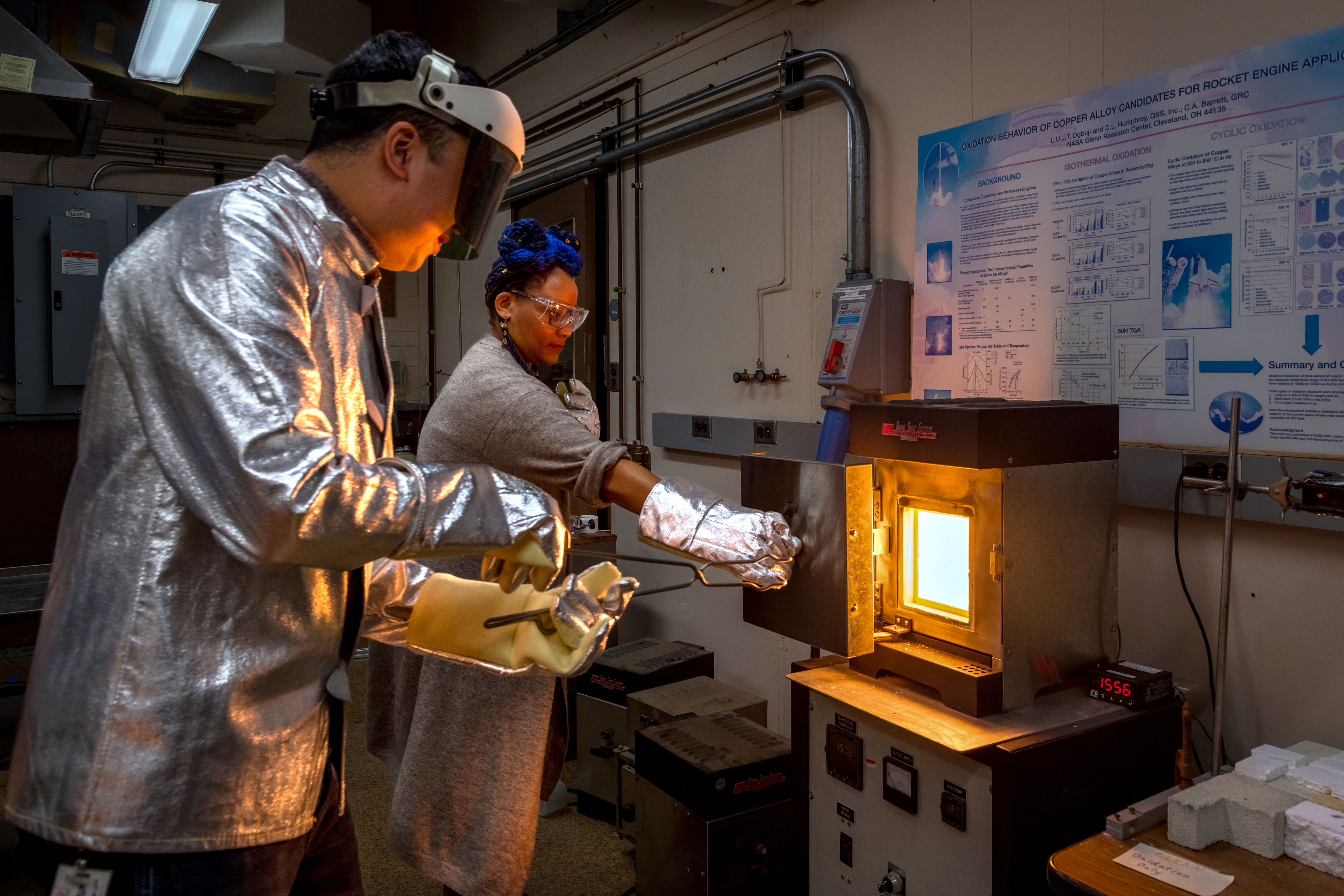
A material recently discovered and tested at NASA’s Glenn Research Center in Cleveland could help astronauts pack lighter for future missions to the Moon. NASA is researching ways explorers could “live off the land” by harnessing lunar resources, including melting Moon rocks to extract metals for building infrastructure and oxygen for fuel and life support.
As part of a graduate fellowship through the agency’s Space Technology Graduate Research Opportunities, Dr. Kevin Yu, who now works as a technologist at NASA’s Jet Propulsion Laboratory in Southern California, teamed up with Dr. Jamesa Stokes, a materials research engineer at NASA Glenn, to study how a variety of substances interacted with liquefied Moon dust.
You could call it lava, because it’s basically rocks that are crushed up and then melted. It’s very corrosive, and it will very quickly eat through a lot of commonly used refractory, or heat-resistant, materials.Dr. kevin yu
Technologist at NASA's Jet Propulsion Laboratory
About six months into their research, Stokes and Yu realized they’d stumbled across something promising and entirely new. After combining simulated lunar dust with a compound called scandium oxide and heat treating the mixture using a red-hot furnace, they discovered that an unknown material had formed. The researchers checked and double-checked their work, but the material didn’t match any of the more than 1 million substances in their X-ray analysis database.
A sample of the new material researchers discovered at NASA’s Glenn Research Center in Cleveland sits inside a platinum crucible, or heat-resistant container, after being removed from a high-temperature furnace. Behind the silver-colored container is a dome that protects the sample during handling.NASA/Jef Janis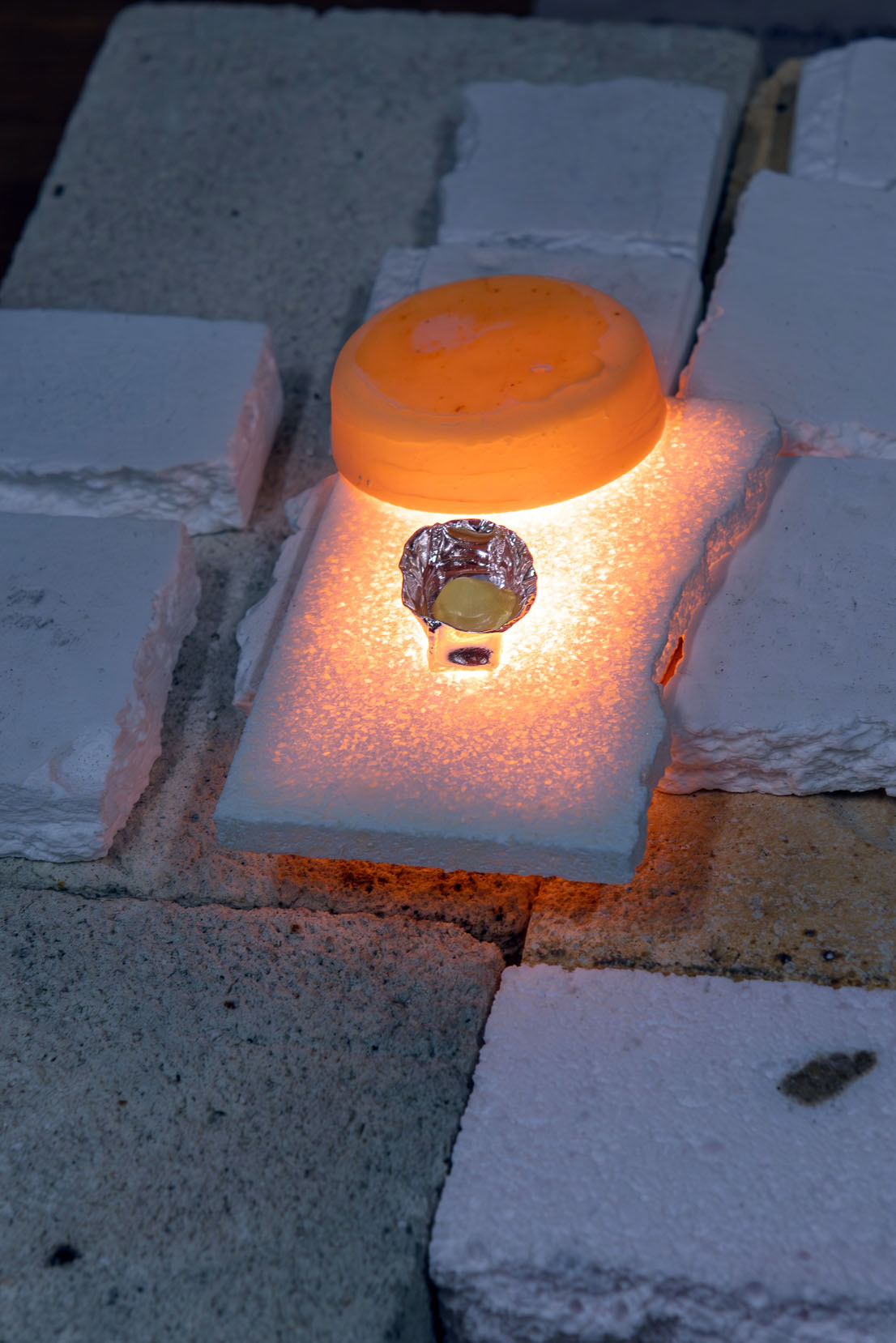
Nothing about the material had ever been studied before, so the team started from scratch, measuring the substance’s chemical composition. To make small, isolated samples and continue testing how it reacted with molten Moon dust, they used special grinding and mixing equipment in their laboratory to crush up around eight basic oxide components in ethyl alcohol before baking the mixture at more than 2,900 degrees Fahrenheit inside the furnace.
“It’s actually a very cool-looking powder; it goes in pink, almost like strawberry milk,” Yu said. “It has a built-in color indicator, so by the time you’re done with it, it turns to a light beige or tan color, and that’s how you know the reaction has proceeded the way you wanted it to.”
The pink powder shown at the far right is used to make the new material researchers discovered at NASA’s Glenn Research Center in Cleveland. The other powders to the left are two types of simulated Moon dirt used to represent dust from both the brighter regions of its surface (referred to as lunar highlands) and the darker regions (referred to as lunar maria).NASA/Jef Janis
After analyzing their results, the team found that the new substance isn’t corroded too quickly by the molten Moon dirt and can withstand the high temperatures needed to melt it — up to six times hotter than the oven in your kitchen. While it’s made with scandium oxide, which can be expensive, it costs much less than precious metals like platinum that would normally be used in these types of high-temperature processes.
The researchers’ insights could help influence NASA’s designs for a future technology that would extract resources from Moon rocks, and the new material could be used to make the pipes or basins holding molten dust inside this potential technology.
The new material’s characteristics also could prove ideal for making coatings that protect parts inside of jet engines, which can reach similarly scorching temperatures. The researchers found it is lighter, less dense, and better at insulating heat than current state-of-the-art coating materials.
Researchers Dr. Jamesa Stokes, left, and Dr. Kevin Yu pose for a portrait inside of a laboratory at NASA’s Glenn Research Center in Cleveland in October 2024.NASA/Jef Janis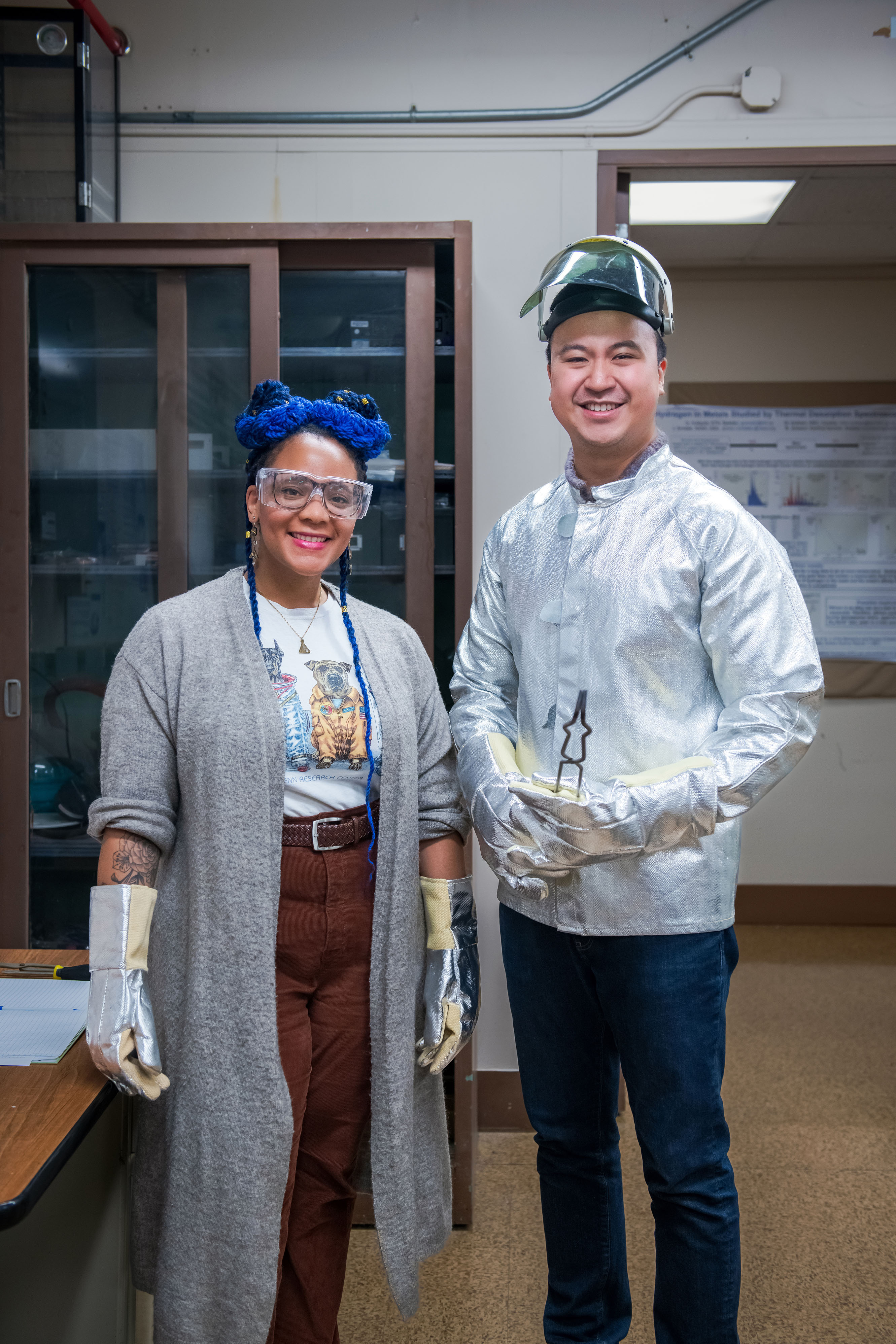
While Yu and Stokes have now completed their initial tests, they hope to fine-tune the material in the future to purify it and make it even more affordable to produce. Materials research will be integral to exploring the harsh environments of the Moon and beyond.
You can have the best idea in the world for a structure or a vehicle, but if you don’t have the materials that have the right properties to make your vision come true, it’s not going to succeed no matter how well you design it.Dr. Jamesa stokes
Materials Research Engineer at NASA Glenn
Studying new materials also advances NASA’s work on Earth.
“I think trying to push what’s possible with materials also allows for a lot of breakthroughs on the terrestrial side. Having a better understanding of materials for all sorts of applications is what gets me excited to go to work in the morning,” Yu said. “That’s why I love NASA’s mission; it’s for the benefit of all.”
This materials research is supported by NASA’s Space Technology Mission Directorate and NASA’s Aeronautics Research Mission Directorate.
For more information, visit:
Share Details Last Updated May 22, 2026 Related Terms Explore More 4 min read Keeping NASA Flying: Ground Crews Ensure Aircraft Readiness Article 3 days ago 2 min read Hubble Captures Galaxy ClusterLook closely at this image from NASA’s Hubble Space Telescope and you’ll see galaxies of…
Article 3 days ago 2 min read NASA Seeks Interest for Artemis Mission CubeSats Article 4 days ago Keep Exploring Discover Related TopicsMissions
Humans in Space
Climate Change
Solar System
New Material Could Help NASA Melt Moon Rocks, Harness Lunar Resources
4 min read
Preparations for Next Moonwalk Simulations Underway (and Underwater) Researchers Dr. Kevin Yu, left, and Dr. Jamesa Stokes prepare to remove a sample of a new material they discovered from a furnace inside a laboratory at NASA’s Glenn Research Center in Cleveland in October 2024. Quenching, or bringing the temperature of the sample down as quickly as possible, helps to ensure no more reactions occur as the sample cools so scientists can focus on studying how it behaves at high temperatures.NASA/Jef JanisA material recently discovered and tested at NASA’s Glenn Research Center in Cleveland could help astronauts pack lighter for future missions to the Moon. NASA is researching ways explorers could “live off the land” by harnessing lunar resources, including melting Moon rocks to extract metals for building infrastructure and oxygen for fuel and life support.
As part of a graduate fellowship through the agency’s Space Technology Graduate Research Opportunities, Dr. Kevin Yu, who now works as a technologist at NASA’s Jet Propulsion Laboratory in Southern California, teamed up with Dr. Jamesa Stokes, a materials research engineer at NASA Glenn, to study how a variety of substances interacted with liquefied Moon dust.
You could call it lava, because it’s basically rocks that are crushed up and then melted. It’s very corrosive, and it will very quickly eat through a lot of commonly used refractory, or heat-resistant, materials.Dr. kevin yu
Technologist at NASA's Jet Propulsion Laboratory
About six months into their research, Stokes and Yu realized they’d stumbled across something promising and entirely new. After combining simulated lunar dust with a compound called scandium oxide and heat treating the mixture using a red-hot furnace, they discovered that an unknown material had formed. The researchers checked and double-checked their work, but the material didn’t match any of the more than 1 million substances in their X-ray analysis database.
A sample of the new material researchers discovered at NASA’s Glenn Research Center in Cleveland sits inside a platinum crucible, or heat-resistant container, after being removed from a high-temperature furnace. Behind the silver-colored container is a dome that protects the sample during handling.NASA/Jef JanisNothing about the material had ever been studied before, so the team started from scratch, measuring the substance’s chemical composition. To make small, isolated samples and continue testing how it reacted with molten Moon dust, they used special grinding and mixing equipment in their laboratory to crush up around eight basic oxide components in ethyl alcohol before baking the mixture at more than 2,900 degrees Fahrenheit inside the furnace.
“It’s actually a very cool-looking powder; it goes in pink, almost like strawberry milk,” Yu said. “It has a built-in color indicator, so by the time you’re done with it, it turns to a light beige or tan color, and that’s how you know the reaction has proceeded the way you wanted it to.”
The pink powder shown at the far right is used to make the new material researchers discovered at NASA’s Glenn Research Center in Cleveland. The other powders to the left are two types of simulated Moon dirt used to represent dust from both the brighter regions of its surface (referred to as lunar highlands) and the darker regions (referred to as lunar maria).NASA/Jef JanisAfter analyzing their results, the team found that the new substance isn’t corroded too quickly by the molten Moon dirt and can withstand the high temperatures needed to melt it — up to six times hotter than the oven in your kitchen. While it’s made with scandium oxide, which can be expensive, it costs much less than precious metals like platinum that would normally be used in these types of high-temperature processes.
The researchers’ insights could help influence NASA’s designs for a future technology that would extract resources from Moon rocks, and the new material could be used to make the pipes or basins holding molten dust inside this potential technology.
The new material’s characteristics also could prove ideal for making coatings that protect parts inside of jet engines, which can reach similarly scorching temperatures. The researchers found it is lighter, less dense, and better at insulating heat than current state-of-the-art coating materials.
Researchers Dr. Jamesa Stokes, left, and Dr. Kevin Yu pose for a portrait inside of a laboratory at NASA’s Glenn Research Center in Cleveland in October 2024.NASA/Jef JanisWhile Yu and Stokes have now completed their initial tests, they hope to fine-tune the material in the future to purify it and make it even more affordable to produce. Materials research will be integral to exploring the harsh environments of the Moon and beyond.
You can have the best idea in the world for a structure or a vehicle, but if you don’t have the materials that have the right properties to make your vision come true, it’s not going to succeed no matter how well you design it.Dr. Jamesa stokes
Materials Research Engineer at NASA Glenn
Studying new materials also advances NASA’s work on Earth.
“I think trying to push what’s possible with materials also allows for a lot of breakthroughs on the terrestrial side. Having a better understanding of materials for all sorts of applications is what gets me excited to go to work in the morning,” Yu said. “That’s why I love NASA’s mission; it’s for the benefit of all.”
This materials research is supported by NASA’s Space Technology Mission Directorate and NASA’s Aeronautics Research Mission Directorate.
For more information, visit:
Share Details Last Updated May 22, 2026 Related Terms Explore More 4 min read Keeping NASA Flying: Ground Crews Ensure Aircraft Readiness Article 3 days ago 2 min read Hubble Captures Galaxy ClusterLook closely at this image from NASA’s Hubble Space Telescope and you’ll see galaxies of…
Article 3 days ago 2 min read NASA Seeks Interest for Artemis Mission CubeSats Article 4 days ago Keep Exploring Discover Related TopicsMissions
Humans in Space
Climate Change
Solar System
Week in images: 18-22 May 2026
Week in images: 18-22 May 2026
Discover our week through the lens
Australia is battling its largest diphtheria outbreak in living memory
Australia is battling its largest diphtheria outbreak in living memory
Span wants to turn homes into mini data centers
Smart-panel start-up Span wants to turn spare household electricity into AI computing power. How far it can scale and what effect that would have on the residential grid remain unsettled
Hubble Captures Galaxy Cluster
- Hubble Home
- Overview
- Impact & Benefits
- Science
- Observatory
- Team
- Multimedia
- News
- More
2 min read
Hubble Captures Galaxy Cluster NASA’s Hubble Space Telescope captured this scene of galaxy cluster MACS J1141.6-1905 in visible and infrared light. NASA, ESA, H. Ebeling (University of Hawaii); Image Processing: G. Kober (NASA/Catholic University of America)Look closely at this image from NASA’s Hubble Space Telescope and you’ll see galaxies of various shapes and sizes clustered together toward the center-left of the image. A few foreground stars shine brightly and are easily distinguished by the spikes that appear to extend outward from each star. These spikes, called diffraction spikes, are the result of how point sources of light (such as stars) bend, or diffract, around the supports for Hubble’s secondary mirror.
Hubble captured this scene of MACS J1141.6-1905 in visible and infrared light. The image includes data from two Hubble observing programs that looked at massive galaxy clusters that shine very brightly in X-rays. Both programs were looking for distant galaxies gravitationally lensed by the cluster. They also wanted to better understand the physical nature of interactions at each cluster’s core. An extra bonus was the addition of Hubble’s visible and infrared observations of these very bright X-ray clusters to its archive.
Hubble’s archive of 1.7 million observations, and counting, is a valuable tool for current and future astronomers. They can mine Hubble’s 36 years of observations and examine the data with new tools, enabling researchers to make new discoveries.
MACS J1141.6-1905 is around four billion light-years away in the constellation Crater (the Cup).
Facebook logo @NASAHubble @NASAHubble Instagram logo @NASAHubbleMedia Contact:
Claire Andreoli
NASA’s Goddard Space Flight Center, Greenbelt, MD
claire.andreoli@nasa.gov
Since its 1990 launch, the Hubble Space Telescope has changed our fundamental understanding of the universe.
Hubble Spectroscopy
Hubble’s Partners in Science
AI and Hubble Science
Hubble Captures Galaxy Cluster
- Hubble Home
- Overview
- Impact & Benefits
- Science
- Observatory
- Team
- Multimedia
- News
- More
2 min read
Hubble Captures Galaxy Cluster NASA’s Hubble Space Telescope captured this scene of galaxy cluster MACS J1141.6-1905 in visible and infrared light. NASA, ESA, H. Ebeling (University of Hawaii); Image Processing: G. Kober (NASA/Catholic University of America)Look closely at this image from NASA’s Hubble Space Telescope and you’ll see galaxies of various shapes and sizes clustered together toward the center-left of the image. A few foreground stars shine brightly and are easily distinguished by the spikes that appear to extend outward from each star. These spikes, called diffraction spikes, are the result of how point sources of light (such as stars) bend, or diffract, around the supports for Hubble’s secondary mirror.
Hubble captured this scene of MACS J1141.6-1905 in visible and infrared light. The image includes data from two Hubble observing programs that looked at massive galaxy clusters that shine very brightly in X-rays. Both programs were looking for distant galaxies gravitationally lensed by the cluster. They also wanted to better understand the physical nature of interactions at each cluster’s core. An extra bonus was the addition of Hubble’s visible and infrared observations of these very bright X-ray clusters to its archive.
Hubble’s archive of 1.7 million observations, and counting, is a valuable tool for current and future astronomers. They can mine Hubble’s 36 years of observations and examine the data with new tools, enabling researchers to make new discoveries.
MACS J1141.6-1905 is around four billion light-years away in the constellation Crater (the Cup).
Facebook logo @NASAHubble @NASAHubble Instagram logo @NASAHubbleMedia Contact:
Claire Andreoli
NASA’s Goddard Space Flight Center, Greenbelt, MD
claire.andreoli@nasa.gov
Since its 1990 launch, the Hubble Space Telescope has changed our fundamental understanding of the universe.
Hubble Spectroscopy
Hubble’s Partners in Science
AI and Hubble Science
What will happen if the Milky Way and Andromeda galaxies collide?
Our galaxy and its nearest large companion, Andromeda, may be headed for a collision on a cosmic scale. What happens then?
What is E15 fuel? Why higher-ethanol gasoline could raise summer smog levels
In an effort to reduce prices at the pump, an EPA wavier allows the sale of fuel with 15 percent ethanol content
Bixonimania’—the fake illness that AI fell for
How an experiment involving a made-up skin condition exposes the risks of increasingly popular AI medical advice
This Week's Sky at a Glance, May 22 – 31
Venus and Jupiter — the Evening Star and the False Evening Star — draw closer together in the western twilight and point down to Mercury. The waxing Moon shows off its rich telescopic detail.
The post This Week's Sky at a Glance, May 22 – 31 appeared first on Sky & Telescope.