
Feed aggregator
President Trump gives Artemis II moon astronauts the Congressional Space Medal of Honor
Four astronauts just received the United States' highest space honor.
President Donald Trump gave the astronauts of NASA's Artemis II moon mission the Congressional Space Medal of Honor today (Aug. 28) during a ceremony at Johnson Space Center in Houston.
"This is a very rare thing. It's for courageous people, brilliant people, bestowed on astronauts who have distinguished themselves with exceptional service to the nation and all of mankind," Trump said during the event.
Artemis II launched on April 1 and came back to Earth nine days later. It was the first crewed mission of NASA's Artemis program, which aims to establish a long-term base near the moon's south pole in the coming years.
The flight sent four people — NASA's Reid Wiseman, Victor Glover and Christina Koch, as well as Canadian Space Agency astronaut Jeremy Hansen — on a looping journey around the lunar far side. It was the first crewed trip beyond low Earth orbit since Apollo 17 in 1972, and its astronauts got farther from their home planet than any people ever had before.
Artemis II engaged folks around the world thanks to its importance, its historic nature and the charisma of its astronauts. And some fortuitous orbital dynamics didn't hurt, either: The Artemis II crew were lucky enough to observe a total solar eclipse from beyond the moon, something human eyes had never seen firsthand before.
The Congressional Space Medal of Honor is awarded "to any astronaut who in the performance of his duties has distinguished himself by exceptionalIy meritorious efforts and contributions to the welfare of the Nation and of mankind," NASA wrote in a description of the award, citing Congress' stated criteria.
Though the president gives out the medal, he does so on the recommendation of the NASA administrator, the agency added. Before today, just 30 people had received the award, and most of them are pretty big names. Past honorees include Apollo 11 astronaut Neil Armstrong; Alan Shepard and John Glenn, who were the first Americans to reach space and orbit Earth, respectively; Gemini astronaut Ed White, the first American to perform a spacewalk; and Apollo 13 commander Jim Lovell.
The award was also given to each of the 14 astronauts who died in the space shuttle Challenger and Columbia disasters.
Hansen therefore wasn't the first non-American to receive the medal. Ilan Ramon, one of the seven people who perished when Columbia broke apart upon reentry to Earth's atmosphere on Feb. 1, 2003, was from Israel.
The Artemis II astronauts gave President Trump a special flight jacket on Aug. 28, 2026. (Image credit: NASA TV)During his speech at today's ceremony, Trump said that the United States is entering a golden age of spaceflight and exploration. And he thanked the Artemis II astronauts for being a guiding light.
"Thanks to the crew of Artemis II, those dreams are closer than ever before," the president said. "We're on the cusp of an adventure and something that's so special, people have really not imagined anything. It's really, civilization is into the stars. The stars are up there and they're beautiful, and you're right next to them. You have the courage to be right next to them. Few people do, but you're leading the way. It's great, great bravery."
The astronauts reciprocated the warmth. For example, they gave the president a blue flight jacket commemorating the mission. And Wiseman, Artemis II's commander, thanked Trump for calling the crew during their mission.
"The one thing that really sticks out to us is, you said how proud you are and how proud our nation is of the job that we have just accomplished," Wiseman said during the ceremony. "And for us, that is what we set out to do. We wanted to inspire this nation and inspire the world, and for us, that showed us we were on the right track. So, thank you for that call."
Editor's note: This story was updated at 1:30 p.m. ET on Aug. 28 with quotes and information from the medal ceremony.
Partial lunar eclipse stuns skywatchers with an ‘almost blood moon’. Here are the best photos
A gorgeous partial lunar eclipse delighted stargazers overnight on Aug. 27-28, as Earth's shadow darkened the full "Sturgeon Moon" in an impressive display of orbital mechanics, and we've got the photos to prove it!
The lunar eclipse occurred as Earth passed between the sun and the moon, granting viewers a spectacular view of our planet's deep umbral shadow as it advanced to cover 96% of the lunar disk, leaving a tiny crescent exposed to direct sunlight.
Photographers were ready and waiting to capture the moon as it turned blood red around the point of maximum eclipse on Aug. 28, as light filtered through Earth's atmosphere via Rayleigh Scattering saturated its shadowed surface. Read on to see our favorite photos of the Aug. 27-28 partial lunar eclipse.
Partial lunar eclipse August 2026: Best photos from around the worldWe kick off with a gorgeous photo of the full moon was captured from the Hungarian village of Zsujta by Robert Nemeti just as Earth's shadow took its first "bite" out of the lunar disk, shortly after the partial phase of the eclipse began at 10:33 p.m. EDT on Aug. 27 (0233 GMT on Aug. 28).
Tycho Crater is visible in the lower region of the lunar disk close to the shadow, while bright ejecta rays of reflective material brighten the darker lunar seas, where lava solidified to form basaltic plains billions of years ago.
Earth's inner shadow touches the lunar disk in the skies over Hungary. (Image credit: Photo by Robert Nemeti/Anadolu via Getty Images)The eclipsed moon shared the stage with the Parthenon in Athens in this tranquil wide-angle photo from Costas Baltas. Earth's curved silhouette can be seen clearly on the lunar disk, serving as proof of our planet's spherical shape, just as it did for the ancient Greek philosophers who helped pioneer the idea over 2,000 years ago.
The eclipsed moon shines over the Parthenon in Athens, Greece (Image credit: Photo by Costas Baltas/Anadolu via Getty Images)Giuseppe Pappa created a stunning composite image of the eclipse depicting Earth's shadow as it rolled across the lunar surface during the partial phase from Pedara, Sicily.
Pappa snapped the images using a Canon 760D with a 300 mm lens to capture the lunar seas standing out on the remaining sunlit portion of the lunar surface.
A composite shot of August's partial lunar eclipse. (Image credit: Giuseppe Pappa)This atmospheric view of the partially eclipsed moon shining over the Suleymaniye Mosque in Istanbul, Turkiye, was taken by Isa Terli.
The partially eclipsed moon shines over Istanbul, Turkiye. (Image credit: Photo by Isa Terli/Anadolu via Getty Images)Kevin McCarthy captured a spectacular view as the eclipsed moon shone blood red in the skies over North Carolina, after a brief weather scare!
"With thunderstorms in the area throughout the night, I was worried I may miss the chance to capture this event," McCarthy told Space.com. "But, at the last minute, as the maximum shadow coverage approached, the clouds parted long enough for me to get the shot."
Deep partial lunar eclipse from Charlotte, North Carolina. (Image credit: Kevin McCarthy)Photographer Josh Dury snapped his own incredible view of that same eclipsed lunar disk as glowed in the predawn sky over the United Kingdom
"The fantastic moment when the moon turned red," Dury said to Space.com. "Nearly didn't get this image due to unexpected fog at my first location. My gut said - 'move'. Approaching the peak of the eclipse this was the image I was able to capture."
(Image credit: Josh Dury)The almost blood moon's crimson coloring was also on full display in this shot from Mauro Pimentel, taken as a thin crescent of the lunar disk was left exposed to direct sunlight in the skies over Rio de Janeiro, Brazil.
The Sturgeon Moon captured over Brazil. (Image credit: Photo by MAURO PIMENTEL / AFP via Getty Images)Another stunning composite view of last night's lunar shenanigans was taken by Kohinoor Kar, who documented the transformation of the lunar disk from full Sturgeon Moon to an eclipsed near-blood moon from Phoenix, Arizona.
Partial lunar eclipse from Pheonix, Arizona. (Image credit: Kohinoor Kar)Photographer Lorenzo Di Cola lined up a stunning shot of the full moon as it glowed close to the Rocca Calascio fortress in Calascio, Italy, on Aug. 28, as Earth's shadow retreated from the lunar disk following the point of maximum eclipse.
The eclipsed moon shines close to the Rocca Calascio fortress in Italy. (Image credit: Photo by Lorenzo Di Cola/NurPhoto via Getty Images)Finally, Angel Martinez captured this gorgeous shot of the eclipsed Sturgeon Moon setting behind a cluster of skyscrapers in Madrid, Spain, as atmospheric effects distorted the true color and outline of the lunar disk.
The moon bids farewell in the skies over Spain. (Image credit: Photo by Angel Martinez/Getty Images)The next great lunar eclipse won't occur until New Year's Eve in December 2028, when a blood moon eclipse will transform Earth's satellite for 5.3 billion people across Asia, Australia and the Pacific, along with parts of Europe, Africa and the U.S.
Thankfully, we'll only have to wait until Feb. 6, 2027, for the next annular solar eclipse, when the moon will pass in front of the sun to create a magnificent 'ring of fire' along a narrow path crossing South America and West Africa.
Editor's Note: If you would like to share your astrophotography with Space.com's readers, then please send your photo(s), comments, and your name and location to spacephotos@space.com.
Observing Samba and Tango’s reentries
The final two of ESA's pioneering Cluster spacecraft, Samba and Tango, will end their journeys as they burn up in our atmosphere on 31 August and 1 September respectively. Their targeted reentries mark the end of a mission that has transformed our understanding of Earth's magnetic environment. The final moments also offer a rare scientific opportunity for reentry observations from a plane.
APOD: 2026 August 28 – The Sky Turns Above Paranal
APOD
Astronomy Picture of the Day
Discover the cosmos! Each day a different image or photograph of our fascinating universe is featured, along with a brief explanation written by a professional astronomer.
The Sky Turns Above Paranal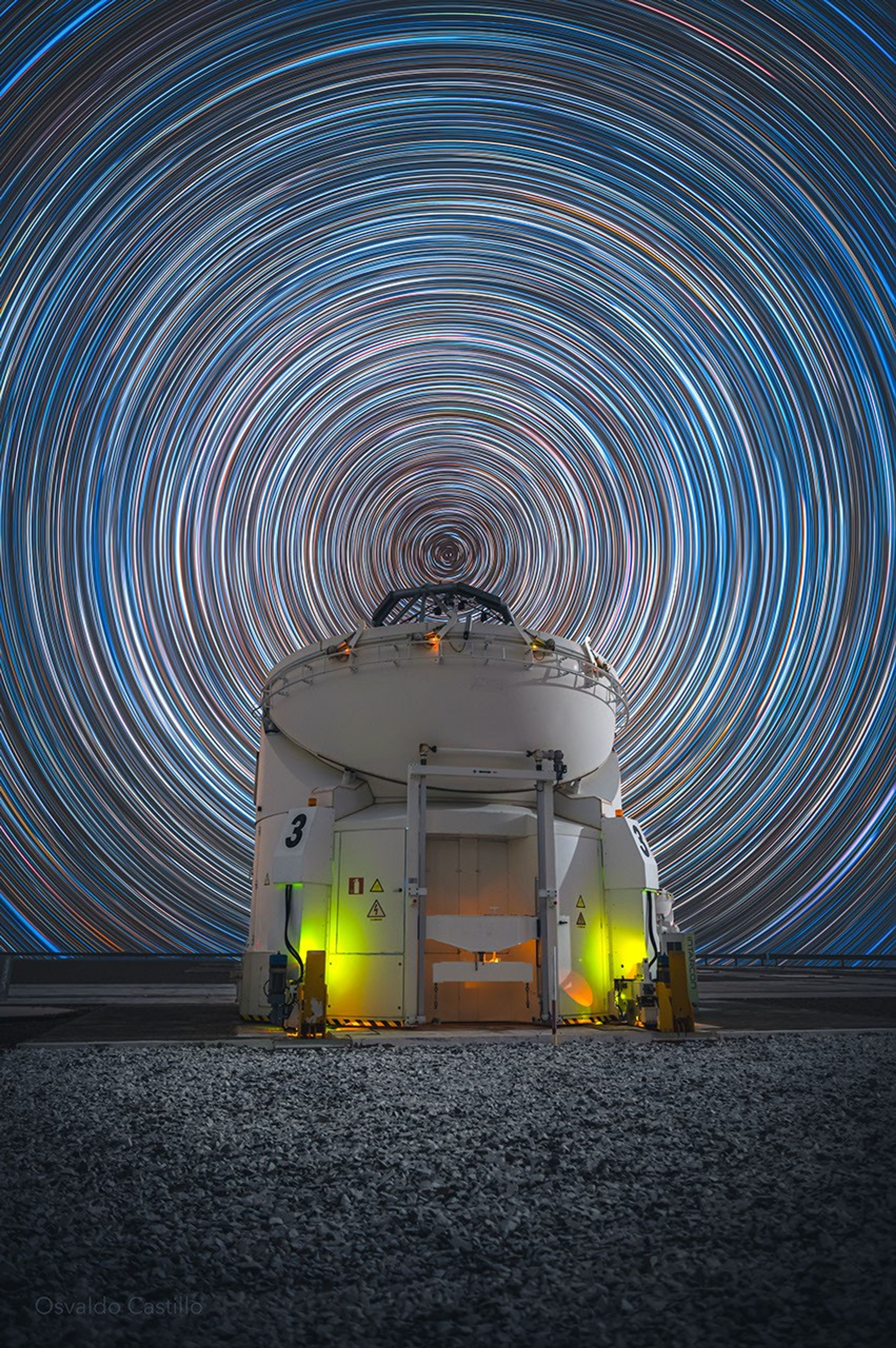
Explanation: At the latitude of ESO’s Paranal Observatory in Chile, about 25 degrees south, Earth’s rotation moves the planet’s surface eastward at over 1,500 kilometers per hour. And while that’s faster than the speed of sound at sea level, the motion is imperceptible. Still, that motion can be revealed in the apparent rotation of the night sky by photographing star trails. This star trail image was composed from a digital stack of 300 consecutive 25-second exposures made with a camera fixed to a tripod to trace the star trail arcs. The graceful arcs are concentric and centered at the south celestial pole, the southern hemisphere extension of Earth’s axis of rotation into space. One of the observatory’s operating 1.8 meter auxiliary telescopes, AT 3, appears beneath the south celestial pole, faintly illuminated in the foreground of this well-planned scene from a rotating planet.
APOD’s main NASA site is moving: From apod.nasa.gov to science.nasa.gov/apod
Tomorrow’s picture: pixels in space
Date August 28, 2026 Credit & Copyright: Osvaldo Castillo Authors & editors: Jerry Bonnell, Cecilia Chirenti, Robert Nemiroff, Keighley Rockcliffe A service of: ASD at NASA / GSFC,NASA Science Activation & Michigan Tech. U.
Random APOD Generator
Yesterday’s Image APOD: 2026 August 27 – Colorful Aurora over an Icelandic Waterfall
Tomorrow’s Image
APOD: 2026 August 28 – The Sky Turns Above Paranal
APOD
Astronomy Picture of the Day
Discover the cosmos! Each day a different image or photograph of our fascinating universe is featured, along with a brief explanation written by a professional astronomer.
The Sky Turns Above ParanalExplanation: At the latitude of ESO’s Paranal Observatory in Chile, about 25 degrees south, Earth’s rotation moves the planet’s surface eastward at over 1,500 kilometers per hour. And while that’s faster than the speed of sound at sea level, the motion is imperceptible. Still, that motion can be revealed in the apparent rotation of the night sky by photographing star trails. This star trail image was composed from a digital stack of 300 consecutive 25-second exposures made with a camera fixed to a tripod to trace the star trail arcs. The graceful arcs are concentric and centered at the south celestial pole, the southern hemisphere extension of Earth’s axis of rotation into space. One of the observatory’s operating 1.8 meter auxiliary telescopes, AT 3, appears beneath the south celestial pole, faintly illuminated in the foreground of this well-planned scene from a rotating planet.
APOD’s main NASA site is moving: From apod.nasa.gov to science.nasa.gov/apod
Tomorrow’s picture: pixels in space
Date August 28, 2026 Credit & Copyright: Osvaldo Castillo Authors & editors: Jerry Bonnell, Cecilia Chirenti, Robert Nemiroff, Keighley Rockcliffe A service of: ASD at NASA / GSFC,NASA Science Activation & Michigan Tech. U.
Random APOD Generator
Yesterday’s Image APOD: 2026 August 27 – Colorful Aurora over an Icelandic Waterfall
Tomorrow’s Image
The Forested Floodplains of Congaree National Park
- Earth
- Earth Observatory
- Image of the Day
- EO Explorer
- Topics
- More Content
- About
The Forested Floodplains of Congaree National Park
- Earth
- Earth Observatory
- Image of the Day
- EO Explorer
- Topics
- More Content
- About
Astronaut Microbes Might Survive at Moon's Pole, NASA Warns
One of the primary objectives of space exploration that often gets overlooked is the intense effort that goes into ensuring Earth microbes don’t contaminate planetary objects, also called forward contamination. This is done to prevent contaminating any potential life that might be present could get killed off my Earth microbes and scientists don’t want to make false discoveries. While space radiation and extreme temperatures often kill off any pesky microbes that hitch a ride on spacecraft, there remains a longstanding knowledge gap regarding whether microbes could survive the lunar polar regions due to its deep craters and varying topography.
Some Comets are Naked, and One Just Got Caught Photo-Bombing
Japanese researchers got lucky when a comet they wanted to study was found photo-bombing archival images from Japan's Subaru Telescope. The Subaru, with its 8.2 meter mirror, happened to image comet 28P/Neujmin from just the right angle to accurately characterize its surface. Their work is part of the ongoing effort to understand comets and asteroids, why some of them share properties, and what that means for their formation and evolution as Solar System objects.
Why Astronauts' Lower Eyelids "Let Go" in Space
A new study identifies possible mechanisms behind changes in astronauts' lower eyelids, a symptom associated with long periods in space that can affect their eyesight.
James Webb Space Telescope observes 72 stars and finds planet formation is a race against time
Using the James Webb Space Telescope (JWST), astronomers have studied 72 young, sun-like stars. As a result, they found that forming planets is a real race against time.
This is because the material that serves as the building blocks for planets is constantly escaping the swirling platters of gas and dust, or protoplanetary disks, that wrap around infant stars. Some types of planets may find their formation window closing sooner than others.
The team's research represents the most in-depth investigation yet into how matter escapes these protoplanetary disks and how this escape gives rise to different stages of planet formation around sun-like stars. All in all, the study helps paint a better picture of how and why our solar system took the shape it did around the infant sun around 4.6 billion years ago.
"Gas giants like Jupiter must assemble their massive atmospheres while the disk is still substantial enough to supply them, before winds and jets carry that raw material away into space," team leader Naman Bajaj from the University of Arizona said in a statement.
An ill wind blows around infant starsThe team conducted its research using data collected by the JWST’s Mid-Infrared Instrument (MIRI). The scientists tracked matter loss by following the movements of molecular hydrogen, one of the most common molecules in protoplanetary disks. Each of the stars involved in the investigation represented a different stage in the early life of a star system. That meant putting these snapshots together allowed the researchers to create a "movie" detailing the early life of a planetary system.
One of the most important findings of this approach is the mechanisms for material loss from protoplanetary disks seem to evolve and switch dominance as an infant star ages.
This is important because gas giants like Jupiter and Saturn have vast atmospheres. They thus require more raw material to form than smaller rocky worlds like Earth do. Understanding matter loss allows scientists to determine at what stages of protoplanetary disk evolution gas giants can form.
"What is exciting about this study is that we can now see, across a large sample of young systems, how the mechanisms that remove gas from planet-forming disks change with time," team member Uma Gorti from the SETI Institute said in the statement. "Disk dispersal sets a fundamental clock for planet formation: once the gas is gone, the opportunity to build gas-rich planets is essentially over."
An illustration of an evolved protoplanetary disk in which material close to the infant star has been dispersed (Image credit: NASA/ JPL-Caltech/ T. Pyle (SSC))The researchers found that early in the evolution of protoplanetary disks, powerful, magnetically driven jets and winds dominate mass loss. These jets and winds are powered by magnetic fields that weave through protoplanetary disks.
Later, as the disk thins and starlight can pass through it more easily, these winds and jets weaken, and magnetic processes are dominated by high-energy radiation from the infant star ionizing gas and blowing it into space. The latter process is called photoevaporation.
All this reveals there is no one single process responsible for stripping planet-forming material from around infant stars. The research also demonstrates the JWST is more than capable of studying the dispersal of gas and dust around individual infant stars.
The next step for the team is to discover just how much material these different mechanisms shift. The scientists could also look into the areas of the disks in which the mechanisms studied operate. Down the line, this will help develop a model to reveal just how rapidly planet-formation is shut off — and in which regions of a protoplanetary disk different types of planets are most likely to form.
The team's research was published on Tuesday (August 25) in The Astronomical Journal.
MTG-I2 completes Europe’s latest weather trio
The second Meteosat Third Generation Imager satellite (MTG-I2) has been launched on board Ariane 6, flight VA270, from Europe’s Spaceport in French Guiana. It will complete the first family of MTG satellites, delivering data for weather forecasting over Europe and northern Africa with unprecedented quality, quantity and frequency.
Theory-Defying Exoplanet Atmospheres Force a Rethink of Theories
The discovery of lava worlds with atmospheres is challenging our theories of how atmospheres escape, and calling into question the idea of the cosmic shoreline. Stanford researchers have developed a model that explains how lava-covered worlds close to their stars can retain their atmospheres. The new theory could inform the search for life beyond our Solar System.
Astronaut Jonny Kim leaves NASA, will return to active military duty
Jonny Kim is leaving NASA to continue his military career.
The 42-year-old astronaut, who has one of the most jaw-dropping resumes of any person alive, is departing today (Aug. 27) after nine years with the agency. He has one mission under his belt, a long-duration flight to the International Space Station (ISS).
"Jonny has been an integral part of the agency, and his immeasurable impact will be felt for generations to come," Vanessa Wyche, director of NASA's Johnson Space Center (JSC) in Houston, said in a statement today. "From advancing groundbreaking science to inspiring the next generation, Jonny has been an incredible source of inspiration to our nation. His exceptional talent, determination, and grit will leave a lasting legacy at NASA."
NASA picked Kim as part of its 2017 astronaut class, the 22nd in the agency's history. He and his 11 fellow selectees nicknamed themselves "The Turtles."
Kim was already incredibly accomplished before he got the NASA nod. He's a physician with a medical degree from Harvard. He served in the U.S. military, as a dual-designated naval aviator and flight surgeon as well as a Navy SEAL — a commando trained to conduct special operations on sea, air and land (hence the acronymic name).
"Over the course of more than 100 combat operations, he served as a medic, sniper, navigator and point man, earning the Silver Star, Bronze Star with Combat 'V,' and numerous additional commendations," NASA officials said in the same statement.
After completing his mandatory two years of NASA astronaut training, Kim served as a CAPCOM ("capsule communicator") at JSC, relaying information between Mission Control and crewmembers on the ISS.
"Kim also contributed to Artemis program development through his work in the astronaut exploration branch, leading the astronaut crew operations branch, and serving as increment lead for Expedition 65," NASA officials said in the same statement. "His experiences as a Navy SEAL, physician and naval aviator provided unique perspectives in mission operations and crew support."
In April 2025, Kim got the chance to go to space himself. He launched to the ISS aboard a Russian Soyuz spacecraft along with Russian cosmonauts Sergey Ryzhikov and Alexey Zubritsky.
The trio lived and worked in space for 245 days, circling Earth 3,920 times and traveling a total of nearly 104 million miles (167 million kilometers), according to NASA. During that time, Kim conducted a variety of scientific experiments that could advance technological development and aid space exploration down the road.
Kim, Ryzhikov and Zubritsky returned to Earth in December, touching down in their Soyuz on the steppe of Kazakhstan .
Kim isn't walking off into the sunset now. Far from it: He's going back to active duty, "to finish out the remainder of his military career within naval aviation training," according to NASA.
"Contributing to space exploration and serving NASA has been the honor of a lifetime," Kim said in the same NASA statement.
"Throughout my career, I’ve learned that beyond the missions, the training, and the hardware, success always comes down to the people," he added. "They are our greatest asset, and leading with love and empathy is how we achieve the impossible. I look forward to carrying my commitment to service, my enduring love for space and technology, and the hard-earned lessons of this past decade into my next chapter to make a meaningful impact on humanity’s future."
Kim isn't the only astronaut to hang up his spacesuit in 2026. NASA's Mike Fincke stepped away this year, as did Canadian Jeremy Hansen, who was one of the four crewmembers on NASA's Artemis II flight around the moon.
Tropical Storm Dolly forms in the Atlantic
It’s a weird meteorological coincidence on the heels of Dolly Parton’s death
NASA Invites Media to Turkey Artemis Accords Signing Ceremony

Turkey will sign the Artemis Accords during a ceremony at 2:30 p.m. EDT Monday, Aug. 31, at NASA Headquarters in Washington, becoming the 71st country signatory.
NASA Administrator Jared Isaacman will host Turkish Minister of Industry and Technology Mehmet Fatih Kacır for the ceremony, together with U.S. Department of State officials.
This event is in person only. Media interested in attending must RSVP no later than 11 a.m. on Aug. 31, to: hq-media@mail.nasa.gov. NASA’s media accreditation policy is online.
In 2020, during the first Trump Administration, the United States, led by NASA and the State Department, joined with seven other founding nations to establish the Artemis Accords, responding to the growing interest in lunar activities by both governments and private companies.
The Artemis Accords introduced the first set of practical principles aimed at enhancing the safety, transparency, and coordination of civil space exploration on the Moon, Mars, and beyond.
Learn more about the Artemis Accords at:
https://www.nasa.gov/artemis-accords
-end-
Camille Gallo / Elizabeth Shaw
Headquarters, Washington
202-358-1600
camille.m.gallo@nasa.gov / elizabeth.a.shaw@nasa.gov
NASA Invites Media to Turkey Artemis Accords Signing Ceremony
Turkey will sign the Artemis Accords during a ceremony at 2:30 p.m. EDT Monday, Aug. 31, at NASA Headquarters in Washington, becoming the 71st country signatory.
NASA Administrator Jared Isaacman will host Turkish Minister of Industry and Technology Mehmet Fatih Kacır for the ceremony, together with U.S. Department of State officials.
This event is in person only. Media interested in attending must RSVP no later than 11 a.m. on Aug. 31, to: hq-media@mail.nasa.gov. NASA’s media accreditation policy is online.
In 2020, during the first Trump Administration, the United States, led by NASA and the State Department, joined with seven other founding nations to establish the Artemis Accords, responding to the growing interest in lunar activities by both governments and private companies.
The Artemis Accords introduced the first set of practical principles aimed at enhancing the safety, transparency, and coordination of civil space exploration on the Moon, Mars, and beyond.
Learn more about the Artemis Accords at:
https://www.nasa.gov/artemis-accords
-end-
Camille Gallo / Elizabeth Shaw
Headquarters, Washington
202-358-1600
camille.m.gallo@nasa.gov / elizabeth.a.shaw@nasa.gov
Civil Servants Sworn in at NASA Ames
Civil Servants Sworn in at NASA Ames
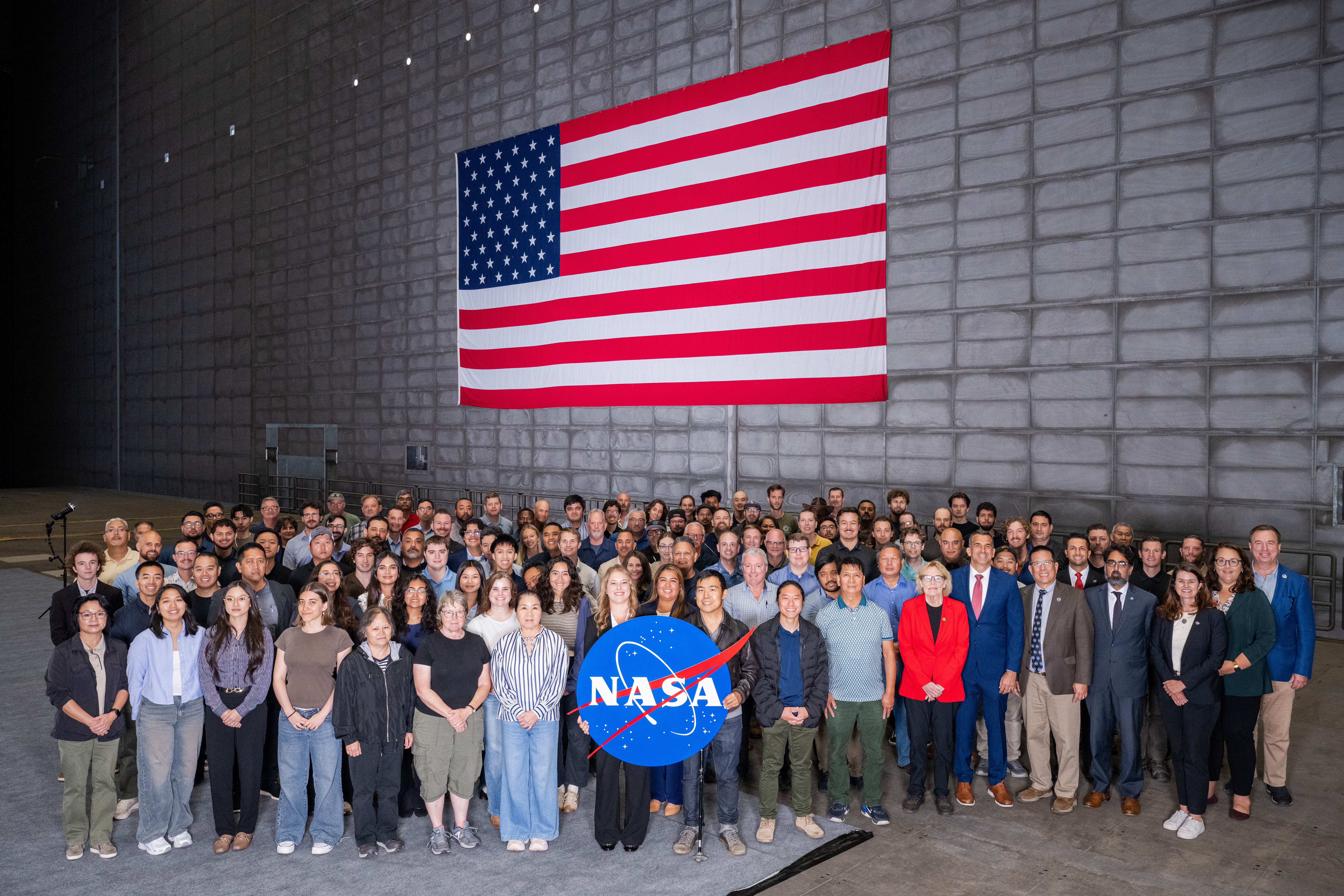
New civil servants and guests pose for a group photo with NASA and center leadership in the National Full-Scale Aerodynamics Complex (NFAC) 80-by-120-foot test section, N221 on Aug. 24, 2026. The civil servants were sworn-in the same day in the largest swearing-in ceremony ever hosted at NASA’s Ames Research Center in California’s Silicon Valley since its inception nearly 87 years ago.
Learn more about wind tunnels at NASA Ames.
Image credit: Brandon Torres Navarrete
Civil Servants Sworn in at NASA Ames
New civil servants and guests pose for a group photo with NASA and center leadership in the National Full-Scale Aerodynamics Complex (NFAC) 80-by-120-foot test section, N221 on Aug. 24, 2026. The civil servants were sworn-in the same day in the largest swearing-in ceremony ever hosted at NASA’s Ames Research Center in California’s Silicon Valley since its inception nearly 87 years ago.
Learn more about wind tunnels at NASA Ames.
Image credit: Brandon Torres Navarrete