
Feed aggregator
Scientists find dead star that predicts our sun's future: 'Broken apart and returned to the galaxy'
Astronomers have watched a dead star, in the guise of the Helix Nebula, being recycled back into the interstellar gas from which it originally came, bringing the story of that star full circle.
Stars can last for millions, or even billions, of years, but they do not last forever. When a sun-like star reaches the end, it blossoms into a beautiful planetary nebula. The Helix Nebula, located 650 light-years away in the constellation of Aquarius, the Water Bearer, is one such example of a planetary nebula.
The Helix's central star has run out of hydrogen needed for nuclear fusion reactions in its core. This caused the core to begin to contract and raised the temperature in the star's outer layers, which ignited fusion reactions there instead. This had the effect of causing the star to bloat into a red giant. Then, eventually, the outer layers of that red giant detached and expanded into space to form the Helix Nebula. Meanwhile, the star's inert core contracted and became a white dwarf.
As the nebula expands, it gradually disperses into the interstellar medium (ISM), feeding the elements formed within the star back into interstellar gas clouds. These clouds will eventually produce the next generation of stars. However, astronomers had never actually seen the point at which a dead star's remains are absorbed into the ISM — until now.
"We are seeing material shed near the end of a star's life being broken apart and returned to the galaxy," said Yale University's Pieter van Dokkum, who led the study, in a statement. "That hand-off — from recognizable stellar debris to the diffuse gas between the stars — has been very difficult to observe."
Van Dokkum's team were not actually looking for this. Instead, they were conducting routine calibration of a new astronomical instrument called MOTHRA, the Modular Optical Telephoto Hyperspectral Robotic Array at the El Sauce Observatory in Chile. When complete, MOTHRA will be armed with 1,140 telephoto lenses that will scrutinize the night sky while looking for traces of faint gas in the Milky Way galaxy.
Astronomical instruments require calibration before use, and this is accomplished by targeting a familiar object in the sky and tuning the instruments to how that object should appear. The MOTHRA team used the Helix Nebula to calibrate the telephoto lenses that they currently have operational, and that was when they found something unexpected.
(Left) The Helix Nebula as seen by the Visible and Infrared Telescope for Astronomy. (Right) The smaller field of view from the JWST’s NIRCam (right). (Image credit: NASA, ESA, CSA, STScI, A. Pagan (STScI))"We thought we were taking a calibration image of one of the best-known nebulas in the sky," Roberto Abraham of the University of Toronto said in the statement. "Instead, we found this extraordinary network of bow-shaped structures. It was immediately clear that the faint outer Helix was telling us a story that had largely been missed."
The Helix Nebula appears donut-shaped and has been imaged countless times before by both professional observatories such as the Hubble Space Telescope and James Webb Space Telescope, and by amateur astronomers whose long exposures can reveal an outer halo of gas around the nebula's bright ring. To give an idea of scale, the outer edge of the bright ring is 5.7 light-years across, and the outer halo exists beyond even this.
The team discovered 22 complete or partial arc-shaped clumps of gas in the outer halo. They are called bow shocks and they arise from the motion of something pressing into another medium, in this case clumps of gas that have expanded out from the planetary nebula running into and plowing through the ISM. It is similar to the bow-shaped waves that ride ahead of the prow of a boat in water.
"The shocks change dramatically with distance from the central star," Imad Pasha of Dragonfly Focused Research Organisation, said in the statement.. "Those nearer the center are large, thin and sharply defined. Further out, they become smaller, fuzzier and increasingly fragmented."
This implies a progression, and that the deeper into the ISM the clumps of the star's ejected material press, the more they become eroded and dispersed back into the interstellar gas. The team estimate that material from the planetary nebula can survive for about 10,000 years after encountering the ISM before they are completely shredded and absorbed back into it.
Stars are born from the molecular gas clouds that lie in interstellar space, and these clouds are enriched with the elements produced by fusion reactions within previous generations of stars. Now, thanks to MOTHRA's observations of the Helix Nebula, we have seen these elements being gifted to the Milky Way at large, and in millions or billions of years they will contribute to a new generation of stars, planets and possibly life.
Our own solar system, and Earth along with it, were formed 4.6 billion years ago from elements produced by dead stars. In another five billion years' time, our sun will also exhaust its supply of hydrogen and its fusion reactions will cease, causing it to unfurl into its own planetary nebula.
"Far in the future the sun will go through a similar process and its material will enter the same cycle," says van Dokkum.
All the elements and molecules that make up you and everything around you will be given back to the Milky Way, and one day it will be reborn again and begin the story of a new star system. What will that story bring, we wonder?
The findings from the Helix Nebula were published on Aug. 12 in the journal Nature.
How Hurricane Lala was juiced by El Niño
El Niño years typically mean warmer ocean temperatures and less wind shear in some parts of the Pacific—and that means more potential for hurricanes
Next Generation of Planetary Scientists Learn Public Engagement Skills
3 min read
Next Generation of Planetary Scientists Learn Public Engagement Skills Group photo of undergraduate research interns and FORCE leaders standing together beside the high-pressure laboratory equipment.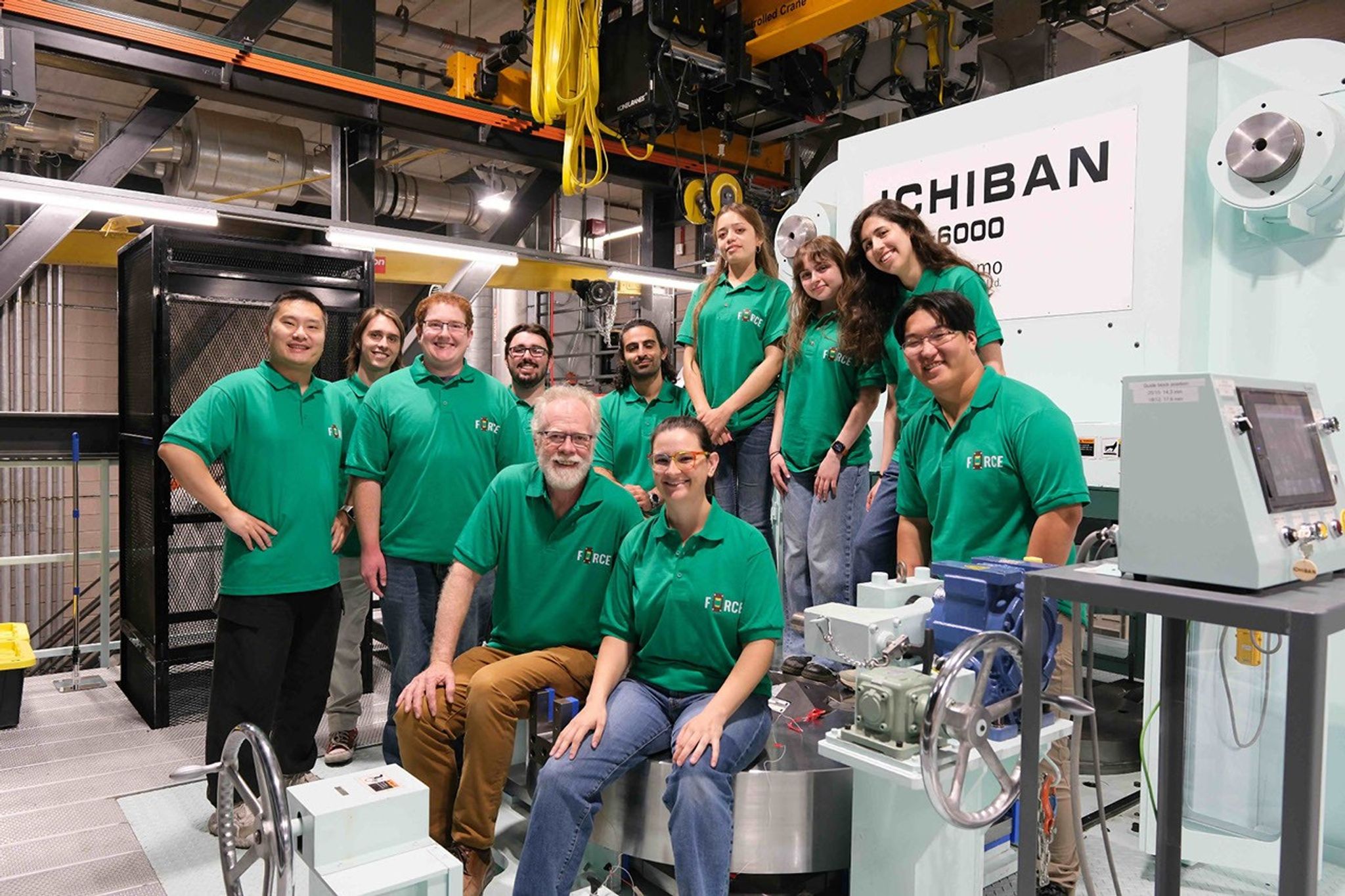
The NASA Science Mission Directorate (SMD) Community of Practice for Education (SCoPE) – part of the NASA Science Activation (SciAct) Program portfolio – enables Earth and Space Science and Engineering Subject Matter Experts (SMEs) – especially NASA-funded SMEs – to efficiently and effectively share their science with support from SciAct education experts.
In Summer 2026, NASA SCoPE partnered with Arizona State University’s Facility for Open Research in a Compressed Environment (FORCE) Summer School to help seven undergraduate student interns build the science communication skills needed to share their research with a variety of audiences. FORCE is a world-class laboratory that uses high-pressure experimental equipment to recreate the extreme conditions found deep within Earth and other planetary bodies, enabling researchers to better understand how planets form, evolve, and behave under immense pressures.
As part of the Summer School, SCoPE facilitated two hands-on workshops on June 25 and 26, followed by office hours the following week, to help interns translate their technical research into compelling stories for non-expert audiences. The training focused on identifying the central themes of their work, developing clear and engaging messages, planning effective visitor interactions, and thinking through the logistics of public engagement. Interns also received guidance on preparing both their research posters and individual outreach stations.
The training culminated in two complementary outreach experiences. The first was the FORCE Open House, which welcomed approximately 50 members of the general public for an inside look at the laboratory. Visitors toured the facility, met the research team, explored the specialized equipment used to simulate the interiors of Earth and other planets, and interacted with interns at themed outreach stations designed to explain the science behind the experiments in accessible, engaging ways.
At the second event, a poster session for ASU faculty, staff, and students, the interns presented their research, providing an opportunity to discuss their scientific findings with members of the university community and receive feedback on their presentations.
By integrating science communication training into the Summer School experience, NASA SCoPE helped equip emerging planetary scientists with practical skills for engaging both scientific peers and public audiences. The poster session and Open House demonstrated how thoughtful communication training can strengthen researchers’ confidence while building stronger connections between cutting-edge planetary science and the communities it serves.
NASA SCoPE is supported by NASA cooperative agreement award number 80NSSC21M0006 and helps enrich and enhance the impact of the NASA Science Activation Program portfolio, which connects learners with authentic NASA science experiences through partnerships with educators and community organizations.
Certain kinds of clouds are misbehaving – appearing more often and lower in the sky…
Article 3 days ago 3 min read Quality Assessment Report Evaluates Polar Geospatial Center EarthDEM Elevation ProductsCSDA’s assessment reports help inform the user community about the quality of commercial Digital Elevation…
Article 5 days ago 5 min read NASA Completes Astronaut-Deployed Science Instrument for Lunar Surface Article 6 days ago Keep Exploring Discover More Topics From NASA James Webb Space TelescopeWebb is the premier observatory of the next decade, serving thousands of astronomers worldwide. It studies every phase in the…
Perseverance RoverThis rover and its aerial sidekick were assigned to study the geology of Mars and seek signs of ancient microbial…
Parker Solar ProbeOn a mission to “touch the Sun,” NASA’s Parker Solar Probe became the first spacecraft to fly through the corona…
JunoNASA’s Juno spacecraft entered orbit around Jupiter in 2016, the first explorer to peer below the planet’s dense clouds to…
Next Generation of Planetary Scientists Learn Public Engagement Skills
3 min read
Next Generation of Planetary Scientists Learn Public Engagement Skills Group photo of undergraduate research interns and FORCE leaders standing together beside the high-pressure laboratory equipment.The NASA Science Mission Directorate (SMD) Community of Practice for Education (SCoPE) – part of the NASA Science Activation (SciAct) Program portfolio – enables Earth and Space Science and Engineering Subject Matter Experts (SMEs) – especially NASA-funded SMEs – to efficiently and effectively share their science with support from SciAct education experts.
In Summer 2026, NASA SCoPE partnered with Arizona State University’s Facility for Open Research in a Compressed Environment (FORCE) Summer School to help seven undergraduate student interns build the science communication skills needed to share their research with a variety of audiences. FORCE is a world-class laboratory that uses high-pressure experimental equipment to recreate the extreme conditions found deep within Earth and other planetary bodies, enabling researchers to better understand how planets form, evolve, and behave under immense pressures.
As part of the Summer School, SCoPE facilitated two hands-on workshops on June 25 and 26, followed by office hours the following week, to help interns translate their technical research into compelling stories for non-expert audiences. The training focused on identifying the central themes of their work, developing clear and engaging messages, planning effective visitor interactions, and thinking through the logistics of public engagement. Interns also received guidance on preparing both their research posters and individual outreach stations.
The training culminated in two complementary outreach experiences. The first was the FORCE Open House, which welcomed approximately 50 members of the general public for an inside look at the laboratory. Visitors toured the facility, met the research team, explored the specialized equipment used to simulate the interiors of Earth and other planets, and interacted with interns at themed outreach stations designed to explain the science behind the experiments in accessible, engaging ways.
At the second event, a poster session for ASU faculty, staff, and students, the interns presented their research, providing an opportunity to discuss their scientific findings with members of the university community and receive feedback on their presentations.
By integrating science communication training into the Summer School experience, NASA SCoPE helped equip emerging planetary scientists with practical skills for engaging both scientific peers and public audiences. The poster session and Open House demonstrated how thoughtful communication training can strengthen researchers’ confidence while building stronger connections between cutting-edge planetary science and the communities it serves.
NASA SCoPE is supported by NASA cooperative agreement award number 80NSSC21M0006 and helps enrich and enhance the impact of the NASA Science Activation Program portfolio, which connects learners with authentic NASA science experiences through partnerships with educators and community organizations.
Certain kinds of clouds are misbehaving – appearing more often and lower in the sky…
Article
3 days ago
3 min read Quality Assessment Report Evaluates Polar Geospatial Center EarthDEM Elevation Products
CSDA’s assessment reports help inform the user community about the quality of commercial Digital Elevation…
Article
5 days ago
5 min read NASA Completes Astronaut-Deployed Science Instrument for Lunar Surface
Article
6 days ago
Keep Exploring Discover More Topics From NASA James Webb Space Telescope
Webb is the premier observatory of the next decade, serving thousands of astronomers worldwide. It studies every phase in the…
Perseverance Rover
This rover and its aerial sidekick were assigned to study the geology of Mars and seek signs of ancient microbial…
Parker Solar Probe
On a mission to “touch the Sun,” NASA’s Parker Solar Probe became the first spacecraft to fly through the corona…
Juno
NASA’s Juno spacecraft entered orbit around Jupiter in 2016, the first explorer to peer below the planet’s dense clouds to…
Nuking An Asteroid on Short Notice Could Save Us
Readers of a certain age will remember a golden area of asteroid films, capstoned by two with very different endings. Deep Impact engrained the devastating consequences of letting a large piece of rock hit our planet, whereas Armageddon, though arguably the more kitschy of the two films, was an uplifting story about technical ingenuity and sacrifice. And now, the central crux of that movie’s storyline - essentially blasting an asteroid with a nuclear detonation - is taking center stage as our last line of defense against a potential Deep Impact scenario. A new paper from researchers at the China Academy of Launch Vehicle Technology, and published in Space: Science & Technology, describes two potential scenarios examining how we might actually be able to nuke a space rock - and whether it would actually save us.
Colorful Collage of Tarantula Nebula
Colorful Collage of Tarantula Nebula
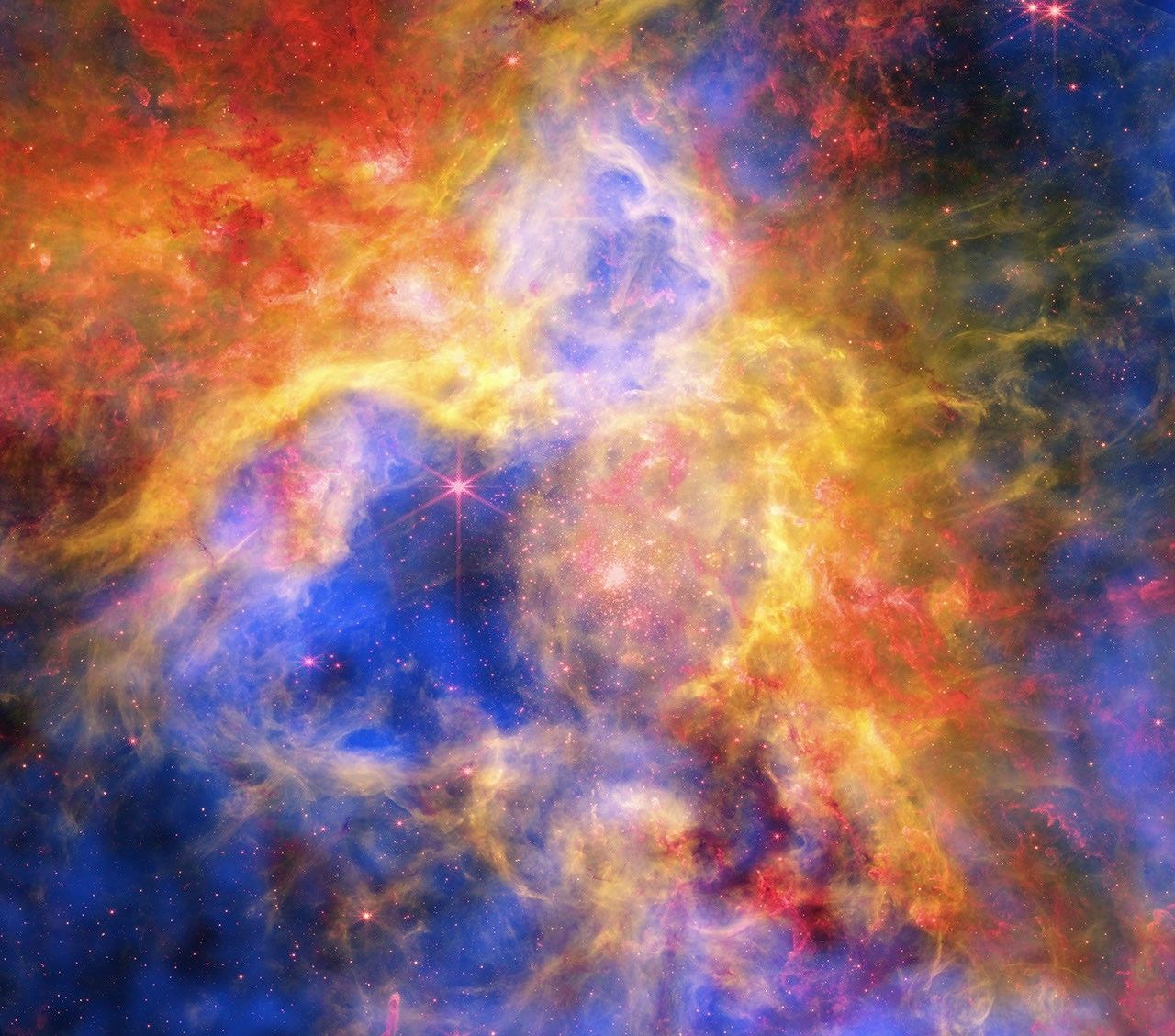
Data from NASA’s Chandra X-ray Observatory, NASA’s James Webb Space Telescope, and NASA’s Hubble Space Telescope combine to reveal a vibrant view of 30 Doradus, or the Tarantula Nebula, in this Aug. 11, 2026, image. Located in the Large Magellanic Cloud, a small neighbor galaxy to the Milky Way about 160,000 light-years from Earth, the Tarantula has thousands of young stars embedded in a vibrant honeycomb-like structure of gas and dust.
By studying the data from Chandra, Hubble, and Webb, combined with data from the agency’s retired Spitzer Space Telescope, astronomers determined that the Tarantula may be losing energy from several sources, including hot gas escaping from the nebula.
Image credit: X-ray: NASA/CXC/Ohio State Univ./J. Rodriguez et al; Infrared: NASA/ESA/CSA/STScI; Optical: NASA/ESA/STScI; Image Processing: NASA/CXC/SAO/P. Edmonds
Colorful Collage of Tarantula Nebula
Data from NASA’s Chandra X-ray Observatory, NASA’s James Webb Space Telescope, and NASA’s Hubble Space Telescope combine to reveal a vibrant view of 30 Doradus, or the Tarantula Nebula, in this Aug. 11, 2026, image. Located in the Large Magellanic Cloud, a small neighbor galaxy to the Milky Way about 160,000 light-years from Earth, the Tarantula has thousands of young stars embedded in a vibrant honeycomb-like structure of gas and dust.
By studying the data from Chandra, Hubble, and Webb, combined with data from the agency’s retired Spitzer Space Telescope, astronomers determined that the Tarantula may be losing energy from several sources, including hot gas escaping from the nebula.
Image credit: X-ray: NASA/CXC/Ohio State Univ./J. Rodriguez et al; Infrared: NASA/ESA/CSA/STScI; Optical: NASA/ESA/STScI; Image Processing: NASA/CXC/SAO/P. Edmonds
How climate change created a new ‘Ice Silk Road’ in the Arctic
China plans to send container ships along Russia’s northern coast, reviving environmental concerns about the fragile polar region
The 1st 'Star Wars: Ahsoka' season 2 trailer finally gives us a release date (video)
After a solid but often unfocused debut in 2023, Ahsoka season 2 has finally kicked off its marketing campaign with a stellar first trailer that promises higher stakes and a much bigger scale when it premieres on Disney Plus early next year.
As part of the D23 2026 celebrations, Disney and Lucasfilm shared a first look at the long-in-the-works second season of the live-action show – set between Return of the Jedi and The Force Awakens – on August 15. Moreover, we now have a premiere date: January 20, 2027.
"Are you a Jedi... or not?" asks Anakin Skywalker, a prominent figure in the action-packed teaser trailer, after briefly appearing in Season 1 with a subtler role.
(Image credit: Disney / Lucasfilm)It's clear Lucasfilm and fans of the prequels wanted to see more of Hayden Christensen as the Chosen One, and series creator, director, and writer Dave Filoni — now also president and CCO at the studio — plans on delivering exactly that through both flashbacks (Who is that Jedi with a new saber design?!) and Force ghost moments.
But that's only the tip of the iceberg, as the first look at Ahsoka season 2 also has huge space battles worthy of the big screen, Imperial villain Grand Admiral Thrawn (Lars Mikkelsen) threatening the New Republic – which he refuses to acknowledge as more than Rebels – Ezra Bridger (Eman Esfandi) taking the fight to Dathomir, and Ahsoka Tano (Rosario Dawson) and Sabine Wren (Natasha Liu Bordizzo) trying to find a way back to the main galaxy.
Meanwhile, the fallen Jedi Baylan Skoll (Rory McCann) wants to uncover a lost power that could change everything. If you know, you know. Alongside the first trailer, Disney and Lucasfilm also shared a first poster with a striking visual style:
(Image credit: Disney / Lucasfilm)Of course, almost none of this will make sense if you haven't watched The Clone Wars and Star Wars Rebels — some of the best Star Wars TV shows around — but it's a trip we recommend embarking on if you enjoy the franchise's more mystical side and have lots of free time.
NASA Challenge Tests Wheel Designs for Moon Base Mobility
As NASA prepares to establish the Moon Base, advancing surface mobility will be key to helping crews and robotic systems travel farther across the lunar surface.
To help advance that capability, the Rock and Roll with NASA Challenge invited public innovators to design and build next-generation lunar rover wheels.
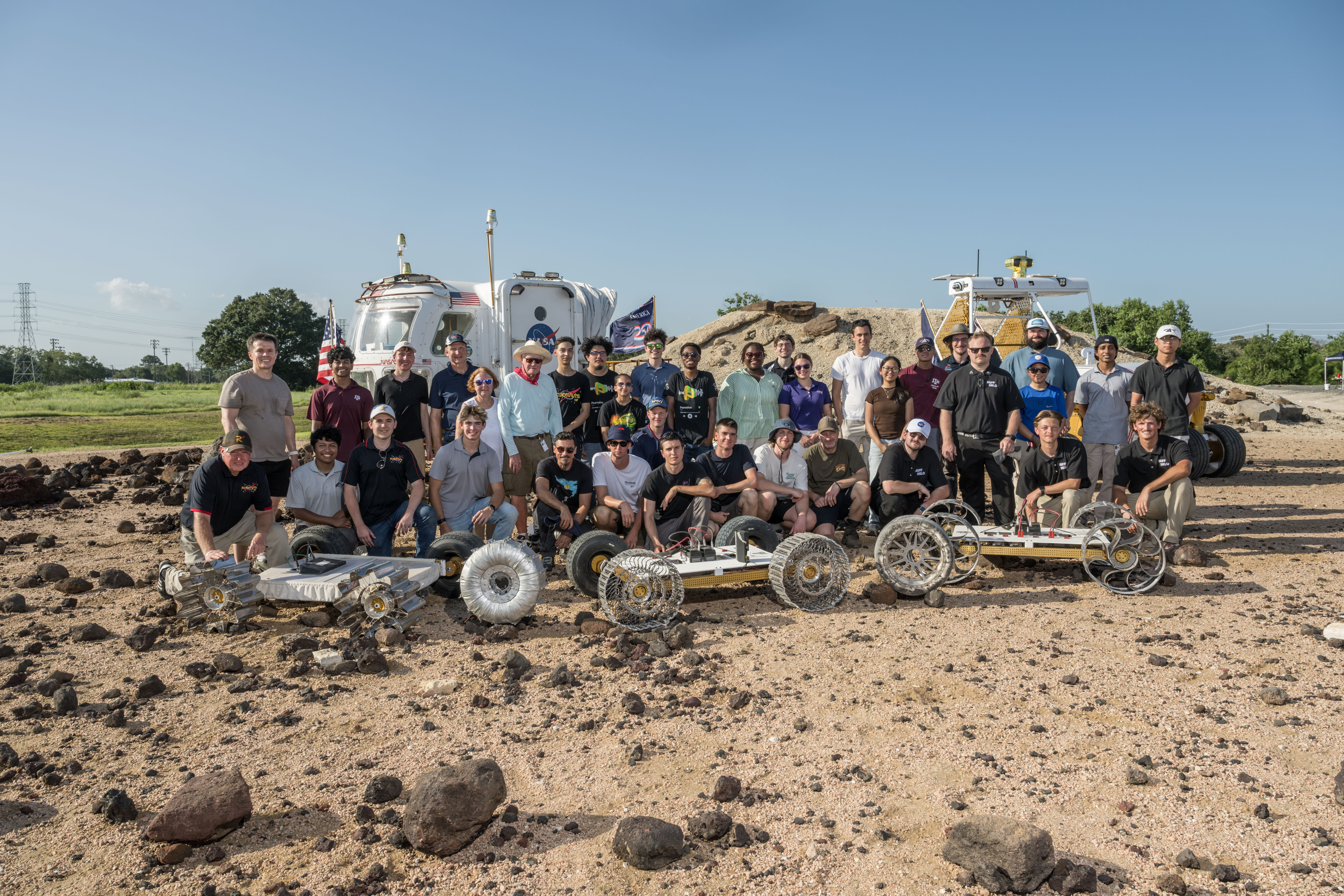
Five teams from 128 submissions and 49 countries advanced to the final phase of the competition, where they tested their prototypes on July 31 at NASA’s Johnson Space Center in Houston.
The Huff Helo lunar wheel prototype is tested at Johnson Space Center’s Rock Yard.NASA/Luna Posadas Nava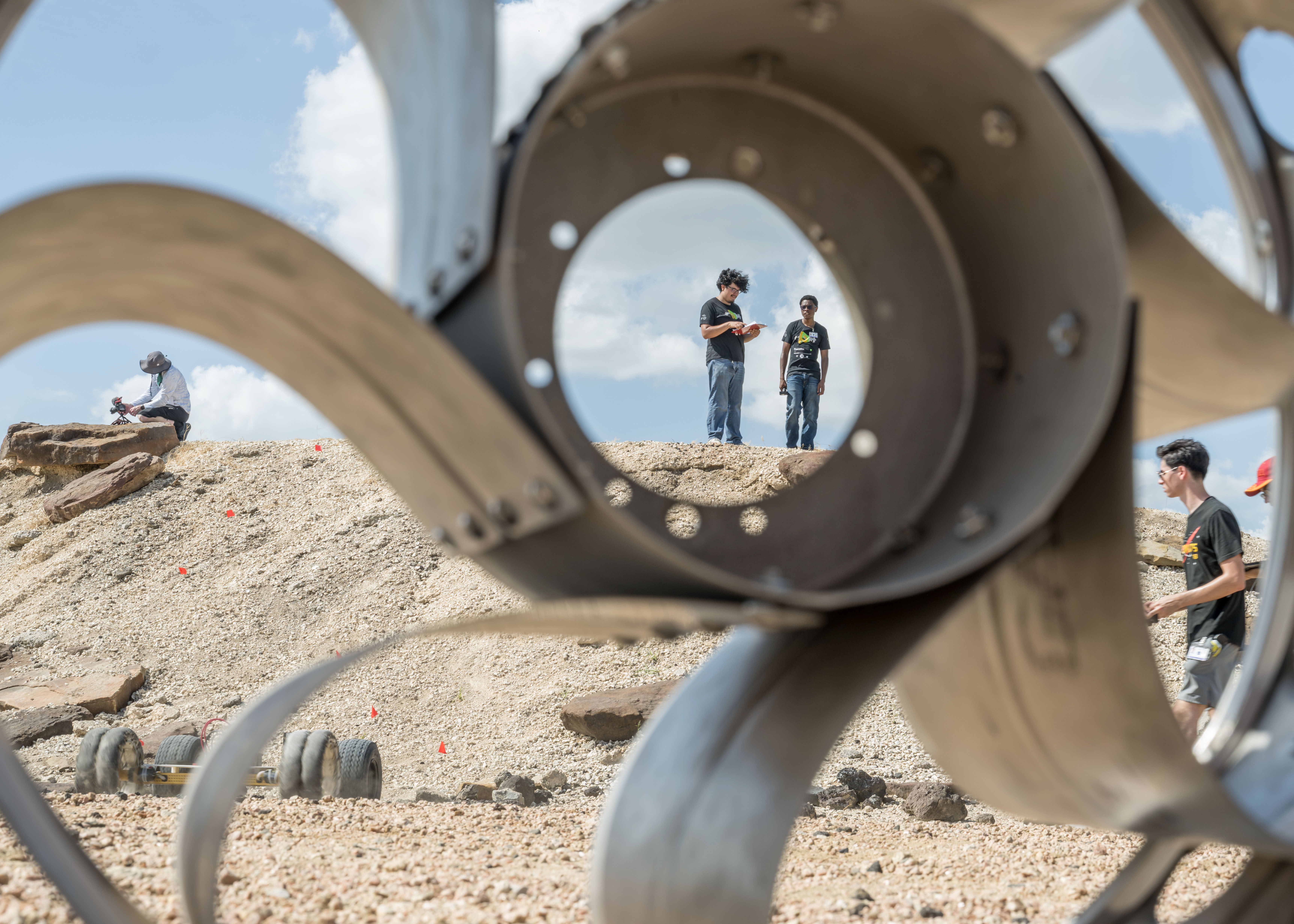
The challenge sought lightweight, durable, and scalable wheels that could support longer-duration lunar surface operations. The designs also needed to be compliant enough to absorb impacts, maintain traction at higher speeds, and withstand the harsh lunar environment.
“Every additional kilometer a rover can reliably travel will expand how far we can explore, what science we can achieve, and what infrastructure we can build,” said Ed Herrera, robotics engineer at Johnson and co-leader of the challenge project.
NASA Johnson uses ground prototypes to test mobility technologies, while lunar terrain vehicles will be delivered to the lunar surface through the Commercial Lunar Payload Services initiative. For the challenge, the wheels were fitted to MicroChariot, a 45-kilogram test rover, and put through a series of courses at Johnson’s Rock Yard to evaluate their performance across different types of terrain.
NASA Robotics Academy students navigate the lunar wheel prototype Scotch Pad Tyres fitted on the MicroChariot rover at Johnson’s Rock Yard.NASA/Luna Posadas Nava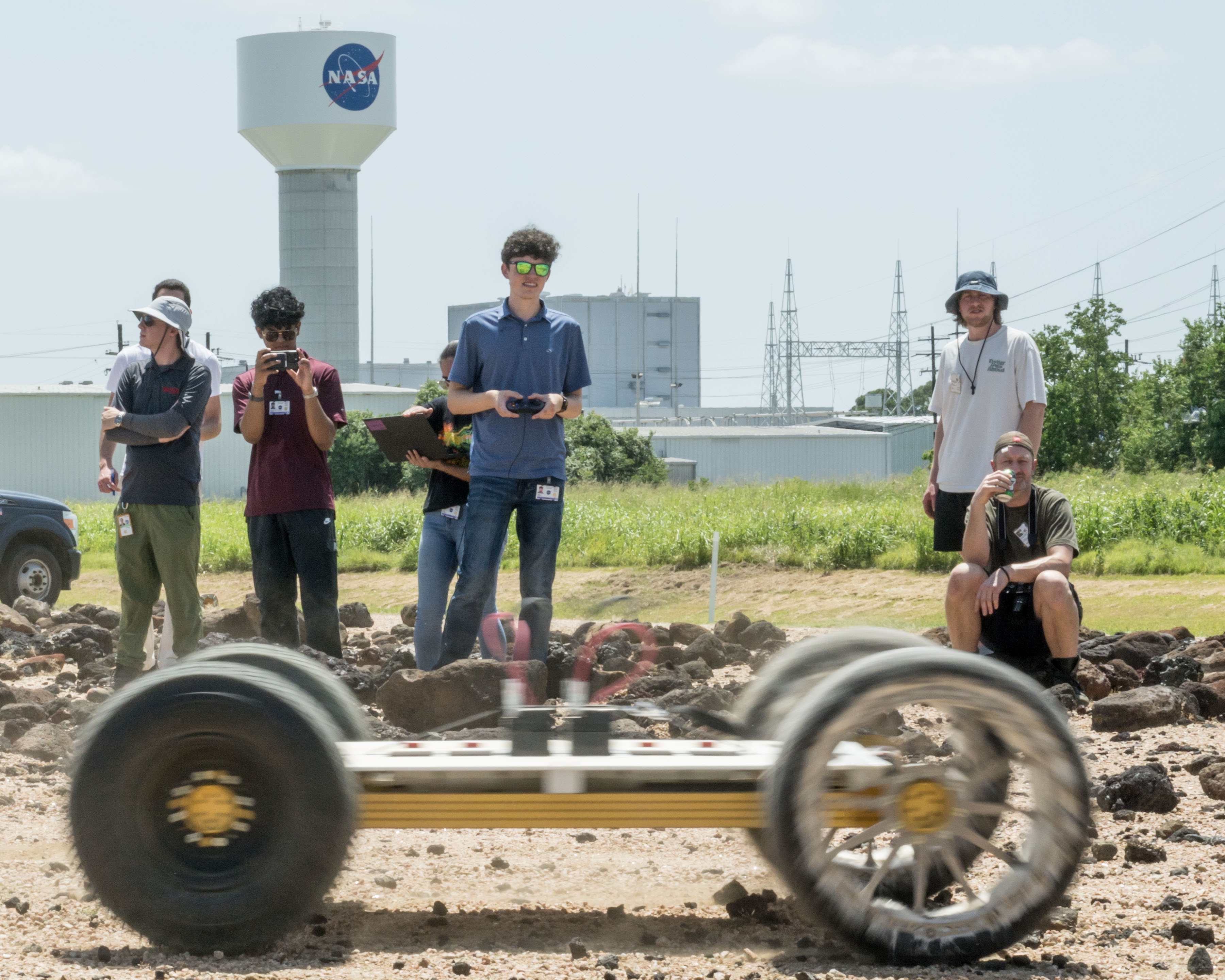
“Crowdsourcing gives us an opportunity to look beyond traditional approaches for lunar wheel design,” Herrera said. “The more wheel technologies we can develop and understand, the more options we have to meet the needs of different vehicles, terrains, and missions on the Moon and Mars.”
Those ideas were reflected in five distinctly different designs.
The HTR Variable Flex Lunar Wheel created by Hellenic Technology of Robotics SA uses an internal system designed to vary the wheel’s stiffness depending on terrain and vehicle needs. The team adapted technology it had been developing for terrestrial wheels for about a decade.
The Hiper Wheel created by Hyperbola uses tensioned cables and a corigated structure that provides spring-like behavior, allowing the wheel to flex without relying on traditional radial spokes.
The Huff Helo Flexible Titanium Wheel created by Huff Helo Inc. uses formed titanium sheet metal as both structure and spring. During testing, the team found that the strength of the design also made the wheel more rigid, causing it to bounce over some obstacles rather than conform to the terrain.
The Payne Aviation Wheel created by Deborah and Craige Payne took inspiration from aviation and history. Its designer, an aircraft mechanic, combined a pneumatic approach with ideas from early automobile tire designs.
The winning Scotch Pad Tyres team poses with their prototype and MicroChariot at Johnson’s Rock Yard. NASA/Luna Posadas Nava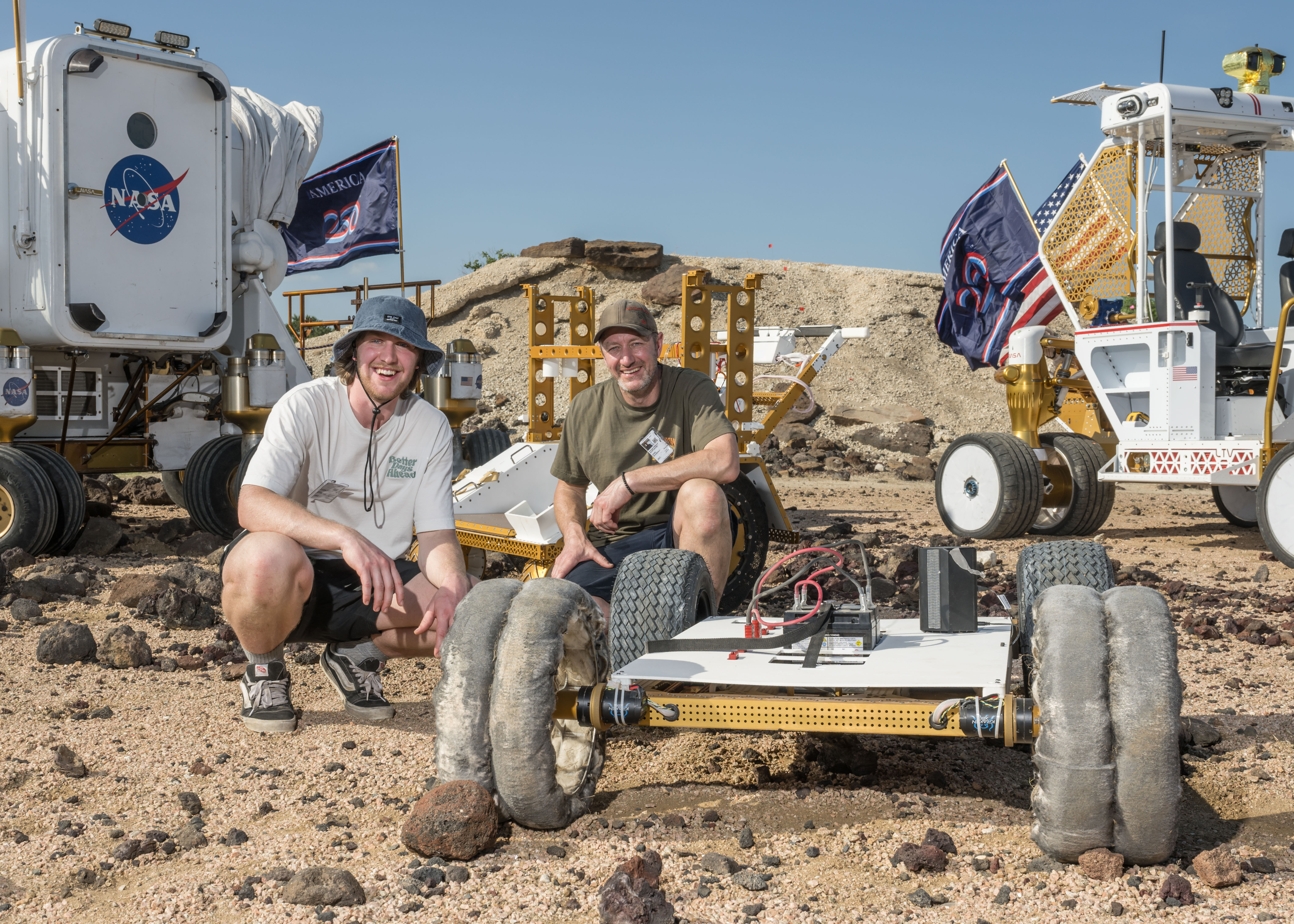
The winning Scotch Pad Tyres concept came from an Australian mechanical engineer Daniel Bloomfield and his son Isaac Bloomfield. Their prototype uses a Nomex-based tire structure supported around an aluminum hub. The soft material allows the tire to deform around terrain, while internal support helps it maintain its shape. A treated outer surface of epoxy and corundum grit was integrated to improve traction.
The Rock Yard testing also demonstrated why different terrains may require different approaches. Loose material can affect traction, while rocks and slopes place different demands on wheels such as vehicle stability.
The HTR Variable Flex Lunar Wheel prototype sits alongside NASA’s Space Exploration Vehicle at Johnson’s Rock Yard. NASA/Luna Posadas Nava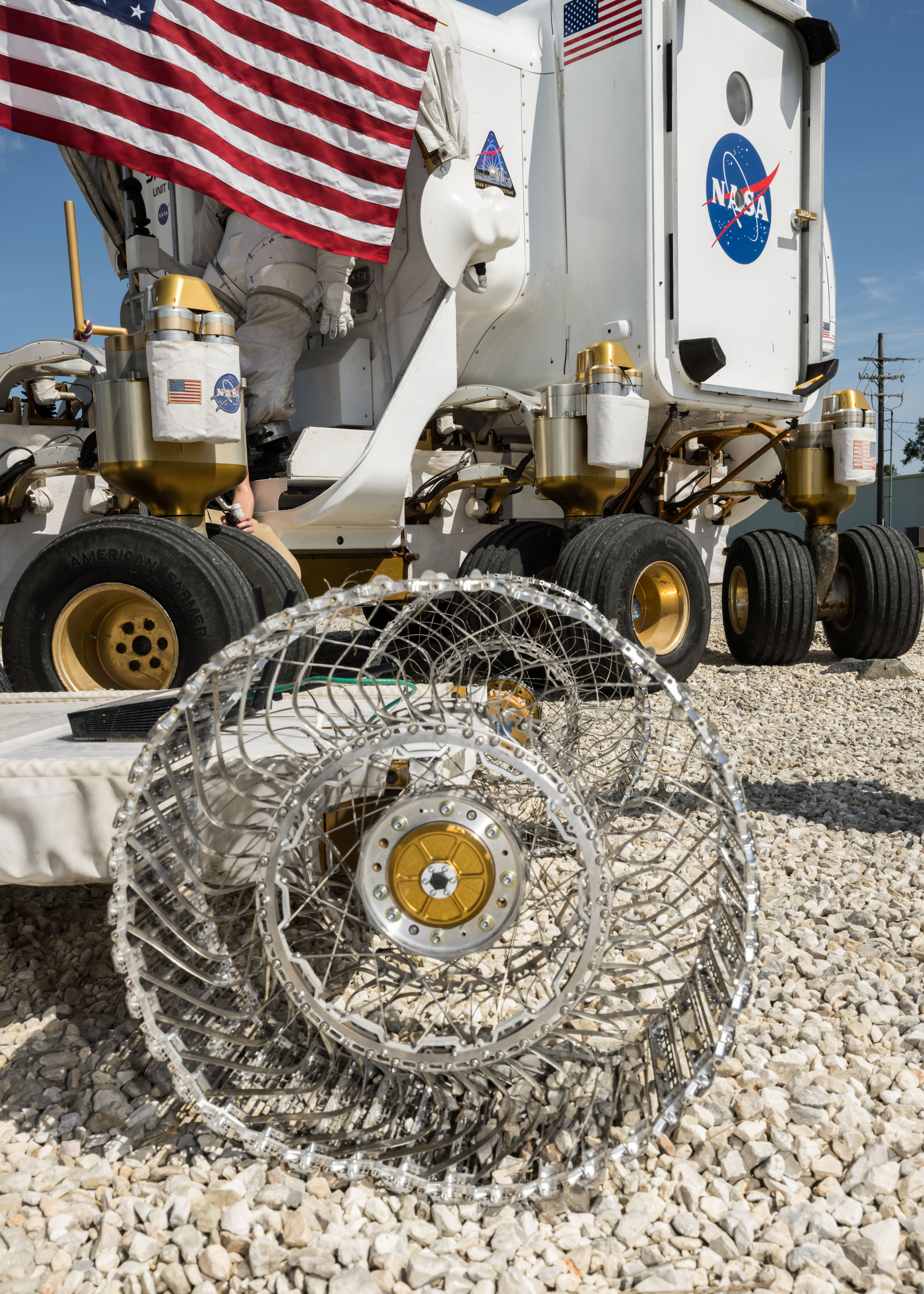
As lunar exploration expands, different vehicles will require different combinations of speed, load capacity, durability, and terrain performance.
Seeking that variety was part of the challenge design. The design options gave engineers different technologies to consider and potentially advance.
“This challenge brought in new ideas from outside traditional industries and helped us identify wheel technologies that may be suitable for longer-duration surface operations,” said Lucien Junkin, robotics engineer at Johnson and co-leader of the challenge project.
The next phase could evaluate how the wheels respond to lunar-like dust, vacuum, and extreme temperatures in Johnson’s thermal vacuum chambers. Engineers could also assess the designs over longer distances and at different sizes and loads.
“Mobility is key to everything we want to do on the Moon,” Junkin said. “The farther we want to explore, the more we need to advance the wheel technologies that can get us there.”
The Common Robotics Project of the Robotic Systems Technology Branch within Johnson’s Engineering Directorate conducted the Rock and Roll with NASA Challenge. NASA’s Center of Excellence for Collaborative Innovation, part of the Prizes, Challenges, and Crowdsourcing Program within the Research and Technology Mission Directorate, managed the challenge contract. Students in NASA’s Robotics Academy helped prepare hardware and support the competition, while engineers from NASA’s Glenn Research Center in Cleveland supported reviews of concepts and proposals. HeroX administered the challenge on behalf of NASA.
About the AuthorSumer Loggins Share Details Last Updated Aug 17, 2026 Related Terms Explore More 3 min read NASA Competition Invites Students to Help Imagine a Future Enabled by Lunar Technologies Article 3 days ago 3 min read NASA Data Helps Commercial Space Plan Living Off Our Moon Article 5 days ago 5 min read NASA Completes Astronaut-Deployed Science Instrument for Lunar SurfaceNASA has declared “wrenches down” on the first completed payload designed for Artemis astronauts to…
Article 6 days ago Keep Exploring Discover More Topics From NASAMissions
Humans in Space
Climate Change
Solar System
NASA Challenge Tests Wheel Designs for Moon Base Mobility
As NASA prepares to establish the Moon Base, advancing surface mobility will be key to helping crews and robotic systems travel farther across the lunar surface.
To help advance that capability, the Rock and Roll with NASA Challenge invited public innovators to design and build next-generation lunar rover wheels.
Five teams from 128 submissions and 49 countries advanced to the final phase of the competition, where they tested their prototypes on July 31 at NASA’s Johnson Space Center in Houston.
The Huff Helo lunar wheel prototype is tested at Johnson Space Center’s Rock Yard.NASA/Luna Posadas NavaThe challenge sought lightweight, durable, and scalable wheels that could support longer-duration lunar surface operations. The designs also needed to be compliant enough to absorb impacts, maintain traction at higher speeds, and withstand the harsh lunar environment.
“Every additional kilometer a rover can reliably travel will expand how far we can explore, what science we can achieve, and what infrastructure we can build,” said Ed Herrera, robotics engineer at Johnson and co-leader of the challenge project.
NASA Johnson uses ground prototypes to test mobility technologies, while lunar terrain vehicles will be delivered to the lunar surface through the Commercial Lunar Payload Services initiative. For the challenge, the wheels were fitted to MicroChariot, a 45-kilogram test rover, and put through a series of courses at Johnson’s Rock Yard to evaluate their performance across different types of terrain.
NASA Robotics Academy students navigate the lunar wheel prototype Scotch Pad Tyres fitted on the MicroChariot rover at Johnson’s Rock Yard.NASA/Luna Posadas Nava“Crowdsourcing gives us an opportunity to look beyond traditional approaches for lunar wheel design,” Herrera said. “The more wheel technologies we can develop and understand, the more options we have to meet the needs of different vehicles, terrains, and missions on the Moon and Mars.”
Those ideas were reflected in five distinctly different designs.
The HTR Variable Flex Lunar Wheel created by Hellenic Technology of Robotics SA uses an internal system designed to vary the wheel’s stiffness depending on terrain and vehicle needs. The team adapted technology it had been developing for terrestrial wheels for about a decade.
The Hiper Wheel created by Hyperbola uses tensioned cables and a corigated structure that provides spring-like behavior, allowing the wheel to flex without relying on traditional radial spokes.
The Huff Helo Flexible Titanium Wheel created by Huff Helo Inc. uses formed titanium sheet metal as both structure and spring. During testing, the team found that the strength of the design also made the wheel more rigid, causing it to bounce over some obstacles rather than conform to the terrain.
The Payne Aviation Wheel created by Deborah and Craige Payne took inspiration from aviation and history. Its designer, an aircraft mechanic, combined a pneumatic approach with ideas from early automobile tire designs.
The winning Scotch Pad Tyres team poses with their prototype and MicroChariot at Johnson’s Rock Yard. NASA/Luna Posadas NavaThe winning Scotch Pad Tyres concept came from an Australian mechanical engineer Daniel Bloomfield and his son Isaac Bloomfield. Their prototype uses a Nomex-based tire structure supported around an aluminum hub. The soft material allows the tire to deform around terrain, while internal support helps it maintain its shape. A treated outer surface of epoxy and corundum grit was integrated to improve traction.
The Rock Yard testing also demonstrated why different terrains may require different approaches. Loose material can affect traction, while rocks and slopes place different demands on wheels such as vehicle stability.
The HTR Variable Flex Lunar Wheel prototype sits alongside NASA’s Space Exploration Vehicle at Johnson’s Rock Yard. NASA/Luna Posadas NavaAs lunar exploration expands, different vehicles will require different combinations of speed, load capacity, durability, and terrain performance.
Seeking that variety was part of the challenge design. The design options gave engineers different technologies to consider and potentially advance.
“This challenge brought in new ideas from outside traditional industries and helped us identify wheel technologies that may be suitable for longer-duration surface operations,” said Lucien Junkin, robotics engineer at Johnson and co-leader of the challenge project.
The next phase could evaluate how the wheels respond to lunar-like dust, vacuum, and extreme temperatures in Johnson’s thermal vacuum chambers. Engineers could also assess the designs over longer distances and at different sizes and loads.
“Mobility is key to everything we want to do on the Moon,” Junkin said. “The farther we want to explore, the more we need to advance the wheel technologies that can get us there.”
The Common Robotics Project of the Robotic Systems Technology Branch within Johnson’s Engineering Directorate conducted the Rock and Roll with NASA Challenge. NASA’s Center of Excellence for Collaborative Innovation, part of the Prizes, Challenges, and Crowdsourcing Program within the Research and Technology Mission Directorate, managed the challenge contract. Students in NASA’s Robotics Academy helped prepare hardware and support the competition, while engineers from NASA’s Glenn Research Center in Cleveland supported reviews of concepts and proposals. HeroX administered the challenge on behalf of NASA.
About the AuthorSumer Loggins Share Details Last Updated Aug 17, 2026 Related Terms Explore More 3 min read NASA Competition Invites Students to Help Imagine a Future Enabled by Lunar Technologies Article 3 days ago 3 min read NASA Data Helps Commercial Space Plan Living Off Our Moon Article 5 days ago 5 min read NASA Completes Astronaut-Deployed Science Instrument for Lunar SurfaceNASA has declared “wrenches down” on the first completed payload designed for Artemis astronauts to…
Article 6 days ago Keep Exploring Discover More Topics From NASAMissions
Humans in Space
Climate Change
Solar System
Hubble Solves Merger Mystery From Milky Way’s Early Years
- Hubble Home
- Overview
- Impact & Benefits
- Science
- Observatory
- Team
- Multimedia
- News
- More
5 min read
Hubble Solves Merger Mystery From Milky Way’s Early Years About 12 billion years ago, a dwarf galaxy known as LKH collided with a young Milky Way and merged with it. This artist’s concept portrays that collision. NASA’s Hubble Space Telescope uncovered definitive evidence of this collision by studying globular star clusters. Illustration: NASA, ESA, Joseph Olmsted (STScI)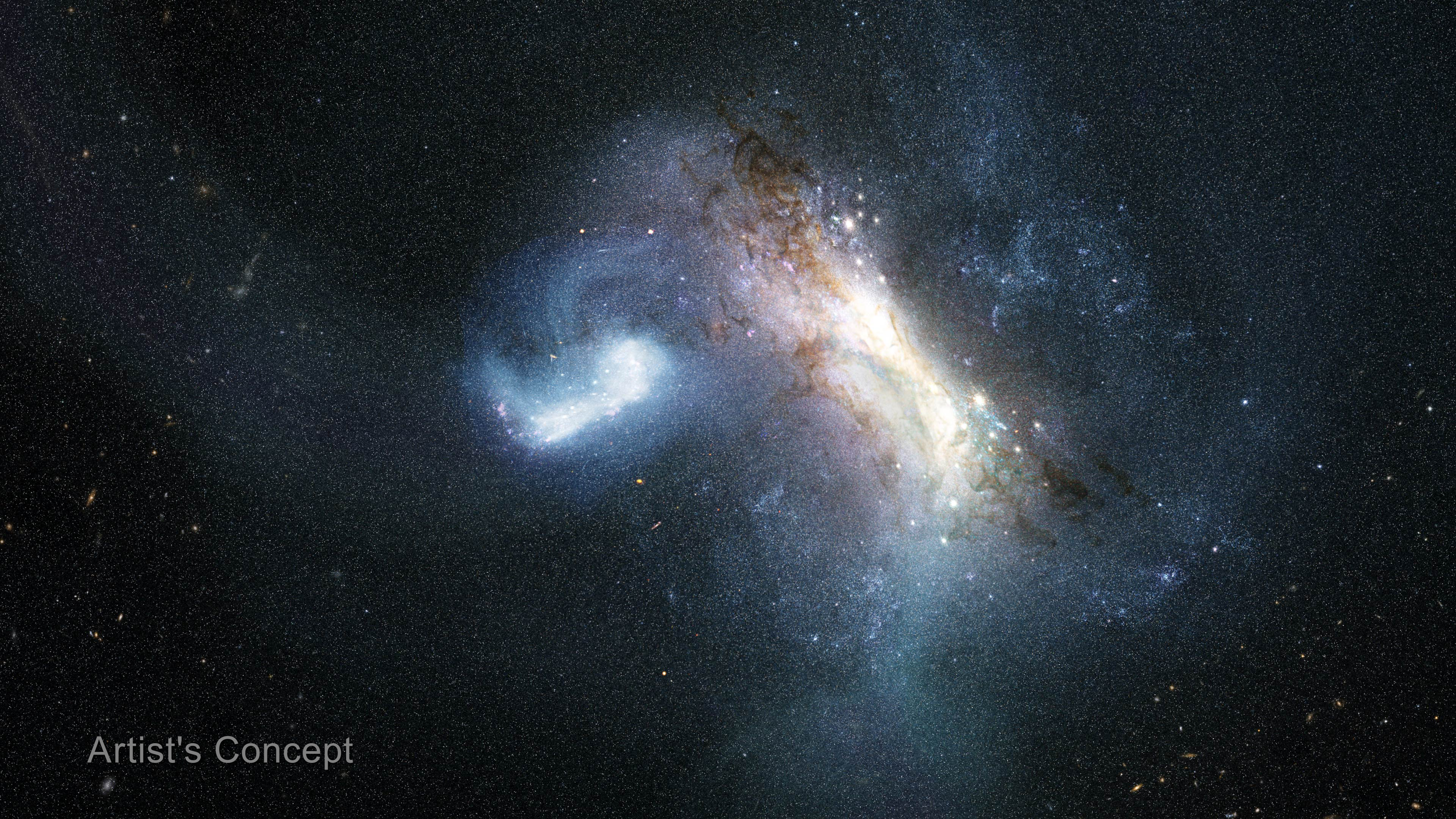
Our home galaxy, the Milky Way, grew to its current size in part by consuming smaller galaxies. Now, new data from NASA’s Hubble Space Telescope shows definitive evidence of a dwarf galaxy merging with the young Milky Way galaxy in the earliest phases of its evolution. This finding extends our knowledge of our galaxy’s history 1.8 billion years farther back in time than before.
The results published Monday in the journal Nature Astronomy.
The Milky Way today is a massive spiral galaxy home to hundreds of billions of stars. However, our galaxy wasn’t always so large; it has grown by forming new stars from its gas clouds as well as collecting stars, gas, and dark matter from other galaxies through mergers.
The most recent massive merger in our galaxy’s history took place with the Sagittarius dwarf galaxy, beginning over 6 billion years ago and still ongoing today. Looking back into the even more distant past, researchers learned that the Milky Way galaxy consumed another dwarf galaxy called Gaia-Sausage-Enceladus 10 billion years ago. This ancient merger greatly affected the structure of our galaxy’s disk of stars. Other, smaller mergers occurred between these two.
But our galaxy’s history doesn’t stop there. Both observations and simulations have suggested that another large merger preceded these two, though the specifics of the event have been heavily debated. Now, Hubble has uncovered definitive evidence of an earlier merger that occurred about 11.8 billion years ago, or just 2 billion years after the big bang.
“Our home is the Milky Way galaxy, but we do not know how our house was built,” said Davide Massari, lead author, Astrophysics and Space Science Observatory of Bologna in Italy. “In this paper we discover where the first significant batch of bricks came from: a dwarf galaxy that we call LKH.”
Cosmic archaeological sitesImmense astronomical surveys and precision data from spacecraft like ESA’s (European Space Agency’s) Gaia mission have been instrumental in piecing together the history of our galaxy. The farther back into our galaxy’s history that scientists attempt to look, the more difficult it becomes to tell what happened. When our galaxy was young, it was smaller and much closer in size to the galaxies it clashed with. It was also more chaotic, and it’s possible that the signs of mergers have been erased over billions of years.
It’s into this murky past that Hubble peered. Researchers used Hubble to study some of the Milky Way galaxy’s globular clusters: immense, roughly spherical collections of tens of thousands to a few million stars. Globular clusters contain some of the oldest stars in our galaxy, and they can act as cosmic archaeological sites that preserve stars from other galaxies the Milky Way galaxy has collected.
“Thanks to the high resolution and depth of Hubble imaging, we could measure the age and the metal content of these clusters with unprecedented precision,” said Chiara Zerbinati, study co-author, University of Bologna in Italy. “Coupled with measurements from Gaia, this made it possible to distinguish a population of globular clusters that are different from the others. These are the clusters that were born in LKH, and they tell us when that galaxy was devoured by ours, and how massive it was.”
The team analyzed Hubble observations of 39 globular clusters in the inner 20,000 light-years of our galaxy, where evidence of the most ancient mergers should be preserved. They expected this sample to contain globular clusters that formed within the young Milky Way galaxy as well as those collected from the Gaia-Sausage-Enceladus dwarf galaxy about 10 billion years ago.
Using Hubble’s sensitive observations to determine each cluster’s precise age and associated metallicity — the abundance of elements heavier than helium — they determined there was a third population of globular clusters in the inner regions of our galaxy. The team found that these clusters are older than the group collected in the Gaia-Sausage-Enceladus merger, but younger than those born in the Milky Way, regardless of their metal content. These clusters, therefore, came from a separate and even earlier merger — in which the Milky Way galaxy absorbed a dwarf galaxy containing roughly 500 million times the mass of the Sun in stars, a significant fraction of our galaxy’s mass at the time. They named this dwarf galaxy Low-energy-Kraken-Heracles, or LKH, in honor of three earlier research papers that championed the idea of a merger early in our galaxy’s history.
Such a large merger so early in the Milky Way galaxy’s formation has profound implications for the evolution of our galaxy.
“Some past studies have argued that the earliest phases of our galaxy’s evolution were defined by stars born only in our galaxy,” says Massari. “Here, we have shown that stars born in external galaxies also need to be considered.”
The team plans to continue their work to unravel the history of the Milky Way galaxy by studying its globular clusters, aiming to characterize all the massive mergers that our galaxy has experienced across cosmic history.
“Hubble is observing globular clusters that have never been studied before, and this will help us characterize the merger events that are far back in time in the Milky Way galaxy’s history,” said Fernando Aguado-Agelet, co-author, University of Vigo and the University of La Laguna in Spain.
The Hubble Space Telescope has been operating for more than three decades and continues to make ground-breaking discoveries that shape our fundamental understanding of the universe. Hubble is a project of international cooperation between NASA and ESA (European Space Agency). NASA’s Goddard Space Flight Center in Greenbelt, Maryland, manages the telescope and mission operations. Lockheed Martin Space also supports mission operations at Goddard. The Space Telescope Science Institute in Baltimore, which is operated by the Association of Universities for Research in Astronomy, conducts Hubble science operations for NASA.
Facebook logo @NASAHubble @NASAHubble Instagram logo @NASAHubble Related Images & Videos LKH Milky Way Merger IllustrationAbout 12 billion years ago, a dwarf galaxy known as LKH collided with a young Milky Way and merged with it. This artist’s concept portrays that collision. NASA’s Hubble Space Telescope uncovered definitive evidence of this collision by studying globular star clusters.
Claire Andreoli
NASA’s Goddard Space Flight Center
Greenbelt, Maryland
claire.andreoli@nasa.gov
Bethany Downer
ESA/Hubble
Baltimore, US
Christine Pulliam
Space Telescope Science Institute
Baltimore, Maryland
Keep Exploring Discover More Topics From Hubble Hubble Space Telescope
Since its 1990 launch, the Hubble Space Telescope has changed our fundamental understanding of the universe.
Hubble Science Highlights
Hubble’s most notable scientific discoveries reflect the broad range of research and the breakthroughs it has achieved.
Hubble Images
Explore Hubble’s iconic images of the universe, and view photos of mission operations and astronauts servicing Hubble in space.
Hubble News
Hubble Solves Merger Mystery From Milky Way’s Early Years
- Hubble Home
- Overview
- Impact & Benefits
- Science
- Observatory
- Team
- Multimedia
- News
- More
5 min read
Hubble Solves Merger Mystery From Milky Way’s Early Years About 12 billion years ago, a dwarf galaxy known as LKH collided with a young Milky Way and merged with it. This artist’s concept portrays that collision. NASA’s Hubble Space Telescope uncovered definitive evidence of this collision by studying globular star clusters. Illustration: NASA, ESA, Joseph Olmsted (STScI)Our home galaxy, the Milky Way, grew to its current size in part by consuming smaller galaxies. Now, new data from NASA’s Hubble Space Telescope shows definitive evidence of a dwarf galaxy merging with the young Milky Way galaxy in the earliest phases of its evolution. This finding extends our knowledge of our galaxy’s history 1.8 billion years farther back in time than before.
The results published Monday in the journal Nature Astronomy.
The Milky Way today is a massive spiral galaxy home to hundreds of billions of stars. However, our galaxy wasn’t always so large; it has grown by forming new stars from its gas clouds as well as collecting stars, gas, and dark matter from other galaxies through mergers.
The most recent massive merger in our galaxy’s history took place with the Sagittarius dwarf galaxy, beginning over 6 billion years ago and still ongoing today. Looking back into the even more distant past, researchers learned that the Milky Way galaxy consumed another dwarf galaxy called Gaia-Sausage-Enceladus 10 billion years ago. This ancient merger greatly affected the structure of our galaxy’s disk of stars. Other, smaller mergers occurred between these two.
But our galaxy’s history doesn’t stop there. Both observations and simulations have suggested that another large merger preceded these two, though the specifics of the event have been heavily debated. Now, Hubble has uncovered definitive evidence of an earlier merger that occurred about 11.8 billion years ago, or just 2 billion years after the big bang.
“Our home is the Milky Way galaxy, but we do not know how our house was built,” said Davide Massari, lead author, Astrophysics and Space Science Observatory of Bologna in Italy. “In this paper we discover where the first significant batch of bricks came from: a dwarf galaxy that we call LKH.”
Cosmic archaeological sitesImmense astronomical surveys and precision data from spacecraft like ESA’s (European Space Agency’s) Gaia mission have been instrumental in piecing together the history of our galaxy. The farther back into our galaxy’s history that scientists attempt to look, the more difficult it becomes to tell what happened. When our galaxy was young, it was smaller and much closer in size to the galaxies it clashed with. It was also more chaotic, and it’s possible that the signs of mergers have been erased over billions of years.
It’s into this murky past that Hubble peered. Researchers used Hubble to study some of the Milky Way galaxy’s globular clusters: immense, roughly spherical collections of tens of thousands to a few million stars. Globular clusters contain some of the oldest stars in our galaxy, and they can act as cosmic archaeological sites that preserve stars from other galaxies the Milky Way galaxy has collected.
“Thanks to the high resolution and depth of Hubble imaging, we could measure the age and the metal content of these clusters with unprecedented precision,” said Chiara Zerbinati, study co-author, University of Bologna in Italy. “Coupled with measurements from Gaia, this made it possible to distinguish a population of globular clusters that are different from the others. These are the clusters that were born in LKH, and they tell us when that galaxy was devoured by ours, and how massive it was.”
The team analyzed Hubble observations of 39 globular clusters in the inner 20,000 light-years of our galaxy, where evidence of the most ancient mergers should be preserved. They expected this sample to contain globular clusters that formed within the young Milky Way galaxy as well as those collected from the Gaia-Sausage-Enceladus dwarf galaxy about 10 billion years ago.
Using Hubble’s sensitive observations to determine each cluster’s precise age and associated metallicity — the abundance of elements heavier than helium — they determined there was a third population of globular clusters in the inner regions of our galaxy. The team found that these clusters are older than the group collected in the Gaia-Sausage-Enceladus merger, but younger than those born in the Milky Way, regardless of their metal content. These clusters, therefore, came from a separate and even earlier merger — in which the Milky Way galaxy absorbed a dwarf galaxy containing roughly 500 million times the mass of the Sun in stars, a significant fraction of our galaxy’s mass at the time. They named this dwarf galaxy Low-energy-Kraken-Heracles, or LKH, in honor of three earlier research papers that championed the idea of a merger early in our galaxy’s history.
Such a large merger so early in the Milky Way galaxy’s formation has profound implications for the evolution of our galaxy.
“Some past studies have argued that the earliest phases of our galaxy’s evolution were defined by stars born only in our galaxy,” says Massari. “Here, we have shown that stars born in external galaxies also need to be considered.”
The team plans to continue their work to unravel the history of the Milky Way galaxy by studying its globular clusters, aiming to characterize all the massive mergers that our galaxy has experienced across cosmic history.
“Hubble is observing globular clusters that have never been studied before, and this will help us characterize the merger events that are far back in time in the Milky Way galaxy’s history,” said Fernando Aguado-Agelet, co-author, University of Vigo and the University of La Laguna in Spain.
The Hubble Space Telescope has been operating for more than three decades and continues to make ground-breaking discoveries that shape our fundamental understanding of the universe. Hubble is a project of international cooperation between NASA and ESA (European Space Agency). NASA’s Goddard Space Flight Center in Greenbelt, Maryland, manages the telescope and mission operations. Lockheed Martin Space also supports mission operations at Goddard. The Space Telescope Science Institute in Baltimore, which is operated by the Association of Universities for Research in Astronomy, conducts Hubble science operations for NASA.
Facebook logo @NASAHubble @NASAHubble Instagram logo @NASAHubble Related Images & Videos LKH Milky Way Merger IllustrationAbout 12 billion years ago, a dwarf galaxy known as LKH collided with a young Milky Way and merged with it. This artist’s concept portrays that collision. NASA’s Hubble Space Telescope uncovered definitive evidence of this collision by studying globular star clusters.
Claire Andreoli
NASA’s Goddard Space Flight Center
Greenbelt, Maryland
claire.andreoli@nasa.gov
Bethany Downer
ESA/Hubble
Baltimore, US
Christine Pulliam
Space Telescope Science Institute
Baltimore, Maryland
Keep Exploring Discover More Topics From Hubble Hubble Space Telescope
Since its 1990 launch, the Hubble Space Telescope has changed our fundamental understanding of the universe.
Hubble Science Highlights
Hubble’s most notable scientific discoveries reflect the broad range of research and the breakthroughs it has achieved.
Hubble Images
Explore Hubble’s iconic images of the universe, and view photos of mission operations and astronauts servicing Hubble in space.
Hubble News
AI decodes the mathematical ‘fingerprints’ of famous jazz musicians, from Chick Corea to Thelonious Monk
Music and math often come together in ways we don’t expect
Scientists find 3 supermassive black holes on the verge of collision inside a distant galaxy
A trio of heavyweight black holes are entangled in a dance of death that will quite possibly see them gradually all merge to form an even greater behemoth.
Scientists have discovered the black holes in a galaxy that is so far away its light has taken 12.5 billion years to reach us, meaning we see it as it was less than 1.3 billion years after the Big Bang. And it's offering strong supporting evidence that one of the ways black holes grew so massive so quickly in the early universe was through mergers.
"This is the first evidence of three active black holes in a single galaxy in the distant universe," Hannah Übler, an astronomer at the Max Planck Institute for Extraterrestrial Physics in Germany who led the study, said in a statement. "It suggests that processes in the early universe were efficient at bringing massive black holes together, setting the stage for the massive black-hole mergers we expect to detect with future gravitational-wave observatories."
The galaxy that plays host to the black holes is catalogued as J0148-4214 and is so far away (their redshift is 5.0167) that the James Webb Space Telescope (JWST), which made the discovery, could not see the black holes directly. Instead, the Integrated Field Spectroscopy unit on the JWST's Near Infrared Spectrometer (NIRSpec) measured the motion of hydrogen gas swirling around at high velocity in the accretion disks encircling each black hole.
"The JWST data allowed us not only to identify the three black holes, but also to estimate their masses, accretion rates and the stellar mass of the galaxy," Giovanni Mazzolari of the Max Planck Institute for Extraterrestrial Physics said in the statement. "We find a total stellar mass of about 1.3 billion suns, and the black holes represent a significant fraction of that."
Two of the black holes reside at the center of J0148-4214, separated by 620 light-years. One of these black holes has a huge mass of 80 million times the mass of our sun, while its companion is a relative pipsqueak at 600,000 solar masses. Yet despite its diminutive stature, the smaller black hole is growing at a tremendous rate by accreting gas faster than the Eddington limit. This is the theoretical maximum rate at which material can fall towards a black hole; if the rate is any higher then the accretion disk around the black hole becomes so dense and hot that radiation from the disk blows material back out again, stifling the black hole's feeding frenzy. This means the smaller black hole will only be able to keep growing at this rate for a short time before negative feedback calls a halt.
The third black hole is 5,500 light-years out from the center of J0148-4214 and has a mass two million times greater than the mass of our sun. This is about half the mass of the supermassive black hole at the center of our Milky Way galaxy, called Sagittarius A*. It's thought that this third black hole, and quite possibly the second one too, found their way into J0148-4214 via mergers between galaxies.
"These results are extremely exciting," said Roberto Maiolini of the University of Cambridge, who was a participant in the findings. "They suggest that black-hole merging may be an additional, fast route for their rapid growth in the early universe."
An image of Sagittarius A*, the supermassive black hole at the heart of the Milky Way. (Image credit: EHT Collaboration)Mergers between black holes produce bursts of gravitational waves. Current gravitational-wave detectors — including The Laser Interferometer Gravitational-Wave Observatory (LIGO) in the United States, Virgo in Italy and KAGRA in Japan — are able to detect the high frequency, short wavelength gravitational waves from the mergers of stellar-mass black holes, the kind formed in certain supernova explosions. To detect the much longer wavelength, shorter frequency gravitational waves produced by the merger of supermassive black holes such as those in J0148-4214 requires a space-based detector with a baseline many millions of miles long.
To that end, the European Space Agency plans to launch LISA, the Laser Interferometer Space Antenna. If all goes to plan, by the mid-2030s. LISA will feature three spacecraft in triangular formation, each side of the triangle being 1.55 million miles (2.5 million kilometers) long. The three spacecraft will beam lasers at each other, looking for deviations in the travel time of those laser beams as evidence for the passing of a long-wavelength gravitational wave.
With regards to J0148-4214, however, there is a caveat: The third black hole might not be on a collision course with the other two. Instead, it could be heading out of the galaxy.
It's the classic three-body problem: How do three objects orbiting one another interact?
The two smaller black holes may have entered J0148-4214 as a binary pair. Then, as they were drawn closer to the 80-million-solar-mass black hole, the more massive black hole could have snatched the 600,000-solar-mass black hole while exchanging angular momentum with the two-million-solar-mass black hole to fling it away at high velocity. We see a similar effect in our galaxy with hypervelocity stars that are racing out of the Milky Way. These speedy stars used to be part of a binary pair of stars that got too close to Sagittarius A*, which is the black hole at the center of our galaxy. One half of the binary was captured by the black hole and the other was flung away.
Currently, there is no way to measure the direction of motion of the third black hole in J0148-4214 and confirm whether it will merge with the other two black holes or escape. If it did escape, it could still be wandering alone and dark in intergalactic space even now, 12.5 billion years later.
The findings are presented in the journal Astronomy & Astrophysics.
These eight Lego Star Wars Smart Play sets are out now and Marvel needs to be next.
It's a good time to be a Lego Star Wars fan. Not only are there a bunch of Mandalorian movie tie-in sets to look forward to, but there are eight brand new sets out, as part of Lego's new Smart Play system. Aimed at kids, these new Smart Play sets are designed to make play more interactive than ever before by introducing light and sound effects without the need for app support.
The key element of these Smart Play sets is an interactive, audio- and light-equipped Smart Brick. The Smart Brick responds to printed tags on other bricks and minifigures. If a particular tag is in range, it will interact with it, making the appropriate sounds or light actions that the tag tells it to. So you can have this Lego Smart Play Throne Room Duel & A-Wing set playing the Imperial March.
Sounds cool? It absolutely is, which is why it's frustrating that Lego has yet to give us any Lego Marvel Smart Play sets. Marvel's Guardians of the Galaxy alone is packed with quotable lines and effects; who wouldn't want a tiny Lego Groot that spoke with Vin Diesel's voice? You could pitch Captain Marvel against Galactus, with Ralph Ineson's voice booming out of a Smart Brick.
Instead, Lego has pivoted to Pokémon. Where's the Infinity Gauntlet when you need it? The good news is that the eight currently available Lego Star Wars Smart Play sets offer plenty in the way of fun.
Smart Play All-in-One SetsLego Star Wars Smart Play: Luke’s Red Five X-Wing: $89.99
Aimed at kids aged six and above, Luke's Red Five X-Wing is pure playset territory. While the X-Wing is the feature here, it also comes with lots of smaller builds, including a command center, a refueling station and an Imperial turret. Along with the Smart Brick and charter, it also comes with five Smart Tags and two Smart Minifigures (Luke Skywalker and Princess Leia). There's also a Stormtrooper minifigure, a Rebel Crew member and R2-D2, although these don't have Smart functionality.
The X-Wing will make sounds and light up when it's flown through the air, and with a Smart Brick in situ, the turret will make appropriate battle sounds. Providing you move the Smart Brick around, the command center and refuel station can make sounds, too.View Deal
Lego Star Wars Smart Play: Throne Room Duel & A-Wing: $159.99
The Throne Room Duel is the most expensive Smart Play set yet, but that's because it comes with not one, but two Smart Bricks. There are also three Smart Minifigures (Luke Skywalker, Darth Vader and Emperor Palpatine), five Smart Tags and the necessary charging stand and cable combo. At $159.99 / £139.99, it's a little on the pricey side, but I think this offers the best, most comprehensive use of the Smart Brick, with a wealth of interactive features baked into the set.
The Throne Room Duel & A-Wing comes with two battle podiums, where the Luke Skywalker and Darth Vader minifigures can be placed to have an epic lightsaber duel. Thanks to the Smart Brick, you can enjoy realistic battle sounds as they fight. The A-Wing can also make blaster sounds as it attacks, but my favorite feature here is the throne, which will play the Imperial March.View Deal
Lego Star Wars Smart Play: Darth Vader’s TIE Fighter: $69.99
At $69.99 / £59.99, the Darth Vader’s TIE Fighter is the most inexpensive way to get your hands on an All-in-One Smart Play set, and it's a pretty nice set, too. Aimed at kids aged 8+, it features an iconic TIE Fighter ship, along with a refueling station and a Rebel outpost. The included Darth Vader minifigure is equipped with a Smart tag, too, so he can be interacted with, and there's also a Rebel Fleet Trooper, although he has no Smart functionality.
With the Smart Brick installed in the TIE Fighter, it will make appropriate sounds and display light effects as it's flown through the air, interacting with the way a child moves it around. It will also make refueling sound effects, should you interact with the brick-built refueling station. The TIE Fighter itself has a cockpit with room to sit Darth Vader, and also working stud blasters.View Deal
Smart Play Compatible setsLego Star Wars Smart Play: Millennium Falcon: $99.99
Yes, it's yet another Millennium Falcon set. Made up of 885 pieces and costing $99.99 / £89.99, it's a little smaller than the most recent Millennium Falcon playsets we've had, but it's still every bit as eye-catching — and this one comes with the added bonus of Smart Play compatibility. All four of its minifigures (Chewbacca, Han Solo, C-3PO and Luke Skywalker) are Smart-enabled, and it also comes with four Smart Tags that allow the Millennium Falcon itself to make various sounds and light effects, including the sound of the hyperdrive, laser battles, explosions and more.
The roof of the Millennium Falcon can lift off, revealing a full interior, where you'll find space for minifigures to sit, a Holochess board and space to practice Lightsaber skills. On the outside of the ship, you'll find blasters and plenty of detail, which makes this model look every bit like the real thing. Even without a Smart Brick, then, this is a great playset with plenty for youngsters to interact with.View Deal
Lego Star Wars Smart Play: Mos Eisley Cantina: $79.99
The Mos Eisley Cantina is undoubtedly one of the most iconic locations in the Star Wars universe. This playset may be considerably scaled down, particularly in comparison to the now-retired UCS Mos Eisley Cantina, but at 666 pieces, it's a good size for a playset aimed at kids eight and above. It features a bar, a seating area, a dance stage and a buildable Dewback — everything needed for some wonderfully imaginative play.
Helping things along are the Smart Play compatible features. Obi-Wan Kenobi and Greedo minifigures are Smart-enabled, three additional Smart Tags allow a wealth of interaction. The Dewback can make walking and sleeping sounds, while the Cantina itself can play music and the sound effects of drinks being mixed.
Lego Star Wars Smart Play: AT-ST Attack on Endor: $49.99
One of the cheaper Smart Play sets to be released, this 347-piece set allows youngsters to build an AT-ST, a speeder bike and three minifigures (Wicket the Ewok, AT-ST Driver and Scout Trooper). Of the three, Wicket features Smart functionality, and there are also two Smart Tags which can bring the AT-ST to life.
Wicket has several moods and reactions that can be played when in range of a Smart Brick, and the AT-ST can make a variety of battle and movement sounds, activated by putting it in motion. Without a Smart Brick, the AT-ST can still be interacted with thanks to an opening cockpit, a moving head and fireable stud shooters.View Deal
Lego Star Wars Smart Play: Luke’s Landspeeder: $39.99
Costing just $39.99 / £34.99, Luke's Landspeeder is the cheapest of all the Smart Play compatible sets available so far. And it's one of the most iconic builds, with Luke's Landspeeder being immediately recognizable. It's a small set, with only 215 pieces, but with an age rating of 6+, it's an ideal build for younger children who may be new to Lego or less confident builders.
It comes with two minifigures (Luke Skywalker and Jawa), with Luke being Smart Play enabled. There's also one Smart Tag, which allows the Landspeeder to make motion sounds as it's moved, and refuel sounds when kids interact with the included refuel station mini build. Perfectly sized for small hands, Luke's Landspeeder is ideal for swooshing through the air, and even without a Smart Brick to bring it to life, kids can use their imaginations to make this a worthwhile play experience.View Deal
Lego Star Wars Smart Play: Yoda’s Hut and Jedi Training: $69.99
An iconic set from Star Wars: The Empire Strikes Back, and something we've seen in numerous Star Wars titles since, we love Yoda's Hut. Its natural appearance, covered in trees and hidden in the swamp, makes it stand out from the usual industrial appearance of Star Wars' ships and buildings. And it's the home of everyone's favorite Yoda: what's not to like? The last time we had a Yoda’s Hut playset was back in 2018, so it's a well overdue release.
The included Yoda and Luke Skywalker minifigures are Smart-enabled, and there's also an R2-D2 minifigure included to complete the trio. Smart Tags within the set allow for cooking sounds to come from Yoda's hut, while kids can enjoy 'force' sounds as Yoda and Luke complete their Jedi training. It's a very nice-looking set, and I'd wager that adults will enjoy this as a display piece if they aren't interested in interacting with the Smart Play functionality — but you may be missing out if you don't enjoy the many interactive sounds that the set can produce with a Smart Brick present.View Deal
Wildfire smoke blankets volcanoes across the Pacific Northwest | Space photo of the day for Aug. 17, 2026
Imagine orbiting hundreds of miles above Earth and seeing your home planet below — up in smoke.
That was the reality recently for astronauts aboard the International Space Station (ISS) who captured this image of the volcano Mount Rainier covered in smoke from nearby wildfires.
What is it?This past July, hundreds of wildfires devastated a number of regions across Canada. But unfortunately, this was not the end of wildfires decimating North America this summer.
Recently, wildfires have spread across Washington and Oregon, burning over 84,000 acres (34,000 hectares) as of Aug. 12, according to NASA.
This image, captured by astronauts aboard the ISS, shows smoke blowing from wildfires in central and eastern Washington to the volcano Mount Rainier. The astronauts also captured imagery of Mt. Hood about 100 miles (160 kilometers) south. With Mt. Hood, you can also see thick plumes of smoke coming from the Grasshopper fire, which was ignited by a lightning strike.
Why is it incredible?This is the worst fire season the Pacific Northwest has seen in over 30 years, CNN has reported. The wildfires have forced many to evacuate their homes, shut down major roads and more. In addition to the immediate dangers presented by the wildfires themselves, as we can see from these images, the smoke from the fires extends far and wide and has created unhealthy air quality levels.
As of Wednesday (Aug. 12), over 2.7 million acres (1.1 million hectares) had already burned, and by Friday (Aug. 14), the region still had dozens of uncontained wildfires, CNN reported.
And higher-than-normal risk for fires to continue through the month of August are expected, according to the National Interagency Fire Center.
While tackling the problem of wildfires — which is increasing as climate change worsens — takes place on Earth, we can learn a lot from seeing things from above. The vantage point of outer space allows for views like this, which can give a larger perspective. And satellite views can provide even more in-depth information to support wildfire fighting activities back on Earth.
On this day in space! Aug. 17, 1877: Asaph Hall discovers the Martian moon Phobos
On Aug. 17, 1877, American astronomer Asaph Hall discovered Mars's moon Phobos.
Moons of Mars: Amazing Photos of Phobos and Deimos
Hall was working at the U.S. Naval Observatory in Washington, D.C. and looking through a 26-inch refractor telescope — which was then the largest in the world — when he first spotted the moon. Six days earlier, he had discovered another, smaller moon that he first described as "a faint star near Mars."
Upon further inspection, not only did he realize that this star was actually the Martian moon Deimos, but he also discovered a second, larger moon now known as Phobos. He announced both discoveries the following day, on Aug. 18, 1877.
Phobos is the largest moon of Mars. Its dimensions measure 10 by 14 by 11 miles (17 by 22 by 18 kilometers) across and orbits Mars three times each Martian day at a distance of about 3,700 miles (6,000 km).
Phobos, Mars' largest moon. (Image credit: ESA/DLR/FU Berlin)Why it matteredOver the century and a half since this discovery, there has been an enormous amount of scientific progress in the study of Mars. In addition to many decades of studying the planet from afar, we have seen a variety of different orbiters and rovers explore the Red Planet over the past few decades. We have sampled bits of Martian material, seen up-close photos of the planet and the rocks which scatter across its surface. It might be easy to take for granted how much we know about our planetary neighbor, and this 19th century discovery was groundbreaking.
As we look to the future with new technologies and new discoveries on the horizon, it is important to also look backward to see and understand the history and work that made all of this progress possible.
Total solar eclipse 2026 (Official ESA broadcast)
We broadcast live from the Observatorio Astrofísico de Javalambre in Spain as a total solar eclipse crossed Europe on 12 August 2026.
The path of totality swept across Greenland, Iceland, Spain and a small area of northeastern Portugal, while much of Europe experienced a partial eclipse.
A total solar eclipse occurs when the Moon passes directly between Earth and the Sun, completely blocking the face of the Sun.
The Observatorio Astrofísico de Javalambre is a world-class astronomical observatory located within the path of totality. During the broadcast, scientists, astronomers and special guests explored the science behind eclipses, the Sun and their wider relevance for space science and Earth.
The broadcast was hosted by Dame Dr Maggie Aderin, award-winning space scientist and science communicator, and featured ESA's Director of Science Carole Mundell alongside other guests.
It included live telescope views of the eclipse, expert commentary and interviews, insights into solar science and space weather, behind-the-scenes coverage from the observatory, and discussions on ESA’s activities linked to the eclipse.
Learn more about ESA’s activities surrounding the 2026 eclipse, as well as those coming to Europe in 2027 and 2028.