

Feed aggregator
We think these Nikon binoculars are excellent for variable magnification on the go
Of all the models in the renewed Nikon Action range released in 2026, the Action Zoom 10–22x50 is definitely one of the most attention-getting, with its zoom capability from 10x to 22x magnification.
These are Nikon's third-generation 10-22x50 binoculars, building upon the past designs of 2007's Action VII Zoom XL 10-22x50 and 2013's Aculon 10-22x50 in 2013. The new design features a generous 16.3mm of eye relief, a tough aluminum chassis and updated optics.
We found them to be a versatile pair of binoculars, and used them at 10x magnification to locate objects before zooming in to 22x for a closer look. Changing magnifications is easily done with a lever on the right eyecup, but the optics do suffer from the sacrifices required when producing a binocular with zoom functionality.
Nikon Action Zoom 10-22x50 binoculars reviewNikon Action Zoom 10-22x50 binoculars: Design- Strong aluminum chassis
- Easy magnification change
- Big focus dial
Along with the fixed magnification models in the Action series, the Action Zoom 10-22x50 binoculars have the same strong, lightweight aluminum chassis. This helps to protect the careful arrangement of lenses required for zooming, as well as making the binoculars more durable without adding extra weight.
L-R: The Nikon Action 7x50, Nikon Action 10x50, Nikon Action 16x50 and Nikon Action Zoom 10-22x50 binoculars (Image credit: Harry Bennett / Future)In fact, the 2026 Action Zoom 10-22x50 is 0.4 oz (10 grams) lighter than the previous Aculon model. This is important for the stargazer or hiker who may already have lots of heavy gear to carry, where small amounts can make all the difference.
We found that the higher the Nikon Action Zoom 10-22x50's magnification was, the darker the image. (Image credit: Harry Bennett / Future)The exterior of the binoculars is covered in a textured rubber armor, which provides good grip while scanning the skies. A chunky focus dial between the barrels is easy to find with your fingers and use, enabling you to adjust focus quickly while observing. Focus touch-ups are usually required when changing magnification.
SpecificationsDesign: Porro prism
Magnification: 10-22x (zoom)
Objective lens diameter: 50mm
Exit pupil: 5.0mm (10x) - 2.27mm (22x)
Angular field of view: 3.9 degrees (10x)
Eye relief: 16.3 mm
Weight: 2.09 lbs (950 g)
Dimensions: 8.0 x 7.9 x 2.6 in (202 x 200 x 66 mm)
Magnification is easily changed with the right eyecup zoom lever, which is pushed down with the right index finger to move from 10x through to 22x. On the bottom of the right eyecup, there are printed white numbers on the body so that you can also set the magnification precisely at 12x, 15x and 18x. This helps with observing targets that don't require the full 22x zoom, and allows an astronomer to be more precise in their observations.
Not sure what zoom you'll need when you're out and about? The Nikon Action Zoom 10-22x50 binoculars have you covered. (Image credit: Harry Bennett / Future)When moving the zoom lever, the lenses in the eyepieces slide forward and backward, changing the distance to the objective lenses at the front of the binoculars. This changes the effective focal length and magnification of the binoculars.
The objective lens caps are easy to remove and replace but they're a little loose so you'll need to keep an eye on them. (Image credit: Harry Bennett / Future)50mm objective lenses let plenty of light through the binoculars when stargazing, delivering a bright image at 10x magnification and helping you to spot faint objects.
Nikon Action Zoom 10-22x50 binoculars: PerformanceFor overhead views, we'd recommend you pair the Nikon Action Zoom 10-22x50 binoculars with a tripod. (Image credit: Harry Bennett / Future)- Good for star-hopping then zooming in
- Noticeably dimmer at 22x
- Needs a tripod for overhead views at 22x
The 22x magnification on the Nikon Action Zoom is the strongest out of the entire range, with the next one down being the 16x50. During handheld observation, the zoom functionality was good for night sky objects that weren't too high overhead or terrestrial observation at horizontal and downward angles.
We were able to see the top portion of the Orion constellation with the magnification at 10x, with a bright Orion's belt and smudgy Orion nebula (M42). Switching to 22x magnification, we got a close-up view of the three stars making up Orion's belt and the dog-star Sirius to its left. At 22x these points of light were much more impressive but the binoculars handled stars much better than diffuse objects such as the Orion Nebula, which looked fairly unimpressive at 22x. We actually got a better view of the Orion Nebula with the NIkon Action 16x50.
The maximum exit pupil on the Action Zoom is 5 mm at 10x magnification, but when fully zoomed in at 22x, the exit pupil drops to 2.3 mm, effectively halving the amount of light your eye is receiving. This makes the view seem dimmer and was especially noticeable when observing Orion's nebula and during terrestrial viewing in daylight.
The Nikon Action Zoom 10-22x50's rubber eyecups are impressively comfortable, more so than twist-up cups. (Image credit: Harry Bennett / Future)We found the Beehive Cluster by star-hopping from Castor to Pollux and then to the star cluster. We used the 10x magnification for star-hopping before zooming in to get a better view of the Beehive cluster, but it was still disappointing. The wide-field view of the Beehive Cluster within the triangle of Cancer at 10x was much better than the zoomed-in dim view at 22x. Paired with the increased handshake from overhead observation without a tripod, it was less rewarding than observing at lower magnifications.
For beginners we would usually recommend using a tripod or getting an image-stabilized model when using binoculars with 12x magnification or over. It is possible to get sturdy views during handheld viewing by tucking your elbows into your chest or sides, but this only works when observing on the horizontal or downwards. When looking directly overhead, it was very hard to keep the Nikon Action Zoom 10-22x50 still enough to make out any details when fully zoomed in.
These binoculars offer excellent wide-field views of the night sky, letting you focus on objects such as the Beehive Cluster. (Image credit: Harry Bennett / Future)This was also an issue when observing another overhead observation target, Jupiter. When trying to spot the faint line of its Galilean moons, the resulting observation was just a mess of bright squiggles. This would definitely be remedied with the use of a tripod adapter and tripod, but be aware that these accessories become a necessity when stargazing overhead.
Looking at the half moon was good and offered a range of lunar views thanks to the magnification change, but again, the higher magnifications required steady hands. The moon at 22x magnification also looked significantly dimmer than the moon when observed with the Nikon Action 16x50s. While it suffered from similar levels of handshake, 16x50s have better light transmission because of their fixed magnification and wider exit pupil. At 10x magnification, the binoculars suffered from distortion around the edges of the view, but this disappeared when zooming into higher magnification.
Nikon Action Zoom 10-22x50 binoculars: Functionality The zoom lever is easy to use while observing, with no fumbling about. (Image credit: Harry Bennett / Future)- Rubber eyecups block light
- Versatile zoom range
- Tripod adapter socket
The Nikon Action Zoom 10-22x50 is a versatile optical tool and is useful when you are unsure what level of magnification you will need before you go out. We tested them out with the other binoculars in the Nikon Action range, the 7x50, 10x50 and 16x50. If we were going out for the evening, we would usually reach for these as it saved us having to take two different binoculars for wide-field and close-up viewing.
The zoom lever was incredibly easy to use during observation and touching up the focus with the focus wheel was easy with my middle finger. That said, viewing overhead objects at 22x magnification is heavily marred by hand shake and would be improved with the use of a tripod.
Just like the rest of the new Nikon Action range, the Zoom model has a tripod adapter socket in-between the two barrels, hidden behind a screw-in Nikon logo. If you are planning on using these for a lot of high-magnification observation, we would recommend buying the Nikon 7650 binocular tripod adapter and a budget tripod, like the Manfrotto Element II tripod, to ensure you can get blur-free views of the stars.
The fold-down eyecups are a boon for glasses wearers. Harry Bennett / FutureHarry Bennett / FutureHarry Bennett / FutureWe found the rubber eyecups were really comfortable, and actually preferred them to the hard, twist-up cups that the rest of the Nikon Action range has. They blocked out any light in the environment far better than the twist-up cups and were much more comfortable on the eye sockets. While the binoculars feature 16.3mm of eye relief, stargazers who wear eyeglasses may be disappointed by only having two heights for eye relief, with the rubber eyecups flipped up or flipped down.
These Nikon Action Zoom 10-22x50 binoculars come with a soft carry case. Harry Bennett / FutureHowever, these binoculars' neck strap is a little thin. Harry Bennett / FutureThe objective lens caps are easy to remove and replace but they can be quite loose and could get lost easily if not attached to a neck strap. The rubber eyecup covers remain fixed in place during transport and keep the eyepieces clean for observation. Nikon provides a neck strap and soft carry case with these binoculars but the neck strap is pretty thin, so if you are planning on carrying them around for a long time, consider getting a padded neoprene strap for binoculars for only $25.
These Nikon binoculars are great if you want variable magnification. Harry Bennett / FutureRemoving the Nikon logo reveals the tripod adapter socket. Harry Bennett / FutureHow we tested the Nikon Action Zoom 10-22x50 binocularsWe took the Nikon Action Zoom 10-22x50 binoculars to a city and local park test them, using them for stargazing and birdwatching respectively. (Image credit: Harry Bennett / Future)We tested the Nikon Action Zoom 10-22x50 binoculars in a city park during the day and at night in mid-March in the U.K. For stargazing, we tested them in a city park with a Bortle scale between 5 and 7. Our primary observation targets were Orion's belt, Sirius, Jupiter, the waxing half moon and the Beehive Cluster in the constellation of Cancer. For terrestrial viewing, we used them for finding birds in a local park and zooming in for up-close observation.
During testing in the U.K., nighttime temperatures were on average between 46 and 54 degrees Fahrenheit (8-12 degrees Celsius). Seeing conditions were clear and during non-lunar viewing, the skies had minimal or no moonlight.
User reviewsAt time of writing, reviews for the Nikon Action Zoom 10-22x50 were relatively positive, with users praising the smooth zoom mechanism and agreeing with the quoted 22x magnification on the zoom.
Users also liked the Zoom’s flexible magnification options and the 50mm objective lenses for height views, but the general consensus was that a tripod would vastly improve observation at the maximum magnification.
Should you buy the Nikon Action Zoom 10-22x50 binoculars?Buy it if:✅ You need one binocular with varied magnification: These binoculars have a variable zoom, from 10x through to 22x
✅ You are a high-magnification beginner: Varying magnification means you can practice higher-magnification viewing without investing in a dedicated pair
Don't buy it if:❌ You want to look at deep-sky objects with binoculars: The view is much dimmer at 22x than at 10x, which drastically reduces the brightness of nebulas and diffuse deep sky objects.
❌ You need super-still images: Unless you buy a tripod, you are unlikely to get fully stationary images with these binoculars.
If you are a binocular beginner or casual stargazer who wants variable magnification, these are a great purchase. The build quality is solid and the zoom mechanism is very smooth, enabling you to observe from 10x through to 22x.
The zoom function does mean that sacrifices have to be made in terms of light transmission, and at full magnification, the view is noticeably dimmer than at lower magnifications. This reduces the brightness when observing deep space objects like nebulas, but for brighter objects and stars, they performed well.
If you want to observe frequently at 22x magnification, though, we would recommend buying a tripod and binocular tripod adapter, so that you can enjoy these night sky wonders shake-free.
If the Nikon Action Zoom 10-22x50 binoculars aren't for youIf you need binoculars purely for wide-field observations, we would recommend the Nikon Action 7x50 binoculars or Action 10x50 binoculars. They have fixed lower magnifications and light transmission isn't sacrificed for the zoom functionality. The build is almost identical to the Action zoom model.
If you need optics for looking at deep sky objects, we would recommend one of the best telescopes, or a pair of binoculars with strong magnification and large objective lenses. Try the Celestron SkyMaster Pro 20x80 or Celestron SkyMaster 25x100 binoculars, both of which have larger objective lenses than the Nikon Action zoom. You will have to use a tripod with these, but the larger objective lenses will give you a brighter view of dim objects.
If you want high-magnification views without needing a tripod, the Fujifilm Fujinon Techno-Stabi TS-L 1640 binoculars are a great choice. The objective lens diameter is only 40mm, but the image stabilization gives you a higher level of detail that makes up for the lower light transmission. For handheld use, the difference is night and day.
Related articlesBest binoculars
Best binocular deals
Best nightvision binoculars
Best monocular
Best binoculars for kids
Best compact binoculars
APOD: 2026 August 15 – Bright Perseids from Sweden
APOD
Astronomy Picture of the Day
Discover the cosmos! Each day a different image or photograph of our fascinating universe is featured, along with a brief explanation written by a professional astronomer.
Bright Perseids from Sweden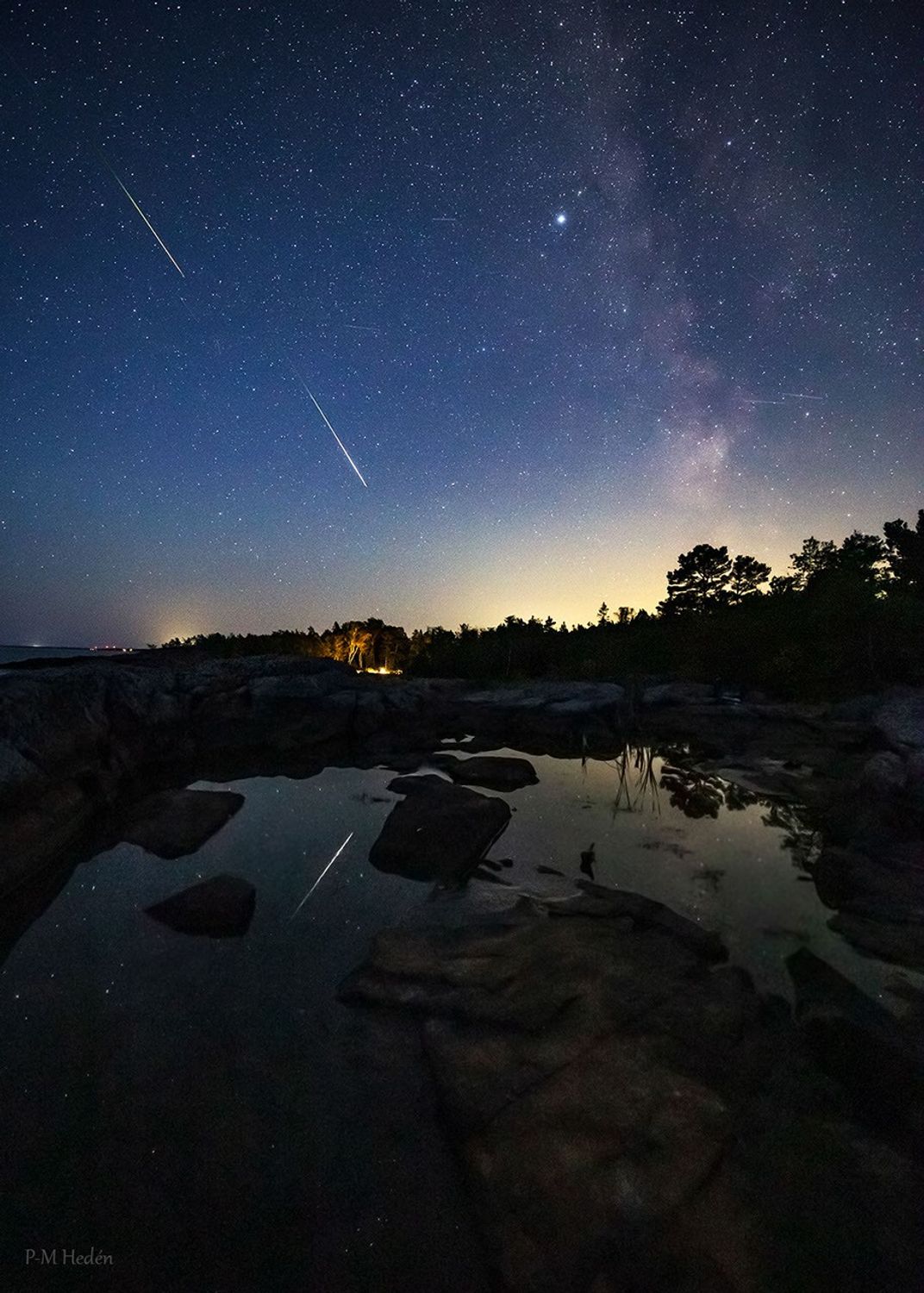
Explanation: Known for its bright and fast meteors, the annual Perseid Meteor Shower comes to planet Earth’s skies from a radiant in the heroic constellation Perseus. The popular northern summer celestial spectacle is created as grains of dust cast off along the orbit of periodic comet 109P/Swift-Tuttle vaporize in Earth’s dense atmosphere, tracing brief, but beautiful streaks through the night. Taken near the shower’s peak of activity on August 12, this composite image recorded two bright perseid meteors and one meteor’s watery reflection from a location near the coastal village of Grisslehamn, Sweden. Almost as bright as Altair, brightest star on the scene, the meteors appear along with the faint, diffuse background of the Milky Way. This year, the shower’s peak activity coincided with a New Moon, so perseid meteor flashes were undiminished by bright moonlight. And for many skywatchers, this night of bright perseid meteors followed their viewing of the silhouette of the New Moon in a much anticipated solar eclipse.
Growing Gallery: Solar Eclipse of 2026 August 12
Tomorrow’s picture: Milky Way over Yellowstone
NASA Science Activation & Michigan Tech. U.
Random APOD Generator
Yesterday’s Image APOD: 2026 August 14 – Total Solar Eclipse from Greenland
Tomorrow’s Image
APOD: 2026 August 15 – Bright Perseids from Sweden
APOD
Astronomy Picture of the Day
Discover the cosmos! Each day a different image or photograph of our fascinating universe is featured, along with a brief explanation written by a professional astronomer.
Bright Perseids from SwedenExplanation: Known for its bright and fast meteors, the annual Perseid Meteor Shower comes to planet Earth’s skies from a radiant in the heroic constellation Perseus. The popular northern summer celestial spectacle is created as grains of dust cast off along the orbit of periodic comet 109P/Swift-Tuttle vaporize in Earth’s dense atmosphere, tracing brief, but beautiful streaks through the night. Taken near the shower’s peak of activity on August 12, this composite image recorded two bright perseid meteors and one meteor’s watery reflection from a location near the coastal village of Grisslehamn, Sweden. Almost as bright as Altair, brightest star on the scene, the meteors appear along with the faint, diffuse background of the Milky Way. This year, the shower’s peak activity coincided with a New Moon, so perseid meteor flashes were undiminished by bright moonlight. And for many skywatchers, this night of bright perseid meteors followed their viewing of the silhouette of the New Moon in a much anticipated solar eclipse.
Growing Gallery: Solar Eclipse of 2026 August 12
Tomorrow’s picture: Milky Way over Yellowstone
NASA Science Activation & Michigan Tech. U.
Random APOD Generator
Yesterday’s Image APOD: 2026 August 14 – Total Solar Eclipse from Greenland
Tomorrow’s Image
The Brightened Night Sky Nobody Actually Wanted
A new study modelling Reflect Orbital's proposed constellation of giant orbital mirrors finds their light pollution would be severe. A single 54 metre satellite would appear four magnitudes brighter than the full moon to anyone in its beam, and its scattered glow would outshine moonlight across the sky from 14 kilometres away, remaining visible from over 30 kilometres out. With the pilot satellite already approved by the FCC despite astronomer objections, and up to 50,000 mirrors planned by the mid-2030s, the research puts hard numbers on a fight over who controls the night sky, and who answers for what's lost when it disappears.
Hubble Reveals that Star Formation is Slowing Down in the Andromeda Galaxy
A team of scientists led by the University of Washington has studied how star formation is declining in the Andromeda galaxy using highly detailed Hubble surveys.
The Tarantula That Lost Its Fire
A new composite image combining data from Chandra, Hubble, Webb and the retired Spitzer telescope has helped astronomers solve a long standing puzzle in the Tarantula Nebula, a star forming region 160,000 light years away. Young, massive stars there should be heating enough gas to emit X-rays, but observations showed far less X-ray emission than predicted.
Upgraded Sardinia Radio Telescope To Continue Probing Mysterious Fast Radio Bursts
Largest Italian radio telescope located on an out of the way mountain plateau in southern Sardinia sheds light on the cosmos’ still misunderstood Fast Radio Bursts (FRBs).
'Strap yourself in and feel the Gs': NASA announces 'Max Power' aerospace expo
NASA will hold a two-day aerospace exposition this November, and it may draw a surprising number of "Simpsons" fans.
The event, which NASA announced today (Aug. 14), will be held Nov. 7 and Nov. 8 at Kennedy Space Center (KSC) on Florida's Space Coast. It's called "Max Power," which is also a famous Homer Simpson pseudonym.
In the 13th episode of the show's 10th season, which first aired in February 1999, Homer legally changed his name to Max Power. He wanted to disassociate himself from a bumbling character on the (fictional) TV show "Police Cops" who shared his given moniker.
Homer made the switch to Max Power — which he said he got off a hair dryer — without consulting his family, a move that did not go over well.
"Wait a minute!" his dad protested. "The family name is my legacy to you. I got it from my father, and he got it from his father, and he traded a mule for it. And that mule went on to save spring break."
Homer's wife Marge was also displeased.
"But I fell in love with Homer Simpson," she said. "I don't want to snuggle with Max Power."
"Nobody snuggles with Max Power," Homer — or rather Max — responded. "You strap yourself in and feel the Gs!"
NASA's Max Power expo is about feeling the Gs as well, at least in part.
"The two-day event will feature immersive experiences for all ages to enjoy, including air shows, skydiving stunts, technology demonstrations, spaceflight hardware, military aircraft and behind‑the‑scenes access to America's spaceport," agency officials wrote in a description of the expo. "Attend talks led by NASA experts and meet astronauts from some of agency’s most famous missions!"
NASA Administrator Jared Isaacman, an accomplished pilot as well as a private astronaut, said that he plans to participate in the expo's air show. And, if you're unable to attend this November, you'll likely have other chances down the road.
"Certainly, the idea is that this event, Max Power, becomes the first of many," Isaacman said during a press conference today.
Is empty space really empty? This magnetic star may finally solve a 90-year-old mystery
Empty space is not as empty as it looks.
That is the takeaway of a new study examining signals from a dead star, offering what researchers say is the strongest evidence yet that extreme magnetic fields can alter the properties of a vacuum, causing seemingly empty space to act like a prism and changing how light travels through it
The findings, led by Rachael Stewart, a graduate student in physics at the George Washington University, confirm a prediction of a strange effect first proposed 90 years ago.
"The information we obtained from looking at this distant star core also gives us clues about the nature of the fabric of reality as we know it, and I find that to be incredible," Stewart said in a statement.
The idea dates to 1936, when the German physicist Werner Heisenberg and his student Hans Euler proposed that space is never truly void. Instead, they argued, it is a simmering sea of "virtual particles" — electrons and their antimatter counterparts, positrons — that flicker in and out of existence, briefly interacting with their surroundings before vanishing.
This subatomic froth is a consequence of quantum mechanics, and it remains invisible under ordinary conditions. But the theory predicts that an extremely strong magnetic field, such as one around a magnetar, can change how light moves, causing the light's waves to become more strongly aligned in a particular direction in an effect known as "vacuum birefringence."
"Detecting vacuum birefringence requires a magnetic field that is over 100 million times stronger than any we've ever made on Earth," study co-author Marcus Lower, an astrophysicist at the Swinburne University in Australia, said in another statement. "Thankfully, nature has provided us with magnetars, which are the perfect cosmic laboratories to go looking for this effect."
Magnetars are dense, city-size remnants left behind after massive stars explode, hosting the most powerful magnetic fields known in the universe. They are among the rare celestial objects capable of generating fields strong enough to reveal vacuum birefringence, offering scientists an extreme environment to test physics under conditions impossible to replicate on Earth.
"We're not just studying astronomical objects anymore; we're using them to test the laws of nature," study co-author Michela Negro, an astrophysicist at the Louisiana State University, said in a statement.
Astronomers have caught glimpses of this elusive phenomenon before, but not conclusively. In 2017, researchers using the Very Large Telescope in Chile observed polarization hints around a faint neutron star called RX J1856.5-3754, located about 400 light-years from Earth. However, those optical measurements remained open to interpretation, partly due to the challenges of isolating the optical signal.
An illustration of a magnetar. (Image credit: ESA)At the time, scientists noted that definitive proof would require space-based X-ray observatories, specifically NASA's then-forthcoming Imaging X-ray Polarimetry Explorer (IXPE). Launched in 2021, IXPE carries three identical telescopes designed to measure the polarization of high-energy X-rays.
"It's only in the last six or so years that we've actually had a telescope capable of detecting this effect around magnetars," Lower told Michael West Media, an independent news website in Australia.
In March and April 2025, the researchers pointed IXPE at 1E 1547-5408, a magnetar that spins once every two seconds and is unusual among its kind for steadily emitting radio waves. The team supplemented that data with observations from an X-ray telescope aboard the International Space Station, as well as Australia's Murriyang radio telescope and the South African Radio Astronomy Observatory.
According to the study, two findings pointed to vacuum birefringence at work.
First, the X-rays picked up by IXPE were nearly three times more polarized than in similar sources, far higher than standard models of a neutron star's surface emission could explain on their own. Second, the polarization pointed the same way as the star's magnetic field, matching the pattern already observed in its radio waves. The researchers concluded that this combination leaves vacuum birefringence as the only explanation that fits the data.
"It's a bit of a relief because it means that our theories still work and there's nothing broken with physics," Lower told the Michael West Media news site.
An artist's depiction of the IXPE observatory in space. (Image credit: NASA)For Fernando Camilo, chief scientist at the South African Radio Astronomy Observatory and a co-author of the new paper, the discovery brings a long journey full circle. Camilo has been studying 1E 1547-5408 since 2007, when he first detected its radio waves using the Murriyang dish, revealing its two-second rotation rate.
"At the time 1E 1547 was only the second magnetar in the Milky Way known to emit radio waves, and we were confident that regular monitoring would unveil interesting behaviour," Camilo said in the statement. "However we could never have imagined that 20 years later it would contribute to investigating a fundamental, and particularly quirky, prediction of quantum mechanics."
The team hopes to confirm the finding with data from future missions, including a proposed orbital mission called GoSOX (short for Globe Orbiting Soft X-ray Polarimeter), alongside improved computer simulations to distinguish the vacuum birefringence signal from other processes around magnetars.
"With these future data on hand and our updated simulations, we may finally be able to complete the quest started by Heisenberg nearly 90 years ago," Lower said in the Swinburne University statement.
This research is described in a paper published Aug. 5 in the journal Nature.
NASA Competition Invites Students to Help Imagine a Future Enabled by Lunar Technologies
3 min read
Preparations for Next Moonwalk Simulations Underway (and Underwater) Artist’s rendering depicting lunar surface operations at a future base in the lunar South Pole. NASA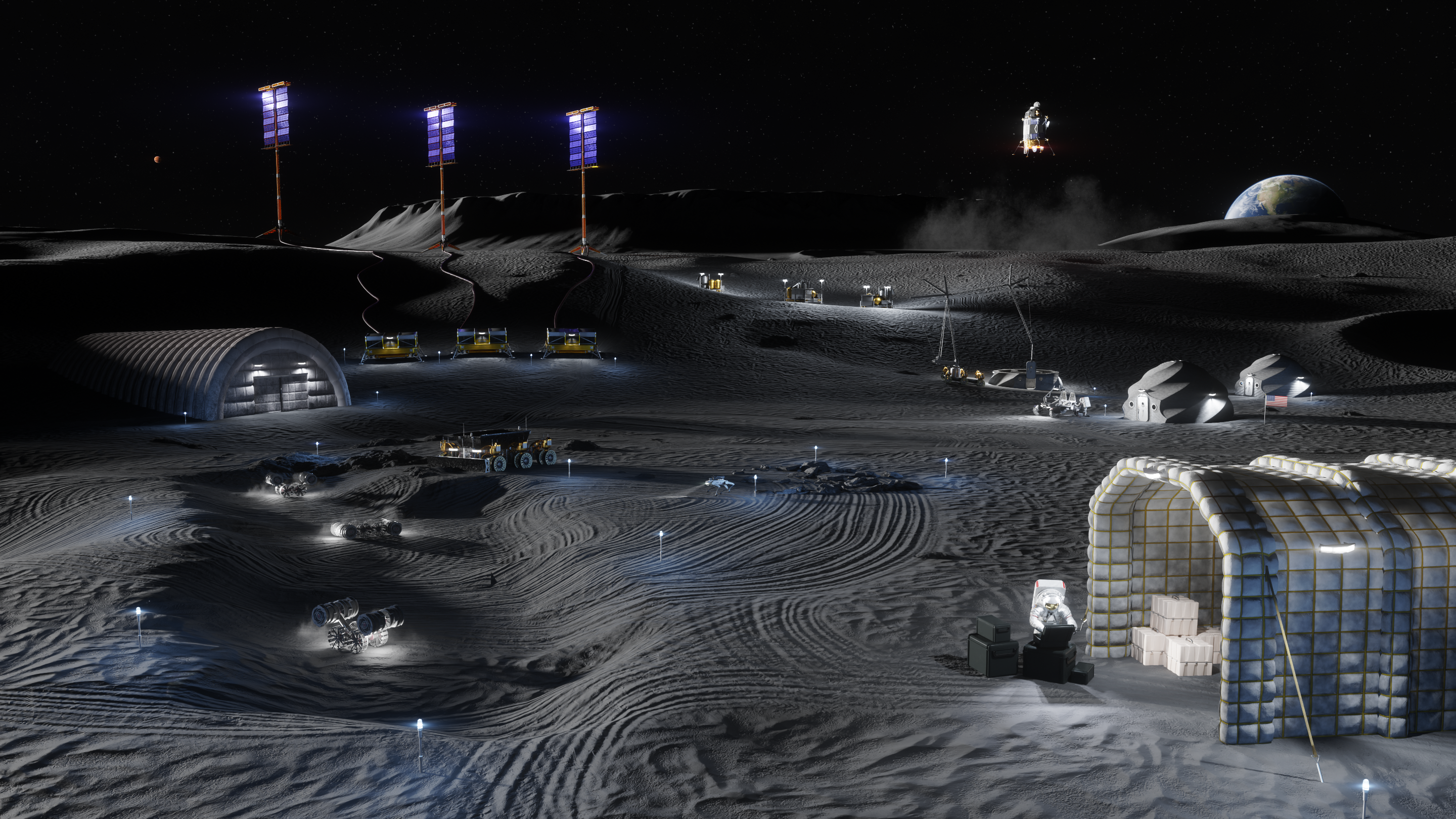
NASA is asking U.S.-based collegiate teams to submit bold, original concepts to the 2027 edition of a student challenge focused on aerospace innovation that could help the agency envision a future on the Moon shaped by new technology.
The latest NASA Revolutionary Aerospace Systems Concepts – Academic Linkage (RASC-AL) competition invites student teams to explore new operations paradigms and advance the technologies needed to support sustained operations in the lunar South Pole region.
“This competition showcases the technical excellence and creativity of the next generation of explorers and innovators,” said Chris Jones, chief technologist, Systems Analysis and Concepts Directorate, NASA’s Langley Research Center in Hampton, Virginia. “The concepts students develop through RASC-AL demonstrate exceptional talent and contribute to the body of work that advances NASA’s missions.”
Since 2002, the annual RASC-AL competition has helped foster aerospace concepts, technology, and prototyping by making connections among universities, NASA, and industry. This year’s competition includes themes ranging from the development of concepts to support prospecting in the permanently shadowed regions of lunar craters to the advancement of critical and expandable infrastructure for future astronauts.
“NASA’s RASC-AL competition connects top university researchers with the agency’s technology and engineering challenges,” said Gabe Merrill, acting cross-program integration lead for the Advanced Research and Technology Division in NASA’s Research and Technology Mission Directorate. “By asking student innovators to design concepts for what our future on the Moon might look like, this competition accelerates the technology we need to explore the Moon and provides a development opportunity for future aerospace innovators and leaders.”
Teams interested in participating are required to submit a non-binding notice of intent by Tuesday, Oct. 13, and will be invited to a Q&A session with NASA experts on Oct. 27.
Challenge proposals and accompanying video submissions are due Feb. 24, 2027. Proposals should demonstrate innovative solutions supported by original engineering and analysis in response to one of the four 2027 RASC-AL themes:
- Enabling extreme exploration
- Transit pathway construction
- Lunar resource exploration
- Smart and resilient lunar habitat
The competition will select as many as 14 teams to advance to its final phase, which involves further developing their concepts, writing a technical paper, and creating a technical poster. Each finalist team will receive a $7,500 award to facilitate its full participation. Finalists will present their concepts to a panel of NASA and industry experts at the 2027 RASC-AL Forum in Cocoa Beach, Florida, June 7 to 10, 2027.
The top two overall teams will receive an additional monetary award and an invitation to attend and present their concept at an aerospace conference later in 2027.
Interested student teams are encouraged to visit the official RASC-AL competition website for detailed guidelines and eligibility requirements.
The 2027 NASA RASC-AL Competition is administered by the National Institute of Aerospace on behalf of NASA’s Advanced Research and Technology Division within the Research and Technology Mission Directorate. NASA’s Center of Excellence for Collaborative Innovation, part of the Prizes, Challenges, and Crowdsourcing Program within the Research and Technology Mission Directorate, manages the challenge contract.
Keep Exploring Discover More Topics From NASANASA Prizes, Challenges, and Crowdsourcing
Langley Research Center
NASA’s Lunar Surface Innovation Initiative
CoECI
NASA Competition Invites Students to Help Imagine a Future Enabled by Lunar Technologies
3 min read
Preparations for Next Moonwalk Simulations Underway (and Underwater) Artist’s rendering depicting lunar surface operations at a future base in the lunar South Pole. NASANASA is asking U.S.-based collegiate teams to submit bold, original concepts to the 2027 edition of a student challenge focused on aerospace innovation that could help the agency envision a future on the Moon shaped by new technology.
The latest NASA Revolutionary Aerospace Systems Concepts – Academic Linkage (RASC-AL) competition invites student teams to explore new operations paradigms and advance the technologies needed to support sustained operations in the lunar South Pole region.
“This competition showcases the technical excellence and creativity of the next generation of explorers and innovators,” said Chris Jones, chief technologist, Systems Analysis and Concepts Directorate, NASA’s Langley Research Center in Hampton, Virginia. “The concepts students develop through RASC-AL demonstrate exceptional talent and contribute to the body of work that advances NASA’s missions.”
Since 2002, the annual RASC-AL competition has helped foster aerospace concepts, technology, and prototyping by making connections among universities, NASA, and industry. This year’s competition includes themes ranging from the development of concepts to support prospecting in the permanently shadowed regions of lunar craters to the advancement of critical and expandable infrastructure for future astronauts.
“NASA’s RASC-AL competition connects top university researchers with the agency’s technology and engineering challenges,” said Gabe Merrill, acting cross-program integration lead for the Advanced Research and Technology Division in NASA’s Research and Technology Mission Directorate. “By asking student innovators to design concepts for what our future on the Moon might look like, this competition accelerates the technology we need to explore the Moon and provides a development opportunity for future aerospace innovators and leaders.”
Teams interested in participating are required to submit a non-binding notice of intent by Tuesday, Oct. 13, and will be invited to a Q&A session with NASA experts on Oct. 27.
Challenge proposals and accompanying video submissions are due Feb. 24, 2027. Proposals should demonstrate innovative solutions supported by original engineering and analysis in response to one of the four 2027 RASC-AL themes:
- Enabling extreme exploration
- Transit pathway construction
- Lunar resource exploration
- Smart and resilient lunar habitat
The competition will select as many as 14 teams to advance to its final phase, which involves further developing their concepts, writing a technical paper, and creating a technical poster. Each finalist team will receive a $7,500 award to facilitate its full participation. Finalists will present their concepts to a panel of NASA and industry experts at the 2027 RASC-AL Forum in Cocoa Beach, Florida, June 7 to 10, 2027.
The top two overall teams will receive an additional monetary award and an invitation to attend and present their concept at an aerospace conference later in 2027.
Interested student teams are encouraged to visit the official RASC-AL competition website for detailed guidelines and eligibility requirements.
The 2027 NASA RASC-AL Competition is administered by the National Institute of Aerospace on behalf of NASA’s Advanced Research and Technology Division within the Research and Technology Mission Directorate. NASA’s Center of Excellence for Collaborative Innovation, part of the Prizes, Challenges, and Crowdsourcing Program within the Research and Technology Mission Directorate, manages the challenge contract.
Keep Exploring Discover More Topics From NASANASA Prizes, Challenges, and Crowdsourcing
Langley Research Center
NASA’s Lunar Surface Innovation Initiative
CoECI
6 space board games to channel the political drama of 'For All Mankind' and 'Star City'
'For All Mankind' was pretty good, wasn't it? Sadly, the show's run has finished now, and while we've got spin-off 'Star City' picking up the mantle, it's still going to be a while before we get any more space politics drama on our screens. Luckily, we can find it on our tabletops instead, with these fantastic space board games.
If you haven't seen it, For All Mankind is the story of an alternate history in which the space race between the U.S. and Russia never fizzled out. Instead, it becomes a multigenerational competition that drives everything from electric vehicle adoption to gender equality.
If, like millions of other Apple TV subscribers, you've been rapt watching 'For All Mankind' and want to bring some of that hot diplomacy and betrayal to your own kitchen table, you're in luck. Several space-based board games let you get a taste of the space race intrigue without having to connive your way to the top of an actual space agency.
Social deduction games have exploded in recent years with good reason. Some of the best tabletop games include some level of politicking, as well as the deal-making, deception, and favor trading that entails. Making social and technological advances often comes at the cost of high levels of international brinkmanship and some very gray ethics.
So, are you ready to kick off the space race once again? Here are 7 space board games that capture the high drama of the era, but without all the devastating foreign policy implications of the real thing.
1. Twilight Struggle(Image credit: GMT Games)Developer: Ananda Gupta, Trevor Devries | Release Date: 2005 | Players: 2 | Recommended Age: 13+
Twilight Struggle is a perfect distillation of the tension and national anxiety embodied by the Cold War. It follows the conflict between the U.S. and Russia across five decades, and its space race track mirrors For All Mankind's geopolitical stakes.
Every satellite you managed to hurl into the atmosphere or astronaut you successfully guide into space represents both a technical and a propaganda victory. It’s like watching Margo Madison and Sergei Nikulov battle with dice in place of launch vehicles.
Buy "Twilight Struggle" at GMT Games
2. Twilight Imperium(Image credit: Future (Ian Stokes))Developer: Corey Konieczka (Fantasy Flight Games) | Release Date: 2017 | Players: 3-6 (up to 8 with expansions) | Recommended Age: 14+
Considered by many to be the gold standard in space politicking, Twilight Imperium drops you into a vast galaxy after the fall of the ancient Lazax empire.
Players take on the role of interstellar empires competing to conquer the capital planet at the center of a huge galaxy. They achieve this by building space docks and warships, trading goods, and clashing in cosmic combat.
The true brilliance of TI lies in its asymmetry, with each of the 17 factions having a variety of advantages and quirks that differentiate it from the others, and the way it drives players to negotiate with — and backstab — each other on the galactic stage.
Laws and elections can quickly shift the balance of power in the game, and the rules can be subverted or twisted to your advantage through the deft deployment of crushing bureaucracy. It's a long game and not one for beginners, but there really is nothing quite like a session of Twilight Imperium.
Buy "Twilight Imperium" at Asmodee
3. High Frontier (4th Edition)(Image credit: Ion Game Design)Developer: Phil Eklund (Sierra Madre Games) | Release Date: 2019 | Players: 1-5 | Recommended Age: 14+
Designed by real-world aerospace engineer and rocket scientist Phil Eklund, High Frontier puts you at the helm of a space agency or private aerospace company and tasks you with building a self-sustaining space economy.
It channels For All Mankind’s scientific obsession and is a great showcase for the intersection of personal and national ambition and feasibility. Every decision feels freighted with international importance, and players are forced to grapple with mechanics like realistically modeled orbital mechanics and unforgiving resource scarcity.
Beware, though; High Frontier is one of the most complex board games ever developed, but can also be one of the most rewarding for committed players.
Buy "High Frontier" at Ion Game Design.
4. SpaceCorp: 2025–2300 AD(Image credit: GMT Games)Developer: Phil Eklund (Sierra Madre Games) | Release Date: 2018 | Players: 1-5 | Recommended Age: 14+
SpaceCorp takes us far beyond the imagined future of For All Mankind's world of governmental space agency programs, and into a timeline where vast, powerful corporations have transformed cosmic exploration and exploitation into big business.
Players begin in low Earth orbit and steadily expand their way into the depths of space, trying to find the balance between risk and profit. Like any good far future dystopia, SpaceCorp positions massive corporations as the true governing entities of the future, swapping in private investors for diplomats and corporate boards for politicians.
It's the natural evolution of the creeping commercialization that For All Mankind's later seasons begin to gesture towards. Real life is making similar gestures, if we're honest, and I, for one, welcome our new corporate overlords.
Buy "SpaceCorp: 2025–2300 AD" at Amazon.
5. Terraforming Mars(Image credit: Future)Developer: Jacob Fryxelius (FryxGames) | Release Date: 2016 | Players: 1-5 | Recommended Age: 12+
Terraforming Mars takes the terrestrial-based space race so vividly portrayed in For All Mankind and ships it to the Martian surface.
Players compete to build massive engines of profit and production to transform Mars into a livable habitat, all in the glorious name of cutthroat capitalism.
It perfectly embodies the dream-versus-profit conflict so adeptly portrayed in For All Mankind, while also reflecting the later seasons' focus on the red planet as a new stage for human rivalry and ethical reckoning, clothed in the reassuring euphemism of progress.
6. Eclipse: Second Dawn for the Galaxy(Image credit: Kolossal Games)Developer: Touko Tahkokallio (Lautapelit.fi) | Release Date: 2020 | Players: 2-6 | Recommended Age: 14+
A personal favorite, Eclipse is a 4X* game that blends elements of exploration with research and direct (fairly deterministic) combat.
Players ruthlessly compete for victory points derived from controlling systems, building specific structures, discovering artifacts, and researching scientific innovations. It's a beautiful interpretation of one of our world's oldest refrains, the often impossible balance of diplomacy and domination.
A full game of Eclipse ends up reflecting on human nature in some of the same ways the show does, illustrating how often our best intentions are undermined by our desire for personal advancement (or total victory).
*4X stands for Explore, Expand, Exploit, Exterminate.
Cards Against Humanity wants to erect a monument to 'honor' Elon Musk
Cards Against Humanity isn't done with its scorched-Earth campaign against SpaceX and Elon Musk.
The Chicago-based company behind the popular fill-in-the-blank adult card game is inviting the public to join its design committee to erect an "Elon Musk is a Sad Little B----- with No Friends" monument on a stretch of land it owns near SpaceX's Starbase manufacturing and test facility in South Texas.
Cards Against Humanity (CAH) brought a $15 million lawsuit against SpaceX in 2024 for illegally dumping construction materials and other equipment on land owned by CAH. SpaceX decided to settle with the company in 2025 and removed its "gravel, tractors, and space garbage" from the property prior to the area's annexation for the city of Starbase's incorporation, according to CAH. But the company, and its apparent distaste for "racist billionaires," as it has labeled Musk, as well as President Trump, is still pushing back.
Trump's role in the ordeal informs why CAH owns the Texas property in the first place. The company launched the "Cards Against Humanity Saves America" campaign during Trump's first term in 2017, which included an effort to throw a roadblock in the U.S. government's ability to complete construction of a U.S.-Mexico border wall.
The campaign attracted 150,000 contributors who paid $15 each, enabling CAH to purchase the land and retain the services of an eminent domain law firm "to make it as time-consuming and expensive as possible for Trump to build his wall."
SpaceX had already purchased much of the surrounding land by then and officially broke ground at what would become Starbase in 2014. Starbase is the center of development and operations for SpaceX's Starship rocket — a fully reusable launch vehicle that will clock in as the world's largest, most powerful rocket in history once it's operational.
Major construction at Starbase began in earnest in 2018, with the first Starship prototype vehicle tests beginning in 2019. When CAH filed its lawsuit against SpaceX in 2024, SpaceX had already managed to launch four full-stack Starship test flights and begun construction of a second Starbase launch pad. That's around when the facility's general expansion began to encroach on CAH's property, according to a complaint the company filed in Texas' Cameron County 404th District Court.
Cards Against Humanity's property before SpaceX's trespassing violation.Cards Against HumanityCards Against Humanity's property after SpaceX's trespassing violation.Cards Against HumanityStarbase's location at the very southern tip of Texas provides a safe and remote area for testing giant rockets. But SpaceX's increased activity there has triggered a large influx of employees in search of housing in and around the unincorporated Boca Chica area, which had been sparsely populated. SpaceX eventually began constructing clusters of homes for its employees around its facilities, and, in an effort to obtain some control over local governance for things like zoning and permitting, workers and residents voted to incorporate Starbase as its own city in May 2025.
That CAH's plot of land was annexed as part of Starbase's official incorporation has apparently not sat well with the people behind the popular card game, and they are once again engaging the public to try to get Musk's attention. In a Threads post on Aug. 13, the company asked, "Who wants to f---- with Elon Musk?"
"Now, our parcel has been annexed into a 'town' called 'Starbase' — a corporate hellscape littered with broken rockets and ugly mansions for Musk's executives," the post says. In typically colorful CAH fashion, it adds, "But hope is not lost! We still have our rights as proud Texas landowners: We can build something on our land. Something that will annoy Elon Musk. A grand monument to make him wonder, for a brief moment, 'Wait, am I a sad little b---- with no friends?'"
A map from CAH showing its land in Starbase, Texas. (Image credit: Cards Against Humanity)The announcement calls for the formation of a design committee for the aforementioned monument, which CAH describes as "a movement of like-minded people working together … to force a moment of introspection" for Musk, available for anyone to join for $10 at "ElonHasNoFriends.com". The post also advertises that 10% of profits from sales of its new game expansion decks will go toward funding the monument as well.
CAH isn't alone in criticizing Musk and SpaceX's Starbase activities. Musk's public persona has grown exponentially with SpaceX's successes over the past decade or so and his 2022 purchase of the social media platform Twitter, which he renamed X. Musk has also drawn criticism for his comments and actions during the 2024 election, which he may have helped swing via the donation of nearly $300 million to Trump and other Republican candidates. As early as 2022, a group of anonymous SpaceX employees posted an open letter to executives on an internal company forum saying, "Elon's behavior in the public sphere is a frequent source of distraction and embarrassment."
Others, however, praise Musk for the inarguable contribution of reusable rockets that SpaceX introduced with the Falcon 9, and his aspiration to make humanity a multi-planetary species. He was also named Time Magazine's person of the year in 2021, and SpaceX has become an indispensable asset to NASA and U.S. spaceflight. The company's Crew Dragon capsule is currently the only American-launched spacecraft capable of transporting astronauts to the International Space Station, and NASA has contracted SpaceX to design a lunar lander version of Starship to deliver astronauts to the surface of the moon on Artemis IV in 2028.
SpaceX's activities at Starbase have received scrutiny as well. When the Federal Aviation Administration (FAA) conducted its environmental assessment of Starbase to approve Starship launches from the site in 2021, more than 18,000 comments were submitted by members of the public, delaying the report's publication for nearly half a year as each one was reviewed. When the FAA did publish its assessment, SpaceX was cleared for Starship launches out of Starbase, pending nearly 80 actions needed to ensure its reduced environmental impact on the area, which SpaceX soon addressed.
To date, SpaceX has launched 13 Starship test flights with varying degrees of success. Some have resulted in the awesome return and catch of the rocket's Super Heavy booster using the "Mechazilla" chopstick arms on the Starbase launch tower, others featured Starship debris raining down within view of populated areas like The Bahamas, and at least a couple launches ended with a combination of both those outcomes.
The very public display of exploding rockets from SpaceX over the last several years has raised more than a few eyebrows of people wondering about the repercussions of where that potential aerospace carnage might come crashing down. But those results are also indicative of SpaceX's iterative "test like you fly" philosophy for vehicle development.
Musk sees Starship as humanity's ticket to extending our species' footprint to the moon, Mars and beyond, and is often quoted saying, about Starship and other subject matter, that "we live on the most interesting timeline." If Starship lives up to Musk and SpaceX's promises, it stands to create another monumental, industry-changing impact on spaceflight history, with the potential to launch our civilization into the cosmos. And, if it has to lift off within sight of a monument calling SpaceX's CEO "a sad little b---- with no friends," that would be pretty interesting indeed.
Tropical Storm Lala nears Hawaii as forecasters expect it to strengthen into a hurricane
Hawaii rarely sees direct hurricane hits—if Lala strengthens, it will be just the third recorded hurricane to make landfall there
NASA Announces MAX POWER: America’s Newest Aerospace Expo, Airshow
In honor of America’s historic 250th anniversary, NASA announced on Friday MAX POWER, a public exposition of American air and space innovation, Nov. 7 and Nov. 8, on and near the agency’s Kennedy Space Center in Florida.
The multi-day, family-friendly event will showcase the next-generation aircraft, spacecraft, autonomous vehicles, and technologies that will help define the future of transportation in air and space, bringing together the public, innovators, investors, pilots, astronauts, engineers, and companies helping open this new frontier.
“This November, we are opening Kennedy Space Center’s historic Shuttle Landing Facility to the public for America’s newest and most exciting aerospace technology expo and airshow, and we are calling it MAX POWER,” said NASA Administrator Jared Isaacman. “For 250 years, America has advanced by building what did not exist, flying higher, moving faster, and reaching toward the near-impossible. There is no better place to celebrate that spirit than at NASA Kennedy, America’s gateway to the stars and the place where so many of our nation’s greatest achievements began.”
By bringing together the legacy of NASA with the companies and technologies shaping what comes next, MAX POWER aims to ignite the spirit of exploration and inspire the next generation of explorers, builders, and dreamers. In addition to the agency, Air Dot Show, Delaware North, Space Florida, Purpose Entertainment, and UP.Summit are external collaborators.
Some activities will take place at NASA Kennedy, including the Apollo Saturn V facility, and the Launch and Landing Facility currently leased by Space Florida. Others will take place at the Kennedy Space Center Visitor Complex adjacent to the center leading up to, and during, the festival.
Events include:
- An air show featuring NASA aircraft, the U.S. Air Force Thunderbirds, and aerial demonstrations by multiple branches of the Department of War
- Guest speaker series featuring NASA experts and Apollo and Artemis astronauts
- Special exhibits and displays showcasing technology demonstrations, historic and current NASA hardware aircraft, commercial aviation displays, next-generation air mobility, and more
- Behind-the-gates bus tours of NASA’s Kennedy Space Center, including the Gantry, Apollo Saturn V Center, and Vehicle Assembly Building
MAX POWER will give the public a front-row seat to the future of American aerospace, including advanced aircraft, autonomous systems, commercial space, NASA’s work to return Americans to the lunar surface, plans for a Moon Base, and the technologies strengthening America’s aerospace industrial base. Teams will highlight work in aviation, exploration, and innovation for the benefit of humanity.
“For a decade, UP.Summit has convened the companies, investors, entrepreneurs, and policymakers building the future of how the world moves,” said Cyrus Sigari, UP.Summit founder and mission commander. “This November we bring that community to Kennedy Space Center as part of MAX POWER. The public will stand next to the aircraft, spacecraft, and autonomous systems that will define the next 250 years and meet the people building them. MAX POWER is about lighting that spark in thousands of Americans and showing the world what this country builds when it aims high.”
“It is an honor to collaborate with NASA and bring an aviation spectacle to the skies over Kennedy Space Center as part of MAX POWER,” said Bryan Lilley, CEO of Air Dot Show. “There could not be a more iconic place to celebrate the past, showcase the present, and preview the future of American aviation and space exploration as our nation marks its 250th anniversary.”
“Kennedy Space Center Visitor Complex is where America’s history of aerospace innovation comes to life, from the aircraft that helped launch the space program to the spacecraft that carried us to the Moon and the technologies shaping what comes next,” said Therrin Protze, chief operating officer of Kennedy Space Center Visitor Complex. “MAX POWER brings that entire story together in one place, giving the public an up-close look at the past, present and future of American aerospace.”
“Florida has been part of some of the most historic moments in American space exploration, and we’re proud to welcome the nation to this storied site for MAX POWER this fall,” said Col. Rob Long (Ret.), president and CEO, Space Florida. “Together with NASA, we have spent generations building the infrastructure, talent, and spirit of innovation that make moments like this possible, and this event offers a front-row seat to that ongoing story.”
This event is open to U.S. and international media. To attend, media must RSVP by 5 p.m. on Tuesday, Oct. 6, to the Kennedy newsroom at: https://media.ksc.nasa.gov. NASA’s media accreditation policy is available online.
There are multiple “parks” and experiences planned, each of which require separate tickets to attend. To learn more and purchase tickets, visit:
-end-
Bethany Stevens / Cheryl Warner
Headquarters, Washington
202-358-1600
bethany.c.stevens@nasa.gov / cheryl.m.warner@nasa.gov
Amanda Griffin
Kennedy Space Center, Fla.
321-593-6244
amanda.griffin@nasa.gov
NASA Announces MAX POWER: America’s Newest Aerospace Expo, Airshow
In honor of America’s historic 250th anniversary, NASA announced on Friday MAX POWER, a public exposition of American air and space innovation, Nov. 7 and Nov. 8, on and near the agency’s Kennedy Space Center in Florida.
The multi-day, family-friendly event will showcase the next-generation aircraft, spacecraft, autonomous vehicles, and technologies that will help define the future of transportation in air and space, bringing together the public, innovators, investors, pilots, astronauts, engineers, and companies helping open this new frontier.
“This November, we are opening Kennedy Space Center’s historic Shuttle Landing Facility to the public for America’s newest and most exciting aerospace technology expo and airshow, and we are calling it MAX POWER,” said NASA Administrator Jared Isaacman. “For 250 years, America has advanced by building what did not exist, flying higher, moving faster, and reaching toward the near-impossible. There is no better place to celebrate that spirit than at NASA Kennedy, America’s gateway to the stars and the place where so many of our nation’s greatest achievements began.”
By bringing together the legacy of NASA with the companies and technologies shaping what comes next, MAX POWER aims to ignite the spirit of exploration and inspire the next generation of explorers, builders, and dreamers. In addition to the agency, Air Dot Show, Delaware North, Space Florida, Purpose Entertainment, and UP.Summit are external collaborators.
Some activities will take place at NASA Kennedy, including the Apollo Saturn V facility, and the Launch and Landing Facility currently leased by Space Florida. Others will take place at the Kennedy Space Center Visitor Complex adjacent to the center leading up to, and during, the festival.
Events include:
- An air show featuring NASA aircraft, the U.S. Air Force Thunderbirds, and aerial demonstrations by multiple branches of the Department of War
- Guest speaker series featuring NASA experts and Apollo and Artemis astronauts
- Special exhibits and displays showcasing technology demonstrations, historic and current NASA hardware aircraft, commercial aviation displays, next-generation air mobility, and more
- Behind-the-gates bus tours of NASA’s Kennedy Space Center, including the Gantry, Apollo Saturn V Center, and Vehicle Assembly Building
MAX POWER will give the public a front-row seat to the future of American aerospace, including advanced aircraft, autonomous systems, commercial space, NASA’s work to return Americans to the lunar surface, plans for a Moon Base, and the technologies strengthening America’s aerospace industrial base. Teams will highlight work in aviation, exploration, and innovation for the benefit of humanity.
“For a decade, UP.Summit has convened the companies, investors, entrepreneurs, and policymakers building the future of how the world moves,” said Cyrus Sigari, UP.Summit founder and mission commander. “This November we bring that community to Kennedy Space Center as part of MAX POWER. The public will stand next to the aircraft, spacecraft, and autonomous systems that will define the next 250 years and meet the people building them. MAX POWER is about lighting that spark in thousands of Americans and showing the world what this country builds when it aims high.”
“It is an honor to collaborate with NASA and bring an aviation spectacle to the skies over Kennedy Space Center as part of MAX POWER,” said Bryan Lilley, CEO of Air Dot Show. “There could not be a more iconic place to celebrate the past, showcase the present, and preview the future of American aviation and space exploration as our nation marks its 250th anniversary.”
“Kennedy Space Center Visitor Complex is where America’s history of aerospace innovation comes to life, from the aircraft that helped launch the space program to the spacecraft that carried us to the Moon and the technologies shaping what comes next,” said Therrin Protze, chief operating officer of Kennedy Space Center Visitor Complex. “MAX POWER brings that entire story together in one place, giving the public an up-close look at the past, present and future of American aerospace.”
“Florida has been part of some of the most historic moments in American space exploration, and we’re proud to welcome the nation to this storied site for MAX POWER this fall,” said Col. Rob Long (Ret.), president and CEO, Space Florida. “Together with NASA, we have spent generations building the infrastructure, talent, and spirit of innovation that make moments like this possible, and this event offers a front-row seat to that ongoing story.”
This event is open to U.S. and international media. To attend, media must RSVP by 5 p.m. on Tuesday, Oct. 6, to the Kennedy newsroom at: https://media.ksc.nasa.gov. NASA’s media accreditation policy is available online.
There are multiple “parks” and experiences planned, each of which require separate tickets to attend. To learn more and purchase tickets, visit:
-end-
Bethany Stevens / Cheryl Warner
Headquarters, Washington
202-358-1600
bethany.c.stevens@nasa.gov / cheryl.m.warner@nasa.gov
Amanda Griffin
Kennedy Space Center, Fla.
321-593-6244
amanda.griffin@nasa.gov
Will the new moon race turn Earth's nearest neighbor into a dumping ground?
An 8,800-pound (4,000 kilograms) Falcon 9 rocket stage hit the moon last Wednesday (Aug. 5), stirring lunar regolith in a massive plume of dust observable all the way from Earth.
The rocket joined some 3,000 manmade objects scattered on the surface of our planet's companion. Some experts think it's about time we start treating the pristine lunar environment with a bit more respect.
Around 200 tons of Earth stuff have been either deliberately left on or crashed into the moon since the beginning of the space age. Some of this material has a prominent place in history books: The descent modules from all six Apollo landing missions, Soviet Lunakhod rovers from the 1970s and China's 2010s Yutu 1 and 2 robots still sit where they had been left or ran out of power.
But there is also a lot of stuff on the moon that wasn't really meant to end up there. Astronomer and space historian Jonathan McDowell says that many rocket stages and other objects left in orbit between Earth and the moon since the first lunar missions in the 1960s may have ended up on the gray dirt. Four years before the Falcon 9 upper stage crashed near Einstein Crater, for example, part of a Chinese Long March 3C rocket slammed into the moon's far side. And experts think such incidents could become increasingly common in the coming years, as exploration of the moon intensifies.
"We're in a transitional moment," McDowell told Space.com. "From the era when there was rare lunar exploration mostly by the U.S. and the Soviet Union, we've seen over the past decade other nations landing on the moon and the beginning of commercial missions. But governance has not kept up with this. We don't have an international set of agreements on how to operate near the moon, how to coordinate activities near the moon, and we're really going to need it because, not only is the amount of activity at the moon increasing, but the number of different players is greatly increasing, too."
Human activities on the moon are governed by the 1967 United Nations Outer Space Treaty, Marieta Valdivia Lefort, a policy officer at the Royal Astronomical Society in the U.K., told Space.com. Article IX of that treaty binds countries to "conduct the exploration of outer space in a way that avoids harmful contamination," she said. But what exactly constitutes such contamination is unclear, she added.
"There are international legal frameworks that apply to activities on the moon and include obligations concerning harmful contamination, but there is no dedicated international 'waste law' or comprehensive 'rubbish-management' system for it," Lefort wrote in an email. "The Outer Space Treaty does not define when contamination becomes 'harmful.' It does not set numerical waste limits, create approved disposal sites or require every object on the moon to be removed."
South Korea's Danuri moon probe captured this photo of the spot where a SpaceX Falcon 9 upper stage hit the moon on Aug. 5, 2026. (Image credit: KARI)The moon is big. Its surface area, around 14.7 million square miles (38 million square kilometers) rivals that of Asia, Earth's largest continent, which covers 17 million square miles (44 million square km). But the moon's low gravity — around 17% that of Earth — means the dust that an impact stirs up travels a long way and takes a long time to settle, McDowell said.
"It's not just a local event," he said. "It's an equivalent to a continental-level event. In the future, when you have permanent human bases and scientific experiments on the moon, you don't want rocket stages smashing into the moon on a regular basis, creating big plumes of dust that could contaminate instruments or disturb gravitational wave detectors."
Moreover, the artificial material introduced and the craters that arise when heavy rocket stages smash into the lunar surface are altering the lunar environment, potentially erasing yet unexplored scientific material.
"The moon is naturally struck by meteoroids, and those impacts form part of the geological record that scientists are trying to understand," Lefort wrote. "The main concern is the alteration of the moon's physical and chemical environment, particularly where repeated disturbances could damage or obscure valuable scientific evidence."
A Chinese rocket body impacted the moon on March 4, 2022, creating a double crater roughly 95 feet (29 meters), as seen in this photo taken by NASA's Lunar Reconnaissance Orbiter. (Image credit: NASA/GSFC/Arizona State University)Gregory Radisic, a space law expert at Australia's Bond University, told Space.com that the Falcon 9 crash was timely, as it can stir debate about responsible behavior in space before the moon gets too busy.
"It's not by good planning that this didn't hit something important," he said. "It's by pure luck that we're only having a conversation about theoretical problems down the line and that this did not destroy a million-dollar experiment or an important site of scientific study."
He added that spaceflight companies may start paying attention to the risks only after human lives are lost or expensive infrastructure suffers, resulting in tangible fines and consequences.
"When there is a loss of life or a loss of investment, the industry will start to care," Radisic said. "As long as things are losing aesthetic or scientific value, the industry is not likely going to care."
The Falcon 9 rocket stage that hit the moon was left in a high-altitude orbit around Earth in January 2025, after it propelled Firefly Aerospace's Blue Ghost and ispace's Resilience landers to the moon.
McDowell explained that, as the rocket stage was left relatively close to the moon, it got repeatedly influenced by lunar gravity, eventually spiralling into its surface.
"If you leave [an object] in an orbit that's in this middle region that is far enough that the moon's gravity is affecting it but not far enough out to go into orbit around the sun, then that orbit is very hard to predict," McDowell said. "The orbital uncertainties multiply over many passes and, eventually, if you get unlucky, the moon tugs it into an orbit where it's going to hit either the moon or Earth in a completely unpredictable way."
McDowell said that, since the January 2025 launch, SpaceX has been pushing its moon-mission rockets farther out into orbit around the sun.
"I hope that we're going to see a new norm evolve, and that what we have seen now is not how you dispose of your rocket stages in the future," he said.
Another First for the JWST: It Detects Three Supermassive Black Holes in the Same Galaxy
Astronomers working with the JWST have found a galaxy only 1.3 billion years after the Big Bang that contains three black holes. Two are close to the galaxy's center and will merge soon. The third is more distant, and is expected to merge much later. The discovery shows that black hole mergers were an important contributor to the masses of the SMBH we find in galaxies today.
Volunteer Develops Machine-Learning Tool to Identify Rare Clouds
Certain kinds of clouds are misbehaving – appearing more often and lower in the sky than they used to. To help identify the factors influencing these changes (e.g. shifts in Earth’s long-term weather patterns), scientists have asked people around the world with cameras to submit fresh images of these clouds as a part of the NASA-supported Space Cloud Watch project. Now, one volunteer has developed a new tool to help other Space Cloud Watch volunteers work more efficiently.
The misbehaving clouds are “noctilucent” or “night-shining” clouds (NLCs). These clouds scatter light from the Sun long after sunset and long before sunrise, giving them a silvery glow. But despite this glow, it can be hard to differentiate NLCs from lower-altitude look-alikes. That confusion has meant extra work for project leaders.
Volunteer Namai Chandra shared, “I noticed that NLC images were being manually verified by the project leaders. It felt like a task well-suited for a human-in-the-loop machine learning pipeline, one that could handle the repetitive screening automatically, while keeping human judgment central for the images that matter most.” In other words, Namai found a way to help observers verify when they are indeed seeing NLCs and when they’re not.
Namai reached out to the Space Cloud Watch scientists Drs. Chihoko Cullens and Brentha Thurairajah, who were delighted with his idea. Namai soon developed a machine learning pipeline, training it on a variety of cloud images, including both the NLCs and the lower altitude look-alikes that are often submitted to Space Cloud Watch. The pipeline combines image pre-screening, cloud classification, and confidence-based review routing. After several rounds of development, testing, and refinement, he released his NLC identification tool to the project. This tool is now being used by cloud contributors who are unsure whether they have observed NLCs, as well as project scientists that want to flag images for review.
Grab a camera and join the Space Cloud Watch project today! If you’ve hesitated to contribute to Space Cloud Watch because you were not certain if what you were seeing was a noctilucent cloud, you now have a way to check before you share – thanks to Namai.
Namai Chandra, Space Cloud Watch volunteer and creator of the Noctilucent Cloud Detector tool. Photo by Surabhi Chandra. Learn More and Get Involved Space Cloud Watch
Photograph clouds just after sunset or before dawn to investigate our changing atmosphere.
Facebook logo @nasascience_ @nasascience_ Instagram logo @nasascience_ Linkedin logo @nasascience_