
Feed aggregator
6 space board games to channel the political drama of 'For All Mankind' and 'Star City'
'For All Mankind' was pretty good, wasn't it? Sadly, the show's run has finished now, and while we've got spin-off 'Star City' picking up the mantle, it's still going to be a while before we get any more space politics drama on our screens. Luckily, we can find it on our tabletops instead, with these fantastic space board games.
If you haven't seen it, For All Mankind is the story of an alternate history in which the space race between the U.S. and Russia never fizzled out. Instead, it becomes a multigenerational competition that drives everything from electric vehicle adoption to gender equality.
If, like millions of other Apple TV subscribers, you've been rapt watching 'For All Mankind' and want to bring some of that hot diplomacy and betrayal to your own kitchen table, you're in luck. Several space-based board games let you get a taste of the space race intrigue without having to connive your way to the top of an actual space agency.
Social deduction games have exploded in recent years with good reason. Some of the best tabletop games include some level of politicking, as well as the deal-making, deception, and favor trading that entails. Making social and technological advances often comes at the cost of high levels of international brinkmanship and some very gray ethics.
So, are you ready to kick off the space race once again? Here are 7 space board games that capture the high drama of the era, but without all the devastating foreign policy implications of the real thing.
1. Twilight Struggle(Image credit: GMT Games)Developer: Ananda Gupta, Trevor Devries | Release Date: 2005 | Players: 2 | Recommended Age: 13+
Twilight Struggle is a perfect distillation of the tension and national anxiety embodied by the Cold War. It follows the conflict between the U.S. and Russia across five decades, and its space race track mirrors For All Mankind's geopolitical stakes.
Every satellite you managed to hurl into the atmosphere or astronaut you successfully guide into space represents both a technical and a propaganda victory. It’s like watching Margo Madison and Sergei Nikulov battle with dice in place of launch vehicles.
Buy "Twilight Struggle" at GMT Games
2. Twilight Imperium(Image credit: Future (Ian Stokes))Developer: Corey Konieczka (Fantasy Flight Games) | Release Date: 2017 | Players: 3-6 (up to 8 with expansions) | Recommended Age: 14+
Considered by many to be the gold standard in space politicking, Twilight Imperium drops you into a vast galaxy after the fall of the ancient Lazax empire.
Players take on the role of interstellar empires competing to conquer the capital planet at the center of a huge galaxy. They achieve this by building space docks and warships, trading goods, and clashing in cosmic combat.
The true brilliance of TI lies in its asymmetry, with each of the 17 factions having a variety of advantages and quirks that differentiate it from the others, and the way it drives players to negotiate with — and backstab — each other on the galactic stage.
Laws and elections can quickly shift the balance of power in the game, and the rules can be subverted or twisted to your advantage through the deft deployment of crushing bureaucracy. It's a long game and not one for beginners, but there really is nothing quite like a session of Twilight Imperium.
Buy "Twilight Imperium" at Asmodee
3. High Frontier (4th Edition)(Image credit: Ion Game Design)Developer: Phil Eklund (Sierra Madre Games) | Release Date: 2019 | Players: 1-5 | Recommended Age: 14+
Designed by real-world aerospace engineer and rocket scientist Phil Eklund, High Frontier puts you at the helm of a space agency or private aerospace company and tasks you with building a self-sustaining space economy.
It channels For All Mankind’s scientific obsession and is a great showcase for the intersection of personal and national ambition and feasibility. Every decision feels freighted with international importance, and players are forced to grapple with mechanics like realistically modeled orbital mechanics and unforgiving resource scarcity.
Beware, though; High Frontier is one of the most complex board games ever developed, but can also be one of the most rewarding for committed players.
Buy "High Frontier" at Ion Game Design.
4. SpaceCorp: 2025–2300 AD(Image credit: GMT Games)Developer: Phil Eklund (Sierra Madre Games) | Release Date: 2018 | Players: 1-5 | Recommended Age: 14+
SpaceCorp takes us far beyond the imagined future of For All Mankind's world of governmental space agency programs, and into a timeline where vast, powerful corporations have transformed cosmic exploration and exploitation into big business.
Players begin in low Earth orbit and steadily expand their way into the depths of space, trying to find the balance between risk and profit. Like any good far future dystopia, SpaceCorp positions massive corporations as the true governing entities of the future, swapping in private investors for diplomats and corporate boards for politicians.
It's the natural evolution of the creeping commercialization that For All Mankind's later seasons begin to gesture towards. Real life is making similar gestures, if we're honest, and I, for one, welcome our new corporate overlords.
Buy "SpaceCorp: 2025–2300 AD" at Amazon.
5. Terraforming Mars(Image credit: Future)Developer: Jacob Fryxelius (FryxGames) | Release Date: 2016 | Players: 1-5 | Recommended Age: 12+
Terraforming Mars takes the terrestrial-based space race so vividly portrayed in For All Mankind and ships it to the Martian surface.
Players compete to build massive engines of profit and production to transform Mars into a livable habitat, all in the glorious name of cutthroat capitalism.
It perfectly embodies the dream-versus-profit conflict so adeptly portrayed in For All Mankind, while also reflecting the later seasons' focus on the red planet as a new stage for human rivalry and ethical reckoning, clothed in the reassuring euphemism of progress.
6. Eclipse: Second Dawn for the Galaxy(Image credit: Kolossal Games)Developer: Touko Tahkokallio (Lautapelit.fi) | Release Date: 2020 | Players: 2-6 | Recommended Age: 14+
A personal favorite, Eclipse is a 4X* game that blends elements of exploration with research and direct (fairly deterministic) combat.
Players ruthlessly compete for victory points derived from controlling systems, building specific structures, discovering artifacts, and researching scientific innovations. It's a beautiful interpretation of one of our world's oldest refrains, the often impossible balance of diplomacy and domination.
A full game of Eclipse ends up reflecting on human nature in some of the same ways the show does, illustrating how often our best intentions are undermined by our desire for personal advancement (or total victory).
*4X stands for Explore, Expand, Exploit, Exterminate.
Cards Against Humanity wants to erect a monument to 'honor' Elon Musk
Cards Against Humanity isn't done with its scorched-Earth campaign against SpaceX and Elon Musk.
The Chicago-based company behind the popular fill-in-the-blank adult card game is inviting the public to join its design committee to erect an "Elon Musk is a Sad Little B----- with No Friends" monument on a stretch of land it owns near SpaceX's Starbase manufacturing and test facility in South Texas.
Cards Against Humanity (CAH) brought a $15 million lawsuit against SpaceX in 2024 for illegally dumping construction materials and other equipment on land owned by CAH. SpaceX decided to settle with the company in 2025 and removed its "gravel, tractors, and space garbage" from the property prior to the area's annexation for the city of Starbase's incorporation, according to CAH. But the company, and its apparent distaste for "racist billionaires," as it has labeled Musk, as well as President Trump, is still pushing back.
Trump's role in the ordeal informs why CAH owns the Texas property in the first place. The company launched the "Cards Against Humanity Saves America" campaign during Trump's first term in 2017, which included an effort to throw a roadblock in the U.S. government's ability to complete construction of a U.S.-Mexico border wall.
The campaign attracted 150,000 contributors who paid $15 each, enabling CAH to purchase the land and retain the services of an eminent domain law firm "to make it as time-consuming and expensive as possible for Trump to build his wall."
SpaceX had already purchased much of the surrounding land by then and officially broke ground at what would become Starbase in 2014. Starbase is the center of development and operations for SpaceX's Starship rocket — a fully reusable launch vehicle that will clock in as the world's largest, most powerful rocket in history once it's operational.
Major construction at Starbase began in earnest in 2018, with the first Starship prototype vehicle tests beginning in 2019. When CAH filed its lawsuit against SpaceX in 2024, SpaceX had already managed to launch four full-stack Starship test flights and begun construction of a second Starbase launch pad. That's around when the facility's general expansion began to encroach on CAH's property, according to a complaint the company filed in Texas' Cameron County 404th District Court.
Cards Against Humanity's property before SpaceX's trespassing violation.Cards Against HumanityCards Against Humanity's property after SpaceX's trespassing violation.Cards Against HumanityStarbase's location at the very southern tip of Texas provides a safe and remote area for testing giant rockets. But SpaceX's increased activity there has triggered a large influx of employees in search of housing in and around the unincorporated Boca Chica area, which had been sparsely populated. SpaceX eventually began constructing clusters of homes for its employees around its facilities, and, in an effort to obtain some control over local governance for things like zoning and permitting, workers and residents voted to incorporate Starbase as its own city in May 2025.
That CAH's plot of land was annexed as part of Starbase's official incorporation has apparently not sat well with the people behind the popular card game, and they are once again engaging the public to try to get Musk's attention. In a Threads post on Aug. 13, the company asked, "Who wants to f---- with Elon Musk?"
"Now, our parcel has been annexed into a 'town' called 'Starbase' — a corporate hellscape littered with broken rockets and ugly mansions for Musk's executives," the post says. In typically colorful CAH fashion, it adds, "But hope is not lost! We still have our rights as proud Texas landowners: We can build something on our land. Something that will annoy Elon Musk. A grand monument to make him wonder, for a brief moment, 'Wait, am I a sad little b---- with no friends?'"
A map from CAH showing its land in Starbase, Texas. (Image credit: Cards Against Humanity)The announcement calls for the formation of a design committee for the aforementioned monument, which CAH describes as "a movement of like-minded people working together … to force a moment of introspection" for Musk, available for anyone to join for $10 at "ElonHasNoFriends.com". The post also advertises that 10% of profits from sales of its new game expansion decks will go toward funding the monument as well.
CAH isn't alone in criticizing Musk and SpaceX's Starbase activities. Musk's public persona has grown exponentially with SpaceX's successes over the past decade or so and his 2022 purchase of the social media platform Twitter, which he renamed X. Musk has also drawn criticism for his comments and actions during the 2024 election, which he may have helped swing via the donation of nearly $300 million to Trump and other Republican candidates. As early as 2022, a group of anonymous SpaceX employees posted an open letter to executives on an internal company forum saying, "Elon's behavior in the public sphere is a frequent source of distraction and embarrassment."
Others, however, praise Musk for the inarguable contribution of reusable rockets that SpaceX introduced with the Falcon 9, and his aspiration to make humanity a multi-planetary species. He was also named Time Magazine's person of the year in 2021, and SpaceX has become an indispensable asset to NASA and U.S. spaceflight. The company's Crew Dragon capsule is currently the only American-launched spacecraft capable of transporting astronauts to the International Space Station, and NASA has contracted SpaceX to design a lunar lander version of Starship to deliver astronauts to the surface of the moon on Artemis IV in 2028.
SpaceX's activities at Starbase have received scrutiny as well. When the Federal Aviation Administration (FAA) conducted its environmental assessment of Starbase to approve Starship launches from the site in 2021, more than 18,000 comments were submitted by members of the public, delaying the report's publication for nearly half a year as each one was reviewed. When the FAA did publish its assessment, SpaceX was cleared for Starship launches out of Starbase, pending nearly 80 actions needed to ensure its reduced environmental impact on the area, which SpaceX soon addressed.
To date, SpaceX has launched 13 Starship test flights with varying degrees of success. Some have resulted in the awesome return and catch of the rocket's Super Heavy booster using the "Mechazilla" chopstick arms on the Starbase launch tower, others featured Starship debris raining down within view of populated areas like The Bahamas, and at least a couple launches ended with a combination of both those outcomes.
The very public display of exploding rockets from SpaceX over the last several years has raised more than a few eyebrows of people wondering about the repercussions of where that potential aerospace carnage might come crashing down. But those results are also indicative of SpaceX's iterative "test like you fly" philosophy for vehicle development.
Musk sees Starship as humanity's ticket to extending our species' footprint to the moon, Mars and beyond, and is often quoted saying, about Starship and other subject matter, that "we live on the most interesting timeline." If Starship lives up to Musk and SpaceX's promises, it stands to create another monumental, industry-changing impact on spaceflight history, with the potential to launch our civilization into the cosmos. And, if it has to lift off within sight of a monument calling SpaceX's CEO "a sad little b---- with no friends," that would be pretty interesting indeed.
Tropical Storm Lala nears Hawaii as forecasters expect it to strengthen into a hurricane
Hawaii rarely sees direct hurricane hits—if Lala strengthens, it will be just the third recorded hurricane to make landfall there
NASA Announces MAX POWER: America’s Newest Aerospace Expo, Airshow
In honor of America’s historic 250th anniversary, NASA announced on Friday MAX POWER, a public exposition of American air and space innovation, Nov. 7 and Nov. 8, on and near the agency’s Kennedy Space Center in Florida.
The multi-day, family-friendly event will showcase the next-generation aircraft, spacecraft, autonomous vehicles, and technologies that will help define the future of transportation in air and space, bringing together the public, innovators, investors, pilots, astronauts, engineers, and companies helping open this new frontier.
“This November, we are opening Kennedy Space Center’s historic Shuttle Landing Facility to the public for America’s newest and most exciting aerospace technology expo and airshow, and we are calling it MAX POWER,” said NASA Administrator Jared Isaacman. “For 250 years, America has advanced by building what did not exist, flying higher, moving faster, and reaching toward the near-impossible. There is no better place to celebrate that spirit than at NASA Kennedy, America’s gateway to the stars and the place where so many of our nation’s greatest achievements began.”
By bringing together the legacy of NASA with the companies and technologies shaping what comes next, MAX POWER aims to ignite the spirit of exploration and inspire the next generation of explorers, builders, and dreamers. In addition to the agency, Air Dot Show, Delaware North, Space Florida, Purpose Entertainment, and UP.Summit are external collaborators.
Some activities will take place at NASA Kennedy, including the Apollo Saturn V facility, and the Launch and Landing Facility currently leased by Space Florida. Others will take place at the Kennedy Space Center Visitor Complex adjacent to the center leading up to, and during, the festival.
Events include:
- An air show featuring NASA aircraft, the U.S. Air Force Thunderbirds, and aerial demonstrations by multiple branches of the Department of War
- Guest speaker series featuring NASA experts and Apollo and Artemis astronauts
- Special exhibits and displays showcasing technology demonstrations, historic and current NASA hardware aircraft, commercial aviation displays, next-generation air mobility, and more
- Behind-the-gates bus tours of NASA’s Kennedy Space Center, including the Gantry, Apollo Saturn V Center, and Vehicle Assembly Building
MAX POWER will give the public a front-row seat to the future of American aerospace, including advanced aircraft, autonomous systems, commercial space, NASA’s work to return Americans to the lunar surface, plans for a Moon Base, and the technologies strengthening America’s aerospace industrial base. Teams will highlight work in aviation, exploration, and innovation for the benefit of humanity.
“For a decade, UP.Summit has convened the companies, investors, entrepreneurs, and policymakers building the future of how the world moves,” said Cyrus Sigari, UP.Summit founder and mission commander. “This November we bring that community to Kennedy Space Center as part of MAX POWER. The public will stand next to the aircraft, spacecraft, and autonomous systems that will define the next 250 years and meet the people building them. MAX POWER is about lighting that spark in thousands of Americans and showing the world what this country builds when it aims high.”
“It is an honor to collaborate with NASA and bring an aviation spectacle to the skies over Kennedy Space Center as part of MAX POWER,” said Bryan Lilley, CEO of Air Dot Show. “There could not be a more iconic place to celebrate the past, showcase the present, and preview the future of American aviation and space exploration as our nation marks its 250th anniversary.”
“Kennedy Space Center Visitor Complex is where America’s history of aerospace innovation comes to life, from the aircraft that helped launch the space program to the spacecraft that carried us to the Moon and the technologies shaping what comes next,” said Therrin Protze, chief operating officer of Kennedy Space Center Visitor Complex. “MAX POWER brings that entire story together in one place, giving the public an up-close look at the past, present and future of American aerospace.”
“Florida has been part of some of the most historic moments in American space exploration, and we’re proud to welcome the nation to this storied site for MAX POWER this fall,” said Col. Rob Long (Ret.), president and CEO, Space Florida. “Together with NASA, we have spent generations building the infrastructure, talent, and spirit of innovation that make moments like this possible, and this event offers a front-row seat to that ongoing story.”
This event is open to U.S. and international media. To attend, media must RSVP by 5 p.m. on Tuesday, Oct. 6, to the Kennedy newsroom at: https://media.ksc.nasa.gov. NASA’s media accreditation policy is available online.
There are multiple “parks” and experiences planned, each of which require separate tickets to attend. To learn more and purchase tickets, visit:
-end-
Bethany Stevens / Cheryl Warner
Headquarters, Washington
202-358-1600
bethany.c.stevens@nasa.gov / cheryl.m.warner@nasa.gov
Amanda Griffin
Kennedy Space Center, Fla.
321-593-6244
amanda.griffin@nasa.gov
NASA Announces MAX POWER: America’s Newest Aerospace Expo, Airshow
In honor of America’s historic 250th anniversary, NASA announced on Friday MAX POWER, a public exposition of American air and space innovation, Nov. 7 and Nov. 8, on and near the agency’s Kennedy Space Center in Florida.
The multi-day, family-friendly event will showcase the next-generation aircraft, spacecraft, autonomous vehicles, and technologies that will help define the future of transportation in air and space, bringing together the public, innovators, investors, pilots, astronauts, engineers, and companies helping open this new frontier.
“This November, we are opening Kennedy Space Center’s historic Shuttle Landing Facility to the public for America’s newest and most exciting aerospace technology expo and airshow, and we are calling it MAX POWER,” said NASA Administrator Jared Isaacman. “For 250 years, America has advanced by building what did not exist, flying higher, moving faster, and reaching toward the near-impossible. There is no better place to celebrate that spirit than at NASA Kennedy, America’s gateway to the stars and the place where so many of our nation’s greatest achievements began.”
By bringing together the legacy of NASA with the companies and technologies shaping what comes next, MAX POWER aims to ignite the spirit of exploration and inspire the next generation of explorers, builders, and dreamers. In addition to the agency, Air Dot Show, Delaware North, Space Florida, Purpose Entertainment, and UP.Summit are external collaborators.
Some activities will take place at NASA Kennedy, including the Apollo Saturn V facility, and the Launch and Landing Facility currently leased by Space Florida. Others will take place at the Kennedy Space Center Visitor Complex adjacent to the center leading up to, and during, the festival.
Events include:
- An air show featuring NASA aircraft, the U.S. Air Force Thunderbirds, and aerial demonstrations by multiple branches of the Department of War
- Guest speaker series featuring NASA experts and Apollo and Artemis astronauts
- Special exhibits and displays showcasing technology demonstrations, historic and current NASA hardware aircraft, commercial aviation displays, next-generation air mobility, and more
- Behind-the-gates bus tours of NASA’s Kennedy Space Center, including the Gantry, Apollo Saturn V Center, and Vehicle Assembly Building
MAX POWER will give the public a front-row seat to the future of American aerospace, including advanced aircraft, autonomous systems, commercial space, NASA’s work to return Americans to the lunar surface, plans for a Moon Base, and the technologies strengthening America’s aerospace industrial base. Teams will highlight work in aviation, exploration, and innovation for the benefit of humanity.
“For a decade, UP.Summit has convened the companies, investors, entrepreneurs, and policymakers building the future of how the world moves,” said Cyrus Sigari, UP.Summit founder and mission commander. “This November we bring that community to Kennedy Space Center as part of MAX POWER. The public will stand next to the aircraft, spacecraft, and autonomous systems that will define the next 250 years and meet the people building them. MAX POWER is about lighting that spark in thousands of Americans and showing the world what this country builds when it aims high.”
“It is an honor to collaborate with NASA and bring an aviation spectacle to the skies over Kennedy Space Center as part of MAX POWER,” said Bryan Lilley, CEO of Air Dot Show. “There could not be a more iconic place to celebrate the past, showcase the present, and preview the future of American aviation and space exploration as our nation marks its 250th anniversary.”
“Kennedy Space Center Visitor Complex is where America’s history of aerospace innovation comes to life, from the aircraft that helped launch the space program to the spacecraft that carried us to the Moon and the technologies shaping what comes next,” said Therrin Protze, chief operating officer of Kennedy Space Center Visitor Complex. “MAX POWER brings that entire story together in one place, giving the public an up-close look at the past, present and future of American aerospace.”
“Florida has been part of some of the most historic moments in American space exploration, and we’re proud to welcome the nation to this storied site for MAX POWER this fall,” said Col. Rob Long (Ret.), president and CEO, Space Florida. “Together with NASA, we have spent generations building the infrastructure, talent, and spirit of innovation that make moments like this possible, and this event offers a front-row seat to that ongoing story.”
This event is open to U.S. and international media. To attend, media must RSVP by 5 p.m. on Tuesday, Oct. 6, to the Kennedy newsroom at: https://media.ksc.nasa.gov. NASA’s media accreditation policy is available online.
There are multiple “parks” and experiences planned, each of which require separate tickets to attend. To learn more and purchase tickets, visit:
-end-
Bethany Stevens / Cheryl Warner
Headquarters, Washington
202-358-1600
bethany.c.stevens@nasa.gov / cheryl.m.warner@nasa.gov
Amanda Griffin
Kennedy Space Center, Fla.
321-593-6244
amanda.griffin@nasa.gov
Will the new moon race turn Earth's nearest neighbor into a dumping ground?
An 8,800-pound (4,000 kilograms) Falcon 9 rocket stage hit the moon last Wednesday (Aug. 5), stirring lunar regolith in a massive plume of dust observable all the way from Earth.
The rocket joined some 3,000 manmade objects scattered on the surface of our planet's companion. Some experts think it's about time we start treating the pristine lunar environment with a bit more respect.
Around 200 tons of Earth stuff have been either deliberately left on or crashed into the moon since the beginning of the space age. Some of this material has a prominent place in history books: The descent modules from all six Apollo landing missions, Soviet Lunakhod rovers from the 1970s and China's 2010s Yutu 1 and 2 robots still sit where they had been left or ran out of power.
But there is also a lot of stuff on the moon that wasn't really meant to end up there. Astronomer and space historian Jonathan McDowell says that many rocket stages and other objects left in orbit between Earth and the moon since the first lunar missions in the 1960s may have ended up on the gray dirt. Four years before the Falcon 9 upper stage crashed near Einstein Crater, for example, part of a Chinese Long March 3C rocket slammed into the moon's far side. And experts think such incidents could become increasingly common in the coming years, as exploration of the moon intensifies.
"We're in a transitional moment," McDowell told Space.com. "From the era when there was rare lunar exploration mostly by the U.S. and the Soviet Union, we've seen over the past decade other nations landing on the moon and the beginning of commercial missions. But governance has not kept up with this. We don't have an international set of agreements on how to operate near the moon, how to coordinate activities near the moon, and we're really going to need it because, not only is the amount of activity at the moon increasing, but the number of different players is greatly increasing, too."
Human activities on the moon are governed by the 1967 United Nations Outer Space Treaty, Marieta Valdivia Lefort, a policy officer at the Royal Astronomical Society in the U.K., told Space.com. Article IX of that treaty binds countries to "conduct the exploration of outer space in a way that avoids harmful contamination," she said. But what exactly constitutes such contamination is unclear, she added.
"There are international legal frameworks that apply to activities on the moon and include obligations concerning harmful contamination, but there is no dedicated international 'waste law' or comprehensive 'rubbish-management' system for it," Lefort wrote in an email. "The Outer Space Treaty does not define when contamination becomes 'harmful.' It does not set numerical waste limits, create approved disposal sites or require every object on the moon to be removed."
South Korea's Danuri moon probe captured this photo of the spot where a SpaceX Falcon 9 upper stage hit the moon on Aug. 5, 2026. (Image credit: KARI)The moon is big. Its surface area, around 14.7 million square miles (38 million square kilometers) rivals that of Asia, Earth's largest continent, which covers 17 million square miles (44 million square km). But the moon's low gravity — around 17% that of Earth — means the dust that an impact stirs up travels a long way and takes a long time to settle, McDowell said.
"It's not just a local event," he said. "It's an equivalent to a continental-level event. In the future, when you have permanent human bases and scientific experiments on the moon, you don't want rocket stages smashing into the moon on a regular basis, creating big plumes of dust that could contaminate instruments or disturb gravitational wave detectors."
Moreover, the artificial material introduced and the craters that arise when heavy rocket stages smash into the lunar surface are altering the lunar environment, potentially erasing yet unexplored scientific material.
"The moon is naturally struck by meteoroids, and those impacts form part of the geological record that scientists are trying to understand," Lefort wrote. "The main concern is the alteration of the moon's physical and chemical environment, particularly where repeated disturbances could damage or obscure valuable scientific evidence."
A Chinese rocket body impacted the moon on March 4, 2022, creating a double crater roughly 95 feet (29 meters), as seen in this photo taken by NASA's Lunar Reconnaissance Orbiter. (Image credit: NASA/GSFC/Arizona State University)Gregory Radisic, a space law expert at Australia's Bond University, told Space.com that the Falcon 9 crash was timely, as it can stir debate about responsible behavior in space before the moon gets too busy.
"It's not by good planning that this didn't hit something important," he said. "It's by pure luck that we're only having a conversation about theoretical problems down the line and that this did not destroy a million-dollar experiment or an important site of scientific study."
He added that spaceflight companies may start paying attention to the risks only after human lives are lost or expensive infrastructure suffers, resulting in tangible fines and consequences.
"When there is a loss of life or a loss of investment, the industry will start to care," Radisic said. "As long as things are losing aesthetic or scientific value, the industry is not likely going to care."
The Falcon 9 rocket stage that hit the moon was left in a high-altitude orbit around Earth in January 2025, after it propelled Firefly Aerospace's Blue Ghost and ispace's Resilience landers to the moon.
McDowell explained that, as the rocket stage was left relatively close to the moon, it got repeatedly influenced by lunar gravity, eventually spiralling into its surface.
"If you leave [an object] in an orbit that's in this middle region that is far enough that the moon's gravity is affecting it but not far enough out to go into orbit around the sun, then that orbit is very hard to predict," McDowell said. "The orbital uncertainties multiply over many passes and, eventually, if you get unlucky, the moon tugs it into an orbit where it's going to hit either the moon or Earth in a completely unpredictable way."
McDowell said that, since the January 2025 launch, SpaceX has been pushing its moon-mission rockets farther out into orbit around the sun.
"I hope that we're going to see a new norm evolve, and that what we have seen now is not how you dispose of your rocket stages in the future," he said.
Another First for the JWST: It Detects Three Supermassive Black Holes in the Same Galaxy
Astronomers working with the JWST have found a galaxy only 1.3 billion years after the Big Bang that contains three black holes. Two are close to the galaxy's center and will merge soon. The third is more distant, and is expected to merge much later. The discovery shows that black hole mergers were an important contributor to the masses of the SMBH we find in galaxies today.
Volunteer Develops Machine-Learning Tool to Identify Rare Clouds
Certain kinds of clouds are misbehaving – appearing more often and lower in the sky than they used to. To help identify the factors influencing these changes (e.g. shifts in Earth’s long-term weather patterns), scientists have asked people around the world with cameras to submit fresh images of these clouds as a part of the NASA-supported Space Cloud Watch project. Now, one volunteer has developed a new tool to help other Space Cloud Watch volunteers work more efficiently.
The misbehaving clouds are “noctilucent” or “night-shining” clouds (NLCs). These clouds scatter light from the Sun long after sunset and long before sunrise, giving them a silvery glow. But despite this glow, it can be hard to differentiate NLCs from lower-altitude look-alikes. That confusion has meant extra work for project leaders.
Volunteer Namai Chandra shared, “I noticed that NLC images were being manually verified by the project leaders. It felt like a task well-suited for a human-in-the-loop machine learning pipeline, one that could handle the repetitive screening automatically, while keeping human judgment central for the images that matter most.” In other words, Namai found a way to help observers verify when they are indeed seeing NLCs and when they’re not.
Namai reached out to the Space Cloud Watch scientists Drs. Chihoko Cullens and Brentha Thurairajah, who were delighted with his idea. Namai soon developed a machine learning pipeline, training it on a variety of cloud images, including both the NLCs and the lower altitude look-alikes that are often submitted to Space Cloud Watch. The pipeline combines image pre-screening, cloud classification, and confidence-based review routing. After several rounds of development, testing, and refinement, he released his NLC identification tool to the project. This tool is now being used by cloud contributors who are unsure whether they have observed NLCs, as well as project scientists that want to flag images for review.
Grab a camera and join the Space Cloud Watch project today! If you’ve hesitated to contribute to Space Cloud Watch because you were not certain if what you were seeing was a noctilucent cloud, you now have a way to check before you share – thanks to Namai.
Namai Chandra, Space Cloud Watch volunteer and creator of the Noctilucent Cloud Detector tool. Photo by Surabhi Chandra. Learn More and Get Involved Space Cloud Watch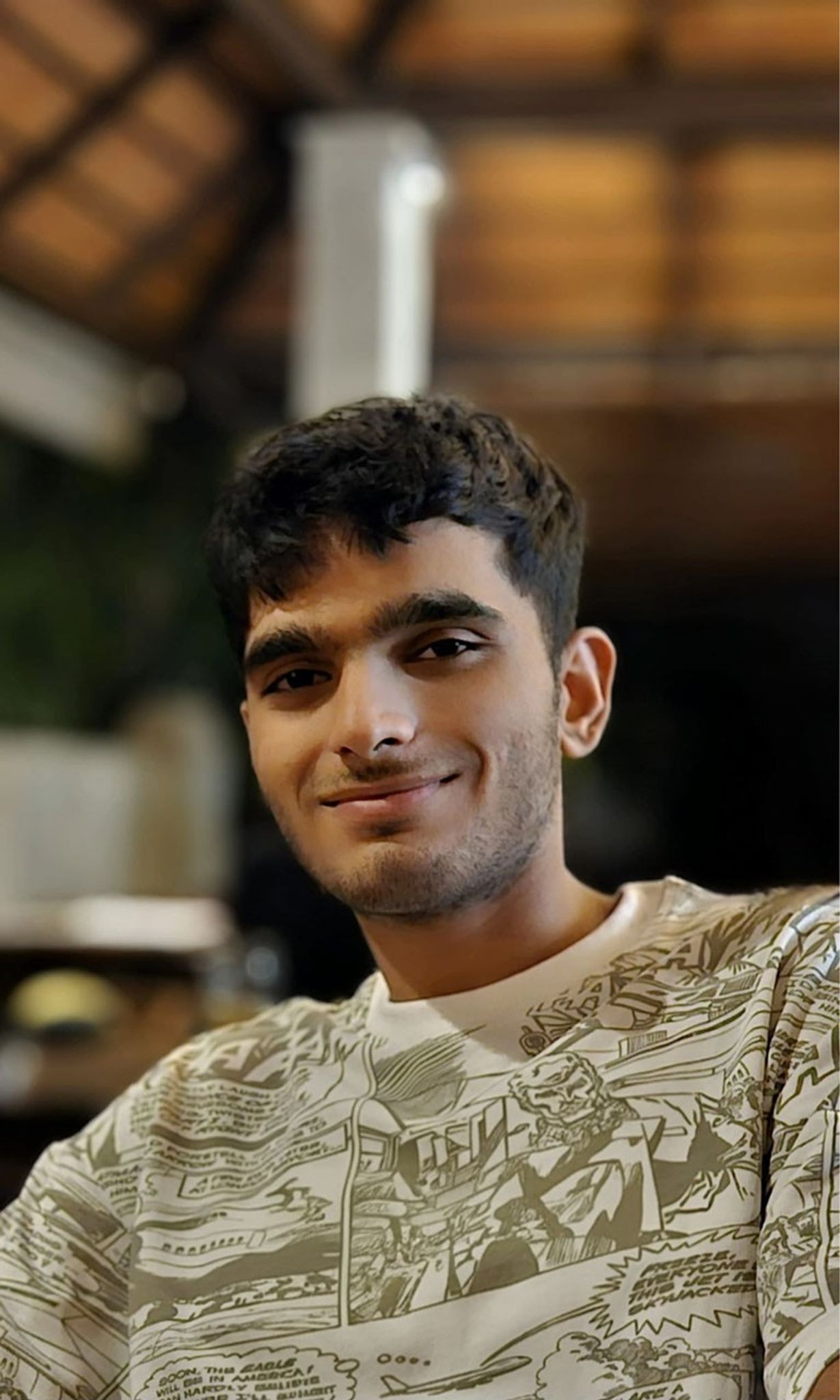
Photograph clouds just after sunset or before dawn to investigate our changing atmosphere.
Facebook logo @nasascience_ @nasascience_ Instagram logo @nasascience_ Linkedin logo @nasascience_
Volunteer Develops Machine-Learning Tool to Identify Rare Clouds
Certain kinds of clouds are misbehaving – appearing more often and lower in the sky than they used to. To help identify the factors influencing these changes (e.g. shifts in Earth’s long-term weather patterns), scientists have asked people around the world with cameras to submit fresh images of these clouds as a part of the NASA-supported Space Cloud Watch project. Now, one volunteer has developed a new tool to help other Space Cloud Watch volunteers work more efficiently.
The misbehaving clouds are “noctilucent” or “night-shining” clouds (NLCs). These clouds scatter light from the Sun long after sunset and long before sunrise, giving them a silvery glow. But despite this glow, it can be hard to differentiate NLCs from lower-altitude look-alikes. That confusion has meant extra work for project leaders.
Volunteer Namai Chandra shared, “I noticed that NLC images were being manually verified by the project leaders. It felt like a task well-suited for a human-in-the-loop machine learning pipeline, one that could handle the repetitive screening automatically, while keeping human judgment central for the images that matter most.” In other words, Namai found a way to help observers verify when they are indeed seeing NLCs and when they’re not.
Namai reached out to the Space Cloud Watch scientists Drs. Chihoko Cullens and Brentha Thurairajah, who were delighted with his idea. Namai soon developed a machine learning pipeline, training it on a variety of cloud images, including both the NLCs and the lower altitude look-alikes that are often submitted to Space Cloud Watch. The pipeline combines image pre-screening, cloud classification, and confidence-based review routing. After several rounds of development, testing, and refinement, he released his NLC identification tool to the project. This tool is now being used by cloud contributors who are unsure whether they have observed NLCs, as well as project scientists that want to flag images for review.
Grab a camera and join the Space Cloud Watch project today! If you’ve hesitated to contribute to Space Cloud Watch because you were not certain if what you were seeing was a noctilucent cloud, you now have a way to check before you share – thanks to Namai.
Namai Chandra, Space Cloud Watch volunteer and creator of the Noctilucent Cloud Detector tool. Photo by Surabhi Chandra. Learn More and Get Involved Space Cloud WatchPhotograph clouds just after sunset or before dawn to investigate our changing atmosphere.
Facebook logo @nasascience_ @nasascience_ Instagram logo @nasascience_ Linkedin logo @nasascience_
Why 14 inches of rain fell in Japan in just one day
This extreme rain was deadly, with at least eight people killed and many others stranded
NASA’s COFFIES Uses AI to Predict Storm-Causing Active Regions on Sun
5 min read
NASA’s COFFIES Uses AI to Predict Storm-Causing Active Regions on SunAs humanity looks to the Moon and stars for future exploration, predicting space weather — conditions in space primarily driven by the Sun — is more important than ever.
Now, a team of astrophysicists and data scientists with NASA’s COFFIES (Consequence Of Fields and Flows in the Interior and Exterior of the Sun) has developed a novel machine-learning model capable of predicting the emergence of active regions on the Sun up to 12 hours before they appear.
The Sun is constantly churning. Intense concentrations of localized magnetic fields can suddenly break through the solar surface, forming sunspots. Space weather forecasters then collectively number and track sunspots since they are visible manifestations of active regions, which serve as the main engines behind severe space weather events such as solar flares and coronal mass ejections. These eruptions send waves of high-energy radiation and charged particles across space, creating storms that can threaten astronauts, disable satellites, and disrupt radio communications on Earth.
NASA’s Solar Dynamics Observatory captured this image of a solar flare — seen as the bright flash in the upper right — on June 30, 2026. The image shows a subset of extreme ultraviolet light that highlights the extremely hot material in flares and which is colorized in teal. NASA’s Goddard Space Flight Center/SDO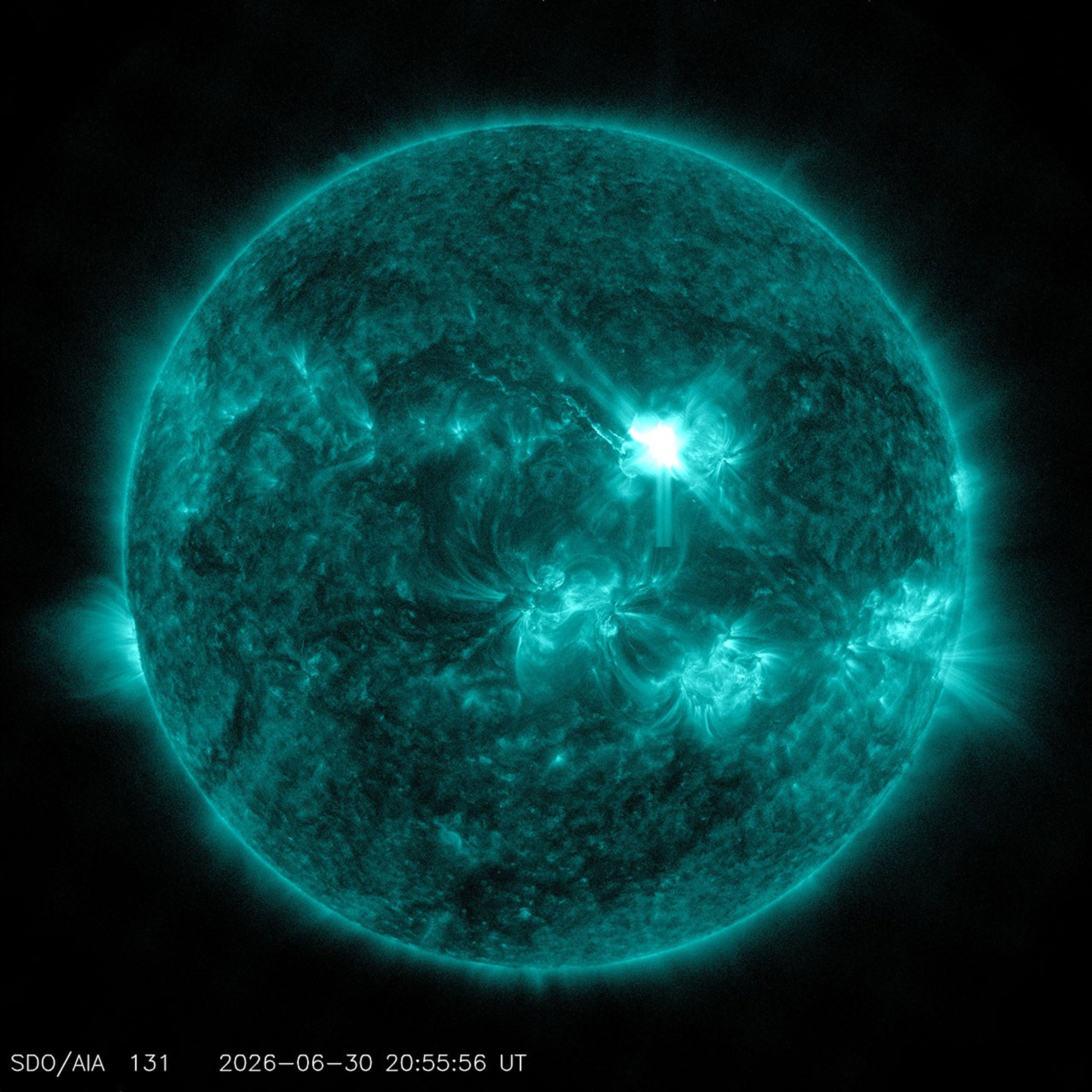
By bridging expertise across different scientific institutions, COFFIES, a NASA DRIVE (Diversify, Realize, Integrate, Venture, Educate) Science Center, brought together a team of researchers from New Jersey Institute of Technology (NJIT), Princeton University, and NASA’s Ames Research Center in California’s Silicon Valley. The team turned to advanced artificial intelligence architectures — which dictate how data is processed and used to produce reliable predictions or actions — to capture subtle, time-based pattern changes on the solar surface before an active region took shape. By analyzing data captured by the agency’s Solar Dynamics Observatory and using NASA Ames’ supercomputing resources, this new approach, published in the Journal of Geophysical Research: Machine Learning and Computation, looks at fluctuations in acoustic waves caused by sunspot regions when the regions form beneath the solar surface and begin the journey upward to emerge on the surface.
“We cannot directly see the magnetic structure while it is still rising through the solar interior. Instead, we must look for indirect effects — very small changes in the magnetic field and in the pattern of acoustic waves continually traveling through the Sun,” said Alexander Kosovichev, a COFFIES co-investigator at NJIT. “The developed technique identifies precursors associated with an emerging active region in slight changes of the Sun’s acoustic power — more like a slight change in rhythm within a very noisy orchestra.”
To view this video please enable JavaScript, and consider upgrading to a web browser that
supports HTML5 video
To develop current operational forecasts, the National Oceanic and Atmospheric Administration’s Space Weather Prediction Center and the United States Air Force monitor active regions that are already visible on the Sun to analyze the regions’ characteristics and estimate the probability of solar flares.
The COFFIES team aims to revolutionize this process. The AI model the team developed a specialized early detection system to handle very long sequences of data — called sliding-window transformer architecture — to use observations to find tiny reductions in the Sun’s acoustic activity and magnetic field, signals that scientists struggled to capture until now. These reductions form patterns that the AI model uses to predict active regions several hours before they become visible on the solar surface. Instead of looking at all activity on the solar surface at once, like earlier deep learning approaches have done, this new model moves a fixed-size “viewing window” across a long timeline of the Sun’s activity to focus on recent data while remembering overall patterns. This method allows forecasters the ability to predict approximate locations of emerging sunspots, rather than relying on counting already visible sunspots.
This promising AI architecture shows how deep machine learning can contribute to heliophysics — the field studying the nature of the Sun and how it influences the very nature of space and the planets that exist there. While the model is not ready for operational real-time forecasting, the team plans to validate the approach across many more known solar events to fine-tune the model.
NASA’s real-time space weather monitoring
As NASA focuses on sending humans to explore the Moon with the Artemis missions and sending the first crewed missions to Mars, monitoring and forecasting space weather is important for ensuring the safety of our astronauts and the equipment they rely on. This predictive leap from the COFFIES team could prove vital for safeguarding technology and deep-space explorers from the volatile environment of our solar system.
To view this video please enable JavaScript, and consider upgrading to a web browser that
supports HTML5 video
Teams across NASA and NOAA collaborate to transition research capabilities into actual 360-degree space weather monitoring operational tools — including NASA’s Space Radiation Analysis Group, Moon to Mars Space Weather Analysis Office (M2M SWAO), and Community Coordinated Modeling Center as well as NOAA’s Space Weather Prediction Center. Sunspot region emergence prediction capabilities, especially of the Sun’s far side, could provide new information that supplements current models used by these teams.
“The COFFIES AI model is exciting to our team because it could provide us with new capabilities towards predicting potential flaring locations ahead of time,” said Michelangelo Romano, M2M SWAO deputy director. “With this heads up, we can provide additional support to NASA missions.”
NASA’s COFFIES is one of three DRIVE Science Centers created to encourage collaborative science by establishing centers that are made of multidisciplinary teams from several institutions across the U.S. These pioneering facilities employ modelers, theoreticians, computer scientists, and observers to study important mysteries of our star and its influence, a branch of science known as heliophysics.
The COFFIES team focuses on the interconnected processes behind the Sun’s activity. Understanding the Sun’s interior and magnetic variability is key to advancing our understanding of the Sun’s 11-year activity cycle and fine-tuning space weather forecasting tools.
About the Author Desiree Apodaca NASA’s Heliophysics Missions Communications LeadShare
Details Last Updated Aug 14, 2026 Related Terms Explore More 5 min read NASA Completes Astronaut-Deployed Science Instrument for Lunar SurfaceArticle
3 days ago
4 min read Lion Nebula Roars to Life With NASA’s Webb
Article
4 days ago
4 min read NASA’s PUNCH Sharpens Solar Storm Forecasting in First Test
Article
1 week ago
Keep Exploring Discover More Topics From NASA
The Sun
Humans in Space
-Space Weather
Solar System
NASA’s COFFIES Uses AI to Predict Storm-Causing Active Regions on Sun
5 min read
NASA’s COFFIES Uses AI to Predict Storm-Causing Active Regions on SunAs humanity looks to the Moon and stars for future exploration, predicting space weather — conditions in space primarily driven by the Sun — is more important than ever.
Now, a team of astrophysicists and data scientists with NASA’s COFFIES (Consequence Of Fields and Flows in the Interior and Exterior of the Sun) has developed a novel machine-learning model capable of predicting the emergence of active regions on the Sun up to 12 hours before they appear.
The Sun is constantly churning. Intense concentrations of localized magnetic fields can suddenly break through the solar surface, forming sunspots. Space weather forecasters then collectively number and track sunspots since they are visible manifestations of active regions, which serve as the main engines behind severe space weather events such as solar flares and coronal mass ejections. These eruptions send waves of high-energy radiation and charged particles across space, creating storms that can threaten astronauts, disable satellites, and disrupt radio communications on Earth.
NASA’s Solar Dynamics Observatory captured this image of a solar flare — seen as the bright flash in the upper right — on June 30, 2026. The image shows a subset of extreme ultraviolet light that highlights the extremely hot material in flares and which is colorized in teal. NASA’s Goddard Space Flight Center/SDOBy bridging expertise across different scientific institutions, COFFIES, a NASA DRIVE (Diversify, Realize, Integrate, Venture, Educate) Science Center, brought together a team of researchers from New Jersey Institute of Technology (NJIT), Princeton University, and NASA’s Ames Research Center in California’s Silicon Valley. The team turned to advanced artificial intelligence architectures — which dictate how data is processed and used to produce reliable predictions or actions — to capture subtle, time-based pattern changes on the solar surface before an active region took shape. By analyzing data captured by the agency’s Solar Dynamics Observatory and using NASA Ames’ supercomputing resources, this new approach, published in the Journal of Geophysical Research: Machine Learning and Computation, looks at fluctuations in acoustic waves caused by sunspot regions when the regions form beneath the solar surface and begin the journey upward to emerge on the surface.
“We cannot directly see the magnetic structure while it is still rising through the solar interior. Instead, we must look for indirect effects — very small changes in the magnetic field and in the pattern of acoustic waves continually traveling through the Sun,” said Alexander Kosovichev, a COFFIES co-investigator at NJIT. “The developed technique identifies precursors associated with an emerging active region in slight changes of the Sun’s acoustic power — more like a slight change in rhythm within a very noisy orchestra.”
To view this video please enable JavaScript, and consider upgrading to a web browser that
supports HTML5 video
To develop current operational forecasts, the National Oceanic and Atmospheric Administration’s Space Weather Prediction Center and the United States Air Force monitor active regions that are already visible on the Sun to analyze the regions’ characteristics and estimate the probability of solar flares.
The COFFIES team aims to revolutionize this process. The AI model the team developed a specialized early detection system to handle very long sequences of data — called sliding-window transformer architecture — to use observations to find tiny reductions in the Sun’s acoustic activity and magnetic field, signals that scientists struggled to capture until now. These reductions form patterns that the AI model uses to predict active regions several hours before they become visible on the solar surface. Instead of looking at all activity on the solar surface at once, like earlier deep learning approaches have done, this new model moves a fixed-size “viewing window” across a long timeline of the Sun’s activity to focus on recent data while remembering overall patterns. This method allows forecasters the ability to predict approximate locations of emerging sunspots, rather than relying on counting already visible sunspots.
This promising AI architecture shows how deep machine learning can contribute to heliophysics — the field studying the nature of the Sun and how it influences the very nature of space and the planets that exist there. While the model is not ready for operational real-time forecasting, the team plans to validate the approach across many more known solar events to fine-tune the model.
NASA’s real-time space weather monitoring
As NASA focuses on sending humans to explore the Moon with the Artemis missions and sending the first crewed missions to Mars, monitoring and forecasting space weather is important for ensuring the safety of our astronauts and the equipment they rely on. This predictive leap from the COFFIES team could prove vital for safeguarding technology and deep-space explorers from the volatile environment of our solar system.
To view this video please enable JavaScript, and consider upgrading to a web browser that
supports HTML5 video
Teams across NASA and NOAA collaborate to transition research capabilities into actual 360-degree space weather monitoring operational tools — including NASA’s Space Radiation Analysis Group, Moon to Mars Space Weather Analysis Office (M2M SWAO), and Community Coordinated Modeling Center as well as NOAA’s Space Weather Prediction Center. Sunspot region emergence prediction capabilities, especially of the Sun’s far side, could provide new information that supplements current models used by these teams.
“The COFFIES AI model is exciting to our team because it could provide us with new capabilities towards predicting potential flaring locations ahead of time,” said Michelangelo Romano, M2M SWAO deputy director. “With this heads up, we can provide additional support to NASA missions.”
NASA’s COFFIES is one of three DRIVE Science Centers created to encourage collaborative science by establishing centers that are made of multidisciplinary teams from several institutions across the U.S. These pioneering facilities employ modelers, theoreticians, computer scientists, and observers to study important mysteries of our star and its influence, a branch of science known as heliophysics.
The COFFIES team focuses on the interconnected processes behind the Sun’s activity. Understanding the Sun’s interior and magnetic variability is key to advancing our understanding of the Sun’s 11-year activity cycle and fine-tuning space weather forecasting tools.
About the Author Desiree Apodaca NASA’s Heliophysics Missions Communications LeadShare
Details Last Updated Aug 14, 2026 Related Terms Explore More 5 min read NASA Completes Astronaut-Deployed Science Instrument for Lunar SurfaceArticle
3 days ago
4 min read Lion Nebula Roars to Life With NASA’s Webb
Article
4 days ago
4 min read NASA’s PUNCH Sharpens Solar Storm Forecasting in First Test
Article
1 week ago
Keep Exploring Discover More Topics From NASA
The Sun
Humans in Space
-Space Weather
Solar System
US Space Force gives Rocket Lab $397 million to build threat-tracking 'Flatellites'
Amid the major uptick in national defense space contracts since the Trump Administration announced plans to assemble a "Golden Dome" missile-defense system in orbit, Rocket Lab has landed another deal to contribute to the cause.
The California-based company was awarded a $397 million Space Force contract to design, manufacture and launch a fleet of "Flatellites" to augment existing infrastructure's ability to track airborne threats in real time. The project is funded under the Space Force's Space-Based Airborne Moving Target Indicator (SB-AMTI) program, and is one of several national security contracts that Rocket Lab has scored over the last two years.
"We are proud to contribute to the deployment of a resilient space-based sensing layer that will enhance the Joint Force’s ability to operate in contested airspace," said Rocket Lab CEO Peter Beck in an Aug. 4 statement.
The Flatellites deal is the company's single largest national defense contract so far this year. Since the beginning of 2026, Rocket Lab has now announced four major U.S. government-funded defense contracts worth a combined $943 million: $190 million from the Department of Defense for 20 HASTE (Hypersonic Accelerator Suborbital Test Electron) test launches, a $90 million Space Force contract for two satellites in geostationary orbit and another Space Force deal for $266 million to launch up to 18 missile-defense missions from Alaska.
Rocket Lab also recently unveiled GHOST design, a new deployable shipping container-based system capable of supporting Electron and HASTE launches for responsive national-security missions from mobile or temporary locations. And, during a recent earnings call, Beck voiced the company's intent to carry out the aforementioned Alaskan launches using GHOST (short for "Global Hypersonic & Orbital Spaceport Technology"), saying, "We've mastered the art of building launch sites. Now we're making them deployable worldwide."
Artist impression of Rocket Lab Flatellite spacecraft inside a Neutron launch vehicle fairing. (Image credit: Rocket Lab)The flat design of Rocket Lab's Flatellites will increase the number of spacecraft that can be delivered per launch and has been optimized for orbital constellations, according to Rocket Lab's statement. The satellites will be equipped with low latency, high bandwidth communication systems and sensors for tracking adversarial air-based threats.
They will launch in stacks aboard Rocket Lab's upcoming Neutron rocket, similar to the payload bay configuration used for Starlink satellites on SpaceX Falcon 9 rockets. Neutron is Rocket Lab's next-generation launch vehicle designed to compete with Falcon 9 lift capabilities and partial reusability, and is currently expected to debut sometime near the end of this year or in early 2027.
Can Venus cast a shadow? Here's how to see it for yourself
Can Venus cast a shadow? With Aug. 12's total solar eclipse — where the moon's dark silhouette is everything — now behind us, it's a good time to test another kind of celestial shadow.
Astronomical folklore has it that the second rock from the sun, Venus, is, after the sun and moon, the third object able to cast a shadow when it's near peak brightness, albeit extremely faint, according to EarthSky.
Is it true? Not in a city, where skylights glow and porch lights blaze, where shadows are mostly thrown by passing cars that appear to become the brightest object in the solar system briefly. Venus does cast a shadow, but the sky must be very dark, transparent and free of any light — apparently.
Timing is everything. Having reached dichotomy — its half-lit phase — on Aug. 12, Venus is currently 49%-lit and waning as it moves closer to Earth, increasing in angular size as it becomes a slim crescent. Cue a surge in brightness, thanks to its reflective clouds and its closeness. Shouldn't it be brightest when it's "full?" No, because it's an inferior planet — i.e., it orbits closer to the sun — so it's fully lit only when it's on the other side of the sun from Earth, when its disk appears at its smallest.
What’s happening and when to lookVenus is beautifully placed this week because it reaches greatest eastern elongation, its widest apparent separation from the sun in the evening sky. Look low in the west after sunset — Venus will be the bright white "star" that appears before the fainter stars even have a chance.
On Aug. 14-15, it sits about 46 degrees from the sun and shines at a magnitude of -4.3 to -4.4, bright enough to dominate twilight but not quite at its most impressive stage of the apparition. The real test comes around Sept. 18, when Venus reaches its greatest brilliancy at magnitude -4.6. Sadly, by then it's going to be rather low in the sky from mid-northern latitudes, making observation from the U.K. difficult, but possible from most of the U.S.
Venus shines over the Mitsuke Iwa Rock in Ishikawa, Japan. (Image credit: Yuga Kurita via Getty Images)How and when I’m watching itAccording to Sky & Telescope, to catch a faint but well-defined shadow of Venus — a point source of light — you'll need to be somewhere free from artificial lighting and wait until twilight is over. Face Venus and place a white surface (a white card or sheet works well) also facing Venus. You'll also need to position something in front of the card to cast a shadow. Although it is possible to see the faint shadow of Venus, photographing the card is the best way to capture it, using a technique similar to that for any night sky photograph — a high ISO, a wide aperture and a long exposure of up to 30 seconds. It may be wise to test the location, find the best line of sight, and work out where the card needs to go while Venus is still high enough above the western horizon.
If you're not in a good location to catch the shadow of Venus, instead try to see and photograph the light from Venus reflecting on water. Any pond, lake or ocean you can get between you and Venus ought to catch its shine in a long exposure image. That identical technique — high ISO, a wide aperture and a long exposure — will also apply, but this time you can actually aim your camera at Venus!
Stargazer’s Corner: August 14-20, 2026This is an excellent week for darkness and faint objects. With new moon on Aug. 12, this week is all about a crescent moon. On Aug. 15 you may catch a 12%-lit waxing crescent close to Venus, but more likely you'll see it on Aug, 16, when it will be 19%-lit. The latter occasion is one to aim for — a beautiful sight. On both occasions, look for "earthshine" on the darkened limb of the moon — sunlight reflected by Earth, and something else you can try to capture with a long exposure. The waxing crescent moon will be low in the western evening sky, but early in the week it sets early enough to leave most of the night usable for stargazing and deep-sky astronomy.
A crescent moon will meet Venus early this week. (Image credit: Jordan Lye via Getty Images)The buzz around the Perseid meteor shower, like the solar eclipse, will by now have completely dissipated, but they're still active after their Aug. 12-13 peak, though rates will be lower. With the moon mostly out of the way, it is still worth spending time outside after midnight in the hope of finding "shooting stars." However, the main attraction during dark nights in August is the Milky Way, which streams through the Summer Triangle to Scorpius and Sagittarius. Every time I see the Summer Triangle stars high in the night sky, I tell myself that the Milky Way is right there — and hidden from us by light pollution. It's a reminder to get to a dark-sky site as much as possible when the moon is down (the period between last-quarter moon and new moon is the best week of any month).
Constellation of the week: ScorpiusScorpius is one of the most distinctive constellations visible from mid-northern latitudes, though it never climbs very high. Its bright red star Antares marks the heart of the scorpion, with a curving tail extending downward toward the horizon. You can see Antares above Venus as it gets dark — a bright, dominating star that's a waymarker of summer in the Northern Hemisphere.
The constellation Scorpius. (Image credit: E. Slawik/NOIRLab/NSF/AURA/M. Zamani)Even in brighter skies, its shape is recognizable, forming a hooked pattern that stands out from the surrounding stars. Because it sits low in the south, it's best observed earlier in the evening before it begins to set. It's one of the few constellations that genuinely resembles its name — and it's where to see the Milky Way meet the horizon.
Why is Illinois suddenly being hit with so many tornadoes?
This state, which has seen more than 200 twisters this year, could beat Texas’s all-time record of 244 tornadoes in 12 months
Earth's Magnetosphere Might Not Protect Us From Superstorms After All
Science seems like a straightforward endeavour. You come up with a hypothesis, collect data to prove or disprove it, and analyze that data to see if the hypothesis is right. But anyone who actually does science will tell you many times it’s not that straightforward. And one of the most common complexities is in data analysis. A new paper suggests that one such complexity, known as regression to the mean, might be causing us to massively underestimate how severe solar storms can truly be.
Water can survive surprisingly close to the Milky Way's supermassive black hole, James Webb Space Telescope finds
The heart of the Milky Way may be more hospitable to water than astronomers thought.
Using the James Webb Space Telescope (JWST), researchers detected water and cosmic dust around an aging star only 0.55 light-years from Sagittarius A* (Sgr A*), the supermassive black hole at the center of our galaxy.
The new study suggests that water and dust can form and survive surprisingly close to a supermassive black hole, where intense radiation and other harsh conditions might otherwise be expected to destroy them. The team used Webb's Mid-Infrared Instrument (MIRI) to study IRS 3, an aging star located in the crowded environment surrounding Sgr A*, which has a mass of about 4 million suns, according to a statement from the European Space Agency (ESA).
(Image credit: ESA/Webb, NASA & CSA, F. Peißker, J. Lu, F. Yusef-Zadeh, N. B. Sabha, C. Chan)"Galactic centres are among the most extreme environments, so understanding whether stars can continue enriching their surroundings there is an important question," Florian Peißker, lead author of the study from the University of Cologne in Germany, said in the statement. "With Webb, we can directly observe how stars behave under these conditions and see that dust production remains remarkably resilient."
IRS 3 — one of the brightest mid-infrared sources in the galactic center — is an asymptotic giant branch star, meaning it has reached a late stage of stellar evolution in which it sheds large amounts of gas and dust through powerful stellar winds. Such dying stars act as cosmic recycling centers, returning material to space that can eventually become incorporated into future generations of stars and planets.
But IRS 3 lives in a particularly unforgiving neighborhood. The center of the Milky Way is densely packed with stars and exposed to intense radiation, raising questions about whether molecules and newly produced dust can persist there.
However, Webb's observations suggest they can. By combining observations of IRS 3's spectrum with simulations of how its light travels through different models of the surrounding material, researchers reconstructed the structure of the star's envelope. They found a layered, shell-like distribution of silicate dust extending roughly 10,000 astronomical units from the star (one astronomical unit, or AU, is the average distance between Earth and the sun). Temperatures within the envelope fall from about 1,700 degrees Fahrenheit (927 degrees Celsius) near the star to around minus 280 F (minus 173 C) in its outer regions. Webb's observations also revealed clear evidence of water within the envelope — the first such detection for IRS 3.
"The detection of water is especially exciting because it shows that molecular material can survive in an environment dominated by intense radiation," Macarena Garcia Marin, co-author of the study and an ESA astronomer, said in the statement.
While the observations don't reveal how much water is present, the detection shows that water can survive in the harsh environment near the galactic center. Water and dust are important ingredients in the chemistry that accompanies star and planet formation, meaning material shed by aging stars such as IRS 3 could eventually contribute to future generations of stars and planets.
Finding water and dust near Sgr A* therefore suggests that aging stars can continue enriching their surroundings even in the harsh conditions near a supermassive black hole. The findings could help astronomers better understand how material is recycled in the centers of galaxies and the role evolved stars play in supplying those regions with fresh dust and molecules.
Their findings were published Aug. 11 in the journal Astronomy & Astrophysics.
Total Solar Eclipse in Sunflower Field
Total Solar Eclipse in Sunflower Field
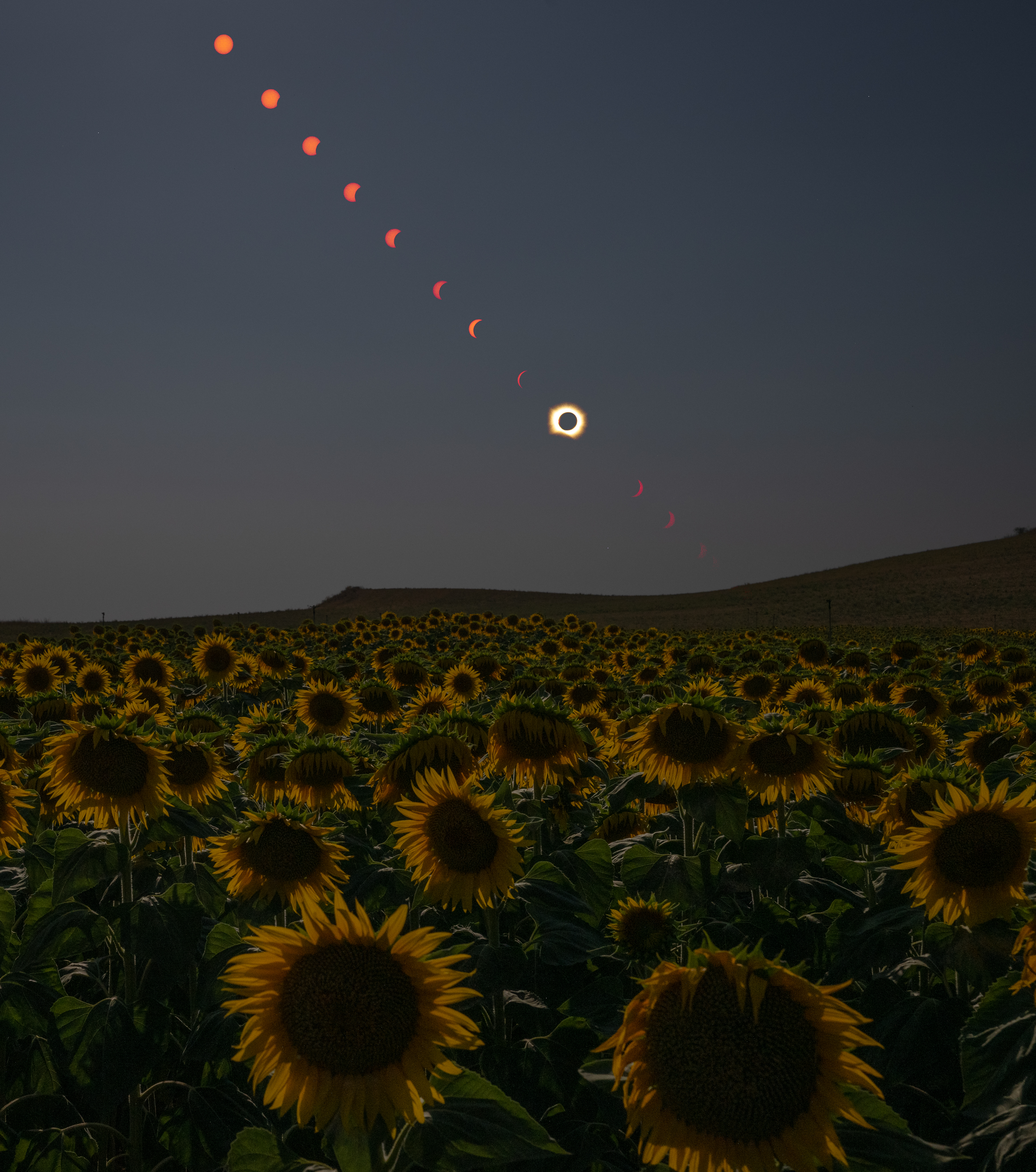
This composite image shows the progression of a total solar eclipse over San Millán de los Caballeros, Spain on, Wednesday, Aug. 12, 2026.
A total solar eclipse swept across parts of Greenland, Iceland, northern Russia, the Atlantic Ocean, Spain, and a small corner of Portugal. A partial eclipse was visible in parts of the U.S., most of Canada, much of Europe, and northwest Africa.
Image credit: NASA/Bill Ingalls