
Feed aggregator
James Webb Space Telescope finds 'hidden stars' making the universe's 1st galaxies much bigger than we knew
Imagine looking at a vast city on Earth from a great distance, knowing nothing about that city; you may assume that its only buildings are the largest, most visible skyscrapers. But, get closer or look with a far more powerful tool, and you would begin to discover smaller buildings between mountainous skyscrapers.
Now, the James Webb Space Telescope has discovered that this looks like that is a fitting analogy for early galaxies.
Astronomers are finding that in between the brightest stars, the 'tallest skyscrapers' in the above analogy, there are much fainter stars analogous to smaller buildings. That means early galaxies may actually have a lot more mass packed into them than we believed.
The team behind this research reached this conclusion by using the James Webb Space Telescope (JWST) to study nine early galaxies that have passed through their period of intense star formation. They combined this data with observations from the Very Large Telescope (VLT) here on Earth to measure the population of small and faint stars in these galaxies for the first time. What they found was that the proportion of small stars in these galaxies is much greater than is found in modern galaxies like the Milky Way. This comes as something of a surprise to scientists who have assumed these populations would be similar.
"This means that the galaxy as a whole is much more massive than previous estimates suggested," team member Chloe Cheng of Leiden University, Netherlands, said in a statement.
The first 'cosmic cities' weren't dominated by skyscrapers, it just looks that wayAstronomers study galaxies and calculate their stellar population rates using the total light, or spectrum, coming from these cosmic metropolises. The problem is, the more massive a star is, the brighter it is. Thus, the overall spectrum of a galaxy is dominated by the most massive stars, while smaller stars are drowned out.
The sensitivity of the JWST has allowed astronomers to finally give these smaller stars a chance to shine and stand out, like spotting an incredible piece of architecture in a vast metropolis of glass and steel.
"Until recently, this type of measurement was simply not possible," team member Martje Slob of Leiden University said. "We needed not only a telescope that collects sufficient light, but also spectra of exceptional quality and new analysis techniques to reliably distinguish the subtle features of small stars."
The team's discovery has implications for our understanding of young galaxies in the early universe. This is because scientists had always assumed the stars of different masses were born in the same proportion across cosmic history. Now that seemingly isn't the case.
That is especially true if more early galaxies are like one particularly striking example examined in this study. This galaxy, which formed less than 1.5 billion years after the Big Bang, contains up to four times the mass previously estimated thanks to its huge population of smaller stars.
Thus, our models of galaxy formation may need some serious revision in the near future.
"This result shows that much more mass than previously thought is hidden in small stars," team leader Mariska Kriek of Leiden University said. "That has implications for all kinds of fields within astronomy. Because many planets orbit small stars, it could even mean that more planets formed in the early universe than we previously assumed."
An illustration of the JWST which continues to break new ground in astronomy. (Image credit: Robert Lea (created with Canva))The team now intends to apply this method to more of the universe's earliest galaxies, hoping to stretch their investigation back to the universe's first stars.
The team's research was published on Wednesday (August 18) in the journal Nature Astronomy.
What Can We Actually Find on an Exoplanet? Part 4: Looking For Us
Some signs of an alien civilization are easier to spot than signs of life itself. On technosignatures, from CFCs and industrial gases to the pandemic dip in pollution, and why Earth's most detectable moment might be right now.
Partial lunar eclipse live: Latest news, viewing tips and live updates from Aug. 27-28 eclipse
The countdown is on for the deep partial lunar eclipse of Aug. 27-28. Over the next week, we'll be bringing you the latest eclipse news, viewing tips as well as live updates throughout eclipse night.
Although this isn't quite a total lunar eclipse, it's pretty close! At maximum eclipse, 96.2% of the moon will slip into Earth's dark central shadow known as the umbra, according to Time and Date. Much of the moon may take on a rusty red hue, while a thin sliver remains brightly illuminated.
It's the deepest partial lunar eclipse visible anywhere on Earth until Dec. 31, 2028, making it a must-see event worth staying up late — or setting an alarm early — for.
1 week to go until the deepest partial lunar eclipse until 2028The partial phase of a lunar eclipse captured over Sydney in September 2025. (Image credit: Photo by Saeed KHAN / AFP via Getty Images)We're officially one week away from one of the best skywatching events of the year!
On the evening of Aug. 27 (for North America), or the early hours of Aug. 28 (for western Europe), Earth's shadow will creep across the full moon during a very deep partial lunar eclipse. At maximum eclipse, 96.2% of the moon will be immersed in Earth's dark central shadow.
The eclipse will be visible, at least in some part, from North and South America, Europe, Africa and parts of western Asia, weather permitting. Observers in the Americas are well-positioned for the best views while skywatchers across Europe will need to look toward the western horizon before sunrise as the eclipse reaches its peak.
Read more: A 96% partial lunar eclipse is just 1 week away: Here's what you need to know.
A 96% partial lunar eclipse is just 1 week away: Here's what you need to know
We're just one week away from a stunning partial lunar eclipse on Aug. 27-28, when billions across North America, South America, Africa and Europe will see Earth's shadow dye the moon a subtle crimson hue, while leaving a thin crescent exposed to direct sunlight.
August's partial lunar eclipse will occur as Earth passes directly between the sun and moon during the full moon phase — an imperfect alignment that will see our planet's intense inner shadow cover 96% of the visible face of our natural satellite.
Stargazers on the night side of Earth will catch their first glimpse of our planet's umbra (the darkest, innermost part of its shadow) creeping onto the moon's surface at 10:33 p.m. EDT on Aug. 27 (0233 GMT on Aug. 28), according to TimeandDate.com. The vast shadow will continue its advance across the crater-scarred landscape in the hours that follow, until it hits the point of maximum eclipse at 12:12 a.m. EDT on Aug. 28 (0412 GMT).
Around this time, you may notice the shadowed region of the moon take on a reddish-orange color, as sunlight filtered through Earth's atmosphere is bent onto the lunar surface — a phenomenon often referred to as a "Blood Moon" during a total eclipse.
Each phase of a lunar eclipse occurs simultaneously for everyone viewing from the night side of Earth, where the lunar disk is visible. However, local timings will differ significantly depending on your location on Earth.
A partial lunar eclipse captured in the skies over the capitol city of Manila in the Philippines. (Image credit: Photo by Ted ALJIBE / AFP via Getty Images)If you're watching from a city on the West Coast of the United States like California, then the point of maximum eclipse will occur shortly after midnight local time on the night of Aug. 27-28.
Viewers in the United Kingdom, meanwhile, won't observe the moment of maximum eclipse until shortly before sunrise on Aug. 28, as the moon lurks low on the southwestern horizon. Be sure to check out a trusted website like TimeandDate for eclipse timings specific to your location.
You won't need any special kit to protect your eyes during a lunar eclipse as you would during a solar eclipse, when there is a serious risk of vision damage from looking directly upon the sun. However, a pair of quality binoculars or a telescope will give you a stunning view of Earth's shadow as it races across the lunar disk.
Need to upgrade your equipment? Then be sure to read our roundups of the best binoculars and telescopes available in 2026. You should also check out our guide to photographing a lunar eclipse, along with our picks of the top cameras and lenses for astrophotography.
Editor's Note: If you capture a photo of the lunar eclipse and want to share it with Space.com's readers, then please send your photo(s), comments, name and location to spacephotos@space.com.
ESA’s photosynthesis satellite fuelled
Europe’s newest eye on the health of Earth’s vegetation has taken another crucial step towards orbit – the European Space Agency’s FLEX satellite has been fuelled at Europe’s Spaceport in French Guiana ahead of its planned launch on 15 September at 03:21 CEST (14 September at 22:21 local time).
Rocket Lab launches private Japanese Earth-observing satellite to orbit (video)
Rocket Lab launched a private Japanese satellite to orbit this morning (Aug. 20), adding to a growing constellation of Earth-observing spacecraft.
An Electron vehicle lifted off from Rocket Lab's New Zealand site at 9:04 a.m. EDT (1304 GMT; 1:04 a.m. on Aug. 21 local New Zealand time), carrying aloft a radar satellite for the Tokyo-based company iQPS.
The nine 3D-printed Rutherford engines that power Electron's first stage shut off as planned about 2.5 minutes after liftoff. Separation with the rocket's second stage immediately followed, which burned for another 6.5 minutes before releasing Electron's "kick stage" with the IQPS payload for a 40-minute coast phase.
Electron lifts off from Rocket Lab's New Zealand launch site at 9:04 a.m. EDT (1304 GMT) on Aug. 20. (Image credit: Rocket Lab)This was Rocket Lab's ninth launch for iQPS, which is building a constellation of 36 synthetic aperture radar (SAR) satellites in low Earth orbit (LEO). Such spacecraft can study Earth day or night, and they can peer through cloud cover as well.
The iQPS network "is being developed and deployed at a rapid pace to provide high resolution and near-real time SAR imagery to its global users," Rocket Lab wrote in a description of today's mission, which it calls "The Lightning God Defends."
That name is a reference to the satellite going up today: It's nicknamed SUSANOO-II, after a Japanese lightning god.
Following the 40-minute coast phase of Electron's kick stage, the rocket completed one final burn to circularize its orbit and successfully deployed SUSANOO-II about 50 minutes after launch, at an altitude of 357 miles (575 kilometers).
Today's flight was Rocket Lab's 14th of 2026 and 93rd overall. The company's most recent launch, on Aug. 6, also lofted an iQPS satellite to LEO.
The vast majority of the company's flights have been performed by Electron, a 59-foot-tall (18 meters) rocket that gives small satellites dedicated rides to Earth orbit and beyond. Rocket Lab also operates a suborbital variant of Electron called HASTE, which allows customers to test sensors and other tech in the hypersonic flight environment.
APOD: 2026 August 20 – The Elephant’s Trunk in Cepheus
APOD
Astronomy Picture of the Day
Discover the cosmos! Each day a different image or photograph of our fascinating universe is featured, along with a brief explanation written by a professional astronomer.
The Elephant’s Trunk in Cepheus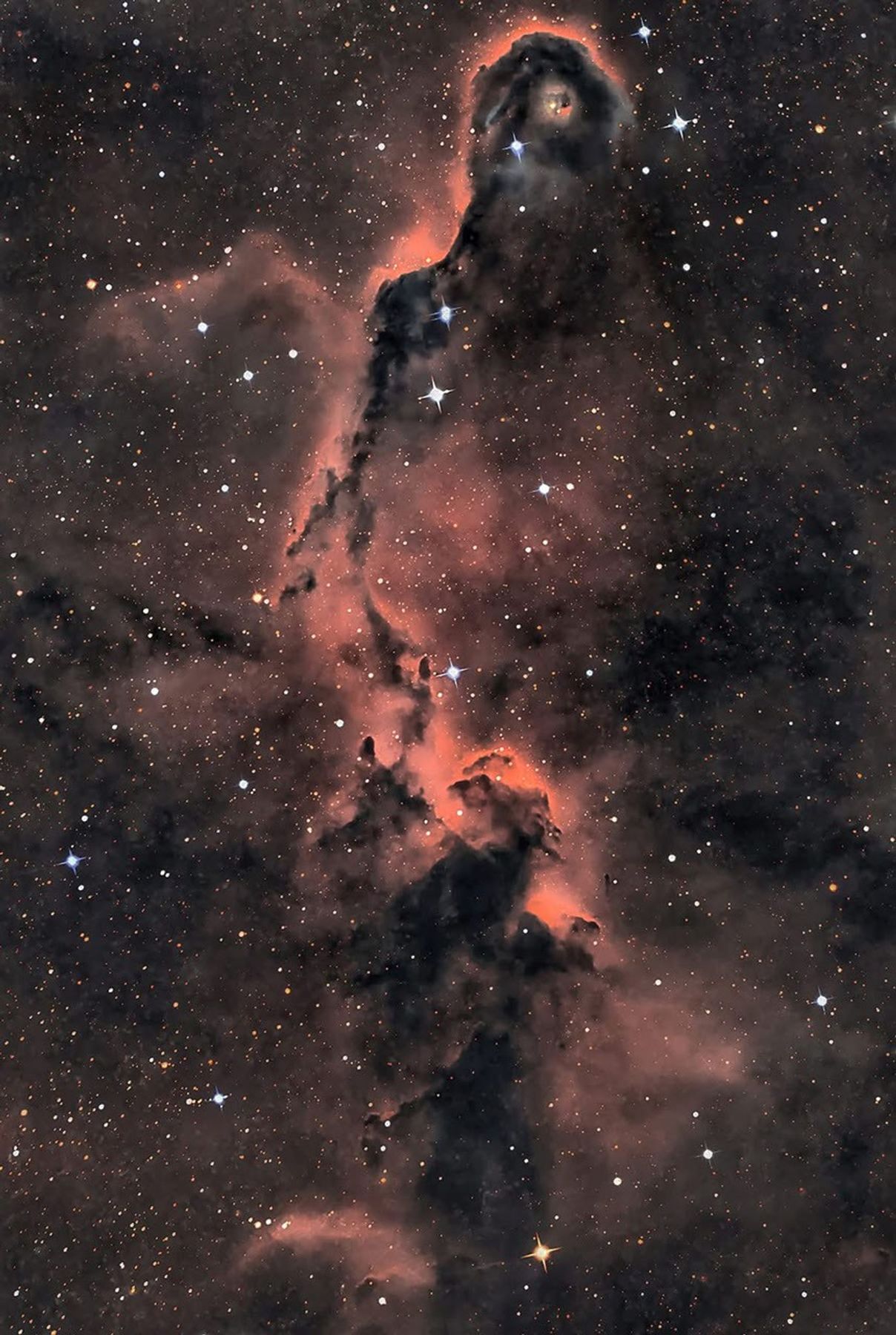
Explanation: Like an illustration in a galactic Just So Story, the Elephant’s Trunk Nebula winds through the emission region and young star cluster complex IC 1396, in the high and far off constellation of Cepheus. Also known as vdB 142, this cosmic elephant’s trunk is over 20 light-years long. The detailed telescopic view features the bright swept-back ridges and pockets of cool interstellar dust and gas that abound in the region. But the dark, tendril-shaped clouds contain the raw material for star formation and hide protostars within. Nearly 3,000 light-years distant, the relatively faint IC 1396 complex covers a large region on the sky, spanning over 5 degrees. Top to bottom this proboscidean-like rendition reaches across an almost 1 degree wide field of view, though. That’s a little less than the angular size of 2 full moons.
Tomorrow’s picture: pixels in space
NASA Science Activation & Michigan Tech. U. Random APOD Generator Yesterday’s Image APOD: 2026 August 19 – The Case of the Mysterious Maybe Meteor Tomorrow’s Image
APOD: 2026 August 20 – The Elephant’s Trunk in Cepheus
APOD
Astronomy Picture of the Day
Discover the cosmos! Each day a different image or photograph of our fascinating universe is featured, along with a brief explanation written by a professional astronomer.
The Elephant’s Trunk in CepheusExplanation: Like an illustration in a galactic Just So Story, the Elephant’s Trunk Nebula winds through the emission region and young star cluster complex IC 1396, in the high and far off constellation of Cepheus. Also known as vdB 142, this cosmic elephant’s trunk is over 20 light-years long. The detailed telescopic view features the bright swept-back ridges and pockets of cool interstellar dust and gas that abound in the region. But the dark, tendril-shaped clouds contain the raw material for star formation and hide protostars within. Nearly 3,000 light-years distant, the relatively faint IC 1396 complex covers a large region on the sky, spanning over 5 degrees. Top to bottom this proboscidean-like rendition reaches across an almost 1 degree wide field of view, though. That’s a little less than the angular size of 2 full moons.
Tomorrow’s picture: pixels in space
Date August 20, 2026 Credit and Copyright: Eddie Sgarbossa Authors & editors: Jerry Bonnell, Cecilia Chirenti, Robert Nemiroff, Keighley Rockcliffe A service of: ASD at NASA / GSFC,NASA Science Activation & Michigan Tech. U.
Random APOD Generator
Yesterday’s Image APOD: 2026 August 19 – The Case of the Mysterious Maybe Meteor
Tomorrow’s Image
NASA calls off rescue mission for its falling Swift space telescope
The space agency’s Neil Gehrels Swift Observatory, which studied cataclysmic cosmic explosions, is expected to burn up in Earth’s atmosphere later this year
Scientists just found the fastest known star in the Milky Way. It zooms around our black hole at 15,500 miles per second
Astronomers have found the fastest known star in the Milky Way, a faint object racing around Sagittarius A*, the supermassive black hole at the heart of our galaxy. Dubbed S301, the star reaches about 15,500 miles (25,000 kilometers) per second at its fastest — more than 8% the speed of light.
"What is special about this star is that it's orbiting Sagittarius A* on a very tight orbit, taking just 8.7 years to complete it, and is approaching the black hole at a mere 12 times the distance of Earth to the sun. That is unprecedented," study author Felix Mang, a Ph.D. student at the Max Planck Institute for Extraterrestrial Physics in Germany, said in a statement.
The discovery gives astronomers a new way to probe the roughly 4.3-million-solar-mass black hole. General relativity predicts that a rotating black hole drags spacetime along with it, an effect known as frame dragging, or Lense-Thirring precession. That distortion should gradually alter S301's orbit — because the star ventures so close to Sagittarius A*, those changes may become measurable within about a decade.
This visible light wide-field view shows the rich star clouds in the constellation of Sagittarius (the Archer) in the direction of the center of our Milky Way galaxy. The entire image is filled with vast numbers of stars — but far more remain hidden behind clouds of dust and are only revealed in infrared images. This view was created from photographs in red and blue light and form part of the Digitized Sky Survey 2. (Image credit: ESO and Digitized Sky Survey 2. Acknowledgment: Davide De Martin and S. Guisard)For the first time, we would actually be able to measure very directly the spin of a massive black hole, which would be a key test of Einstein's theory," said study co-author Stefan Gillessen, also of the Max Planck Institute.
This sequence of images, taken with the GRAVITY instrument at ESO’s Very Large Telescope Interferometer (VLTI), show several stars orbiting Sagittarius A*, the supermassive black hole at the centre of our galaxy. One of these stars, known as S301, was recently found to pass much closer to the black hole than any other known star. (Image credit: ESO/GRAVITY collaboration)Researchers spotted S301 in 2023 using the GRAVITY instrument on the European Southern Observatory's Very Large Telescope Interferometer in Chile, then traced it back through observations from 2021 and 2017. Its highly elongated orbit suggests S301 may once have belonged to a binary system that wandered too close to Sagittarius A*. The black hole could have captured S301 while flinging its companion outward at tremendous speed.
Astronomers plan to keep tracking S301 with GRAVITY+ and, eventually, ESO's Extremely Large Telescope. With its next close pass expected in 2031, observations spanning two full orbits could reveal Sagittarius A*'s spin for the first time.
The team's research was published on August 19 in the journal Nature.
Webb Captures the Treasure Chest at the Heart of the Carina Nebula
This NASA/ESA/CSA James Webb Space Telescope Picture of the Month takes us to a fantastical realm within our home galaxy, where piercing starlight and billowing winds sculpt dust clouds into inventive shapes. This scene is from the Carina Nebula, which lies just 7500 light-years away in the constellation Carina (the Keel).
Moderna and Merck announce ‘landmark’ trial showing mRNA therapy significantly cuts odds of recurrent skin cancer
The combined drug works by nudging the body’s own immune system to make proteins that attack and destroy melanoma cells
Private mission to save NASA's Swift space telescope fails
NASA is calling off the effort to save its Neil Gehrels Swift Observatory after a private rescue spacecraft couldn't overcome its own problems in orbit.
LINK, the specialized probe from Katalyst Space that NASA contracted for the Swift Boost mission, was delivered to space on an air-launched Northrop Grumman Pegasus XL rocket on July 3. The vehicle was designed to rendezvous with the Swift Observatory in order to grapple and raise it to a more stable orbit, but LINK ran into trouble when it began to spin uncontrollably about three weeks after launch.
Today (Aug. 19), NASA announced an official end to LINK's efforts to boost Swift's orbit, citing ongoing attitude control issues with the private spacecraft, but the agency hasn't canceled the mission outright. LINK will still attempt a rendezvous with Swift in order to practice proximity operations and demonstrate its capabilities other than spacecraft capture, which could aid future missions down the road.
From its inception, the Swift Boost mission was always viewed as a long shot. Increased solar activity had already begun decaying the observatory's orbit faster than anticipated when NASA awarded the $30 million Swift Boost contract to Katalyst in 2025, giving the Arizona-based company less than a year to complete LINK's design, manufacture and testing before time to save Swift would run out.
"NASA should be willing to move quickly and take smart risks when the potential return is worth it, and that is exactly what we did with this mission," NASA Administrator Jared Isaacman said in a statement today. "This is not the outcome we were working toward, but it does not change why this mission was worth attempting. The team moved with extraordinary speed to give Swift a chance to carry out more science while advancing capabilities America will need for satellite servicing in the future."
Swift is a one-of-its kind orbital observatory designed to study high-energy phenomena across the universe. It can detect sudden events like gamma-ray bursts and quickly direct its instruments to study them in X-ray, ultraviolet and visible light. The spacecraft is also routinely redirected for rapid response research to study things like newly discovered supernovae, black-hole ejections, fast radio bursts and other short-lived astronomical events.
With LINK now incapable of boosting Swift's orbit, NASA estimates the observatory will dip catastrophically low into Earth's atmosphere before the end of the year. After Swift dies, the agency says it will "continue to prioritize finding new options to react rapidly to cosmic events, using current missions to help fill the gap in the meantime."
Katalyst is working closely with NASA as the Swift Boost mission enters its next phase. Together, the company and space agency are evaluating logistics for LINK's rendezvous and maneuvering demonstration within Swift's vicinity, which will provide data for potential future servicing missions to other satellites, NASA's statement says.
Pluto Planetary Science is the Gift that Keeps on Giving
Something's wetting the surface of dwarf planet Pluto along the northern edge of Sputnik Planitia, and planetary scientists have found a good explanation for it. A recent study of new Horizons images taken during the 2015 flyby revealed evidence that liquid nitrogen is rising up through cracks in Sputnik Planitia. That's the giant heart-shaped glacial basin we see in all the Pluto images taken by the spacecraft.
Scientists create 'laundry gun' for astronauts to clean their clothes by shooting out plasma
If you have ever shared a room with multiple people for days on end, you may know how clothes and living conditions can rapidly turn rather smelly. Imagine that happening in a confined spacecraft.
Even worse, since water on a space mission is in short supply, space travelers can't easily do their laundry. This is more than a body odor problem — unclean clothes and linens are ripe feeding grounds for infectious bacteria. Astronauts might wear the same clothes for days or even weeks, seal away used clothes in airtight bags, then return them to Earth for cleaning or cast them away to burn up in Earth's atmosphere.
This is fine for short trips near Earth, but what about a months-long odyssey to Mars? Engineers have devised a new way for astronauts to dry-clean their dirty laundry. They've crafted a prototype "laundry gun" that sterilizes fabric by shooting violet-colored plasma into it.
"This will reduce the microbial load and keep clothes and other soft surfaces clean, at least microbially, for astronaut health," says Gabe Xu, a professor at the University of Alabama in Huntsville and one of the laundry gun's creators, in a statement. "It could also be used to sterilize space suits and tools before they leave the habitat and step foot on Mars."
A plasma is an energized soup of charged particles, ions and electrons. While many plasmas like that in the sun are very hot, the laundry gun's plasma is "cold," closer to room temperature.
Its electrons are key to killing bacteria. As the laundry gun shoots plasma into fabric, the electrons collide with gas molecules in the surrounding air, such as oxygen (O2) and water vapor (H2O). These collisions create other molecules like ozone (O3), which chemists call "oxidizing species". These oxidizing species can chemically react with the membrane that surrounds a bacterium, damaging and destroying it.
In collaboration with NASA's Marshall Space Flight Center, Xu and colleagues have created a prototype plasma gun, about the size of a pen, which can sanitize about a square centimeter at a time. In their tests, the prototype reduced spore colonies on a scrap of fabric by more than 75%.
Earthly disinfectants like peroxide and bleach also attack bacteria by oxidizing them in this way. The laundry gun's creators could allow astronauts to travel without such cleaning chemicals. Instead, the apparatus creates its cleaning plasma from the spacecraft’s own air and water vapor. In space travel, where every gram of mass matters, this is a major advantage.
The plasma gun at work. (Image credit: Gabe Xu | UAH)"The use of plasma treatment could significantly reduce the mass of goods needed for a human mission, especially one to Mars where resupply is difficult," Xu wrote in the statement.
That said, the "laundry gun" is not a perfect replacement for the standard washing machine — not yet, at any rate. "This won't remove coffee or grass stains (though we haven't tried that)," Xu wrote in the statement.
Moreover, a pen-sized laundry gun is too small to be practical. Xu and colleagues are planning to build larger, but still handheld, devices. They'll also need to deal with their plasma gun's ozone, which can be harmful in large quantities — they're working on a filtration system to remove this.
Space laundry is a rather active area of research today — astronauts on the International Space Station (ISS) recently tested a space detergent, and the Chinese space program has developed a washing machine suitable for low-water use.
NASA TechLeap Prize: Orbital Clarity Challenge
1 min read
Preparations for Next Moonwalk Simulations Underway (and Underwater)
The Orbital Clarity Challenge — the sixth in the NASA TechLeap Prize series — is a collaborative effort between NASA’s Heliophysics Division, Flight Opportunities program, and Center of Excellence for Collaborative Innovation. The Heliophysics Division studies space weather, including how it heats and expands Earth’s outer atmosphere during intense solar activity, creating orbital drag through atmospheric density changes. The challenge calls for low-cost methods of measuring thermospheric density, pressure, or drag in low Earth orbit. NASA is seeking approaches that are inexpensive and scalable enough to be produced in quantity and flown as hosted payloads across the commercial fleet. The challenge will unfold across three phases, advancing up to four winners’ concepts to a flight-ready solution within 12 months. At the conclusion of the challenge, NASA intends to offer each winning team a test flight at no cost.
Award: Up to four winners may receive up to $500,000 in prizes across three phases
Challenge Open Date: August 19, 2026
Phase 1 Registration Close Date: October 28, 2026
Phase 1 Submission Close: November 11, 2026
For more information, visit: https://occ.nasatechleap.org/