
Feed aggregator
Black Eye Galaxy
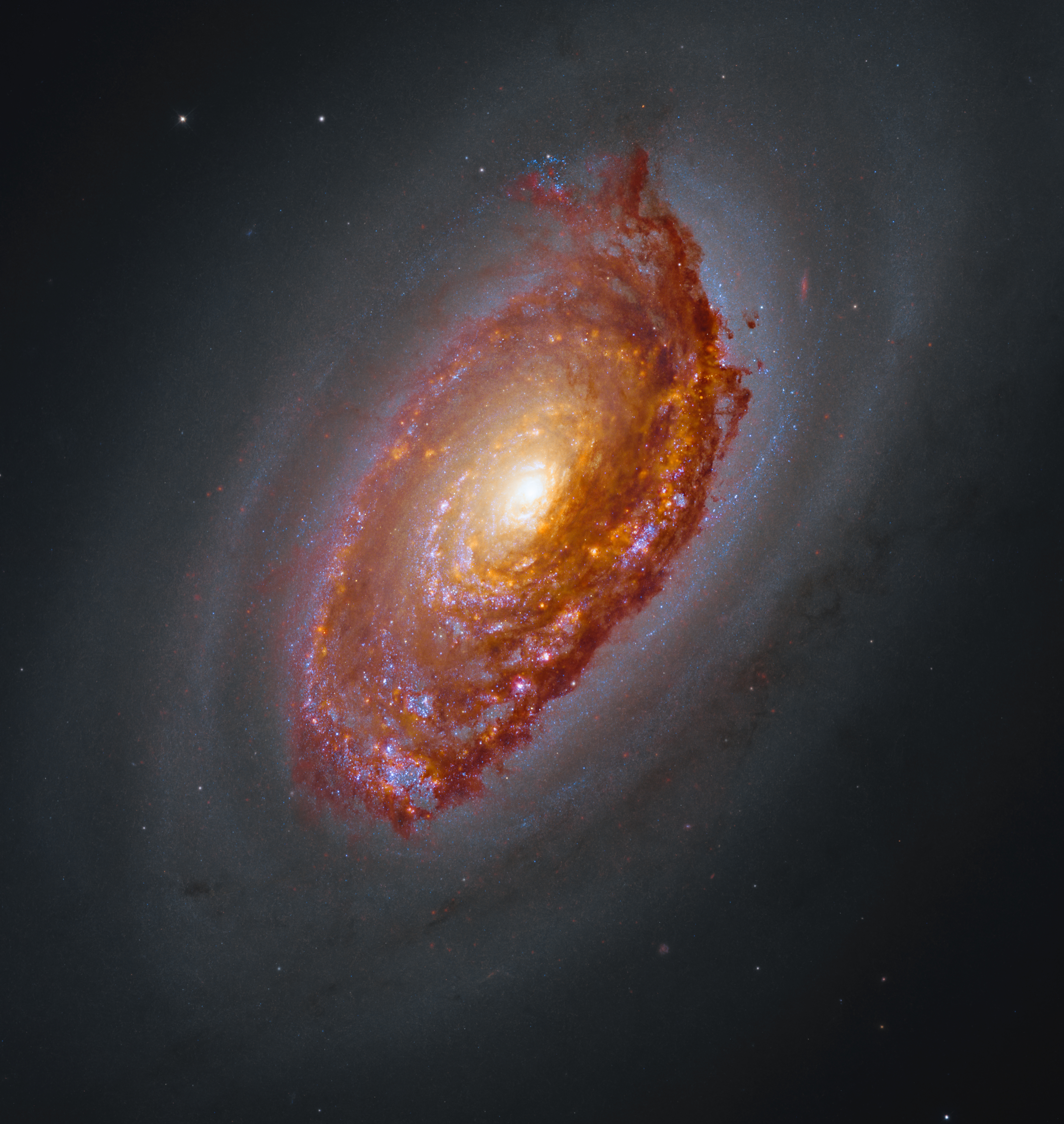
This March 20, 2026, image of Messier 64, or the Black Eye Galaxy, is a composite view from NASA’s Hubble Space Telescope and James Webb Space Telescope. It shows Messier 64 captured at near- and mid-infrared wavelengths by Webb, while Hubble’s image shows the galaxy in ultraviolet, visible, and near-infrared light.
Messier 64 is characterized by its bizarre internal motion. The gas in the outer regions of this spiral galaxy is rotating in the opposite direction from the gas and stars in its inner regions. This strange behavior may be the result of a merger between M64 and a satellite galaxy over a billion years ago.
Image credit: NASA, CSA, ESA, F. Belfiore (European Southern Observatory – Germany), J. Lee (Space Telescope Science Institute), A. Leroy (The Ohio State University), and D. Thilker (The Johns Hopkins University); Processing: Gladys Kober (NASA/Catholic University of America)
Black Eye Galaxy
This March 20, 2026, image of Messier 64, or the Black Eye Galaxy, is a composite view from NASA’s Hubble Space Telescope and James Webb Space Telescope. It shows Messier 64 captured at near- and mid-infrared wavelengths by Webb, while Hubble’s image shows the galaxy in ultraviolet, visible, and near-infrared light.
Messier 64 is characterized by its bizarre internal motion. The gas in the outer regions of this spiral galaxy is rotating in the opposite direction from the gas and stars in its inner regions. This strange behavior may be the result of a merger between M64 and a satellite galaxy over a billion years ago.
Image credit: NASA, CSA, ESA, F. Belfiore (European Southern Observatory – Germany), J. Lee (Space Telescope Science Institute), A. Leroy (The Ohio State University), and D. Thilker (The Johns Hopkins University); Processing: Gladys Kober (NASA/Catholic University of America)
SpaceX’s historic IPO ignites the new space race
SpaceX’s IPO—the largest in history—has out-of-this-world implications for AI, space commerce and extraterrestrial exploration
Week in images: 08-12 June 2026
Week in images: 08-12 June 2026
Discover our week through the lens
Did A Moon-Size Planet Grow Fast and Die Young in the Early Solar System?
A rare meteorite recovered from the Sahara Desert could be a fragment of a Moon-size body that met a violent end in the earliest days of the solar system.
The post Did A Moon-Size Planet Grow Fast and Die Young in the Early Solar System? appeared first on Sky & Telescope.
Steven Spielberg’s Disclosure Day gets one major thing wrong about the search for aliens
The new movie Disclosure Day is all about a big, alien secret. But SETI researchers behind the updated postdetection protocol say they aren’t in the business of secrets
Quantum computer quickly mines cryptocurrency while using less energy
Quantum computer quickly mines cryptocurrency while using less energy
Hubble Sees Swarm of Galaxies
- Hubble Home
- Overview
- Impact & Benefits
- Science
- Observatory
- Team
- Multimedia
- News
- More
2 min read
Hubble Sees Swarm of Galaxies This NASA Hubble Space Telescope image features the galaxy cluster MACS0329-0211. NASA, ESA, M. Postman (STScI); Image Processing: G. Kober (NASA/Catholic University of America)Looking somewhat like a swarm of bees returning to their hive, this NASA Hubble Space Telescope image features the galaxy cluster MACS0329-0211. Galaxy clusters like MACS0329-0211 are important signposts in the story of how the structure of the universe evolved, and are the ultimate telescopic lenses, placing gravitationally lensed galaxies from the earliest stages of the universe into our view.
Zoom into this galaxy swarm and you will find large, oval-shaped elliptical galaxies, and thin spiral and lenticular galaxies viewed from the edge. We can also see the full, face-on view of spiral galaxies and their curving spiral arms. The image’s upper-right quadrant holds faint arcs of distant galaxies gravitationally lensed by the cluster’s massive gravity. The largest of these arcs appears above the bright oval shape of a giant elliptical galaxy. Closer inspection of the image’s center reveals several bright-white intersecting curves that appear as a distorted figure eight. This may be another distant galaxy whose light was magnified and distorted by this massive cluster’s gravity.
Hubble looked at MACS0329-0211 as part of an observing program of X-ray bright galaxy clusters. Researchers used Hubble’s two main cameras, the Advanced Camera for Surveys and its Wide Field Camera 3, to gather data visible and infrared light from the cluster. Hubble’s ability to see such a broad spectrum of light makes it a valuable tool in understanding the very nature of these galaxy clusters.
Facebook logo @NASAHubble @NASAHubble Instagram logo @NASAHubbleMedia Contact:
Claire Andreoli
NASA’s Goddard Space Flight Center, Greenbelt, MD
claire.andreoli@nasa.gov
Since its 1990 launch, the Hubble Space Telescope has changed our fundamental understanding of the universe.
Hubble’s Galaxies
Hubble Science Highlights
Hubble Images
Hubble Sees Swarm of Galaxies
- Hubble Home
- Overview
- Impact & Benefits
- Science
- Observatory
- Team
- Multimedia
- News
- More
2 min read
Hubble Sees Swarm of Galaxies This NASA Hubble Space Telescope image features the galaxy cluster MACS0329-0211. NASA, ESA, M. Postman (STScI); Image Processing: G. Kober (NASA/Catholic University of America)Looking somewhat like a swarm of bees returning to their hive, this NASA Hubble Space Telescope image features the galaxy cluster MACS0329-0211. Galaxy clusters like MACS0329-0211 are important signposts in the story of how the structure of the universe evolved, and are the ultimate telescopic lenses, placing gravitationally lensed galaxies from the earliest stages of the universe into our view.
Zoom into this galaxy swarm and you will find large, oval-shaped elliptical galaxies, and thin spiral and lenticular galaxies viewed from the edge. We can also see the full, face-on view of spiral galaxies and their curving spiral arms. The image’s upper-right quadrant holds faint arcs of distant galaxies gravitationally lensed by the cluster’s massive gravity. The largest of these arcs appears above the bright oval shape of a giant elliptical galaxy. Closer inspection of the image’s center reveals several bright-white intersecting curves that appear as a distorted figure eight. This may be another distant galaxy whose light was magnified and distorted by this massive cluster’s gravity.
Hubble looked at MACS0329-0211 as part of an observing program of X-ray bright galaxy clusters. Researchers used Hubble’s two main cameras, the Advanced Camera for Surveys and its Wide Field Camera 3, to gather data visible and infrared light from the cluster. Hubble’s ability to see such a broad spectrum of light makes it a valuable tool in understanding the very nature of these galaxy clusters.
Facebook logo @NASAHubble @NASAHubble Instagram logo @NASAHubbleMedia Contact:
Claire Andreoli
NASA’s Goddard Space Flight Center, Greenbelt, MD
claire.andreoli@nasa.gov
Since its 1990 launch, the Hubble Space Telescope has changed our fundamental understanding of the universe.
Hubble’s Galaxies
Hubble Science Highlights
Hubble Images
SpaceX IPO valuation depends on Starship and orbital AI data centers
Reusable rockets and Starlink made Elon Musk’s company dominant in spaceflight. Its record valuation leans on making Starship flights routine and orbital AI data centers real
Crowdsourcing could discover new meteor showers and more
Meteor camera networks can reveal the hidden history of the solar system, and you can assist from your own backyard
Can black holes send information back in time?
Extremely curved spacetime can warp cause and effect, creating channels for backward communication
Mission Control | Keeping Columbus Running 24/7 | ESA Explores #19
Step inside the Columbus Control Centre near Munich, Germany, and discover what it takes to keep ESA's Columbus laboratory running—24 hours a day, 365 days a year.
Columbus Flight Director Tristan Hermel takes us behind the scenes of mission control, where teams on the ground coordinate operations, support astronauts and work with international partners across the globe.
Get a glimpse of life behind the consoles as ESA astronaut Sophie Adenot carries out her Epsilon mission on board the Space Station.
This interview was recorded in January 2026.
Disclosure Day and interspecies communication—alien language isn’t just weird noises
A linguist lays out what communicating with aliens could actually involve—and what that tells us about human language
This Week's Sky at a Glance, June 12 – 21
The three planets in the western twilight are pulling away from each other now. On Wednesday, the Moon will occult Venus in daylight.
The post This Week's Sky at a Glance, June 12 – 21 appeared first on Sky & Telescope.