
Feed aggregator
Planets Hurry To Form Before the Protoplanetary Disk Dissipates
Planets form in protoplanetary disks, reservoirs of gas and dust around young stars. But young stars are a little hyperactive, and they emit powerful winds that can dissipate the gas. So planets, especially gas giants, are in a race against time to form. They only have a few million years before the gas is gone.
Next Up! A Deep Partial Lunar Eclipse on Aug. 27–28
A near-total lunar eclipse wraps up August's trifecta of two major eclipses and the Perseids.
The post Next Up! A Deep Partial Lunar Eclipse on Aug. 27–28 appeared first on Sky & Telescope.
APOD: 2026 August 27 – Colorful Aurora over an Icelandic Waterfall
APOD
Astronomy Picture of the Day
Discover the cosmos! Each day a different image or photograph of our fascinating universe is featured, along with a brief explanation written by a professional astronomer.
Colorful Aurora over Icelandic Waterfall
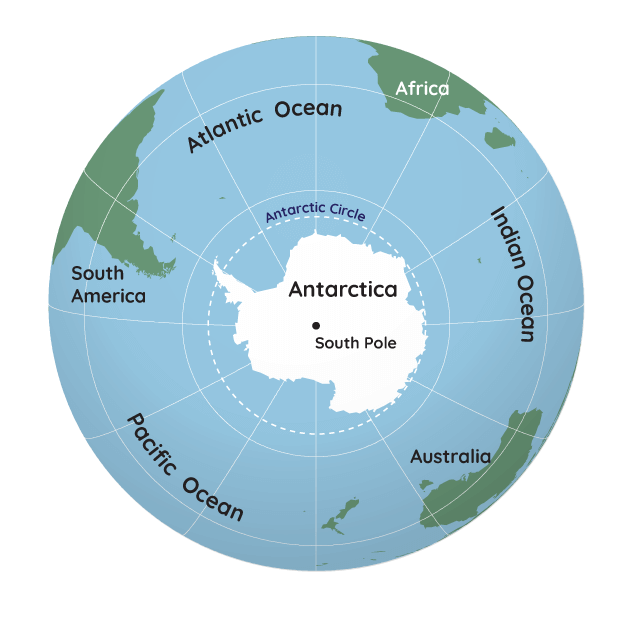
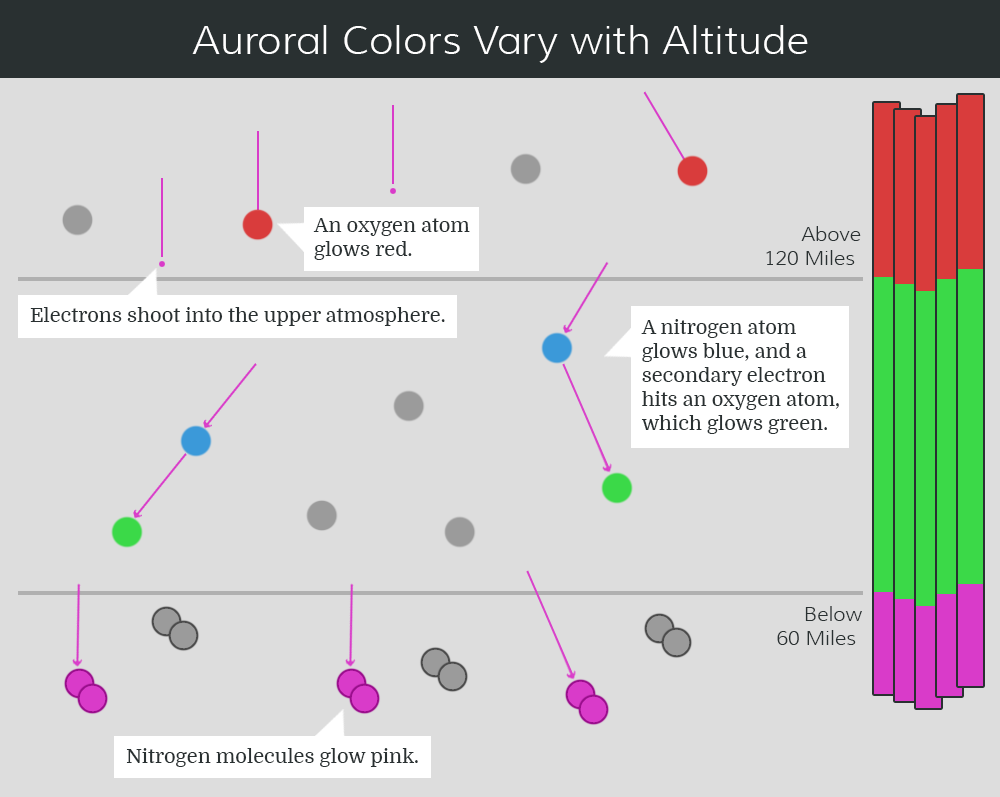
Explanation: What a sight to behold, when a night sky became filled with colors that appeared to rain over the Skógafoss waterfall in Iceland. This image was taken in a single 5 second exposure by the photographer in April 2025. Seeing an aurora is on many people’s bucket lists. But it is not easy. It requires high solar activity, dark and clear skies, and usually a viewing location at high latitude. That makes the northern lights more easily seen than the corresponding southern lights, simply because there is less landmass in the Southern Hemisphere, especially around the Antarctic Circle. Auroras are caused by charged particles from the solar wind that are captured by the Earth’s magnetosphere and guided by the magnetic field to a region close to one of the poles, where they collide with gas particles in the atmosphere. Different colors indicate interactions with different gases at different altitudes, like oxygen (red and green) and nitrogen (blue and pink).
APOD’s main NASA site is moving : From apod.nasa.gov to science.nasa.gov/apod
Tomorrow’s picture: What’s next?
NASA Science Activation & Michigan Tech. U.
Random APOD Generator
Yesterday’s Image APOD: 2026 August 26 – JWST Images The Lion’s Head Nebula
Tomorrow’s Image
APOD: 2026 August 27 – Colorful Aurora over an Icelandic Waterfall
APOD
Astronomy Picture of the Day
Discover the cosmos! Each day a different image or photograph of our fascinating universe is featured, along with a brief explanation written by a professional astronomer.
Colorful Aurora over Icelandic WaterfallExplanation: What a sight to behold, when a night sky became filled with colors that appeared to rain over the Skógafoss waterfall in Iceland. This image was taken in a single 5 second exposure by the photographer in April 2025. Seeing an aurora is on many people’s bucket lists. But it is not easy. It requires high solar activity, dark and clear skies, and usually a viewing location at high latitude. That makes the northern lights more easily seen than the corresponding southern lights, simply because there is less landmass in the Southern Hemisphere, especially around the Antarctic Circle. Auroras are caused by charged particles from the solar wind that are captured by the Earth’s magnetosphere and guided by the magnetic field to a region close to one of the poles, where they collide with gas particles in the atmosphere. Different colors indicate interactions with different gases at different altitudes, like oxygen (red and green) and nitrogen (blue and pink).
APOD’s main NASA site is moving : From apod.nasa.gov to science.nasa.gov/apod
Tomorrow’s picture: What’s next?
NASA Science Activation & Michigan Tech. U.
Random APOD Generator
Yesterday’s Image APOD: 2026 August 26 – JWST Images The Lion’s Head Nebula
Tomorrow’s Image
NASA’s Webb Telescope Rules Out Two New Dyson Sphere Candidates
Recent searches for the technosignatures of hypothetical Dyson Spheres again turn up empty.
AI Spots Hidden Solar Storm Signs 9 Hours Early
When we think of weather forecasts, we instinctively think of weather on Earth like rain or shine. However, we rarely consider weather forecasts from outside of the Earth, also called space weather. While space weather often results in the awe-inspiring aurora located at the northern and southern latitudes, we often forget the negative impacts of space weather on our everyday lives. This includes potential disruption of communication satellites or ground stations. The primary conundrum that has eluded researchers is being able to forecast incoming space weather so we can better prepare for its impact.
Is there a ‘window of opportunity’ to prevent Alzheimer’s in women?
A pair of new studies point to the role of early menopause and hormone treatment in cognitive decline, but more research is needed, experts say
Scientists Melted A Diamond and Cracked a Secret of Ice Giants
Some of the strangest weather in the solar system doesn’t happen on Earth, or even Jupiter’s Great Red Spot - it happens in the interior of the Ice Giants like Neptune and Uranus. Specifically, scientists have long believed that, at certain pressure and temperatures, it literally rains diamonds inside of these planets. And for the first time, scientists have mimicked the process they believe creates that. A new paper by physicists at the Lawrence Livermore National Laboratory (LLNL), published in Nature Physics, resolves a 20 year old scientific mystery, and shows how the same physics that makes it rain diamonds inside Neptune could also help us triple our fusion energy output.
Building Foresight for Earth Science, featuring Lindsey Jacobson
NASA’s Earth-observing satellite missions track dozens of features of a changing planet — aerosols, sea levels, land cover, cloud cover — over years and decades. Sustaining that record for the scientific and operational communities who depend on it requires more than engineering talent. It requires planning for an uncertain future: anticipating where a mission delay or on-orbit event might create a gap in the data those communities rely on.
Lindsey Jacobson’s work helps NASA anticipate those disruptions before they happen and gives senior leaders options for managing them.
A Pathways intern in engineering, Jacobson supports NASA’s Earth Science Division through the NASA Earth Science Strategic Integration Environment (NESSIE) team within the Systems Analysis and Concepts Directorate (SACD) at NASA’s Langley Research Center in Hampton, Virginia.
NASA’s Pathways program connects undergraduate and graduate students with NASA centers through internships that, with satisfactory performance, can lead to full-time civil service positions. Jacobson has returned to NASA Langley every summer since 2022, splitting her time between the center and finishing her mechanical engineering dissertation at North Carolina State University.
Lindsey Jacobson, Pathways InternCredit: NASA
“The way we do Earth science is changing.“
Jacobson and the NESSIE team support the Earth science satellite portfolio — dozens of missions, each measuring specific features of the planet, from clouds to sea surface temperature to land use. The goal is providing end user communities with the data products they depend on. The challenge is the unknown.
This image depicts a full view of the Earth, taken by the Geostationary Operational Environment Satellite (GOES-8), a satellite that was in service from 1994-2004. It was owned and operated by the National Oceanic and Atmospheric Administration (NOAA) and provided the kind of continuous monitoring necessary for intensive data analysis.Credit: NASA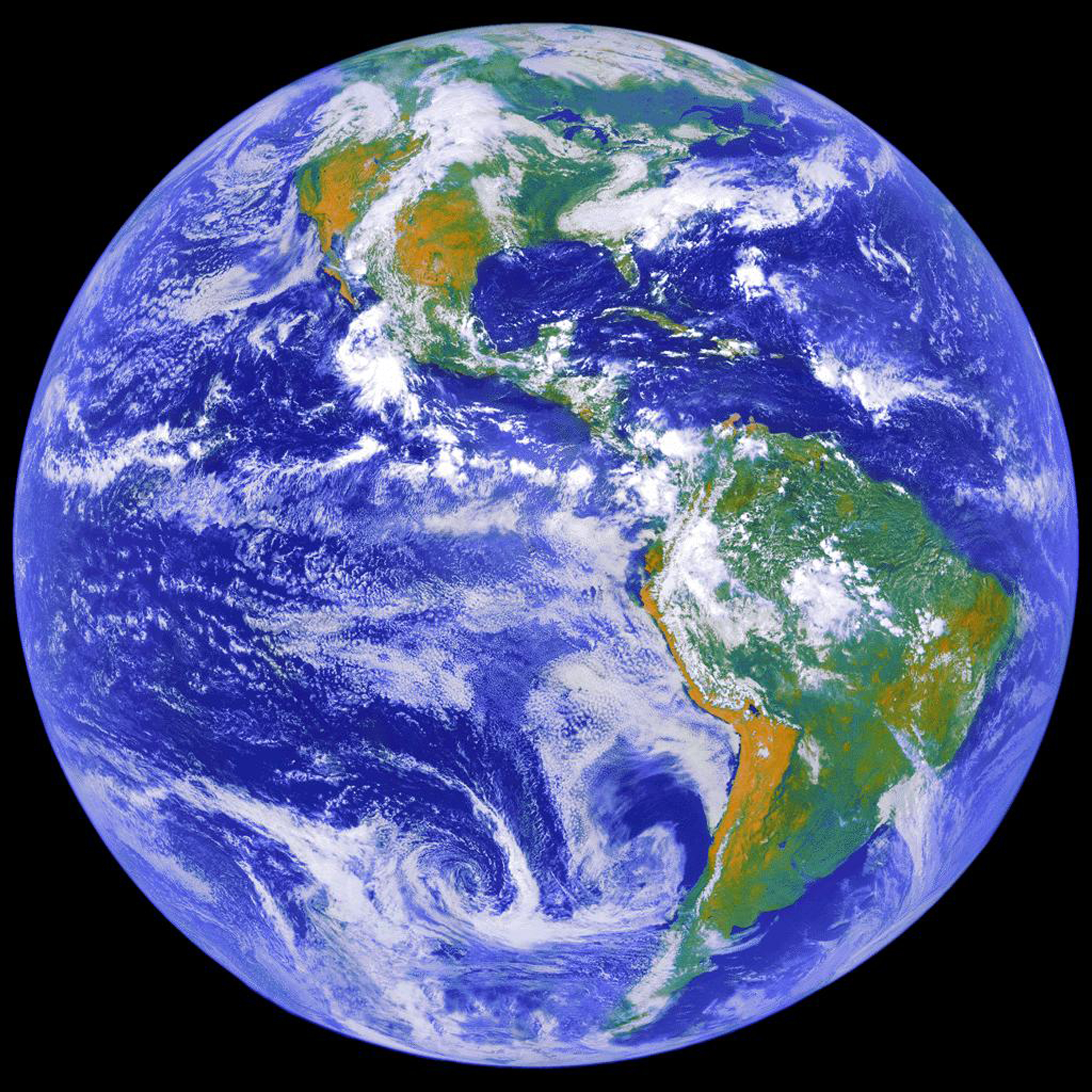
“There’s uncertainty about mission lifetimes and what could happen on orbit, and about schedules,” Jacobson explains. The team’s work gives NASA’s senior leadership a way to navigate that uncertainty: understanding where a gap in coverage might emerge and identifying options to mitigate or hedge against it. By providing alternative pathways for meeting end-user needs, this work supports senior leaders in managing a complex, interdependent portfolio.
Writing the CodeWithin that effort, Jacobson’s focus is building analysis tools that give the team what she calls a “foresight ability.”
“It’s the ability to anticipate different things that might happen — changes that might occur across the portfolio of Earth-observing missions — and to have strategies in mind for how to respond, so we can keep delivering data to end users,” she says.
Not every change is bad news. Missions sometimes operate well beyond their planned lifespan, creating room to extend their value. But whether an adjustment is welcome or not, the principle is the same: know the options before anything happens.
Jacobson compares it to preparing for hurricane season. “You get the storm shutters, you buy the sandbags, and you have them pre-positioned,” she says. “Then when the warning comes, you’re not scrambling, and you’re not at risk of the store selling out. You already have what you need in place.” NESSIE’s work follows the same logic for the Earth-observing portfolio by understanding ahead of time what a disruption might mean and having a set of responses ready before anything happens.
“We proactively suggest the strategies and alternatives that could be enacted if there’s a change,” Jacobson says. “We do that ahead of time, so people understand what options might exist.”
Her approach carries echoes of her graduate research, which examines how complex systems — infrastructure that can’t simply be torn down and rebuilt, like the electric grid — must evolve deliberately instead. “We designed a grid, and now we live with that grid forever,” she says. “We can’t tear it down and build a new one. What we can do is modify, expand, and improve upon what we have.” It’s the same instinct for working with what exists, rather than starting from scratch, that shapes how she approaches her work at NASA.
Keeping PaceEngineers arriving at NASA for the first time might expect the hardest part of the job to be technical. Jacobson found something else: the landscape itself is what demands the most adaptability.
“The way we do Earth science is changing,” she says. Commercial companies are increasingly contributing data alongside government agencies. New space agencies are entering the field. Innovative technologies and architectures are emerging all the time. Keeping pace with that shift — understanding how NASA’s own capabilities are evolving and how to best serve the communities that depend on the data — is as much a part of the job as any calculation.
Jacobson presenting NESSIE’s work on managing portfolios of Earth-observing missions to meet science needs despite uncertainties in mission scheduling and lifetimes, Institute of Electrical and Electronics Engineers (IEEE) Aerospace Conference, 2025.Credit: NASA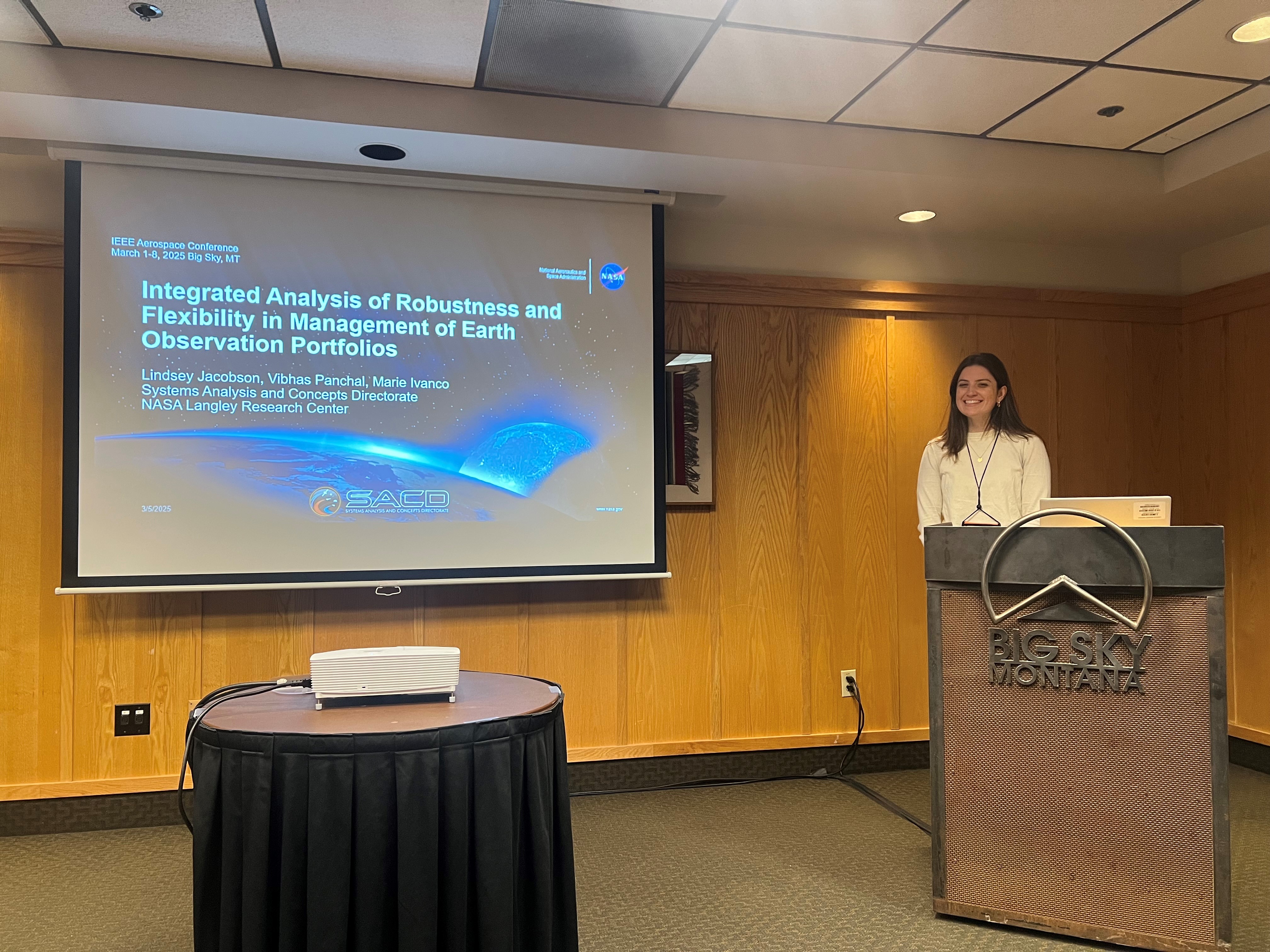
Some of that adaptability shows up in smaller ways too, like the growing role of AI tools in her team’s own workflow. “Langley has done a lot of firsts,” Jacobson says, echoing something she heard recently from Trina Dyal, NASA Langley’s director, at an intern event. “And we want to continue to be the first. That means learning new things and figuring out how to bring them into how we work.”
On Jacobson’s Sci-Fi ShelfThe Sirens of Titan by Kurt Vonnegut
Jacobson received this novel in high school, let it sit on her shelf for years, and finally picked it up during the pandemic.
“It was very special. It touches a lot on the meaning of life, and that connects to some of the reasons I was motivated by space in the first place. The idea that space exploration can bring humanity together. That cosmic perspective.”

Part of the Systems Analysis and Concepts Directorate at NASA’s Langley Research Center.
Learn more about our work by visiting our website.
Building Foresight for Earth Science, featuring Lindsey Jacobson
NASA’s Earth-observing satellite missions track dozens of features of a changing planet — aerosols, sea levels, land cover, cloud cover — over years and decades. Sustaining that record for the scientific and operational communities who depend on it requires more than engineering talent. It requires planning for an uncertain future: anticipating where a mission delay or on-orbit event might create a gap in the data those communities rely on.
Lindsey Jacobson’s work helps NASA anticipate those disruptions before they happen and gives senior leaders options for managing them.
A Pathways intern in engineering, Jacobson supports NASA’s Earth Science Division through the NASA Earth Science Strategic Integration Environment (NESSIE) team within the Systems Analysis and Concepts Directorate (SACD) at NASA’s Langley Research Center in Hampton, Virginia.
NASA’s Pathways program connects undergraduate and graduate students with NASA centers through internships that, with satisfactory performance, can lead to full-time civil service positions. Jacobson has returned to NASA Langley every summer since 2022, splitting her time between the center and finishing her mechanical engineering dissertation at North Carolina State University.
Lindsey Jacobson, Pathways InternCredit: NASA
“The way we do Earth science is changing.“
Jacobson and the NESSIE team support the Earth science satellite portfolio — dozens of missions, each measuring specific features of the planet, from clouds to sea surface temperature to land use. The goal is providing end user communities with the data products they depend on. The challenge is the unknown.
This image depicts a full view of the Earth, taken by the Geostationary Operational Environment Satellite (GOES-8), a satellite that was in service from 1994-2004. It was owned and operated by the National Oceanic and Atmospheric Administration (NOAA) and provided the kind of continuous monitoring necessary for intensive data analysis.Credit: NASA“There’s uncertainty about mission lifetimes and what could happen on orbit, and about schedules,” Jacobson explains. The team’s work gives NASA’s senior leadership a way to navigate that uncertainty: understanding where a gap in coverage might emerge and identifying options to mitigate or hedge against it. By providing alternative pathways for meeting end-user needs, this work supports senior leaders in managing a complex, interdependent portfolio.
Writing the CodeWithin that effort, Jacobson’s focus is building analysis tools that give the team what she calls a “foresight ability.”
“It’s the ability to anticipate different things that might happen — changes that might occur across the portfolio of Earth-observing missions — and to have strategies in mind for how to respond, so we can keep delivering data to end users,” she says.
Not every change is bad news. Missions sometimes operate well beyond their planned lifespan, creating room to extend their value. But whether an adjustment is welcome or not, the principle is the same: know the options before anything happens.
Jacobson compares it to preparing for hurricane season. “You get the storm shutters, you buy the sandbags, and you have them pre-positioned,” she says. “Then when the warning comes, you’re not scrambling, and you’re not at risk of the store selling out. You already have what you need in place.” NESSIE’s work follows the same logic for the Earth-observing portfolio by understanding ahead of time what a disruption might mean and having a set of responses ready before anything happens.
“We proactively suggest the strategies and alternatives that could be enacted if there’s a change,” Jacobson says. “We do that ahead of time, so people understand what options might exist.”
Her approach carries echoes of her graduate research, which examines how complex systems — infrastructure that can’t simply be torn down and rebuilt, like the electric grid — must evolve deliberately instead. “We designed a grid, and now we live with that grid forever,” she says. “We can’t tear it down and build a new one. What we can do is modify, expand, and improve upon what we have.” It’s the same instinct for working with what exists, rather than starting from scratch, that shapes how she approaches her work at NASA.
Keeping PaceEngineers arriving at NASA for the first time might expect the hardest part of the job to be technical. Jacobson found something else: the landscape itself is what demands the most adaptability.
“The way we do Earth science is changing,” she says. Commercial companies are increasingly contributing data alongside government agencies. New space agencies are entering the field. Innovative technologies and architectures are emerging all the time. Keeping pace with that shift — understanding how NASA’s own capabilities are evolving and how to best serve the communities that depend on the data — is as much a part of the job as any calculation.
Jacobson presenting NESSIE’s work on managing portfolios of Earth-observing missions to meet science needs despite uncertainties in mission scheduling and lifetimes, Institute of Electrical and Electronics Engineers (IEEE) Aerospace Conference, 2025.Credit: NASASome of that adaptability shows up in smaller ways too, like the growing role of AI tools in her team’s own workflow. “Langley has done a lot of firsts,” Jacobson says, echoing something she heard recently from Trina Dyal, NASA Langley’s director, at an intern event. “And we want to continue to be the first. That means learning new things and figuring out how to bring them into how we work.”
On Jacobson’s Sci-Fi ShelfThe Sirens of Titan by Kurt Vonnegut
Jacobson received this novel in high school, let it sit on her shelf for years, and finally picked it up during the pandemic.
“It was very special. It touches a lot on the meaning of life, and that connects to some of the reasons I was motivated by space in the first place. The idea that space exploration can bring humanity together. That cosmic perspective.”
Part of the Systems Analysis and Concepts Directorate at NASA’s Langley Research Center.
Learn more about our work by visiting our website.
Wall of floodwater sweeps away villages in Nepal, with hundreds missing
A massive flood potentially caused by a chunk of ice breaking off from a glacier has swept away bridges, schools, and other buildings and killed at least 160 people
Roman Space Telescope Travels to SpaceX Hangar
Roman Space Telescope Travels to SpaceX Hangar
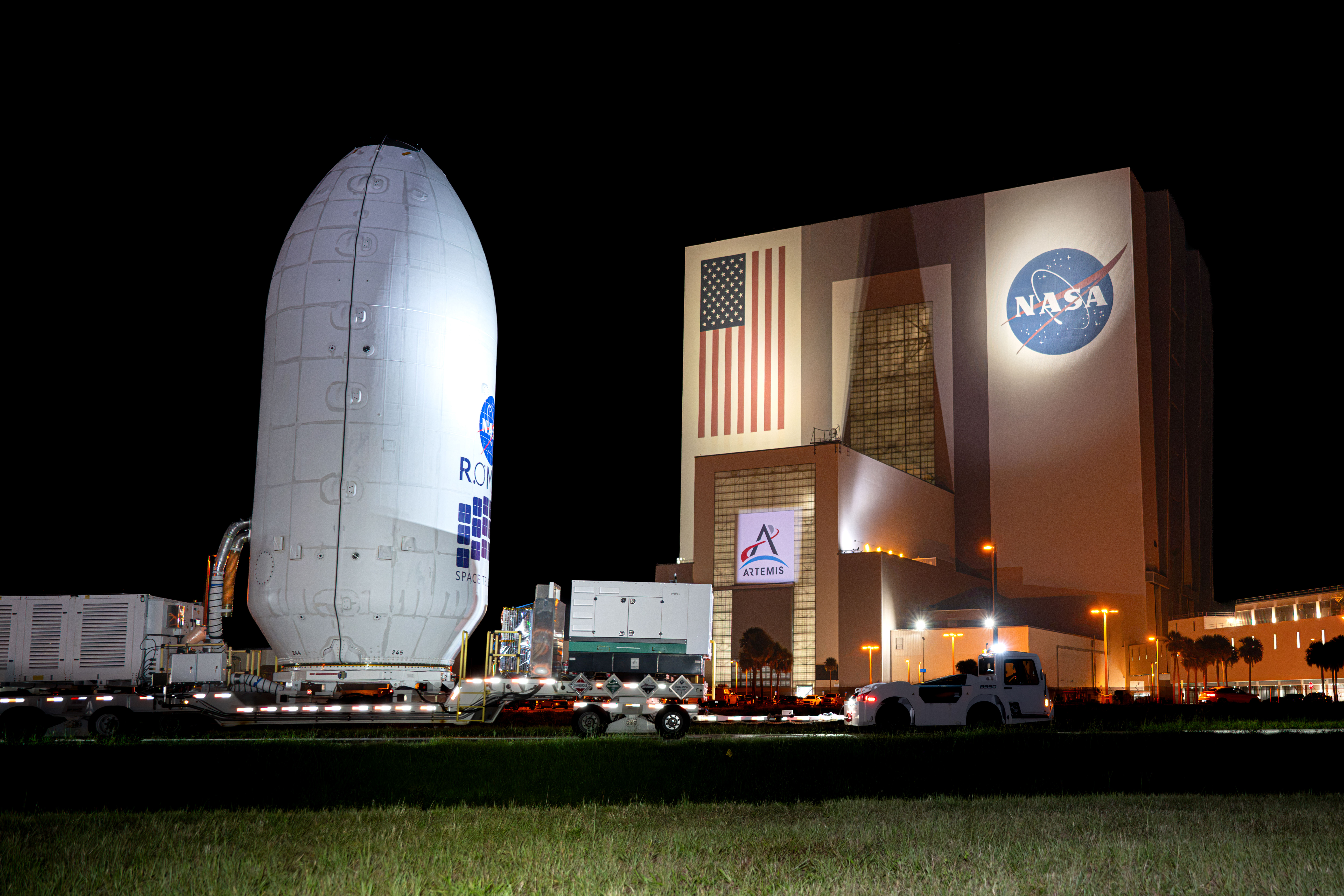
NASA’s Nancy Grace Roman Space Telescope, encapsulated in its payload fairing, travels from the Payload Hazardous Servicing Facility to the SpaceX hangar at Launch Complex 39A at NASA’s Kennedy Space Center on Tuesday, Aug. 25, 2026, ahead of mating to a SpaceX Falcon Heavy rocket.
Roman’s science instruments are designed to help researchers understand dark energy, the mysterious force accelerating the universe’s expansion. The observatory also will map how galaxies form, cluster, and evolve by tracing the influence of dark matter. Liftoff from NASA Kennedy is targeted no earlier than Sunday, Aug. 30, 2026.
Image credit: NASA/Sydney Rohde (Rocz)
Roman Space Telescope Travels to SpaceX Hangar
NASA’s Nancy Grace Roman Space Telescope, encapsulated in its payload fairing, travels from the Payload Hazardous Servicing Facility to the SpaceX hangar at Launch Complex 39A at NASA’s Kennedy Space Center on Tuesday, Aug. 25, 2026, ahead of mating to a SpaceX Falcon Heavy rocket.
Roman’s science instruments are designed to help researchers understand dark energy, the mysterious force accelerating the universe’s expansion. The observatory also will map how galaxies form, cluster, and evolve by tracing the influence of dark matter. Liftoff from NASA Kennedy is targeted no earlier than Sunday, Aug. 30, 2026.
Image credit: NASA/Sydney Rohde (Rocz)
Astronomers discover hot watery exoplanet destined to be swallowed by its star
Astronomers have discovered a new ocean world outside the solar system that orbits extremely close to its parent star. This means that the extrasolar planet, or "exoplanet," is in hot water, both literally and figuratively.
The exoplanet orbits the star HD 176071 located around 335 light-years away, and is about two and a half times the size of Earth, but has about eight and a half times the mass of our planet. That indicates to scientists that this planet is about 50% water. At a distance from its star of just under 1.5 million miles (about 1.6% of the distance between the Earth and the sun) and with a year lasting just 14 hours, HD 176071 b is a rare example of a "hot water world."
That close distance to its star means the planet experiences extreme tidal forces due to the pull of the star's gravity. These forces are driving the planet, designated HD 176071 b, towards a rapid and inexorable fatal encounter that will see it eventually violently devoured by its host star.
The exoplanet is also a rare occupant of what scientists call "Neptunian Desert" a term which describes a lack of Neptune sized worlds orbiting very close to their host stars. This is thought to be because intense stellar radiation strips planets of their gaseous layers effectively shrinking them. However, HD 176071 b seems to defy this suggestion, as this water world possesses surprisingly a dynamic atmosphere that hasn't been stripped away.
"Comparing historical data from the Kepler space telescope with new TESS (Transisting Exoplante Survey Satellite) observations six years later, we noticed an unexpected phase shift in the modulation of the reflected light," lead researcher Sylvain N. Breton of the Italian National Institute for Astrophysics (INAF) said in a statement.
"This tells us that we are not looking at a static photograph, but a living and changing atmosphere, in which dense, highly reflective clouds form, evolve, and move along the planet's coldest edges."
That isn't the only extraordinary thing about HD 176071 b. The way the ocean exoplanet was initially discovered is pretty special too.
This ocean world doesn't cross its stellar parentCurrently NASA's catalog of confirmed exoplanets has over 6,000 entries with thousands more worlds beyond the solar system awaiting conformation. The vast majority of these were discovered when they passed in from of their host star and caused a tiny dip in starlight reaching us from that stellar body in what's known as the transit method of exoplanet detection.
Thus, the transit method requires the planet to pass between its star and Earth. As you may imagine, that's a really fortunate arrangement for astronomers to find new planets in. Most known planets in the Milky Way don't do that.
"The vast majority of planets in the universe never transit in front of their star from Earth's perspective, making them virtually invisible," Breton said.
HD 176071 b is just such a world, with this geometric hinderance, so Breton and colleagues had to be crafty to discover this water world.
The team still used the starlight of the parent star of HD 176071 b to detect the exoplanet, but instead hunted for tiny fluctuations in brightness caused when the light from this star was reflected from the planet. HD 176071 b is tidally locked, meaning it has a permanent "dayside" facing its star, and a perpetual "nightside" facing out to space. The variations in brightness result because sometimes the nightside of the planet faces us, and other times our instruments see its dayside.
"Thanks to the dataset acquired with the HARPS-N instrument on the Galileo National Telescope, we have managed to overcome this geometric obstacle: by measuring with extreme precision how the light reflected by the planet varies throughout its orbital journey, we can not only detect these elusive worlds, but also begin to characterize their structure and atmosphere, opening a fundamental window onto previously almost inaccessible planetary populations," Breton said.
The discovery of HD 176071 b shows that current astronomy techniques are sophisticated enough to characterize the atmosphere and internal structure of worlds beyond the solar system. That is a big boost for the detection of worlds that don't pass between Earth and their host star.
The team's research was published on Tuesday (August 25) in the journal Astronomy & Astrophysics.
A Greenland Glacier Loses Another Chunk of Ice
The ESA's Sentinel satellites captured a 76 sq. km. chunk of ice breaking off from Greenland's Petermann Glacier. They watched the cracks and deformations happen in real time leading up to the calving. While calving is normal, it's happening more often, and this is another clear sign that the Arctic is rapidly changing due to the warming climate.
NASA Johnson Pilots Chase Moon’s Shadow for Eclipse Science
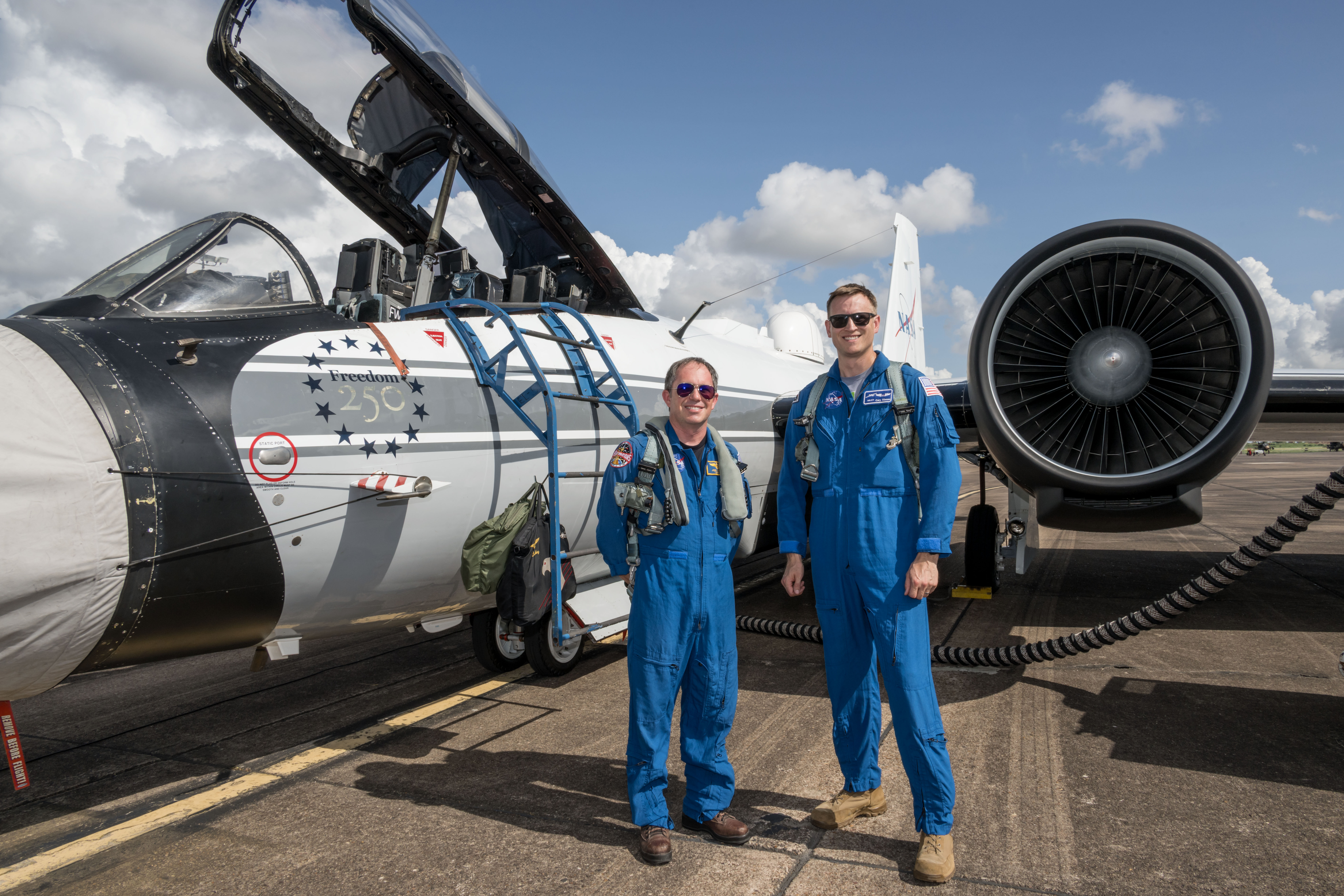
During the Aug. 12 total solar eclipse over Europe, scientists aimed to study a long-standing mystery: why the Sun’s outer atmosphere, the corona, is far hotter than its visible surface. Capturing the data they needed meant being in exactly the right place at the right time.
Pilots from NASA’s Johnson Space Center flew the WB-57F high altitude research aircraft from Ellington Field in Houston to Iceland, their base for flying through the path of totality to give scientists a clearer view of the Sun’s corona.
A total solar eclipse provides a unique opportunity to examine the corona because the Moon temporarily blocks the Sun’s bright surface, revealing its fainter outer atmosphere. Observations collected during this brief window can help scientists better understand how energy and material move through the corona and away from the Sun, improving our understanding of space weather.
John Gustine, NASA WB-57F pilot, prepares for flight at Ellington Field in Houston ahead of the aircraft’s departure for Iceland to support the Aug. 12 total solar eclipse. NASA/Robert Markowitz
At about 50,000 feet, the WB-57F flew above most clouds, dust, and water vapor that can interfere with observations from the ground. The altitude reduced atmospheric interference while also allowing the science instruments to observe infrared wavelengths that are largely absorbed lower in Earth’s atmosphere.
Capturing those observations required careful coordination between scientists and the flight crew. Before the mission, teams calculated where the aircraft needed to be as the Moon’s shadow moved across the North Atlantic.
“Going into a mission like this takes a huge team. It starts with the science team establishing the requirements, and then we work closely with them for months leading up to the mission,” said Tom Parent, NASA WB-57F pilot. “We rely heavily on our maintenance team to get the instruments serviced, prepared, loaded onto the aircraft, and flight tested. It’s a huge team effort to get an aircraft like this up there to image and achieve these objectives.”
NASA’s WB-57F aircraft takes off from Ellington Field in Houston ahead of its mission supporting the Aug. 12 total solar eclipse from Iceland. NASA/Robert Markowitz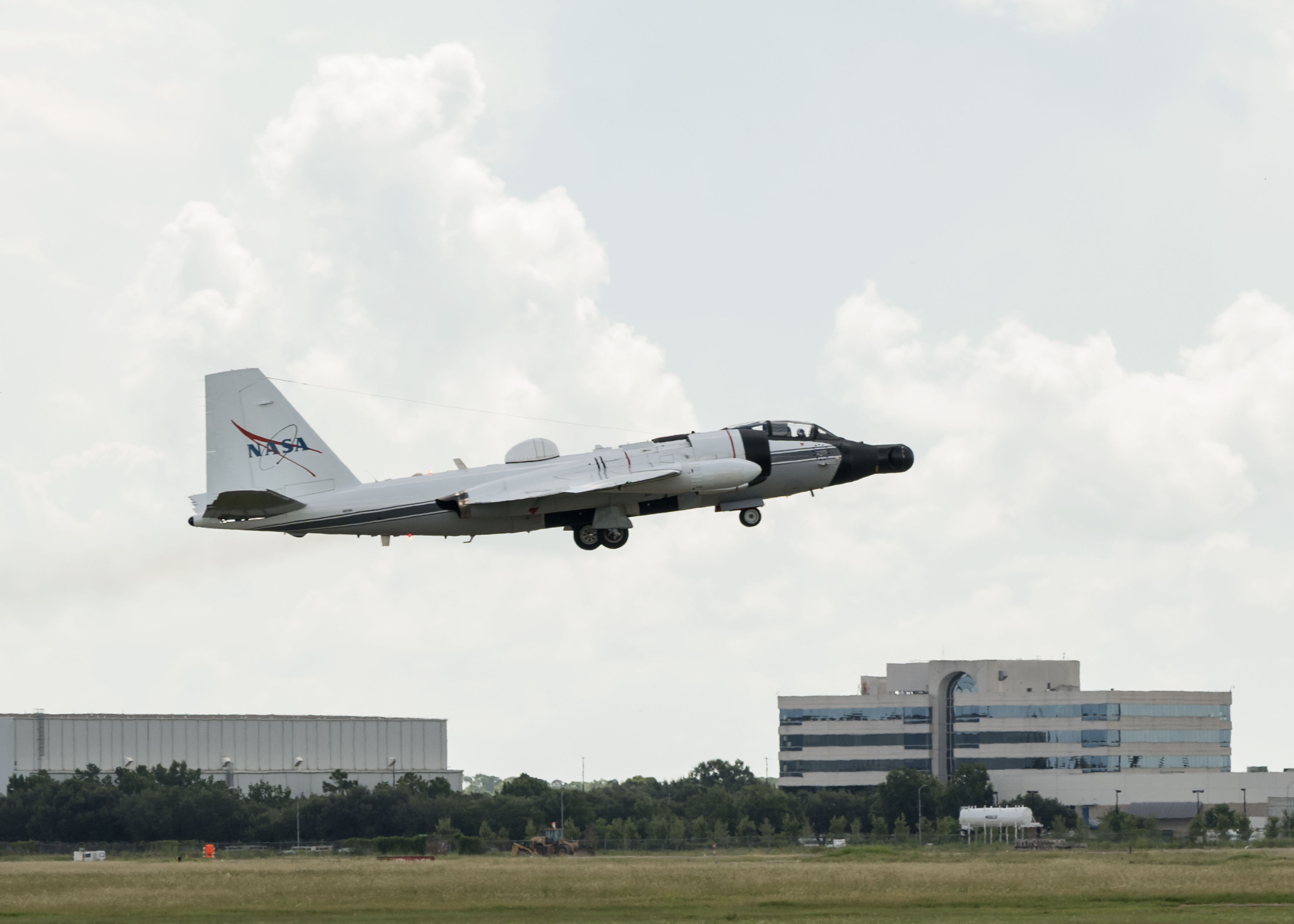
During totality, NASA WB-57F pilot John Gustine positioned the aircraft along the eclipse path to maximize time in the Moon’s shadow and give scientists as much opportunity as possible to collect data.
From the back seat, Cary Klemm, sensor equipment operator for NASA’s WB-57F, controlled the camera systems, adjusting focus and exposure times while tracking features of interest throughout totality.
With the cameras capturing observations throughout the brief window, every second mattered.
“Every image is another piece of data that could reveal something new about the Sun,” Klemm said.
What scientists can learn from those observations reaches far beyond the eclipse itself. The Sun’s corona is made of plasma shaped by magnetic fields, and many of the same physical processes occur elsewhere in the universe.
“The NASA WB-57F’s unique capabilities of high-altitude flight were truly crucial in providing access to these valuable wavelengths during an eclipse whose path crossed mostly over the ocean in an area where clouds are common,” said Amir Caspi, principal investigator for the study at Southwest Research Institute in Boulder, Colorado. “We could not have achieved this success without this platform, and all of the efforts of the many intrepid ground, air, and science crew members.”
Members of NASA’s WB-57F eclipse mission team gather at Ellington Field in Houston ahead of the aircraft’s departure for Iceland. NASA/Robert Markowitz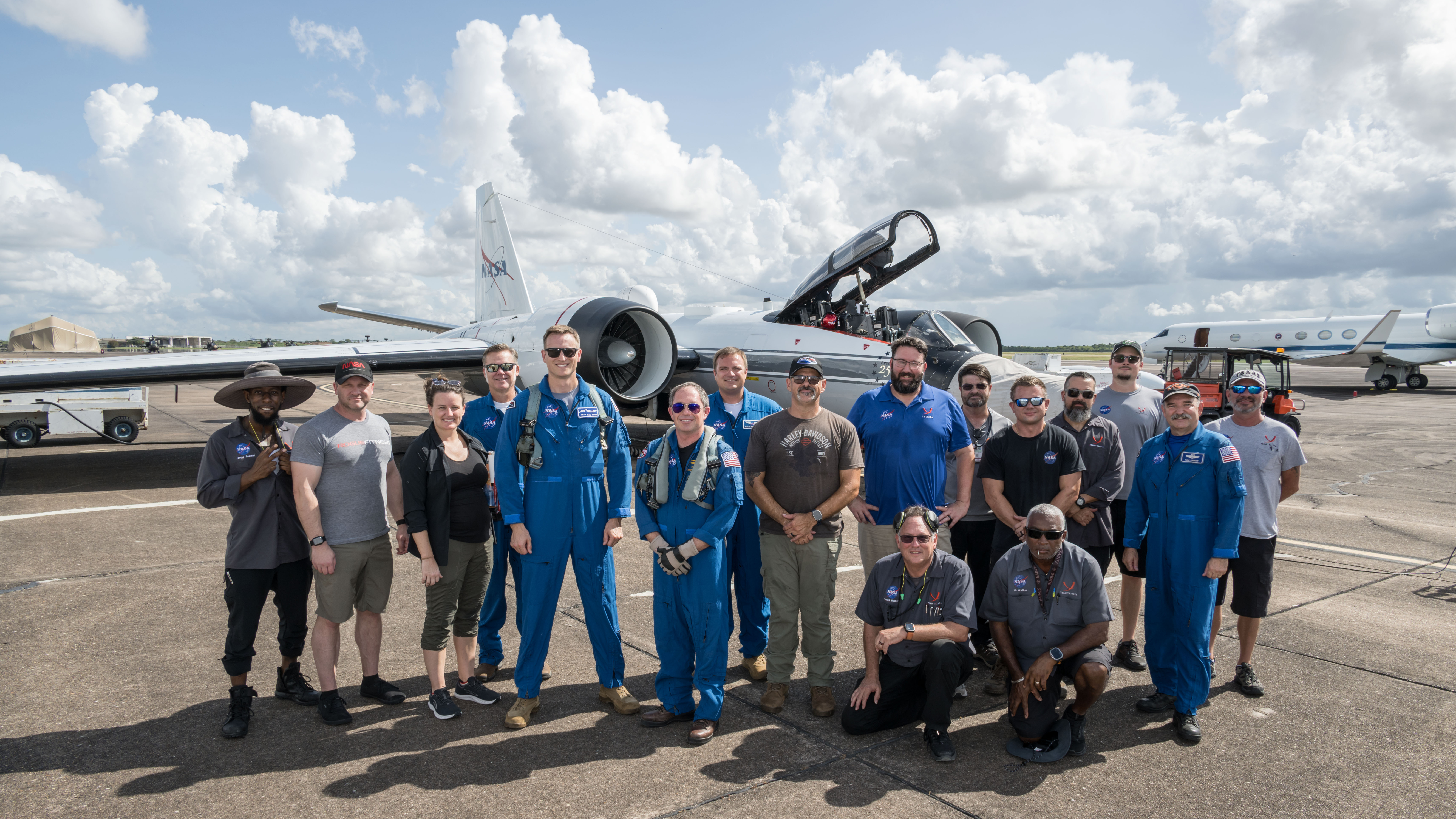
The data gathered during the flight will give scientists another opportunity to investigate the Sun and the processes that influence the space environment around Earth.
View images and videos from NASA’s eclipse mission.
About the AuthorSumer Loggins Share Details Last Updated Aug 26, 2026 Related Terms Explore More 3 min read NASA Shares Views of August Solar Eclipse from Ground, Air, SpaceOn Aug. 12, a total solar eclipse darkened skies over Greenland, Iceland, and Spain. As…
Article 6 days ago 5 min read Human-Related Microbes May Survive Moon’s South Pole, NASA FindsLee esta historia en español aquí. Some of Earth’s microbes likely to hitch a ride…
Article 1 week ago 7 min read Behind the Lens: Meet NASA Johnson’s Photographers Article 1 week ago Keep Exploring Discover More Topics From NASAMissions
Humans in Space
Climate Change
Solar System
NASA Johnson Pilots Chase Moon’s Shadow for Eclipse Science
During the Aug. 12 total solar eclipse over Europe, scientists aimed to study a long-standing mystery: why the Sun’s outer atmosphere, the corona, is far hotter than its visible surface. Capturing the data they needed meant being in exactly the right place at the right time.
Pilots from NASA’s Johnson Space Center flew the WB-57F high altitude research aircraft from Ellington Field in Houston to Iceland, their base for flying through the path of totality to give scientists a clearer view of the Sun’s corona.
A total solar eclipse provides a unique opportunity to examine the corona because the Moon temporarily blocks the Sun’s bright surface, revealing its fainter outer atmosphere. Observations collected during this brief window can help scientists better understand how energy and material move through the corona and away from the Sun, improving our understanding of space weather.
John Gustine, NASA WB-57F pilot, prepares for flight at Ellington Field in Houston ahead of the aircraft’s departure for Iceland to support the Aug. 12 total solar eclipse. NASA/Robert MarkowitzAt about 50,000 feet, the WB-57F flew above most clouds, dust, and water vapor that can interfere with observations from the ground. The altitude reduced atmospheric interference while also allowing the science instruments to observe infrared wavelengths that are largely absorbed lower in Earth’s atmosphere.
Capturing those observations required careful coordination between scientists and the flight crew. Before the mission, teams calculated where the aircraft needed to be as the Moon’s shadow moved across the North Atlantic.
“Going into a mission like this takes a huge team. It starts with the science team establishing the requirements, and then we work closely with them for months leading up to the mission,” said Tom Parent, NASA WB-57F pilot. “We rely heavily on our maintenance team to get the instruments serviced, prepared, loaded onto the aircraft, and flight tested. It’s a huge team effort to get an aircraft like this up there to image and achieve these objectives.”
NASA’s WB-57F aircraft takes off from Ellington Field in Houston ahead of its mission supporting the Aug. 12 total solar eclipse from Iceland. NASA/Robert MarkowitzDuring totality, NASA WB-57F pilot John Gustine positioned the aircraft along the eclipse path to maximize time in the Moon’s shadow and give scientists as much opportunity as possible to collect data.
From the back seat, Cary Klemm, sensor equipment operator for NASA’s WB-57F, controlled the camera systems, adjusting focus and exposure times while tracking features of interest throughout totality.
With the cameras capturing observations throughout the brief window, every second mattered.
“Every image is another piece of data that could reveal something new about the Sun,” Klemm said.
What scientists can learn from those observations reaches far beyond the eclipse itself. The Sun’s corona is made of plasma shaped by magnetic fields, and many of the same physical processes occur elsewhere in the universe.
“The NASA WB-57F’s unique capabilities of high-altitude flight were truly crucial in providing access to these valuable wavelengths during an eclipse whose path crossed mostly over the ocean in an area where clouds are common,” said Amir Caspi, principal investigator for the study at Southwest Research Institute in Boulder, Colorado. “We could not have achieved this success without this platform, and all of the efforts of the many intrepid ground, air, and science crew members.”
Members of NASA’s WB-57F eclipse mission team gather at Ellington Field in Houston ahead of the aircraft’s departure for Iceland. NASA/Robert MarkowitzThe data gathered during the flight will give scientists another opportunity to investigate the Sun and the processes that influence the space environment around Earth.
View images and videos from NASA’s eclipse mission.
About the AuthorSumer Loggins Share Details Last Updated Aug 26, 2026 Related Terms Explore More 3 min read NASA Shares Views of August Solar Eclipse from Ground, Air, SpaceOn Aug. 12, a total solar eclipse darkened skies over Greenland, Iceland, and Spain. As…
Article 5 days ago 5 min read Human-Related Microbes May Survive Moon’s South Pole, NASA FindsLee esta historia en español aquí. Some of Earth’s microbes likely to hitch a ride…
Article 1 week ago 7 min read Behind the Lens: Meet NASA Johnson’s Photographers Article 1 week ago Keep Exploring Discover More Topics From NASAMissions
Humans in Space
Climate Change
Solar System
More Americans believe the government is withholding information about UFOs
According to a new poll, more Americans also think they have seen a UFO now than they did in the past 53 years
Jill Lepore on why Silicon Valley gets science fiction wrong
Historian Jill Lepore explains what tech leaders miss in their favorite stories—and why the fight over AI data centers may be where the machine stops