
Feed aggregator
U.S. industries push to revive tungsten production amid shortage
Tungsten is a coveted metal for military uses. Restoring domestic supply could help with ongoing munitions shortages
World Cup camera coverage poses a moving math puzzle
Mathematicians have considered how to watch every corner of a space—but soccer adds moving players, blocked views and constant action
Earth From Space with our llive Space Bot - Answers Your Space / Astronomy Questions
NASA Study Challenges Theories on Where the Ingredients for Life Came From
NASA-supported scientists have provided new information about how the early Earth may have acquired some elements necessary for the planet to become habitable. They also suggest a new role for Jupiter in the distribution of these elements throughout the young solar system. The study, published in Science Advances, examines this history by looking at the ratio of phosphorus to nitrogen in iron meteorites and in younger objects known as chondrites.
NASA’s experimental quiet supersonic plane passes another critical milestone
NASA’s X-59 research aircraft reached its target speed and altitude for the first time on Friday
Former U.S. health official explains why the Trump administration ‘ignored’ a key alcohol study
A study finding that even one drink a day causes health risks was deliberately sidelined by the Trump administration, a former federal public health official alleges
Earth’s permafrost could soon release hidden ‘deep carbon,’ supercharging warming
Melting permafrost is releasing carbon into the atmosphere, but scientists may have underestimated just how bad the situation may be, a new analysis finds
The relationship recession is even bigger for Gen Z than we thought
The relationship recession is even bigger for Gen Z than we thought
Killer robots are here – we must finally decide whether to accept them
Killer robots are here – we must finally decide whether to accept them
The Universe is Still Running Away From Us
Last year, a study sent a quiet tremor through the field of cosmology. A team of researchers claimed that the universe's expansion might be slowing down, not speeding up, suggesting that dark energy, the mysterious force thought to be driving the cosmos apart, could be weakening. If true, it would have shaken the foundations of our understanding of the universe. Now, a new study including two Nobel laureates has looked carefully at the evidence and reached a clear verdict - crisis averted.
The Smallest Window on the Sun
Every so often, the Sun hurls billions of tonnes of charged particles toward Earth in what are called coronal mass ejections and if a big one hits at the wrong moment, the consequences for satellites, power grids, and communications systems could be catastrophic. Our best defence is to predict them before they happen, and that means watching the Sun's magnetic fields constantly and precisely. Now, a component smaller than a shirt button could transform how we do exactly that.
Reading the Galaxy's Past
Every galaxy you've ever seen in a photograph is hiding something. Beyond the glowing disc of stars and gas that the camera captures lies a vast, ghostly outer region called a halo, too faint to see easily but packed with clues about how that galaxy came to be. ESA has just formally committed to a mission designed to reveal those hidden haloes in unprecedented detail, and in doing so, finally answer one of the most fundamental questions in astronomy: how did galaxies like our own Milky Way form?
NASA to Cover 34th SpaceX Resupply Mission Space Station Departure
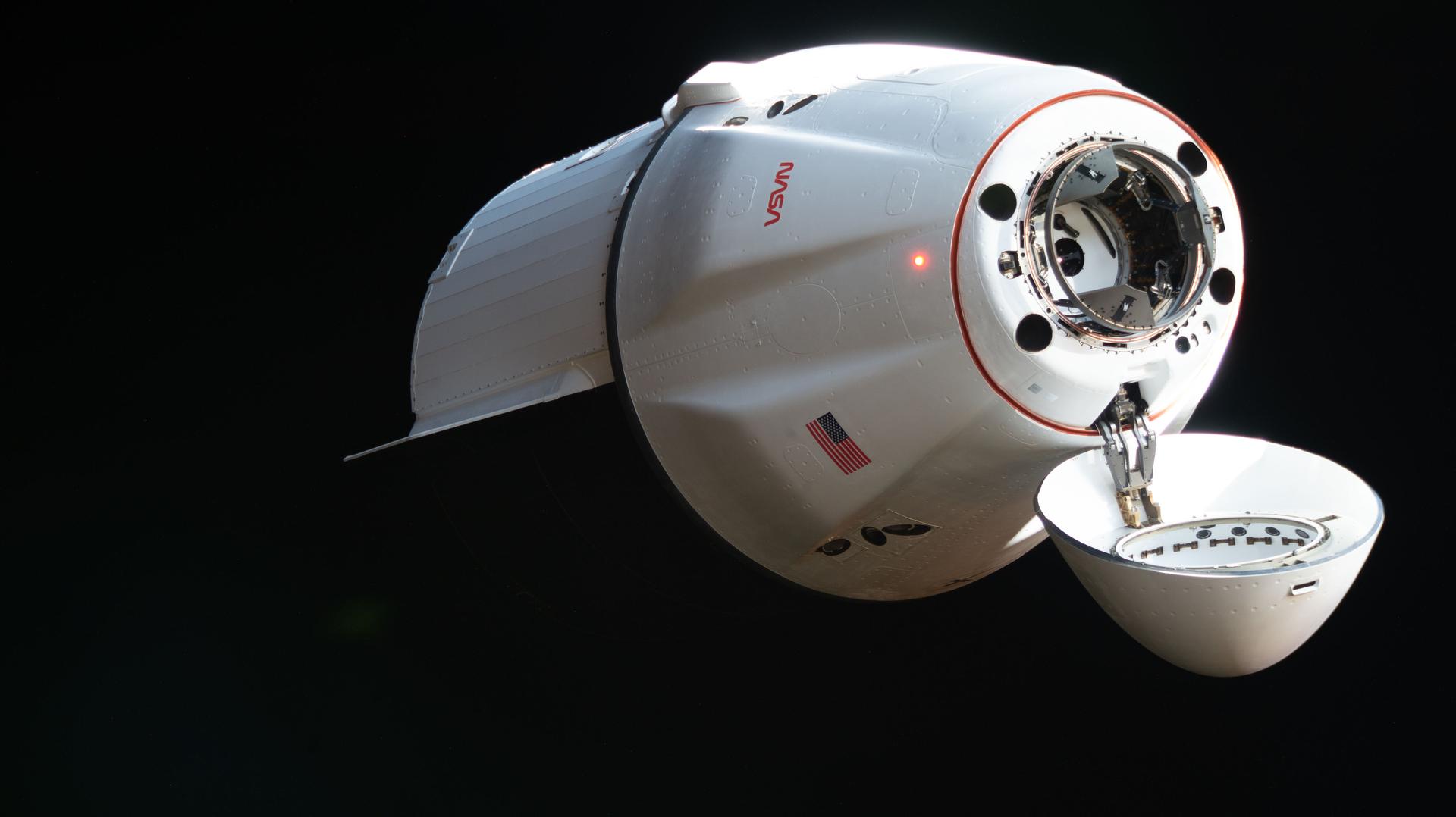
NASA and its international partners are set to receive scientific research samples and hardware as a SpaceX Dragon spacecraft is scheduled to depart the International Space Station on Tuesday, June 16, for its return to Earth.
Watch NASA’s live undocking coverage beginning at 11:45 a.m. EDT on NASA+, Amazon Prime, and the agency’s YouTube channel. Learn how to watch NASA content through a variety of online platforms, including social media.
The Dragon spacecraft will undock from the forward port of the station’s Harmony module at about 12:05 p.m., after receiving a command from SpaceX ground controllers. The spacecraft then will fire its thrusters to move safely away from the orbiting complex.
Following a June 16 departure, the spacecraft will reenter Earth’s atmosphere on Wednesday, June 17, before splashing down off the coast of California at approximately 5:08 a.m. PDT. NASA will not stream the splashdown but will post updates on its space station blog.
Dragon will return to Earth with thousands of pounds of cargo, carrying samples that could shape future space exploration and life on Earth. Research returning includes bioprinted organ and cartilage tissue, data on improving cryogenic fuel storage for future space missions, and DNA‑inspired materials to develop new cancer treatments. The returning hardware includes an ocular imaging device used to monitor crew members’ eye health, an absorbent bed that filters trace contaminants from cabin air, and a separator pump from the waste and hygiene compartment.
Loaded with nearly 6,500 pounds of crew cargo and science experiments, Dragon arrived at the station on May 17 after launching two days earlier on a Falcon 9 rocket from Space Launch Complex 40 at Cape Canaveral Space Force Station in Florida.
For more than 25 years, people have lived and worked continuously aboard the International Space Station, advancing scientific knowledge and making research breakthroughs not possible on Earth. The space station helps NASA understand and overcome the challenges of human spaceflight, expand commercial opportunities in low Earth orbit, and build on the foundation for long-duration missions to the Moon, as part of the Artemis program, and to Mars.
Get breaking news, images, and features from the space station on Instagram, Facebook, and X.
Learn more about International Space Station research and operations at:
https://www.nasa.gov/international-space-station
-end-
Jimi Russell
Headquarters, Washington
202-358-1100
james.j.russell@nasa.gov
Leah Cheshier
Johnson Space Center, Houston
281-483-5111
leah.d.cheshier@nasa.gov
NASA to Cover 34th SpaceX Resupply Mission Space Station Departure
NASA and its international partners are set to receive scientific research samples and hardware as a SpaceX Dragon spacecraft is scheduled to depart the International Space Station on Tuesday, June 16, for its return to Earth.
Watch NASA’s live undocking coverage beginning at 11:45 a.m. EDT on NASA+, Amazon Prime, and the agency’s YouTube channel. Learn how to watch NASA content through a variety of online platforms, including social media.
The Dragon spacecraft will undock from the forward port of the station’s Harmony module at about 12:05 p.m., after receiving a command from SpaceX ground controllers. The spacecraft then will fire its thrusters to move safely away from the orbiting complex.
Following a June 16 departure, the spacecraft will reenter Earth’s atmosphere on Wednesday, June 17, before splashing down off the coast of California at approximately 5:08 a.m. PDT. NASA will not stream the splashdown but will post updates on its space station blog.
Dragon will return to Earth with thousands of pounds of cargo, carrying samples that could shape future space exploration and life on Earth. Research returning includes bioprinted organ and cartilage tissue, data on improving cryogenic fuel storage for future space missions, and DNA‑inspired materials to develop new cancer treatments. The returning hardware includes an ocular imaging device used to monitor crew members’ eye health, an absorbent bed that filters trace contaminants from cabin air, and a separator pump from the waste and hygiene compartment.
Loaded with nearly 6,500 pounds of crew cargo and science experiments, Dragon arrived at the station on May 17 after launching two days earlier on a Falcon 9 rocket from Space Launch Complex 40 at Cape Canaveral Space Force Station in Florida.
For more than 25 years, people have lived and worked continuously aboard the International Space Station, advancing scientific knowledge and making research breakthroughs not possible on Earth. The space station helps NASA understand and overcome the challenges of human spaceflight, expand commercial opportunities in low Earth orbit, and build on the foundation for long-duration missions to the Moon, as part of the Artemis program, and to Mars.
Get breaking news, images, and features from the space station on Instagram, Facebook, and X.
Learn more about International Space Station research and operations at:
https://www.nasa.gov/international-space-station
-end-
Jimi Russell
Headquarters, Washington
202-358-1100
james.j.russell@nasa.gov
Leah Cheshier
Johnson Space Center, Houston
281-483-5111
leah.d.cheshier@nasa.gov
The 24 alien books Scientific American recommends
The 24 alien books the Scientific American staff love, from The Hitchhiker’s Guide to the Galaxy to Contact and beyond