
Feed aggregator
Super Typhoon Bavi
- Earth
- Earth Observatory
- Image of the Day
- EO Explorer
- Topics
- More Content
- About
Could Astronauts Grow Rice on the Moon?
Scientists in Japan have built a low power device that pulls nitrogen straight from the air and turns it into fertiliser, then used it to successfully grow rice in simulated lunar soil. Along the way, they stumbled on an unexpected bonus that could make crops both healthier and better suited to life in space, one with surprising promise for farms back on Earth too.
7,000 Galaxy Clusters, Hiding in Plain Sight
A five year survey by the South Pole Telescope has produced a catalogue of more than seven thousand galaxy clusters, some dating back nearly eight billion years, giving astronomers their most detailed map yet of the universe's largest structures. Hidden inside the data is something even the researchers did not expect, a discovery that is quietly reshaping how we think star formation unfolded across the history of the universe.
Detecting Atomic Weapons in Space
The Outer Space Treaty from 1967 prohibits weapons in space. But a satellite launched by Russia has generated suspicion. Despite claims that it's a normal satellite, some things about it suggest otherwise. New research proposes a way to detect atomic weapons in space, helping enforce the treaty.
The Milky Way's Arms Reach Out Further Than we Thought
A new result using NASA’s Chandra X-ray Observatory shows that the outer spiral arms in the Milky Way galaxy may reach wider than previously thought. This finding may lead astronomers to adjust their understanding of our home galaxy’s structure.
Students Connect NASA Science With Indigenous Knowledge to Study Coastal Erosion
3 min read
Students Connect NASA Science With Indigenous Knowledge to Study Coastal Erosion Students return from fieldwork and sit together in the classroom, examining NASA satellite images to learn about the changes to their community’s coastline.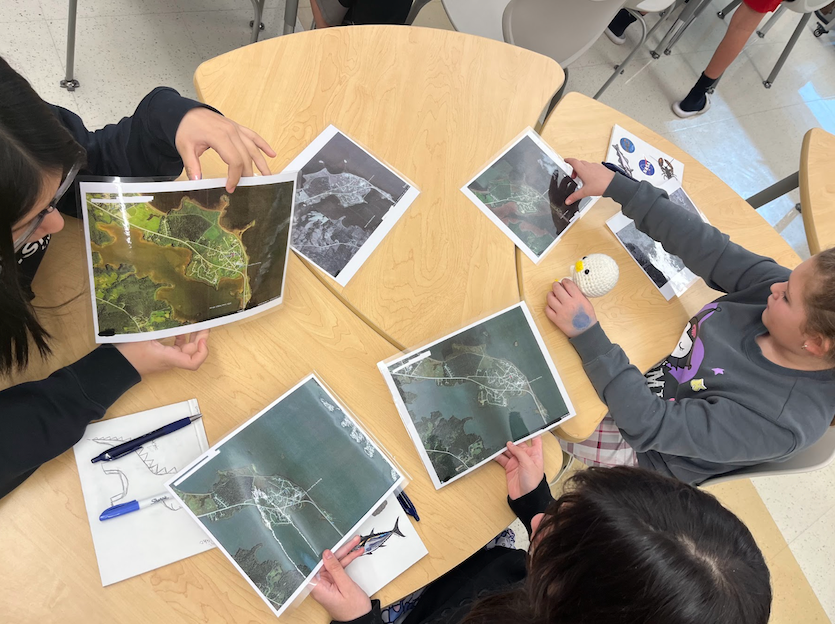
Story by Keri Moskowitz, Gulf of Maine Research Institute
For the Pleasant Point Passamaquoddy Reservation, or Sipayik, the ocean has always been a teacher. Situated in what is known as Downeast Maine, along the shores of Passamaquoddy Bay, generations of Indigenous people have lived along the coast, learning from the tides, the land, and their elders. But today, the shoreline is changing more rapidly. Coastal erosion is slowly taking land away. Land that already holds a history of loss.
In the summer of 2023, inspired by a trip to Fairbanks, AK to attend Climate Change in My Community – a workshop organized by the NASA Science Activation (SciAct) program’s Arctic and Earth Signs project – SciAct’s Learning Ecosystems Northeast (LENE) team began working with partners, including Indigenous leaders and scientists, to ask an important question: What does coastal erosion mean to people who have already lost land?
By November 2024, planning was underway at Sipayik Elementary School. The goal was to bring together Western science and Indigenous knowledge so students could understand the changes happening in their own community.
The lessons began in March 2025. For five weeks, nine 5th-grade students explored erosion in many ways. They visited local field sites and listened to elders share stories about how the coastline used to look. Learners used these accounts to measure the changes, both on the coast and via maps back in the classroom. They built erosion trays from simple materials to test how waves shape the land. They measured current high tide lines and compared them to historical ones. They studied old photographs and aerial images from 1942 to 2023 to see how much the shoreline had moved. They even compared 300-year-old tribal maps with future flood projections.
Students learned that science does not only live in textbooks. As one observer shared, “Our people were scientists without having to go to school.”
The students were curious, engaged, and proud. They saw that resilience is part of who they are. They have always adapted while holding on to culture.
In June of 2026, the students were invited to the Gulf of Maine Research Institute to present their work to scientists, staff, and REU (Research Experience for Undergraduate) interns. They traveled 3.5 hours for this opportunity, and the journey proved worthwhile. During the Q&A portion following their slideshow, someone asked whether learning to read the various maps was difficult. One student responded with a reminder: these were not merely maps but NASA satellite images.
Future goals for the project include inviting more elders and adding more field sites in the work, strengthening language and cultural connections, sharing student learning with other Native youth, and planning resilience strategies like marsh restoration in coordination with tribal leadership. When the students were asked if they planned to continue their studies and work on this cause after their time in the classroom ended, they all resoundingly stated “YES”.
In Sipayik, the story of erosion is not just about land washing away. It is about memory, knowledge, identity, and the strength of a community that continues to learn from the shore.
Share Details Last Updated Jul 08, 2026 Editor NASA Science Editorial Team Related Terms Explore More 4 min read Northwest Earth and Space Science Pathways Project Celebrates Student Innovation Through ROADS from Earth to Venus National ChallengeArticle
1 week ago
3 min read GLOBE Mission Earth Educators Participate in Land Cover Community of Practice
During the 2025-2026 school year, educators from the NASA Science Activation Program’s GLOBE (Global Learning…
Article
4 weeks ago
5 min read Girl Scouts Event Brings Space Science to the Next Generation
In early May 2026, NASA employees, contractors, and volunteers helped to bring Heliophysics to girls…
Article
1 month ago
Keep Exploring Discover More Topics From NASA James Webb Space Telescope
Webb is the premier observatory of the next decade, serving thousands of astronomers worldwide. It studies every phase in the…
Perseverance Rover
This rover and its aerial sidekick were assigned to study the geology of Mars and seek signs of ancient microbial…
Parker Solar Probe
On a mission to “touch the Sun,” NASA’s Parker Solar Probe became the first spacecraft to fly through the corona…
Juno
NASA’s Juno spacecraft entered orbit around Jupiter in 2016, the first explorer to peer below the planet’s dense clouds to…
Students Connect NASA Science With Indigenous Knowledge to Study Coastal Erosion
3 min read
Students Connect NASA Science With Indigenous Knowledge to Study Coastal Erosion Students return from fieldwork and sit together in the classroom, examining NASA satellite images to learn about the changes to their community’s coastline.Story by Keri Moskowitz, Gulf of Maine Research Institute
For the Pleasant Point Passamaquoddy Reservation, or Sipayik, the ocean has always been a teacher. Situated in what is known as Downeast Maine, along the shores of Passamaquoddy Bay, generations of Indigenous people have lived along the coast, learning from the tides, the land, and their elders. But today, the shoreline is changing more rapidly. Coastal erosion is slowly taking land away. Land that already holds a history of loss.
In the summer of 2023, inspired by a trip to Fairbanks, AK to attend Climate Change in My Community – a workshop organized by the NASA Science Activation (SciAct) program’s Arctic and Earth Signs project – SciAct’s Learning Ecosystems Northeast (LENE) team began working with partners, including Indigenous leaders and scientists, to ask an important question: What does coastal erosion mean to people who have already lost land?
By November 2024, planning was underway at Sipayik Elementary School. The goal was to bring together Western science and Indigenous knowledge so students could understand the changes happening in their own community.
The lessons began in March 2025. For five weeks, nine 5th-grade students explored erosion in many ways. They visited local field sites and listened to elders share stories about how the coastline used to look. Learners used these accounts to measure the changes, both on the coast and via maps back in the classroom. They built erosion trays from simple materials to test how waves shape the land. They measured current high tide lines and compared them to historical ones. They studied old photographs and aerial images from 1942 to 2023 to see how much the shoreline had moved. They even compared 300-year-old tribal maps with future flood projections.
Students learned that science does not only live in textbooks. As one observer shared, “Our people were scientists without having to go to school.”
The students were curious, engaged, and proud. They saw that resilience is part of who they are. They have always adapted while holding on to culture.
In June of 2026, the students were invited to the Gulf of Maine Research Institute to present their work to scientists, staff, and REU (Research Experience for Undergraduate) interns. They traveled 3.5 hours for this opportunity, and the journey proved worthwhile. During the Q&A portion following their slideshow, someone asked whether learning to read the various maps was difficult. One student responded with a reminder: these were not merely maps but NASA satellite images.
Future goals for the project include inviting more elders and adding more field sites in the work, strengthening language and cultural connections, sharing student learning with other Native youth, and planning resilience strategies like marsh restoration in coordination with tribal leadership. When the students were asked if they planned to continue their studies and work on this cause after their time in the classroom ended, they all resoundingly stated “YES”.
In Sipayik, the story of erosion is not just about land washing away. It is about memory, knowledge, identity, and the strength of a community that continues to learn from the shore.
Share Details Last Updated Jul 08, 2026 Editor NASA Science Editorial Team Related Terms Explore More 4 min read Northwest Earth and Space Science Pathways Project Celebrates Student Innovation Through ROADS from Earth to Venus National ChallengeArticle
1 week ago
3 min read GLOBE Mission Earth Educators Participate in Land Cover Community of Practice
During the 2025-2026 school year, educators from the NASA Science Activation Program’s GLOBE (Global Learning…
Article
4 weeks ago
5 min read Girl Scouts Event Brings Space Science to the Next Generation
In early May 2026, NASA employees, contractors, and volunteers helped to bring Heliophysics to girls…
Article
1 month ago
Keep Exploring Discover More Topics From NASA James Webb Space Telescope
Webb is the premier observatory of the next decade, serving thousands of astronomers worldwide. It studies every phase in the…
Perseverance Rover
This rover and its aerial sidekick were assigned to study the geology of Mars and seek signs of ancient microbial…
Parker Solar Probe
On a mission to “touch the Sun,” NASA’s Parker Solar Probe became the first spacecraft to fly through the corona…
Juno
NASA’s Juno spacecraft entered orbit around Jupiter in 2016, the first explorer to peer below the planet’s dense clouds to…
Scientists get clearest view yet of a spreading seafloor
A rare eruption in the Indian Ocean let researchers capture one of the clearest views yet of a seafloor spreading event
Seeding clouds with seawater could prevent a super El Niño
Seeding clouds with seawater could prevent a super El Niño
The JWST and the Mystery of Massive Quenched Galaxies in the Early Universe
With its ability to observe the red-shifted light from early galaxies, the JWST has revealed some surprises. Many massive galaxies in the early Universe had ceased star formation and were already quenched hundreds of millions of years sooner than thought. By examining their morphology, new research shows that mergers that were previously hidden from view are responsible.