
Feed aggregator
Early Career Faculty (ECF) 2025 Awards
1 min read
Preparations for Next Moonwalk Simulations Underway (and Underwater)Advanced Diagnostics for High-Enthalpy Test Facilities Simulating Spacecraft Atmospheric Entry
- Damiano Baccarella
University of Tennessee, Knoxville
Application of Resonance Enhanced Multi-Photon Ionization Diagnostics to the Characterization of Arcjet Flows - Ciprian Dumitrache
Colorado State University
Ultrafast Laser Diagnostics for Nonequilibrium Flowfields Characterization in Atmospheric Entry Studies - Dan Fries
University of Kentucky, Lexington
Multiplexed Polarization Spectroscopy for Single-Shot Multi-Species Diagnostics in High-Enthalpy Flows - Yi Mazumdar
Georgia Institute of Technology
Simultaneous Temperature, Species, and Velocity Measurements using Ultrafast Laser Diagnostics for Ground Testing of Spacecraft Atmospheric Entry Systems
Planning for Autonomous Spacecraft Using Machine Learning Methods to Enable Onboard Guidance, Navigation, and Control
- Glen Chou
Colorado School of Mines
Robust Real-Time Hierarchical Neural Planning and Control with System-Level Guarantees - Roshan Eapen
University of California, Berkeley
Hamilton-Jacobi aided Planning and Reasoning for Intelligent Spacecraft Maneuvers (HJ-PRISM) - Bin Hu
Stanford University
Safety-Enabled and Efficient Onboard Planning for Autonomous Spacecraft via Physics-Informed Reinforcement Learning
NASA Volunteers Help Zooniverse Reach 1 Billion Classifications

The Zooniverse, a NASA grantee that runs the world’s largest platform for online people-powered research, has reached an extraordinary milestone: 1 billion classifications contributed by volunteers around the world. This milestone is a celebration of everyone who has marked a dip in a light curve, confirmed the presence of a moving object in a short video, or identified species in a camera trap image. Each of these small contributions collectively advances our understanding of the universe.
A total of 31 NASA-sponsored citizen science projects have been hosted on Zooniverse, accounting for 120 million classifications by 324 thousand volunteers since 2020. Through projects like Planet Hunters TESS, Daily Minor Planet, Backyard Worlds: Planet 9, Space Umbrella, and Snapshot Wisconsin, volunteers help discover exoplanets, identify near-Earth objects and asteroids, search for brown dwarfs and planetary systems, analyze effects of the solar wind, and inform wildlife management decisions. These projects have led to 96 scientific publications, and 56 of these articles feature NASA citizen scientists as co-authors to recognize the significance of their research contributions. These efforts demonstrate how public participation can accelerate discovery by combining human curiosity and pattern recognition with data from NASA missions and observatories. Collaboration between volunteers, scientists, and computing technology will be even more important in the future as we tackle enormous and complex datasets, like those from NASA’s upcoming Nancy Grace Roman Space Telescope.
“One billion classifications represent far more than a number; it’s one billion moments of curiosity transformed into meaningful contributions to research,” said Laura Trouille, principal investigator of Zooniverse and vice president of Science Engagement at the Adler Planetarium. “Every classification on Zooniverse brings us one step closer to new discoveries and a deeper understanding of our universe, our world, and ourselves.”
Zooniverse is the world’s largest platform for people-powered research. Co-founded by the Adler Planetarium and the University of Oxford, with the University of Minnesota serving as a key institutional partner, Zooniverse enables anyone, anywhere to contribute directly to real scientific research. Through its six-year collaboration with NASA, Zooniverse provides science-enabling infrastructure to NASA researchers through tools and a community of more than 3 million registered volunteers.
Facebook logo @nasascience_ @nasascience_ Instagram logo @nasascience_ Linkedin logo @nasascience_NASA Photographer Captures Images from F-18 Over Washington
2 min read
Preparations for Next Moonwalk Simulations Underway (and Underwater) NASA photographer Jim Ross flies above the Washington Monument in Washington on Saturday, July 4, 2026, in an F-18 aircraft, as part of a flyover to celebrate America’s 250th birthday. This aircraft is from NASA’s Armstrong Flight Research Center in Edwards, California, and it joined other NASA aircraft for the flyover.NASA/Jim Ross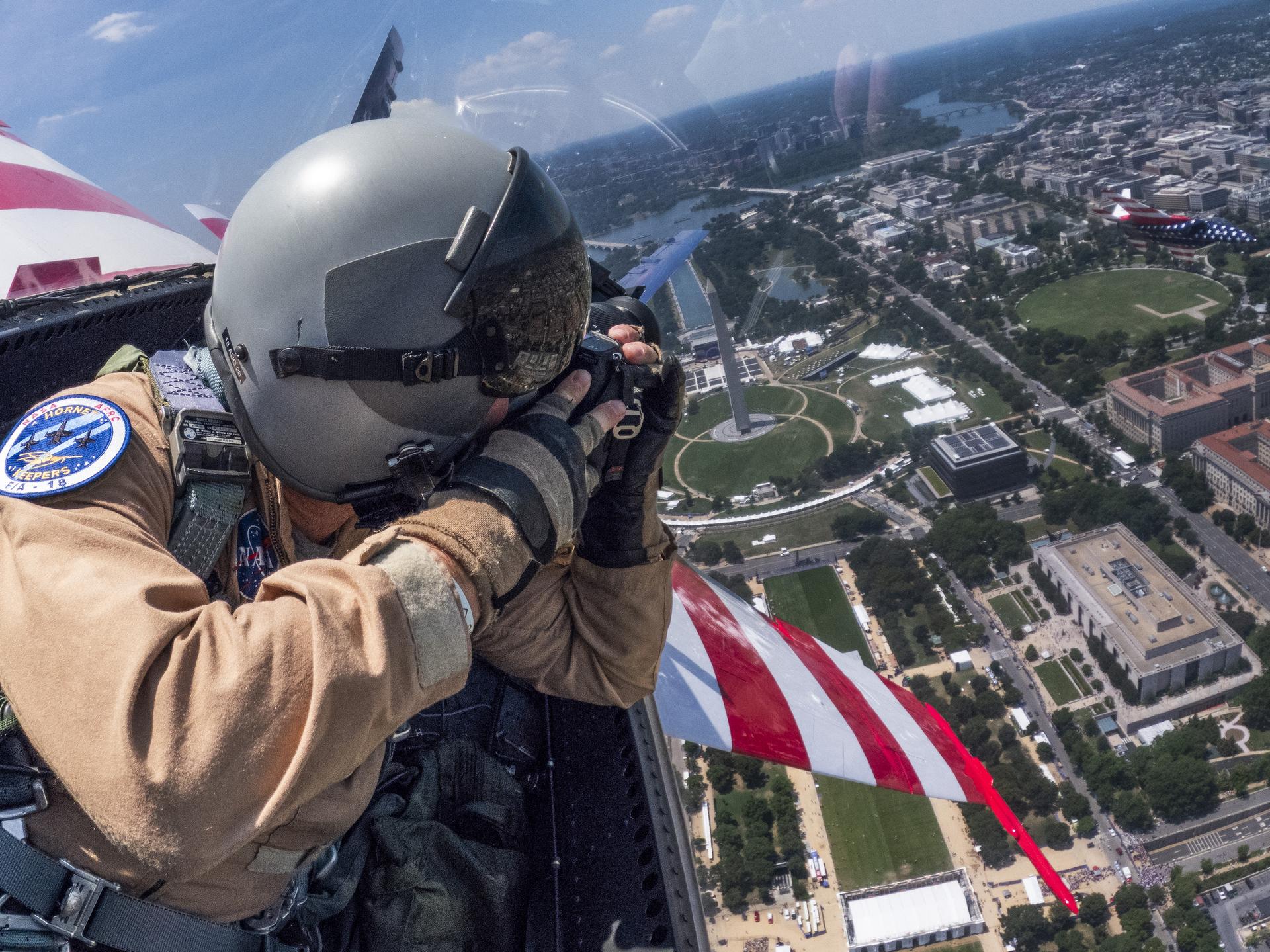
NASA flight photographers capture history from a perspective few ever experience, getting a rare bird’s-eye view of the agency’s missions in action. Their photos document key NASA research and give the public a front-row seat to the work happening behind the scenes.
Jim Ross, a photographer at NASA’s Armstrong Flight Research Center in Edwards, California, flew over Washington during the Fourth of July celebration to document a NASA flyover commemorating America’s 250th birthday. He’s captured some of the agency’s most exhilarating milestones, like early SR-71 flights, the delivery flight of Space Shuttle Endeavour to Los Angeles, and first flights of NASA’s X-59 quiet supersonic research aircraft.
“I grew up in Bozeman, Montana, when it was still considered a small town, so if someone told that little kid that he would be flying in a F-18 over the National Mall, he would have never believed it,” Ross said. “I love documenting history, and having the opportunity to capture flights and launches has kept me doing it for almost 37 years.”
Ross began his aviation photography career in 1989 when he joined the staff at NASA Armstrong (then Dryden). He became the photo lead in 1997, a title he retains.
Check out his images from the flyover here: https://www.nasa.gov/gallery/freedom-250/
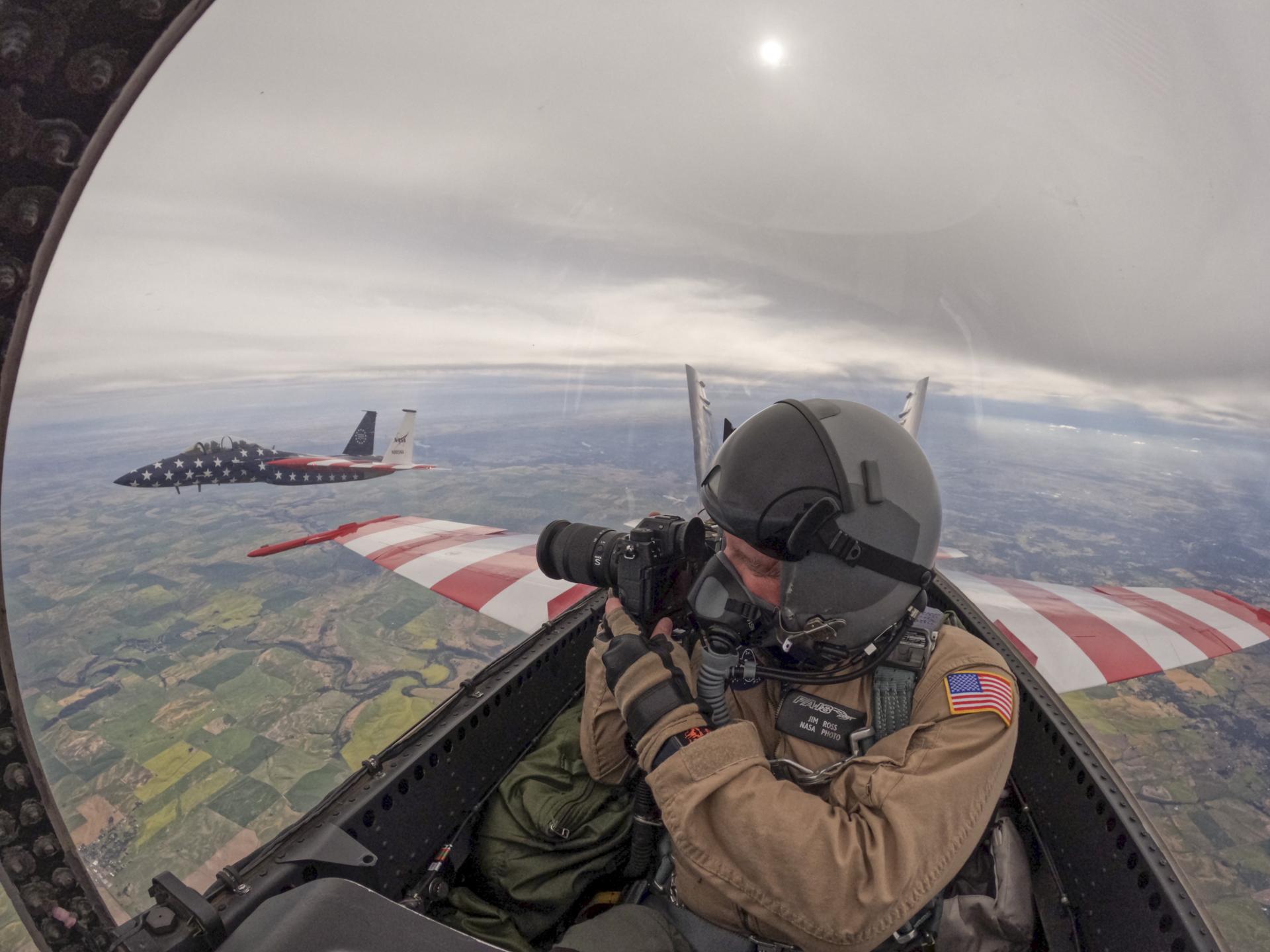
NASA photographer Jim Ross takes a selfie from the rear seat of a NASA F/A‑18 during a cross‑country flight from Spokane, Washington, to Washington, D.C., on Thursday, July 2, 2026. The agency’s F‑15, flying alongside the aircraft, is visible through the window. Both aircraft, from NASA’s Armstrong Flight Research Center in Edwards, California, participated in the Freedom 250 flyover with other NASA and military aircraft on Saturday, July 4, 2026.NASA/Jim Ross NASA photographer Jim Ross flies above Washington on Saturday, July 4, 2026, in an F-18 aircraft, as part of a flyover to celebrate America’s 250th birthday. This aircraft is from NASA’s Armstrong Flight Research Center in Edwards, California, and it joined other NASA aircraft for the flyover. A NASA F-15 is seen flying to the side of the NASA F-18.NASA/Jim Ross Share Details Last Updated Jul 10, 2026 EditorDede DiniusContactTeresa Whitingteresa.whiting@nasa.gov Related Terms Explore More 3 min read A Day of Flight Testing at NASA Armstrong Article 1 week ago 5 min read NASA’s Newest Wind Tunnel Builds on Legacy of Innovation Article 2 weeks ago 3 min read This is How NASA Flight Tests New Technology Article 2 weeks ago Keep Exploring Discover More Topics From NASA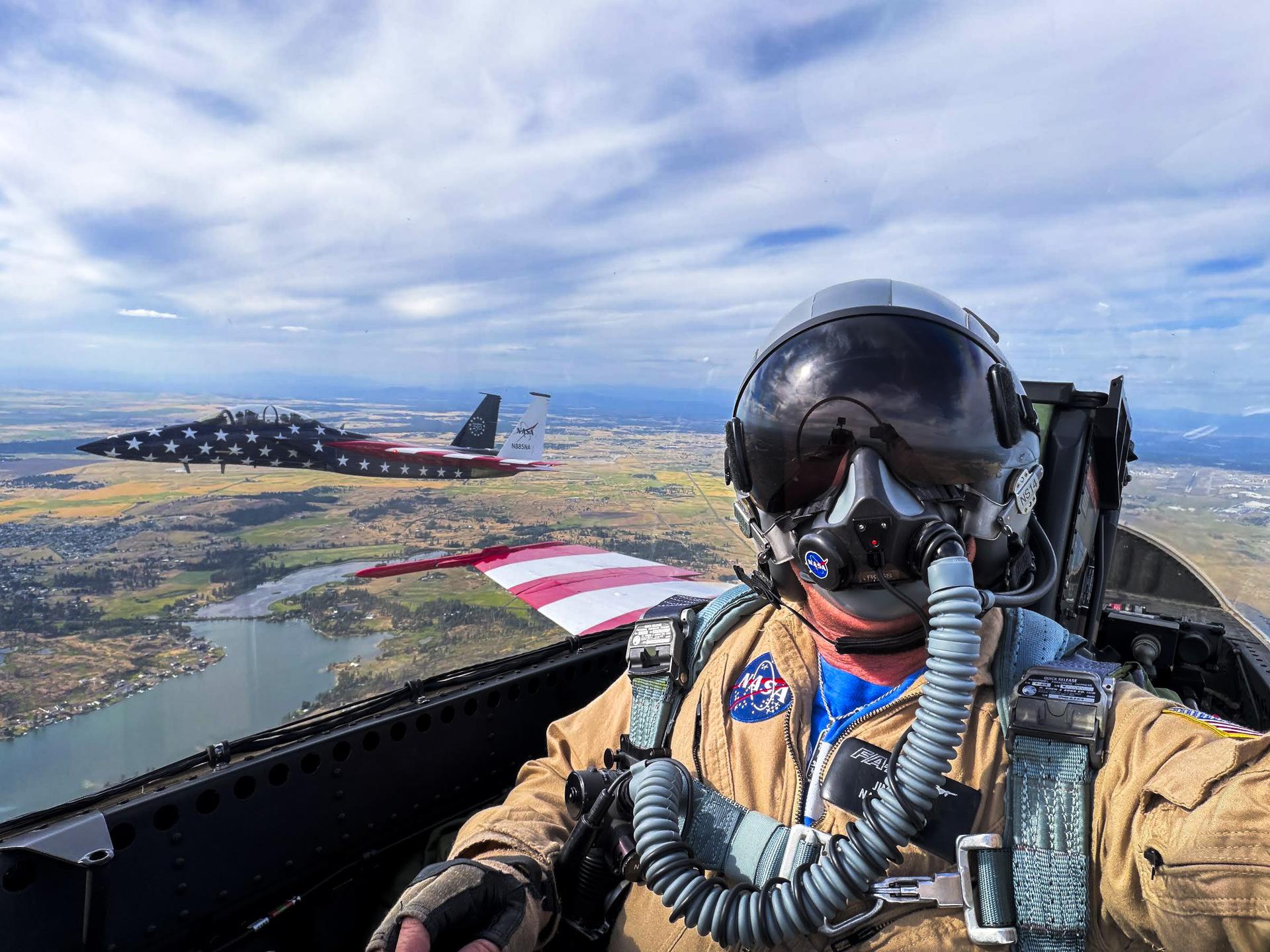
Armstrong Flight Research Center
Aircraft Flown at Armstrong
Aeronautics
Armstrong Flight Operations
Only Binary Stars Can Create Interacting Supernovae
When a massive star reaches the end of its life, it explodes as a supernova that can light up the sky for months. But some supernovae stay luminous for much longer, and astrophysicists have wondered what causes their extended brightness. New research points to binary stars, where one star expels material right before the explosion that creates a cocoon of circumstellar medium.
UN space database aimed at easing global tensions is mysteriously down
Waxing Gibbous Moon
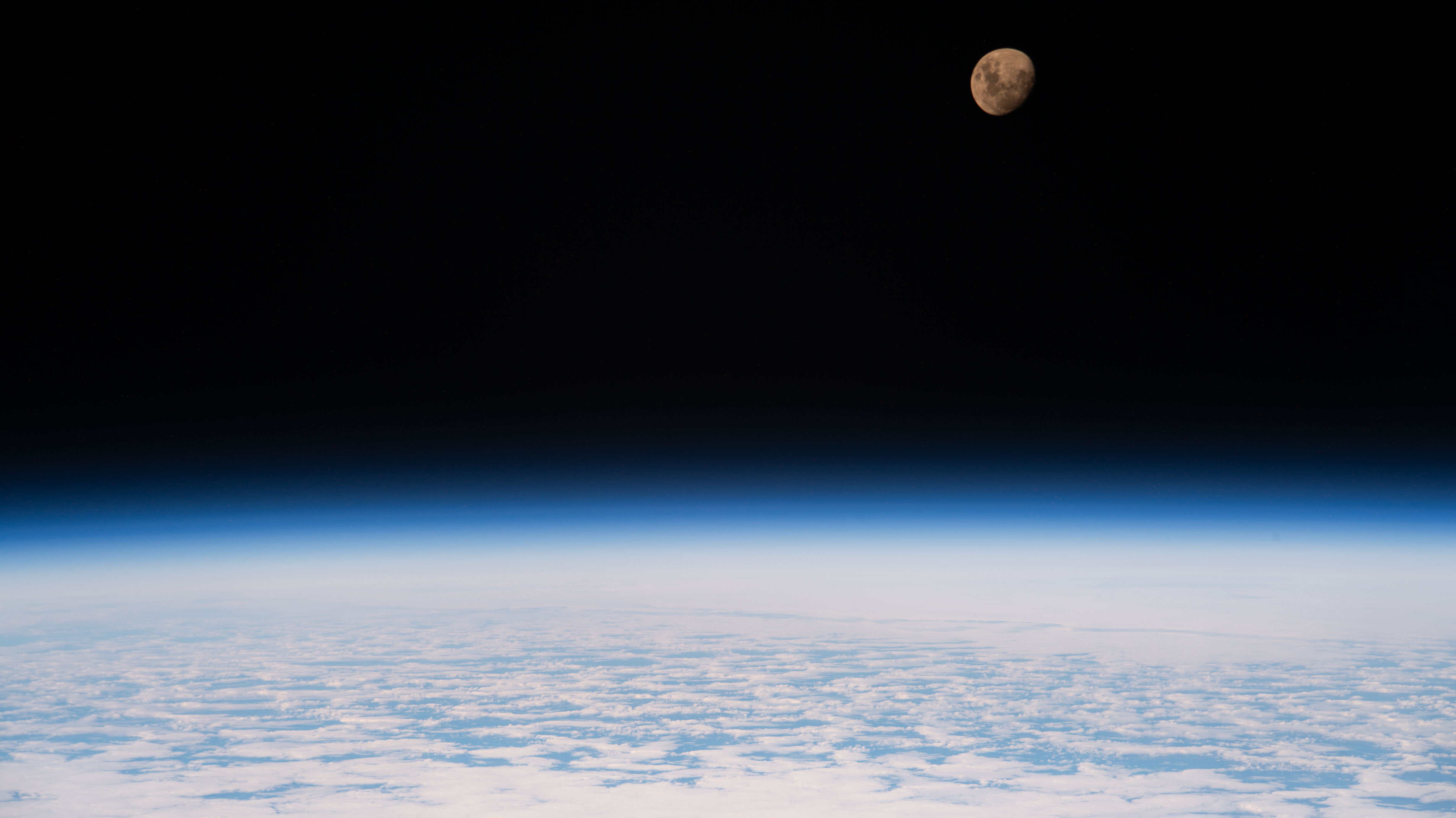
The waxing gibbous moon is nestled in the darkness of space in this June 26, 2026, image from the International Space Station. The space station was 264 miles above the Indian Ocean southeast of Madagascar at the time.
The waxing gibbous phase comes before the full moon phase. During this time, the Moon appears brighter in the night sky to viewers on Earth.
Image credit: NASA
Global warming already causing crop losses of over $20 billion a year
Mathematicians put AI to work on Fermat's last theorem
Mathematicians put AI to work on Fermat's last theorem
The sneaky maths trick for solving problems without answering them
The sneaky maths trick for solving problems without answering them
‘Dark’ comets sprouting tails could help solve interstellar mysteries
A strange class of comet could explain the enigmatic behavior of ‘Oumuamua, the first known interstellar object—and even shed light on how Earth became habitable
This Week's Sky at a Glance, July 10 – 19
The bright, distinctive pattern of Upper Scorpius is on its best display in the south right after nightfall. Telescopic treasures await. In the west, Regulus now departs from Venus.
The post This Week's Sky at a Glance, July 10 – 19 appeared first on Sky & Telescope.
2026 eclipse: 5 citizen science projects you can contribute to
2026 eclipse: 5 citizen science projects you can contribute to
Where Venezuela’s Earthquakes Shifted the Ground
- Earth
- Earth Observatory
- Image of the Day
- EO Explorer
- Topics
- More Content
- About
How 'Star City' Reimagined the Space Race With Soviets as the Stars
How do you capture the mood of the 1960s space race in a fictional universe where the Soviets beat the Americans to the moon? The production team for Apple TV's "Star City" series rose to the challenge.