
Feed aggregator
Oldest known plague outbreak killed hunter-gatherer children
Oldest known plague outbreak killed hunter-gatherer children
Pigeons lock their eyes in place when they are flying
Pigeons lock their eyes in place when they are flying
Our brains have their first thoughts unexpectedly early in life
Our brains have their first thoughts unexpectedly early in life
Our brains have their first thoughts surprisingly early in life
Our brains have their first thoughts surprisingly early in life
See Venus Disappear in Broad Daylight on June 17th
On June 17th, much of North America can watch the Moon occult Venus in the daytime sky. All you need are binoculars.
The post See Venus Disappear in Broad Daylight on June 17th appeared first on Sky & Telescope.
Could this ancient burial site be the oldest lethal plague outbreak?
Graves of hunter-gatherers in Siberia point to a deadly disease outbreak dating to some 5,500 years ago, a new DNA analysis finds
Autism and ADHD are on the rise due to widening diagnostic criteria
Autism and ADHD are on the rise due to widening diagnostic criteria
347th ESA Council: Media information session
Watch the replay of the media information session where ESA Director General Josef Aschbacher and outgoing ESA Council Chair Renato Krpoun provide an update on the main outcomes of the 347th ESA Council meeting, held at ESA Headquarters in Paris on 16–17 June 2026.
Hubble Sees Swarm of Galaxies
Hubble Sees Swarm of Galaxies
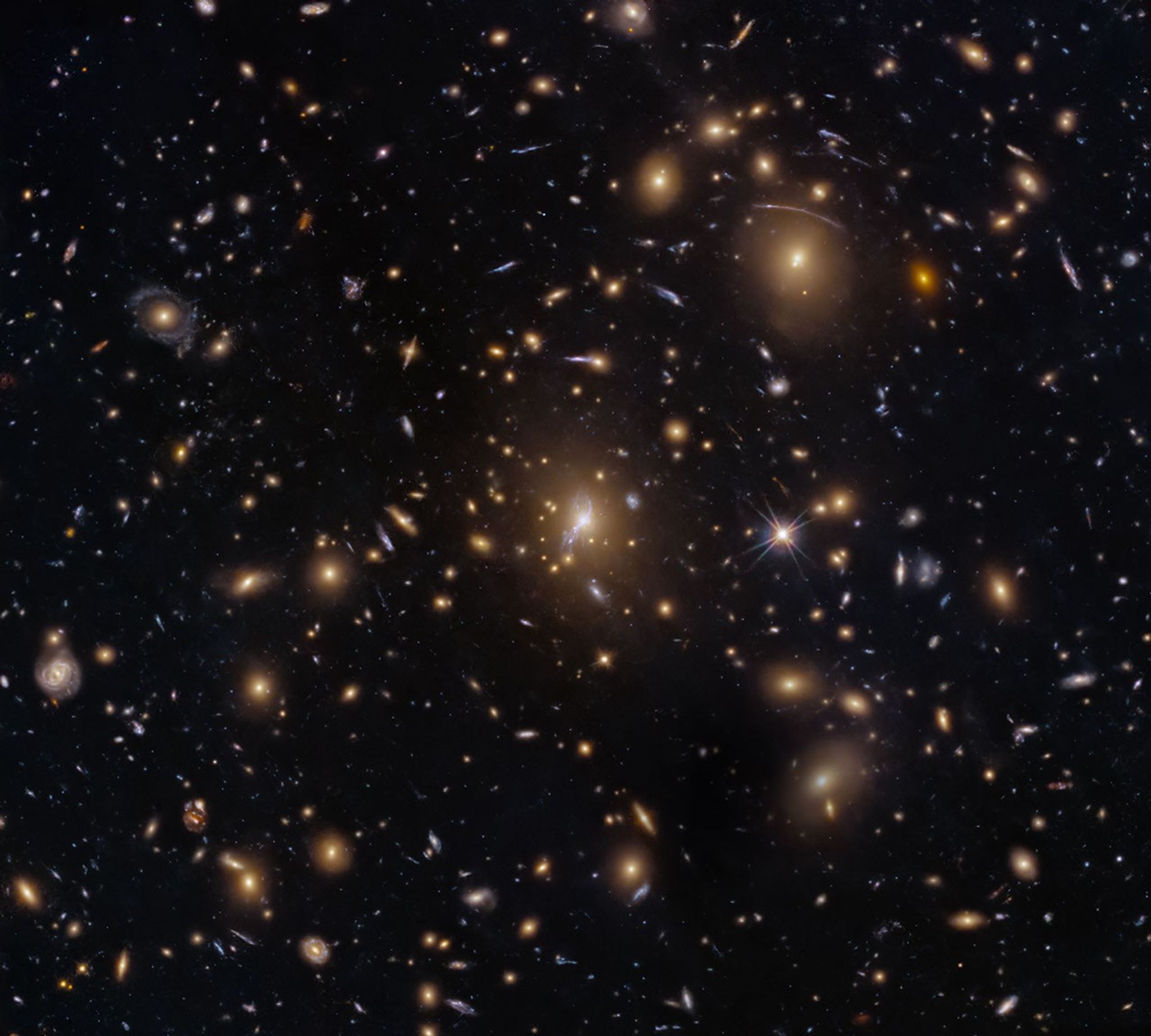
Looking somewhat like a swarm of bees returning to their hive, this NASA Hubble Space Telescope image released on June 12, 2026, features the galaxy cluster MACS0329-0211. Galaxy clusters like MACS0329-0211 are important signposts in the story of how the structure of the universe evolved, and are the ultimate telescopic lenses, placing gravitationally lensed galaxies from the earliest stages of the universe into our view.
Zoom into this galaxy swarm and you will find large, oval-shaped elliptical galaxies, and thin spiral and lenticular galaxies viewed from the edge. We can also see the full, face-on view of spiral galaxies and their curving spiral arms. The image’s upper-right quadrant holds faint arcs of distant galaxies gravitationally lensed by the cluster’s massive gravity. The largest of these arcs appears above the bright oval shape of a giant elliptical galaxy. Closer inspection of the image’s center reveals several bright-white intersecting curves that appear as a distorted figure eight. This may be another distant galaxy whose light was magnified and distorted by this massive cluster’s gravity.
Hubble looked at MACS0329-0211 as part of an observing program of X-ray bright galaxy clusters. Researchers used Hubble’s two main cameras, the Advanced Camera for Surveys and its Wide Field Camera 3, to gather data visible and infrared light from the cluster. Hubble’s ability to see such a broad spectrum of light makes it a valuable tool in understanding the very nature of these galaxy clusters.
Image credit: NASA, ESA, M. Postman (STScI); Image Processing: G. Kober (NASA/Catholic University of America)
Hubble Sees Swarm of Galaxies
Looking somewhat like a swarm of bees returning to their hive, this NASA Hubble Space Telescope image released on June 12, 2026, features the galaxy cluster MACS0329-0211. Galaxy clusters like MACS0329-0211 are important signposts in the story of how the structure of the universe evolved, and are the ultimate telescopic lenses, placing gravitationally lensed galaxies from the earliest stages of the universe into our view.
Zoom into this galaxy swarm and you will find large, oval-shaped elliptical galaxies, and thin spiral and lenticular galaxies viewed from the edge. We can also see the full, face-on view of spiral galaxies and their curving spiral arms. The image’s upper-right quadrant holds faint arcs of distant galaxies gravitationally lensed by the cluster’s massive gravity. The largest of these arcs appears above the bright oval shape of a giant elliptical galaxy. Closer inspection of the image’s center reveals several bright-white intersecting curves that appear as a distorted figure eight. This may be another distant galaxy whose light was magnified and distorted by this massive cluster’s gravity.
Hubble looked at MACS0329-0211 as part of an observing program of X-ray bright galaxy clusters. Researchers used Hubble’s two main cameras, the Advanced Camera for Surveys and its Wide Field Camera 3, to gather data visible and infrared light from the cluster. Hubble’s ability to see such a broad spectrum of light makes it a valuable tool in understanding the very nature of these galaxy clusters.
Image credit: NASA, ESA, M. Postman (STScI); Image Processing: G. Kober (NASA/Catholic University of America)
'High-Res' is the Secret to Finding Alien Life with the Next Great Space Telescope
We’re still in the definition phase of the Habitable Worlds Observatory (HWO), but it seems like every week a new research group comes out with a paper helping to contribute to what is shaping up to be one of the most important space telescopes of the 2040s. A new paper from a team of researchers led by Daniel Jaffe of the University of Texas at Austin contributes to this ongoing definition work by arguing that it’s time HWO adopted a high-resolution near-IR spectroscopy capability, - which sounds great in practice, but so far hasn’t been attempted due to technological limitations. But, according to the paper, two recent inventions finally make a working version of an extremely high resolution exoplanet hunter viable.
Astronomers discover another galaxy seemingly devoid of dark matter
A galaxy appears to be missing the invisible substance thought to hold such objects together, further challenging long-held assumptions about how galaxies form
First Ariane 6 liftoff with most powerful boosters
On the 17th of June Ariane 6 flight VA269 soared to orbit from Europe's Spaceport in French Guiana. The latest generation of Europe's largest and most powerful rocket launched 36 satellites for Amazon's Leo constellation.
The debut of the four new boosters based on the P160C solid-propellant rocket motor allowed 36 satellites to be launched, four more than the two Leo launches Ariane 6 had delivered before.
Ariane 6 is Europe’s heavy-lift launcher and a key element of ESA’s efforts to ensure autonomous access to space for Europe’s citizens. The new P160C boosters increase considerably performance, payload capacity and competitiveness, allowing for more satellites to be launched, further elevating the future of Europe.