

Feed aggregator
NASA’s PACE Mission Studies Smoke, Fires
3 min read
NASA’s PACE Mission Studies Smoke, FiresWith the North American fire season underway, and a record number of acres already burned nationwide, NASA’s Plankton, Aerosol, Cloud, and ocean Ecosystem (PACE) satellite’s three instruments are observing vegetation precursors to fires, along with plumes of smoke and their movement. This data will help scientists piece together clues that deepen their understanding of wildfires.
“The challenge that we have is to take those clues and use them in a meaningful way, so our models of Earth properly represent what’s happening,” said Kirk Knobelspiesse, a remote sensing scientist working on the PACE mission at NASA’s Goddard Space Flight Center in Greenbelt, Maryland.
Wisps of smoke coming from fires in multiple provinces and territories in Canada travel over the Great Lakes. This image was taken by the Ocean Color Instrument aboard NASA’s PACE satellite on May 31, 2025. NASA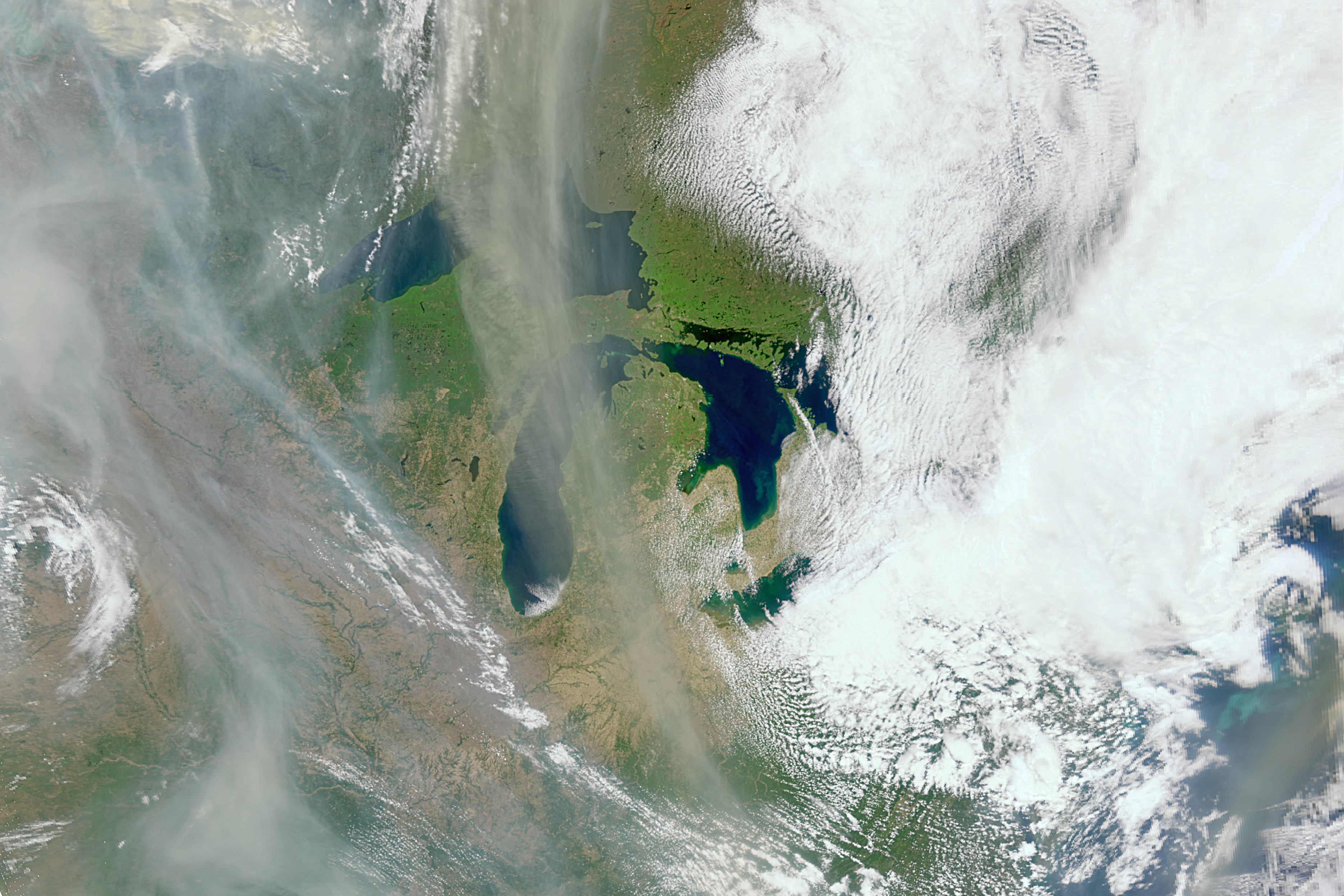
While the satellite, which launched in February 2024, was designed to study Earth’s ocean and atmosphere, it has an unexpected capability: monitoring changes to vegetation. It can also tell us about burn scars, the charred area of land left behind after a wildfire.
“The PACE satellite observes land too, and does it really well,” said Skye Caplan, terrestrial lead for the PACE mission at NASA Goddard. “There is so much to explore with a new hyperspectral data set.”
The Ocean Color Instrument on board PACE is a hyperspectral instrument, observing the planet in several hundred different wavelengths of visible, near infrared, and ultraviolet light. This breadth of the spectrum allows it to gather data on the health of plants, such as their state of stress, dryness, and their relative pigment balance, all of which assist in identifying high fire-risk areas. Land managers can use this data to distribute resources to help mitigate fire risk.
This instrument views the entire Earth daily, with more frequent coverage at high latitudes. With this frequency, on clear days, PACE scientists can quickly assess the aftermath of fires, determining the location and span of a burn scar. Areas that have been burned by wildfire often see increased flood and landslide risk. It’s important to identify these high-risk areas and monitor how they evolve through time, Caplan said.
Using wavelengths in the ultraviolet range, the Ocean Color Instrument can also monitor the smoke after a fire, along with information on how high in the atmosphere these particles drift — height plays a role in how far the particles travel and the systems they impact. The instrument, with its ultraviolet data, expands on fire observations from other satellite instruments, such as the Visible Infrared Imaging Radiometer Suite and the Moderate Resolution Imaging Spectroradiometer.
Thick smoke plumes coming from fires raging in multiple provinces and territories in Canada is visible in this image and affecting a large part of the north of the country. This image was taken by the Ocean Color Instrument aboard NASA’s PACE satellite on Aug. 11, 2024. NASA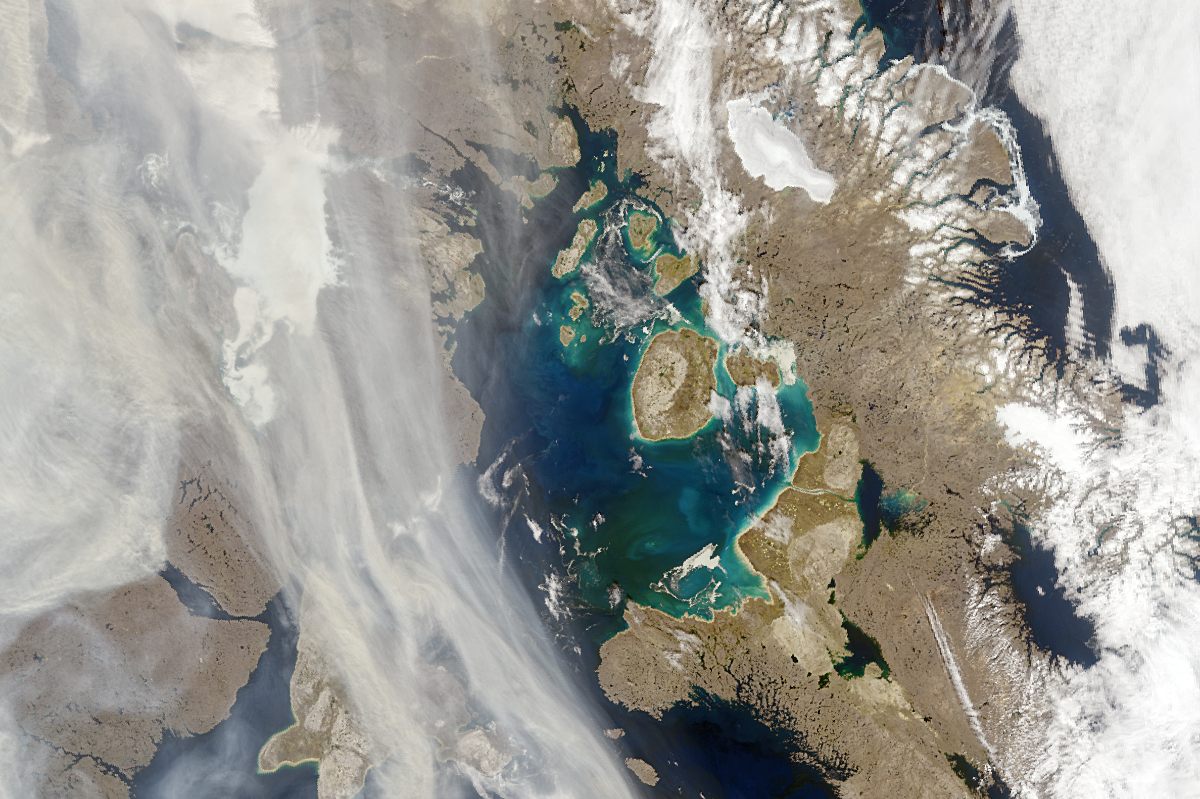
The other two instruments on PACE, the Hyper-Angle Rainbow Polarimeter 2 and the Spectro-polarimeter for Planetary Exploration one, are rich with information about the composition of aerosols from vastly different regions, said Andrew Sayer, PACE project science lead for atmospheres from the Ocean Color Instrument at NASA Goddard.
By measuring characteristics of light as it reflects off particles in the atmosphere, these two instruments can determine the quantity of these particles, along with their chemical properties, color, size, and shape. Scientists use this information to differentiate smoke from other particulates. Smoke particulates are typically light absorbing — appearing gray, black, or brown in color — and are small in size compared to other aerosols PACE views, such as pollutants and dust.
Data from PACE will help scientists create more accurate wildfire models and simulate future events, said Knobelspiesse, the satellite’s polarimeter lead. “We’ll be able to then look at different scenarios of emissions in the future and see how smoke that’s created in one location can impact other parts of the Earth system.”
NASA’s Goddard Space Flight Center, Greenbelt, Md.
Share Details Last Updated Jun 26, 2026 Editor Jenny Marder Contact Erica McNamee erica.s.mcnamee@nasa.gov Location Goddard Space Flight Center Related Terms Explore More 4 min read NASA’s PACE Mission Reveals a Year of Terrestrial Data on Plant HealthA lot can change in a year for Earth’s forests and vegetation, as springtime and…
Article
1 year ago
5 min read New NASA Satellite To Unravel Mysteries About Clouds, Aerosols
Some of the same properties of light and optics that make the sky blue and…
Article
3 years ago
5 min read NASA-Funded Study Shows Wildfire Smoke’s Hidden Ozone Toll
Over the last decade, wildfires have worsened ground-level ozone pollution across much of the contiguous…
Article
3 weeks ago
Hubble Spies Starry Chandelier
- Hubble Home
- Overview
- Impact & Benefits
- Science
- Observatory
- Team
- Multimedia
- News
- More
3 min read
Hubble Spies Starry Chandelier This NASA/ESA Hubble Space Telescope image features the globular cluster NGC 6723, sometimes called the Chandelier Cluster. ESA/Hubble & NASA, A. Sarajedini, G. Piotto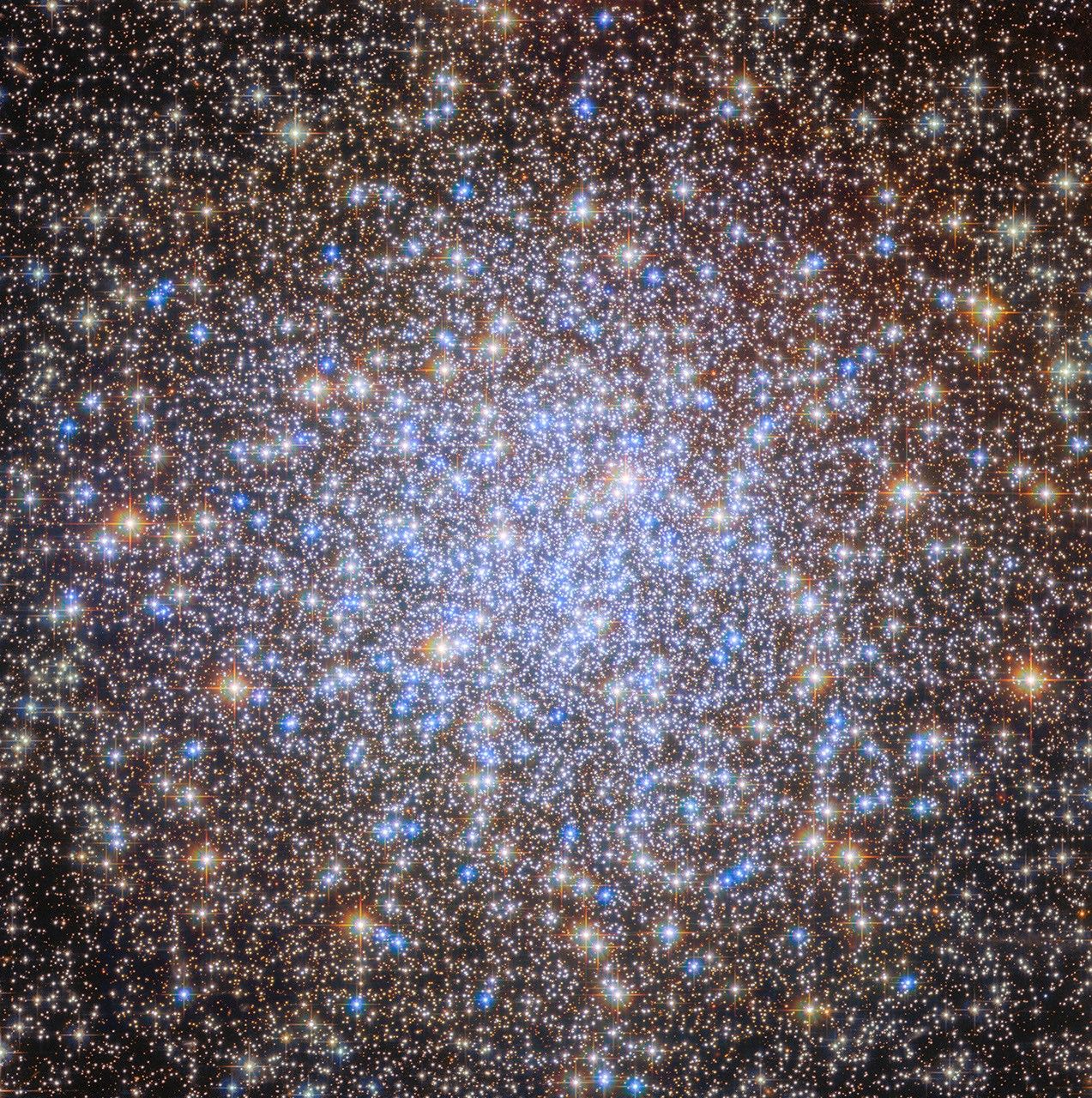
The subject of today’s NASA/ESA Hubble Space Telescope image is an ancient inhabitant of our galaxy. This sparkling scene features a globular cluster: a collection of tens of thousands to millions of stars, all tightly bound together under the influence of gravity. There are more than 150 globular clusters in our galaxy, though there may be others still undiscovered, hidden from view by dust or densely packed fields of stars.
This globular cluster, NGC 6723, sometimes called the Chandelier Cluster, is much like its namesake because it sparkles with countless lights. However, each ‘lightbulb’ in this chandelier is an individual star 27,000 light-years away in the constellation Sagittarius (the Archer).
Globular clusters like NGC 6723 contain some of the oldest stars in our galaxy. These clusters have ages that often exceed 10 billion years old, and some are nearly as old as the universe itself. Astronomers think globular clusters are some of the first structures that formed in our galaxy, coalescing potentially billions of years before the thin disk of stars in which our Sun orbits. The details of how globular clusters formed, however, are not yet certain.
Astronomers initially thought that all stars in a globular cluster formed at the same time in a single flourish of star formation. This would mean that all stars in a globular cluster would be the same age and made of the same mixture of chemical elements. Now, thanks to observations from telescopes like Hubble, researchers know that these seemingly simple stellar populations have more complex histories than originally thought.
Hubble first observed NGC 6723 as part of an ambitious survey dedicated to demystifying the properties of globular clusters in our Milky Way galaxy. In this observing program (#10775, PI: Sarajedini), researchers used Hubble to study 65 globular clusters in our galaxy in visible and near-infrared light. That data allowed researchers to study everything from the ages of globular clusters to the process through which massive stars sink to the center of a star cluster and lower-mass stars drift toward the cluster outskirts. This survey has been immensely scientifically valuable, and these observations have inspired several hundred published research papers.
In a later observing program (#13297, PI: Piotto), researchers set their sights again on many of these same clusters, including NGC 6723. This time, they used Hubble’s unique sensitivity to ultraviolet light to detect the subtle variations in chemical composition between the stars of globular clusters and determine the age spread among the clusters’ stars. For NGC 6723, researchers found evidence of two closely-spaced periods of star formation, the second occurring within 634 million years of the first. (‘Closely-spaced’ is relative; 634 million years is a blink of an eye for a star cluster that is more than 10 billion years old!)
Thanks to these findings, astronomers are on the path to understanding how and when globular clusters formed — and Hubble observations of celestial chandeliers like NGC 6723 are lighting the way.
Text Credit: ESA/Hubble
Facebook logo @NASAHubble @NASAHubble Instagram logo @NASAHubbleMedia Contact:
Claire Andreoli
NASA’s Goddard Space Flight Center, Greenbelt, MD
claire.andreoli@nasa.gov
Since its 1990 launch, the Hubble Space Telescope has changed our fundamental understanding of the universe.
Hubble’s Star Clusters
Hubble e-Books
Hubble’s Cosmic Adventure
Hubble Spies Starry Chandelier
- Hubble Home
- Overview
- Impact & Benefits
- Science
- Observatory
- Team
- Multimedia
- News
- More
3 min read
Hubble Spies Starry Chandelier This NASA/ESA Hubble Space Telescope image features the globular cluster NGC 6723, sometimes called the Chandelier Cluster. ESA/Hubble & NASA, A. Sarajedini, G. PiottoThe subject of today’s NASA/ESA Hubble Space Telescope image is an ancient inhabitant of our galaxy. This sparkling scene features a globular cluster: a collection of tens of thousands to millions of stars, all tightly bound together under the influence of gravity. There are more than 150 globular clusters in our galaxy, though there may be others still undiscovered, hidden from view by dust or densely packed fields of stars.
This globular cluster, NGC 6723, sometimes called the Chandelier Cluster, is much like its namesake because it sparkles with countless lights. However, each ‘lightbulb’ in this chandelier is an individual star 27,000 light-years away in the constellation Sagittarius (the Archer).
Globular clusters like NGC 6723 contain some of the oldest stars in our galaxy. These clusters have ages that often exceed 10 billion years old, and some are nearly as old as the universe itself. Astronomers think globular clusters are some of the first structures that formed in our galaxy, coalescing potentially billions of years before the thin disk of stars in which our Sun orbits. The details of how globular clusters formed, however, are not yet certain.
Astronomers initially thought that all stars in a globular cluster formed at the same time in a single flourish of star formation. This would mean that all stars in a globular cluster would be the same age and made of the same mixture of chemical elements. Now, thanks to observations from telescopes like Hubble, researchers know that these seemingly simple stellar populations have more complex histories than originally thought.
Hubble first observed NGC 6723 as part of an ambitious survey dedicated to demystifying the properties of globular clusters in our Milky Way galaxy. In this observing program (#10775, PI: Sarajedini), researchers used Hubble to study 65 globular clusters in our galaxy in visible and near-infrared light. That data allowed researchers to study everything from the ages of globular clusters to the process through which massive stars sink to the center of a star cluster and lower-mass stars drift toward the cluster outskirts. This survey has been immensely scientifically valuable, and these observations have inspired several hundred published research papers.
In a later observing program (#13297, PI: Piotto), researchers set their sights again on many of these same clusters, including NGC 6723. This time, they used Hubble’s unique sensitivity to ultraviolet light to detect the subtle variations in chemical composition between the stars of globular clusters and determine the age spread among the clusters’ stars. For NGC 6723, researchers found evidence of two closely-spaced periods of star formation, the second occurring within 634 million years of the first. (‘Closely-spaced’ is relative; 634 million years is a blink of an eye for a star cluster that is more than 10 billion years old!)
Thanks to these findings, astronomers are on the path to understanding how and when globular clusters formed — and Hubble observations of celestial chandeliers like NGC 6723 are lighting the way.
Text Credit: ESA/Hubble
Facebook logo @NASAHubble @NASAHubble Instagram logo @NASAHubbleMedia Contact:
Claire Andreoli
NASA’s Goddard Space Flight Center, Greenbelt, MD
claire.andreoli@nasa.gov
Since its 1990 launch, the Hubble Space Telescope has changed our fundamental understanding of the universe.
Hubble’s Star Clusters
Hubble e-Books
Hubble’s Cosmic Adventure
Week in images: 22-26 June 2026
Week in images: 22-26 June 2026
Discover our week through the lens
Ancient human DNA found on cave art for the first time
Ancient human DNA found on cave art for the first time
Astronomers Catch the Glowing Shockwave of a Galaxy on the Move
Astronomers have discovered a galaxy so unlike anything in the textbooks that the researcher who found it, after 25 years studying these objects, says he has never seen its equal. Named RAD-BAARG, it is falling supersonically into a distant cluster of galaxies and ploughing up a glowing arc of radio plasma nearly 1.8 million light years across, shaped uncannily like a bow and arrow. It offers astronomers their clearest view yet of a bow shock, a structure long predicted but almost never glimpsed. And in a final twist, the first person to spot it was not a professional at all, but a student combing through telescope data from a remote hillside in the Himalayas.
How NASA Taught Four Astronauts to Read the Moon
When Artemis II swept around the far side of the Moon this April, carrying the first humans beyond Earth orbit in more than fifty years, NASA had prepared its four astronauts for something more than flying the spacecraft. It had trained them to see. Reid Wiseman, Victor Glover, Christina Koch and Jeremy Hansen spent two years learning to read the Moon like field geologists, hunting through impact rocks in Labrador and volcanic ash in Iceland, so that when they finally gazed down on the terrain, they could describe its colours, shadows and history with a scientist's judgement. It’s a quiet revolution in what we send astronauts to the Moon to do, and a glimpse of how the next explorers will work when they finally land.
How Mbappe, Haaland and Messi use psychology to stay sharp at the World Cup
Sports psychology plays a major role on and off the pitch, helping players manage chaos and stay strategic
Read an extract from Slow Gods by Claire North
Read an extract from Slow Gods by Claire North
Why I started my sci-fi novel with a world-ending supernova
Why I started my sci-fi novel with a world-ending supernova
This Week's Sky at a Glance, June 26 – July 5
The almost-full Moon steps past orange Antares between Friday and Saturday evenings, June 26th and 27th.
The post This Week's Sky at a Glance, June 26 – July 5 appeared first on Sky & Telescope.
Can video games help us better understand quantum mechanics?
Can video games help us better understand quantum mechanics?
Uranus, Neptune May Be Magma Worlds, Not Ice Giants
Uranus and Neptune remain two of the most mysterious objects in the solar system, primarily because they’ve only been visited by NASA’s Voyager 2 spacecraft in 1986 and 1989, respectively. Their “ice giant” moniker comes from longstanding hypotheses that their interiors are comprised of an icy mantle beneath their hydrogen/helium atmospheres. While Jupiter and Saturn are also comprised primarily of hydrogen and helium, Uranus and Neptune are hypothesized to have a layered structure comprised of icy elements within their interiors.