
Feed aggregator
What's It Like to Travel Near the Speed of Light? Part 3: The Limited View
Constant acceleration builds a horizon out of nothing but motion, walling off part of the universe forever. Meet Wolfgang Rindler, the coffee date you'll never reach, and the light that can chase you for infinite time without ever catching up.
NASA Welcomes Mauritius as 70th Artemis Accords Signatory
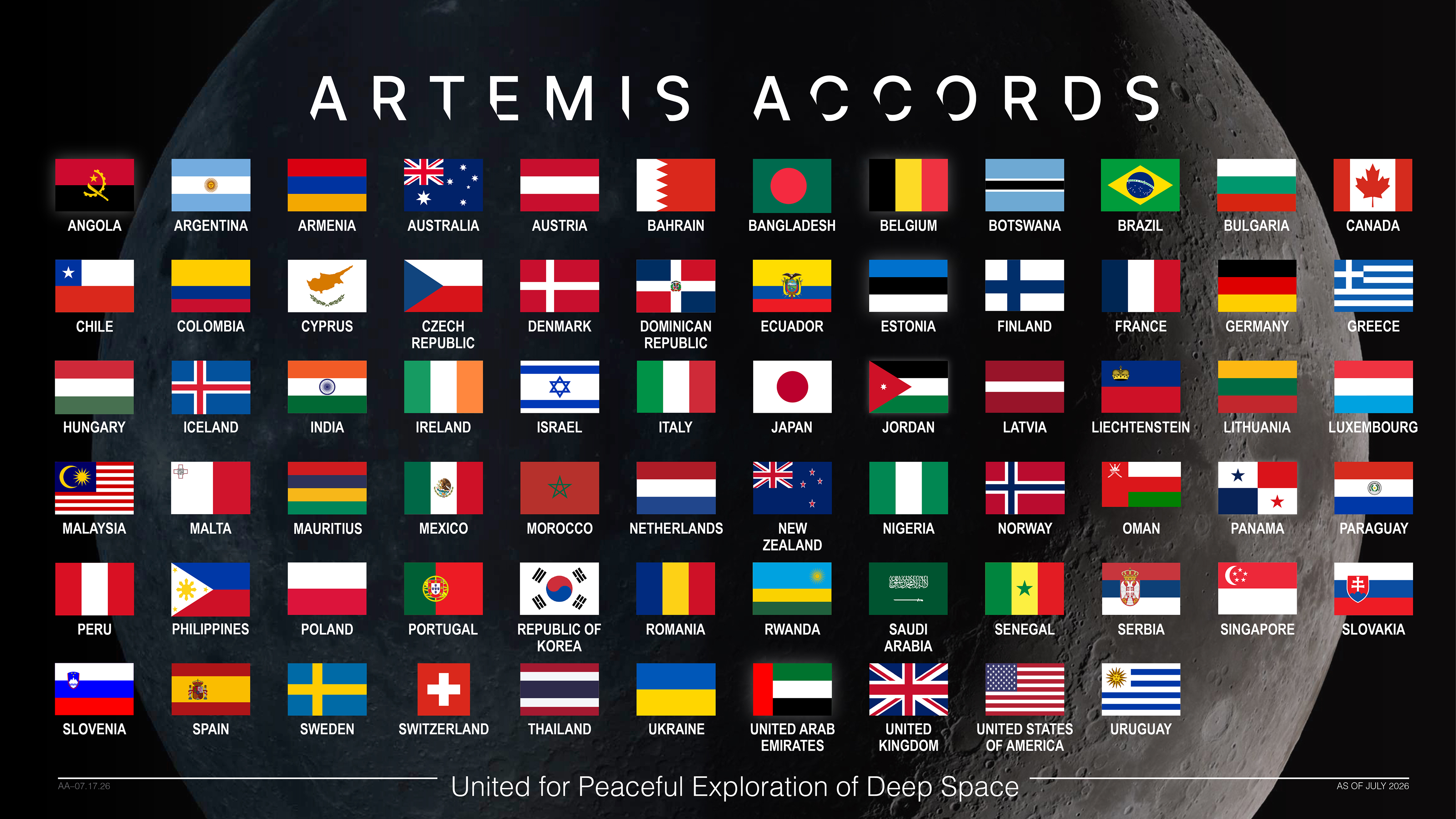
The Republic of Mauritius has officially joined the global coalition committed to responsible space exploration, becoming the newest signatory and seventh African country to join the Artemis Accords. NASA’s Deputy Administrator Matt Anderson contributed video remarks for a signing ceremony on Friday, in the island nation’s city of Ébène.
“We are honored to welcome Mauritius to the Artemis Accords community and look forward to working together in the years ahead,” said Anderson. “Together, we are creating the foundation for future exploration while ensuring that space remains peaceful, accessible, and beneficial for all. America will return to the Moon and ignite the Golden Age of exploration and discovery. That work requires capable partners and a shared commitment to responsible exploration.”
Mauritius’ Permanent Secretary at the Ministry of Tertiary Education, Science and Research Navindsing Jugmohunsing signed the Artemis Accords on behalf of the country. U.S. Deputy Assistant Secretary of State for African Affairs Sarah Troutman and U.S. Chargé d’Affaires to Mauritius Craig Halbmaier were present to witness the signing.
“The accession of Mauritius to the Artemis Accords marks a defining chapter in our New Space journey,” said Jugmohunsing. “As a Small Island Developing State in the Indian Ocean, we are committed to ensuring that space serves humanity by protecting our oceans and coastlines and amplifying the voices of nations like ours. Mauritius stands ready to help shape the future of space governance while unlocking new opportunities for innovation and partnership.”
NASA first engaged with Mauritius through its early global mapping efforts, owing to the nation’s strategic location. Between 1965 and 1980, NASA used several satellite missions to collect global measurements of Earth’s size and shape. As part of that work, NASA sent teams to Mauritius and other international tracking stations that supported satellite photography for geodetic analysis. Their observations strengthened the navigation technologies used from Apollo to Artemis and helped lay the foundation for the partnership reaffirmed today by the Artemis Accords.
In 2020, NASA and the Department of State joined with seven other founding nations to establish the Artemis Accords, responding to the growing interest in lunar activities by both governments and private companies. They introduced the first set of practical principles aimed at enhancing the safety and coordination between like-minded nations as they explore the Moon, Mars, and beyond, committing nations to:
- explore peaceably and transparently
- render aid to those in need
- enable access to scientific data
- ensure activities do not interfere with those of others
- preserve historically significant sites and artifacts by developing best practices
Five years later, President Donald J. Trump’s National Space Policy directed NASA to establish a sustained lunar outpost. With this Moon Base, NASA is putting the principles of the Artemis Accords into practice, inviting every signatory including now Mauritius to take part in the endeavor.
More countries are expected to sign the Artemis Accords in the months and years ahead, as NASA continues its work to establish a safe, peaceful, and prosperous future in space.
Learn more about the Artemis Accords at:
https://www.nasa.gov/artemis-accords
Share Details Last Updated Jul 17, 2026 LocationNASA Headquarters Related TermsNASA Welcomes Mauritius as 70th Artemis Accords Signatory
The Republic of Mauritius has officially joined the global coalition committed to responsible space exploration, becoming the newest signatory and seventh African country to join the Artemis Accords. NASA’s Deputy Administrator Matt Anderson contributed video remarks for a signing ceremony on Friday, in the island nation’s city of Ébène.
“We are honored to welcome Mauritius to the Artemis Accords community and look forward to working together in the years ahead,” said Anderson. “Together, we are creating the foundation for future exploration while ensuring that space remains peaceful, accessible, and beneficial for all. America will return to the Moon and ignite the Golden Age of exploration and discovery. That work requires capable partners and a shared commitment to responsible exploration.”
Mauritius’ Permanent Secretary at the Ministry of Tertiary Education, Science and Research Navindsing Jugmohunsing signed the Artemis Accords on behalf of the country. U.S. Deputy Assistant Secretary of State for African Affairs Sarah Troutman and U.S. Chargé d’Affaires to Mauritius Craig Halbmaier were present to witness the signing.
“The accession of Mauritius to the Artemis Accords marks a defining chapter in our New Space journey,” said Jugmohunsing. “As a Small Island Developing State in the Indian Ocean, we are committed to ensuring that space serves humanity by protecting our oceans and coastlines and amplifying the voices of nations like ours. Mauritius stands ready to help shape the future of space governance while unlocking new opportunities for innovation and partnership.”
NASA first engaged with Mauritius through its early global mapping efforts, owing to the nation’s strategic location. Between 1965 and 1980, NASA used several satellite missions to collect global measurements of Earth’s size and shape. As part of that work, NASA sent teams to Mauritius and other international tracking stations that supported satellite photography for geodetic analysis. Their observations strengthened the navigation technologies used from Apollo to Artemis and helped lay the foundation for the partnership reaffirmed today by the Artemis Accords.
In 2020, NASA and the Department of State joined with seven other founding nations to establish the Artemis Accords, responding to the growing interest in lunar activities by both governments and private companies. They introduced the first set of practical principles aimed at enhancing the safety and coordination between like-minded nations as they explore the Moon, Mars, and beyond, committing nations to:
- explore peaceably and transparently
- render aid to those in need
- enable access to scientific data
- ensure activities do not interfere with those of others
- preserve historically significant sites and artifacts by developing best practices
Five years later, President Donald J. Trump’s National Space Policy directed NASA to establish a sustained lunar outpost. With this Moon Base, NASA is putting the principles of the Artemis Accords into practice, inviting every signatory including now Mauritius to take part in the endeavor.
More countries are expected to sign the Artemis Accords in the months and years ahead, as NASA continues its work to establish a safe, peaceful, and prosperous future in space.
Learn more about the Artemis Accords at:
https://www.nasa.gov/artemis-accords
Share Details Last Updated Jul 17, 2026 LocationNASA Headquarters Related TermsX-Ray Eyes Reveal the Magnetic Secrets of the Lighthouse Pulsar's Cosmic Wake
Occasionally, when a massive star dies in a supernova, it can leave behind a dense, rapidly spinning core known as a pulsar. These extreme objects are some of the most fascinating in the universe, and are extremely useful for astronomers when measuring distances or navigating the void of space. A new paper from Jack Dinsmore, a graduate student at Stanford, and his co-authors, and published in The Astrophysical Journal, takes a look at some of the features of one of the most famous examples of a pulsar - PSR J1101-6101, commonly known as the Lighthouse pulsar.
Week in images: 13-17 July 2026
Week in images: 13-17 July 2026
Discover our week through the lens
See unprecedented images of Sunda clouded leopards, the ‘ghosts of the forest’
New, never-before-seen images provide a glimpse into the secretive lives of a clouded leopard species found in the dense rainforests of Borneo and Sumatra
FCC Approves First Launch for Space Reflector Constellation
The United States Federal Communications Commission (FCC) recently approved the first test launch of Reflect Orbital’s Eärendil-1 satellite. Sporting an 18 by 18 meter-wide reflector once unfurled, the satellite will test the ability to reflect sunlight back to Earth, on demand. The company envisions more than 50,000 reflectors girding the Earth in low Earth orbit by 2035, while many in the astronomical community have raised concerns on the project's impact.
What’s the longest total solar eclipse?
Duration, location, aviation: What makes the best possible view of a total solar eclipse?
European Service Module team meets Artemis II crew
Permanent daylight savings is bad for Americans’ health—here’s what science says could be better
More sunlight in the evenings doesn’t always equate to better health
This Week's Sky at a Glance, July 17 – 26
The crescent Moon visits Venus in twilight. After dark, we're in the peak month for "the Orion of Summer" with its Cat's Eyes. And cold-weather Cassiopeia is already poking up.
The post This Week's Sky at a Glance, July 17 – 26 appeared first on Sky & Telescope.
Cyclospora outbreak linked to iceberg lettuce supplied to Taco Bell
U.S. officials have traced an explosive-diarrhea-causing parasite outbreak in five states to shredded lettuce served at this popular fast-food chain
Ancient Egyptian princesses were ‘powerful’ weapon users, new analysis suggests
These findings challenge a long-held belief about weapons found in female burial sites
A Tide-Fueled Trove of Biodiversity in Guinea-Bissau
- Earth
- Earth Observatory
- Image of the Day
- EO Explorer
- Topics
- More Content
- About
A Tide-Fueled Trove of Biodiversity in Guinea-Bissau
- Earth
- Earth Observatory
- Image of the Day
- EO Explorer
- Topics
- More Content
- About
SpaceX’s latest Starship launch attempt ends in a scrub
SpaceX’s first attempt to launch the company’s Starship megarocket on the vehicle’s 13th flight test ended before it could properly begin, aborting just before liftoff
Satellite Images of Pengiun Poo Reveal Climate Change's Impact on the Species
Researchers utilized 30 years of Landsat satellite imagery to analyze the color and spectral signatures of Adélie penguin guano across Antarctica, marking the first time space-based observations have captured food-web and population dynamics at a continental scale.