
Feed aggregator
NASA Sets Coverage for Astronaut Anil Menon Launch to Space Station

NASA astronaut Anil Menon will launch aboard the Roscosmos Soyuz MS-29 spacecraft to the International Space Station on Tuesday, July 14, accompanied by cosmonauts Pyotr Dubrov and Anna Kikina, where they will join the Expedition 74 crew advancing scientific research.
Menon, Dubrov, and Kikina will lift off at 10:47 a.m. EDT (7:47 p.m. Baikonur time) from the Baikonur Cosmodrome in Kazakhstan. Live launch and docking coverage is available on NASA+, Amazon Prime, and the agency’s YouTube channel. Learn how to watch NASA content through a variety of online platforms, including social media.
After a two-orbit, three-hour trip to the station, the spacecraft will automatically dock at 1:56 p.m. to the Prichal module. Shortly afterward, hatches will open between the Soyuz and the orbiting laboratory.
Once aboard, the trio will join NASA astronauts Jessica Meir, Jack Hathaway, and Chris Williams, ESA (European Space Agency) astronaut Sophie Adenot, and Roscosmos cosmonauts Sergey Kud-Sverchkov, Sergei Mikaev, and Andrey Fedyaev.
NASA’s coverage schedule is as follows (all times Eastern and subject to change based on real-time operations):
Tuesday, July 14
9:45 a.m. – Launch coverage begins on NASA+, Amazon Prime, and YouTube.
10:47 a.m. – Launch
1:10 p.m. – Rendezvous and docking coverage begins on NASA+, Amazon Prime, and YouTube.
1:56 p.m. – Docking
3:30 p.m. – Hatch opening and welcome coverage begins on NASA+, Amazon Prime, and YouTube.
3:55 p.m. – Hatch opening
Menon, Dubrov, and Kikina will spend about eight months aboard the orbital complex as International Space Station Expedition 74/75 crew members before returning to Earth in April 2027. This will be Menon’s first spaceflight and the second for both Dubrov and Kikina.
During his stay on the station, Menon will conduct scientific research and technology demonstrations aimed at advancing human space exploration and benefiting life on Earth. He will continue research to refine in-space production of semiconductor crystals to enable the large-scale manufacturing of components needed for high-performance computers, artificial intelligence, and improved medical devices. Menon also will perform ultrasound using augmented reality and artificial intelligence methods that could eliminate the need for medical support from Earth on future space missions. He will be a test subject helping researchers understand how blood flow is affected in space to protect future astronauts. He also will test bioprinting vascular constructs in microgravity to improve understanding of the aging process to advance therapeutic developments.
For more than 25 years, people have lived and worked continuously aboard the International Space Station, advancing scientific knowledge and making research breakthroughs not possible on Earth. The space station helps NASA understand and overcome the challenges of human spaceflight, expand commercial opportunities in low Earth orbit, and build on the foundation for long-duration missions to the Moon, as part of the Artemis program, and to Mars.
To learn more about International Space Station research, operations, and its crews, visit:
-end-
Joshua Finch / Jimi Russell
Headquarters, Washington
202-358-1100
joshua.a.finch@nasa.gov / james.j.russell@nasa.gov
Sandra Jones
Johnson Space Center, Houston
281-483-5111
sandra.p.jones@nasa.gov
NASA Sets Coverage for Astronaut Anil Menon Launch to Space Station
NASA astronaut Anil Menon will launch aboard the Roscosmos Soyuz MS-29 spacecraft to the International Space Station on Tuesday, July 14, accompanied by cosmonauts Pyotr Dubrov and Anna Kikina, where they will join the Expedition 74 crew advancing scientific research.
Menon, Dubrov, and Kikina will lift off at 10:47 a.m. EDT (7:47 p.m. Baikonur time) from the Baikonur Cosmodrome in Kazakhstan. Live launch and docking coverage is available on NASA+, Amazon Prime, and the agency’s YouTube channel. Learn how to watch NASA content through a variety of online platforms, including social media.
After a two-orbit, three-hour trip to the station, the spacecraft will automatically dock at 1:56 p.m. to the Prichal module. Shortly afterward, hatches will open between the Soyuz and the orbiting laboratory.
Once aboard, the trio will join NASA astronauts Jessica Meir, Jack Hathaway, and Chris Williams, ESA (European Space Agency) astronaut Sophie Adenot, and Roscosmos cosmonauts Sergey Kud-Sverchkov, Sergei Mikaev, and Andrey Fedyaev.
NASA’s coverage schedule is as follows (all times Eastern and subject to change based on real-time operations):
Tuesday, July 14
9:45 a.m. – Launch coverage begins on NASA+, Amazon Prime, and YouTube.
10:47 a.m. – Launch
1:10 p.m. – Rendezvous and docking coverage begins on NASA+, Amazon Prime, and YouTube.
1:56 p.m. – Docking
3:30 p.m. – Hatch opening and welcome coverage begins on NASA+, Amazon Prime, and YouTube.
3:55 p.m. – Hatch opening
Menon, Dubrov, and Kikina will spend about eight months aboard the orbital complex as International Space Station Expedition 74/75 crew members before returning to Earth in April 2027. This will be Menon’s first spaceflight and the second for both Dubrov and Kikina.
During his stay on the station, Menon will conduct scientific research and technology demonstrations aimed at advancing human space exploration and benefiting life on Earth. He will continue research to refine in-space production of semiconductor crystals to enable the large-scale manufacturing of components needed for high-performance computers, artificial intelligence, and improved medical devices. Menon also will perform ultrasound using augmented reality and artificial intelligence methods that could eliminate the need for medical support from Earth on future space missions. He will be a test subject helping researchers understand how blood flow is affected in space to protect future astronauts. He also will test bioprinting vascular constructs in microgravity to improve understanding of the aging process to advance therapeutic developments.
For more than 25 years, people have lived and worked continuously aboard the International Space Station, advancing scientific knowledge and making research breakthroughs not possible on Earth. The space station helps NASA understand and overcome the challenges of human spaceflight, expand commercial opportunities in low Earth orbit, and build on the foundation for long-duration missions to the Moon, as part of the Artemis program, and to Mars.
To learn more about International Space Station research, operations, and its crews, visit:
-end-
Joshua Finch / Jimi Russell
Headquarters, Washington
202-358-1100
joshua.a.finch@nasa.gov / james.j.russell@nasa.gov
Sandra Jones
Johnson Space Center, Houston
281-483-5111
sandra.p.jones@nasa.gov
NASA Space Telescope Maps Magnetic Fields of ‘Lighthouse’ Pulsar
For the first time, scientists have used NASA’s IXPE (Imaging X-ray Polarimetry Explorer) to directly measure the magnetic fields of PSR J1101−6101, a pulsar located within what is often referred to as the Lighthouse Nebula. The results provide new insight into the structure of some of the most extreme objects in the cosmos, as NASA continues to explore the secrets of how the universe works. A paper describing the results published Thursday in the Astrophysical Journal.
Scientists have successfully measured the magnetic field of the Lighthouse pulsar’s nebula using NASA’s IXPE. Their measurements confirm the theory that high-energy particles escape along the galaxy’s magnetic field lines. This composite image contains X-ray data from IXPE in blue (highlighted in the inset), the Chandra X-ray Observatory in purple, and radio data from CSIRO in green. The starfield is optical data from the 2MASS optical survey. X-ray: Chandra: NASA/CXC/Stanford Univ./J.T. Dinsmore et al.; IXPE: NASA/MSFC/J.T. Dinsmore et al., Radio: CSIRO/ATNF/ATCA; Optical: 2MASS/UMass/IPAC-Caltech/NASA/NSF; Image processing: NASA/CXC/SAO/L. Frattare Fast facts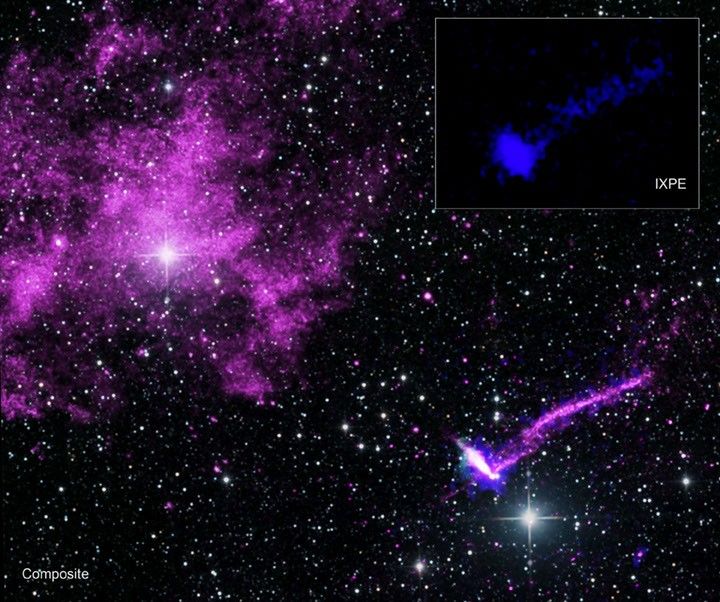
- A pulsar is a type of neutron star with a strong magnetic field that spins incredibly fast. The pulsar at the center of the Lighthouse Nebula is rotating 16 times per second.
- Neutron stars are the leftover cores of massive stars, formed at the end of their life cycles, that possess more mass than the Sun. They are condensed down to the size of a city, making them natural laboratories for studying extreme physics.
- Polarization is a property of light that describes the direction of its electric field vibrations. The polarization degree is a measurement of how aligned those vibrations are with each other.
In June 2025, IXPE spent nearly 18 days focused on the Lighthouse Nebula.
Astronomers studied two narrow X-ray offshoots extending from the pulsar to better understand how electrons at nearly the speed of light interact with this energetic system. The longer offshoot is known as the “filament,” and the shorter one is the “trail.”
When high-energy particles from the pulsar collide with the gas of interstellar space, they form a bow shock, like the bow wave formed at the front of a speeding boat. Most particles become trapped behind this bow shock, forming the turbulent trail behind the pulsar.
Researchers have suspected since 2008 that the highest-energy particles escape through this bow shock into interstellar space, flowing along the galaxy’s magnetic field lines to create the nebula’s long, thin filament.
“We wanted to test that theory,” said Jack Dinsmore, undergraduate student at Stanford University, who led the study. “The ‘smoking gun’ would come by measuring the polarization of the light, which indicates the magnetic field direction. If the magnetic field points along the filament, that confirms that the filament’s particles are flowing along the field.”
One challenge with these measurements is that the Lighthouse Nebula is relatively faint. To address this, IXPE scientists developed advanced analysis methods that use every bit of data, avoiding simplifying steps that could limit information. With these new tools and the new observations of the Lighthouse, the science team successfully measured the filament’s polarization. These techniques also gave a polarization measurement of the trail, and the pulsar’s emission signal.
Their analysis confirmed with more than 99% confidence that the magnetic field does indeed align with the particles’ flow.
While the parallel direction confirms models for the particle’s motion, the polarization degree was high enough to raise new questions.
“Many of the models for filaments assume strong magnetic turbulence,” said Roger Romani, a Stanford University professor who co-authored this paper. “The high polarization degree we measured indicates lower turbulence than such models require.”
The IXPE observations also showed that the magnetic field responsible for X-ray emission had to be parallel to the trail. However, the authors collected radio frequency observations showing a magnetic field pointing almost exactly perpendicular.
“The striking divergence in magnetic field orientations observed between radio and X-ray wavelengths provides compelling evidence for the highly structured nature of these objects,” said Niccolò Bucciantini of the Italian National Institute for Astrophysics and co-author of the study. “This marks the first clear indication that particles of different energies occupy distinct regions within the system, hinting at the presence of multiple, and potentially very different, acceleration mechanisms at work.”
More about IXPEThe IXPE mission, which continues to provide unprecedented data enabling groundbreaking discoveries about celestial objects across the universe, is a joint NASA and Italian Space Agency mission with partners and science collaborators in 12 countries. It is led by NASA’s Marshall Space Flight Center in Huntsville, Alabama, and BAE Systems, Inc. manages spacecraft operations together with the University of Colorado’s Laboratory for Atmospheric and Space Physics in Boulder.
Learn more about IXPE’s ongoing mission here:
About the Author Michael AllenShare
Details Last Updated Jul 09, 2026 Editor Lee Mohon Contact Joel Wallace Location Marshall Space Flight Center Related Terms Explore More 3 min read NASA’s IXPE Measures White Dwarf Star for First TimeBy Michael Allen For the first time, scientists have used NASA’s IXPE (Imaging X-ray Polarimetry…
Article
6 months ago
4 min read NASA’s IXPE Obtains First X-ray Polarization Measurement of Magnetar Outburst
What happens when the universe’s most magnetic object shines with the power of 1,000 Suns…
Article
1 year ago
8 min read NASA Telescopes Tune Into a Black Hole Prelude, Fugue
NASA released three new pieces of cosmic sound Thursday that are associated with the densest…
Article
1 year ago
Keep Exploring Discover More Topics From NASA IXPE
The Imaging X-ray Polarimetry Explorer (IXPE) is NASA’s first mission to study the polarization of X-rays.
Chandra X-ray Observatory
Hubble Space Telescope
Since its 1990 launch, the Hubble Space Telescope has changed our fundamental understanding of the universe.
James Webb Space Telescope
Webb is the premier observatory of the next decade, serving thousands of astronomers worldwide. It studies every phase in the…
NASA Space Telescope Maps Magnetic Fields of ‘Lighthouse’ Pulsar
For the first time, scientists have used NASA’s IXPE (Imaging X-ray Polarimetry Explorer) to directly measure the magnetic fields of PSR J1101−6101, a pulsar located within what is often referred to as the Lighthouse Nebula. The results provide new insight into the structure of some of the most extreme objects in the cosmos, as NASA continues to explore the secrets of how the universe works. A paper describing the results published Thursday in the Astrophysical Journal.
Scientists have successfully measured the magnetic field of the Lighthouse pulsar’s nebula using NASA’s IXPE. Their measurements confirm the theory that high-energy particles escape along the galaxy’s magnetic field lines. This composite image contains X-ray data from IXPE in blue (highlighted in the inset), the Chandra X-ray Observatory in purple, and radio data from CSIRO in green. The starfield is optical data from the 2MASS optical survey. X-ray: Chandra: NASA/CXC/Stanford Univ./J.T. Dinsmore et al.; IXPE: NASA/MSFC/J.T. Dinsmore et al., Radio: CSIRO/ATNF/ATCA; Optical: 2MASS/UMass/IPAC-Caltech/NASA/NSF; Image processing: NASA/CXC/SAO/L. Frattare Fast facts- A pulsar is a type of neutron star with a strong magnetic field that spins incredibly fast. The pulsar at the center of the Lighthouse Nebula is rotating 16 times per second.
- Neutron stars are the leftover cores of massive stars, formed at the end of their life cycles, that possess more mass than the Sun. They are condensed down to the size of a city, making them natural laboratories for studying extreme physics.
- Polarization is a property of light that describes the direction of its electric field vibrations. The polarization degree is a measurement of how aligned those vibrations are with each other.
In June 2025, IXPE spent nearly 18 days focused on the Lighthouse Nebula.
Astronomers studied two narrow X-ray offshoots extending from the pulsar to better understand how electrons at nearly the speed of light interact with this energetic system. The longer offshoot is known as the “filament,” and the shorter one is the “trail.”
When high-energy particles from the pulsar collide with the gas of interstellar space, they form a bow shock, like the bow wave formed at the front of a speeding boat. Most particles become trapped behind this bow shock, forming the turbulent trail behind the pulsar.
Researchers have suspected since 2008 that the highest-energy particles escape through this bow shock into interstellar space, flowing along the galaxy’s magnetic field lines to create the nebula’s long, thin filament.
“We wanted to test that theory,” said Jack Dinsmore, undergraduate student at Stanford University, who led the study. “The ‘smoking gun’ would come by measuring the polarization of the light, which indicates the magnetic field direction. If the magnetic field points along the filament, that confirms that the filament’s particles are flowing along the field.”
One challenge with these measurements is that the Lighthouse Nebula is relatively faint. To address this, IXPE scientists developed advanced analysis methods that use every bit of data, avoiding simplifying steps that could limit information. With these new tools and the new observations of the Lighthouse, the science team successfully measured the filament’s polarization. These techniques also gave a polarization measurement of the trail, and the pulsar’s emission signal.
Their analysis confirmed with more than 99% confidence that the magnetic field does indeed align with the particles’ flow.
While the parallel direction confirms models for the particle’s motion, the polarization degree was high enough to raise new questions.
“Many of the models for filaments assume strong magnetic turbulence,” said Roger Romani, a Stanford University professor who co-authored this paper. “The high polarization degree we measured indicates lower turbulence than such models require.”
The IXPE observations also showed that the magnetic field responsible for X-ray emission had to be parallel to the trail. However, the authors collected radio frequency observations showing a magnetic field pointing almost exactly perpendicular.
“The striking divergence in magnetic field orientations observed between radio and X-ray wavelengths provides compelling evidence for the highly structured nature of these objects,” said Niccolò Bucciantini of the Italian National Institute for Astrophysics and co-author of the study. “This marks the first clear indication that particles of different energies occupy distinct regions within the system, hinting at the presence of multiple, and potentially very different, acceleration mechanisms at work.”
More about IXPEThe IXPE mission, which continues to provide unprecedented data enabling groundbreaking discoveries about celestial objects across the universe, is a joint NASA and Italian Space Agency mission with partners and science collaborators in 12 countries. It is led by NASA’s Marshall Space Flight Center in Huntsville, Alabama, and BAE Systems, Inc. manages spacecraft operations together with the University of Colorado’s Laboratory for Atmospheric and Space Physics in Boulder.
Learn more about IXPE’s ongoing mission here:
About the Author Michael AllenShare
Details Last Updated Jul 09, 2026 Editor Lee Mohon Contact Joel Wallace Location Marshall Space Flight Center Related Terms Explore More 3 min read NASA’s IXPE Measures White Dwarf Star for First TimeBy Michael Allen For the first time, scientists have used NASA’s IXPE (Imaging X-ray Polarimetry…
Article
6 months ago
4 min read NASA’s IXPE Obtains First X-ray Polarization Measurement of Magnetar Outburst
What happens when the universe’s most magnetic object shines with the power of 1,000 Suns…
Article
1 year ago
8 min read NASA Telescopes Tune Into a Black Hole Prelude, Fugue
NASA released three new pieces of cosmic sound Thursday that are associated with the densest…
Article
1 year ago
Keep Exploring Discover More Topics From NASA IXPE
The Imaging X-ray Polarimetry Explorer (IXPE) is NASA’s first mission to study the polarization of X-rays.
Chandra X-ray Observatory
Hubble Space Telescope
Since its 1990 launch, the Hubble Space Telescope has changed our fundamental understanding of the universe.
James Webb Space Telescope
Webb is the premier observatory of the next decade, serving thousands of astronomers worldwide. It studies every phase in the…
To Ancient Astronomers, Theta Eridani Was Brighter For A Thousand Years. Now We Know Why
Ptolemy and al-Sufi were keen ancient astronomers, one in Greece and one in Persia, whose observations were separated by almost a thousand years. They both noted that the star Theta Eridani was far brighter than it is today. Now we know why.
Special relativity can warp chemical bonds – now we've seen it happen
Special relativity can warp chemical bonds – now we've seen it happen
Ultra-Black Coating Could Mitigate Light Pollution Caused by Satellites
Astrophysicists working tirelessly to tackle the growing impact of satellite constellations have pioneered a new ultra-black coating as one possible way to mitigate the problem.
Principal Investigator and Quality Assessment Reports Evaluate Umbra Synthetic Aperture Radar Data
Two new reports from NASA’s Commercial Satellite Data Acquisition (CSDA) program evaluate data from the Umbra X-band Synthetic Aperture Radar (SAR) satellite constellation for the NASA Earth science research and applications community. The results of these evaluations help to inform NASA program management and the user community about the quality of these commercial data for use in NASA science.
NASA’s CSDA program released the Umbra SAR Principal Investigator Evaluation Summary and Umbra SAR Quality Assessment Reports in May 2026. (The cover of the Quality Assessment Report is shown at left.) The results of these evaluations help inform NASA program management about the quality of this commercial data for use in NASA science. At right, a collage of synthetic aperture radar images from Umbra. Credit: NASA CSDA program / © Umbra Lab Inc., 2026. All Rights Reserved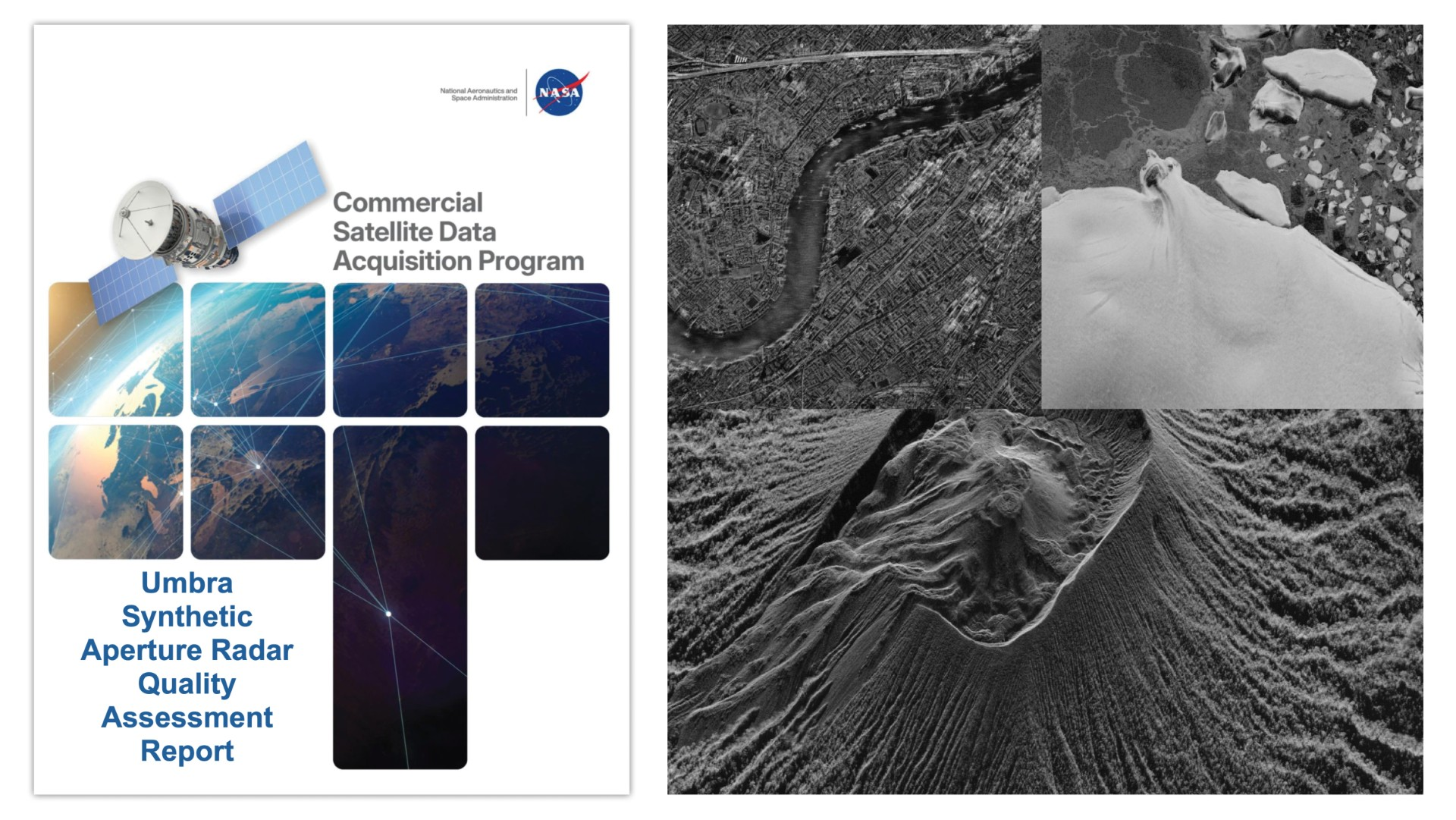
The CSDA Umbra Synthetic Aperture Radar SAR Principal Investigator Evaluation Summary documents the findings of evaluation teams. The teams were given access to the Umbra archive as well as the ability to task the Umbra constellation for new acquisitions. The tasking capability allowed evaluation teams to test the utility of Umbra data in time-sensitive workflows and to monitor areas experiencing rapid change and/or emergent environmental conditions, such as harmful algal blooms.
Although the Principal Investigator Evaluation Summary supports the use of Umbra SAR data for NASA Earth science research and applications overall, it noted several strengths and weaknesses of the Umbra X-band data. Strengths included access to a very high spatial resolution X-band SAR satellite constellation; taskable access to high temporal repeat opportunities with quick turnaround; imaging flexibility with a range of azimuth and incidence angles; and the company’s Open Data Program. Conversely, the PI teams reported weaknesses, including issues with Umbra geolocation (noting large and small geolocation errors), limited software compatibility, metadata, and some missing technical documentation.
Additionally, the CSDA Umbra Synthetic Aperture Radar SAR Quality Assessment Report documents the results of radiometric and geometric analyses performed by NASA subject matter experts (SMEs) enlisted to evaluate the fundamental quality of the Umbra data following the Joint NASA/European Space Agency (ESA) assessment guidelines (ESA-NASA, 2024).
Performed mainly on the single-look complex (SLC) Level 1 data products in Sensor Independent Complex Data (SICD) format, along with some additional Level 2 products used in science usability assessments by the evaluation team, the CSDA SMEs found the spatial resolution of the data agreed with Umbra’s specifications. However, the quality analysis results for geolocation accuracy did not universally align with the company’s specifications. Given these results, the SME’s concluded that “the overall positioning performance of the Umbra data did not meet the expected accuracy.
Regarding the radiometric performance of the data, which was assessed in terms of absolute accuracy, stability, and sensitivity, the SMEs found the data “underperform[ed] relative to that of well-calibrated reference SAR systems.”
About the CSDA ProgramThe CSDA program was established to identify, evaluate, and acquire data from commercial sources that support the NASA Earth science research and application goals. NASA’s Earth Science Division recognizes the potential impact commercial satellite constellations may have in encouraging/enabling efficient approaches to advancing Earth System Science and applications development for societal benefit. Commercially acquired data may also provide a cost-effective means to augment and/or complement the suite of Earth observations acquired by NASA, other U.S. government agencies, and international partners.
To read the reports in full, see the links under “Evaluation” heading on the CSDA’s Umbra commercial vendor webpage.
Principal Investigator and Quality Assessment Reports Evaluate Umbra Synthetic Aperture Radar Data
Two new reports from NASA’s Commercial Satellite Data Acquisition (CSDA) program evaluate data from the Umbra X-band Synthetic Aperture Radar (SAR) satellite constellation for the NASA Earth science research and applications community. The results of these evaluations help to inform NASA program management and the user community about the quality of these commercial data for use in NASA science.
NASA’s CSDA program released the Umbra SAR Principal Investigator Evaluation Summary and Umbra SAR Quality Assessment Reports in May 2026. (The cover of the Quality Assessment Report is shown at left.) The results of these evaluations help inform NASA program management about the quality of this commercial data for use in NASA science. At right, a collage of synthetic aperture radar images from Umbra. Credit: NASA CSDA program / © Umbra Lab Inc., 2026. All Rights ReservedThe CSDA Umbra Synthetic Aperture Radar Umbra SAR Principal Investigator Evaluation Summary documents the findings of evaluation teams. The teams were given access to the Umbra archive as well as the ability to task the Umbra constellation for new acquisitions. The tasking capability allowed evaluation teams to test the utility of Umbra data in time-sensitive workflows and to monitor areas experiencing rapid change and/or emergent environmental conditions, such as harmful algal blooms.
Although the Principal Investigator Evaluation Summary supports the use of Umbra SAR data for NASA Earth science research and applications overall, it noted several strengths and weaknesses of the Umbra X-band data. Strengths included access to a very high spatial resolution X-band SAR satellite constellation; taskable access to high temporal repeat opportunities with quick turnaround; imaging flexibility with a range of azimuth and incidence angles; and the company’s Open Data Program. Conversely, the PI teams reported weaknesses, including issues with Umbra geolocation (noting large and small geolocation errors), limited software compatibility, metadata, and some missing technical documentation.
Additionally, the CSDA Umbra Synthetic Aperture Radar Umbra SAR Quality Assessment Report documents the results of radiometric and geometric analyses performed by NASA subject matter experts (SMEs) enlisted to evaluate the fundamental quality of the Umbra data following the Joint NASA/European Space Agency (ESA) assessment guidelines (ESA-NASA, 2024).
Performed mainly on the single-look complex (SLC) Level 1 data products in Sensor Independent Complex Data (SICD) format, along with some additional Level 2 products used in science usability assessments by the evaluation team, the CSDA SMEs found the spatial resolution of the data agreed with Umbra’s specifications. However, the quality analysis results for geolocation accuracy did not universally align with the company’s specifications. Given these results, the SME’s concluded that “the overall positioning performance of the Umbra data did not meet the expected accuracy.
Regarding the radiometric performance of the data, which was assessed in terms of absolute accuracy, stability, and sensitivity, the SMEs found the data “underperform[ed] relative to that of well-calibrated reference SAR systems.”
About the CSDA ProgramThe CSDA program was established to identify, evaluate, and acquire data from commercial sources that support the NASA Earth science research and application goals. NASA’s Earth Science Division recognizes the potential impact commercial satellite constellations may have in encouraging/enabling efficient approaches to advancing Earth System Science and applications development for societal benefit. Commercially acquired data may also provide a cost-effective means to augment and/or complement the suite of Earth observations acquired by NASA, other U.S. government agencies, and international partners.
To read the reports in full, see the links under “Evaluation” heading on the CSDA’s Umbra commercial vendor webpage.
Physicist says splashy new cosmology study made ‘elemental’ mistake
A recent study in the journal Nature carries cosmos-quaking implications for our understanding of the universe—except a new preprint says that it’s wrong
These absurdly cute mice live at higher altitudes than any other mammal—here’s how they do it
Living at altitudes with less than half the oxygen at sea level, these mice have adapted to their environment in unique ways
Tianwen 2 Arrives at Quasi-Moon Kamoʻoalewa, Returns Images
China’s Tianwen 2 mission returns its close view of Earth's tiny "quasi-moon" Kamoʻoalewa.
The post Tianwen 2 Arrives at Quasi-Moon Kamoʻoalewa, Returns Images appeared first on Sky & Telescope.
Curiosity Sees Martian Sulfur Up Close
Curiosity Sees Martian Sulfur Up Close

This close-up view shows fragments of sulfur crystals — the first ever seen on the Red Planet. The crystals were found after NASA’s Curiosity Mars rover happened to drive over a rock and crush it on May 30, 2024. Several days later, Curiosity used a camera on the end of its robotic arm to take this image.
A recent paper in Science suggests that the sulfur formed when magma deep below the surface released fluids or gases that deposited sulfur on the Red Planet’s surface about 3 billion years ago.
Image credit: NASA/JPL-Caltech/MSSS