
Feed aggregator
Supersonic!
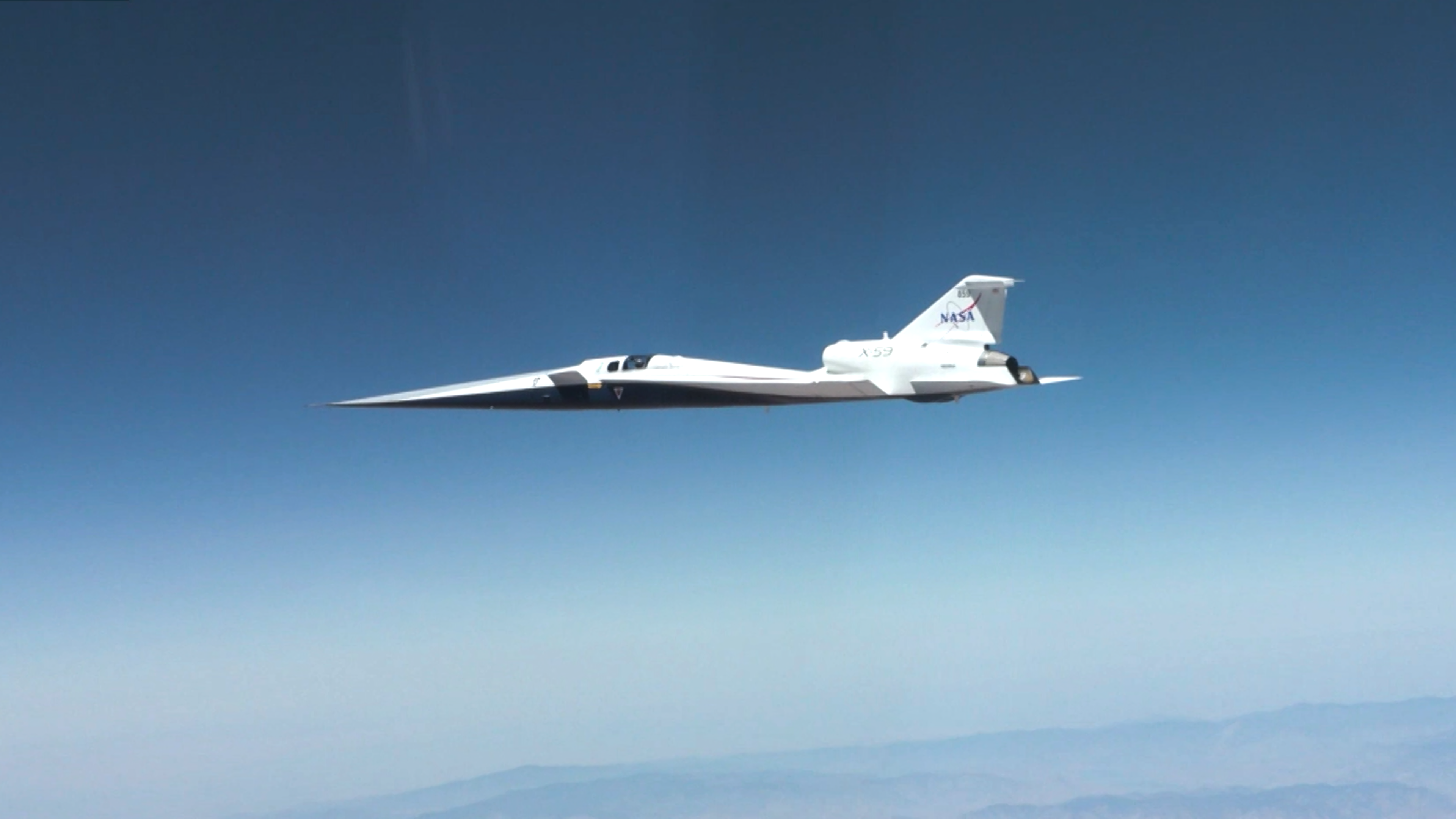
On June 5, 2026, NASA’s experimental X-59 aircraft flew faster than the speed of sound for the first time, setting the stage for demonstrating its quiet supersonic capabilities later this year. NASA test pilot Jim “Clue” Less took off and landed at Edwards Air Force Base in California, reaching a top speed of approximately Mach 1.1 (713 mph). The flight lasted 81 minutes, with the team focusing on flying qualities at both subsonic and then supersonic speeds.
The X-59 is the centerpiece of NASA’s Quesst mission, which aims to demonstrate quiet supersonic flight and help enable commercial supersonic flight over land worldwide. These advancements will help travelers reach their preferred destinations faster, spending less time in the air.
Learn more about the milestone and Quesst.
Image credit: NASA/Lori Losey
NASA’s INCUS Satellites Progress Toward Launch
Blue Canyon Technologies Photojournal Navigation Downloads NASA’s INCUS Satellites Progress Toward Launch
JPEG (10.32 MB)
Description
One of the three satellites that make up NASA’s INCUS (Investigation of Convective Updrafts) mission sits on a fixture at the facilities of Blue Canyon Technologies in Lafayette, Colorado. The satellite completed testing in preparation for launch in late May 2026. The mission will make the first space-based survey of the dynamics of tropical convective storms.
The three nearly identical satellites will fly in tight coordination in low Earth orbit, with the first and second satellites separated by 30 seconds, and the second and third satellite separated by 90 seconds.
Each satellites carries a radar designed to observe the vertical motion of air and water — known as convective mass flux — as storms develop and evolve. The middle satellite will also carry a microwave radiometer.
The INCUS mission is set to launch in 2027 from NASA’s Wallops Flight Facility in Virginia.
Funded through the Earth Venture Mission-3 acquisition under NASA’s Earth System Science Pathfinder Program and led by principal investigator Sue van den Heever at Colorado State University in Fort Collins, INCUS is one of several missions fulfilling the clouds, convection, and precipitation requirements of NASA’s Earth System Observatory, a set of interconnected missions set to study our home planet’s dynamic natural systems and how they interact. The mission is also part of FALCON (Fleet for the Atmosphere Linking Commercial Observations with NASA), a fleet of atmosphere-observing satellites that will combine hardware contributions from NASA centers, universities, and commercial partners.
Keep Exploring Discover More Topics From Photojournal
Photojournal
Search Photojournal
Photojournal’s Latest Content
Feedback
NASA’s INCUS Satellites Progress Toward Launch
Blue Canyon Technologies Photojournal Navigation Downloads NASA’s INCUS Satellites Progress Toward Launch
JPEG (10.32 MB)
Description
One of the three satellites that make up NASA’s INCUS (Investigation of Convective Updrafts) mission sits on a fixture at the facilities of Blue Canyon Technologies in Lafayette, Colorado. The satellite completed testing in preparation for launch in late May 2026. The mission will make the first space-based survey of the dynamics of tropical convective storms.
The three nearly identical satellites will fly in tight coordination in low Earth orbit, with the first and second satellites separated by 30 seconds, and the second and third satellite separated by 90 seconds.
Each satellites carries a radar designed to observe the vertical motion of air and water — known as convective mass flux — as storms develop and evolve. The middle satellite will also carry a microwave radiometer.
The INCUS mission is set to launch in 2027 from NASA’s Wallops Flight Facility in Virginia.
Funded through the Earth Venture Mission-3 acquisition under NASA’s Earth System Science Pathfinder Program and led by principal investigator Sue van den Heever at Colorado State University in Fort Collins, INCUS is one of several missions fulfilling the clouds, convection, and precipitation requirements of NASA’s Earth System Observatory, a set of interconnected missions set to study our home planet’s dynamic natural systems and how they interact. The mission is also part of FALCON (Fleet for the Atmosphere Linking Commercial Observations with NASA), a fleet of atmosphere-observing satellites that will combine hardware contributions from NASA centers, universities, and commercial partners.
Keep Exploring Discover More Topics From Photojournal
Photojournal
Search Photojournal
Photojournal’s Latest Content
Feedback
The Hidden Physics Complicating Interstellar Lightsails
If we’re to reach another star, chemical propulsion will not get us there in any reasonable time frame. We’re going to need a different propulsion technology, and one of the most promising seems to be a solar sail. These giant reflective surfaces form the basis of many interstellar missions. Combined with giant lasers pushing them, they can be accelerated to speeds unreachable by any other current technologies. However, according to a new paper available on arXiv from Chao Shen and Jiaze Li of the Harbin Institute of Technology, once those missions start reaching a significant percentage of the speed of light they’re going to run into a drag force from the light itself.
Half the world's reservoirs could be clogged up with dirt by 2060
Half the world's reservoirs could be clogged up with dirt by 2060
Understanding anorexia’s grip on the brain could unlock new therapies
Understanding anorexia’s grip on the brain could unlock new therapies
Increase in wildfire-driven ozone pollution linked to premature deaths across the U.S.
Smog from wildfires is getting worse across much of the U.S., according to a NASA-funded study
Unpicking endometriosis reveals how it affects more than the pelvis
Unpicking endometriosis reveals how it affects more than the pelvis
You could get some of the benefits of sleep without having to nod off
You could get some of the benefits of sleep without having to nod off
Why GLP-1 drugs might reduce cancer risk
A new wave of research links GLP-1 drugs to reduced cancer spread and better survival, and the mechanism may go beyond just weight loss
World Cup begins under health watch as new AI rules spark debate and ancient Rome’s road network expands
World Cup crowds spark outbreak tracking as AI tensions rise and ancient Rome’s roads get a stunning reboot
ESA at ILA Berlin International Airshow 2026
Under the theme 'Space4Future', the European Space Agency (ESA) will welcome visitors to the Space Pavilion at ILA Berlin International Airshow, Hall B, from 10 to 14 June. From Moon exploration to climate monitoring, from navigation and telecommunication to European launchers, visitors to the pavilion will discover how space is shaping our future.
ESA and EBRD to advance Earth observation for development and impact finance
The European Space Agency (ESA) signed an agreement with the European Bank for Reconstruction and Development (EBRD), hailing a new era of cooperation with the aim of advancing the use of Earth observation data and services for development and impact finance initiatives.
Digging Back in Time in the UAE
- Earth
- Earth Observatory
- Image of the Day
- EO Explorer
- Topics
- More Content
- About
Digging Back in Time in the UAE
- Earth
- Earth Observatory
- Image of the Day
- EO Explorer
- Topics
- More Content
- About
Can AI detect smuggled sea cucumbers?
In a new study, an AI tool identified images of seahorse, shark fin and sea cucumber samples in luggage