
_0.thumbnail.jpg "Image (3).jpg")
Feed aggregator
What If There's a Star Inside a Black Hole?
Ask what lies inside a black hole and the honest answer has always been a bit of a shrug and something about a singularity, a point where density becomes infinite and physics stops being able to tell you anything at all. It is the most unsatisfying answer in astrophysics, second only perhaps to what happened before the Big Bang. Now two theorists in China have produced a solution in which something else sits inside the horizon entirely, a neutron star, whole and intact, twelve kilometres across, its interior perfectly well behaved and apparently defying the laws of physics.
Scientists create largest 2D map of the universe with 5.6 trillion pixels and nearly 4 billion cosmic objects
Astronomers have released the largest two-dimensional map of the universe ever created, offering a sweeping new view of nearly 4 billion celestial objects across roughly three-quarters of the sky.
The new map, created by the Dark Energy Spectroscopic Instrument (DESI) Legacy Imaging Surveys team, contains a staggering 5.6 trillion pixels and combines more than 263,000 telescope exposures collected over more than a decade. The observations span visible and near-infrared wavelengths, providing an enormous portrait of stars, galaxies and other cosmic phenomena across the sky, according to a statement from the National Science Foundation (NSF) NOIRLab. (You can explore the full data here.)
"It's part of the fabric of astronomy research now," David Schlegel, co-lead of the Legacy Surveys and a scientist at the U.S. Department of Energy's Lawrence Berkeley National Laboratory, said in the statement. "When you're working with astronomical objects today, you often start by pulling up the Legacy Imaging Viewer to see what you're looking at."
The latest 2D cosmic map represents the culmination of 13 years of observations and data processing. The Legacy Imaging Surveys were originally designed to help DESI determine where to point its thousands of robotic optical fibers, essentially creating the 2D foundation for DESI's much larger effort to map the universe in three dimensions.
Installed on the Nicholas U. Mayall 4-meter Telescope at Kitt Peak National Observatory in Arizona, DESI measures the spectra of galaxies and quasars. By determining their redshifts — how much their light has been stretched as the universe expands — astronomers can calculate their distances and transform a flat view of the sky into a 3D map of the cosmos.
DESI began its main survey in 2021 with the goal of tracing how the universe has expanded over billions of years and, in turn, helping scientists better understand dark energy, the mysterious phenomenon thought to be driving that expansion.
The project has since far surpassed its original targets. By April 2026, DESI had mapped more than 47 million galaxies and quasars, creating the largest high-resolution 3D map of the universe to date. Previous DESI results have also provided intriguing evidence that dark energy may evolve over time rather than remain constant, as predicted by the standard model of cosmology.
Among the nearly four billion objects in the DESI Legacy Imaging Surveys' map is Messier 96 (NGC 3368), a majestic spiral galaxy nestled in the constellation Leo approximately 35 million light-years from Earth. (Image credit: DESI Legacy Imaging Surveys/LBNL/DOE & KPNO/CTIO/NOIRLab/NSF/AURA)DESI isn't the only project finding new ways to map the cosmos. Earlier this year, astronomers with the Hobby-Eberly Telescope Dark Energy Experiment (HETDEX) created a different kind of 3D map using faint Lyman-alpha emission from hydrogen between galaxies. That effort illuminated previously hidden structures dating to between 9 billion and 11 billion years ago, when the universe was experiencing a peak in star formation.
The new Legacy Imaging Surveys map, meanwhile, will have uses well beyond DESI. Previous versions of the dataset have already been referenced in more than 1,800 scientific papers, while the latest release could help astronomers search for rare objects and phenomena, study galaxy evolution and train artificial intelligence systems to analyze the enormous volumes of data expected from next-generation observatories.
"Explorations of our universe always start with images of the night sky. The DESI Imaging Legacy Surveys are just one step in this venerable human tradition," Arjun Dey, co-lead of the Legacy Imaging Surveys and an astronomer at NSF NOIRLab, said in the statement. "For our team, these data are fundamental to the investigation of the expansion history of the universe and the formation of our galaxy. But the skies belong to everyone, and this survey gives everyone the chance to marvel at their wonders."
Scientists find 2 million active black holes, exploding stars and more, nearly doubling our view of the high-energy universe
Astronomers have nearly doubled the number of known cosmic X-ray sources, offering the most comprehensive public view yet of the universe's hottest and most energetic objects.
The second major public data release from the German-led eROSITA X-ray telescope contains a catalog of nearly 2 million X-ray-emitting objects, including supermassive black holes, galaxy clusters, stars and other extreme cosmic phenomena. The unprecedented dataset — called DR2 — will help astronomers investigate how black holes grow, galaxies evolve and the universe's largest structures formed, according to a statement from the Max Planck Institute for Extraterrestrial Physics.
"DR2 is the best inventory of the X-ray sky we have to date and opens the door to robust statistical studies of cosmic populations," Miriam E. Ramos-Ceja, Ground Segment Manager of the eROSITA instrument and lead author of the DR2 publication said in the statement.
The new release combines observations collected during eROSITA's first three all-sky scans over 556 days, allowing astronomers to detect increasingly faint X-ray sources that previous surveys missed.
Of the nearly 2 million detections, more than 1.9 million are point-like sources, most of them active supermassive black holes feeding at the centers of distant galaxies or stars within the Milky Way. These black holes offer astronomers a window into how galaxies grow and evolve over cosmic time, while the stellar sources help researchers better understand everything from stellar activity to the life cycles of stars.
Another roughly 64,000 sources are extended objects, including massive galaxy clusters, nearby galaxies and the glowing remnants of exploded stars (also known as supernovas). Galaxy clusters are especially valuable because they trace the universe's largest structures, helping scientists investigate the influence of dark matter and dark energy on the evolution of the cosmos.
Unlike visible light, X-rays reveal some of the universe's most energetic environments. Material spiraling toward a black hole can be heated to millions of degrees before crossing the event horizon, while neutron stars, supernova remnants and the enormous reservoirs of hot gas filling galaxy clusters also emit strongly in X-rays.
The size of the catalog gives astronomers a powerful new dataset for studying the high-energy universe. With nearly 2 million sources observed under the same conditions, astronomers can study how supermassive black holes have grown over billions of years, map the distribution of galaxy clusters to better understand the large-scale structure of the universe, and search for rare or unusual objects that may otherwise have gone unnoticed. Large, uniform surveys also make it easier to compare different classes of objects and identify long-term trends that smaller observations cannot reveal.
A full version of the western X-ray sky from eROSITA. (Image credit: MPE, J. Sanders)This animation shows a representation of the active galactic nuclei (AGN) identified in the DR2 catalogue. Each dot shows a single object, where the distance from the three-dimensional center increases with the source's redshift, or how far away it is from us. (Image credit: MPE/J. Sanders)The release also includes optical and infrared counterparts for many of the X-ray sources, helping astronomers determine whether each object is a nearby star, a distant galaxy, an active supermassive black hole or another type of high-energy phenomenon. In the portion of the catalog where counterparts have been identified, about 88% are distant galaxies hosting actively feeding supermassive black holes, according to the statement.
"X-ray detection is only the first step," Mara Salvato, eROSITA spokesperson and chair of the follow-up working group, said in the statement. "By linking X-ray sources to their counterparts at other wavelengths, we can work out what these objects are, where they sit on the cosmic distance ladder, and build clean, well-defined samples on an unprecedented scale."
Although eROSITA stopped collecting scientific observations in early 2022, the mission completed enough sky scans beforehand to support additional public data releases. Researchers say the next Data Release 3 (DR3) is planned for 2028.
The eROSITA-DE DR2 catalogue is available to view online.
NASA Completes Astronaut-Deployed Science Instrument for Lunar Surface

NASA has declared “wrenches down” on the first completed payload designed for Artemis astronauts to deploy on the Moon’s surface. Engineers working on NASA’s Lunar Environment Monitoring Station, or LEMS, have completed hardware development and testing and the payload is ready for its permanent home near the lunar South Pole. With the hardware complete, LEMS is ready to support one of the Artemis program’s core goals: enabling sustained lunar science and exploration.
The LEMS instrument package contains two highly sensitive seismometers that will monitor ground vibrations from moonquakes and meteorite impacts, providing scientists with insights into the Moon’s interior and the seismic hazards astronauts might encounter at the surface. Its modular design allows the system to be adapted or expanded to host new instruments in the future, creating a reusable platform that can evolve as scientific priorities grow.
The payload will remain in a clean room at NASA’s Goddard Space Flight Center in Greenbelt, Maryland, where it was built, until it is assigned to an Artemis mission for deployment to the lunar surface.
“The completion of the LEMS scientific instrument is a major step in a new era of lunar surface science. Innovative science experiments will uncover, measure, and reveal the Moon’s secrets while astronauts open new frontiers for discovery,” said Joel Kearns, deputy associate administrator for exploration, Science Mission Directorate, NASA Headquarters in Washington. “And, behind the scenes, countless teams across NASA and our partners are pushing the boundaries of what surface instruments can do, building the tools that will make future exploration possible and safer.”
A scientist wearing NASA’s xEMU prototype space suit is testing the handling of a mockup version of NASA’s Lunar Environment Monitoring Station, or LEMS. The testing took place at the Active Response Gravity Offload System, a simulated reduced gravity environment at NASA’s Johnson Space Center in Houston. NASA Johnson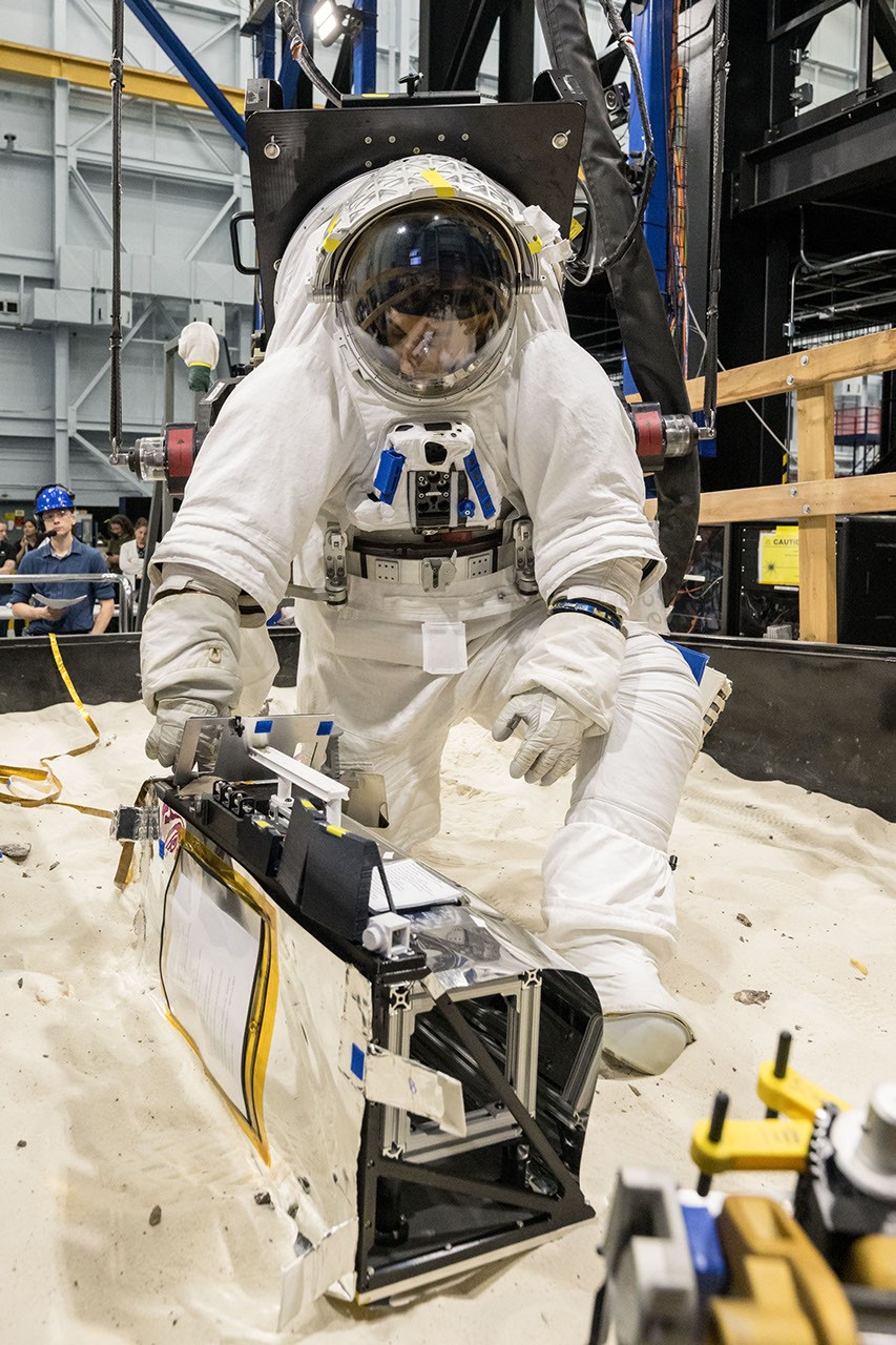
The LEMS payload builds on a legacy of lunar seismic tracking. Apollo astronauts deployed a network of seismometers on the Moon’s nearside equatorial region between 1969 and 1972. Those instruments operated until 1977, recording about 13,000 moonquakes and other ground vibrations that helped scientists begin to understand the composition of the Moon’s interior. For decades, researchers have hoped to spread more seismometers, updated with new technologies, across the lunar surface.
Now, LEMS will carry the first seismometers to be deployed by future astronauts to listen for faint ground vibrations, collecting new clues to the Moon’s internal structure and ongoing seismic activity. The sensors will be the most compact, sensitive, and energy-efficient seismometers ever built for planetary exploration.
LEMS itself is about the size of a small suitcase, weighing 11 pounds in the Moon’s low-gravity environment. It will carry not just these seismic sensors, but everything it needs to function independently of humans after deployment. LEMS is built to manage its own power production via a lightweight, flexible solar array that conforms to the shape of the LEMS unit. It also will manage its operational activities to ensure continuous data collection based on a preset plan, and monthly data transmission to Earth. The payload will do all this while maintaining a stable internal temperature throughout the massive day-to-night temperature swings of the South Pole region.
Mechanical Engineer Brie Ludwig inspects the Lunar Environment Monitoring Station (LEMS) in preparation for testing in a thermal vacuum chamber at Goddard Space Flight Center in Greenbelt, Maryland, on March 31, 2026. LEMS is a compact, autonomous, and self-sustaining seismometer suite designed to carry out continuous, long-term monitoring of the lunar seismic environment at the South Polar region. NASA/Denny Henry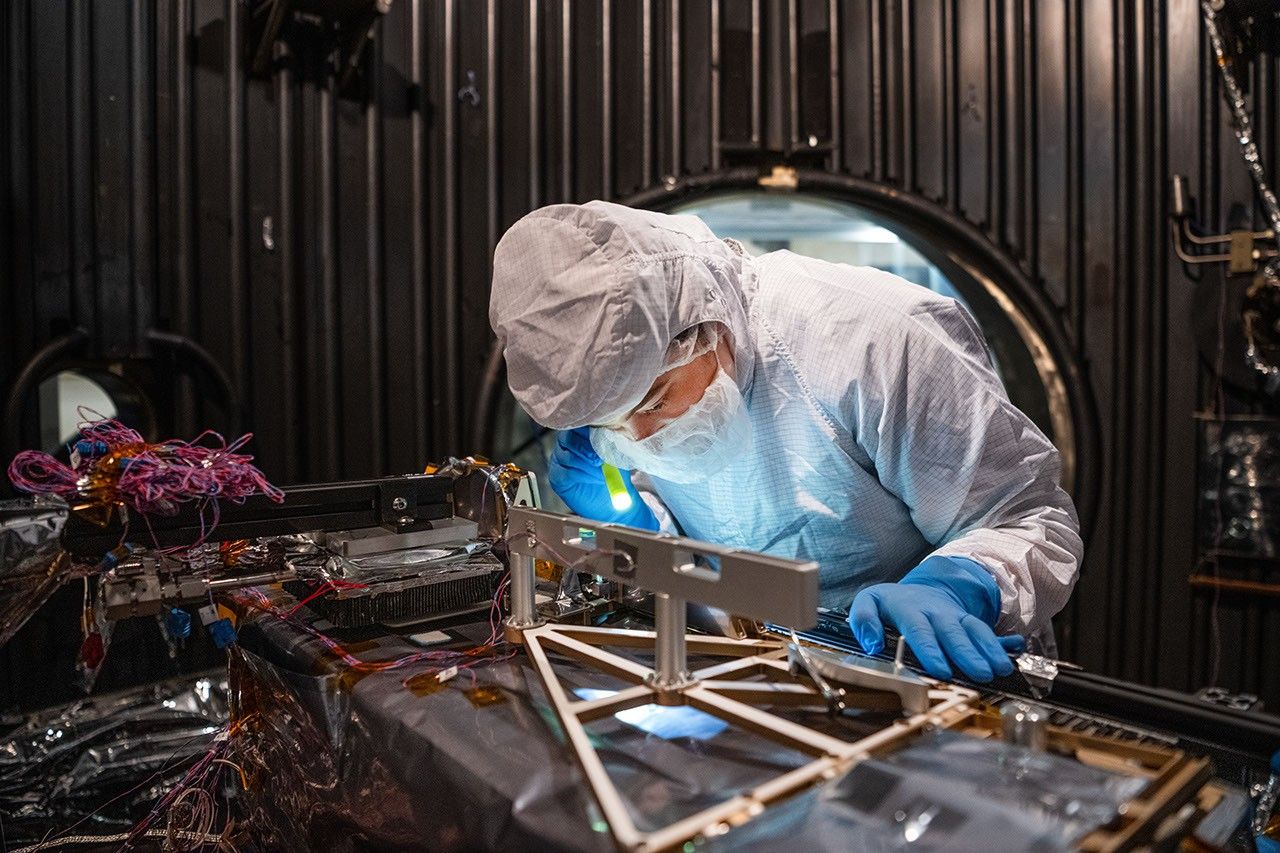
“When we conceived of LEMS, we weren’t just thinking about the next mission, we were thinking about the next generation of lunar exploration,” said Mehdi Benna, a University of Maryland Baltimore County scientist who leads LEMS from NASA Goddard. “Our vision was to create a scientific buoy for the Moon. Like an ocean buoy on Earth, LEMS is designed to be easy to build, adaptable to different scientific objectives, and capable of operating independently for years.”
Before any surface science could happen, Benna and his team had to ensure that LEMS could survive the trip to the Moon and the harsh environment of its surface. Over the past five months, LEMS and its components have been subjected to a demanding series of environmental and operational tests. Engineers verified LEMS can endure the violent shaking of launch, the journey to the lunar surface, and the Moon’s temperature and radiation environment. The team also showed that the instrument package’s mechanical and electrical design is safe for astronaut handling.
The LEMS payload was built to operate through the lunar night, which lasts two Earth weeks, without external power assistance or a heat source. Past lunar surface instruments relied on radioisotope heaters for warmth and power. But LEMS instead will withstand temperatures that dip to minus 400 degrees Fahrenheit in some areas by using advanced insulation materials, low-thermal-conductivity cables that minimize heat loss, and a thermal regulator that conducts heat away during the day to prevent overheating and helps retain heat at night.
These innovations reduce mass and power needs, setting the stage for lighter, energy-efficient instruments that can operate continuously at future Artemis landing sites and the NASA-led Moon Base.
The LEMS payload is led by University of Maryland Baltimore County and University of Maryland College Park. Technical implementation is led by NASA Goddard. The University of Arizona, in partnership with Silicon Audio, Inc., supplied LEMS’ two state-of-the-art seismometers. Morehead State University in Kentucky provided LEMS’ telecommunication system and will operate the instrument on the surface. Washington University in St. Louis will manage the instrument’s data processing and dissemination to the larger scientific community.
Explore More 3 min read Stops Along the Path of TotalityWestern Iceland and northern Spain are among the few Northern Hemisphere locations experiencing a total…
Article
10 hours ago
4 min read NASA Telescopes Create Colorful ‘Craft’ From Nearby Nebula
Article
23 hours ago
4 min read Lion Nebula Roars to Life With NASA’s Webb
Article
2 days ago
NASA Completes Astronaut-Deployed Science Instrument for Lunar Surface
NASA has declared “wrenches down” on the first completed payload designed for Artemis astronauts to deploy on the Moon’s surface. Engineers working on NASA’s Lunar Environment Monitoring Station, or LEMS, have completed hardware development and testing and the payload is ready for its permanent home near the lunar South Pole. With the hardware complete, LEMS is ready to support one of the Artemis program’s core goals: enabling sustained lunar science and exploration.
The LEMS instrument package contains two highly sensitive seismometers that will monitor ground vibrations from moonquakes and meteorite impacts, providing scientists with insights into the Moon’s interior and the seismic hazards astronauts might encounter at the surface. Its modular design allows the system to be adapted or expanded to host new instruments in the future, creating a reusable platform that can evolve as scientific priorities grow.
The payload will remain in a clean room at NASA’s Goddard Space Flight Center in Greenbelt, Maryland, where it was built, until it is assigned to an Artemis mission for deployment to the lunar surface.
“The completion of the LEMS scientific instrument is a major step in a new era of lunar surface science. Innovative science experiments will uncover, measure, and reveal the Moon’s secrets while astronauts open new frontiers for discovery,” said Joel Kearns, deputy associate administrator for exploration, Science Mission Directorate, NASA Headquarters in Washington. “And, behind the scenes, countless teams across NASA and our partners are pushing the boundaries of what surface instruments can do, building the tools that will make future exploration possible and safer.”
A scientist wearing NASA’s xEMU prototype space suit is testing the handling of a mockup version of NASA’s Lunar Environment Monitoring Station, or LEMS. The testing took place at the Active Response Gravity Offload System, a simulated reduced gravity environment at NASA’s Johnson Space Center in Houston. NASA JohnsonThe LEMS payload builds on a legacy of lunar seismic tracking. Apollo astronauts deployed a network of seismometers on the Moon’s nearside equatorial region between 1969 and 1972. Those instruments operated until 1977, recording about 13,000 moonquakes and other ground vibrations that helped scientists begin to understand the composition of the Moon’s interior. For decades, researchers have hoped to spread more seismometers, updated with new technologies, across the lunar surface.
Now, LEMS will carry the first seismometers to be deployed by future astronauts to listen for faint ground vibrations, collecting new clues to the Moon’s internal structure and ongoing seismic activity. The sensors will be the most compact, sensitive, and energy-efficient seismometers ever built for planetary exploration.
LEMS itself is about the size of a small suitcase, weighing 11 pounds in the Moon’s low-gravity environment. It will carry not just these seismic sensors, but everything it needs to function independently of humans after deployment. LEMS is built to manage its own power production via a lightweight, flexible solar array that conforms to the shape of the LEMS unit. It also will manage its operational activities to ensure continuous data collection based on a preset plan, and monthly data transmission to Earth. The payload will do all this while maintaining a stable internal temperature throughout the massive day-to-night temperature swings of the South Pole region.
Mechanical Engineer Brie Ludwig inspects the Lunar Environment Monitoring Station (LEMS) in preparation for testing in a thermal vacuum chamber at Goddard Space Flight Center in Greenbelt, Maryland, on March 31, 2026. LEMS is a compact, autonomous, and self-sustaining seismometer suite designed to carry out continuous, long-term monitoring of the lunar seismic environment at the South Polar region. NASA/Denny Henry“When we conceived of LEMS, we weren’t just thinking about the next mission, we were thinking about the next generation of lunar exploration,” said Mehdi Benna, a University of Maryland Baltimore County scientist who leads LEMS from NASA Goddard. “Our vision was to create a scientific buoy for the Moon. Like an ocean buoy on Earth, LEMS is designed to be easy to build, adaptable to different scientific objectives, and capable of operating independently for years.”
Before any surface science could happen, Benna and his team had to ensure that LEMS could survive the trip to the Moon and the harsh environment of its surface. Over the past five months, LEMS and its components have been subjected to a demanding series of environmental and operational tests. Engineers verified LEMS can endure the violent shaking of launch, the journey to the lunar surface, and the Moon’s temperature and radiation environment. The team also showed that the instrument package’s mechanical and electrical design is safe for astronaut handling.
The LEMS payload was built to operate through the lunar night, which lasts two Earth weeks, without external power assistance or a heat source. Past lunar surface instruments relied on radioisotope heaters for warmth and power. But LEMS instead will withstand temperatures that dip to minus 400 degrees Fahrenheit in some areas by using advanced insulation materials, low-thermal-conductivity cables that minimize heat loss, and a thermal regulator that conducts heat away during the day to prevent overheating and helps retain heat at night.
These innovations reduce mass and power needs, setting the stage for lighter, energy-efficient instruments that can operate continuously at future Artemis landing sites and the NASA-led Moon Base.
The LEMS payload is led by University of Maryland Baltimore County and University of Maryland College Park. Technical implementation is led by NASA Goddard. The University of Arizona, in partnership with Silicon Audio, Inc., supplied LEMS’ two state-of-the-art seismometers. Morehead State University in Kentucky provided LEMS’ telecommunication system and will operate the instrument on the surface. Washington University in St. Louis will manage the instrument’s data processing and dissemination to the larger scientific community.
Explore More 3 min read Stops Along the Path of TotalityWestern Iceland and northern Spain are among the few Northern Hemisphere locations experiencing a total…
Article
10 hours ago
4 min read NASA Telescopes Create Colorful ‘Craft’ From Nearby Nebula
Article
23 hours ago
4 min read Lion Nebula Roars to Life With NASA’s Webb
Article
2 days ago
Watching the First Moments in a Star's Death
Astronomers were fortunate when the Einstein Probe detected the difficult-to-observe initial shock break out (SBO) from a supernova. The SBO is the first electromagnetic indication that a star is going to explode, and by observing it and the aftermath, researchers were able to determine what type of progenitor star exploded, and what it's pre-explosion environment was like.
'Star Trek: Strange New Worlds': Anson Mount, Rebecca Romijn, & Carol Kane on season 4's big leaps and 'outside the box' episodes
Season 4 of Paramount+'s "Star Trek: Strange New Worlds" is off to a roaring start with episodes already airing centered around primeval dinosaurs, a haunted starship, and a hedonistic pleasure planet.
This week's chapter, titled "A Case of Chiaroscuro", airs on Aug. 13 and takes another bold swing, featuring a wartime film noir-style tale with tense galactic politics at its core.
We connected with three of "Strange New Worlds'" brightest stars — Anson Mount (Captain Christopher Pike), Rebecca Romijn (Lt. Cmdr Una Chin-Riley), and Carol Kane (Commander Pelia) — to hear about this penultimate season's boundary-pushing vision delivered by executive producers Akiva Goldsman and Henry Alonso Myers, and learn more about that Muppet episode called “Level-Five Transporter Accident” that's coming later this month on Aug. 20.
A scene from "Strange New Worlds"' season 4, "The Griffin Incident" (Image credit: Paramount)"We're all in agreement that season 4 and season 5 are the strongest seasons of the whole series," Romijn tells Space. "I think the producers had more time to prepare for season 4, and every episode felt incredible on the page. Every episode felt like a really fun challenge. We just had a blast.
"The writers think so outside the box, and I can't believe they come up with the things they come up with," continues Romijn. "Every time a writer asks, 'What haven’t you done that you’d like to do?' I can't even think as outside the box as our writers. I leave it up to them."
Mount echoes those sentiments and finds the sci-fi series to be fully engaged.
"It just feels like the bolts were tight," Mount adds. "We've built this incredible machine and we were able to take bigger leaps and have more fun. Even curve balls that came in season 1 and season 2. I grew tired of going to Akiva and Henry and saying, 'Are you sure about this?' And then those ended up being the episodes that really pop. So I stopped asking questions and trusted them. Also, I think the sense of consequence was heightened at the same time."
Carol Kane as Commander Pelia in "Strange New Worlds" season 4 (Image credit: Paramount+)Even though Carol Kane's ancient Lanthanite character, Pelia, didn't arrive until the second season, even she senses a major shift in the show's momentum.
"I feel like as we went on people were more and more willing to take risks at every level, from the writing to the acting to the cinematography to the directing and the wardrobe," Kane notes. "It was like, what the hell. Let's roll them dice. I feel that was a wonderful freedom."
As fans eagerly anticipate the Muppet episode (they won’t be disappointed!), the trio all admitted that the Pelia puppet with its wild tangle of blonde hair was the one most of the cast wanted to take home with them.
Sadly, none of the actors were allowed to actually keep their Muppets, though if folks saw the price tag on those puppets they’d quickly understand why.
"We were already working on another episode," Mount explains when the surreal time arrived to record their particular puppets' dialogue. "It was really wild going into the recording booth and trying to do an interpretation of someone else’s interpretation of your character."
"Star Trek: Strange New Worlds" season 4 is now streaming on Paramount+.
Land speed record holder shatters hydrogen car record with 406-mph race
Andy Green holds the overall land speed record, having hit 763.035 miles per hour while driving a jet-powered vehicle in 1997
1-billion-year-old Mars meteorite found in Algeria is like nothing we've seen from the Red Planet
A newly found Mars meteorite is revealing the secrets of a previously hidden time period of Red Planet geological history.
The 1.27-billion-year-old space rock, called Northwest Africa (NWA) 13441, was discovered in Algeria in 2019 — but its age was not confirmed until recently. Now scientists say the meteorite helps answer questions about a huge gap in the Martian geologic record: a span of time between 600 million years ago and 2.4 billion years ago.
This vast timespan has no known examples of meteorites containing igneous (solid magma) shergottites, which are the most abundant type of Martian meteorites, chunks of the Red Planet that were blasted away by impacts, ejected into space and eventually fell to Earth. The only meteorites known from this time range, roughly 1.3 billion to 1.4 billion years ago, are rarer types known as chassignites and nahklites. As such, the newly analyzed meteorite is opening new insights already about this time period.
"The characteristics of this meteorite were entirely surprising," stated Boston College Earth and environmental sciences professor Ethan Baxter, co-author of a study published Aug. 1 in the journal Geochimica et Cosmochimica Acta. "No other Martian meteorite like this has an age of 1.27 billion years old."
NWA 13441 was surprising to researchers in two ways. The first was its composition — while it is a shergottite, the space rock also contains isotopes (element types) of a rare-Earth metal called neodymium. Neodymium is usually found in chrondrites — another kind of meteorite made up of unmelted rocks — and chondrites were common in the solar system when it was formed 4.56 billion years ago.
This blended composition of shergottite and chrondrite suggests deeper parts of Mars have remained relatively untouched since the planet was formed, Baxter stated. That finding aligns with what scientists already know about Mars, which likely formed only five million years after the solar system was formed. (Mars also has no plate tectonics, making it different from Earth and which allows the earliest bits of it to remain undisturbed by the types of geologic processes that take place on our planet.)
A different Mars meteorite found in Northwest Africa, known as 7635. It is a shergottite believed to be around 2.5 billion years old. (Image credit: Mohammed Hmani)Peering deeper at the chondrites added a second surprise: the composition of the isotopes, or element types, are helping establish "new boundaries on the processes that happened in the very early solar system as Mars formed," the authors stated. The paper's abstract added this information suggests the meteorite may have come from a "previously unsampled" reservoir on the Red Planet lying between "enriched and depleted shergottite sources."
Scientists hope that more analysis of this meteorite will reveal "magmatic and volcanic activity on Mars," Seal said in the same statement. Next up will be looking at the meteorite's isotopes to figure out its connection to other meteorites formed early in Martian history.
Can AI make mathematics more human?
Mathematician Yang-Hui He explains why artificial intelligence is fundamentally transforming mathematical work—and why that’s a good thing
Lion Nebula Roars in Webb's Sights
Lion Nebula Roars in Webb’s Sights
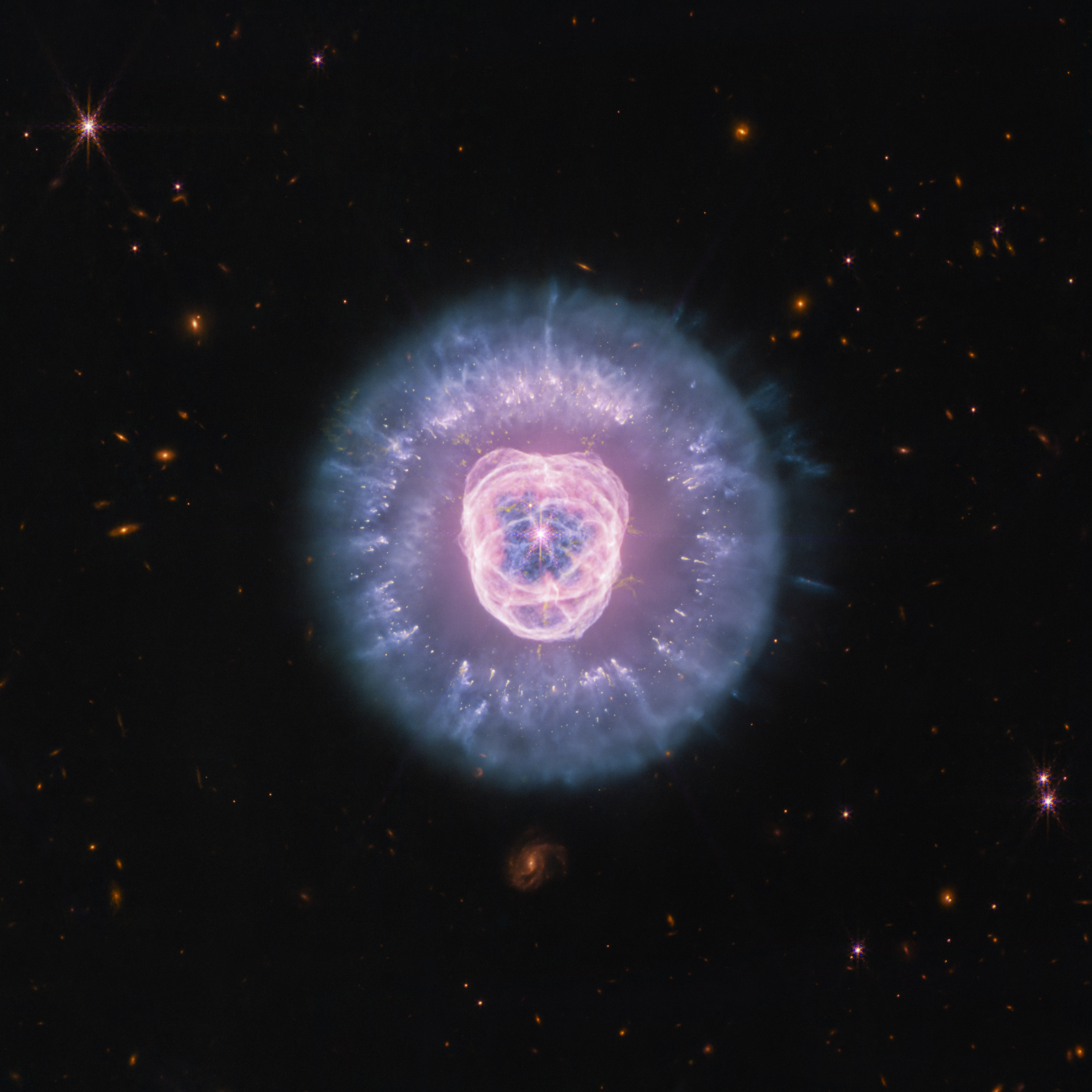
Observing across the starry “plains” of space, NASA’s James Webb Space Telescope has taken new images of NGC 2392, nicknamed the Lion Nebula. The nebula’s “mane” is clear and detailed in this image released on Aug. 10, 2026, due to Webb’s high-resolution imaging.
See more images of the Lion Nebula from Webb.
Image: NASA, ESA, CSA, STScI; Image Processing: Alyssa Pagan (STScI)
Lion Nebula Roars in Webb’s Sights
Observing across the starry “plains” of space, NASA’s James Webb Space Telescope has taken new images of NGC 2392, nicknamed the Lion Nebula. The nebula’s “mane” is clear and detailed in this image released on Aug. 10, 2026, due to Webb’s high-resolution imaging.
See more images of the Lion Nebula from Webb.
Image: NASA, ESA, CSA, STScI; Image Processing: Alyssa Pagan (STScI)
National Academy of Sciences pulls climate chapter from judges’ manual
President Donald Trump and other Republican officials had criticized this chapter as biased against fossil fuel companies
The ESCAPE Mission Will Study the Evolution of Exoplanet Atmospheres
Exoplanets need to be habitable for a long time for complex life to develop. To sustain habitability, exoplanets need to retain their atmospheres. But many exoplanets are exposed to extreme ultraviolet light and coronal mass ejections that can strip atmospheres away. A new mission aims to understand these processes and help exoplanet scientists identify exoplanets that can stay habitable for meaningful lengths of time.
Percy Sees An 'Eclipse' of Earth, From Mars
Sure. It may not look like much. But sometimes, the 'wow' factor in an image lies in knowing just what you're seeing. While most of us are eagerly awaiting Wednesday’s total solar eclipse across the North Atlantic and Spain, robotic emissaries on the Martian surface have recently given us a look at an astronomical occlusion of a different sort, as Phobos crossed in front of Earth.
NASA Telescopes Create Colorful ‘Craft’ From Nearby Nebula
Like a collage made of layered sheets of colored cellophane, a vibrant new image layers observations of a famous star-forming nebula from NASA space telescopes. The resulting cosmic “craft” reveals new details about the star formation region known as 30 Doradus, or the Tarantula Nebula.
Located in the Large Magellanic Cloud, a small neighbor galaxy to the Milky Way about 160,000 light-years from Earth, the Tarantula has thousands of young stars embedded in a vibrant honeycomb-like structure of gas and dust.
X-ray: NASA/CXC/Ohio State Univ./J. Rodriguez et al; Infrared: NASA/ESA/CSA/STScI; Optical: NASA/ESA/STScI; Image Processing: NASA/CXC/SAO/P. Edmonds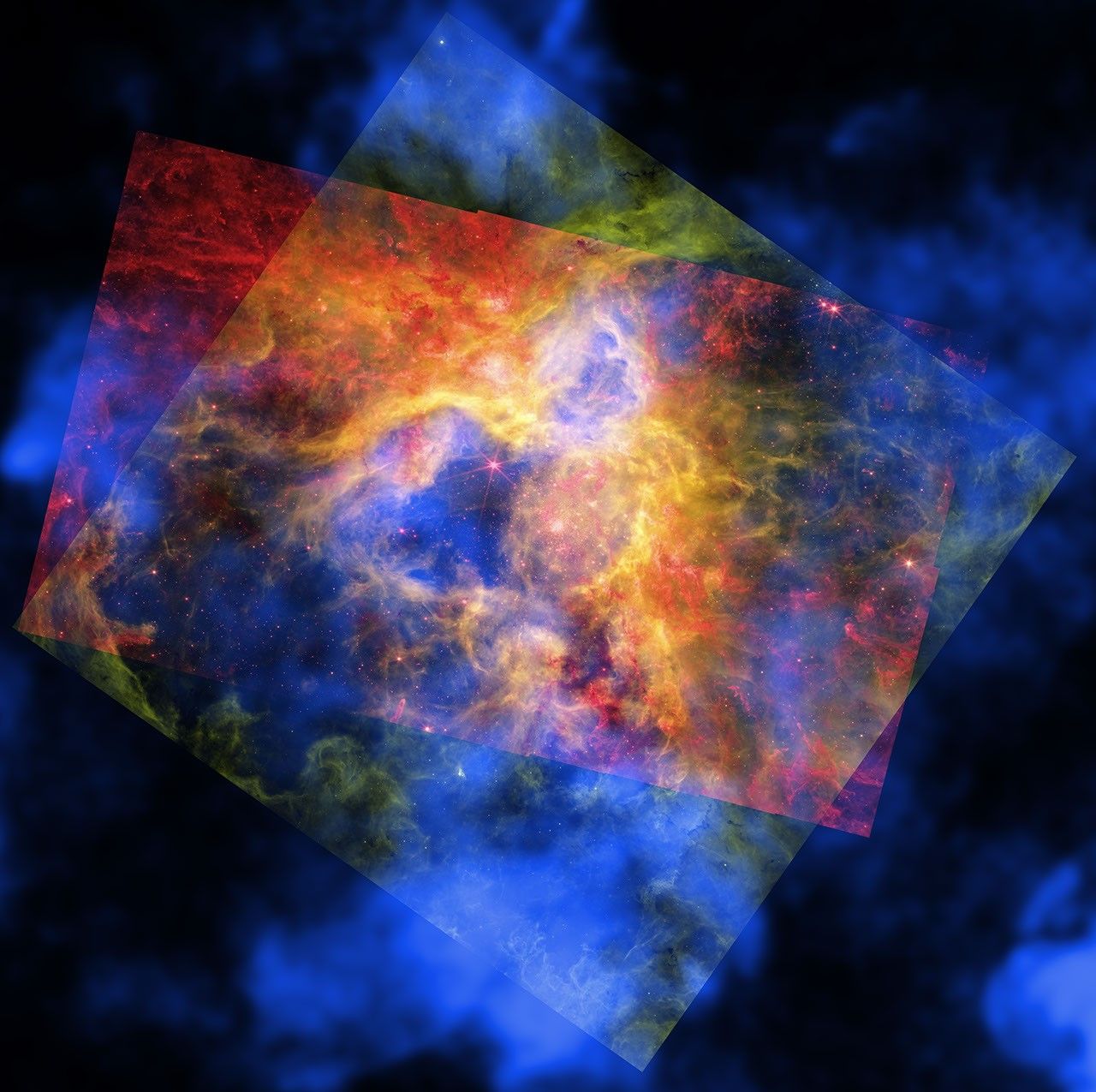
Like a collage made of layered sheets of colored cellophane, a vibrant new image layers observations of a famous star-forming nebula from NASA space telescopes. The resulting cosmic “craft” reveals new details about the star formation region known as 30 Doradus, or the Tarantula Nebula.
Located in the Large Magellanic Cloud, a small neighbor galaxy to the Milky Way about 160,000 light-years from Earth, the Tarantula has thousands of young stars embedded in a vibrant honeycomb-like structure of gas and dust.
The new composite image contains X-rays from NASA’s Chandra X-ray Observatory, which has repeatedly observed the Tarantula Nebula over the course of its mission, in the layer that appears in blue. The X-ray data reveals gas blown away by winds from the surfaces of young, massive stars and heated to millions of degrees by shock waves, like sonic booms from supersonic jets.
The red represents infrared data from NASA’s James Webb Space Telescope showing thousands of young stars, plus swaths of cool dust that will provide the ingredients to form new stars and planets. Optical data in the green layer from NASA’s Hubble Space Telescope uncovers hydrogen gas that is warmer than seen with Webb, as well as some individual stars through the nebula.
The composite image shows the full Hubble and Webb images of this region, as well as a large section of the Chandra image, all recently published in a research paper in the Astrophysical Journal. In some regions the blue Chandra layer stands alone, and in others it combines with either the red Webb data or the green Hubble data. In the middle region all three images overlap to provide a holistic view in red, orange, yellow, green, and blue.
Previously, astronomers had studied the amount and the impact of energy produced by winds from young, massive stars in the Tarantula Nebula. Scientists expect that much of this energy should heat gas so that it produces X-rays. However, the research paper shows that there is much less X-ray-emitting gas in the nebula than expected. This led researchers to ask: Where has this energy gone and what tamed the Tarantula Nebula?
By studying the data from Chandra, Hubble, and Webb, combined with data from NASA’s retired Spitzer Space Telescope, the team concluded the Tarantula may be losing energy from several sources.
First, up to half of the hot gas is leaking through the shell walls of the gas and dust structures and escaping the nebula. Next, there is stirring and mixing between the cold gas near the shell walls and some of the hot gas, lowering the overall temperature of the gas. Finally, comparisons with computer simulations suggest the Tarantula may be losing energy through conduction. This involves direct physical contact between hot and cooler material, like with a frying pan on a burner, causing the hot and cooler material to equalize in temperature. In the case of the Tarantula Nebula, the hot gas would be conducting heat by being in direct contact with the cooler gas in the shells, especially in the densest regions. This scenario does not necessarily involve mixing the hot and cooler gas.
The combination of these three channels for losing large amounts of energy leads to this colorful and complex display revealed by NASA’s telescopes working together.
Tarantula Nebula / 30 Doradus, cropped version. X-ray: NASA/CXC/Ohio State Univ./J. Rodriguez et al; Infrared: NASA/ESA/CSA/STScI; Optical: NASA/ESA/STScI; Image Processing: NASA/CXC/SAO/P. Edmonds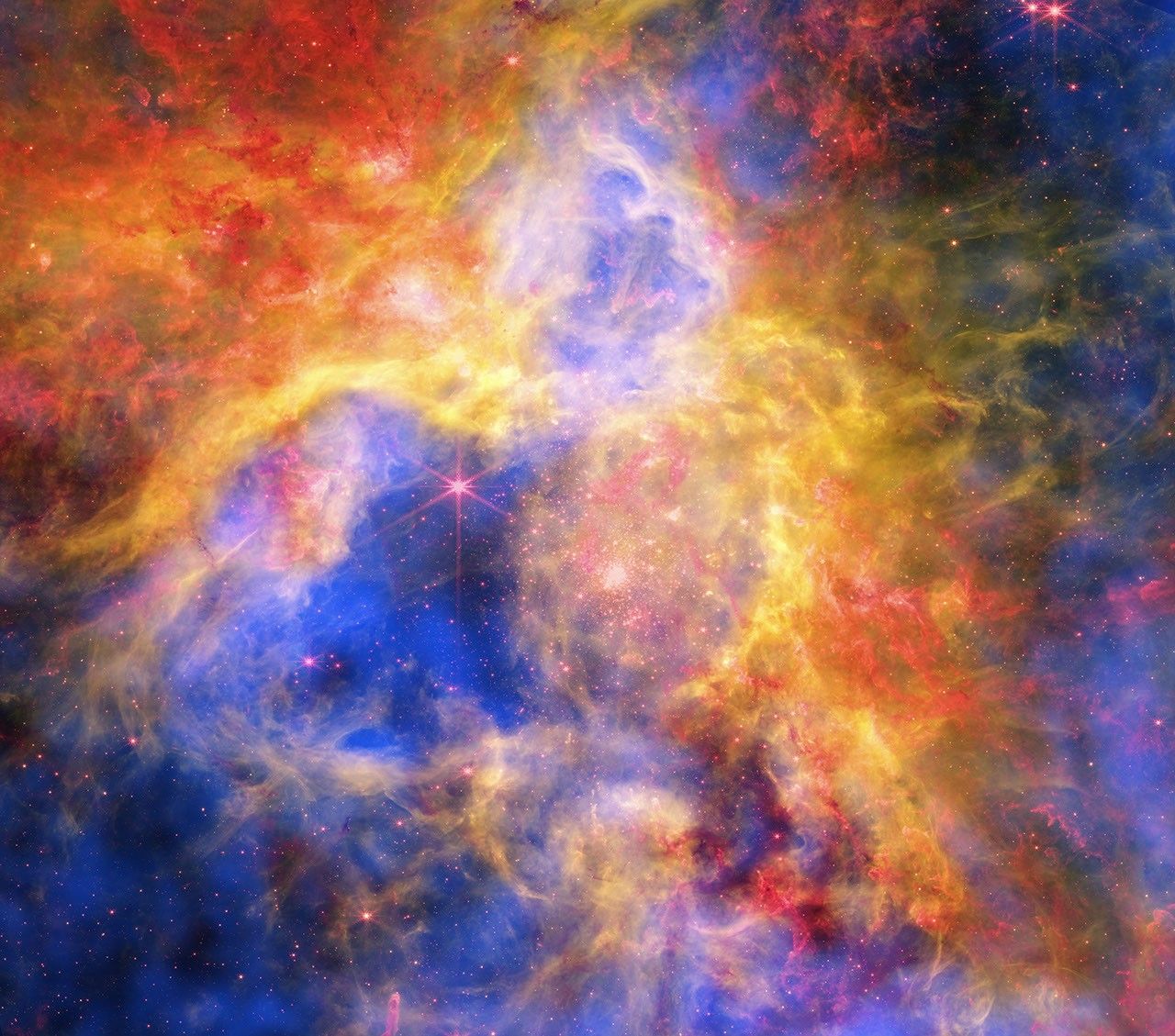
The paper describing these results was led by Jennifer Rodriguez of The Ohio State University in Columbus. Additional authors on the paper include Laura Lopez, Ohio State; Lachlan Lancaster, Columbia University in New York City; Anna Rosen, San Diego State University; Omnaraynai Nayak, Space Telescope Science Institute in Baltimore; Sebastian Lopez, Ohio State; Tyler Holland-Ashford, NASA’s Goddard Space Flight Center in Greenbelt, Maryland; and Trinity Webb, Ohio State.
NASA’s Marshall Space Flight Center in Huntsville, Alabama, manages the Chandra program. The Smithsonian Astrophysical Observatory’s Chandra X-ray Center controls science operations from Cambridge, Massachusetts, and flight operations from Burlington, Massachusetts.
To learn more about Chandra, visit:
About the Author Megan WatzkeShare
Details Last Updated Aug 12, 2026 Editor Lee Mohon Contact Megan Watzke Joel Wallace joel.w.wallace@nasa.gov Location Marshall Space Flight Center Related Terms Explore More 4 min read NASA Space Telescope Maps Magnetic Fields of ‘Lighthouse’ PulsarArticle
1 month ago
5 min read NASA’s Chandra Examines Milky Way at Arms’ Length
Article
1 month ago
5 min read NASA’s Chandra Discovers Possible Supernova Remnant in Galactic Center
Article
2 months ago
Keep Exploring Discover More Topics From NASA Chandra X-ray Observatory
The Chandra X-ray Observatory is the world’s most powerful X-ray telescope.
Hubble Space Telescope
Since its 1990 launch, the Hubble Space Telescope has changed our fundamental understanding of the universe.
James Webb Space Telescope
Webb is the premier observatory of the next decade, serving thousands of astronomers worldwide. It studies every phase in the…
Universe
NASA Telescopes Create Colorful ‘Craft’ From Nearby Nebula
Like a collage made of layered sheets of colored cellophane, a vibrant new image layers observations of a famous star-forming nebula from NASA space telescopes. The resulting cosmic “craft” reveals new details about the star formation region known as 30 Doradus, or the Tarantula Nebula.
Located in the Large Magellanic Cloud, a small neighbor galaxy to the Milky Way about 160,000 light-years from Earth, the Tarantula has thousands of young stars embedded in a vibrant honeycomb-like structure of gas and dust.
X-ray: NASA/CXC/Ohio State Univ./J. Rodriguez et al; Infrared: NASA/ESA/CSA/STScI; Optical: NASA/ESA/STScI; Image Processing: NASA/CXC/SAO/P. EdmondsLike a collage made of layered sheets of colored cellophane, a vibrant new image layers observations of a famous star-forming nebula from NASA space telescopes. The resulting cosmic “craft” reveals new details about the star formation region known as 30 Doradus, or the Tarantula Nebula.
Located in the Large Magellanic Cloud, a small neighbor galaxy to the Milky Way about 160,000 light-years from Earth, the Tarantula has thousands of young stars embedded in a vibrant honeycomb-like structure of gas and dust.
The new composite image contains X-rays from NASA’s Chandra X-ray Observatory, which has repeatedly observed the Tarantula Nebula over the course of its mission, in the layer that appears in blue. The X-ray data reveals gas blown away by winds from the surfaces of young, massive stars and heated to millions of degrees by shock waves, like sonic booms from supersonic jets.
The red represents infrared data from NASA’s James Webb Space Telescope showing thousands of young stars, plus swaths of cool dust that will provide the ingredients to form new stars and planets. Optical data in the green layer from NASA’s Hubble Space Telescope uncovers hydrogen gas that is warmer than seen with Webb, as well as some individual stars through the nebula.
The composite image shows the full Hubble and Webb images of this region, as well as a large section of the Chandra image, all recently published in a research paper in the Astrophysical Journal. In some regions the blue Chandra layer stands alone, and in others it combines with either the red Webb data or the green Hubble data. In the middle region all three images overlap to provide a holistic view in red, orange, yellow, green, and blue.
Previously, astronomers had studied the amount and the impact of energy produced by winds from young, massive stars in the Tarantula Nebula. Scientists expect that much of this energy should heat gas so that it produces X-rays. However, the research paper shows that there is much less X-ray-emitting gas in the nebula than expected. This led researchers to ask: Where has this energy gone and what tamed the Tarantula Nebula?
By studying the data from Chandra, Hubble, and Webb, combined with data from NASA’s retired Spitzer Space Telescope, the team concluded the Tarantula may be losing energy from several sources.
First, up to half of the hot gas is leaking through the shell walls of the gas and dust structures and escaping the nebula. Next, there is stirring and mixing between the cold gas near the shell walls and some of the hot gas, lowering the overall temperature of the gas. Finally, comparisons with computer simulations suggest the Tarantula may be losing energy through conduction. This involves direct physical contact between hot and cooler material, like with a frying pan on a burner, causing the hot and cooler material to equalize in temperature. In the case of the Tarantula Nebula, the hot gas would be conducting heat by being in direct contact with the cooler gas in the shells, especially in the densest regions. This scenario does not necessarily involve mixing the hot and cooler gas.
The combination of these three channels for losing large amounts of energy leads to this colorful and complex display revealed by NASA’s telescopes working together.
Tarantula Nebula / 30 Doradus, cropped version. X-ray: NASA/CXC/Ohio State Univ./J. Rodriguez et al; Infrared: NASA/ESA/CSA/STScI; Optical: NASA/ESA/STScI; Image Processing: NASA/CXC/SAO/P. EdmondsThe paper describing these results was led by Jennifer Rodriguez of The Ohio State University in Columbus. Additional authors on the paper include Laura Lopez, Ohio State; Lachlan Lancaster, Columbia University in New York City; Anna Rosen, San Diego State University; Omnaraynai Nayak, Space Telescope Science Institute in Baltimore; Sebastian Lopez, Ohio State; Tyler Holland-Ashford, NASA’s Goddard Space Flight Center in Greenbelt, Maryland; and Trinity Webb, Ohio State.
NASA’s Marshall Space Flight Center in Huntsville, Alabama, manages the Chandra program. The Smithsonian Astrophysical Observatory’s Chandra X-ray Center controls science operations from Cambridge, Massachusetts, and flight operations from Burlington, Massachusetts.
To learn more about Chandra, visit:
About the Author Megan WatzkeShare
Details Last Updated Aug 11, 2026 Editor Lee Mohon Contact Megan Watzke Joel Wallace Location Marshall Space Flight Center Related Terms Explore More 4 min read NASA Space Telescope Maps Magnetic Fields of ‘Lighthouse’ PulsarArticle
1 month ago
5 min read NASA’s Chandra Examines Milky Way at Arms’ Length
Article
1 month ago
5 min read NASA’s Chandra Discovers Possible Supernova Remnant in Galactic Center
Article
2 months ago
Keep Exploring Discover More Topics From NASA Chandra X-ray Observatory
The Chandra X-ray Observatory is the world’s most powerful X-ray telescope.
Hubble Space Telescope
Since its 1990 launch, the Hubble Space Telescope has changed our fundamental understanding of the universe.
James Webb Space Telescope
Webb is the premier observatory of the next decade, serving thousands of astronomers worldwide. It studies every phase in the…
Universe
Robots Could Build Massive Metamaterial Radars in Orbit
Tracking the debris orbiting at high velocity in space is only going to get harder over time. We have ground-based radar systems, such as the Space Fence, designed to detect pieces down to around 10 cm. But finding objects smaller than that, which can still cause a lot of damage traveling at 17,000 miles per hour, requires completely new thinking. One potential solution is a new idea from Dr. David Smith of Duke University, who was recently funded for a NASA Innovative Advanced Concepts (NIAC) Phase I grant to build robotically assembled electromagnetic metamaterials for long-range space situational awareness.
107 years ago, the Eddington total eclipse experiment helped prove Einstein’s theory of relativity
The Eddington experiment used a solar eclipse to prove Albert Einstein’s general theory of relativity