
_0.thumbnail.jpg "Image (3).jpg")
Feed aggregator
Radiation-shielding vest aced Artemis I lunar test, could protect astronauts on moon and Mars missions
A radiation-shielding vest might one day protect astronauts from dangerous, random outbursts from the sun, a new study finds.
More than 50 years after the final Apollo mission, NASA's Artemis program aims to return humans to the moon. To succeed, this project must protect astronauts from solar radiation, especially the intense and unpredictable radiation from solar storms. Coating an entire spacecraft with a meaningfully thick layer of radiation shielding remains impractical due to weight constraints, but wrapping astronauts in protective garments may potentially be helpful.
In the new study, researchers experimented with the AstroRad vest, which was designed by the Israeli startup StemRad with support from the Israel Space Agency and aerospace giant Lockheed Martin. The garment was created to protect astronauts from explosions from the sun known as solar particle events.
The "phantoms" Helga and Zohar inside the Orion spacecraft at NASA's Vehicle Assembly Building prior to the launch of Artemis I. Zohar, right, wore the AstroRad vest while Helga did not. (Image credit: NASA/Lockheed Martin/DLR)"Radiation in space is unavoidable, and a single major solar particle event can make a substantial contribution to an astronaut's lifetime risk of radiation-induced cancer," study co-author Oren Milstein, CEO and co-founder of StemRad, told Space.com. "By significantly reducing that contribution, personal shielding could be particularly important for future lunar and Mars missions."
When it comes to protection against radiation, lead is excellent at blocking hazardous forms of light, such as X-rays and gamma rays. However, lead is much less effective at defending against the kinds of dangerous particles that can hurtle through space. For instance, when fast high-energy electrons known as beta particles strike dense lead atoms, they can trigger a shower of X-rays that are more harmful than the beta particles themselves. And if neutrons strike lead atoms, they can knock loose a spray of neutrons from the atoms' nuclei, worsening the impact from the radiation.
Instead, AstroRad relies on a high-density plastic rich in hydrogen. Among the elements, hydrogen possesses the highest density of electrons per atom, which can help create a dense shield to protect against incoming particles. At the same time, hydrogen atoms normally do not have neutrons, so if neutrons hit them, they cannot generate the kind of dangerous neutron sprays that can happen with lead atoms.
Moreover, the plastic in AstroRad is much lighter than lead. This makes it easier to move around in garments incorporating the plastic, and more practical for space missions in which weight is a major limitation.
The scientists combined thousands of hexagonal rods of the rigid plastic together like scales to create a flexible garment. All in all, each vest weighed about 57 pounds (26 kilograms).
The scientists developed a vest rather than a full-body suit or a helmet because "different organs and tissues have very different sensitivities to radiation, so shielding every part of the body equally is not the most effective approach," study co-author Jordan Houri, lead scientist for space exploration at StemRad, told Space.com. "At the same time, a full-body suit would be much harder to put on and move around in."
The shielding thickness of the AstroRad vest was based on how sensitive to radiation the underlying organs were. This strategy provides about a 30% greater reduction in the dose of radiation a person receives compared with distributing the same amount of shielding uniformly across the body, Houri said.
The researchers tested their vest during NASA's uncrewed Artemis I moon mission in late 2022 using a pair of extraordinarily complex dummies called phantoms. These artificial torsos were constructed of plastics that mimicked the density of human tissue, bone and organs, and each was equipped with more than 5,600 radiation sensors on and in them.
The two phantoms were designed to be adult females, since previous research found that breasts and ovaries are especially susceptible to radiation damage.
"Women are predicted to face a higher risk of radiation-induced cancer," Milstein said. "Targeted shielding could help narrow that difference in risk between male and female astronauts."
Since the phantoms mimicked women, they were given women's names, Zohar and Helga. "Helga was contributed to the experiment by the German Aerospace Center, and Helga is a traditional German name," Milstein said. "Zohar was contributed by the Israel Space Agency, which selected the name through a public outreach campaign. Zohar is a traditional Hebrew name meaning 'radiance,' which we thought was particularly fitting."
Assembling the Zohar phantom with the AstroRad vest at Kennedy Space Center prior to launch of Artemis I. (Image credit: NASA/DLR)Zohar and Helga flew seated in NASA's Orion spacecraft; Zohar was equipped with an AstroRad vest, while Helga was not. Although Orion did not encounter a significant solar outburst during its 26-day mission to lunar orbit and back, the researchers were able to extrapolate how much solar radiation astronauts might experience based on what the phantoms encountered passing through the inner Van Allen belt of radiation surrounding Earth.
When the scientists analyzed past solar particle events, they found the AstroRad vest would have significantly reduced the dose of radiation a person during those outbursts — for instance, by nearly 60% for a solar particle event that happened in August 1972.
"We had originally anticipated something closer to 45%, so when we first saw the result, we thought we needed to go back and find an error," Houri said. "Instead, the detailed analysis showed that AstroRad's approach of providing targeted shielding to the most radiation-sensitive organs and tissues was even more effective than we had projected."
Such a reduction could spare astronauts the equivalent of up to 193 days of deep-space radiation exposure. "The most important implication is that AstroRad could help overcome one of the major health challenges limiting long-duration human exploration beyond Earth," Milstein said.
3D rendering of the Matroshka AstroRad Radiation Experiment (MARE) during NASA’s Artemis I mission, showing the two radiation dosimetry phantoms, Helga and Zohar inside the Orion spacecraft. (Image credit: NASA/Lockheed Martin/DLR/StemRad)AstroRad is not something astronauts would wear continuously throughout an entire mission, Houri said. "AstroRad was developed as an emergency countermeasure for solar particle events, so astronauts would only wear it when radiation levels are elevated, typically for periods of hours or days," he explained.
Still, "although it is not something astronauts would need to wear throughout an entire mission, we designed the vest to remain usable for many hours at a time," Milstein said. During tests with the vests on the International Space Station, "several crew members even slept with it on."
The level of radiation protection the AstroRad vest provided was similar to that supplied by the Orion spacecraft's onboard storm shelter, "while allowing the astronaut wearing it to leave the shelter and continue mission-critical tasks," Houri said. "AstroRad can be used on its own or together with a shelter, but one of its main advantages is that an astronaut can remain protected while moving around the cabin and carrying out essential mission operations rather than remaining inside the shelter."
The scientists are now investigating whether it is possible to manufacture radiation shielding in space using onboard materials. For instance, in collaboration with Florida aerospace company Redwire, "we have already demonstrated that it is possible to 3D-print AstroRad components from recycled polyethylene aboard the International Space Station," Milstein said.
The scientists detailed their findings online today (Aug. 12) in the journal Science Advances.
NASA Upgrades Vertical Motion Simulator for Modern Mission Needs
2 min read
Preparations for Next Moonwalk Simulations Underway (and Underwater) The Vertical Motion Simulator at NASA’s Ames Research Center in California’s Silicon Valley is capable of vertical and horizontal motion to simulate a range of flight experiences, such as lunar landers, helicopters, and commercial aircraft.NASA/Jesse CarpenterImagine stepping into a machine that can make you feel like you’re flying a spacecraft, piloting a next generation air taxi, or landing on the Moon, all without leaving the ground. NASA’s Vertical Motion Simulator, the largest of its kind in the world, does exactly that. And now, with new upgrades, it’s more powerful and realistic than before.
The Vertical Motion Simulator, located at NASA’s Ames Research Center in California’s Silicon Valley, has shaped the future of aviation and spaceflight since 1979. It allows pilots and researchers to experience realistic aircraft motion due to its ability to travel 60 feet vertically and 40 feet horizontally, simulating vehicles ranging from helicopters to spacecraft with high accuracy.
New improvements are making the simulator even more powerful. One of the biggest changes is the switch from analog systems to modern digital technology. This upgrade includes a dome surrounding the simulator’s cockpit with advanced 4K projectors that create visuals with nearly 20/20 clarity, giving pilots clearer, sharper images and a larger field of view of the world outside the cockpit.
The upgraded cab of the Vertical Motion Simulator at NASA’s Ames Research Center in California’s Silicon Valley provides researchers with near-20/20 visual clarity, providing clearer, sharper images.NASA/Brandon Torres-Navarrete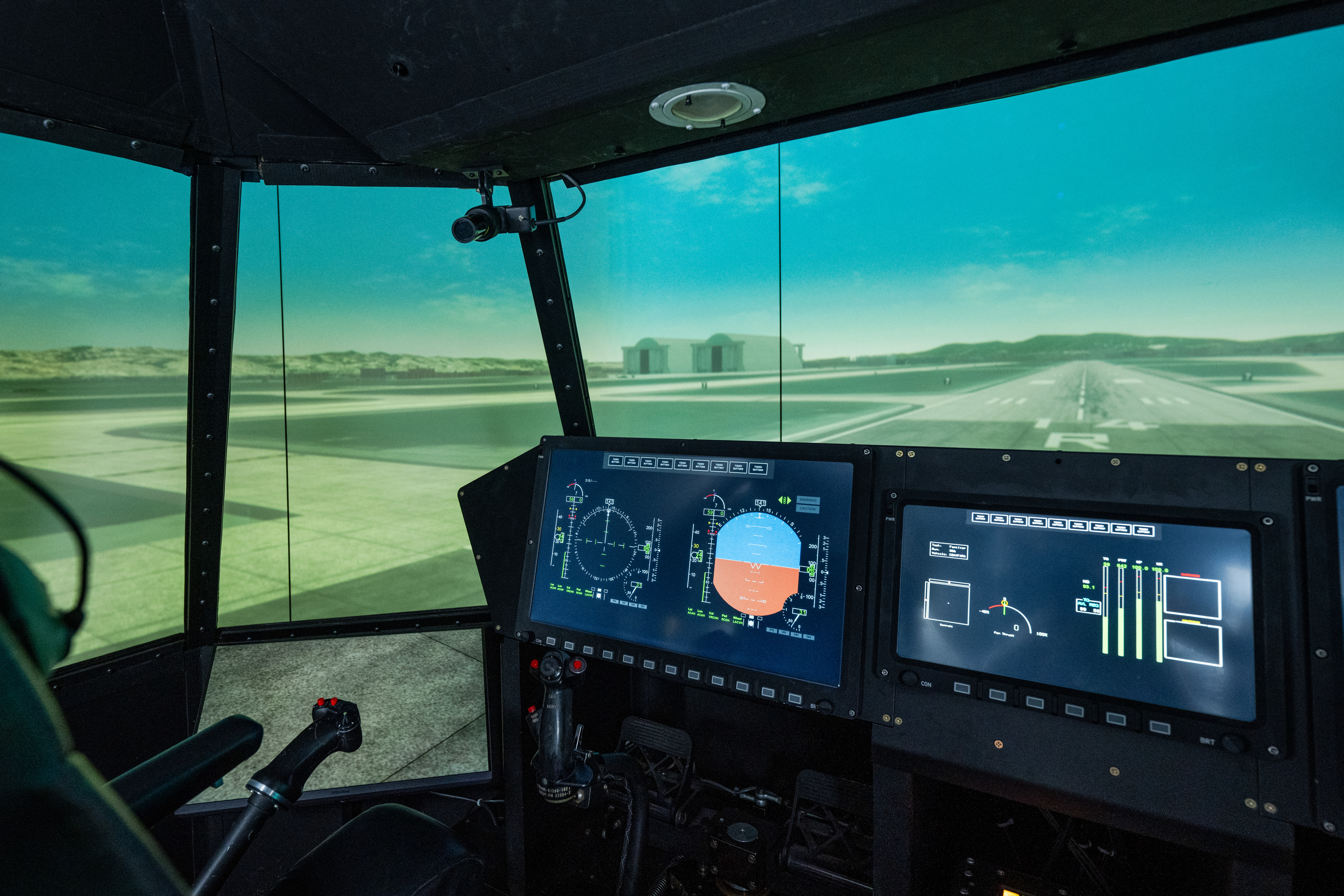
“The new dome configuration and improved systems can support far more aggressive mission tasks while giving pilots and crews a more realistic environment to work in,” said Diana Acosta, aerospace simulation research and development branch chief at NASA Ames. “It strengthens how teams coordinate, react, and manage challenging scenarios, exactly the kind of preparation we need for the missions coming next.”
The system also can automatically line up and color‑match images to integrate them into a simulated background, a process that used to take hours, or even days, to do by hand.
In the past, changing simulation configurations from lunar lander to air taxi required swapping out the cab, a large, heavy structure that was time‑consuming and complex to move. Instead of replacing an entire cab, teams can use lighter, removable inserts that include only the controls, seats, and panels needed to stand in for a specific vehicle. The inserts drastically reduce physical labor and cut the time needed to configure a simulation in half.
The upgrades to the Vertical Motion Simulator will enable tests of next-generation aircraft and spacecraft before they ever leave the ground, bringing us closer to safer skies, more efficient air travel, and successful human landings on the Moon and Mars.
Share Details Last Updated Aug 12, 2026 Related Terms Explore More 4 min read Building the Moon Base: NASA Stories at the Ion Article 2 days ago 3 min read NASA’s Lunar Development and Test Facility Prepares Artemis Hardware for Moon Article 6 days ago 2 min read Ames Science Stars of the Month – August 2026 Article 1 week ago Keep Exploring Discover More Topics From NASAAmes Research Center
Aeronautics at Ames
Vertical Motion Simulator
Aeronautics Research Mission Directorate
NASA Upgrades Vertical Motion Simulator for Modern Mission Needs
2 min read
Preparations for Next Moonwalk Simulations Underway (and Underwater) The Vertical Motion Simulator at NASA’s Ames Research Center in California’s Silicon Valley is capable of vertical and horizontal motion to simulate a range of flight experiences, such as lunar landers, helicopters, and commercial aircraft.NASA/Jesse CarpenterImagine stepping into a machine that can make you feel like you’re flying a spacecraft, piloting a next generation air taxi, or landing on the Moon, all without leaving the ground. NASA’s Vertical Motion Simulator, the largest of its kind in the world, does exactly that. And now, with new upgrades, it’s more powerful and realistic than before.
The Vertical Motion Simulator, located at NASA’s Ames Research Center in California’s Silicon Valley, has shaped the future of aviation and spaceflight since 1979. It allows pilots and researchers to experience realistic aircraft motion due to its ability to travel 60 feet vertically and 40 feet horizontally, simulating vehicles ranging from helicopters to spacecraft with high accuracy.
New improvements are making the simulator even more powerful. One of the biggest changes is the switch from analog systems to modern digital technology. This upgrade includes a dome surrounding the simulator’s cockpit with advanced 4K projectors that create visuals with nearly 20/20 clarity, giving pilots clearer, sharper images and a larger field of view of the world outside the cockpit.
The upgraded cab of the Vertical Motion Simulator at NASA’s Ames Research Center in California’s Silicon Valley provides researchers with near-20/20 visual clarity, providing clearer, sharper images.NASA/Brandon Torres-Navarrete“The new dome configuration and improved systems can support far more aggressive mission tasks while giving pilots and crews a more realistic environment to work in,” said Diana Acosta, aerospace simulation research and development branch chief at NASA Ames. “It strengthens how teams coordinate, react, and manage challenging scenarios, exactly the kind of preparation we need for the missions coming next.”
The system also can automatically line up and color‑match images to integrate them into a simulated background, a process that used to take hours, or even days, to do by hand.
In the past, changing simulation configurations from lunar lander to air taxi required swapping out the cab, a large, heavy structure that was time‑consuming and complex to move. Instead of replacing an entire cab, teams can use lighter, removable inserts that include only the controls, seats, and panels needed to stand in for a specific vehicle. The inserts drastically reduce physical labor and cut the time needed to configure a simulation in half.
The upgrades to the Vertical Motion Simulator will enable tests of next-generation aircraft and spacecraft before they ever leave the ground, bringing us closer to safer skies, more efficient air travel, and successful human landings on the Moon and Mars.
Share Details Last Updated Aug 12, 2026 Related Terms Explore More 4 min read Building the Moon Base: NASA Stories at the Ion Article 2 days ago 3 min read NASA’s Lunar Development and Test Facility Prepares Artemis Hardware for Moon Article 7 days ago 2 min read Ames Science Stars of the Month – August 2026 Article 1 week ago Keep Exploring Discover More Topics From NASAAmes Research Center
Aeronautics at Ames
Vertical Motion Simulator
Aeronautics Research Mission Directorate
See hundreds of stingrays swarming off the coast of New York
A “fever” of cownose rays revealed by striking drone footage could be a sign of warming oceans
NASA Astronaut Mike Fincke Leaves NASA, Career Includes 4 Spaceflights
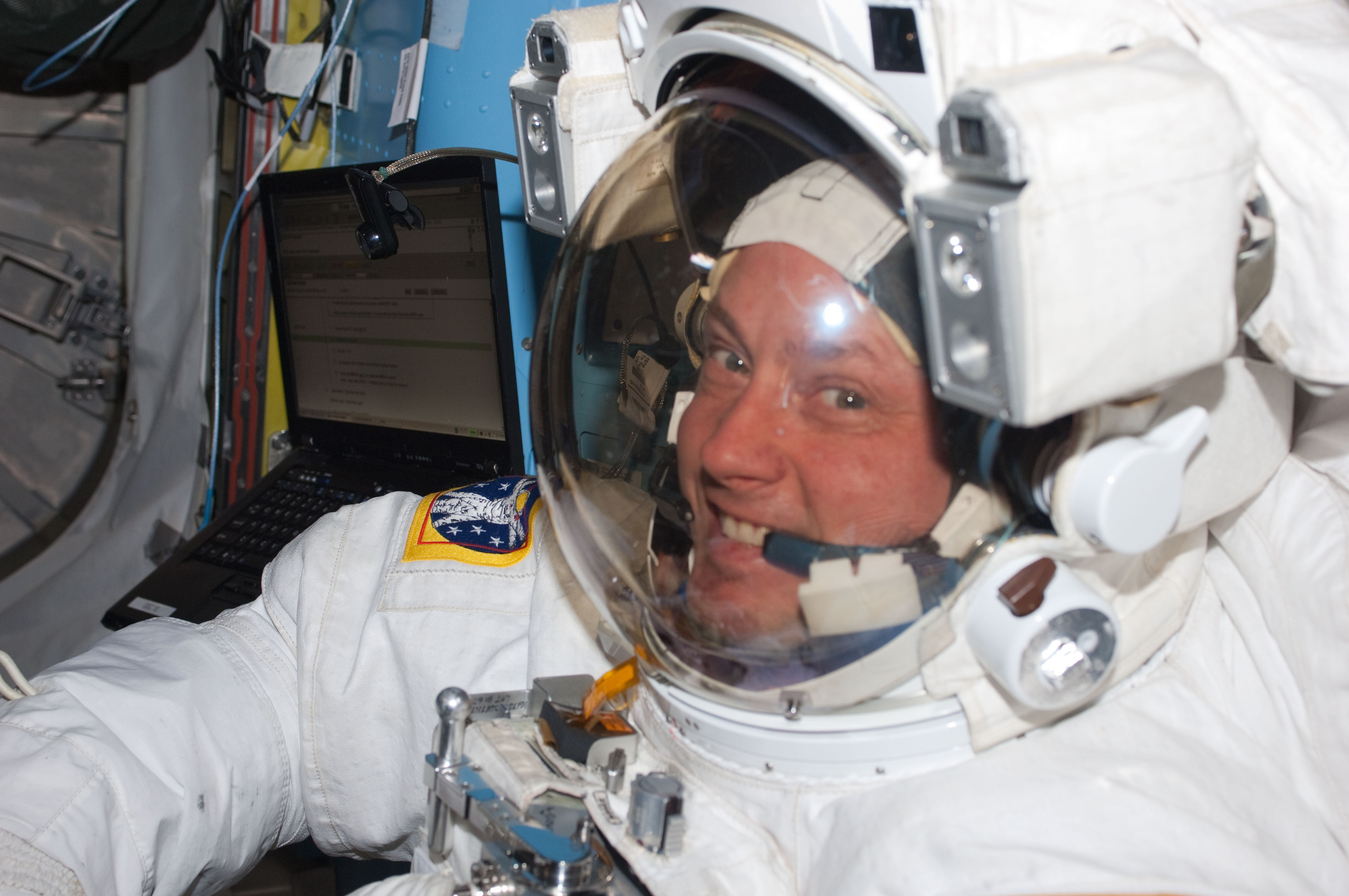
NASA astronaut Mike Fincke is departing the agency on Wednesday after 30 years of service. Throughout his career, he flew four missions, spent 549 days in space, and completed nine spacewalks in support of the International Space Station.
“Few people have had the opportunity to shape as many chapters of NASA’s history as Mike Fincke,” said NASA Administrator Jared Isaacman. “Over a remarkable career, Mike served our nation as a pilot, engineer, astronaut, and mentor. From long-duration missions aboard the International Space Station to helping prepare the Artemis generation, his contributions have helped position NASA for what comes next. The success we’re building on today is possible because of people like Mike, who dedicated their careers to moving our space program forward and preparing the next generation to carry the mission even further. I’d like to congratulate Mike on an incredible career and thank him for his decades of service to NASA, our nation, and the countless people who had the opportunity to learn from and fly alongside him.”
He ranks fourth among NASA astronauts in accumulated time in space, and his spacewalks total 48 hours and 37 minutes. Most recently, Fincke piloted NASA’s SpaceX Crew‑11 mission, which launched in August 2025 and returned in January. During the mission, he served as a flight engineer for International Space Station Expedition 73 and commander of Expedition 74.
Fincke joined NASA’s 16th astronaut class in 1996 and first flew to space in 2004 aboard Soyuz TMA‑4 in support of the space station’s Expedition 9. Serving as a science officer and flight engineer, he helped maintain station systems and performed four spacewalks. He returned to space in 2008 on Soyuz TMA‑13 as commander of Expedition 18, preparing the space station for its transition to six‑person crews at the time and completing two more spacewalks.
In 2011, Fincke flew on STS‑134, the final flight of space shuttle Endeavour. As mission specialist and robotic arm operator, he completed three spacewalks and helped deliver and install the Alpha Magnetic Spectrometer.
“Mike’s remarkable career reflects three decades of dedication to NASA’s mission and the advancement of human spaceflight,” said Vanessa Wyche, director of NASA’s Johnson Space Center in Houston. “From his time aboard the International Space Station to his commitment to mentoring the next generation, Mike has made an immense impact across our agency. His legacy of service, mentorship, and dedication to exploration will continue to inspire the generations to come.”
Throughout his career, Fincke bridged spacecraft development, flight testing, and mission operations. Early in the International Space Station Program, he helped test and integrate several of the station’s initial modules before launch. His flight experience spanned multiple generations of human spacecraft, including two missions aboard Soyuz, one aboard the space shuttle, and later piloting the SpaceX Dragon.
Fincke was a foundational contributor to NASA’s Commercial Crew Program. As chief of the Astronaut Office’s Commercial Crew Branch, he worked to ensure astronaut needs, crew safety, and human spaceflight experience informed development of the nation’s next generation of crewed spacecraft. He spent five years supporting Boeing’s Crew Flight Test program training as a crew member and backup pilot, contributing to flight software, systems integration, integrated testing, and spacecraft interfaces.
Fincke also supported station operations from the ground as a crew test support team member in Russia, a capsule communicator, or capcom, and crew procedures team lead. He helped translate complex engineering and operational requirements into clear instructions for crews working in orbit. His continuity across development, integration, mission support, and long‑duration flight gave him an end‑to‑end perspective on space station assembly and operation.
“Mike approached every assignment with experience, humility, and an unwavering focus on the mission,” said Scott Tingle, chief of the Astronaut Office at NASA Johnson. “Whether flying aboard the station, supporting crews from the ground, or helping shape the spacecraft that future crews will rely on, he consistently strengthened our team. His legacy is woven into the way we fly today.”
A native of Emsworth, Pennsylvania, Fincke holds bachelor’s degrees in aeronautics and astronautics and in Earth, atmospheric, and planetary sciences from the Massachusetts Institute of Technology, where he also studied in the Soviet Union through an exchange program with the Moscow Aviation Institute. He earned master’s degrees in aeronautics and astronautics from Stanford University and in planetary geology from the University of Houston, Clear Lake.
Fincke is a retired U.S. Air Force colonel and distinguished graduate of the U.S. Air Force Test Pilot School. He served as a space systems engineer and flight test engineer at Edwards and Eglin Air Force Bases and later as the U.S. flight test liaison to the Japanese‑U.S. XF‑2 fighter program at Gifu Air Base in Japan. He accumulated more than 2,000 flight hours in more than 30 aircraft types.
“After exactly 30 years, I am departing NASA, but I remain deeply committed to the work of exploration.” Fincke said. “NASA gave me the extraordinary privilege of serving alongside remarkable people, flying and helping develop spacecraft, and contributing to the International Space Station from its earliest days through command in orbit. I am profoundly grateful to my crewmates, the teams on the ground, our international partners, and the families who make this work possible. I am excited to carry those lessons forward and help prepare the next generation of engineers, explorers, and leaders. Together, we will return humanity to the Moon, travel to Mars, journey outward to the planets and moons beyond Earth, and someday reach for the stars – all while caring for Earth, the most beautiful planet in our solar system.”
To learn more about NASA’s astronauts and space exploration, visit:
https://www.nasa.gov/astronauts
-end-
Jimi Russell
Headquarters, Washington
202-358-1100
james.j.russell@nasa.gov
Anna Schneider
Johnson Space Center, Houston
281-483-5111
anna.c.schneider@nasa.gov
NASA Astronaut Mike Fincke Leaves NASA, Career Includes 4 Spaceflights
NASA astronaut Mike Fincke is departing the agency on Wednesday after 30 years of service. Throughout his career, he flew four missions, spent 549 days in space, and completed nine spacewalks in support of the International Space Station.
“Few people have had the opportunity to shape as many chapters of NASA’s history as Mike Fincke,” said NASA Administrator Jared Isaacman. “Over a remarkable career, Mike served our nation as a pilot, engineer, astronaut, and mentor. From long-duration missions aboard the International Space Station to helping prepare the Artemis generation, his contributions have helped position NASA for what comes next. The success we’re building on today is possible because of people like Mike, who dedicated their careers to moving our space program forward and preparing the next generation to carry the mission even further. I’d like to congratulate Mike on an incredible career and thank him for his decades of service to NASA, our nation, and the countless people who had the opportunity to learn from and fly alongside him.”
He ranks fourth among NASA astronauts in accumulated time in space, and his spacewalks total 48 hours and 37 minutes. Most recently, Fincke piloted NASA’s SpaceX Crew‑11 mission, which launched in August 2025 and returned in January. During the mission, he served as a flight engineer for International Space Station Expedition 73 and commander of Expedition 74.
Fincke joined NASA’s 16th astronaut class in 1996 and first flew to space in 2004 aboard Soyuz TMA‑4 in support of the space station’s Expedition 9. Serving as a science officer and flight engineer, he helped maintain station systems and performed four spacewalks. He returned to space in 2008 on Soyuz TMA‑13 as commander of Expedition 18, preparing the space station for its transition to six‑person crews at the time and completing two more spacewalks.
In 2011, Fincke flew on STS‑134, the final flight of space shuttle Endeavour. As mission specialist and robotic arm operator, he completed three spacewalks and helped deliver and install the Alpha Magnetic Spectrometer.
“Mike’s remarkable career reflects three decades of dedication to NASA’s mission and the advancement of human spaceflight,” said Vanessa Wyche, director of NASA’s Johnson Space Center in Houston. “From his time aboard the International Space Station to his commitment to mentoring the next generation, Mike has made an immense impact across our agency. His legacy of service, mentorship, and dedication to exploration will continue to inspire the generations to come.”
Throughout his career, Fincke bridged spacecraft development, flight testing, and mission operations. Early in the International Space Station Program, he helped test and integrate several of the station’s initial modules before launch. His flight experience spanned multiple generations of human spacecraft, including two missions aboard Soyuz, one aboard the space shuttle, and later piloting the SpaceX Dragon.
Fincke was a foundational contributor to NASA’s Commercial Crew Program. As chief of the Astronaut Office’s Commercial Crew Branch, he worked to ensure astronaut needs, crew safety, and human spaceflight experience informed development of the nation’s next generation of crewed spacecraft. He spent five years supporting Boeing’s Crew Flight Test program training as a crew member and backup pilot, contributing to flight software, systems integration, integrated testing, and spacecraft interfaces.
Fincke also supported station operations from the ground as a crew test support team member in Russia, a capsule communicator, or capcom, and crew procedures team lead. He helped translate complex engineering and operational requirements into clear instructions for crews working in orbit. His continuity across development, integration, mission support, and long‑duration flight gave him an end‑to‑end perspective on space station assembly and operation.
“Mike approached every assignment with experience, humility, and an unwavering focus on the mission,” said Scott Tingle, chief of the Astronaut Office at NASA Johnson. “Whether flying aboard the station, supporting crews from the ground, or helping shape the spacecraft that future crews will rely on, he consistently strengthened our team. His legacy is woven into the way we fly today.”
A native of Emsworth, Pennsylvania, Fincke holds bachelor’s degrees in aeronautics and astronautics and in Earth, atmospheric, and planetary sciences from the Massachusetts Institute of Technology, where he also studied in the Soviet Union through an exchange program with the Moscow Aviation Institute. He earned master’s degrees in aeronautics and astronautics from Stanford University and in planetary geology from the University of Houston, Clear Lake.
Fincke is a retired U.S. Air Force colonel and distinguished graduate of the U.S. Air Force Test Pilot School. He served as a space systems engineer and flight test engineer at Edwards and Eglin Air Force Bases and later as the U.S. flight test liaison to the Japanese‑U.S. XF‑2 fighter program at Gifu Air Base in Japan. He accumulated more than 2,000 flight hours in more than 30 aircraft types.
“After exactly 30 years, I am departing NASA, but I remain deeply committed to the work of exploration.” Fincke said. “NASA gave me the extraordinary privilege of serving alongside remarkable people, flying and helping develop spacecraft, and contributing to the International Space Station from its earliest days through command in orbit. I am profoundly grateful to my crewmates, the teams on the ground, our international partners, and the families who make this work possible. I am excited to carry those lessons forward and help prepare the next generation of engineers, explorers, and leaders. Together, we will return humanity to the Moon, travel to Mars, journey outward to the planets and moons beyond Earth, and someday reach for the stars – all while caring for Earth, the most beautiful planet in our solar system.”
To learn more about NASA’s astronauts and space exploration, visit:
https://www.nasa.gov/astronauts
-end-
Jimi Russell
Headquarters, Washington
202-358-1100
james.j.russell@nasa.gov
Anna Schneider
Johnson Space Center, Houston
281-483-5111
anna.c.schneider@nasa.gov
Yale study finds ‘Medicare for All’ could save $1 trillion and 114,000 lives every year
This study has been touted by Senator Bernie Sanders of Vermont as proof of the benefits of a universal, single-payer health care system, but the research hasn’t been peer-reviewed
Pursuing a Dream of Working for NASA
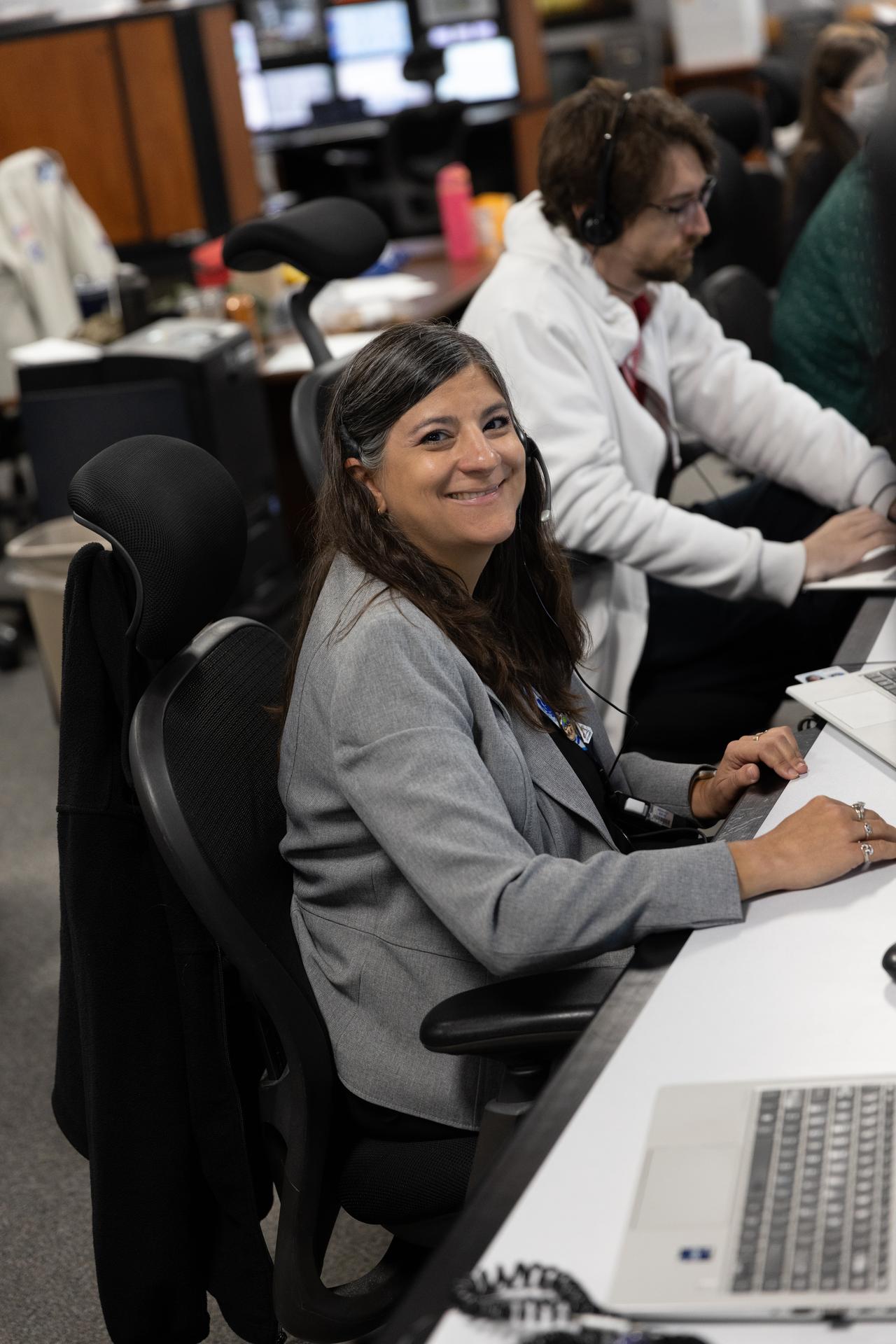
As a young girl raised in Worcester, Massachusetts, Lindsey Waitt dreamed of working for NASA. Her dream is now a reality as she embarks on her role as a NASA test project engineer with the Artemis launch team – an integral part of the agency’s missions that will enable humans to return to the surface of the Moon after launching from NASA’s Kennedy Space Center in Florida.
When she was in middle school in the late 1990’s, Waitt recalls meeting NASA Space Shuttle astronauts Michael Lopez-Alegria and Albert Sacco, Jr., a former professor at the college, during a visit to Worcester Polytechnic Institute (WPI) in Worcester, Massachusetts. She was inspired while listening to them recount their spaceflight experiences including an experiment on conducting research for growing cells on the Moon. She even posed for a picture and got their autographs. Little did young Waitt know, these would not be the only astronauts she would meet.
Lindsey Waitt (far right), poses for a photograph with NASA astronaut Michael Lopez-Alegria and her cousin at Worcester Polytechnic Institute in Massachusetts.Photo credit: NASA/Lindsey Waitt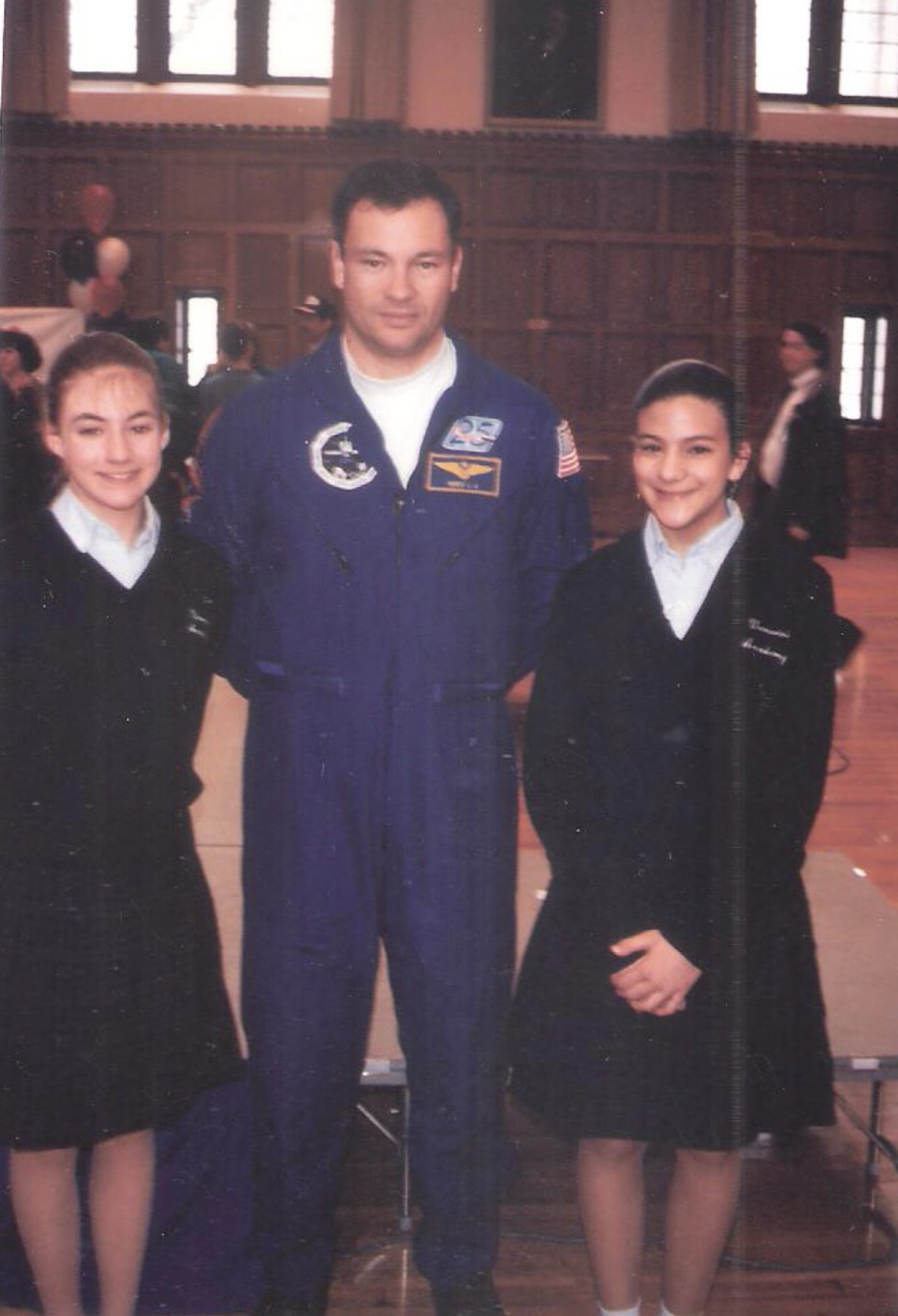
Her passion for learning about all things space and engineering led Waitt back to WPI where she studied engineering, absorbing different disciplines. She received her Bachelor of Science degree in Mechanical Engineering with a concentration in aerospace engineering and she left the school fueled by her passion to be a part of America’s space agency.
After graduation, she worked as a systems engineer on radar flight test missions for a defense contractor, and while excelling in her role, she realized it wasn’t the aerospace engineering field that she desired.
“It was an exciting program, and it was meaningful to be a part of a project focused on protecting the country from enemy attacks. But it wasn’t space,” Waitt said.
As the wife of a now retired sergeant first class officer in the United States Army, Waitt and her family traveled around the world during her husband’s enlistment, and she continued to follow NASA missions from around the globe. While Waitt was dedicated to raising her three young boys, she simultaneously pursued her master’s degree in Space Operations from the University of Colorado in Colorado Springs. Twelve years later, she made the courageous decision to fully return to her first career passion – working for NASA – despite nay-sayers suggesting too much time had passed for her to return to the industry.
The sky is not the limit, it's wide open now. The universe is the limit.Lindsey waitt
Test project engineer
Waitt vividly remembers watching NASA astronauts Doug Hurley and Bob Behnken soar skyward during NASA’s first commercial crew mission to the International Space Station in 2020. Watching alongside her family, she even set up a rocket-shaped tent, and she and her children pretended to blast off from their yard as they cheered excitedly as the astronauts lifted off from what would be her future place of work.
After moving to Florida in 2022 to work at a small satellite company in Cape Canaveral, as a systems engineer and program manager, she continued to search for opportunities to work for the agency. Waitt vividly remembers watching Artemis I with her family. They had just moved to the Sunshine State, and she woke up in the early hours of the morning to watch the historic launch, having no idea she would be working on the next Artemis mission – the first time NASA sent humans around the Moon in over 50 years!
In 2024, Waitt began her career at Kennedy working for a contractor as a test project engineer during the Artemis II launch. As “problem-solvers,” test project engineers are the main hub of experts for technical tests and launch activities and they work to coordinate resolutions across the different subsystems that may arise during the dynamic operations associated with a rocket launch. Leading up to the Artemis II launch in April, Waitt quickly became certified to sit on the launch console during the dynamic pre and post-launch operations for the massive SLS (Space Launch System) rocket and Orion spacecraft and she eagerly watched from outside Kennedy’s Launch Control Center as the four crew members lifted off the launch pad towards the Moon.
When NASA announced its insourcing initiative earlier this year, Waitt seized the opportunity to fully realize her dream. She applied for a position and is now a NASA civil servant supporting the Artemis launch team as a test project engineer for NASA– a core position for the agency’s launch team. With Artemis III in front of her, Lindsey will see the buildup of launch operations from start to finish.
As the only female of the 14 test project engineers who work on the Artemis launch team, Waitt said she was fully embraced by the colleagues she stands beside.
“Everybody’s very open and welcoming,” Waitt said. “I’ve worked on teams before, but it’s never been like this. Everyone is so passionate about the mission, and everybody is working together to get things done quickly, but safely – that’s always first priority. We Are Going.”
This opportunity didn’t happen by chance. Waitt is embracing life’s journey and focused on making her dream come true, one launch at a time. “The sky is not the limit – it’s wide open now,” Waitt said. “The universe is the limit.”
Pursuing a Dream of Working for NASA
As a young girl raised in Worcester, Massachusetts, Lindsey Waitt dreamed of working for NASA. Her dream is now a reality as she embarks on her role as a NASA test project engineer with the Artemis launch team – an integral part of the agency’s missions that will enable humans to return to the surface of the Moon after launching from NASA’s Kennedy Space Center in Florida.
When she was in middle school in the late 1990’s, Waitt recalls meeting NASA Space Shuttle astronauts Michael Lopez-Alegria and Albert Sacco, Jr., a former professor at the college, during a visit to Worcester Polytechnic Institute (WPI) in Worcester, Massachusetts. She was inspired while listening to them recount their spaceflight experiences including an experiment on conducting research for growing cells on the Moon. She even posed for a picture and got their autographs. Little did young Waitt know, these would not be the only astronauts she would meet.
Lindsey Waitt (far right), poses for a photograph with NASA astronaut Michael Lopez-Alegria and her cousin at Worcester Polytechnic Institute in Massachusetts.Photo credit: NASA/Lindsey WaittHer passion for learning about all things space and engineering led Waitt back to WPI where she studied engineering, absorbing different disciplines. She received her Bachelor of Science degree in Mechanical Engineering with a concentration in aerospace engineering and she left the school fueled by her passion to be a part of America’s space agency.
After graduation, she worked as a systems engineer on radar flight test missions for a defense contractor, and while excelling in her role, she realized it wasn’t the aerospace engineering field that she desired.
“It was an exciting program, and it was meaningful to be a part of a project focused on protecting the country from enemy attacks. But it wasn’t space,” Waitt said.
As the wife of a now retired sergeant first class officer in the United States Army, Waitt and her family traveled around the world during her husband’s enlistment, and she continued to follow NASA missions from around the globe. While Waitt was dedicated to raising her three young boys, she simultaneously pursued her master’s degree in Space Operations from the University of Colorado in Colorado Springs. Twelve years later, she made the courageous decision to fully return to her first career passion – working for NASA – despite nay-sayers suggesting too much time had passed for her to return to the industry.
The sky is not the limit, it's wide open now. The universe is the limit.Lindsey waitt
Test project engineer
Waitt vividly remembers watching NASA astronauts Doug Hurley and Bob Behnken soar skyward during NASA’s first commercial crew mission to the International Space Station in 2020. Watching alongside her family, she even set up a rocket-shaped tent, and she and her children pretended to blast off from their yard as they cheered excitedly as the astronauts lifted off from what would be her future place of work.
After moving to Florida in 2022 to work at a small satellite company in Cape Canaveral, as a systems engineer and program manager, she continued to search for opportunities to work for the agency. Waitt vividly remembers watching Artemis I with her family. They had just moved to the Sunshine State, and she woke up in the early hours of the morning to watch the historic launch, having no idea she would be working on the next Artemis mission – the first time NASA sent humans around the Moon in over 50 years!
In 2024, Waitt began her career at Kennedy working for a contractor as a test project engineer during the Artemis II launch. As “problem-solvers,” test project engineers are the main hub of experts for technical tests and launch activities and they work to coordinate resolutions across the different subsystems that may arise during the dynamic operations associated with a rocket launch. Leading up to the Artemis II launch in April, Waitt quickly became certified to sit on the launch console during the dynamic pre and post-launch operations for the massive SLS (Space Launch System) rocket and Orion spacecraft and she eagerly watched from outside Kennedy’s Launch Control Center as the four crew members lifted off the launch pad towards the Moon.
When NASA announced its insourcing initiative earlier this year, Waitt seized the opportunity to fully realize her dream. She applied for a position and is now a NASA civil servant supporting the Artemis launch team as a test project engineer for NASA– a core position for the agency’s launch team. With Artemis III in front of her, Lindsey will see the buildup of launch operations from start to finish.
As the only female of the 14 test project engineers who work on the Artemis launch team, Waitt said she was fully embraced by the colleagues she stands beside.
“Everybody’s very open and welcoming,” Waitt said. “I’ve worked on teams before, but it’s never been like this. Everyone is so passionate about the mission, and everybody is working together to get things done quickly, but safely – that’s always first priority. We Are Going.”
This opportunity didn’t happen by chance. Waitt is embracing life’s journey and focused on making her dream come true, one launch at a time. “The sky is not the limit – it’s wide open now,” Waitt said. “The universe is the limit.”
Farthest 'black hole star' ever found could help solve the James Webb Space Telescope's little red dot mystery
The most distant 'black hole star' yet found, existing in the universe less than 660 million years after the Big Bang, has provided a vital clue as to the origin of the mysterious "little red dots" that populate the James Webb Space Telescope's images of the early universe.
The consensus seems to be that these bizarre objects, which were first discovered in 2022, are growing supermassive black holes entombed within huge clouds of gas that have spectrums similar to cool, red stars, such as red giants. Recently, astronomers have been finding that some of these objects are placed within the center of young galaxies whose light has been traveling for about 12 billion years, give or take a billion, to reach us. Given their distance and faintness, black hole stars' light is difficult to disentangle from the light of a surrounding galaxy, especially when we know there is likely a galaxy there that's too faint for the JWST to resolve.
However, a newly discovered black hole star, unearthed during a JWST program called the Mirage or Miracle (MoM) survey, is acting as a kind of a missing link.
"The Mirage or Miracle survey was designed specifically to target sources considered 'risky,' meaning they could either be amazing discoveries or just interlopers, such as some cold nearby stars that look like distant galaxies," Jorryt Matthee of the Institute of Science and Technology Austria and a co-investigator on the MoM survey said in a statement. In particular, the survey focuses on objects that look like they could be very high redshift galaxies (around a redshift of 10 or more, which equates to having existed about at least 13.1 billion years ago).
The black hole star found by the survey has been named MoM-BH*-1 and is the best example yet of a "naked" black hole star, meaning astronomers are fairly certain it exists in space on its own rather than inside a burgeoning galaxy. This means all of its light is generated by accretion onto the black hole at the center of the cloud. Though we cannot see this accretion because of the obscuring gas cloud, this light energizes the surrounding cloud from within, causing it to glow just as energy generated within the sun causes its outer layers to radiate.
"The spectrum we detected is our best evidence of a cloak of gas feeding an early forming black hole," Rohan Naidu of the University of Hawaii, who led the team who discovered MoM-BH*-1 and is co-leader of the MoM survey, said in the statement.
Some of the JWST's little red dot discoveries. (Image credit: NASA, ESA, CSA, STScI, Dale Kocevski (Colby College))Intriguingly, MoM-BH*-1 lies close in space to a young galaxy at the same redshift, and estimates suggest that it will take another 100 million years for the black hole star to collide and merge with the galaxy. Naidu and Matthee's team modeled what the spectrum of the galaxy would look like after it has merged with MoM-BH*-1, and found that it would look very much like the little red dots already known to exist within galaxies.
"Considering the black hole star as a template for the black hole component of little red dots helps clarify many of the uncertainties about them," said Matthee. "If embedded in similar host galaxies, black hole stars like MoM-BH*-1 might well serve as the central engines of baby quasars."
In this way, MoM-BH*-1 provides strong evidence for the object at the heart of faint galaxies encompassing little red dots as being a black hole star. Recent observations of some little red dots at lower redshifts have shown the cloud of gas around the black hole begin to disintegrate, exposing the black hole and the X-rays produced by the accretion of gas onto it. These black holes appear to be growing fast, and the environments surrounding such active black holes become highly luminous, creating a quasar.
An artist's impression depicting the similarity between stars and black hole stars, except that black hole stars are at least 100,000 times larger than the sun. (Image credit: Rohan Naidu (University of Hawaii).)"Astronomers have never lacked imagination: since the discovery of quasars, there has been no dearth of theories to explain how these black holes grew so massive so fast," said Naidu. "Something spectacular must have happened in the early universe. Now with JWST, we can directly observe this era and see for ourselves which scenarios actually occur."
Learning of the birth of supermassive black holes and whether they predate the galaxies that surround them was one of the primary science goals of the JWST before it launched. In this it has been tremendously successful so far. Despite little red dots having only been discovered four years ago, research into them and black hole stars is accelerating, with new findings coming out now almost on a weekly basis.
"These are incredibly exciting times with nearly a thousand papers and preprints on little red dots in the past two to three years," said Matthee. "Far from a mirage, this might well be a cosmic miracle."
The findings were published on Aug. 13 in the journal Nature.
A Perfectly Timed Perseid Meteor Shower
With a new Moon in play, skywatchers anticipate a fine Perseid performance this year.
The post A Perfectly Timed Perseid Meteor Shower appeared first on Sky & Telescope.
JWST images illuminate ‘black hole stars’ at cosmic dawn
First glimpsed as “little red dots” in deep-space images from the James Webb Space Telescope, these giant, gas-shrouded black holes are full of surprises
No, AI didn’t just solve the thorniest problem in math
There’s a $1-million prize for proving the Riemann hypothesis. Claude couldn’t pull that off, but it made significant progress on a related problem
Stunning new images reveal cosmic cycle of death and rebirth
A new study of the Helix Nebula shows a never-before-seen detail of how dying stars recycle elements. Researchers found it by accident
The Helix Nebula is Hurling Clumps of Gas through Space
The star at the heart of the oft-observed Helix Nebula powered a clumpy wind before it died. Now, new images capture these clumps’ dissolution into the space between stars.
The post The Helix Nebula is Hurling Clumps of Gas through Space appeared first on Sky & Telescope.
APOD: 2026 August 12 – Perseids over a Little Planet
APOD
Astronomy Picture of the Day
Discover the cosmos! Each day a different image or photograph of our fascinating universe is featured, along with a brief explanation written by a professional astronomer.
Perseids over a Little Planet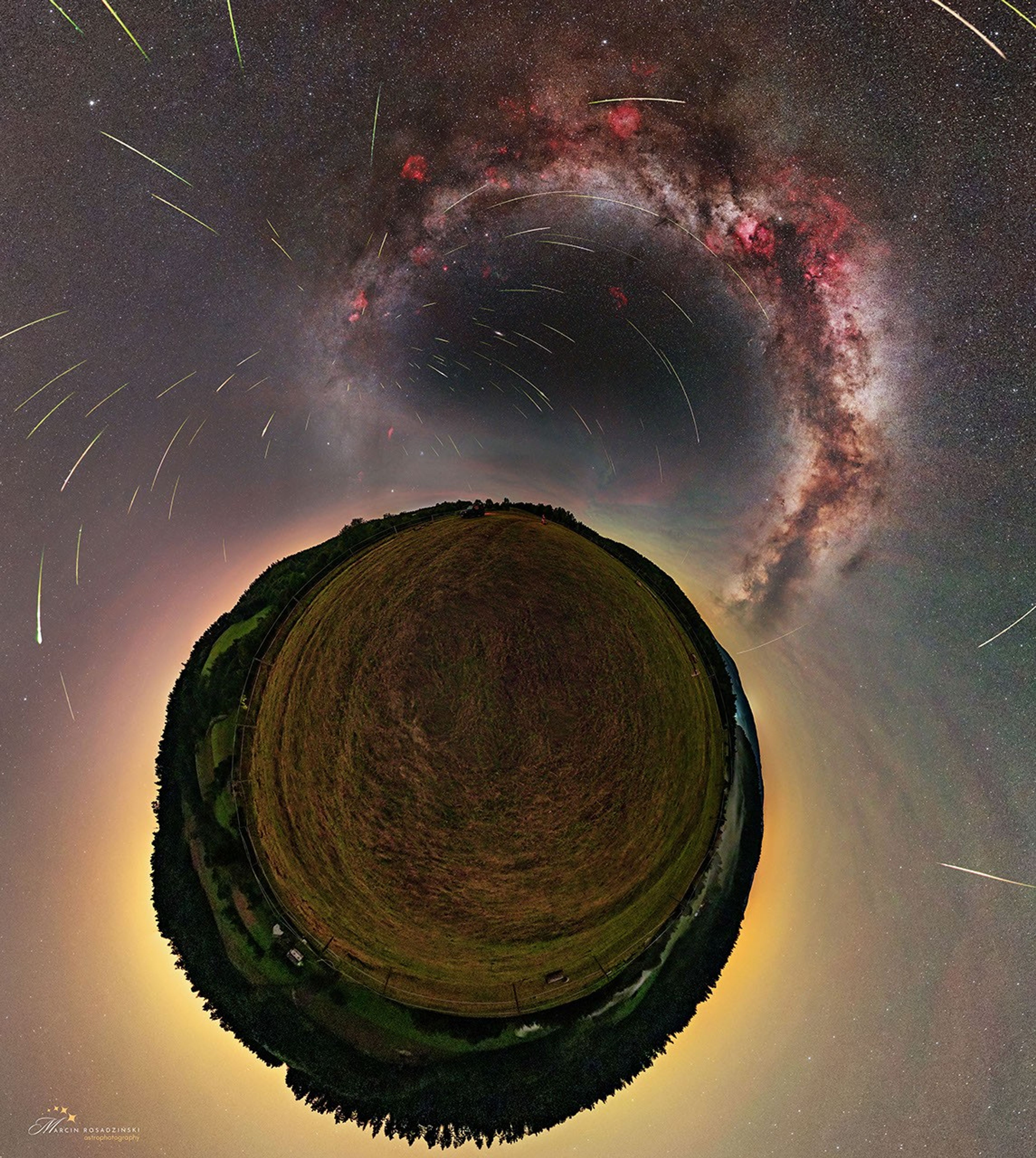
Explanation: It looks like a view from the Little Prince‘s planet. The featured image is a throwback to the 2024 Perseid meteor shower, surrounded in this projection by the Bieszczady Mountains in Poland. Visible in the sky is the arch of the Milky Way, along with several nebulas in red and over a hundred meteors pointing to the radiant. The Perseids are easily visible and quite popular in the Northern Hemisphere summer. (Watching meteor showers in the winter is less convenient for a good reason). This year they are expected to offer an even more dazzling spectacle than usual, because the peak coincides with a new moon. The 2026 Perseid meteor shower will peak tonight with as many as 50-100 meteors per hour, when the Earth’s path crosses through debris left behind by Comet Swift-Tuttle. Typically, the best times for seeing the meteors are between midnight and pre-dawn. You won’t need binoculars to see the meteors, but a lawn chair and a dark sky location help.
NASA Stream: August 12 Total Solar Eclipse.
Tomorrow’s picture: pixels in space
NASA Science Activation & Michigan Tech. U.
Random APOD Generator
Yesterday’s Image APOD: 2026 August 11 – Six Moons of Saturn
Tomorrow’s Image
APOD: 2026 August 12 – Perseids over a Little Planet
APOD
Astronomy Picture of the Day
Discover the cosmos! Each day a different image or photograph of our fascinating universe is featured, along with a brief explanation written by a professional astronomer.
Perseids over a Little PlanetExplanation: It looks like a view from the Little Prince‘s planet. The featured image is a throwback to the 2024 Perseid meteor shower, surrounded in this projection by the Bieszczady Mountains in Poland. Visible in the sky is the arch of the Milky Way, along with several nebulas in red and over a hundred meteors pointing to the radiant. The Perseids are easily visible and quite popular in the Northern Hemisphere summer. (Watching meteor showers in the winter is less convenient for a good reason). This year they are expected to offer an even more dazzling spectacle than usual, because the peak coincides with a new moon. The 2026 Perseid meteor shower will peak tonight with as many as 50-100 meteors per hour, when the Earth’s path crosses through debris left behind by Comet Swift-Tuttle. Typically, the best times for seeing the meteors are between midnight and pre-dawn. You won’t need binoculars to see the meteors, but a lawn chair and a dark sky location help.
NASA Stream: August 12 Total Solar Eclipse.
Tomorrow’s picture: pixels in space
NASA Science Activation & Michigan Tech. U.
Random APOD Generator
Yesterday’s Image APOD: 2026 August 11 – Six Moons of Saturn
Tomorrow’s Image
Quality Assessment Report Evaluates Polar Geospatial Center EarthDEM Elevation Products
A new quality assessment report from NASA’s Commercial Satellite Data Acquisition (CSDA) program evaluates data from the Polar Geospatial Center’s (PGC) EarthDEM product. The results of the evaluation help inform NASA program management and the user community about the quality of commercial Digital Elevation Models (DEMs) for use in NASA science.
At left, the cover of the Commercial Satellite Data Acquisition programs’s recently released Polar Geospatial Center EarthDEM Quality Assessment Report. At right, a shaded relief rendering of EarthDEM data showing the Virgin River in Nevada. DEM derived from Vantor imagery. Credit: NASA CSDA program/EarthDEM Project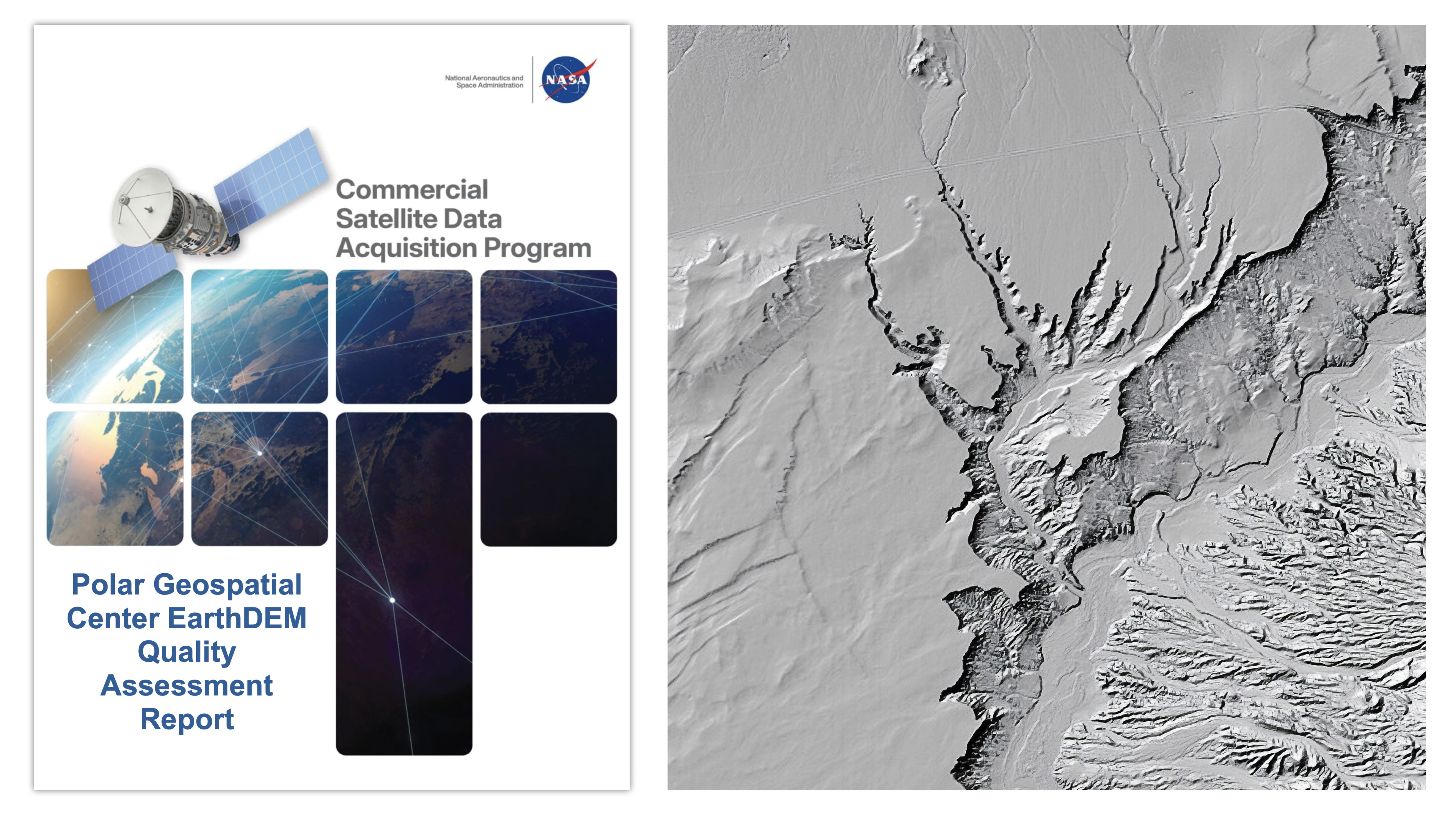
Issued August 8, 2026, the CSDA Polar Geospatial Center EarthDEM Quality Assessment Report was conducted by NASA Digital Elevation Model (DEM) subject matter experts (SMEs) enlisted to evaluate the horizontal and vertical accuracy of two PGC EarthDEM1 (i.e., Digital Elevation Model) products: the center’s “Mosaic Tile” and “Strip” Digital Surface Models (DSMs).
To assess the vertical and horizontal accuracy of the EarthDEM Strip DSM and Mosaic Tile products over a variety of surface characteristics, the SMEs compared them to airborne lidar data samples from across the United States and Senegal. They found the horizontal accuracy of the EarthDEM products (Strip DSM: 0.5-meter (m) Root Mean Square Error Horizontal (RMSEH); Mosaic Tile: 0.3 m RMSEH) agreed with the specifications provided by the PGC and graded them “Excellent.” The vertical accuracy results of the EarthDEM Strip DSM (5.6 m Root Mean Square Error Vertical (RMSEV)) and the Mosaic Tile (4.9 m RMSEV) products varied by land cover type, with all land cover types exceeding the specification provided by the PGC (0.5 m RMSEV). Strip DSM vertical accuracy was found to vary from 4.6-6.8 m RMSEV depending on the cloud cover metadata field generated by the PGC. Given this variation, the vertical accuracy compliance for the EarthDEM products was graded as “Basic.”
Overall, the assessment report supports the use of EarthDEM data for NASA Earth science research and applications, as long as the data characteristics (e.g., vertical accuracy, poor cloud masking, missing surface features, data voids, etc.) are compatible with the specific science objectives and use cases.
The report also provides a Data Provider Documentation Review for the EarthDEM product that evaluated information from the PGC website, as well as a series of peer-reviewed publications by researchers at The Ohio State University’s Byrd Polar and Climate Research Center. (Only documents listed in this report were considered in the evaluation.) The report’s authors found that, overall, the EarthDEM product is “well documented,” with most information present within the product User Guide, a series of peer reviewed papers, or the PGC GitHub repository.
About the CSDA ProgramThe CSDA program was established to identify, evaluate, and acquire data from commercial sources that support the NASA Earth science research and application goals. NASA’s Earth Science Division recognizes the potential impact commercial satellite constellations may have in encouraging/enabling efficient approaches to advancing Earth System Science and applications development for societal benefit. Commercially acquired data may also provide a cost-effective means to augment and/or complement the suite of Earth observations acquired by NASA, other U.S. government agencies, and international partners.
To read the reports in full, see the links under “Evaluation” heading on the Polar Geospatial Center vendor page on the CSDA website.
Notes:1. According the authors of the report, “it should be noted that the PGC EarthDEM product is not technically a commercial product…. EarthDEM is a digital elevation dataset derived from imagery collected from the Vantor (formerly Maxar) fleet of optical satellites.”