
Feed aggregator
Week in images: 03-07 August 2026
Week in images: 03-07 August 2026
Discover our week through the lens
Why Google DeepMind broke up the AlphaFold team
This artificial intelligence system largely accomplished the task it was built to solve, and researchers outside DeepMind have already been carrying its work forward
Did life on Earth only arise once? Perhaps not
The last common ancestor of all living things may not have been alive at all
Preview to Totality: A Resource Guide to August 12th Total Solar Eclipse
It’s almost show time. We’re just a few days away now, from the only total solar eclipse of 2026. While eclipses are a surety as the celestial gears of the Universe grind on, there are always a few unknowns leading up to eclipse day. We wrote a recent guide to the upcoming total solar eclipse featuring totality across Greenland, Iceland, the North Atlantic and Spain on August 12th. As that date is now only a few days away, it’s a good time to look at prospects and resources to have at the ready leading up to eclipse day.
NASA’s Voyager 2 survives daring ‘big bang’ maneuver
After 49 years in space, NASA’s Voyagers are running low on power—but an audacious move should extend the tenures of the two spacecraft
Science Campaigns Planned for the August 12th Total Solar Eclipse
Several science campaigns plan to greet the racing shadow of the Moon on August 12th.
The post Science Campaigns Planned for the August 12th Total Solar Eclipse appeared first on Sky & Telescope.
Danube’s waters fall to record lows
How many paper folds would get you to the moon?
Folding a piece of paper makes it thicker. How many folds would it take to reach the moon—and beyond?
Is Gen Z actually smoking more? An investigation
Smoking in movies and TV is up, and “cigfluencers” have become a thing, but lags in data make it unclear if the vibe shift has any reality to it
Smoking was supposed to be fading away. Why are young people embracing it again?
Smoking rates remain low, but experts say social media, stress and shifting attitudes could be fueling a cigarette revival
IRIS² reinforced and accelerated as implementation advances
On 7 August, the European Commission and the SpaceRISE consortium concluded negotiations and signed an implementation agreement to roll out IRIS², the European Union’s new flagship satellite constellation. The agreement, among other things, adds 66 satellites into low Earth orbit to the programme, bringing the main constellation to 348 satellites, and moving it from planning to full-scale deployment with the support of the European Space Agency (ESA).
NASA’s Lunar Development and Test Facility Prepares Artemis Hardware for Moon
Before astronauts return to the Moon’s surface through NASA’s Artemis program, the hardware they depend on must first prove it can survive the unforgiving lunar environment. At NASA’s Johnson Space Center in Houston, engineers at the Lunar Development and Test Facility are tackling one of exploration’s biggest challenges: Moon dust.
Unlike sand on Earth, lunar dust is sharp, abrasive, and clings to nearly everything. Without mitigation, lunar dust could damage equipment and spacesuits while posing health risks to astronauts. Understanding and mitigating the effects of lunar dust is essential as astronauts prepare to live and work on the surface of the Moon.
The Handheld Lunar Electrostatic Dust Mitigation tool is tested inside the Lunar Development and Test Facility at NASA’s Johnson Space Center in Houston. NASA/Josh Valcarcel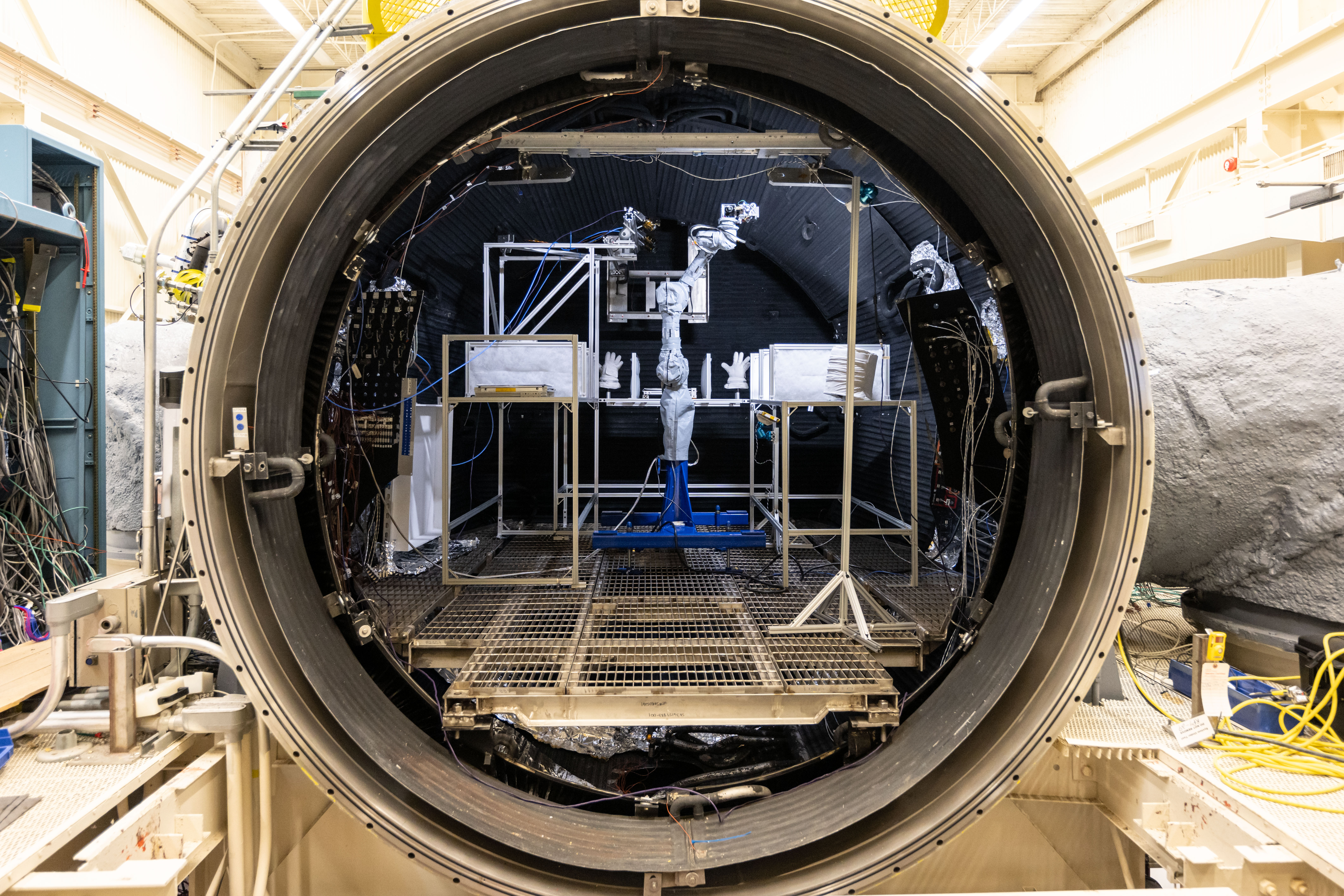
Located within the Energy Systems Test Area and managed by NASA engineers, the Lunar Development and Test Facility supports the development and testing of hardware in simulated lunar conditions. Engineers evaluate systems and subsystems inside vacuum chambers using lunar regolith simulant to better understand how spacesuits, spacecraft components, and mechanisms with moving parts and joints will perform during future Artemis missions.
Lunar spacewalking tools undergo a dust mitigation test inside Johnson’s thermal vacuum chamber. NASA/Bill Stafford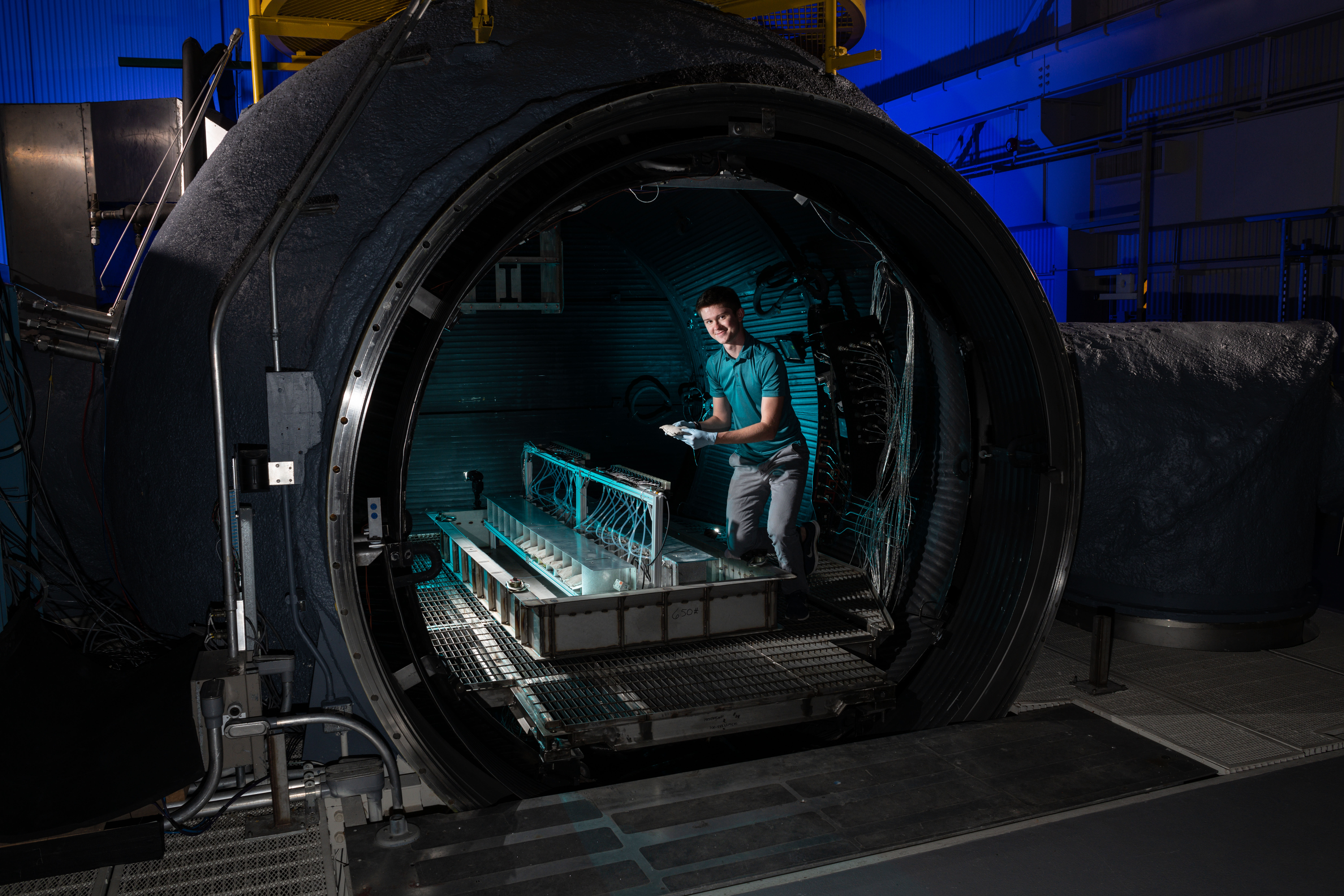
NASA Johnson’s Propulsion and Power Division developed specialized systems that make the facility’s lunar simulations possible. The facility includes a dust containment and preparation laboratory for ambient testing, a 3-foot cube vacuum chamber, and a 15-foot thermal vacuum chamber.
Inside the chamber, engineers test hardware under realistic lunar conditions using lunar regolith simulant. The chamber uses a closed-loop nitrogen system to recreate the harsh lunar environment.
“The facility helps develop and test technologies needed for long-duration lunar exploration,” said Mike Salinas, Propulsion and Power Division branch deputy chief. “Engineers are advancing techniques to extract resources from lunar regolith, which can be turned into oxygen for astronauts and liquid oxygen for rocket propellant.”
The spirit of exploration extends beyond the facility’s walls. Its exterior features a large-scale mural depicting astronauts exploring the lunar surface beneath a view of the cosmos. Completed in 2024 by artist Sebastian Boileau, the artwork celebrates the innovation, ingenuity, and discovery happening inside the building every day.
Artist Sebastien Boileau, left, and Margaret Braun pose in front of Johnson’s Lunar Development and Test Facility after the mural’s completion on Feb. 7, 2024. NASA/Josh Valcarcel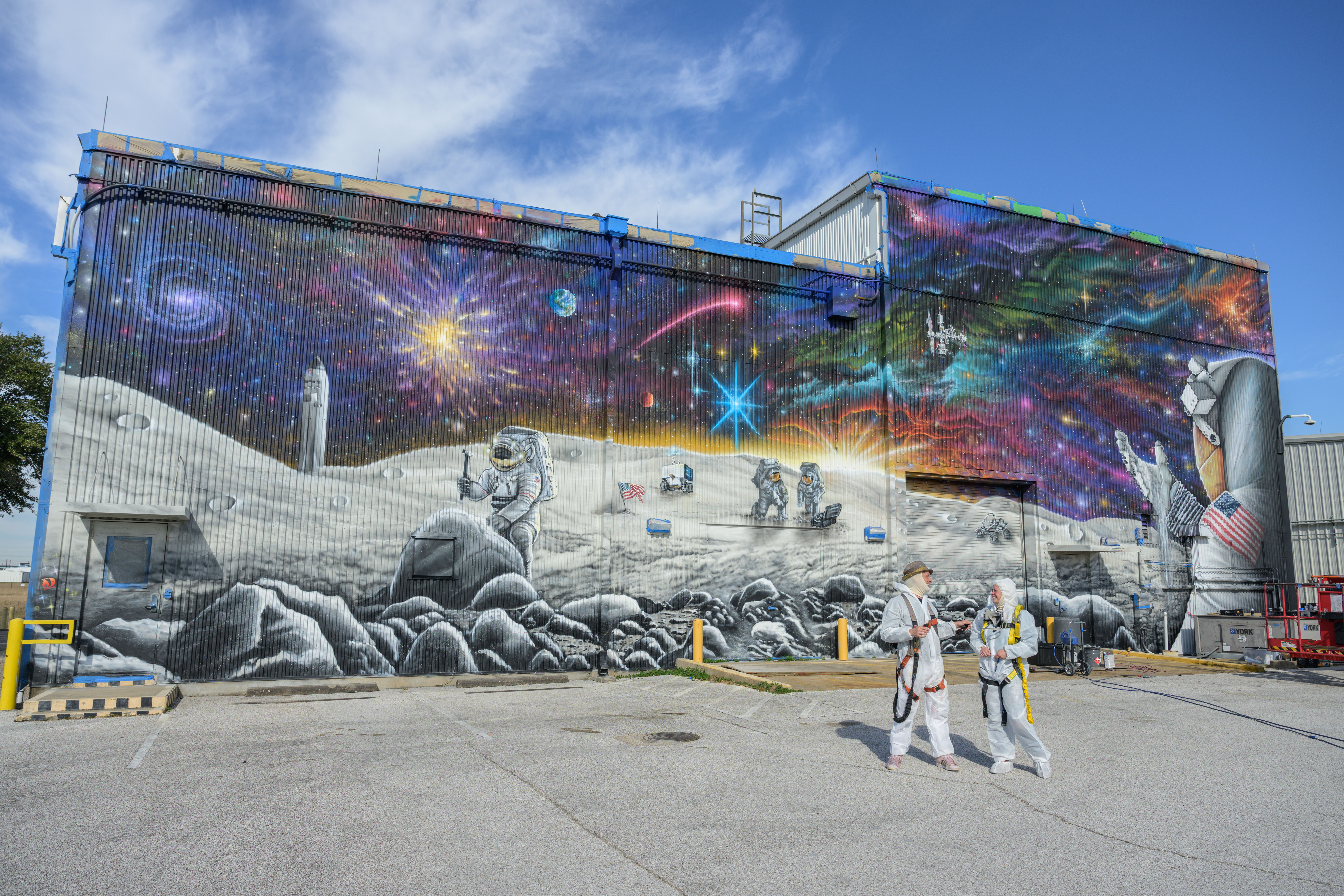
Now, anyone can step inside the facility from anywhere. Explore NASA’s new 3D virtual tour of the Lunar Development and Test Facility to see where engineers are helping prepare the technologies that support this Golden Age of exploration and innovation.
About the AuthorSumer Loggins Share Details Last Updated Aug 07, 2026 Related Terms Explore More 2 min read Ames Science Stars of the Month – August 2026 Article 5 days ago 6 min read NASA Provides Updates on Moon Base Cargo Landers, Tech Demonstrations Article 6 days ago 5 min read Ike Theriot Helps Prepare Astronauts to Work on the Moon Article 7 days ago Keep Exploring Discover More Topics From NASAMissions
Humans in Space
Climate Change
Solar System
NASA’s Lunar Development and Test Facility Prepares Artemis Hardware for Moon
Before astronauts return to the Moon’s surface through NASA’s Artemis program, the hardware they depend on must first prove it can survive the unforgiving lunar environment. At NASA’s Johnson Space Center in Houston, engineers at the Lunar Development and Test Facility are tackling one of exploration’s biggest challenges: Moon dust.
Unlike sand on Earth, lunar dust is sharp, abrasive, and clings to nearly everything. Without mitigation, lunar dust could damage equipment and spacesuits while posing health risks to astronauts. Understanding and mitigating the effects of lunar dust is essential as astronauts prepare to live and work on the surface of the Moon.
The Handheld Lunar Electrostatic Dust Mitigation tool is tested inside the Lunar Development and Test Facility at NASA’s Johnson Space Center in Houston. NASA/Josh ValcarcelLocated within the Energy Systems Test Area and managed by NASA engineers, the Lunar Development and Test Facility supports the development and testing of hardware in simulated lunar conditions. Engineers evaluate systems and subsystems inside vacuum chambers using lunar regolith simulant to better understand how spacesuits, spacecraft components, and mechanisms with moving parts and joints will perform during future Artemis missions.
Lunar spacewalking tools undergo a dust mitigation test inside Johnson’s thermal vacuum chamber. NASA/Bill StaffordNASA Johnson’s Propulsion and Power Division developed specialized systems that make the facility’s lunar simulations possible. The facility includes a dust containment and preparation laboratory for ambient testing, a 3-foot cube vacuum chamber, and a 15-foot thermal vacuum chamber.
Inside the chamber, engineers test hardware under realistic lunar conditions using lunar regolith simulant. The chamber uses a closed-loop nitrogen system to recreate the harsh lunar environment.
“The facility helps develop and test technologies needed for long-duration lunar exploration,” said Mike Salinas, Propulsion and Power Division branch deputy chief. “Engineers are advancing techniques to extract resources from lunar regolith, which can be turned into oxygen for astronauts and liquid oxygen for rocket propellant.”
The spirit of exploration extends beyond the facility’s walls. Its exterior features a large-scale mural depicting astronauts exploring the lunar surface beneath a view of the cosmos. Completed in 2024 by artist Sebastian Boileau, the artwork celebrates the innovation, ingenuity, and discovery happening inside the building every day.
Artist Sebastien Boileau, left, and Margaret Braun pose in front of Johnson’s Lunar Development and Test Facility after the mural’s completion on Feb. 7, 2024. NASA/Josh ValcarcelNow, anyone can step inside the facility from anywhere. Explore NASA’s new 3D virtual tour of the Lunar Development and Test Facility to see where engineers are helping prepare the technologies that support this Golden Age of exploration and innovation.
About the AuthorSumer Loggins Share Details Last Updated Aug 07, 2026 Related Terms Explore More 2 min read Ames Science Stars of the Month – August 2026 Article 6 days ago 6 min read NASA Provides Updates on Moon Base Cargo Landers, Tech Demonstrations Article 6 days ago 5 min read Ike Theriot Helps Prepare Astronauts to Work on the Moon Article 1 week ago Keep Exploring Discover More Topics From NASAMissions
Humans in Space
Climate Change
Solar System
APOD: 2026 August 7 – Rubin’s Cosmos Field
APOD
Astronomy Picture of the Day
Discover the cosmos! Each day a different image or photograph of our fascinating universe is featured, along with a brief explanation written by a professional astronomer.
Rubin’s COSMOS Field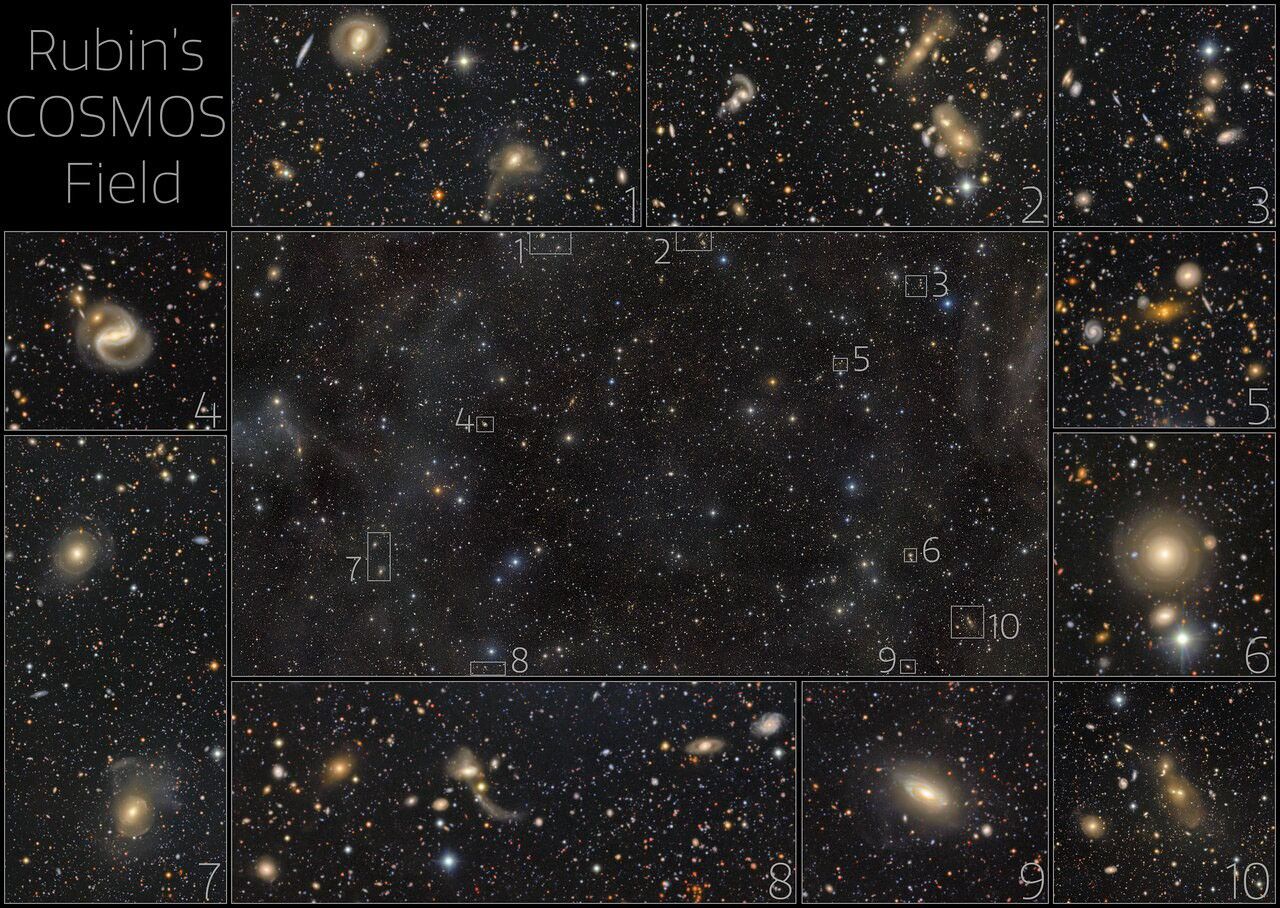
Explanation: There are more than half a million galaxies in the central panel of this image from the NSF-DOE Vera C. Rubin Observatory in Chile. This is the COSMOS field, a patch of sky several times larger than the full moon, first observed by Hubble. It has also been observed by Webb and other telescopes because it contains comparatively few bright stars from our own galaxy, offering a relatively unimpeded view of other galaxies outside the Milky Way. The outer panels, numbered 1-10, show zoomed-in views of the corresponding small regions highlighted in the central panel. The variety of galaxy shapes and sizes is astonishing. Some of them are so far away that their light has traveled for billions of years before reaching Earth. Rubin will come back every couple of days to the COSMOS field as part of its ten-year Legacy Survey of Space and Time. It will allow a dynamic view of the COSMOS field and how the sky changes over time.
Tomorrow’s picture: a Messier moment
Date August 7, 2026 Credit & Copyright NSF–DOE Vera C. Rubin Observatory/NOIRLab/SLAC/AURA Authors & editors: Cecilia Chirenti, Jerry Bonnell, Robert Nemiroff, Keighley Rockcliffe A service of: ASD at NASA / GSFC,NASA Science Activation & Michigan Tech. U.
Random APOD Generator
Yesterday’s Image APOD: 2026 August 6 – New Sharpest Image of the Sun Uncovers Instability
Tomorrow’s Image APOD: 2026 August 8 – A Messier Moment for Tempel 2
APOD: 2026 August 7 – Rubin’s Cosmos Field
APOD
Astronomy Picture of the Day
Discover the cosmos! Each day a different image or photograph of our fascinating universe is featured, along with a brief explanation written by a professional astronomer.
Rubin’s COSMOS FieldExplanation: There are more than half a million galaxies in the central panel of this image from the NSF-DOE Vera C. Rubin Observatory in Chile. This is the COSMOS field, a patch of sky several times larger than the full moon, first observed by Hubble. It has also been observed by Webb and other telescopes because it contains comparatively few bright stars from our own galaxy, offering a relatively unimpeded view of other galaxies outside the Milky Way. The outer panels, numbered 1-10, show zoomed-in views of the corresponding small regions highlighted in the central panel. The variety of galaxy shapes and sizes is astonishing. Some of them are so far away that their light has traveled for billions of years before reaching Earth. Rubin will come back every couple of days to the COSMOS field as part of its ten-year Legacy Survey of Space and Time. It will allow a dynamic view of the COSMOS field and how the sky changes over time.
Tomorrow’s picture: a Messier moment
Date August 7, 2026 Credit & Copyright NSF–DOE Vera C. Rubin Observatory/NOIRLab/SLAC/AURA Authors & editors: Cecilia Chirenti, Jerry Bonnell, Robert Nemiroff, Keighley Rockcliffe A service of: ASD at NASA / GSFC,NASA Science Activation & Michigan Tech. U.
Random APOD Generator
Yesterday’s Image APOD: 2026 August 6 – New Sharpest Image of the Sun Uncovers Instability
Tomorrow’s Image APOD: 2026 August 8 – A Messier Moment for Tempel 2
Sensing the Poles’ Hidden Heat
- Earth
- Earth Observatory
- Image of the Day
- EO Explorer
- Topics
- More Content
- About
Sensing the Poles’ Hidden Heat
- Earth
- Earth Observatory
- Image of the Day
- EO Explorer
- Topics
- More Content
- About
Scientists Watch as a Distant World's Atmosphere Shrinks and Thins
As dwarf planet Pluto moves along in its distant, high-obliquity 248-year orbit, its atmosphere is changing. That's because it's beginning to travel through colder, darker parts of the outer Solar System for the next 88 years. As a consequence, the mostly-nitrogen atmosphere is expected to grow gradually thinner and eventually freeze out over the coming decades. When that happens, the atmosphere will shrink.
Educators & Teens Get Hands-On With TEMPO Data to Help Investigate Local Air Quality
4 min read
Educators & Teens Get Hands-On With TEMPO Data to Help Investigate Local Air Quality An educator explores NASA’s TEMPO mission data using the CosmicDS TEMPO-Lab viewer during a hands-on immersion session at the BEST AQI Leadership Institute. Credit: Devika Elakara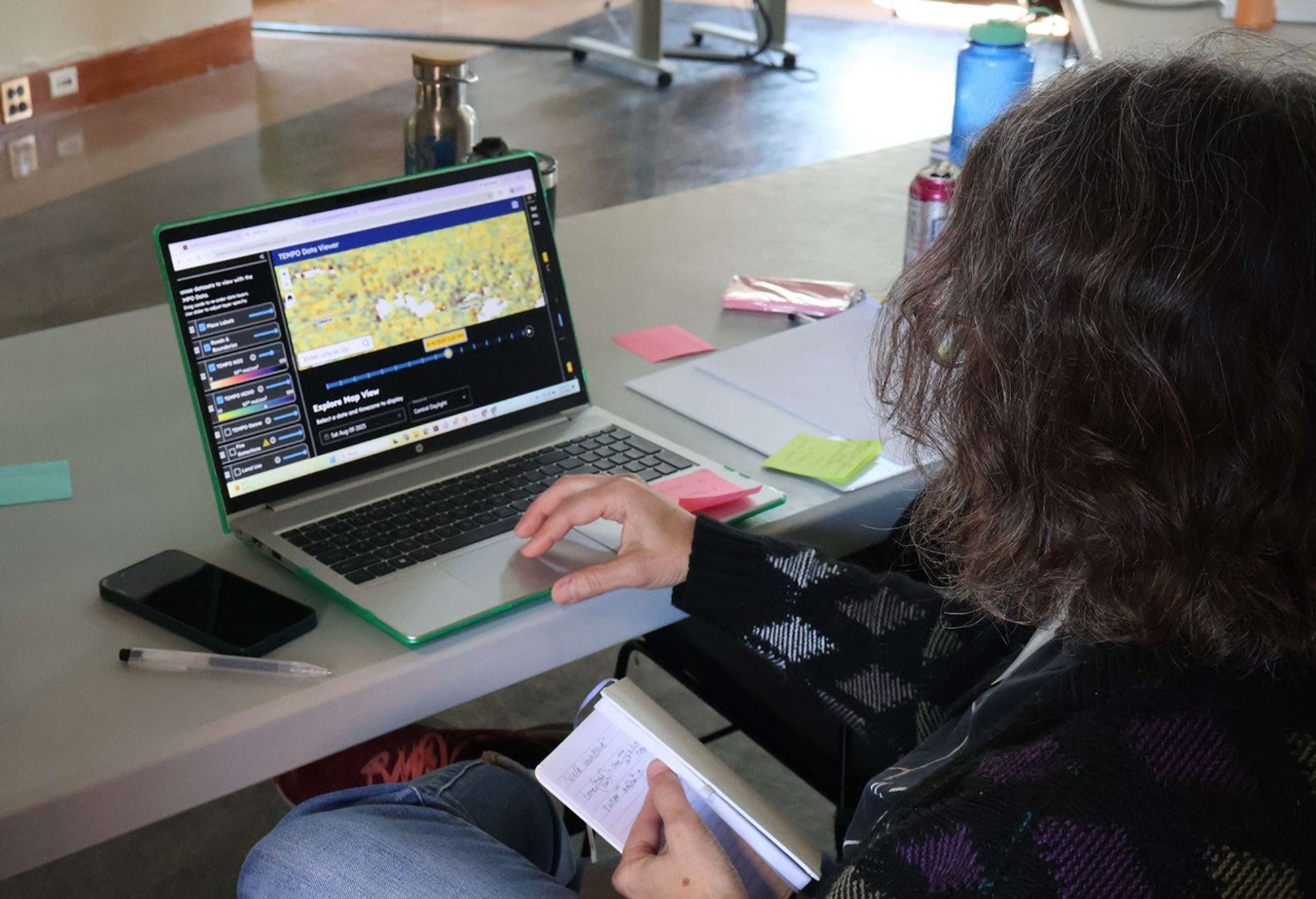
The NASA Science Activation Program’s Cosmic Storytelling with NASA Data (CosmicDS) project, led by Harvard University in Cambridge, Massachusetts, works to bring authentic NASA data into the hands of educators and learners. From July 27–29, 2026, the CosmicDS team partnered with the Smithsonian Institution’s BEST AQI (Breathing Easier: Supporting Teen Air Quality Investigations) project to host a Leadership Institute at the Center for Astrophysics | Harvard & Smithsonian (CfA) in Cambridge, MA. The Institute brought together 13 formal and informal educators who serve as advisors to BEST AQI, an initiative that guides teens through their own air quality research to support actions that improve air quality in their communities.
On Day 1 of the Institute, the CosmicDS Science Principal Investigator Pat Udomprasert led a hands-on immersion session introducing educators to TEMPO-Lab, a free online tool built with NASA Science Activation Program funding. TEMPO-Lab lets learners explore and analyze near-real-time air quality measurements collected by NASA’s TEMPO (Tropospheric Emissions: Monitoring of Pollution) mission, which measures pollution across North America hourly during daylight hours. During Days 2 and 3 of the Institute, as educators worked together to co-develop BEST AQI curriculum and resources, they used TEMPO-Lab to build case studies covering a variety of real-world air quality scenarios, including wildfire smoke and emissions from rush-hour traffic, power plants, and agriculture. These case studies will give the teens in their programs a strong foundation for investigating air quality where they live and deciding what actions they might take in their own communities.
One moment made the workshop especially memorable. During a science briefing, TEMPO scientist Heesung Chong shared that a new beta-version ground-level ozone data product had recently become available. TEMPO-Lab’s flexible design made it possible for CosmicDS software developer and educator John Lewis to integrate the new data product into the tool overnight, letting workshop participants explore cutting-edge ozone data themselves the very next morning. It was a striking example of how CosmicDS’s data tools can match the pace of active NASA science, giving educators and their learners access to data almost as soon as scientists themselves do.
“The BEST AQI Leadership Institute reinforced the value of the TEMPO-Lab as a tool for empowering youth to investigate local air quality issues using authentic NASA data. Educators were excited not only by the scientific capabilities of the platform, but by its potential to help young people use evidence to make informed decisions and contribute to positive change in their communities.”
— Erika Wright, Education Specialist, Smithsonian Astrophysical Observatory (SAO), and BEST AQI Principal Investigator
Equipping educators with both the technical skills and the curriculum to bring NASA air quality data into their classrooms matters because it builds data literacy skills that teens can carry into any career, while also giving them the tools to investigate issues that affect their health and their own communities. Air quality is a subject teens can see, smell, and feel the effects of — and BEST AQI is designed to help them turn that lived experience into evidence-based understanding and, ultimately, action.
The CosmicDS team will continue supporting these efforts in the year ahead. The 13 educators who attended this Leadership Institute plan to share the BEST AQI toolkit and TEMPO-Lab with approximately 100 additional educators across their partner sites in South Dakota, Maryland, and New York, potentially extending this work to thousands of teen air quality researchers.
Experience TEMPO-Lab at https://projects.cosmicds.cfa.harvard.edu/tempo-lab and learn more about the CosmicDS project at https://cosmicds.cfa.harvard.edu.
Cosmic DS is supported by NASA cooperative agreement award number 80NSSC21M0002 and is part of the NASA Science Activation Program portfolio, which connects learners with authentic NASA science experiences through partnerships with educators and community organizations.
Share Details Last Updated Aug 07, 2026 Editor NASA Science Editorial Team Related Terms Explore More 3 min read A Week of Smoky Skies Across North AmericaBrown carbon, emitted by wildland fires and tracked over the span of a week in…
Article
2 weeks ago
6 min read New NASA Earth Missions Gear Up to Start Science Flights
The first of six new airborne campaigns will hit the skies this summer.
Article
3 weeks ago
3 min read Ontario Wildfire Smoke Moves East
Canadian wildfires sent plumes of smoke streaming over Ontario, Quebec, and parts of the U.S.…
Article
3 weeks ago
Keep Exploring Discover More Topics From NASA James Webb Space Telescope
Webb is the premier observatory of the next decade, serving thousands of astronomers worldwide. It studies every phase in the…
Perseverance Rover
This rover and its aerial sidekick were assigned to study the geology of Mars and seek signs of ancient microbial…
Parker Solar Probe
On a mission to “touch the Sun,” NASA’s Parker Solar Probe became the first spacecraft to fly through the corona…
Juno
NASA’s Juno spacecraft entered orbit around Jupiter in 2016, the first explorer to peer below the planet’s dense clouds to…