

Feed aggregator
NASA Funds 'Interworld Slingshot' Concept to Map Solar System Resources
In-situ Resource Utilization (ISRU) is going to be a critical technical component of any human expansion out into the solar system. Our first challenge with utilizing those resources, though, is finding them. We know how, at least in theory - send a probe to an asteroid, or a particular part of the Moon, and take a sample, maybe analyze that sample with some spectrographs, or send it back to Earth to be poked and prodded. The problem with this methodology is simple - it’s expensive. Sending dedicated probes to every near-Earth asteroid, or every potentially interesting site near a lunar base is prohibitively expensive. So a new NASA Institute for Advanced Concepts (NIAC) grant explores a different opportunity - using a single, relatively small spacecraft to visit multiple ISRU locations, and figure out their composition from tens of kilometers away.
NASA Shares Station Research Today Supporting Moon, Mars Tomorrow
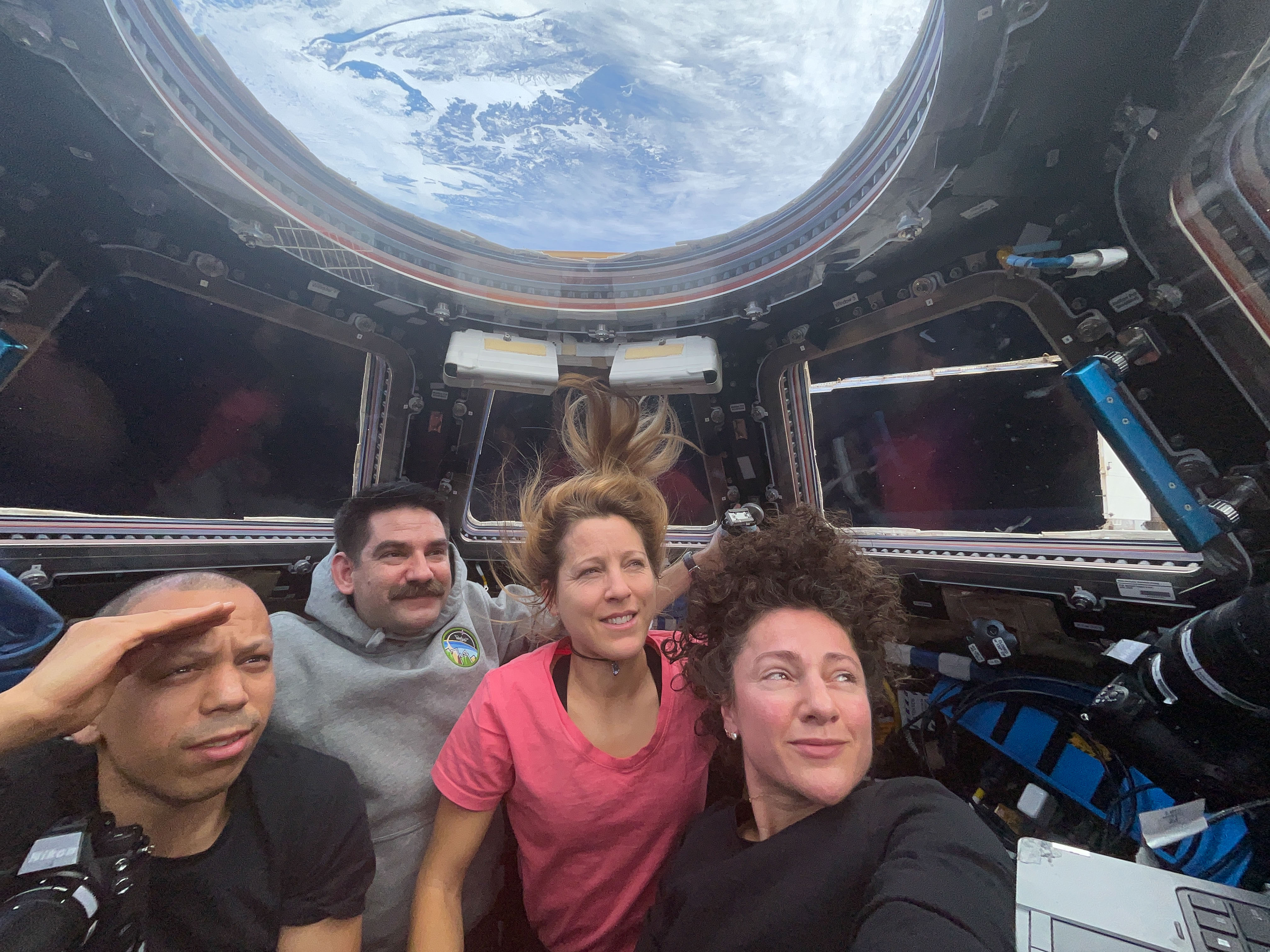
The International Space Station has been busy throughout 2026, as it continues to be a bustling workspace for astronauts conducting a variety of scientific experiments that lay the groundwork for missions to the Moon and beyond.
NASA’s Artemis II mission in April was the first crewed flight around the Moon in more than 50 years, marking a major milestone for humanity’s return to the lunar surface. While the mission validated key systems needed for future deep space human exploration, work aboard the International Space Station continues to support those goals. Astronauts on the orbiting laboratory are testing technologies, studying how the human body adapts to long-duration spaceflight, and conducting experiments to help ensure crews can live and work safely in deep space. Research aboard the space station, coupled with Artemis and Moon Base programs, will continue to demonstrate how NASA is preparing for sustained astronaut exploration of the Moon and, eventually, Mars.
Optimizing space technologyTo view this video please enable JavaScript, and consider upgrading to a web browser that supports HTML5 video
ESA (European Space Agency) astronaut Sophie Adenot activates the European Enhanced Exploration Exercise Device (E4D), marking the start of a two-year technology demonstration.ESA/NASAAstronauts aboard the International Space Station demonstrate and optimize innovative technologies to support exploration missions, reduce the technology footprint, and fine-tune systems ahead of travel beyond low Earth orbit.
Exercise equipment is important for long-duration spaceflight. On average, astronauts lose between 1% and 1.5% of their bone density each month while in microgravity, increasing the potential risk for fractures and other bone-related issues. Regular exercise can help counteract these effects and keep astronauts healthy. The European Enhanced Exploration Exercise Device (E4D) is a compact, versatile system now being tested aboard the space station for exploration crews. The system supports a variety of exercises, can simulate different gravity levels and may lead to even more compact exercise technology for exploration crews.
During deep space missions, astronauts may need medical care but could be too far from Earth to receive a resupply spacecraft with additional equipment. To prepare for that possibility, researchers are testing medical technologies aboard the station. One of these investigations, the Intravenous Fluid Generation – Mini (IVGEN Mini),evaluates producing intravenous (IV) fluids using the station’s potable water supply. Because commercially available IV fluids have a shelf life of only about 16 months, successful demonstrations of this technology could help meet medical needs while reducing launch mass and volume.
Medical care is one hurdle crews may face during future missions, while another is the limited time astronauts have to complete tasks that require human intervention. Robotic technologies, such as the Test facility for lab-aUtomation System in Kibo (TUSK), may help address these time constraints. This investigation studies how microgravity affects delicate robotic operations that rely on precise movement. Insights could help improve the design of future automated systems that can execute tasks independently, freeing up astronauts’ valuable time during future missions.
Studying the body in space NASA astronauts Jessica Meir and Chris Williams collect frozen research samples from inside the International Space Station’s Destiny laboratory module.ESA/Sophie Adenot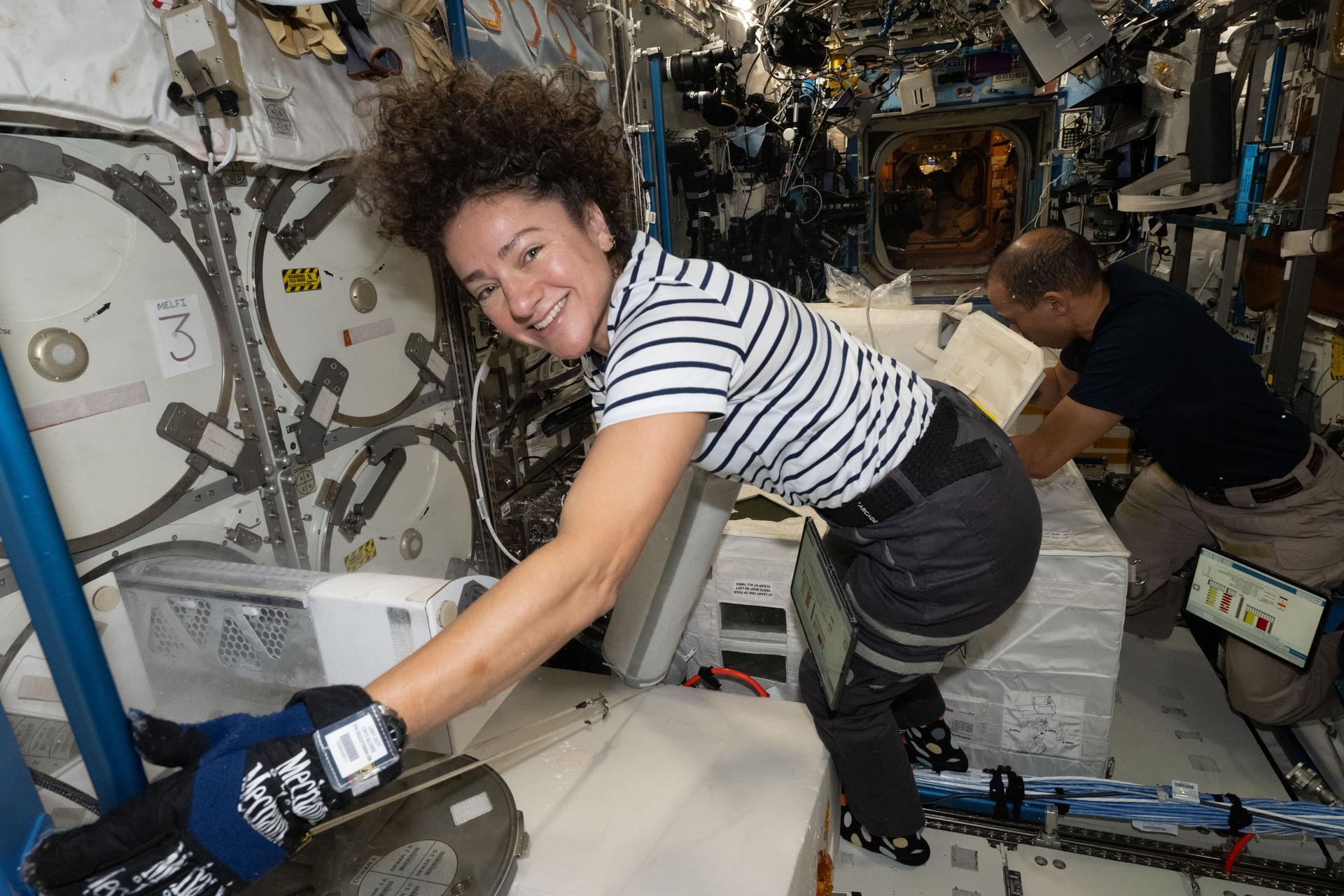
Astronauts also serve as test subjects. They collect biological samples, conduct medical exams, and perform scans to understand how bodies adapt to life in space. This research helps scientists and medical personnel understand the effects of spaceflight and protects crew health as missions extend farther into the solar system.
Past research shows weightlessness during spaceflight can sometimes disrupt astronauts’ normal blood flow, which may increase health risks for conditions, such as blood clots.The Spaceflight Thrombosis and Risk Factors (Venous Haemostasis) experiment examines changes in blood flow to identify unique physiological correlations and create preventative measures for at-risk crew members.
Astronauts also may experience changes to their cardiovascular and respiratory systems during spaceflight, which could affect blood pressure regulation. Research with the Causal Analysis of Cardiorespiratory Coupling on the ISS (CARDIOBREATH) uses the Bio-Monitor “smart shirt” to track heart rate, blood pressure, breathing rate, and activity during exercise sessions aboard the orbiting complex. Results will improve understanding of cardiovascular health in microgravity and inform treatments for cardiorespiratory risks during and after long-duration missions.
Maintaining mental health in space is as important as physical health. Prolonged isolation and confinement can impact a crew member’s sleep, morale, and decision-making. The Mind/Body Practices for Deep Space Exploration (RelaxPro) experiment evaluates non-invasive practices, such as meditation, to develop a structured system to reduce stress and improve sleep on future missions.
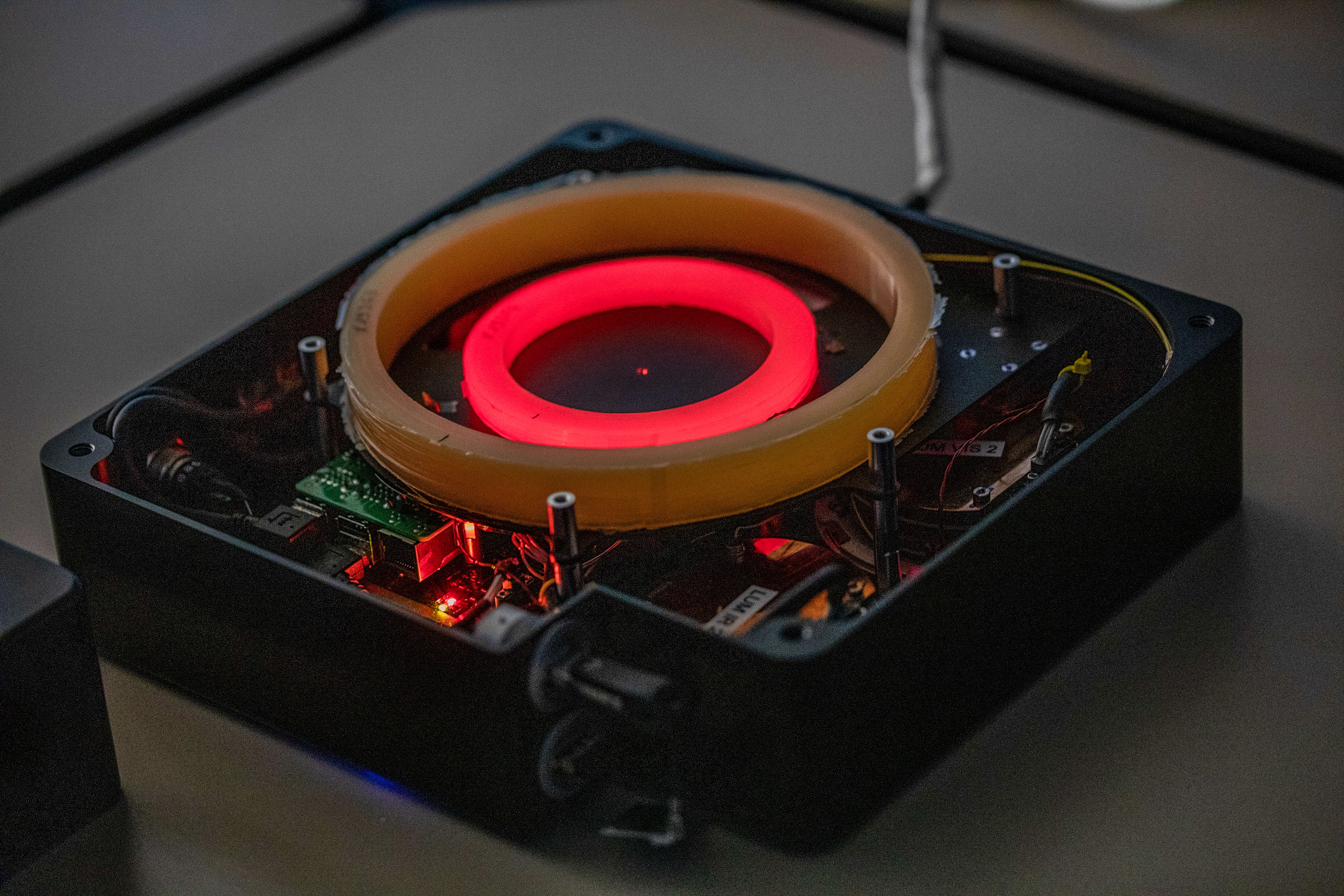
Spacecraft are a critical aspect of deep space missions, providing shelter from the harsh environment of space, along with oxygen, water, and other life-support systems. Testing systems aboard the International Space Station allows researchers to refine technologies for next generation spacecraft traveling beyond low Earth orbit.
The Fiber-optic Active Dosimeter (Lumina) demonstrates real-time radiation monitoring using optical fibers that darken when exposed to radiation. Monitoring ionizing radiation keeps astronauts safe and remains one of the key challenges for future deep space exploration.
Many spacecraft use cryogenic, or extremely cold, fuels for propulsion. These fuels must remain cold to stay in liquid form, but temperature fluctuations in space can cause them to slowly evaporate and escape the tank, affecting fuel efficiency. The Zero Boil-Off Tank Noncondensables (ZBOT-NC)investigation evaluates how gases that do not liquify at low temperatures impact pressure control, evaporation, and condensation rates inside propellant tanks. Data from this experiment will help validate models and support the design of more efficient cryogenic fuel storage systems.
As the crew’s living environment, the spacecraft must also be monitored for microbial activity to help ensure a safe and healthy habitat. The Genomic Enumeration of Antibiotic Resistance in Space (GEARS) investigation surveys the space station for antibiotic-resistant organisms to better understand how bacteria may adapt in space. The study uses DNA sequencing techniques to advance onsite identification and diagnostic capabilities that will be important for future missions.
International Space Station science still is buzzing for the remainder of 2026. To learn more about ongoing research aboard the space station, visit:
Share Details Last Updated Aug 11, 2026 Related Terms Keep Exploring Discover More Topics From NASAInternational Space Station
Space Station Research and Technology
Space Station Research Results
Humans In Space
NASA Shares Station Research Today Supporting Moon, Mars Tomorrow
The International Space Station has been busy throughout 2026, as it continues to be a bustling workspace for astronauts conducting a variety of scientific experiments that lay the groundwork for missions to the Moon and beyond.
NASA’s Artemis II mission in April was the first crewed flight around the Moon in more than 50 years, marking a major milestone for humanity’s return to the lunar surface. While the mission validated key systems needed for future deep space human exploration, work aboard the International Space Station continues to support those goals. Astronauts on the orbiting laboratory are testing technologies, studying how the human body adapts to long-duration spaceflight, and conducting experiments to help ensure crews can live and work safely in deep space. Research aboard the space station, coupled with Artemis and Moon Base programs, will continue to demonstrate how NASA is preparing for sustained astronaut exploration of the Moon and, eventually, Mars.
Optimizing space technologyTo view this video please enable JavaScript, and consider upgrading to a web browser that supports HTML5 video
ESA (European Space Agency) astronaut Sophie Adenot activates the European Enhanced Exploration Exercise Device (E4D), marking the start of a two-year technology demonstration.ESA/NASAAstronauts aboard the International Space Station demonstrate and optimize innovative technologies to support exploration missions, reduce the technology footprint, and fine-tune systems ahead of travel beyond low Earth orbit.
Exercise equipment is important for long-duration spaceflight. On average, astronauts lose between 1% and 1.5% of their bone density each month while in microgravity, increasing the potential risk for fractures and other bone-related issues. Regular exercise can help counteract these effects and keep astronauts healthy. The European Enhanced Exploration Exercise Device (E4D) is a compact, versatile system now being tested aboard the space station for exploration crews. The system supports a variety of exercises, can simulate different gravity levels and may lead to even more compact exercise technology for exploration crews.
During deep space missions, astronauts may need medical care but could be too far from Earth to receive a resupply spacecraft with additional equipment. To prepare for that possibility, researchers are testing medical technologies aboard the station. One of these investigations, the Intravenous Fluid Generation – Mini (IVGEN Mini),evaluates producing intravenous (IV) fluids using the station’s potable water supply. Because commercially available IV fluids have a shelf life of only about 16 months, successful demonstrations of this technology could help meet medical needs while reducing launch mass and volume.
Medical care is one hurdle crews may face during future missions, while another is the limited time astronauts have to complete tasks that require human intervention. Robotic technologies, such as the Test facility for lab-aUtomation System in Kibo (TUSK), may help address these time constraints. This investigation studies how microgravity affects delicate robotic operations that rely on precise movement. Insights could help improve the design of future automated systems that can execute tasks independently, freeing up astronauts’ valuable time during future missions.
Studying the body in space NASA astronauts Jessica Meir and Chris Williams collect frozen research samples from inside the International Space Station’s Destiny laboratory module.ESA/Sophie AdenotAstronauts also serve as test subjects. They collect biological samples, conduct medical exams, and perform scans to understand how bodies adapt to life in space. This research helps scientists and medical personnel understand the effects of spaceflight and protects crew health as missions extend farther into the solar system.
Past research shows weightlessness during spaceflight can sometimes disrupt astronauts’ normal blood flow, which may increase health risks for conditions, such as blood clots.The Spaceflight Thrombosis and Risk Factors (Venous Haemostasis) experiment examines changes in blood flow to identify unique physiological correlations and create preventative measures for at-risk crew members.
Astronauts also may experience changes to their cardiovascular and respiratory systems during spaceflight, which could affect blood pressure regulation. Research with the Causal Analysis of Cardiorespiratory Coupling on the ISS (CARDIOBREATH) uses the Bio-Monitor “smart shirt” to track heart rate, blood pressure, breathing rate, and activity during exercise sessions aboard the orbiting complex. Results will improve understanding of cardiovascular health in microgravity and inform treatments for cardiorespiratory risks during and after long-duration missions.
Maintaining mental health in space is as important as physical health. Prolonged isolation and confinement can impact a crew member’s sleep, morale, and decision-making. The Mind/Body Practices for Deep Space Exploration (RelaxPro) experiment evaluates non-invasive practices, such as meditation, to develop a structured system to reduce stress and improve sleep on future missions.
Spacecraft are a critical aspect of deep space missions, providing shelter from the harsh environment of space, along with oxygen, water, and other life-support systems. Testing systems aboard the International Space Station allows researchers to refine technologies for next generation spacecraft traveling beyond low Earth orbit.
The Fiber-optic Active Dosimeter (Lumina) demonstrates real-time radiation monitoring using optical fibers that darken when exposed to radiation. Monitoring ionizing radiation keeps astronauts safe and remains one of the key challenges for future deep space exploration.
Many spacecraft use cryogenic, or extremely cold, fuels for propulsion. These fuels must remain cold to stay in liquid form, but temperature fluctuations in space can cause them to slowly evaporate and escape the tank, affecting fuel efficiency. The Zero Boil-Off Tank Noncondensables (ZBOT-NC)investigation evaluates how gases that do not liquify at low temperatures impact pressure control, evaporation, and condensation rates inside propellant tanks. Data from this experiment will help validate models and support the design of more efficient cryogenic fuel storage systems.
As the crew’s living environment, the spacecraft must also be monitored for microbial activity to help ensure a safe and healthy habitat. The Genomic Enumeration of Antibiotic Resistance in Space (GEARS) investigation surveys the space station for antibiotic-resistant organisms to better understand how bacteria may adapt in space. The study uses DNA sequencing techniques to advance onsite identification and diagnostic capabilities that will be important for future missions.
International Space Station science still is buzzing for the remainder of 2026. To learn more about ongoing research aboard the space station, visit:
Share Details Last Updated Aug 11, 2026 Related Terms Keep Exploring Discover More Topics From NASAInternational Space Station
Space Station Research and Technology
Space Station Research Results
Humans In Space
Rare Total Solar Eclipse-Perseid Meteor Shower Double-Header August 12th
The only total solar eclipse of the year coincides with the Perseid meteor shower. Here's what you need to know to watch the eclipse.
The post Rare Total Solar Eclipse-Perseid Meteor Shower Double-Header August 12th appeared first on Sky & Telescope.
A total solar eclipse is coming to Europe
When the Moon passes between Earth and the Sun, it casts a shadow onto Earth's surface. For people in the darkest part of this shadow, the face of the Sun is totally blocked out, and its wispy atmosphere becomes visible.
On Wednesday 12 August, such a shadow will cross Greenland, Iceland, northeastern Portugal and Spain. With this being the first total eclipse visible from mainland Spain since 1905, the European Space Agency (ESA) has decided to do something special.
ESA’s live broadcast from the Observatorio Astrofísico de Javalambre will allow anyone to experience this rare phenomenon from anywhere in the world. Meanwhile, the Agency is working with the City and University of León to organise a free in-person event, inviting people to come together for a day of interactive workshops, talks and live observations.
<p><a href="https://apod.nasa.gov/apod
Scientists are closer than ever to understanding the power of the vagus nerve
The vagus nerve is the autonomic nervous system’s highway, connecting every major organ
Has science finally made up its mind about coffee’s health benefits?
Doctors used to warn coffee drinkers. Now research reassures them
The birth of modern life was fueled by poop, new theory proposes
The Cambrian explosion is a critical moment for life on Earth—and it may have been all about poop
Humans’ sense of smell is still evolving
A genetic study shows how smell capabilities were maintained in a hunter-gatherer population
First-of-its-kind clinic treats psychedelic side effects
As psychedelic therapies expand, new clinics treat uncommon long-term harms
Sophie Adenot’s first spacewalk
ESA astronaut Sophie Adenot will take part in her first-ever spacewalk during U.S. Spacewalk 97. Together with NASA astronaut Anil Menon, she will replace a Space-to-Ground antenna on the International Space Station, a critical communications system that enables high-speed data and voice links between Mission Control in Houston and the space station.
Watch it live on ESA WebTV and the ESA’s YouTube channel. Coverage begins at 13:00 CEST, with the spacewalk scheduled to begin at approximately 14:35 CEST.
Dust and water spotted close to giant black hole
Using the NASA/ESA/CSA James Webb Space Telescope, an international team of astronomers have discovered that dust and water can form and survive surprisingly close to the supermassive black hole at the centre of our Milky Way galaxy. The observations reveal that the evolved star IRS 3 continues to enrich its surroundings with newly formed material despite the intense radiation environment around Sagittarius A*.
Curiosity Blog, Sols 4968-4974: Rock Climbing Towards the Discontinuity
- Curiosity Home
- Science
- News and Features
- Multimedia
- Mars Missions
- Mars Home
3 min read
Curiosity Blog, Sols 4968-4974: Rock Climbing Towards the Discontinuity NASA’s Mars rover Curiosity acquired this image, a frame of the “Longquimay” mosaic showing fine-scale sedimentary textures in a bedrock block near the supersurface, using its Mars Hand Lens Imager (MAHLI), located on the turret at the end of the rover’s robotic arm. Curiosity acquired the image on Aug. 1, 2026 — Sol 4972, or Martian day 4,972 of the Mars Science Laboratory mission — at 23:35:43 UTC. NASA/JPL-Caltech/MSSS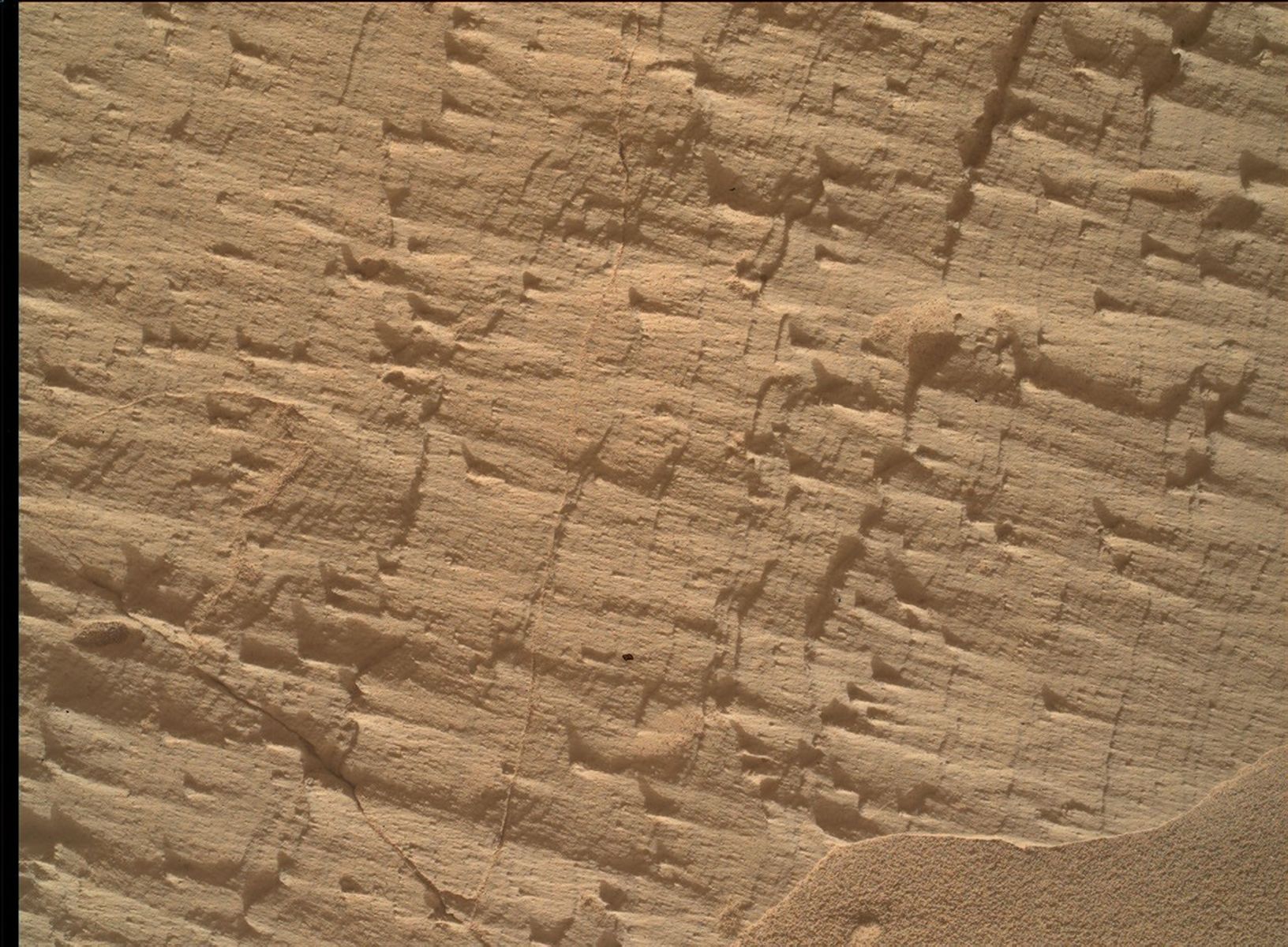
Written by Lucy Lim, Planetary Scientist at NASA’s Goddard Space Flight Center
Earth planning date: Friday, July 31, 2026
As mentioned in the previous blog, Curiosity has been exploring a large-scale feature in Gale’s sedimentary record suspected to be an “erosional supersurface.” The “supersurface” represents a period in time when a net depositional environment changed to a net erosional one before returning to a depositional regime, thus producing a discontinuity in the rock record. The erosion can involve wind, water, or both. Sometimes there are clues about these environmental changes in the layers below and above the supersurface. So far we’ve been seeing some patterns that look like aeolian features and also some “lens” deposits that sometimes appear consistent with fluvial origins. We need higher-resolution imaging of these features.
This week Curiosity came within detailed imaging range of a section of the “Cerro Paine Grande” vertical exposure just below the candidate supersurface before climbing on top of it. Mastcam was the star of the show on both planning days this week, capturing large stereo mosaics of the vertical face of the outcrop and a 360-degree panorama after the rover climbed on top of it.
NASA’s Mars rover Curiosity acquired this image, showing the rover arm in action in the “Longquimay” workspace at the top of a steep climb. Curiosity captured the image using its Right Navigation Camera on Aug. 2, 2026 — Sol 4972, or Martian day 4,972 of the Mars Science Laboratory mission — at 00:49:52 UTC. NASA/JPL-Caltech
Roving to the top took full advantage of Curiosity’s climbing capabilities, leaving the rover at an approximate 24-degree tilt in its final parking spot. The rover planners managed to reach the right posture for contact science at the same time — quite a feat, and one that approached the mission’s contact science tilt record of 27 degrees!
Meanwhile, MAHLI and our geochemical instruments provided detailed characterization of the rock layers beneath the discontinuity. I was the Geology and Mineralogy Theme Lead for the Sol 4968 (Monday) planning cycle, during which “Puyehue” in the light-toned bedrock block of the workspace was co-targeted with APXS, MAHLI, and ChemCam LIBS. The other two targeted LIBS observations in the plan went to a similar-looking nearby bedrock block (“Lago Palena”) and an intriguing layered block off to the side of the workspace (“Piedras Juntas”). Another APXS measurement went to a sand target, “Cormudesi,” which will help us assess the consistency of sand compositions along the rover’s traverse.
In the Sol 4972 workspace atop the slope, the bedrock was sharply divided between a smooth bedding-parallel surface on the local top of the outcrop and the darker-toned, rougher, angled exposure of the same rocks. The light-toned top surface was measured by MAHLI, APXS, and the LIBS at target “Sierra de Sangre,” whereas the darker-toned laminated face was targeted by APXS and MAHLI at “Laguna del Laja.” The fine-scale sedimentary structures in the textured material were also documented by a MAHLI mosaic (“Longquimay”) supported by Mastcam M100 imaging.
Rounding out the week’s science observations were several long-distance ChemCam RMI mosaics on more distant targets such as sedimentary structures above the rover’s current stratigraphic position, and finally our regular cadence measurements of the modern Martian environment, including atmospheric opacity and a ChemCam passive-sky survey to monitor abundances of minor atmospheric gases.
-
Want to read more posts from the Curiosity team?
-
Want to learn more about Curiosity’s science instruments?
Article
2 weeks ago
3 min read Curiosity Blog, Sols 4954–4960: Celebrating Our Rover Engineers Past and Present
Article
3 weeks ago
3 min read Curiosity Blog, Sols 4947-4953: Gale Crater Then and Now
Article
4 weeks ago
Keep Exploring Discover More Topics From NASA Mars
Mars is the fourth planet from the Sun, and the seventh largest. It’s the only planet we know of inhabited…
All Mars Resources
Explore this collection of Mars images, videos, resources, PDFs, and toolkits. Discover valuable content designed to inform, educate, and inspire,…
Rover Basics
Each robotic explorer sent to the Red Planet has its own unique capabilities driven by science. Many attributes of a…
Mars Exploration: Science Goals
The key to understanding the past, present or future potential for life on Mars can be found in NASA’s four…
Curiosity Blog, Sols 4968-4974: Rock Climbing Towards the Discontinuity
- Curiosity Home
- Science
- News and Features
- Multimedia
- Mars Missions
- Mars Home
3 min read
Curiosity Blog, Sols 4968-4974: Rock Climbing Towards the Discontinuity NASA’s Mars rover Curiosity acquired this image, a frame of the “Longquimay” mosaic showing fine-scale sedimentary textures in a bedrock block near the supersurface, using its Mars Hand Lens Imager (MAHLI), located on the turret at the end of the rover’s robotic arm. Curiosity acquired the image on Aug. 1, 2026 — Sol 4972, or Martian day 4,972 of the Mars Science Laboratory mission — at 23:35:43 UTC. NASA/JPL-Caltech/MSSSWritten by Lucy Lim, Planetary Scientist at NASA’s Goddard Space Flight Center
Earth planning date: Friday, July 31, 2026
As mentioned in the previous blog, Curiosity has been exploring a large-scale feature in Gale’s sedimentary record suspected to be an “erosional supersurface.” The “supersurface” represents a period in time when a net depositional environment changed to a net erosional one before returning to a depositional regime, thus producing a discontinuity in the rock record. The erosion can involve wind, water, or both. Sometimes there are clues about these environmental changes in the layers below and above the supersurface. So far we’ve been seeing some patterns that look like aeolian features and also some “lens” deposits that sometimes appear consistent with fluvial origins. We need higher-resolution imaging of these features.
This week Curiosity came within detailed imaging range of a section of the “Cerro Paine Grande” vertical exposure just below the candidate supersurface before climbing on top of it. Mastcam was the star of the show on both planning days this week, capturing large stereo mosaics of the vertical face of the outcrop and a 360-degree panorama after the rover climbed on top of it.
NASA’s Mars rover Curiosity acquired this image, showing the rover arm in action in the “Longquimay” workspace at the top of a steep climb. Curiosity captured the image using its Right Navigation Camera on Aug. 2, 2026 — Sol 4972, or Martian day 4,972 of the Mars Science Laboratory mission — at 00:49:52 UTC. NASA/JPL-CaltechRoving to the top took full advantage of Curiosity’s climbing capabilities, leaving the rover at an approximate 24-degree tilt in its final parking spot. The rover planners managed to reach the right posture for contact science at the same time — quite a feat, and one that approached the mission’s contact science tilt record of 27 degrees!
Meanwhile, MAHLI and our geochemical instruments provided detailed characterization of the rock layers beneath the discontinuity. I was the Geology and Mineralogy Theme Lead for the Sol 4968 (Monday) planning cycle, during which “Puyehue” in the light-toned bedrock block of the workspace was co-targeted with APXS, MAHLI, and ChemCam LIBS. The other two targeted LIBS observations in the plan went to a similar-looking nearby bedrock block (“Lago Palena”) and an intriguing layered block off to the side of the workspace (“Piedras Juntas”). Another APXS measurement went to a sand target, “Cormudesi,” which will help us assess the consistency of sand compositions along the rover’s traverse.
In the Sol 4972 workspace atop the slope, the bedrock was sharply divided between a smooth bedding-parallel surface on the local top of the outcrop and the darker-toned, rougher, angled exposure of the same rocks. The light-toned top surface was measured by MAHLI, APXS, and the LIBS at target “Sierra de Sangre,” whereas the darker-toned laminated face was targeted by APXS and MAHLI at “Laguna del Laja.” The fine-scale sedimentary structures in the textured material were also documented by a MAHLI mosaic (“Longquimay”) supported by Mastcam M100 imaging.
Rounding out the week’s science observations were several long-distance ChemCam RMI mosaics on more distant targets such as sedimentary structures above the rover’s current stratigraphic position, and finally our regular cadence measurements of the modern Martian environment, including atmospheric opacity and a ChemCam passive-sky survey to monitor abundances of minor atmospheric gases.
-
Want to read more posts from the Curiosity team?
-
Want to learn more about Curiosity’s science instruments?
Article
2 weeks ago
3 min read Curiosity Blog, Sols 4954–4960: Celebrating Our Rover Engineers Past and Present
Article
3 weeks ago
3 min read Curiosity Blog, Sols 4947-4953: Gale Crater Then and Now
Article
4 weeks ago
Keep Exploring Discover More Topics From NASA Mars
Mars is the fourth planet from the Sun, and the seventh largest. It’s the only planet we know of inhabited…
All Mars Resources
Explore this collection of Mars images, videos, resources, PDFs, and toolkits. Discover valuable content designed to inform, educate, and inspire,…
Rover Basics
Each robotic explorer sent to the Red Planet has its own unique capabilities driven by science. Many attributes of a…
Mars Exploration: Science Goals
The key to understanding the past, present or future potential for life on Mars can be found in NASA’s four…
APOD: 2026 August 11 – Six Moons of Saturn
APOD
Astronomy Picture of the Day
Discover the cosmos! Each day a different image or photograph of our fascinating universe is featured, along with a brief explanation written by a professional astronomer.
Six Moons of Saturn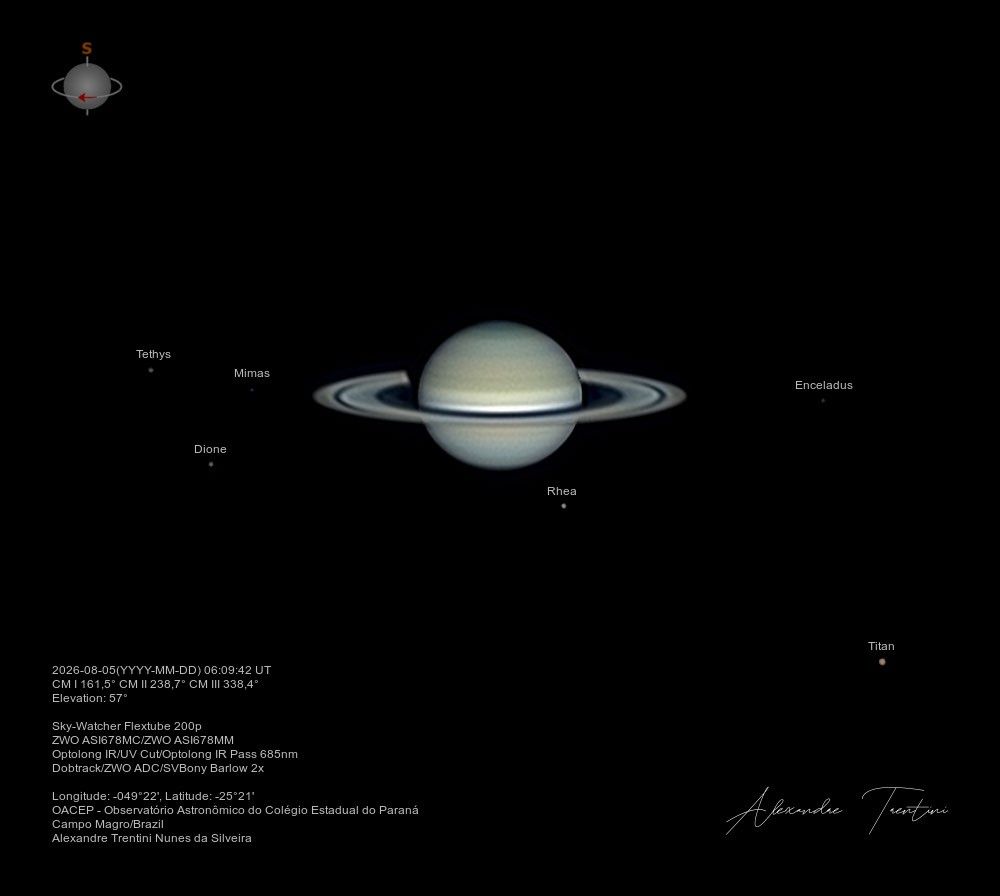
Explanation: How many moons does Saturn have? While the total will likely continue to grow, as of June 2026 the ringed gas giant had 293 confirmed moons. That’s easily more than any other planet of the Solar System, including ruling gas giant Jupiter with a mere 115 confirmed moons. Most of Saturn’s known moons are small, irregular satellites. Many are only few kilometers to a fraction of a kilometer across and grouped in tilted outer orbits. Six of its largest satellites can be seen here, though, in this sharp telescopic Saturnian family portrait taken on August 5. Larger than Earth’s Moon and even slightly larger than inner planet Mercury, Titan, with a diameter of 5,150 kilometers, is at lower right. You can also spot icy major moons Mimas, Tethys, Enceladus, Dione, and Rhea in the frame. Saturn’s first known natural satellite, Titan was discovered in 1655 by Dutch astronomer Christiaan Huygens. During the space age Voyager and Cassini discoveries have added to the swelling ranks of Saturnian moons.
NASA Stream: August 12 Total Solar Eclipse.
Tomorrow’s picture: pixels in space
NASA Science Activation & Michigan Tech. U.
Random APOD Generator
Yesterday’s Image APOD: 2026 August 10 – Three Galaxy Pairs
Tomorrow’s Image
APOD: 2026 August 11 – Six Moons of Saturn
APOD
Astronomy Picture of the Day
Discover the cosmos! Each day a different image or photograph of our fascinating universe is featured, along with a brief explanation written by a professional astronomer.
Six Moons of SaturnExplanation: How many moons does Saturn have? While the total will likely continue to grow, as of June 2026 the ringed gas giant had 293 confirmed moons. That’s easily more than any other planet of the Solar System, including ruling gas giant Jupiter with a mere 115 confirmed moons. Most of Saturn’s known moons are small, irregular satellites. Many are only few kilometers to a fraction of a kilometer across and grouped in tilted outer orbits. Six of its largest satellites can be seen here, though, in this sharp telescopic Saturnian family portrait taken on August 5. Larger than Earth’s Moon and even slightly larger than inner planet Mercury, Titan, with a diameter of 5,150 kilometers, is at lower right. You can also spot icy major moons Mimas, Tethys, Enceladus, Dione, and Rhea in the frame. Saturn’s first known natural satellite, Titan was discovered in 1655 by Dutch astronomer Christiaan Huygens. During the space age Voyager and Cassini discoveries have added to the swelling ranks of Saturnian moons.
NASA Stream: August 12 Total Solar Eclipse.
Tomorrow’s picture: pixels in space
NASA Science Activation & Michigan Tech. U.
Random APOD Generator
Yesterday’s Image APOD: 2026 August 10 – Three Galaxy Pairs
Tomorrow’s Image
Bountiful Roebuck Bay
- Earth
- Earth Observatory
- Image of the Day
- EO Explorer
- Topics
- More Content
- About
Bountiful Roebuck Bay
- Earth
- Earth Observatory
- Image of the Day
- EO Explorer
- Topics
- More Content
- About
Seven Needles, 800,000 Haystacks
A quasar is a supermassive black hole in the act of feeding, and it’s so bright that it drowns out the galaxy it sits in. That is a nuisance if you want to weigh the galaxy and weighing it is exactly what you need to do to understand how black holes and the host galaxies grew up together. There is a way round it however, catch a quasar whose galaxy happens to be bending the light of something further away, and the bending betrays the mass. The catch is that such alignments are vanishingly rare, and the survey that might contain them holds 800,000 quasars. A team at Ohio State set a neural network on the pile and it came back with seven.