
Feed aggregator
Sperm with DNA damage might be the true cause of repeated miscarriages
New guidelines say testing sperm for DNA damage could help explain recurrent pregnancy losses
Can ‘magic mushrooms’ help treat cocaine dependence?
Psychedelic-assisted therapy could open a new path for treating cocaine use disorder, which has no approved medications yet
SpaceX rocket crashes into the moon as cyberattacks hit U.S. water systems
Scientists analyze an accidental SpaceX impact on the moon as cyberattacks target U.S. water systems and a new mRNA flu vaccine is approved by the FDA
Ancient Maltese Seafarers Likely Navigated By The Stars
Ancient Maltese seafarers had both a complex cosmology and likely at least rudimentary skills in celestial navigation. It's thought that they used stars in the southern constellation of Crux to make their way around the south-central Mediterranean.
APOD: 2026 August 10 – Three Galaxy Pairs
APOD
APOD: 2026 August 10 – Three Galaxy Pairs
Discover the cosmos! Each day a different image or photograph of our fascinating universe is featured, along with a brief explanation written by a professional astronomer.
UnlabeledLabeled Three Galaxy PairsExplanation: Each of these pairs of galaxies is different. The two galaxies at the top are likely not interacting, at least presently. However, the top galaxy with the blue stripe, NGC 4650A, is a polar ring galaxy and may be the result of a past galaxy collision. The two galaxies in the middle of the featured image appear like they could be interacting gravitationally — but their relative speeds make this unlikely. Of these two, the larger galaxy, NGC 4650, is a spiral galaxy with a bright bar of stars across its center. The two galaxies at the bottom are actively interacting. Possibly in a billion years or so, NGC 4622A and NGC 4622B will merge and become one single galaxy. All of these galaxies are likely members of the larger Centaurus Galaxy Cluster.
Tomorrow’s picture: many moons
Date: August 10, 2026 Credit & Copyright: Rafael Sampaio Authors & editors: Robert Nemiroff, Jerry Bonnell, Cecilia Chirenti, Keighley Rockcliffe A service of: ASD at NASA / GSFC,NASA Science Activation & Michigan Tech. U.
Random APOD Generator
Yesterday’s Image APOD: 2026 August 9 – Contemplating the Sun
Tomorrow’s Image
APOD: 2026 August 10 – Three Galaxy Pairs
APOD
APOD: 2026 August 10 – Three Galaxy Pairs
Discover the cosmos! Each day a different image or photograph of our fascinating universe is featured, along with a brief explanation written by a professional astronomer.
UnlabeledLabeled Three Galaxy PairsExplanation: Each of these pairs of galaxies is different. The two galaxies at the top are likely not interacting, at least presently. However, the top galaxy with the blue stripe, NGC 4650A, is a polar ring galaxy and may be the result of a past galaxy collision. The two galaxies in the middle of the featured image appear like they could be interacting gravitationally — but their relative speeds make this unlikely. Of these two, the larger galaxy, NGC 4650, is a spiral galaxy with a bright bar of stars across its center. The two galaxies at the bottom are actively interacting. Possibly in a billion years or so, NGC 4622A and NGC 4622B will merge and become one single galaxy. All of these galaxies are likely members of the larger Centaurus Galaxy Cluster.
Tomorrow’s picture: many moons
Date: August 10, 2026 Credit & Copyright: Rafael Sampaio Authors & editors: Robert Nemiroff, Jerry Bonnell, Cecilia Chirenti, Keighley Rockcliffe A service of: ASD at NASA / GSFC,NASA Science Activation & Michigan Tech. U.
Random APOD Generator
Yesterday’s Image APOD: 2026 August 9 – Contemplating the Sun
Tomorrow’s Image
El Niño Alters Marine Life in the Pacific
- Earth
- Earth Observatory
- Image of the Day
- EO Explorer
- Topics
- More Content
- About
El Niño Alters Marine Life in the Pacific
- Earth
- Earth Observatory
- Image of the Day
- EO Explorer
- Topics
- More Content
- About
NASA's MAVEN Illuminates New Understanding of Auroras at Mars
NASA MAVEN (Mars Atmosphere and Volatile Evolution) mission scientists have uncovered a key puzzle piece in understanding certain types of auroras on Mars, finding that they form in a similar way to Earth-based auroras.
Europe's wildfires are igniting forgotten WWII and Cold War bombs
Europe is full of buried explosives left over from 20th century wars, and the continent’s wildfires are now big enough, hot enough and last long enough to reach them
How spaceflight changes astronauts' ability to eat and drink
If humans are to spend more time in space, scientists need to understand how life in microgravity affects eating and drinking
APOD: 2026 August 9 – Contemplating the Sun
APOD
Astronomy Picture of the Day
Discover the cosmos! Each day a different image or photograph of our fascinating universe is featured, along with a brief explanation written by a professional astronomer.
Contemplating the Sun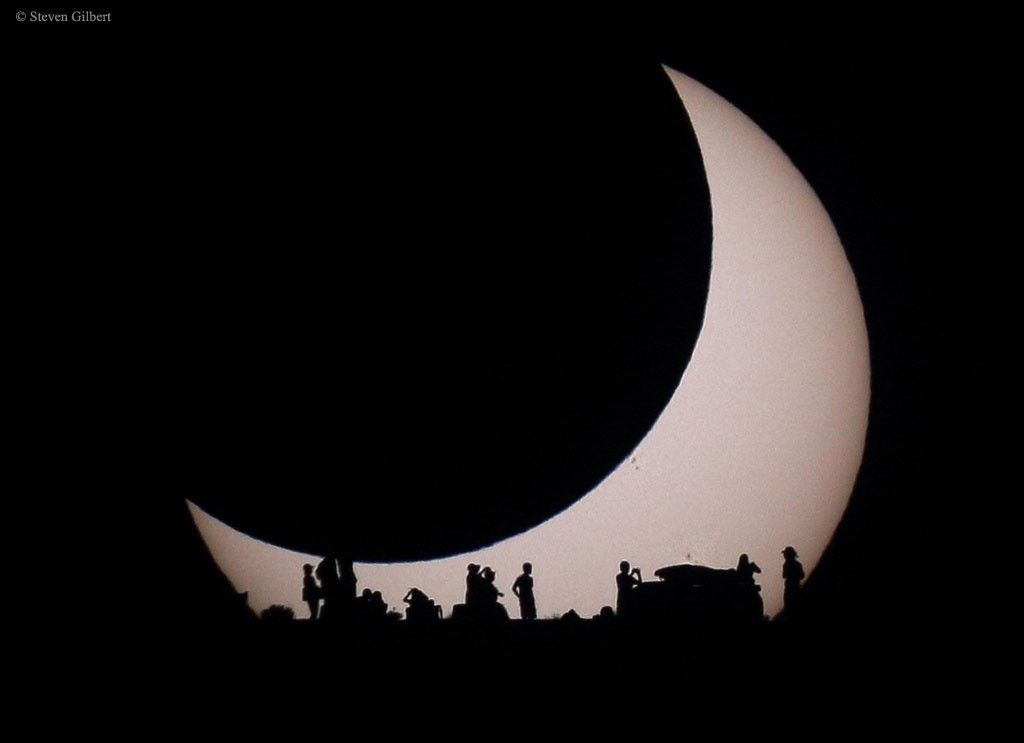
Explanation: Have you contemplated your home star recently? Featured here, a Sun partially eclipsed on the top left by the Moon is also seen eclipsed by earthlings contemplating the eclipse below. This spectacular menagerie of silhouettes was taken in 2012 from the Glen Canyon National Recreation Area near Page, Arizona, USA, where park rangers and astronomers expounded on the unusual event to interested gatherers. Also, faintly visible on the Sun’s disk, just to the lower right of the dark Moon’s disk, is a group of sunspots. A new solar eclipse will occur this week and give many people in northeastern North America, Europe, and northwestern Africa a new chance to contemplate a partially eclipsed Sun. A thin swath of Earth from Greenland to Portugal will further experience a total solar eclipse. An open question is whether any meteors from the peaking Perseids will be visible during totality.
Date August 9, 2026 Credit & Copyright Steven Gilbert Authors & editors: Robert Nemiroff, Jerry Bonnell, Cecilia Chirenti, Keighley Rockcliffe A service of: ASD at NASA / GSFC,
NASA Science Activation & Michigan Tech. U.
Random APOD Generator
Yesterday’s Image APOD: 2026 August 8 – A Messier Moment for Tempel 2
Tomorrow’s Image APOD: 2026 August 10 – Three Galaxy Pairs
APOD: 2026 August 9 – Contemplating the Sun
APOD
Astronomy Picture of the Day
Discover the cosmos! Each day a different image or photograph of our fascinating universe is featured, along with a brief explanation written by a professional astronomer.
Contemplating the SunExplanation: Have you contemplated your home star recently? Featured here, a Sun partially eclipsed on the top left by the Moon is also seen eclipsed by earthlings contemplating the eclipse below. This spectacular menagerie of silhouettes was taken in 2012 from the Glen Canyon National Recreation Area near Page, Arizona, USA, where park rangers and astronomers expounded on the unusual event to interested gatherers. Also, faintly visible on the Sun’s disk, just to the lower right of the dark Moon’s disk, is a group of sunspots. A new solar eclipse will occur this week and give many people in northeastern North America, Europe, and northwestern Africa a new chance to contemplate a partially eclipsed Sun. A thin swath of Earth from Greenland to Portugal will further experience a total solar eclipse. An open question is whether any meteors from the peaking Perseids will be visible during totality.
Date August 9, 2026 Credit & Copyright Steven Gilbert Authors & editors: Robert Nemiroff, Jerry Bonnell, Cecilia Chirenti, Keighley Rockcliffe A service of: ASD at NASA / GSFC,NASA Science Activation & Michigan Tech. U.
Random APOD Generator
Yesterday’s Image APOD: 2026 August 8 – A Messier Moment for Tempel 2
Tomorrow’s Image APOD: 2026 August 10 – Three Galaxy Pairs
Hank Green AI controversy raises questions for science communicators
The backlash raises a bigger question for science communicators: Where should AI fit into their work?
Monkeys keep pets and maintain friendships with other animals
This behaviour may shed light on one of the defining features of our own species: our extraordinary relationships with other animals
Why loneliness and not social isolation may be making you sick
One in six people are thought to experience loneliness, and that can have a serious knock-on effect on their mental and physical health
APOD: 2026 August 8 – A Messier Moment for Tempel 2
APOD
Astronomy Picture of the Day
Discover the cosmos! Each day a different image or photograph of our fascinating universe is featured, along with a brief explanation written by a professional astronomer.
A Messier Moment for Tempel 2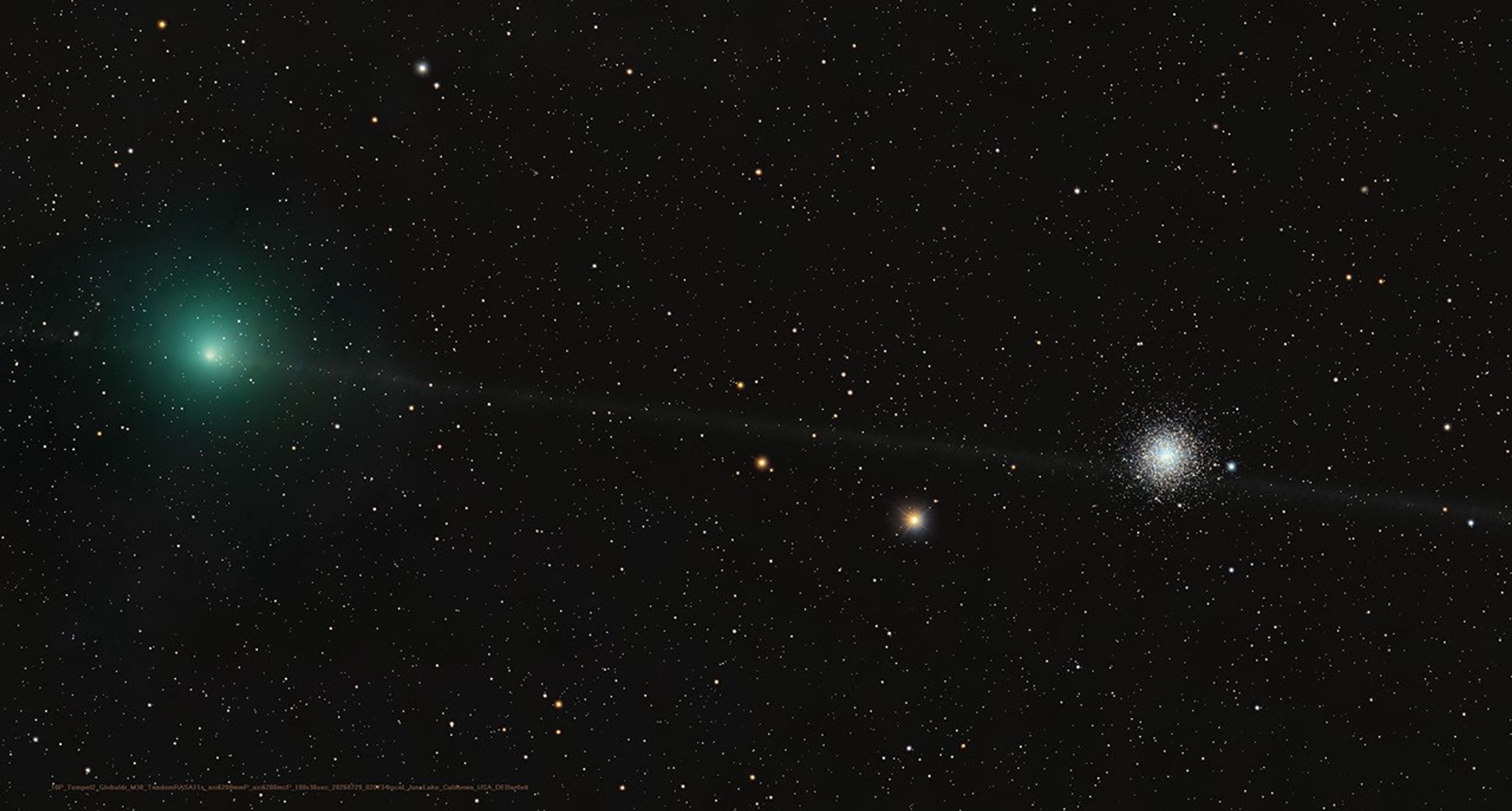
Explanation: Which of these is not a comet? You guessed it – the one on the right is a globular star cluster. The diffuse greenish coma of periodic comet 10P/Tempel 2 is at left in the frame. In fact the globular star cluster is Messier 30, also known as M30, or the 30th entry in astronomer Charles Messier’s catalog of things which are not comets. The well-known 18th century astronomer kept a list of objects he observed, now his famous Messier Catalogue of Nebulae and Star Clusters, which did not move from night to night against the background stars and so were not the comets he was hunting for. So the famous comet hunter would get the correct answer too, even though his telescope would show both 10P/Tempel 2 and distant star cluster as similar looking faint and fuzzy objects in his field of view. Recorded on July 29, this modern telescopic image captures periodic comet Tempel 2 as it briefly swept close on the sky to M30. While the periodic comet’s faint, narrow, orbital dust trail seems to pierce the globular star cluster, Tempel 2 was a mere 3.5 light-minutes away. Messier 30 is some 28,000 light-years distant.
Tomorrow’s picture: Contemplating the Sun
Date August 8, 2026 Credit & Copyright Dan Bartlett Authors & editors: Jerry Bonnell, Cecilia Chirenti, Robert Nemiroff, Keighley Rockcliffe A service of: ASD at NASA / GSFC,NASA Science Activation & Michigan Tech. U.
Random APOD Generator
Yesterday’s Image APOD: 2026 August 7 – Rubin’s Cosmos Field
Tomorrow’s Image