
Feed aggregator
Raging wildfires near Madrid, Spain
NASA to Cover Three US Spacewalks, Host Preview News Conference
Editor’s note: This media advisory was updated July 27, 2026 to reflect an updated start time for the spacewalk on Thursday, Aug. 6.
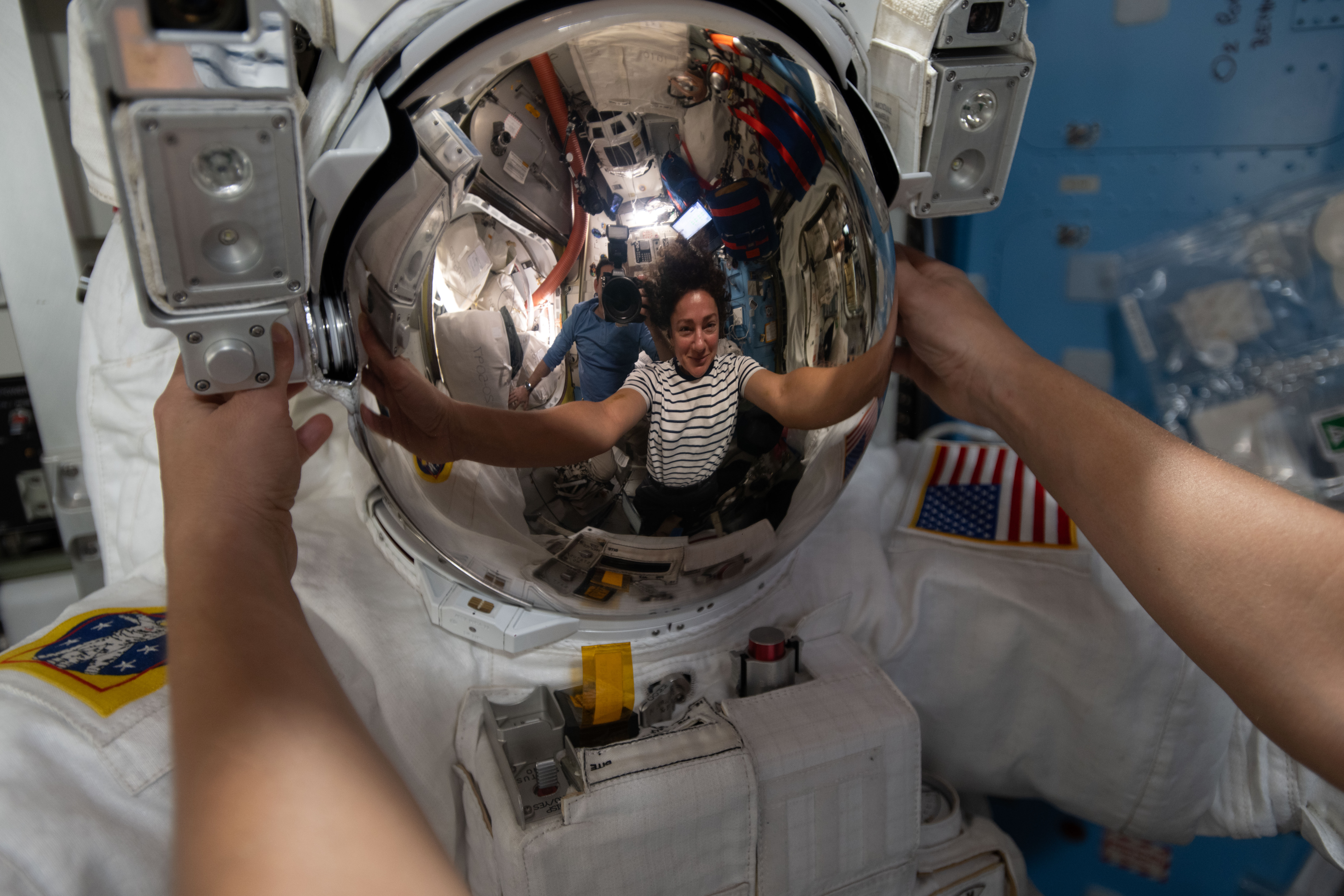
NASA will provide coverage as astronauts venture outside the International Space Station during three spacewalks in August to continue upgrading solar arrays, replace a communications antenna, and connect power and data cables in support of space station operations.
Experts will preview the upcoming spacewalks during a news conference at 2 p.m. EDT, Thursday, July 30, from NASA’s Johnson Space Center in Houston.
NASA will stream these events through a variety of platforms. Learn where to watch online:
NASA participants in the news conference include:
- Bill Spetch, deputy manager of Commercial, Low Earth Orbit Program
- Chris Dobbins, spacewalk flight director
- Chloe Mehring, spacewalk flight director
United States-based media interested in attending in person must contact the Johnson newsroom no later than 3 p.m., Wednesday, July 29, at jsccommu@mail.nasa.gov. Media joining by phone should request dial-in details by the same deadline. To ask a question, media must dial in no later than 15 minutes before the start of the news conference.
Thursday, Aug. 6
NASA astronauts Jessica Meir and Anil Menon will exit the Quest airlock to install hardware that will modify the station’s 3B power channel and prepare it for the future installation of an International Space Station Roll-Out Solar Array (IROSA). The solar array, scheduled for delivery later this year, will be the seventh IROSA and will provide additional power to support critical station operations, including its safe and controlled deorbit.
Watch NASA’s live coverage of U.S. spacewalk 96 beginning at 7 a.m. The spacewalk is expected to start at 8:35 a.m. and last about six and a half hours.
This spacewalk will be the sixth for Meir and the first for Menon. Meir will serve as spacewalk crew member 1 and will wear a suit with red stripes. Menon will serve as crew member 2 and will wear an unmarked suit.
Thursday, Aug. 13
During U.S. spacewalk 97, two astronauts will replace a Space-to-Ground antenna on the orbital complex. The antenna is a critical communication system NASA uses to transmit data and high‑speed communication between the Mission Control Center in Houston and the space station.
Tuesday, Aug. 25
The U.S. spacewalk 98 crew members will connect power channel cables and data relay systems as part of ongoing maintenance, including preparations for the space station’s future deorbit. The astronauts also will replace a navigational aid used for spacecraft docking on the Harmony module’s forward port.
NASA will share additional details about U.S. spacewalks 97 and 98, including timing, assigned crew members, and coverage information, closer to each operation.
The spacewalks will be the 281st, 282nd, and 283rd conducted in support of space station assembly, maintenance, and upgrades.
To learn more about International Space Station research, operations, and its crews, visit:
-end-
Joshua Finch / Jimi Russell
Headquarters, Washington
202-358-1100
joshua.a.finch@nasa.gov / james.j.russell@nasa.gov
Sandra Jones / Anna Schneider
Johnson Space Center, Houston
281-483-5111
sandra.p.jones@nasa.gov / anna.c.schneider@nasa.gov
NASA to Cover Three US Spacewalks, Host Preview News Conference
Editor’s note: This media advisory was updated July 27, 2026 to reflect an updated start time for the spacewalk on Thursday, Aug. 6.
NASA will provide coverage as astronauts venture outside the International Space Station during three spacewalks in August to continue upgrading solar arrays, replace a communications antenna, and connect power and data cables in support of space station operations.
Experts will preview the upcoming spacewalks during a news conference at 2 p.m. EDT, Thursday, July 30, from NASA’s Johnson Space Center in Houston.
NASA will stream these events through a variety of platforms. Learn where to watch online:
NASA participants in the news conference include:
- Bill Spetch, deputy manager of Commercial, Low Earth Orbit Program
- Chris Dobbins, spacewalk flight director
- Chloe Mehring, spacewalk flight director
United States-based media interested in attending in person must contact the Johnson newsroom no later than 3 p.m., Wednesday, July 29, at jsccommu@mail.nasa.gov. Media joining by phone should request dial-in details by the same deadline. To ask a question, media must dial in no later than 15 minutes before the start of the news conference.
Thursday, Aug. 6
NASA astronauts Jessica Meir and Anil Menon will exit the Quest airlock to install hardware that will modify the station’s 3B power channel and prepare it for the future installation of an International Space Station Roll-Out Solar Array (IROSA). The solar array, scheduled for delivery later this year, will be the seventh IROSA and will provide additional power to support critical station operations, including its safe and controlled deorbit.
Watch NASA’s live coverage of U.S. spacewalk 96 beginning at 7 a.m. The spacewalk is expected to start at 8:35 a.m. and last about six and a half hours.
This spacewalk will be the sixth for Meir and the first for Menon. Meir will serve as spacewalk crew member 1 and will wear a suit with red stripes. Menon will serve as crew member 2 and will wear an unmarked suit.
Thursday, Aug. 13
During U.S. spacewalk 97, two astronauts will replace a Space-to-Ground antenna on the orbital complex. The antenna is a critical communication system NASA uses to transmit data and high‑speed communication between the Mission Control Center in Houston and the space station.
Tuesday, Aug. 25
The U.S. spacewalk 98 crew members will connect power channel cables and data relay systems as part of ongoing maintenance, including preparations for the space station’s future deorbit. The astronauts also will replace a navigational aid used for spacecraft docking on the Harmony module’s forward port.
NASA will share additional details about U.S. spacewalks 97 and 98, including timing, assigned crew members, and coverage information, closer to each operation.
The spacewalks will be the 281st, 282nd, and 283rd conducted in support of space station assembly, maintenance, and upgrades.
To learn more about International Space Station research, operations, and its crews, visit:
-end-
Joshua Finch / Jimi Russell
Headquarters, Washington
202-358-1100
joshua.a.finch@nasa.gov / james.j.russell@nasa.gov
Sandra Jones / Anna Schneider
Johnson Space Center, Houston
281-483-5111
sandra.p.jones@nasa.gov / anna.c.schneider@nasa.gov
NASA’s Hubble Shows Star Formation in Andromeda Galaxy Winding Down
- Hubble Home
- Overview
- Impact & Benefits
- Science
- Observatory
- Team
- Multimedia
- News
- More
Image: NASA, ESA, Benjamin Williams (UWashington), Zhuo Chen (UWashington), L. Clifton Johnson (Northwestern); Image Processing: Joseph DePasquale (STScI)
A new study using data from NASA’s Hubble Space Telescope finds that star formation in the nearby Andromeda galaxy has undergone a 500-million-year decline, with an even steeper drop in the last 40 million years. Andromeda, a spiral galaxy comparable in size to our Milky Way, is close enough to be seen with the unaided eye from areas with dark skies. Located about 2.5 million light-years from Earth, practically our cosmic backyard, Andromeda offers an opportunity for astronomers to examine its stellar populations in detail, leading to better understanding of the past of galaxies like our own.
The results published Monday in The Astrophysical Journal.
To reach this conclusion, the researchers combined data from two Hubble surveys: the Panchromatic Hubble Andromeda Treasury and the Panchromatic Hubble Andromeda Southern Treasury. Together, these two surveys mapped two-thirds of the disk of Andromeda in ultra-sharp detail. In total, the team measured about 200 million individual stars across the galaxy, giving them a detailed picture of Andromeda’s past activity.
“We need to measure the individual stars because they are the fossil record of the galaxy’s formation. Hubble is the only telescope that can give you high enough spatial resolution over a large enough area to be able to do that in Andromeda,” said Ben Williams, astronomer at the University of Washington and a co-author on the study.
Massive stars are bluer and short-lived, while less massive stars are redder and longer-lived. As a result, areas that have experienced recent star formation tend to have a larger fraction of blue stars, while areas with less recent star formation typically have a redder population. The team divided the Andromeda images into thousands of squares, spanning 300 light-years on each side of the square, and determined the history of star formation within each parcel to gain a comprehensive view of the galaxy’s past.
Unable to render the provided source NASA’s Hubble Space Telescope has provided a detailed view of millions of stars in the Andromeda galaxy. Regions that have experienced recent star formation (1) appear significantly bluer than regions with less recent star formation (2). NASA, ESA, Benjamin Williams (UWashington), Zhuo Chen (UWashington), L. Clifton Johnson (Northwestern); Image Processing: Joseph DePasquale (STScI) Steady declinePrevious research showed the Andromeda galaxy experienced a dramatic burst of star formation about 2 billion years ago, likely due to a past interaction or merger with another galaxy. Since that time, star formation has been steadily declining.
Astronomers measure the rate of star formation in terms of the mass, or amount of gas and dust, converted into stars per year. The researchers calculated that, 500 million years ago, Andromeda formed stars at a rate of about one solar mass per year. However, the formation rate dropped to about half that by 40 million years ago. The current rate has plummeted even farther, to about one-fifth the mass of our Sun per year.
The team also examined whether that decline was consistent across the galaxy or concentrated in certain areas. They found that much of the recent star formation has occurred in a star-forming ring located about 32,000 light-years from the galaxy’s center. As a result, much of the decline they measure is driven by decreasing activity within that ring.
Rather than being the result of reduced material from which new stars can form, the decline is more likely to be a natural winding down from its previous, more active state.
“It’s just like after running a marathon, sometimes you’ve got to take a bit of a breather,” said Tobin Wainer, lead author, University of Washington.
Likely suspectThe team also investigated whether there was any connection between the decrease of activity in Andromeda and its proximity to satellite galaxy M32 (Messier 32). The M32 galaxy is separated from Andromeda by about 16,000 light-years in the plane of the sky; however, its 3D location in space is uncertain. As a result, astronomers are unsure if or when it might have interacted with Andromeda in the past.
“One of the major motivations for this program was to probe potential interactions between M32 and Andromeda’s disk,” said Zhuo Chen, co-author, University of Washington.
Survey data from the Panchromatic Hubble Andromeda Southern Treasury allowed the team to study the history of star formation in Andromeda near M32. They found that this area showed signs of decreased star formation compared with other regions. The timing of this decrease, which this study finds began roughly 60 million years ago, could help constrain when the M32 galaxy interacted with Andromeda’s disk.
“We can’t explicitly say that we are seeing a decrease in star formation because of M32. But it’s right there, and it’s definitely the most likely suspect,” said Wainer.
To view this video please enable JavaScript, and consider upgrading to a web browser that
supports HTML5 video
The team plans to continue analyzing the Hubble data and combine it with data from ground-based observatories to gain additional insights into the history of Andromeda.
“There’s a strong scientific value to this archival data. Andromeda is important because it’s a neighbor that is close enough that we can see it in great detail while also getting a global perspective,” said Raja GuhaThakurta, co-author, University of California Santa Cruz.
An even greater global perspective is likely to come from NASA’s Nancy Grace Roman Space Telescope after it launches as early as Sunday, Aug. 30. Roman’s gigantic field of view can cover at least 100 times as much area as Hubble at near-infrared wavelengths in a single observation. A newly approved Roman observing program will image the entirety of Andromeda’s disk and areas of its surrounding halo, allowing astronomers to measure hundreds of millions of stars and enabling groundbreaking new science.
The Hubble Space Telescope has been operating for more than three decades and continues to make ground-breaking discoveries that shape our fundamental understanding of the universe. Hubble is a project of international cooperation between NASA and ESA (European Space Agency). NASA’s Goddard Space Flight Center in Greenbelt, Maryland, manages the telescope and mission operations. Lockheed Martin Space also supports mission operations at Goddard. The Space Telescope Science Institute in Baltimore, which is operated by the Association of Universities for Research in Astronomy, conducts Hubble science operations for NASA.
Facebook logo @NASAHubble @NASAHubble Instagram logo @NASAHubbleRelated Images & Videos Andromeda Galaxy
NASA’s Hubble Space Telescope has provided a detailed view of millions of stars in the Andromeda galaxy.
Star Formation Rate in Andromeda Over Time
This movie, created from an analysis of data from NASA’s Hubble Space Telescope, demonstrates how the rate of star formation in the Andromeda galaxy has declined over the past 500 million years.
Claire Andreoli
NASA’s Goddard Space Flight Center
Greenbelt, Maryland
claire.andreoli@nasa.gov
Christine Pulliam
Space Telescope Science Institute
Baltimore, Maryland
- Academic Paper: “The Panchromatic Hubble Andromeda Southern Treasury (PHAST). II. The Spatially Resolved Recent Star Formation History in M31”
Keep Exploring Discover More Topics From Hubble Hubble Space Telescope
Since its 1990 launch, the Hubble Space Telescope has changed our fundamental understanding of the universe.
Hubble Science Highlights
Hubble’s most notable scientific discoveries reflect the broad range of research and the breakthroughs it has achieved.
Hubble Images
Explore Hubble’s iconic images of the universe, and view photos of mission operations and astronauts servicing Hubble in space.
Hubble News
NASA’s Hubble Shows Star Formation in Andromeda Galaxy Winding Down
- Hubble Home
- Overview
- Impact & Benefits
- Science
- Observatory
- Team
- Multimedia
- News
- More
Image: NASA, ESA, Benjamin Williams (UWashington), Zhuo Chen (UWashington), L. Clifton Johnson (Northwestern); Image Processing: Joseph DePasquale (STScI)
A new study using data from NASA’s Hubble Space Telescope finds that star formation in the nearby Andromeda galaxy has undergone a 500-million-year decline, with an even steeper drop in the last 40 million years. Andromeda, a spiral galaxy comparable in size to our Milky Way, is close enough to be seen with the unaided eye from areas with dark skies. Located about 2.5 million light-years from Earth, practically our cosmic backyard, Andromeda offers an opportunity for astronomers to examine its stellar populations in detail, leading to better understanding of the past of galaxies like our own.
The results published Monday in The Astrophysical Journal.
To reach this conclusion, the researchers combined data from two Hubble surveys: the Panchromatic Hubble Andromeda Treasury and the Panchromatic Hubble Andromeda Southern Treasury. Together, these two surveys mapped two-thirds of the disk of Andromeda in ultra-sharp detail. In total, the team measured about 200 million individual stars across the galaxy, giving them a detailed picture of Andromeda’s past activity.
“We need to measure the individual stars because they are the fossil record of the galaxy’s formation. Hubble is the only telescope that can give you high enough spatial resolution over a large enough area to be able to do that in Andromeda,” said Ben Williams, astronomer at the University of Washington and a co-author on the study.
Massive stars are bluer and short-lived, while less massive stars are redder and longer-lived. As a result, areas that have experienced recent star formation tend to have a larger fraction of blue stars, while areas with less recent star formation typically have a redder population. The team divided the Andromeda images into thousands of squares, spanning 300 light-years on each side of the square, and determined the history of star formation within each parcel to gain a comprehensive view of the galaxy’s past.
Unable to render the provided source NASA’s Hubble Space Telescope has provided a detailed view of millions of stars in the Andromeda galaxy. Regions that have experienced recent star formation (1) appear significantly bluer than regions with less recent star formation (2). NASA, ESA, Benjamin Williams (UWashington), Zhuo Chen (UWashington), L. Clifton Johnson (Northwestern); Image Processing: Joseph DePasquale (STScI) Steady declinePrevious research showed the Andromeda galaxy experienced a dramatic burst of star formation about 2 billion years ago, likely due to a past interaction or merger with another galaxy. Since that time, star formation has been steadily declining.
Astronomers measure the rate of star formation in terms of the mass, or amount of gas and dust, converted into stars per year. The researchers calculated that, 500 million years ago, Andromeda formed stars at a rate of about one solar mass per year. However, the formation rate dropped to about half that by 40 million years ago. The current rate has plummeted even farther, to about one-fifth the mass of our Sun per year.
The team also examined whether that decline was consistent across the galaxy or concentrated in certain areas. They found that much of the recent star formation has occurred in a star-forming ring located about 32,000 light-years from the galaxy’s center. As a result, much of the decline they measure is driven by decreasing activity within that ring.
Rather than being the result of reduced material from which new stars can form, the decline is more likely to be a natural winding down from its previous, more active state.
“It’s just like after running a marathon, sometimes you’ve got to take a bit of a breather,” said Tobin Wainer, lead author, University of Washington.
Likely suspectThe team also investigated whether there was any connection between the decrease of activity in Andromeda and its proximity to satellite galaxy M32 (Messier 32). The M32 galaxy is separated from Andromeda by about 16,000 light-years in the plane of the sky; however, its 3D location in space is uncertain. As a result, astronomers are unsure if or when it might have interacted with Andromeda in the past.
“One of the major motivations for this program was to probe potential interactions between M32 and Andromeda’s disk,” said Zhuo Chen, co-author, University of Washington.
Survey data from the Panchromatic Hubble Andromeda Southern Treasury allowed the team to study the history of star formation in Andromeda near M32. They found that this area showed signs of decreased star formation compared with other regions. The timing of this decrease, which this study finds began roughly 60 million years ago, could help constrain when the M32 galaxy interacted with Andromeda’s disk.
“We can’t explicitly say that we are seeing a decrease in star formation because of M32. But it’s right there, and it’s definitely the most likely suspect,” said Wainer.
To view this video please enable JavaScript, and consider upgrading to a web browser that
supports HTML5 video
The team plans to continue analyzing the Hubble data and combine it with data from ground-based observatories to gain additional insights into the history of Andromeda.
“There’s a strong scientific value to this archival data. Andromeda is important because it’s a neighbor that is close enough that we can see it in great detail while also getting a global perspective,” said Raja GuhaThakurta, co-author, University of California Santa Cruz.
An even greater global perspective is likely to come from NASA’s Nancy Grace Roman Space Telescope after it launches as early as Sunday, Aug. 30. Roman’s gigantic field of view can cover at least 100 times as much area as Hubble at near-infrared wavelengths in a single observation. A newly approved Roman observing program will image the entirety of Andromeda’s disk and areas of its surrounding halo, allowing astronomers to measure hundreds of millions of stars and enabling groundbreaking new science.
The Hubble Space Telescope has been operating for more than three decades and continues to make ground-breaking discoveries that shape our fundamental understanding of the universe. Hubble is a project of international cooperation between NASA and ESA (European Space Agency). NASA’s Goddard Space Flight Center in Greenbelt, Maryland, manages the telescope and mission operations. Lockheed Martin Space also supports mission operations at Goddard. The Space Telescope Science Institute in Baltimore, which is operated by the Association of Universities for Research in Astronomy, conducts Hubble science operations for NASA.
Facebook logo @NASAHubble @NASAHubble Instagram logo @NASAHubbleRelated Images & Videos Andromeda Galaxy
NASA’s Hubble Space Telescope has provided a detailed view of millions of stars in the Andromeda galaxy.
Star Formation Rate in Andromeda Over Time
This movie, created from an analysis of data from NASA’s Hubble Space Telescope, demonstrates how the rate of star formation in the Andromeda galaxy has declined over the past 500 million years.
Claire Andreoli
NASA’s Goddard Space Flight Center
Greenbelt, Maryland
claire.andreoli@nasa.gov
Christine Pulliam
Space Telescope Science Institute
Baltimore, Maryland
- Academic Paper: “The Panchromatic Hubble Andromeda Southern Treasury (PHAST). II. The Spatially Resolved Recent Star Formation History in M31”
Keep Exploring Discover More Topics From Hubble Hubble Space Telescope
Since its 1990 launch, the Hubble Space Telescope has changed our fundamental understanding of the universe.
Hubble Science Highlights
Hubble’s most notable scientific discoveries reflect the broad range of research and the breakthroughs it has achieved.
Hubble Images
Explore Hubble’s iconic images of the universe, and view photos of mission operations and astronauts servicing Hubble in space.
Hubble News
Can bees sense magnetic fields?
Magnetoreception is one of the most controversial animal senses. And several bee species might have it
The best science books to read this summer, according to Scientific American editors
From ecohorror to science-inspired poetry, discover the books Scientific American staffers are recommending this summer
Meet space startups at ESA’s Industry Space Days
Startup companies which have come up with brilliant ideas for using space will join the European Space Agency’s (ESA) Industry Space Days (ISD) event on 16–17 September at ESA-ESTEC in the Netherlands.
Over two days Europe’s space industry will exchange ideas, showcase capabilities, discuss collaboration, and explore opportunities with ESA.
Black Hole Collisions Tell a Tale of Repeating Mergers
A black hole merger is one of the Universe's most energetic and massive events. During such a collision, two black holes orbit closer and closer until they collide and become a much more massive black hole. The event also gives off radiation and, as it happens, gravitational waves. They help tell the story of the two objects involved in the collision.
New Research Shows How Clouds Shape the Interiors of sub-Neptunes
Scientists at ASU's School of Earth and Space Exploration have demonstrated how clouds in a sub-Neptune's atmosphere shape the interior structure of the planet.
UCF Researchers Are Developing Tools to Help Find Habitable Planets
Through the Photonics-Enabled Exoplanet Spectroscopic System (PEEPSS) program, researchers are developing a technology that will assist NASA's planned Habitable World's Observatory (HWO).
Are Aliens Harvesting the Spin of Stars?
One of the challenges of searching for “technosignatures” (i.e. signs that intelligent life somewhere in the universe has created technology) is understanding what to look for. Technology is a very broad area, and different types would show up as different features. One of the most commonly cited is a Dyson sphere, which attempts to encapsulate a star and capture it’s outgoing light to produce energy. But while we’ve looked for the mid-infrared waste heat these structures would produce for decades, we haven’t found a definitive instance of one. According to a new paper, available in pre-print on arXiv by Turkish high school student Sahin Torlakcik, that might be because we are looking for the wrong type of energy all together.
NASA Astronaut Chris Williams, Crewmates Return from Space Station
Concluding an eight-month science mission aboard the International Space Station, NASA astronaut Chris Williams returned to Earth on Sunday alongside Roscosmos cosmonauts Sergey Kud-Sverchkov and Sergei Mikaev.
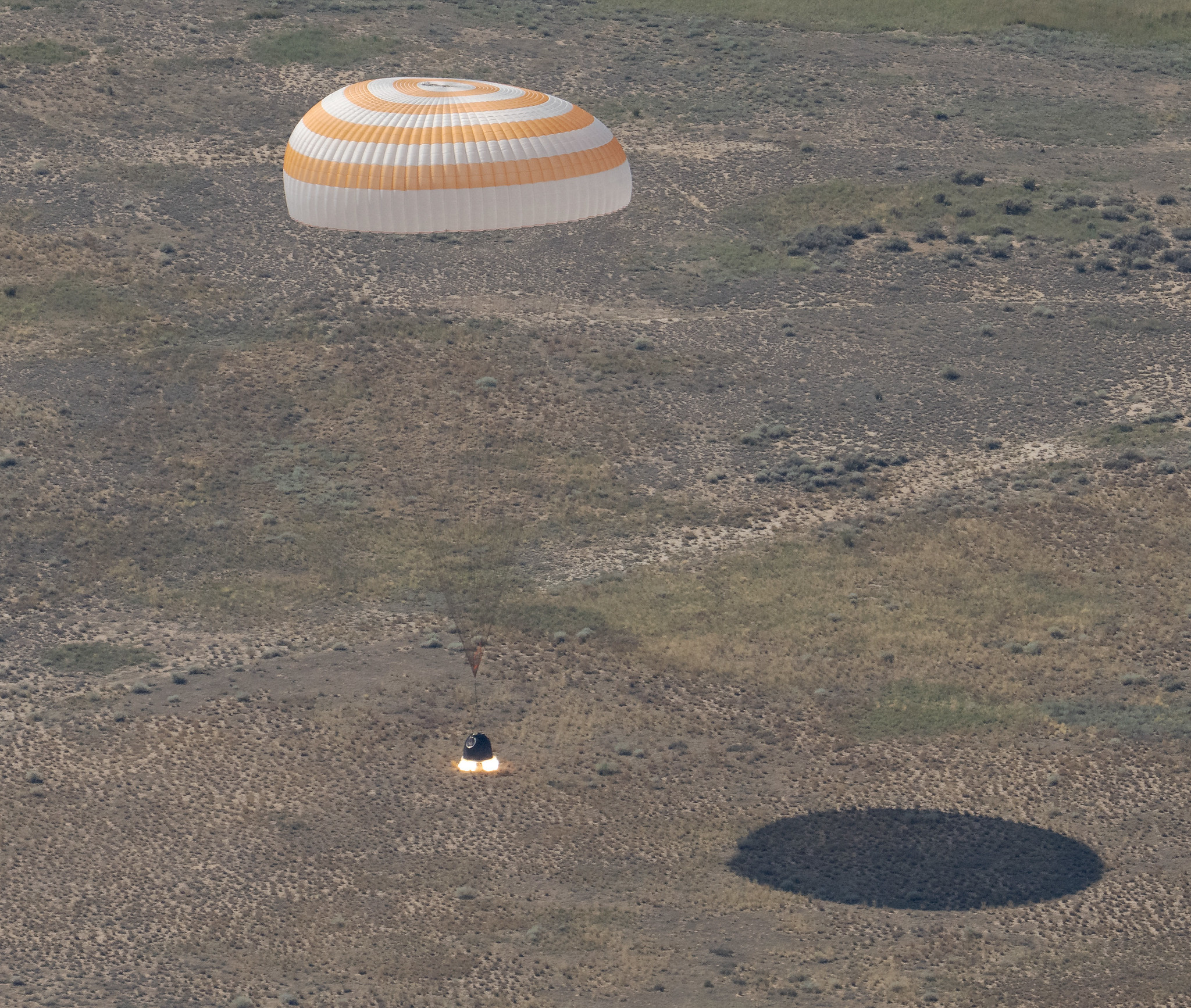
The crew made its safe, parachute-assisted landing at 5:27 a.m. CDT (3:27 p.m., Kazakhstan time), southeast of Dzhezkazgan, after departing the space station at 2:03 a.m., aboard the Soyuz MS-28 spacecraft.
The crew was in space for 241 days, orbiting the Earth 3,856 times and traveling more than 102 million miles. They launched to the International Space Station on Nov. 27, 2025. The mission was the first for Williams and Mikaev and the second for Kud-Sverchkov.
While aboard the orbiting laboratory, Williams supported a wide range of scientific investigations and technology demonstrations. He helped advance research for new cancer treatments and improved in-space manufacturing of materials used in high-performance computers and electronics. Williams also completed two spacewalks to prep for space station power system upgrades and to replace a faulty joint on the Canadarm2 robotic arm. The crew’s work aboard the space station helps improve life on Earth and prepare for future human missions to the Moon and Mars.
Following post-landing medical checks, the crew members will fly by helicopter to Karaganda, Kazakhstan, where recovery teams are based. Williams then will board a NASA aircraft bound for the agency’s Johnson Space Center in Houston.
For more than 25 years, people have lived and worked continuously aboard the International Space Station, advancing scientific knowledge and making research breakthroughs not possible on Earth. The space station helps NASA understand and overcome the challenges of human spaceflight, expand commercial opportunities in low Earth orbit, and build on the foundation for long-duration missions to the Moon, as part of the Artemis program, and to Mars.
To learn more about International Space Station research, operations, and its crews, visit:
-end-
Joshua Finch / Jimi Russell
Headquarters, Washington
202-358-1100
joshua.a.finch@nasa.gov / james.j.russell@nasa.gov
Leah Cheshier / Anna Schneider
Johnson Space Center, Houston
281-483-5111
leah.d.cheshier@nasa.gov / anna.c.schneider@nasa.gov
NASA Astronaut Chris Williams, Crewmates Return from Space Station
Concluding an eight-month science mission aboard the International Space Station, NASA astronaut Chris Williams returned to Earth on Sunday alongside Roscosmos cosmonauts Sergey Kud-Sverchkov and Sergei Mikaev.
The crew made its safe, parachute-assisted landing at 5:27 a.m. CDT (3:27 p.m., Kazakhstan time), southeast of Dzhezkazgan, after departing the space station at 2:03 a.m., aboard the Soyuz MS-28 spacecraft.
The crew was in space for 241 days, orbiting the Earth 3,856 times and traveling more than 102 million miles. They launched to the International Space Station on Nov. 27, 2025. The mission was the first for Williams and Mikaev and the second for Kud-Sverchkov.
While aboard the orbiting laboratory, Williams supported a wide range of scientific investigations and technology demonstrations. He helped advance research for new cancer treatments and improved in-space manufacturing of materials used in high-performance computers and electronics. Williams also completed two spacewalks to prep for space station power system upgrades and to replace a faulty joint on the Canadarm2 robotic arm. The crew’s work aboard the space station helps improve life on Earth and prepare for future human missions to the Moon and Mars.
Following post-landing medical checks, the crew members will fly by helicopter to Karaganda, Kazakhstan, where recovery teams are based. Williams then will board a NASA aircraft bound for the agency’s Johnson Space Center in Houston.
For more than 25 years, people have lived and worked continuously aboard the International Space Station, advancing scientific knowledge and making research breakthroughs not possible on Earth. The space station helps NASA understand and overcome the challenges of human spaceflight, expand commercial opportunities in low Earth orbit, and build on the foundation for long-duration missions to the Moon, as part of the Artemis program, and to Mars.
To learn more about International Space Station research, operations, and its crews, visit:
-end-
Joshua Finch / Jimi Russell
Headquarters, Washington
202-358-1100
joshua.a.finch@nasa.gov / james.j.russell@nasa.gov
Leah Cheshier / Anna Schneider
Johnson Space Center, Houston
281-483-5111
leah.d.cheshier@nasa.gov / anna.c.schneider@nasa.gov
550 years later, scientists claim to have solved what killed Botticelli’s muse
Italian Renaissance painter Sandro Botticelli painted Simonetta Vespucci as Venus rising from the waves. Now scientists think they’ve solved how she died
JWST May Be Missing Water Hidden Deep Within Mini-Neptune Worlds
Sub-Neptune exoplanets, exoplanets that are slightly smaller than Neptune, have been designated as the most common type of planet in the Milky Way Galaxy based on their vast discovery numbers, totaling almost 3,300 out of the more than 6,300 confirmed exoplanets to date. Despite these numbers, the characteristics of sub-Neptunes remain relatively unknown. This is primarily due to our own solar system not having its own sub-Neptune to use as an analog, along with their atmospheres being thick and hazy. As a result, this makes telescopic observations, even from powerful instruments like NASA’s James Webb Space Telescope, extremely difficult.
Could We Send a Spacecraft to a Black Hole?
Black holes represent some of the most extreme environments in the universe. They’re the sources of the strongest consistent gravitational fields, which allows us to test Einstein’s Theory of General Relativity to an extent that’s impossible with small objects. But we’re also reaching our limit of what we can learn about one remotely. So various authors have put forward ideas for how we might eventually send a probe directly to a black hole to observe it up close. One of the most vocal of those authors is Cosimo Bambi of Fudan University in Shanghai - and he recently released a paper, available in pre-print on arXiv, about what it would take for us to send a gram-size probe to a nearby black hole.
The math of traffic jams and how to avoid them
When the roads get crowded, many drivers start changing lanes. Mathematics suggests this intuition is typically wrong