
Feed aggregator
Meet the Constellations: Delphinus, the Dolphin
Delphinus, the constellation looks just like a tiny Dolphin that's splashing its way through the sky amidst other famous summer sights.
The post Meet the Constellations: Delphinus, the Dolphin appeared first on Sky & Telescope.
Daddy long legs perform fellatio—and other wild facts about how these arachnids mate
Some female daddy longlegs will perform fellatio, perhaps to avoid potential violence from males, while males of another species entice females with a secretion on their penises
Cyclosporiasis cases surge while new research questions ‘protein maxxing’
An outbreak of Cyclospora infections tied to produce spreads across multiple states as new research challenges the protein maxxing craze
APOD: 2026 August 3 – Vaporizing Meteor Photobombs the Lacerta Nebula
APOD
Astronomy Picture of the Day
Discover the cosmos! Each day a different image or photograph of our fascinating universe is featured, along with a brief explanation written by a professional astronomer.
Vaporizing Meteor Photobombs the Lacerta Nebula
Explanation: What’s happening to this meteor? This bright meteor streak appeared and disappeared quickly during a long exposure of the Great Lacerta Nebula, seen faintly in red toward the center of the image. The meteoroid, likely a small pebble, creates its glow partly by heating and exciting surrounding air in Earth’s atmosphere, but itself vaporizes and leaves wind-blown gas and dust with colors that give clues to its composition. The featured image was captured last month from Death Valley Observatories in Nevada, USA. This month, though, is particularly good for seeing meteors. Presently there are three meteor showers ongoing, although they are currently competing for visibility with the glow of a bright gibbous Moon. The most active of these showers, the Perseids, will be busiest in about 10 days — after the Moon has dimmed considerably. This year, the Perseids peak nearly coincides with not only a new Moon, but, from some locations, one that totally eclipses the Sun.
Sky Surprise: What picture did APOD feature on your birthday? (>1995)
Tomorrow’s picture: open space…
NASA Science Activation & Michigan Tech. U. Random APOD Generator Yesterday’s Image APOD: 2026 August 2 – A Fire Rainbow over West Virginia Tomorrow’s Image
APOD: 2026 August 3 – Vaporizing Meteor Photobombs the Lacerta Nebula
APOD
Astronomy Picture of the Day
Discover the cosmos! Each day a different image or photograph of our fascinating universe is featured, along with a brief explanation written by a professional astronomer.
Vaporizing Meteor Photobombs the Lacerta Nebula
Explanation: What’s happening to this meteor? This bright meteor streak appeared and disappeared quickly during a long exposure of the Great Lacerta Nebula, seen faintly in red toward the center of the image. The meteoroid, likely a small pebble, creates its glow partly by heating and exciting surrounding air in Earth’s atmosphere, but itself vaporizes and leaves wind-blown gas and dust with colors that give clues to its composition. The featured image was captured last month from Death Valley Observatories in Nevada, USA. This month, though, is particularly good for seeing meteors. Presently there are three meteor showers ongoing, although they are currently competing for visibility with the glow of a bright gibbous Moon. The most active of these showers, the Perseids, will be busiest in about 10 days — after the Moon has dimmed considerably. This year, the Perseids peak nearly coincides with not only a new Moon, but, from some locations, one that totally eclipses the Sun.
Sky Surprise: What picture did APOD feature on your birthday? (>1995)
Tomorrow’s picture: open space…
NASA Science Activation & Michigan Tech. U. Random APOD Generator Yesterday’s Image APOD: 2026 August 2 – A Fire Rainbow over West Virginia Tomorrow’s Image
Plan for Next Year's Total Solar Eclipse: August 2, 2027
The longest total solar eclipse visible from land until 2114 will sweep across Spain and North Africa on August 2, 2027. Here’s how to choose where to watch it.
The post Plan for Next Year's Total Solar Eclipse: August 2, 2027 appeared first on Sky & Telescope.
APOD: 2026 August 2 – A Fire Rainbow over West Virginia
APOD
Astronomy Picture of the Day
Discover the cosmos! Each day a different image or photograph of our fascinating universe is featured, along with a brief explanation written by a professional astronomer.
A Fire Rainbow over West Virginia
Explanation: What’s happening to this cloud? Ice crystals in a distant cirrus cloud are acting like little floating prisms. Known informally as a fire rainbow for its flame-like appearance, a circumhorizon arc appears parallel to the horizon. For a circumhorizontal arc to be visible, the Sun must be at least 58 degrees high in a sky where cirrus clouds present below — in this case cirrus fibratus. The numerous, flat, hexagonal ice-crystals that compose the cirrus cloud must be aligned horizontally to properly refract sunlight in a collectively similar manner. Therefore, circumhorizontal arcs are somewhat unusual to see. The featured fire rainbow was photographed in 2021 near North Fork Mountain in West Virginia, USA.
Tomorrow’s picture: meteoric photobomb

NASA Science Activation & Michigan Tech. U. Random APOD Generator Yesterday’s Image APOD: 2026 August 1 – Buck Moon and Belt of Venus Tomorrow’s Image APOD: 2026 August 3 – Vaporizing Meteor Photobombs the Lacerta Nebula
APOD: 2026 August 2 – A Fire Rainbow over West Virginia
APOD
Astronomy Picture of the Day
Discover the cosmos! Each day a different image or photograph of our fascinating universe is featured, along with a brief explanation written by a professional astronomer.
A Fire Rainbow over West Virginia
Explanation: What’s happening to this cloud? Ice crystals in a distant cirrus cloud are acting like little floating prisms. Known informally as a fire rainbow for its flame-like appearance, a circumhorizon arc appears parallel to the horizon. For a circumhorizontal arc to be visible, the Sun must be at least 58 degrees high in a sky where cirrus clouds present below — in this case cirrus fibratus. The numerous, flat, hexagonal ice-crystals that compose the cirrus cloud must be aligned horizontally to properly refract sunlight in a collectively similar manner. Therefore, circumhorizontal arcs are somewhat unusual to see. The featured fire rainbow was photographed in 2021 near North Fork Mountain in West Virginia, USA.
Tomorrow’s picture: meteoric photobomb
NASA Science Activation & Michigan Tech. U. Random APOD Generator Yesterday’s Image APOD: 2026 August 1 – Buck Moon and Belt of Venus Tomorrow’s Image APOD: 2026 August 3 – Vaporizing Meteor Photobombs the Lacerta Nebula
The Asteroid That May Be Three Worlds
We have been watching asteroid (44) Nysa for well over a century without ever really knowing what it looks like. Now the sharpest images ever taken of it, from two of the largest telescopes on Earth, have revealed two deep valleys running right around its circumference and the team behind them think those are necks, joining three separate lobes into a single 75 kilometre body. If that holds up, Nysa is the first three lobed world we have ever found. And in the glare beside it the same observations turned up something nobody was looking for, a tiny moon a kilometre across, which may be the thing that settles the argument.
August Podcast: Three Big Events!
This month we’ve got three big celestial events to cover: eclipses of the Sun and Moon, and especially good prospects for the Perseid meteor shower. Plus we’ll track down a few planets, and gaze at the center of our galaxy. So load up on the bug juice, and come along on this month’s Sky Tour.
The post August Podcast: Three Big Events! appeared first on Sky & Telescope.
Smashed Ice Worlds Formed Neptune's Inner Moons and Rings
The planet Neptune has 16 known moons, with its largest Moon, Triton, comprising more than 99.5 percent of the mass of all of them. Triton’s incredible size has led scientists to hypothesize it was a captured object originating from the Kuiper Belt, which wreaked havoc on Neptune’s original moon system upon its capture and subsequential elliptical orbit. Today, some remnants of these original moons are part of the dusty rings that orbit Neptune. But what did that original moon system consist of? Were they the same small worlds observed today or are they pieces of what was once much larger worlds?
APOD: 2026 August 1 – Buck Moon and Belt of Venus
APOD
Astronomy Picture of the Day
Discover the cosmos! Each day a different image or photograph of our fascinating universe is featured, along with a brief explanation written by a professional astronomer.
Buck Moon and Belt of Venus
Explanation: The Buck Moon is a traditional name for the full moon of July. In this colorful Adriatic sea and skyscape captured on July 28 from Krk Island along the coast of Croatia, a full Buck Moon is just rising over distant mountains. Since a full moon rises as the Sun sets, Earth’s shadow also rises in the twilight scene, a diffuse gray band extending above the mountainous southeastern horizon. Above Earth’s shadow band is the pinkish antitwilight arch. That subtly tinted band of backscattered sunlight is more widely known as the Belt of Venus. As it shares the eastern horizon with the atmospheric shadow of Earth and Belt of Venus, this full Buck Moon seems to set the stage for the New Moon to come. The New Moon of August 12 will cast its own shadow on planet Earth in a much anticipated total solar eclipse.
Tomorrow’s picture: fire and rainbow
NASA Science Activation & Michigan Tech. U. Random APOD Generator Yesterday’s Image APOD: 2026 July 31 – NGC 4372 and the Dark Doodad Tomorrow’s Image APOD: 2026 August 2 – A Fire Rainbow over West Virginia
APOD: 2026 August 1 – Buck Moon and Belt of Venus
APOD
Astronomy Picture of the Day
Discover the cosmos! Each day a different image or photograph of our fascinating universe is featured, along with a brief explanation written by a professional astronomer.
Buck Moon and Belt of Venus
Explanation: The Buck Moon is a traditional name for the full moon of July. In this colorful Adriatic sea and skyscape captured on July 28 from Krk Island along the coast of Croatia, a full Buck Moon is just rising over distant mountains. Since a full moon rises as the Sun sets, Earth’s shadow also rises in the twilight scene, a diffuse gray band extending above the mountainous southeastern horizon. Above Earth’s shadow band is the pinkish antitwilight arch. That subtly tinted band of backscattered sunlight is more widely known as the Belt of Venus. As it shares the eastern horizon with the atmospheric shadow of Earth and Belt of Venus, this full Buck Moon seems to set the stage for the New Moon to come. The New Moon of August 12 will cast its own shadow on planet Earth in a much anticipated total solar eclipse.
Tomorrow’s picture: fire and rainbow
NASA Science Activation & Michigan Tech. U. Random APOD Generator Yesterday’s Image APOD: 2026 July 31 – NGC 4372 and the Dark Doodad Tomorrow’s Image APOD: 2026 August 2 – A Fire Rainbow over West Virginia
Charon’s Mountains Reveal Moon Once Spun 10x Faster
Pluto’s moon, Charon, is one of the most unexplored (and arguably underappreciated) planetary objects in the entire solar system. This is primarily because it’s only been visited once by NASA’s New Horizons spacecraft during its famous Pluto flyby in July 2015. Despite this quick encounter, New Horizons beamed back troves of data regarding Charon that scientists continue to pour over with the goal of gaining insight into Charon’s formation and evolution. This is because Charon is the largest moon compared to its parent body in the solar system, noted by it being half of Pluto’s diameter and one-eighth of Pluto’s mass.
Interstellar Travel: The Space Age and Nuclear Rockets
Given the state of our technology, it would take a spacecraft a ridiculously long time to reach even the nearest star in our galaxy. However, scientists continue to ponder ways in which we could achieve the dream of interstellar spaceflight. Here are a few of their best ideas.
What’s Up: August 2026 Skywatching Tips from NASA
A solar eclipse, the Perseids, bright Venus after sunset, and a deep partial lunar eclipse highlight August’s skywatching.
Skywatching Highlights- Aug. 5: Last Quarter Moon
- Aug. 12: Total solar eclipse across northern Russia, Greenland, Iceland, northern Spain, and part of Portugal; partial eclipse in parts of the U.S.; New Moon
- Aug. 12-13: Perseid meteor shower peak under dark skies
- Aug. 14-16: Venus reaches greatest eastern elongation and shines low in the west after sunset
- Aug. 27-28: Partial lunar eclipse visible from much of North and South America and parts of Europe and Africa
A solar eclipse, one of the year’s best meteor showers, Venus at its brightest in the evening sky, and a lunar eclipse to close out the month.
That’s “What’s Up” for August.
On Aug. 12, a total solar eclipse crosses northern Russia, Greenland, Iceland, and northern Spain, with a small corner of Portugal inside the path of totality.
In parts of the United States, from Alaska to North Carolina, the eclipse is partial. The Moon will take only a small bite out of the Sun, and the amount of coverage will vary with location.
A map showing viewing areas of the August 2026 total solar eclipse.NASA/JPL-Caltech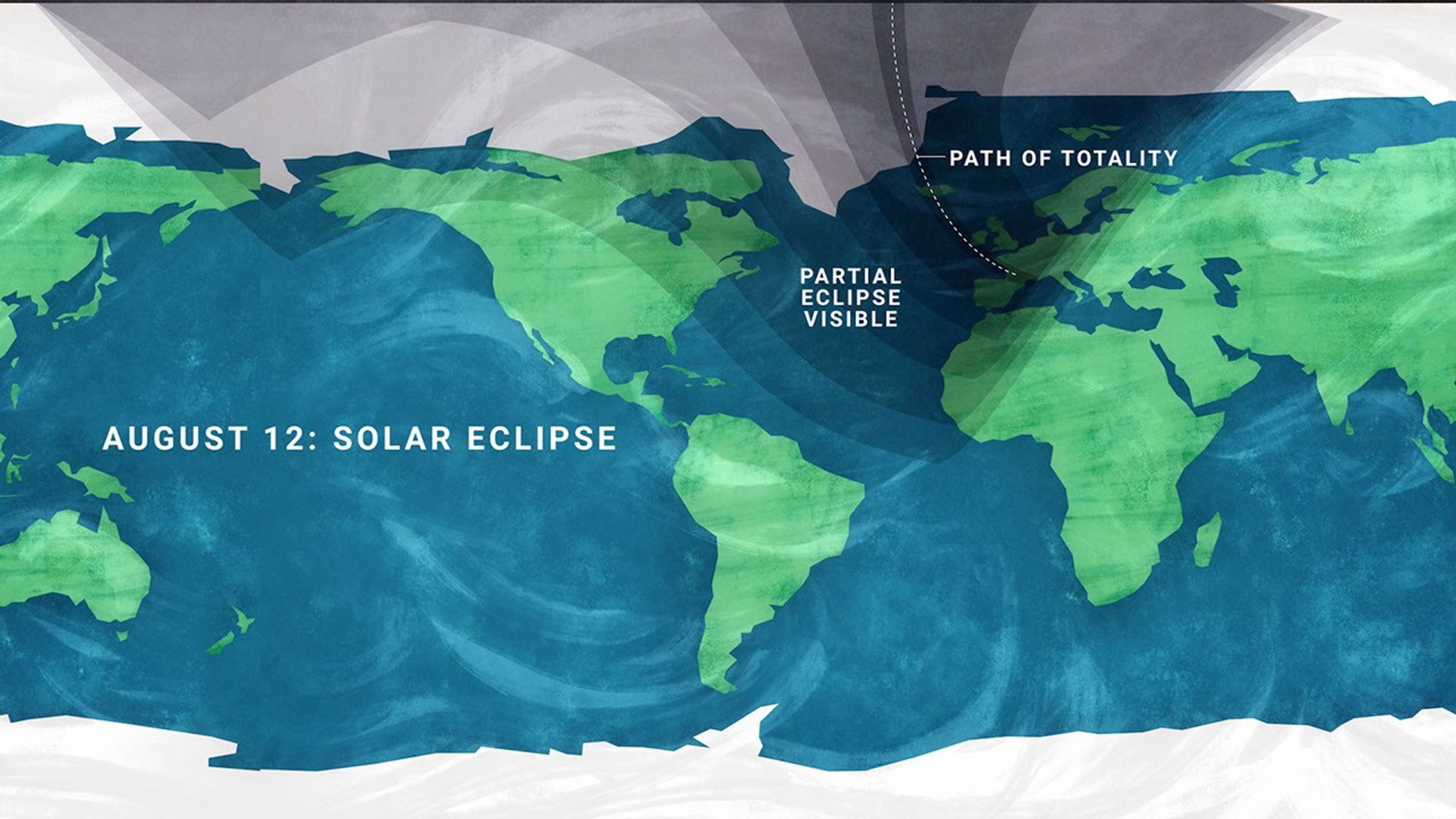
Remember to watch safely. Use certified eclipse glasses or a safe solar viewer any time any part of the Sun is visible. Regular sunglasses are not safe. And never use binoculars, a telescope, or a camera without a solar filter made for the front of the optics.
Later that same night, the Perseid meteor shower will light up the sky, peaking the evening of Aug. 12 into the early morning hours of the 13th. And with a New Moon arriving on the 12th, the skies will be ideally dark.
The Perseids happen every year when Earth passes through a debris stream left behind by Comet Swift-Tuttle. As those tiny bits of comet dust hit our atmosphere at high speed, they burn up as bright streaks of light.
To view this meteor shower, look toward the northeast once it’s fully dark and watch for the constellation Perseus to clear the horizon. This is where the meteors originate, but let your eyes wander, because they can flash across any part of the sky.
For the best view, stay out late as the stars climb higher, find a dark open spot, and give your eyes 30 minutes to adjust.
This illustration shows where in the night sky to look for the Perseid meteor shower.NASA/JPL-Caltech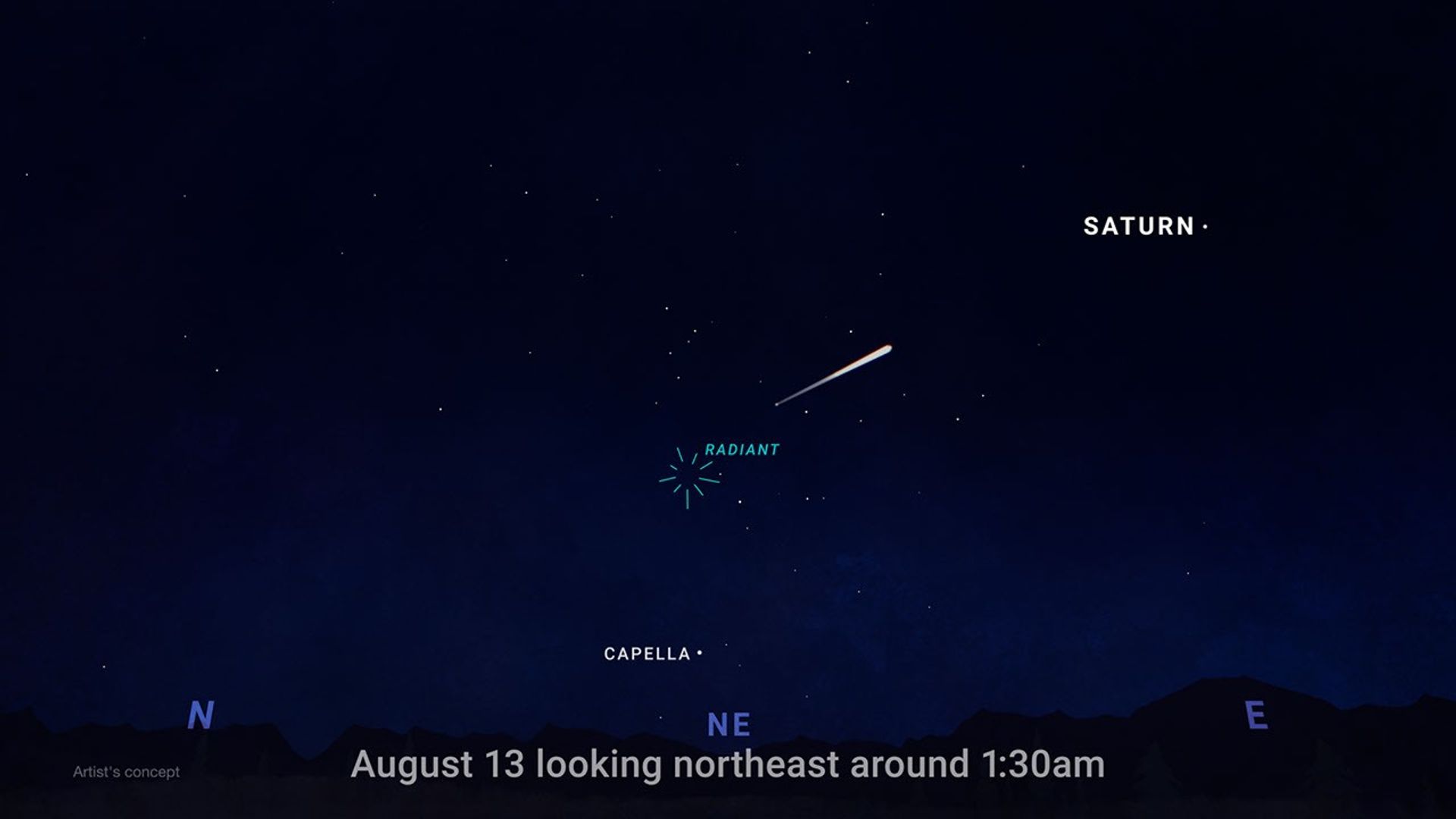
Aug. 14-16, Venus reaches its greatest eastern elongation, which is its widest apparent separation from the Sun during this evening appearance.
Look low in the western sky shortly after sunset for the bright object that will outshine every star around it. Through a telescope after sunset, Venus will look close to half lit, like a tiny lunar phase.
This illustration shows where to observe Venus after sunset in August.NASA/JPL-Caltech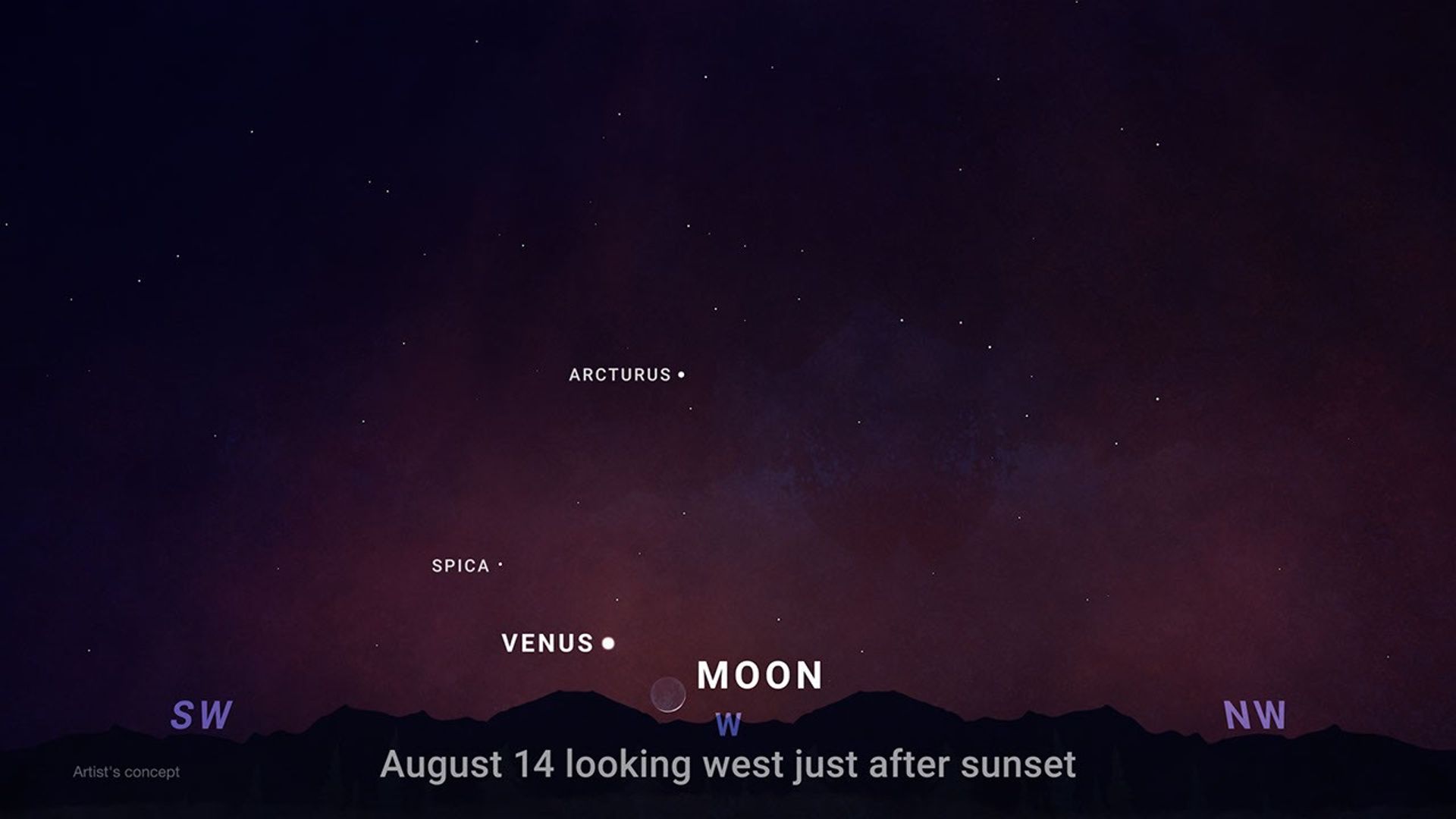
On the night of Aug. 27, continuing into Aug. 28 for some time zones, the Full Moon slips through Earth’s shadow, resulting in a partial lunar eclipse. It will be visible from much of North and South America and parts of Europe and Africa.
Viewing areas for the August 2026 lunar eclipse.NASA/JPL-Caltech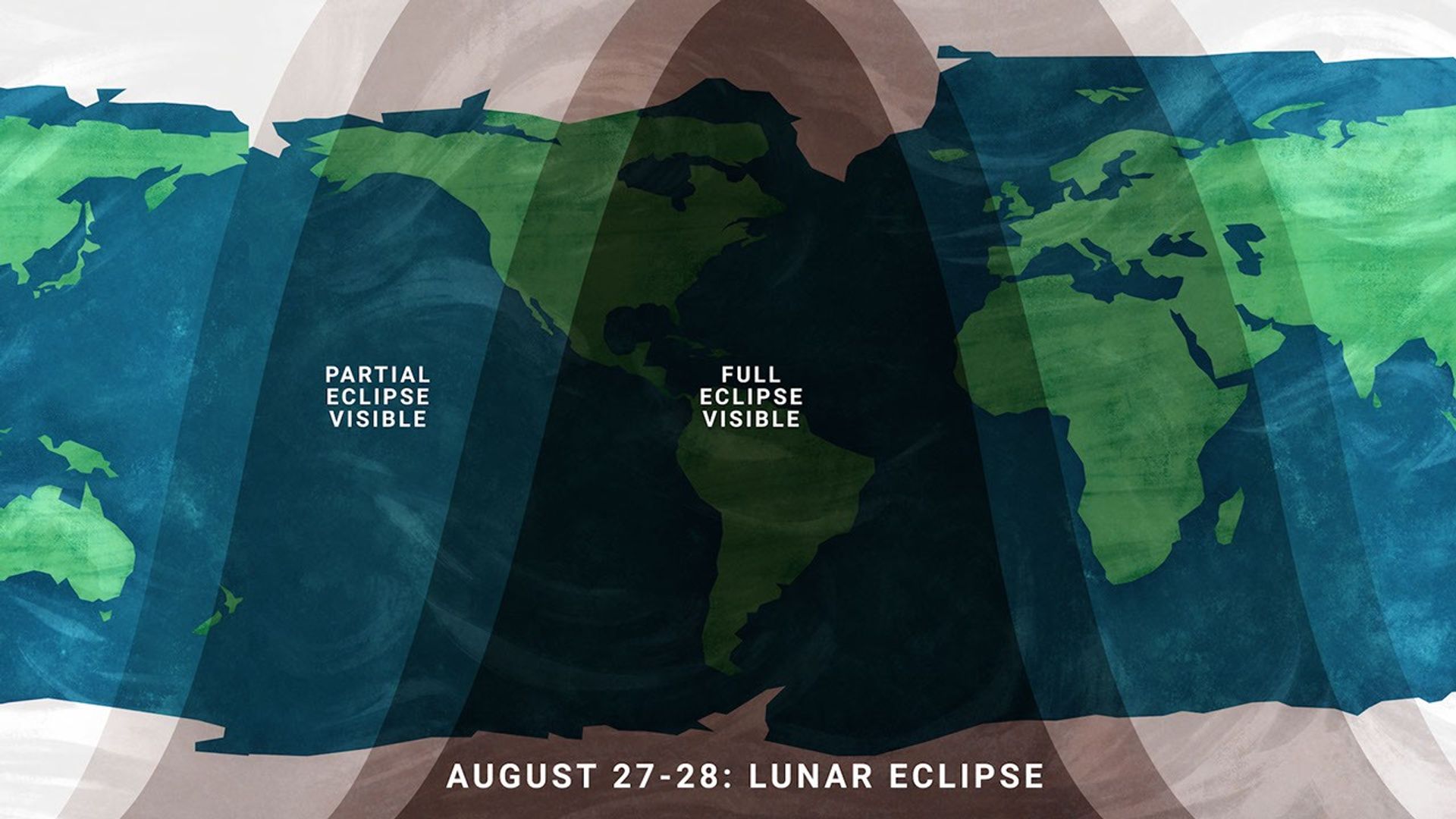
At maximum eclipse, about 93% of the Moon’s diameter will be inside Earth’s dark central shadow, called the umbra. The Moon will not be completely covered, but it can look dramatically darkened, with a rusty, coppery tint along the covered edge.
Unlike a solar eclipse, a lunar eclipse is safe to watch with just your eyes. Binoculars or a small telescope can give you a closer view of Earth’s curved shadow moving across the Moon.
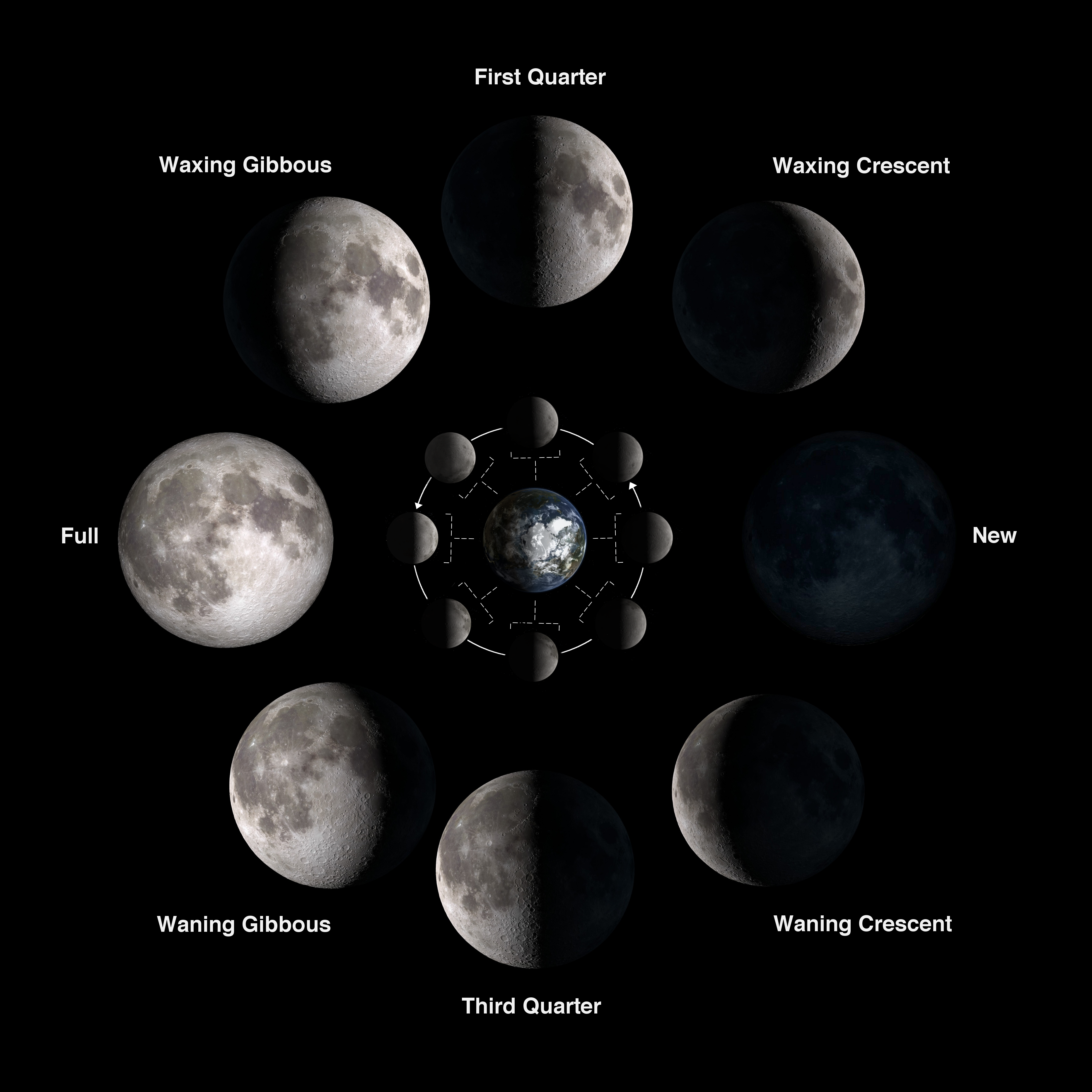
Here are the phases of the Moon for August.
NASA/JPL-Caltech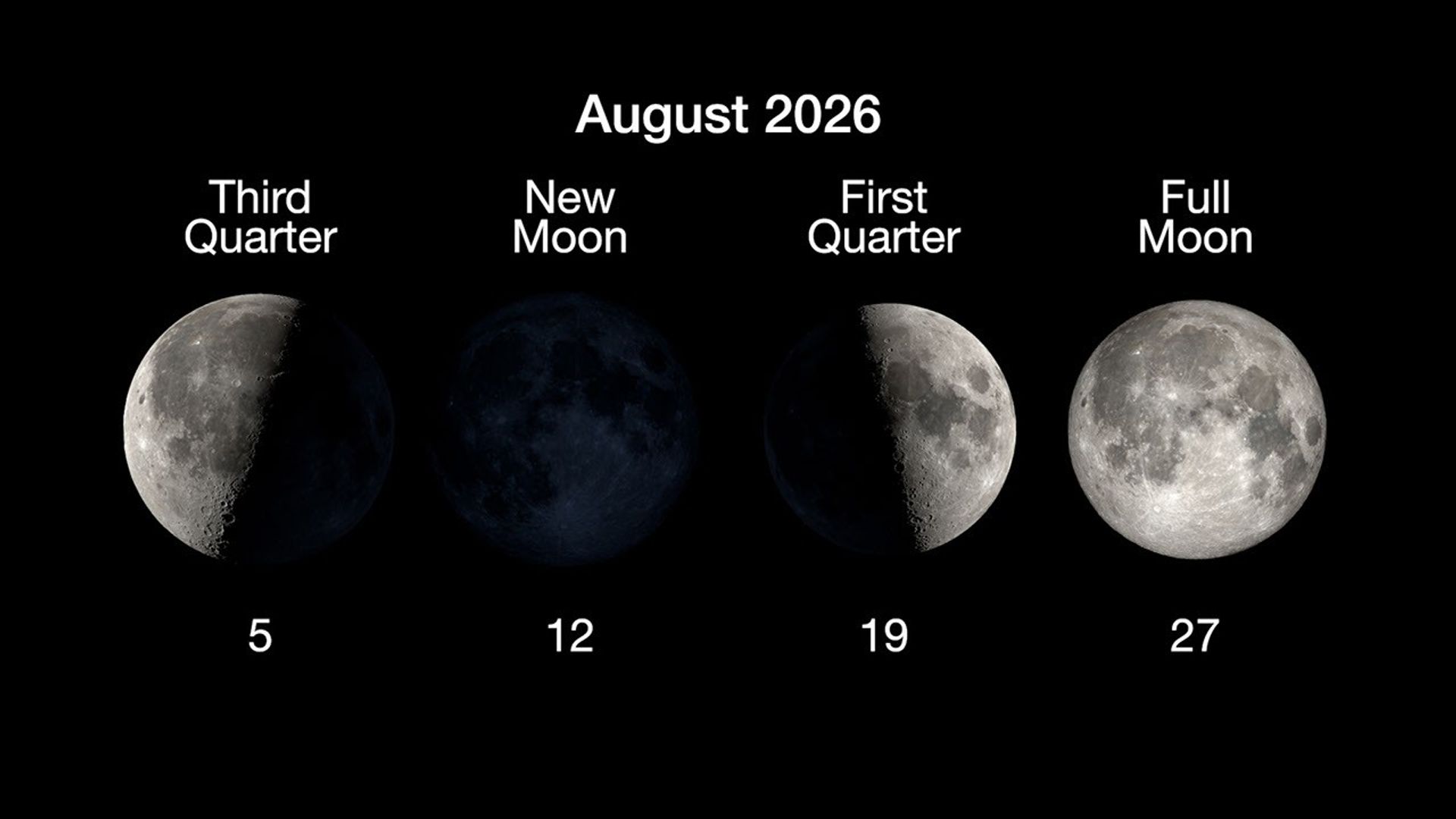
You can stay up to date on all of NASA’s missions exploring the solar system and beyond at science.nasa.gov. I’m Raquel Villanueva from NASA’s Jet Propulsion Laboratory, and that’s What’s Up for this month.
Find skywatching events and clubs with NASA’s Night Sky Network More skywatching resources from NASA Share Details Last Updated Aug 03, 2026 Related Terms Keep Exploring Discover More Topics From NASAWhat’s Up
Skywatching
Galaxies
Stars