
Feed aggregator
Scientist Constructs "Big Picture" of Mars Water from Rover Data
Rover data from more than 20 years ago has revealed clues to the existence of liquid water on ancient Mars. The NASA Spirit Rover carried a specialized instrument called a Mössbauer Spectrometer that performed mineralogical analyses of soil, rock, and dust on the surface of the Red Planet at Gusev Crater. Individual measurements didn't always indicate definitive proof of water, but when scientist Paolo de Souza of Edith Cowan University in Australia examined years' worth of measurements together, a definite pattern began to show up in the existence of minerals that could only exist in the presence of water. His analysis shows that Mars used to sport a lot more water than scientists expected and that the data showing its existence was in the data all along.
NASA Will Attempt to Observe Rocket Part’s Lunar Impact
Using ground-based telescopes and space-based assets, NASA and SpaceX are tracking a used Falcon 9 upper stage from a commercial mission expected to impact the Moon on Wednesday, Aug. 5, near the Einstein and Bell craters. The impact poses no danger to Earth and NASA scientists are planning to collect lunar data from the event and refine techniques for tracking objects in space.
On Jan. 15, 2025, SpaceX launched the Falcon 9 rocket and successfully deployed Firefly Aerospace’s Blue Ghost 1 lunar lander to the Moon under NASA’s CLPS (Commercial Lunar Payload Services) initiative. Solar activity and gravitational forces caused the stage’s unplanned return to the Moon. NASA and SpaceX remain in communication about the upper stage and its flight path.
Independent astronomers first identified the trajectory using publicly available data. NASA’s Center for Near Earth Object Studies at the agency’s Jet Propulsion Laboratory in Southern California, which tracks natural objects that could pose hazards to Earth, later confirmed the stage has a 100% chance of impacting the Moon. NASA will continue tracking it as part of training operations.
Because the Moon has no atmosphere to slow incoming objects, it is struck by meteoroids daily. Human‑made object impacts are far less common but do occur. The rocket stage is expected to create a crater about 60 feet wide and 12 feet deep and throw dust and rock outward as ejecta. For comparison, a meteoroid with the same energy as the upper stage hits the Moon about every six days, so the lunar surface is constantly absorbing impacts with the same force. Despite the disturbance, observing impacts gives scientists valuable insight by revealing how ejecta plumes behave, helping to understand the Moon’s geology and refine models that guide future exploration and science missions.
The impact will not be visible to the naked eye on Earth, but NASA will attempt to observe it in real time. The Meteoroid Environments Office at the agency’s Marshall Space Flight Center in Huntsville, will use ground‑based telescopes to image the impact; however, weather and lighting conditions may make viewing difficult.
Additionally, NASA’s Lunar Reconnaissance Orbiter and the ShadowCam instrument aboard South Korea’s Korea Pathfinder Lunar Orbiter will look for chances to image the site before and after the impact. Image availability will depend on lighting, orbital timing, and spacecraft position, and it may take several days to receive imagery. Any data collected will help scientists better understand artificial impacts and their exploration implications.
Although unplanned in this instance, disposing of upper stages on the lunar surface is a technically accepted and safe method and, in some cases, can be the only practical option for missions in low lunar orbit. Many operators choose controlled impacts because they provide predictable and trackable end of life outcomes.
NASA is committed to debris mitigation and demonstrating responsible disposal practices that safeguard Earth, its orbital environment, and other planetary bodies while enabling discoveries that deepen our understanding of the solar system and benefit humanity.
NASA Will Attempt to Observe Rocket Part’s Lunar Impact
Using ground-based telescopes and space-based assets, NASA and SpaceX are tracking a used Falcon 9 upper stage from a commercial mission expected to impact the Moon on Wednesday, Aug. 5, near the Einstein and Bell craters. The impact poses no danger to Earth and NASA scientists are planning to collect lunar data from the event and refine techniques for tracking objects in space.
On Jan. 15, 2025, SpaceX launched the Falcon 9 rocket and successfully deployed Firefly Aerospace’s Blue Ghost 1 lunar lander to the Moon under NASA’s CLPS (Commercial Lunar Payload Services) initiative. Solar activity and gravitational forces caused the stage’s unplanned return to the Moon. NASA and SpaceX remain in communication about the upper stage and its flight path.
Independent astronomers first identified the trajectory using publicly available data. NASA’s Center for Near Earth Object Studies at the agency’s Jet Propulsion Laboratory in Southern California, which tracks natural objects that could pose hazards to Earth, later confirmed the stage has a 100% chance of impacting the Moon. NASA will continue tracking it as part of training operations.
Because the Moon has no atmosphere to slow incoming objects, it is struck by meteoroids daily. Human‑made object impacts are far less common but do occur. The rocket stage is expected to create a crater about 60 feet wide and 12 feet deep and throw dust and rock outward as ejecta. For comparison, a meteoroid with the same energy as the upper stage hits the Moon about every six days, so the lunar surface is constantly absorbing impacts with the same force. Despite the disturbance, observing impacts gives scientists valuable insight by revealing how ejecta plumes behave, helping to understand the Moon’s geology and refine models that guide future exploration and science missions.
The impact will not be visible to the naked eye on Earth, but NASA will attempt to observe it in real time. The Meteoroid Environments Office at the agency’s Marshall Space Flight Center in Huntsville, will use ground‑based telescopes to image the impact; however, weather and lighting conditions may make viewing difficult.
Additionally, NASA’s Lunar Reconnaissance Orbiter and the ShadowCam instrument aboard South Korea’s Korea Pathfinder Lunar Orbiter will look for chances to image the site before and after the impact. Image availability will depend on lighting, orbital timing, and spacecraft position, and it may take several days to receive imagery. Any data collected will help scientists better understand artificial impacts and their exploration implications.
Although unplanned in this instance, disposing of upper stages on the lunar surface is a technically accepted and safe method and, in some cases, can be the only practical option for missions in low lunar orbit. Many operators choose controlled impacts because they provide predictable and trackable end of life outcomes.
NASA is committed to debris mitigation and demonstrating responsible disposal practices that safeguard Earth, its orbital environment, and other planetary bodies while enabling discoveries that deepen our understanding of the solar system and benefit humanity.
NASA’s PUNCH Sharpens Solar Storm Forecasting in First Test
Using continuous imagery from NASA’s PUNCH (Polarimeter to Unify the Corona and Heliosphere) mission, scientists predicted the near-Earth arrival of a solar eruption to within 30 minutes in an initial proof of concept test. The results, presented Tuesday at the Committee on Space Research Scientific Meeting and under review at the journal Space Weather, could revolutionize the way Earth-impacting storms are forecasted.
“We thought PUNCH would be good at this, but it’s a stunning result,” said Craig DeForest, principal investigator for PUNCH at Southwest Research Institute’s Solar System Science and Exploration Division in Boulder, Colorado. “To put it in perspective, this could be the space weather equivalent of going from a steam engine to a modern internal combustion engine.”
Solar storms are caused by huge explosions of material off the Sun called coronal mass ejections. Forecasting when the ejections will reach Earth is key for mitigating their impacts on power grids, satellites, and astronauts. However, until recently, coronal mass ejections could not continuously be tracked for much of their journey across the solar system.
That changed in 2025 with the launch of the PUNCH mission, which uses four spacecraft in low Earth orbit to make continuous 3D observations of the inner solar system. Before PUNCH, coronal mass ejections could only be seen as they traversed one-fifth the way from the Sun to Earth, leaving scientists to guess what happened over the rest of the distance. With PUNCH’s wider field-of-view, scientists can now routinely track the solar explosions nearly all the way to Earth, capturing a new image every four minutes.
To view this video please enable JavaScript, and consider upgrading to a web browser that supports HTML5 video
This video created from PUNCH images shows the May 31, 2025 coronal mass ejection (CME) streaming out from the Sun. The yellow line shows the leading edge of the CME. By tracking a CME across the inner solar system, scientists are now able to predict when a solar storm will reach Earth better than ever before.NASA/PUNCH/SwRIScientists used data from a coronal mass ejection that left the Sun on May 31, 2025, to retroactively test if they could improve forecast modeling. Scientists input the images into a computer model, which analyzed the leading edge of the coronal mass ejection over time. As it moved and evolved across the inner solar system, the model used the coronal mass ejection’s speed and geometry to calculate when it would reach Earth.
Twelve hours after the coronal mass ejection left the Sun, the model settled on a final prediction showing the storm would arrive eight hours later. That predicted arrival time was ultimately accurate to within a half hour, making it 10 times better than currently used methods, which only provide a 5-hour window. In addition, the model itself revealed when the estimate had stabilized, so that a space weather forecaster would be able to predict the arrival time with confidence.
“We accomplished an order of magnitude better result than the state-of-the-art method with a really basic process, just informed by the fact that the coronal mass ejection could be tracked continuously across the solar system,” DeForest said.
These first results demonstrate the power of PUNCH’s wide-field imagery to track the solar events as they travel out from the Sun. Ultimately, the scientists think that with more refined PUNCH data and better models, they could be able to forecast coronal mass ejection arrival times even further in advance.
Beyond space weather forecasting, the images also help scientists glean new insights on coronal mass ejections. The high-resolution images allowed the scientists to see new structures in coronal mass ejections, revealing that the clouds of material are clumpier than previously thought and continue to evolve as they cross the solar system.
The PUNCH data is also helping scientists better understand how plasma, the solar material launched by coronal mass ejections, moves across space. This information can help astrophysicists better understand plasma’s behavior across the galaxy, such as in star-forming regions where it is nearly impossible to study on small scales.
Southwest Research Institute, based in San Antonio, leads the PUNCH mission and operates the mission’s four spacecraft from its facilities in Boulder. The mission is managed by Space Science Mission Operations at NASA’s Goddard Space Flight Center in Greenbelt, Maryland, for the Science Mission Directorate at the agency’s headquarters in Washington.
By Mara Johnson-Groh
NASA’s Goddard Space Flight Center, Greenbelt, Md.
NASA’s PUNCH Sharpens Solar Storm Forecasting in First Test
Using continuous imagery from NASA’s PUNCH (Polarimeter to Unify the Corona and Heliosphere) mission, scientists predicted the near-Earth arrival of a solar eruption to within 30 minutes in an initial proof of concept test. The results, presented Tuesday at the Committee on Space Research Scientific Meeting and under review at the journal Space Weather, could revolutionize the way Earth-impacting storms are forecasted.
“We thought PUNCH would be good at this, but it’s a stunning result,” said Craig DeForest, principal investigator for PUNCH at Southwest Research Institute’s Solar System Science and Exploration Division in Boulder, Colorado. “To put it in perspective, this could be the space weather equivalent of going from a steam engine to a modern internal combustion engine.”
Solar storms are caused by huge explosions of material off the Sun called coronal mass ejections. Forecasting when the ejections will reach Earth is key for mitigating their impacts on power grids, satellites, and astronauts. However, until recently, coronal mass ejections could not continuously be tracked for much of their journey across the solar system.
That changed in 2025 with the launch of the PUNCH mission, which uses four spacecraft in low Earth orbit to make continuous 3D observations of the inner solar system. Before PUNCH, coronal mass ejections could only be seen as they traversed one-fifth the way from the Sun to Earth, leaving scientists to guess what happened over the rest of the distance. With PUNCH’s wider field-of-view, scientists can now routinely track the solar explosions nearly all the way to Earth, capturing a new image every four minutes.
To view this video please enable JavaScript, and consider upgrading to a web browser that supports HTML5 video
This video created from PUNCH images shows the May 31, 2025 coronal mass ejection (CME) streaming out from the Sun. The yellow line shows the leading edge of the CME. By tracking a CME across the inner solar system, scientists are now able to predict when a solar storm will reach Earth better than ever before.NASA/PUNCH/SwRIScientists used data from a coronal mass ejection that left the Sun on May 31, 2025, to retroactively test if they could improve forecast modeling. Scientists input the images into a computer model, which analyzed the leading edge of the coronal mass ejection over time. As it moved and evolved across the inner solar system, the model used the coronal mass ejection’s speed and geometry to calculate when it would reach Earth.
Twelve hours after the coronal mass ejection left the Sun, the model settled on a final prediction showing the storm would arrive eight hours later. That predicted arrival time was ultimately accurate to within a half hour, making it 10 times better than currently used methods, which only provide a 5-hour window. In addition, the model itself revealed when the estimate had stabilized, so that a space weather forecaster would be able to predict the arrival time with confidence.
“We accomplished an order of magnitude better result than the state-of-the-art method with a really basic process, just informed by the fact that the coronal mass ejection could be tracked continuously across the solar system,” DeForest said.
These first results demonstrate the power of PUNCH’s wide-field imagery to track the solar events as they travel out from the Sun. Ultimately, the scientists think that with more refined PUNCH data and better models, they could be able to forecast coronal mass ejection arrival times even further in advance.
Beyond space weather forecasting, the images also help scientists glean new insights on coronal mass ejections. The high-resolution images allowed the scientists to see new structures in coronal mass ejections, revealing that the clouds of material are clumpier than previously thought and continue to evolve as they cross the solar system.
The PUNCH data is also helping scientists better understand how plasma, the solar material launched by coronal mass ejections, moves across space. This information can help astrophysicists better understand plasma’s behavior across the galaxy, such as in star-forming regions where it is nearly impossible to study on small scales.
Southwest Research Institute, based in San Antonio, leads the PUNCH mission and operates the mission’s four spacecraft from its facilities in Boulder. The mission is managed by Space Science Mission Operations at NASA’s Goddard Space Flight Center in Greenbelt, Maryland, for the Science Mission Directorate at the agency’s headquarters in Washington.
By Mara Johnson-Groh
NASA’s Goddard Space Flight Center, Greenbelt, Md.
Wormholes could be the key to time travel
Wormholes are one way that physicists have imagined traveling into the past. But if something gets there, is it physically possible to change anything?
Ames Science Stars of the Month – August 2026

The NASA Ames Science Directorate recognizes the outstanding contributions of (pictured left to right) Danielle Lopez, Jennifer Claudio, and Duncan Mifsud. Their commitment to the NASA mission represents the entrepreneurial spirit, technical expertise, and collaborative disposition needed to explore this world and beyond.
Space Biosciences Star of the Month: Danielle Lopez
Danielle Lopez is the Deputy Project Manager for the Open Science Data Repository with Amentum in the Space Biosciences Division. She is recognized for her management efforts that have been critical to the success of Open Science at NASA including collaborations across directorates at Ames, across NASA centers, and with the public. Danielle has been a critical stabilizing force during challenging and tumultuous times, keeping multiple projects not only on track, but at the forefront of Open Science for the entire Agency.
Space Biosciences Star of the Month: Jennifer Claudio
Jennifer Claudio is a research staff member with Blue Marble Space in the Space Biosciences Division. Jennifer has made outstanding contributions in supporting the 2026 GeneLab for High School (GL4HS) summer program. She is recognized for her efficiency and initiative executing the program. Notably, Jennifer swiftly and successfully overcame a security breach of the GL4HS learning platform, demonstrating her resourcefulness and commitment to the program.
Astrophysics Star of the Month: Duncan Mifsud
Duncan Mifsud is a postdoctoral research scientist for the Bay Area Environmental Research Institute (BAERI) in the Astrophysics Division. Duncan is recognized this month for his exceptional work on the infrared analysis of several laboratory samples produced from the ultraviolet irradiation of soluble organic molecules as well as extraterrestrial sample returned from asteroid Bennu by NASA’s OSIRIS-REx mission.
Ames Science Stars of the Month – August 2026
The NASA Ames Science Directorate recognizes the outstanding contributions of (pictured left to right) Danielle Lopez, Jennifer Claudio, and Duncan Mifsud. Their commitment to the NASA mission represents the entrepreneurial spirit, technical expertise, and collaborative disposition needed to explore this world and beyond.
Space Biosciences Star of the Month: Danielle LopezDanielle Lopez is the Deputy Project Manager for the Open Science Data Repository with Amentum in the Space Biosciences Division. She is recognized for her management efforts that have been critical to the success of Open Science at NASA including collaborations across directorates at Ames, across NASA centers, and with the public. Danielle has been a critical stabilizing force during challenging and tumultuous times, keeping multiple projects not only on track, but at the forefront of Open Science for the entire Agency.
Space Biosciences Star of the Month: Jennifer ClaudioJennifer Claudio is a research staff member with Blue Marble Space in the Space Biosciences Division. Jennifer has made outstanding contributions in supporting the 2026 GeneLab for High School (GL4HS) summer program. She is recognized for her efficiency and initiative executing the program. Notably, Jennifer swiftly and successfully overcame a security breach of the GL4HS learning platform, demonstrating her resourcefulness and commitment to the program.
Astrophysics Star of the Month: Duncan MifsudDuncan Mifsud is a postdoctoral research scientist for the Bay Area Environmental Research Institute (BAERI) in the Astrophysics Division. Duncan is recognized this month for his exceptional work on the infrared analysis of several laboratory samples produced from the ultraviolet irradiation of soluble organic molecules as well as extraterrestrial sample returned from asteroid Bennu by NASA’s OSIRIS-REx mission.
See the Perseid Meteors on a New Moon Year
You couldn’t ask for a better year for one of the top annual meteor showers. If skies are clear be sure to watch for one of the top skywatching draws of 2026: the August Perseid meteor shower. While the Perseids are a draw on any year, 2026 is special, and has a few things going for it in terms of the Moon phase, peak timing and prospects.
August 2026 Satellite Puzzler
- Earth
- Earth Observatory
- Image of the Day
- EO Explorer
- Topics
- More Content
- About
August 2026 Satellite Puzzler
- Earth
- Earth Observatory
- Image of the Day
- EO Explorer
- Topics
- More Content
- About
Newly discovered carnivorous plant is as deceptive as it is deadly
Charles Darwin predicted in 1875 that some members of the Saxifraga genus could be carnivorous—now scientists have finally proven him right
NASA Provides Updates on Moon Base Cargo Landers, Tech Demonstrations
6 min read
Preparations for Next Moonwalk Simulations Underway (and Underwater) Artist’s rendering of the Moon’s South Pole region. Glowing points of light scattered across the lunar surface represent surface assets supporting sustained human and robotic operations near the South Pole.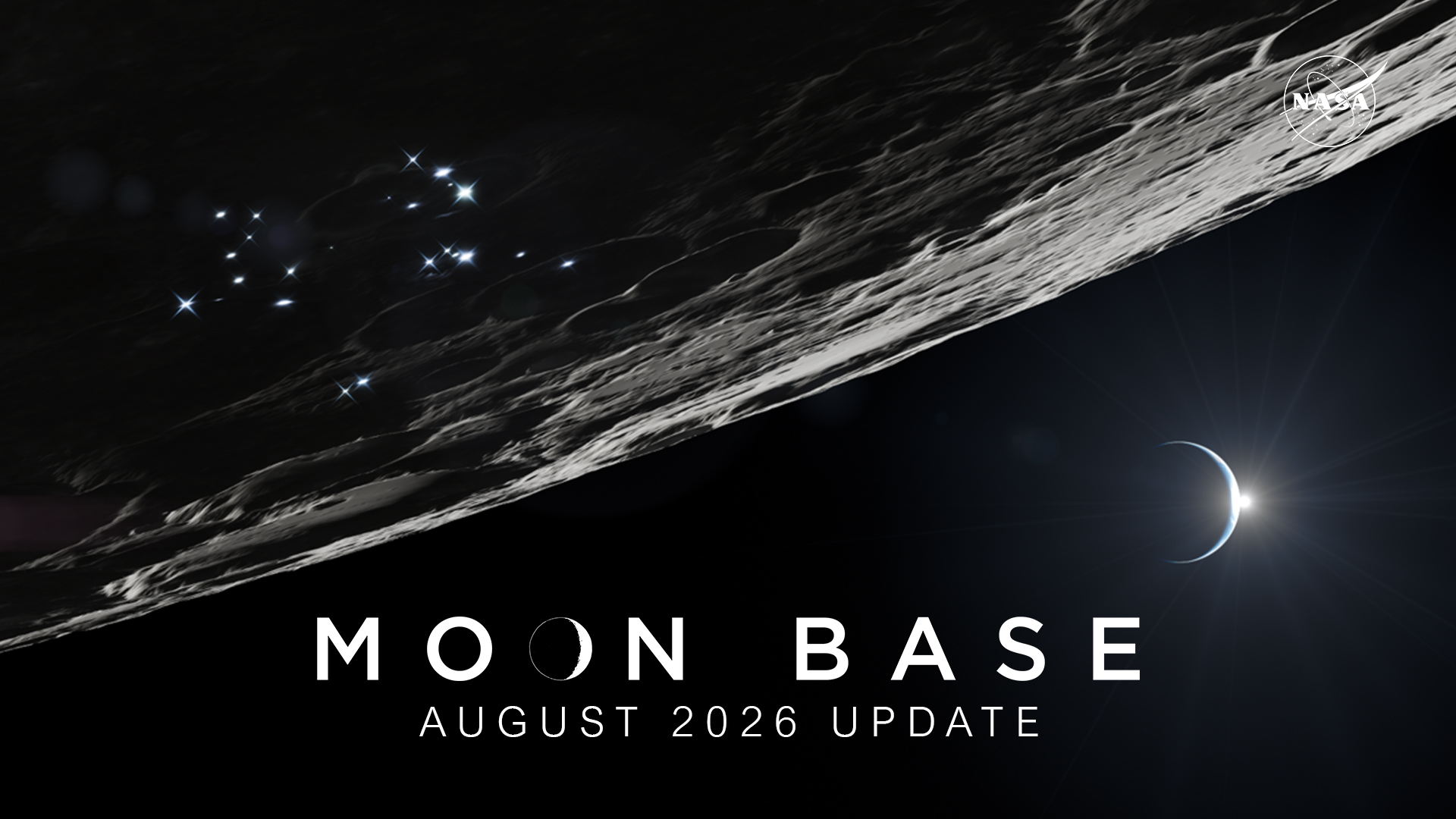
NASA is making progress in building the Moon Base, which will become a resilient outpost near the Moon’s South Pole for science, technology, and eventual human operations. To advance lunar surface infrastructure development, commercial partners such as Blue Origin, Firefly Aerospace, Intuitive Machines, and Voyager Lunar Systems are working toward delivering landers by 2028. These landers will deliver the foundational architecture for a sustained presence on the Moon. Their progress represents major advances in commercial lunar delivery and lays the groundwork for the systems and surface capabilities the Moon Base will rely on.
Phase I of the Moon Base architecture plan, taking place now through 2029, includes more than twenty robotic landings, with each mission designed to incrementally advance system capabilities and validate operational components for those that follow. Before astronauts arrive, robotic missions will deploy critical scientific instruments that characterize the lunar environment, test new technologies, and begin assembling the infrastructure needed for human habitation.
These early robotic missions also will create opportunities to gather insights and improve the overall reliability of the Moon Base architecture. Recurring deliveries under NASA’s CLPS (Commercial Lunar Payload Services) initiative will play a vital role in building a dependable lunar supply chain, advancing the agency’s efforts toward a permanent human and robotic presence on the Moon.
On Tuesday, NASA released a Moon Base video update offering a closer look at the progress these four companies are making to advance their flights and hardware to further the agency’s Moon Base objectives.
Blue Origin’s Blue Moon MK1 lander is progressing through integrated testing to prepare for its upcoming lunar delivery. This first mission, named Endurance, represents a new class of commercial landers designed to deliver large-scale payloads to the lunar surface. The lander successfully completed an extensive environmental test campaign, including a thermal‑vacuum assessment at NASA’s Johnson Space Center in Houston, verifying its capability to perform under lunar‑like conditions.
Teams are advancing through a series of integration milestones that will lead MK1 into its next test campaign. The structure, propulsion elements, and avionics systems are fully assembled, and upcoming assessments will verify the wiring harnesses connections that enable payload integration. The lander completed communications checkouts with NASA’s Tracking and Data Relay Satellite System and the Deep Space Network. Up next, cryogenic propellants will be loaded as one of the final tests prior to integration for launch. Endurance will demonstrate precision landing capabilities, characterize the lunar environment, and tests autonomous systems for future Moon Base missions.
Firefly AerospaceFirefly’s Blue Ghost Mission 2 builds on its first successful lunar landing with a larger, dual‑spacecraft configuration built specifically for operations on the Moon’s far side. Blue Ghost is stacked on top of Elytra, Firefly’s orbital spacecraft, forming a 22‑foot‑tall system nearly three times the height of the spacecraft flown for Blue Ghost Mission 1 in 2025. With the ability to deploy payloads in orbit and on the lunar surface, Elytra brings added versatility to Moon Base logistics and science.
Planned to be the first American landing on the Moon’s far side, Blue Ghost Mission 2 will explore a uniquely quiet region, allowing study of lunar far side geology and the cosmic Dark Ages, a time when newly-formed stars were just becoming visible. Carrying three NASA payloads, the mission aims to advance scientific research and test technologies for future habitation and infrastructure development.
The autonomous landing sequence demonstrated during its first mission exhibits Firefly’s performance in lunar flight and will play a role in supporting mission operations. Reusing subsystems from the previous mission allows Firefly to accelerate development and reduce risk, supporting Moon Base objectives for scalable and repeatable commercial lander capabilities.
Intuitive MachinesIntuitive Machines’ IM‑3 mission highlights how commercial landers are essential infrastructure to establish the Moon Base. This mission represents Intuitive Machines’ third Nova-C lunar landing on the Moon, and introduces Altus-1, the company’s first lunar data‑relay satellite, which will fly alongside the lander.
Named Trinity, Intuitive Machines’ Nova‑C lander assembly and integration are progressing to help meet the long-term need for regular cargo and science deliveries. The top deck is aligned, and internal wiring is undergoing extensive testing before closeout panels are added. Recently, Intuitive Machines along with the X-Ray Cryogenic Facility crew at NASA’s Marshall Space Center in Huntsville, Alabama successfully completed long-range thermal vacuum testing to confirm that Intuitive Machines’ sensors operate accurately under both ends of the thermal range they may encounter during lunar descent. In the coming weeks, teams will complete the final stages of development, including engine integration and hot fire tests.
By deploying Altus-1 in lunar orbit with its three payloads and delivering five NASA payloads along with six commercial and one civil payload to the surface on IM-3, Intuitive Machines aims to advance Moon Base science objectives in Reiner Gamma’s geomagnetic environment, a magnetic anomaly on the lunar surface. The IM-3 mission will be the first to explore the surface of a lunar swirl, enabling robotics and deployed instruments to deepen the scientific investigation of this mysterious region.
Voyager TechnologiesVoyager Technologies’ Griffin‑1 lander is undergoing testing in the Environmental Test Laboratory at NASA’s Jet Propulsion Laboratory in Southern California, a critical step toward being ready for its mission to the Moon. Testing at NASA JPL verifies commercial lunar landers meet the precision and durability needed to support Moon Base operations.
Griffin-1, built as an infrastructure‑class lander, plans to launch in late 2026 and will transport the largest commercial payload ever delivered to the lunar surface. Five NASA payloads will be mounted on the Astrolab FLIP (FLEX Lunar Innovation Platform) rover that together will enable the mission objective of advancing surface mobility capabilities, technology demonstrations, and long‑duration lunar operations.
Griffin‑1 recently completed mass properties testing, providing fundamental data for guidance, navigation, control, and flight dynamics. Over the next several weeks, additional environmental tests replicating anticipated conditions, from launch through lunar landing, will further reduce mission risk and strengthen readiness for operations in the lunar environment.
Once environmental testing concludes, Griffin‑1 will return to Voyager’s Lunar System Pittsburgh facility for final assembly. The spacecraft will proceed through final launch-readiness operations before being shipped to Cape Canaveral.
Northrop GrummanNASA is working with Northrop Grumman to develop three technology demonstration payloads slated for delivery to the lunar surface. These demonstrations build on power and avionics hardware developed for the Gateway program’s HALO (Habitation And Logistics Outpost) module, now being repurposed following NASA’s shift from an orbital-focused lunar strategy to one centered on surface operations. The initial demonstrations will test survive-the-night systems capable of enduring the Moon’s extreme conditions, including multi-day shadow periods. They also will test shared surface power infrastructure designed to support critical payloads or other Moon Base assets, along with essential avionics and power capabilities.
NASA is advancing development of the Moon Base by pursuing long-term lunar exploration and infrastructure initiatives designed to enable a sustained human presence on the Moon, supported by scientific deliveries and commercial lunar landers.
Facebook logo @NASA@NASASocial@NASAMoonBase @NASA@NASAMoonBase Instagram logo @NASA@NASAMoonBase Linkedin logo @NASA Share Details Last Updated Aug 04, 2026 Related Terms Keep Exploring Discover Related TopicsMissions
Humans in Space
Climate Change
Solar System
NASA Provides Updates on Moon Base Cargo Landers, Tech Demonstrations
6 min read
Preparations for Next Moonwalk Simulations Underway (and Underwater) Artist’s rendering of the Moon’s South Pole region. Glowing points of light scattered across the lunar surface represent surface assets supporting sustained human and robotic operations near the South Pole.NASA is making progress in building the Moon Base, which will become a resilient outpost near the Moon’s South Pole for science, technology, and eventual human operations. To advance lunar surface infrastructure development, commercial partners such as Blue Origin, Firefly Aerospace, Intuitive Machines, and Voyager Lunar Systems are working toward delivering landers by 2028. These landers will deliver the foundational architecture for a sustained presence on the Moon. Their progress represents major advances in commercial lunar delivery and lays the groundwork for the systems and surface capabilities the Moon Base will rely on.
Phase I of the Moon Base architecture plan, taking place now through 2029, includes more than twenty robotic landings, with each mission designed to incrementally advance system capabilities and validate operational components for those that follow. Before astronauts arrive, robotic missions will deploy critical scientific instruments that characterize the lunar environment, test new technologies, and begin assembling the infrastructure needed for human habitation.
These early robotic missions also will create opportunities to gather insights and improve the overall reliability of the Moon Base architecture. Recurring deliveries under NASA’s CLPS (Commercial Lunar Payload Services) initiative will play a vital role in building a dependable lunar supply chain, advancing the agency’s efforts toward a permanent human and robotic presence on the Moon.
On Tuesday, NASA released a Moon Base video update offering a closer look at the progress these four companies are making to advance their flights and hardware to further the agency’s Moon Base objectives.
Blue Origin’s Blue Moon MK1 lander is progressing through integrated testing to prepare for its upcoming lunar delivery. This first mission, named Endurance, represents a new class of commercial landers designed to deliver large-scale payloads to the lunar surface. The lander successfully completed an extensive environmental test campaign, including a thermal‑vacuum assessment at NASA’s Johnson Space Center in Houston, verifying its capability to perform under lunar‑like conditions.
Teams are advancing through a series of integration milestones that will lead MK1 into its next test campaign. The structure, propulsion elements, and avionics systems are fully assembled, and upcoming assessments will verify the wiring harnesses connections that enable payload integration. The lander completed communications checkouts with NASA’s Tracking and Data Relay Satellite System and the Deep Space Network. Up next, cryogenic propellants will be loaded as one of the final tests prior to integration for launch. Endurance will demonstrate precision landing capabilities, characterize the lunar environment, and tests autonomous systems for future Moon Base missions.
Firefly AerospaceFirefly’s Blue Ghost Mission 2 builds on its first successful lunar landing with a larger, dual‑spacecraft configuration built specifically for operations on the Moon’s far side. Blue Ghost is stacked on top of Elytra, Firefly’s orbital spacecraft, forming a 22‑foot‑tall system nearly three times the height of the spacecraft flown for Blue Ghost Mission 1 in 2025. With the ability to deploy payloads in orbit and on the lunar surface, Elytra brings added versatility to Moon Base logistics and science.
Planned to be the first American landing on the Moon’s far side, Blue Ghost Mission 2 will explore a uniquely quiet region, allowing study of lunar far side geology and the cosmic Dark Ages, a time when newly-formed stars were just becoming visible. Carrying three NASA payloads, the mission aims to advance scientific research and test technologies for future habitation and infrastructure development.
The autonomous landing sequence demonstrated during its first mission exhibits Firefly’s performance in lunar flight and will play a role in supporting mission operations. Reusing subsystems from the previous mission allows Firefly to accelerate development and reduce risk, supporting Moon Base objectives for scalable and repeatable commercial lander capabilities.
Intuitive MachinesIntuitive Machines’ IM‑3 mission highlights how commercial landers are essential infrastructure to establish the Moon Base. This mission represents Intuitive Machines’ third Nova-C lunar landing on the Moon, and introduces Altus-1, the company’s first lunar data‑relay satellite, which will fly alongside the lander.
Named Trinity, Intuitive Machines’ Nova‑C lander assembly and integration are progressing to help meet the long-term need for regular cargo and science deliveries. The top deck is aligned, and internal wiring is undergoing extensive testing before closeout panels are added. Recently, Intuitive Machines along with the X-Ray Cryogenic Facility crew at NASA’s Marshall Space Center in Huntsville, Alabama successfully completed long-range thermal vacuum testing to confirm that Intuitive Machines’ sensors operate accurately under both ends of the thermal range they may encounter during lunar descent. In the coming weeks, teams will complete the final stages of development, including engine integration and hot fire tests.
By deploying Altus-1 in lunar orbit with its three payloads and delivering five NASA payloads along with six commercial and one civil payload to the surface on IM-3, Intuitive Machines aims to advance Moon Base science objectives in Reiner Gamma’s geomagnetic environment, a magnetic anomaly on the lunar surface. The IM-3 mission will be the first to explore the surface of a lunar swirl, enabling robotics and deployed instruments to deepen the scientific investigation of this mysterious region.
Voyager TechnologiesVoyager Technologies’ Griffin‑1 lander is undergoing testing in the Environmental Test Laboratory at NASA’s Jet Propulsion Laboratory in Southern California, a critical step toward being ready for its mission to the Moon. Testing at NASA JPL verifies commercial lunar landers meet the precision and durability needed to support Moon Base operations.
Griffin-1, built as an infrastructure‑class lander, plans to launch in late 2026 and will transport the largest commercial payload ever delivered to the lunar surface. Five NASA payloads will be mounted on the Astrolab FLIP (FLEX Lunar Innovation Platform) rover that together will enable the mission objective of advancing surface mobility capabilities, technology demonstrations, and long‑duration lunar operations.
Griffin‑1 recently completed mass properties testing, providing fundamental data for guidance, navigation, control, and flight dynamics. Over the next several weeks, additional environmental tests replicating anticipated conditions, from launch through lunar landing, will further reduce mission risk and strengthen readiness for operations in the lunar environment.
Once environmental testing concludes, Griffin‑1 will return to Voyager’s Lunar System Pittsburgh facility for final assembly. The spacecraft will proceed through final launch-readiness operations before being shipped to Cape Canaveral.
Northrop GrummanNASA is working with Northrop Grumman to develop three technology demonstration payloads slated for delivery to the lunar surface. These demonstrations build on power and avionics hardware developed for the Gateway program’s HALO (Habitation And Logistics Outpost) module, now being repurposed following NASA’s shift from an orbital-focused lunar strategy to one centered on surface operations. The initial demonstrations will test survive-the-night systems capable of enduring the Moon’s extreme conditions, including multi-day shadow periods. They also will test shared surface power infrastructure designed to support critical payloads or other Moon Base assets, along with essential avionics and power capabilities.
NASA is advancing development of the Moon Base by pursuing long-term lunar exploration and infrastructure initiatives designed to enable a sustained human presence on the Moon, supported by scientific deliveries and commercial lunar landers.
Facebook logo @NASA@NASASocial@NASAMoonBase @NASA@NASAMoonBase Instagram logo @NASA@NASAMoonBase Linkedin logo @NASA Share Details Last Updated Aug 04, 2026 Related Terms Keep Exploring Discover Related TopicsMissions
Humans in Space
Climate Change
Solar System
Roman Space Telescope Plaque Install
Roman Space Telescope Plaque Install
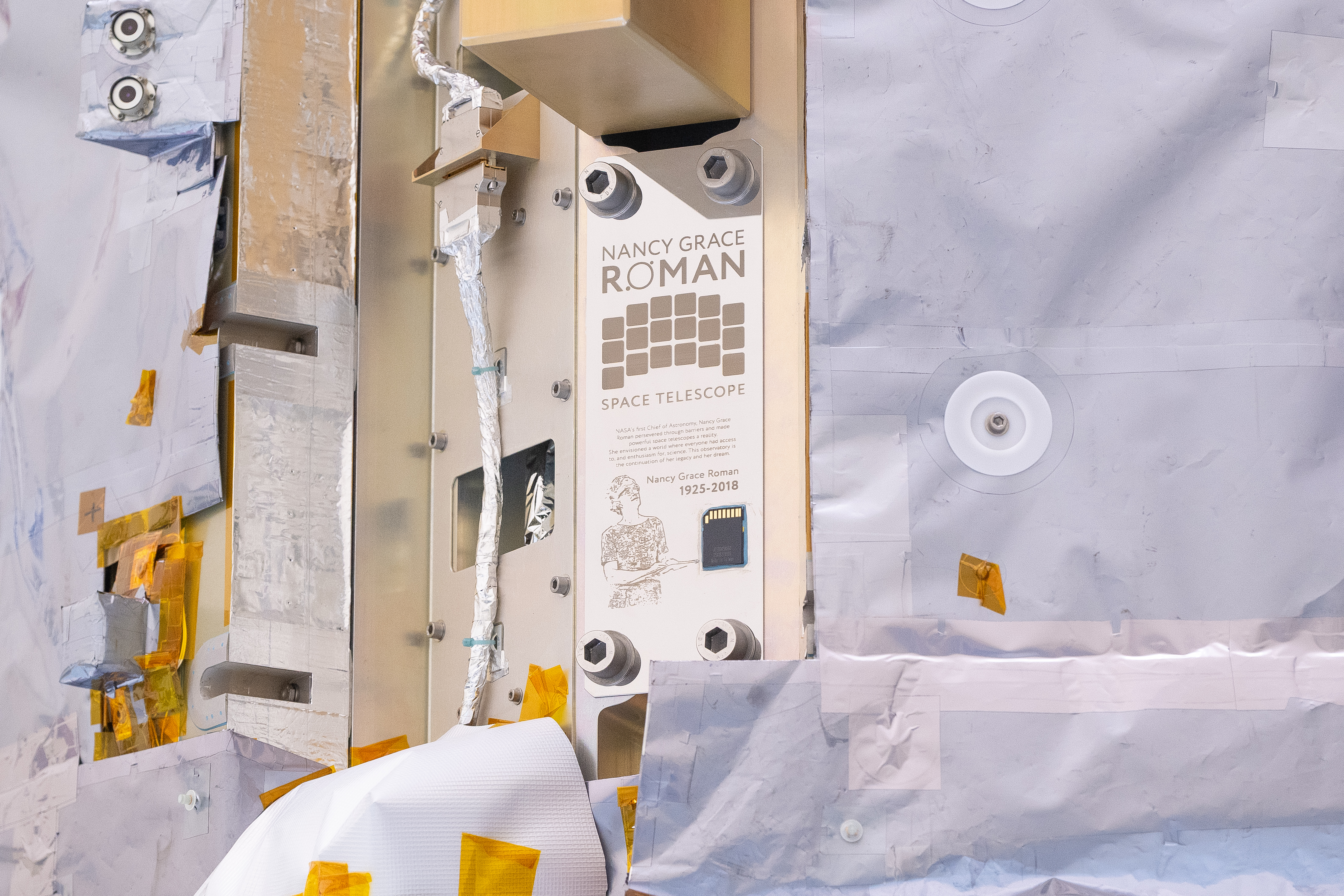
Technicians installed a commemorative plaque, seen in this July 28, 2026, photo, on NASA’s Nancy Grace Roman Space Telescope. The plaque honors the legacy of Dr. Nancy Grace Roman, NASA’s first chief astronomer and one of the architects of the agency’s modern science program. It also features a memory card containing a total of 1,350,144 names submitted by people from across the globe, including astronauts from NASA’s Artemis II and Artemis III missions.
This observatory, scheduled to launch Aug. 30, 2026, will be able to block starlight to directly see exoplanets and planet-forming disks, complete a statistical census of planetary systems in our galaxy, and settle essential questions in the areas of dark energy, exoplanets, and infrared astrophysics.
Image credit: NASA/Jolearra Tshiteya
Roman Space Telescope Plaque Install
Technicians installed a commemorative plaque, seen in this July 28, 2026, photo, on NASA’s Nancy Grace Roman Space Telescope. The plaque honors the legacy of Dr. Nancy Grace Roman, NASA’s first chief astronomer and one of the architects of the agency’s modern science program. It also features a memory card containing a total of 1,350,144 names submitted by people from across the globe, including astronauts from NASA’s Artemis II and Artemis III missions.
This observatory, scheduled to launch Aug. 30, 2026, will be able to block starlight to directly see exoplanets and planet-forming disks, complete a statistical census of planetary systems in our galaxy, and settle essential questions in the areas of dark energy, exoplanets, and infrared astrophysics.
Image credit: NASA/Jolearra Tshiteya
Project backed by Leonardo DiCaprio and Jeff Bezos aims to save 100 critically endangered species
This billionaire-backed fund is dedicating $200 million to preserve animals and even plants that are facing extinction around the world
A SpaceX rocket is about to hit the moon—these videos show what could happen
Astronomers’ simulations predict what this lunar impact—and its aftermath—will look like
A New Way to Map the Universe's Missing Matter
Brief but powerful flashes of radio waves are aiding astronomers' quest to find and map cosmic gas.
The post A New Way to Map the Universe's Missing Matter appeared first on Sky & Telescope.