
Feed aggregator
I Am Artemis: Tom Percy
As NASA sets its sights on long-term exploration of the Moon and Mars, the agency is increasing the cadence of its Artemis missions. Helping bring these plans to fruition is Tom Percy, manager of systems engineering and integration for NASA’s Human Landing System Program.
Tom Percy, manager of systems engineering and integration for NASA’s Human Landing Systems Program, stands in front of an Apollo Program lander exhibit at the U.S. Space and Rocket Center in Huntsville near NASA’s Marshall Space Flight Center. NASA/Charles Beason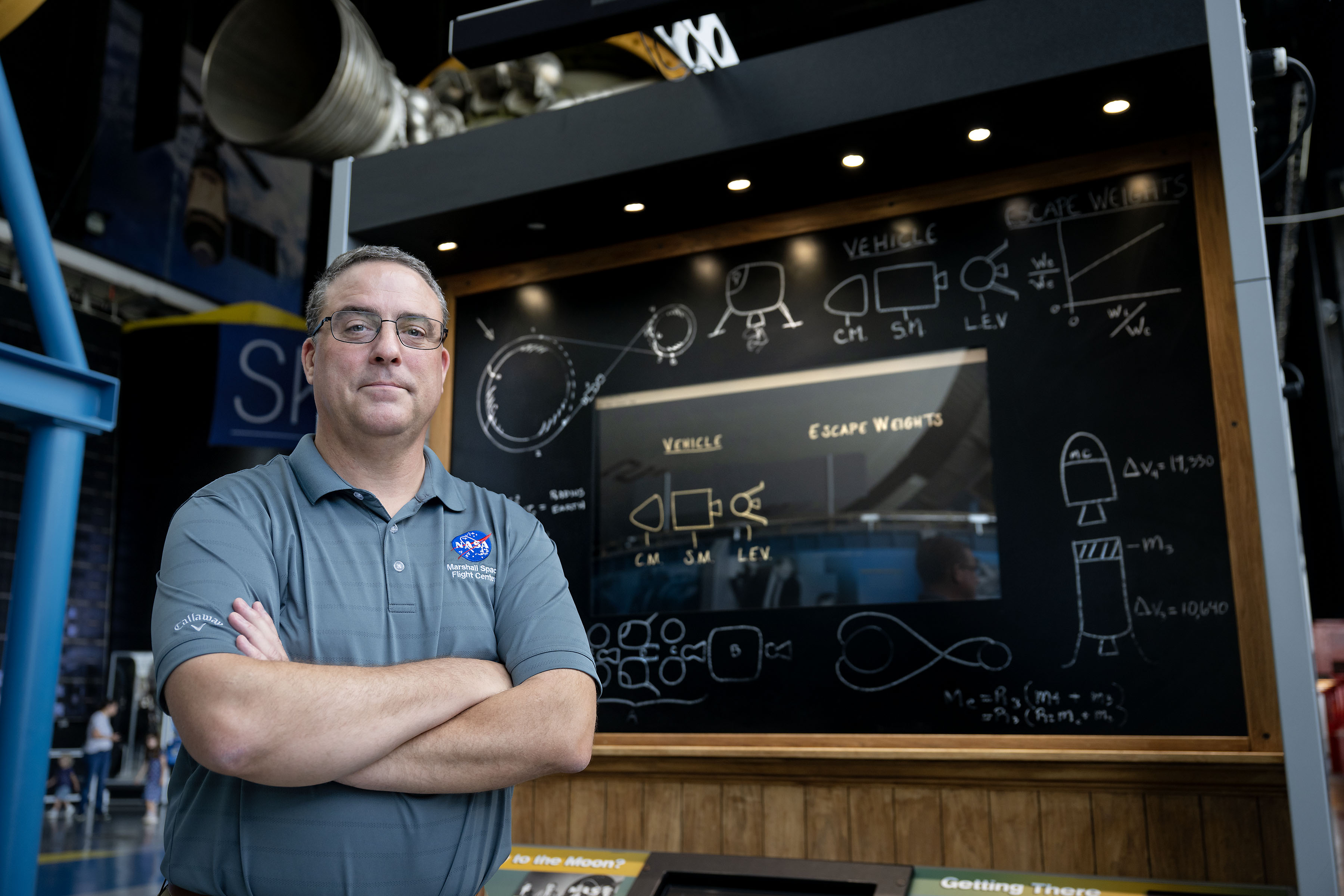
Percy serves as a focal point in working with providers SpaceX and Blue Origin to accelerate and streamline systems designs, manufacturing, testing, and certification. He ensures the crewed landers that SpaceX and Blue Origin are developing for Artemis are designed, built, tested, and will operate with other NASA exploration assets safely and effectively.
“You might say that all human landing system integration work lands on my desk. And with the rest of my talented, hard-working systems engineering and integration team, we’re working to make it all happen,” Percy said.
A native of North Easton, Massachusetts, Percy earned a bachelor’s degree in mechanical engineering from the Rochester Institute of Technology in Rochester, New York, where he first got hands-on experience working on designs that could be applied to NASA’s sustainable lunar architecture.
“As an undergrad, I served as president of the Rochester Institute of Technology’s chapter of the American Society of Mechanical Engineers. To get some real-world engineering experience, we decided to participate in the Great Moonbuggy Race,” Percy said. “Now called the Human Exploration Rover Challenge, the competition is held annually at NASA’s Marshall Space Flight Center in Huntsville, Alabama.
“At the time, I had never heard of Marshall Space Flight Center,” said Percy. “But our student team designed and built a rover and traveled to Huntsville for the race. That’s when I learned about some of the projects in Marshall’s diverse portfolio that the center works for NASA. And that’s when I began planning to make my way to NASA Marshall for my career.”
Percy chose to move south and earn a master’s degree in aerospace engineering from the Georgia Institute of Technology in Atlanta. His research in the advanced propulsion lab and courses in space systems design culminated in a spacecraft design course and the chance to work directly with engineers at Marshall.
Since landing at Marshall in 2003, Percy has been involved in evaluating transportation architecture options for human deep space exploration, including missions to land astronauts on the Moon and Mars. He also has expertise in space transportation, including advanced propulsion technology development; trajectory analysis; and spacecraft and mission concept development. Percy earned a doctorate in aerospace systems engineering from the University of Alabama in Huntsville.
The range of experience comes together in his current role as manager of human landing systems engineering and integration.
“The world watched the amazing success of Artemis II. NASA and our commercial providers are looking forward to flying again soon and executing increasingly complex Artemis missions,” Percy said.
Through the Artemis program, NASA will send astronauts on increasingly complex missions to explore more of the Moon for scientific discovery, economic benefits, establish an enduring human presence on the lunar surface, and to build on our foundation for the first crewed missions to Mars.
To learn more about the Artemis program, visit:
About the AuthorBeverly PerryCommunications Strategist Share Details Last Updated Aug 06, 2026 EditorLee MohonContactCorinne Beckingercorinne.m.beckinger@nasa.govLocationMarshall Space Flight Center Related Terms Explore More 4 min read I Am Artemis: Jason PetersonJason Peterson’s responsibilities for NASA’s Artemis II mission went beyond his usual role as the…
Article 2 months ago 3 min read I Am Artemis: Elkin Norena Article 2 months ago 4 min read I Am Artemis: Daniel Stubbs Article 2 months ago Keep Exploring Discover More Topics From NASAMissions
Humans in Space
Climate Change
Solar System
I Am Artemis: Tom Percy
As NASA sets its sights on long-term exploration of the Moon and Mars, the agency is increasing the cadence of its Artemis missions. Helping bring these plans to fruition is Tom Percy, manager of systems engineering and integration for NASA’s Human Landing System Program.
Tom Percy, manager of systems engineering and integration for NASA’s Human Landing Systems Program, stands in front of an Apollo Program lander exhibit at the U.S. Space and Rocket Center in Huntsville near NASA’s Marshall Space Flight Center. NASA/Charles BeasonPercy serves as a focal point in working with providers SpaceX and Blue Origin to accelerate and streamline systems designs, manufacturing, testing, and certification. He ensures the crewed landers that SpaceX and Blue Origin are developing for Artemis are designed, built, tested, and will operate with other NASA exploration assets safely and effectively.
“You might say that all human landing system integration work lands on my desk. And with the rest of my talented, hard-working systems engineering and integration team, we’re working to make it all happen,” Percy said.
A native of North Easton, Massachusetts, Percy earned a bachelor’s degree in mechanical engineering from the Rochester Institute of Technology in Rochester, New York, where he first got hands-on experience working on designs that could be applied to NASA’s sustainable lunar architecture.
“As an undergrad, I served as president of the Rochester Institute of Technology’s chapter of the American Society of Mechanical Engineers. To get some real-world engineering experience, we decided to participate in the Great Moonbuggy Race,” Percy said. “Now called the Human Exploration Rover Challenge, the competition is held annually at NASA’s Marshall Space Flight Center in Huntsville, Alabama.
“At the time, I had never heard of Marshall Space Flight Center,” said Percy. “But our student team designed and built a rover and traveled to Huntsville for the race. That’s when I learned about some of the projects in Marshall’s diverse portfolio that the center works for NASA. And that’s when I began planning to make my way to NASA Marshall for my career.”
Percy chose to move south and earn a master’s degree in aerospace engineering from the Georgia Institute of Technology in Atlanta. His research in the advanced propulsion lab and courses in space systems design culminated in a spacecraft design course and the chance to work directly with engineers at Marshall.
Since landing at Marshall in 2003, Percy has been involved in evaluating transportation architecture options for human deep space exploration, including missions to land astronauts on the Moon and Mars. He also has expertise in space transportation, including advanced propulsion technology development; trajectory analysis; and spacecraft and mission concept development. Percy earned a doctorate in aerospace systems engineering from the University of Alabama in Huntsville.
The range of experience comes together in his current role as manager of human landing systems engineering and integration.
“The world watched the amazing success of Artemis II. NASA and our commercial providers are looking forward to flying again soon and executing increasingly complex Artemis missions,” Percy said.
Through the Artemis program, NASA will send astronauts on increasingly complex missions to explore more of the Moon for scientific discovery, economic benefits, establish an enduring human presence on the lunar surface, and to build on our foundation for the first crewed missions to Mars.
To learn more about the Artemis program, visit:
About the AuthorBeverly PerryCommunications Strategist Share Details Last Updated Aug 06, 2026 EditorLee MohonContactCorinne Beckingercorinne.m.beckinger@nasa.govLocationMarshall Space Flight Center Related Terms Explore More 4 min read I Am Artemis: Jason PetersonJason Peterson’s responsibilities for NASA’s Artemis II mission went beyond his usual role as the…
Article 2 months ago 3 min read I Am Artemis: Elkin Norena Article 2 months ago 4 min read I Am Artemis: Daniel Stubbs Article 2 months ago Keep Exploring Discover More Topics From NASAMissions
Humans in Space
Climate Change
Solar System
Taking Flight to Prepare for Space
Taking Flight to Prepare for Space
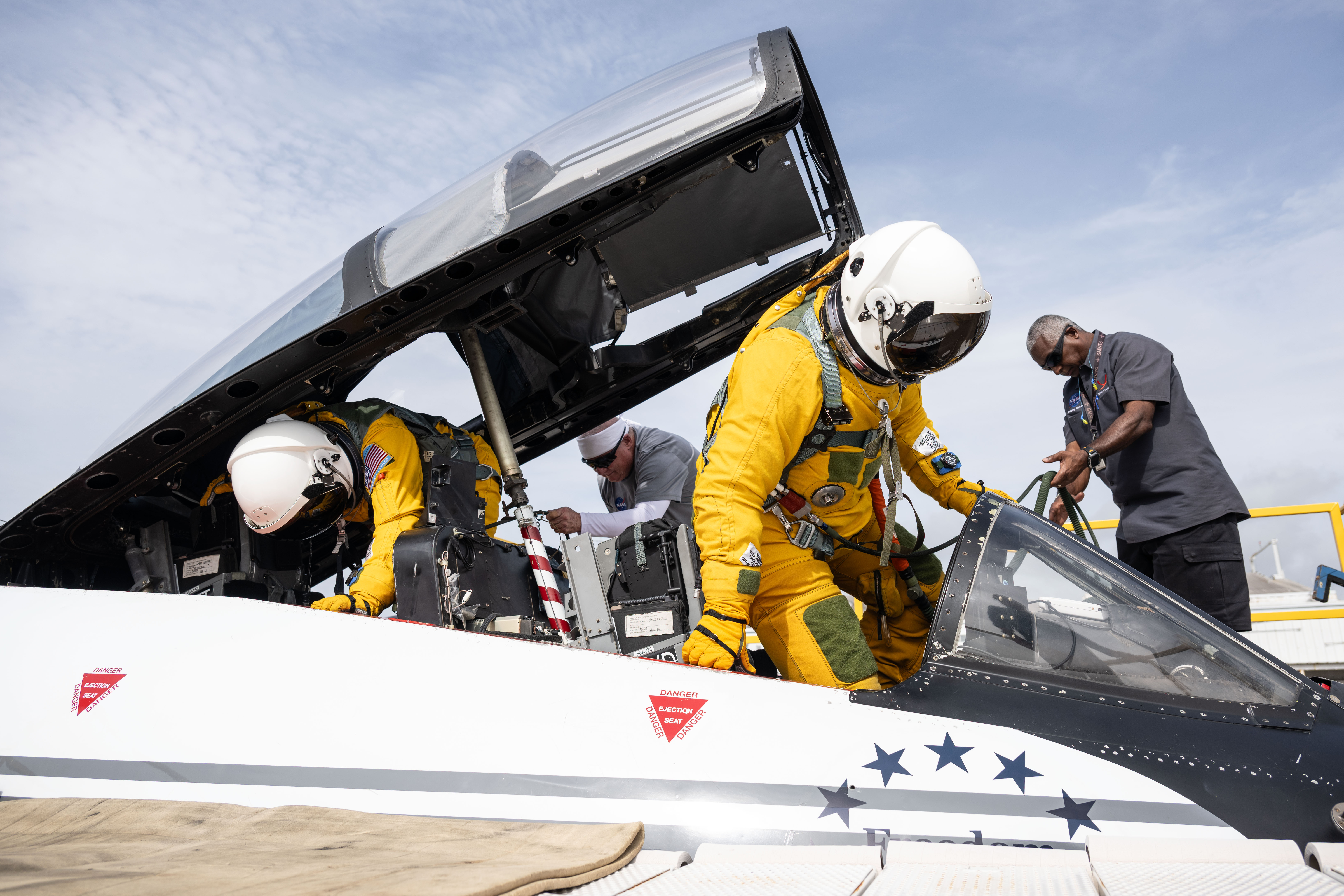
NASA astronaut Adam Fuhrmann (right, in yellow) prepares for a training flight aboard NASA’s WB-57 aircraft in this July 16, 2026, photo.
These high-altitude flights train the crew to work in a tight environment and operate aircraft systems while in a pressure suit, preparing them for future missions to the International Space Station, Moon, or beyond.
Image credit: NASA/Josh Valcarcel
Taking Flight to Prepare for Space
NASA astronaut Adam Fuhrmann (right, in yellow) prepares for a training flight aboard NASA’s WB-57 aircraft in this July 16, 2026, photo.
These high-altitude flights train the crew to work in a tight environment and operate aircraft systems while in a pressure suit, preparing them for future missions to the International Space Station, Moon, or beyond.
Image credit: NASA/Josh Valcarcel
JOB OPPORTUNITIES: NASA OFFICE OF THE GENERAL COUNSEL
1 min read
Preparations for Next Moonwalk Simulations Underway (and Underwater) View all current NASA job openings at USAJobs Return to OGC HomepageJOB OPPORTUNITIES: NASA OFFICE OF THE GENERAL COUNSEL
1 min read
Preparations for Next Moonwalk Simulations Underway (and Underwater) View all current NASA job openings at USAJobs Return to OGC HomepageCDC warns of Salmonella outbreak tied to jalapeño peppers sold to Chipotle and QDOBA
As cases of a parasite-caused disease tied to shredded iceberg lettuce continue to climb, the nation’s top public health body is warning of a new foodborne illness
Physicists harness sunlight for quantum entanglement
A proof-of-principle experiment used concentrated sunlight to produce entangled photons
Can quantum computers solve math’s hardest problem?
A million-dollar math mystery may someday be resolved in a physics lab. A new study brings this vision one step closer.
U.S. lawmakers vote to hold Biden’s former medical adviser Anthony Fauci in contempt of Congress
Fauci previously served as the chief medical officer to President Joe Biden and led the U.S. COVID pandemic response effort during the first Trump administration
U.S. approves Moderna’s mRNA vaccine for flu—the first of its kind
This flu shot, mFlusiva, was shown in a clinical trial to be up to 27 percent more effective than a standard flu jab
All I Need for a Night of Stargazing Is...
All you really need for stargazing is your eyes and dark skies . . . right?
The post All I Need for a Night of Stargazing Is... appeared first on Sky & Telescope.
Urban landscapes can boost storms—or break them up
New work shows how different storm types are shifted by cities’ microclimates
The Scientific American guide to 2026’s total solar eclipse
Here’s everything you need to know about this eclipse, from the weather to the best viewing locations
ExoMars stretches out its legs
The footage shows the simultaneous deployment of two landing legs from the ExoMars landing platform, in two sequential pairs.
The legs travel stowed on the spacecraft through deep space, and are automatically deployed in pairs in less than a second using non-explosive actuators, just after the front shield is jettisoned. This is a crucial step in the landing module’s preparation for touchdown.
The tests used a full-scale model of the landing platform at the Thales Alenia facilities in Turin, Italy. The four legs replicate the structure and dimensions of those that will fly to Mars.
The landing legs are crucial gear for the safe touchdown of ESA’s ExoMars Rosalind Franklin rover mission in 2030, alongside parachutes and engines that will slow the spacecraft’s descent onto Mars.
While Thales Alenia Space is the industrial lead of the mission, Airbus provides the landing platform. Teams from the Sener company, based in Spain, designed and built the landing legs.
Webb opens a Treasure Chest filled with stars
This NASA/ESA/CSA James Webb Space Telescope Picture of the Month takes us to a fantastical realm within our home galaxy, where piercing starlight and billowing winds sculpt dust clouds into inventive shapes. This scene is from the Carina Nebula, which lies just 7500 light-years away in the constellation Carina (the Keel).
Spanning roughly 260 light-years, the nebula is home to an incredible collection of objects, including the Cosmic Cliffs revealed in the first-ever Webb image release. The Carina Nebula is also the nearest high-mass star-forming region that allows astronomers to study the full range of star formation. This nebula houses some of the most massive stars in our galaxy as well as tens of thousands of protostars, offering a valuable opportunity to understand how stars shape their neighbourhoods.
The feature highlighted in today’s image, aptly called the Treasure Chest, looks right at home in this celestial sculpture garden. The Treasure Chest is what’s known as a cometary globule. A cometary globule is an isolated cloud of gas and dust with a dense, dark head and a sweeping tail. These clouds often somewhat resemble comets, but the Treasure Chest looks distinctly like a wooden chest with its lid wide open.
However, this chest doesn’t contain jewels or gold coins, but instead a compact cluster of young stars. These stars are responsible for the otherworldly glow coming from within the Treasure Chest, revealed by Webb’s sensitive Near-Infrared Camera (NIRCam). Researchers estimate that the Treasure Chest’s cluster contains about 70 stars, the most massive of which is a rare O-type star roughly 19 times as massive as the Sun.
The star cluster is likely around 1.3 million years old, though earlier estimates found it to be as young as just 100 000 years old. Because of its youth, the cluster is still deeply embedded within the dusty clouds of the Treasure Chest. The individual stars in the cluster are wrapped up in dust as well; astronomers have found evidence that many of these stars are surrounded by circumstellar discs. Over time, the brilliant starlight from these young stars will dissipate the surrounding cloud and reveal the entire cluster.
The key to the Treasure Chest’s sculptural shape lies outside this image: just 39 light-years to the northwest, as measured on the sky, sits Eta Carinae, the most luminous object in the entire Carina Nebula. Eta Carinae is a star system containing at least two stars, one of which is 100 times as massive as the Sun. This star alone is about 5 million times as luminous as the Sun. Adding to this intense radiation is the nearby star cluster Trumpler 16, which also contains several extremely hot massive stars.
With Webb, astronomers have carried out an observing programme (#5408; PI: Reiter) dedicated to studying how young stars in the Carina Nebula collect gas from their surroundings and expel it through outflows.
[Image Description: A region of space filled with bright stars and clouds of gas. In the centre, the densest clouds form the shape of a chest with its lid open. The chest appears to glow from within. At its base it breaks apart into long pillars of thick gas. Many of the gas clouds in the background are dark orange globules, while others form large, pale hazes. A few brightly shining stars lie in the foreground, the biggest and brightest in front of the chest’s lid.]
How much of our existence do we owe to sugar?
It may be time to rethink our relationship with the sweet stuff
APOD: 2026 August 6 – New Sharpest Image of the Sun Uncovers Instability
APOD
Astronomy Picture of the Day
Discover the cosmos! Each day a different image or photograph of our fascinating universe is featured, along with a brief explanation written by a professional astronomer.
New Sharpest Image of the Sun Uncovers Instability
Explanation: What does the new sharpest image of our Sun show? Instability. To be clear, a certain kind of interactive process called the Kelvin-Helmholtz instability (KHI). This instability can create waves and swirls when two streams flow past each other — in this case variable streams of solar magnetic plasma. Long hypothesized to occur on the Sun’s surface, KHI streaks and swirls were confirmed in just-released dramatic high-resolution images taken recently by the Inouye Solar Telescope in Hawaii, USA. The featured false-yellow image, actually taken in deep blue, is the highest resolution image yet of the Sun in visible light. It spans about the radius of the Earth, but its finest details are city sized. Visible are several smooth tops of changing solar granules, while the edges of the flower-like structures have been found to harbor multiple KHI swirls. Future research may investigate how the KHI helps move energy and magnetic fields, and may even heat the surrounding solar corona.
Tomorrow’s picture: Rubin’s COSMOS
Date August 6, 2026 Credit NSF, NSO, AURA, MPS, Inouye Tel Authors & editors: Robert Nemiroff, Jerry Bonnell, Cecilia Chirenti, Keighley Rockcliffe A service of: ASD at NASA / GSFC,NASA Science Activation & Michigan Tech. U.
Random APOD Generator
Yesterday’s Image APOD: 2026 August 5 – Spokes on Saturn’s B Ring
Tomorrow’s Image
APOD: 2026 August 6 – New Sharpest Image of the Sun Uncovers Instability
APOD
Astronomy Picture of the Day
Discover the cosmos! Each day a different image or photograph of our fascinating universe is featured, along with a brief explanation written by a professional astronomer.
New Sharpest Image of the Sun Uncovers InstabilityExplanation: What does the new sharpest image of our Sun show? Instability. To be clear, a certain kind of interactive process called the Kelvin-Helmholtz instability (KHI). This instability can create waves and swirls when two streams flow past each other — in this case variable streams of solar magnetic plasma. Long hypothesized to occur on the Sun’s surface, KHI streaks and swirls were confirmed in just-released dramatic high-resolution images taken recently by the Inouye Solar Telescope in Hawaii, USA. The featured false-yellow image, actually taken in deep blue, is the highest resolution image yet of the Sun in visible light. It spans about the radius of the Earth, but its finest details are city sized. Visible are several smooth tops of changing solar granules, while the edges of the flower-like structures have been found to harbor multiple KHI swirls. Future research may investigate how the KHI helps move energy and magnetic fields, and may even heat the surrounding solar corona.
Tomorrow’s picture: Rubin’s COSMOS
Date August 6, 2026 Credit NSF, NSO, AURA, MPS, Inouye Tel Authors & editors: Robert Nemiroff, Jerry Bonnell, Cecilia Chirenti, Keighley Rockcliffe A service of: ASD at NASA / GSFC,NASA Science Activation & Michigan Tech. U.
Random APOD Generator
Yesterday’s Image APOD: 2026 August 5 – Spokes on Saturn’s B Ring
Tomorrow’s Image