
Feed aggregator
NASA Welcomes Serbia as Newest Artemis Accords Signatory

The Republic of Serbia signed the Artemis Accords Thursday during a ceremony hosted by NASA at the agency’s Headquarters in Washington, becoming the 69th nation to join a large community of like-minded nations committed to the peaceful, transparent, and responsible exploration of space.
“Serbia’s connection to NASA reaches back to the Apollo program, when the work of Serbian engineers helped make some of humanity’s greatest achievements in space possible,” said NASA Deputy Administrator Matt Anderson. “Among them was Milojko ‘Mike’ Vučelić, who was awarded the Presidential Medal of Freedom for the critical role he played in bringing the Apollo 13 crew safely home. Their story stands as a reminder that the greatest achievements in space are made possible by talented people working together.”
The broader team of Serbian American engineers played key roles during the Apollo era across systems engineering, propulsion, power systems, spacecraft docking, electronics reliability, and mission coordination. Their expertise supported critical functions ranging from lunar landing analysis to safe spacecraft docking.
Serbia’s Minister of Foreign Affairs Marko Đurić signed the Artemis Accords on behalf of the country.
“The great beyond has always inspired humanity to achieve its greatest feats — from the Roman ‘per aspera ad astra’ to Norman Vincent Peale’s belief that if we aim for the Moon, we will at least land among the stars,” said Đurić. “Those words feel especially fitting today. We come from a nation of great minds like Nikola Tesla and Milutin Milanković, but also from the legacy of David Vujic, one of the pioneers of the Apollo missions and a member of the ‘Serbian Seven,’ a group of engineers and technicians whose contributions to NASA helped make the Moon landing possible. In that spirit, we owe it to both our brave ancestors and our children to keep pushing toward new frontiers — to explore, to inspire one another, and to dare even greater things.”
By signing the Artemis Accords, nations open the door to opportunities for future lunar exploration with NASA, such as providing science and technology payloads for the U.S.-led Moon Base and CubeSats for upcoming Artemis missions, advancing humanity’s return to the Moon, and shaping the Golden Age of space exploration and innovation.
Ambassador of the Republic of Serbia to the United States Dragan Šutanovac; State Secretary for Serbia’s Ministry of Science, Technological Development and Innovation Marija Gnjatović; and U.S. Department of State Assistant Secretary for Oceans and International Environmental and Scientific Affairs Wesley Brooks all participated in Serbia’s signing ceremony.
In 2020, NASA and the Department of State joined with seven other founding nations to establish the Artemis Accords, responding to the growing interest in lunar activities by both governments and private companies. They introduced the first set of practical principles aimed at enhancing the safety and coordination between nations as they explore the Moon, Mars, and beyond, committing nations to:
- explore peaceably and transparently
- render aid to those in need
- enable access to scientific data
- ensure activities do not interfere with those of others
- preserve historically significant sites and artifacts by developing best practices
Five years later, President Donald J. Trump’s National Space Policy directed NASA to establish a sustained lunar outpost. With this Moon Base, NASA is putting the principles of the Artemis Accords into practice, inviting every signatory to take part in the endeavor.
More countries are expected to sign the Artemis Accords in the months and years ahead, as NASA continues its work to establish a safe, peaceful, and prosperous future in space.
Learn more about the Artemis Accords at:
https://www.nasa.gov/artemis-accords
Share Details Last Updated Jul 16, 2026 LocationNASA Headquarters Related TermsNASA Welcomes Serbia as Newest Artemis Accords Signatory
The Republic of Serbia signed the Artemis Accords Thursday during a ceremony hosted by NASA at the agency’s Headquarters in Washington, becoming the 69th nation to join a large community of like-minded nations committed to the peaceful, transparent, and responsible exploration of space.
“Serbia’s connection to NASA reaches back to the Apollo program, when the work of Serbian engineers helped make some of humanity’s greatest achievements in space possible,” said NASA Deputy Administrator Matt Anderson. “Among them was Milojko ‘Mike’ Vučelić, who was awarded the Presidential Medal of Freedom for the critical role he played in bringing the Apollo 13 crew safely home. Their story stands as a reminder that the greatest achievements in space are made possible by talented people working together.”
The broader team of Serbian American engineers played key roles during the Apollo era across systems engineering, propulsion, power systems, spacecraft docking, electronics reliability, and mission coordination. Their expertise supported critical functions ranging from lunar landing analysis to safe spacecraft docking.
Serbia’s Minister of Foreign Affairs Marko Đurić signed the Artemis Accords on behalf of the country.
“The great beyond has always inspired humanity to achieve its greatest feats — from the Roman ‘per aspera ad astra’ to Norman Vincent Peale’s belief that if we aim for the Moon, we will at least land among the stars,” said Đurić. “Those words feel especially fitting today. We come from a nation of great minds like Nikola Tesla and Milutin Milanković, but also from the legacy of David Vujic, one of the pioneers of the Apollo missions and a member of the ‘Serbian Seven,’ a group of engineers and technicians whose contributions to NASA helped make the Moon landing possible. In that spirit, we owe it to both our brave ancestors and our children to keep pushing toward new frontiers — to explore, to inspire one another, and to dare even greater things.”
By signing the Artemis Accords, nations open the door to opportunities for future lunar exploration with NASA, such as providing science and technology payloads for the U.S.-led Moon Base and CubeSats for upcoming Artemis missions, advancing humanity’s return to the Moon, and shaping the Golden Age of space exploration and innovation.
Ambassador of the Republic of Serbia to the United States Dragan Šutanovac; State Secretary for Serbia’s Ministry of Science, Technological Development and Innovation Marija Gnjatović; and U.S. Department of State Assistant Secretary for Oceans and International Environmental and Scientific Affairs Wesley Brooks all participated in Serbia’s signing ceremony.
In 2020, NASA and the Department of State joined with seven other founding nations to establish the Artemis Accords, responding to the growing interest in lunar activities by both governments and private companies. They introduced the first set of practical principles aimed at enhancing the safety and coordination between nations as they explore the Moon, Mars, and beyond, committing nations to:
- explore peaceably and transparently
- render aid to those in need
- enable access to scientific data
- ensure activities do not interfere with those of others
- preserve historically significant sites and artifacts by developing best practices
Five years later, President Donald J. Trump’s National Space Policy directed NASA to establish a sustained lunar outpost. With this Moon Base, NASA is putting the principles of the Artemis Accords into practice, inviting every signatory to take part in the endeavor.
More countries are expected to sign the Artemis Accords in the months and years ahead, as NASA continues its work to establish a safe, peaceful, and prosperous future in space.
Learn more about the Artemis Accords at:
https://www.nasa.gov/artemis-accords
Share Details Last Updated Jul 16, 2026 LocationNASA Headquarters Related TermsThis Exoplanet Hid for 10 Years Before Astronomers Finally Found It
A team of astronomers have discovered a third planet orbiting the star Beta Pictoris. The new planet, Beta Pictoris d, is 100 times fainter than Beta Pictoris b — the first planet discovered in the same system — and is among the lightest exoplanets ever to be imaged from the ground. After spotting the planet using the European Southern Observatory’s Very Large Telescope (ESO’s VLT), the team found it had been hiding in archive observations spanning more than a decade.
NASA Study Finds Near-Earth Asteroid Is Actually Comet
5 min read
Preparations for Next Moonwalk Simulations Underway (and Underwater) This artist’s concept depicts a near-Earth asteroid with an elongated orbit. A few objects such as these can exhibit significant perturbations in their motion around the Sun and, like the asteroid 1998 SH2, could turn out to be regular comets with a weak tail and coma (the gas and dust around a comet’s nucleus).NASA/JPL-Caltech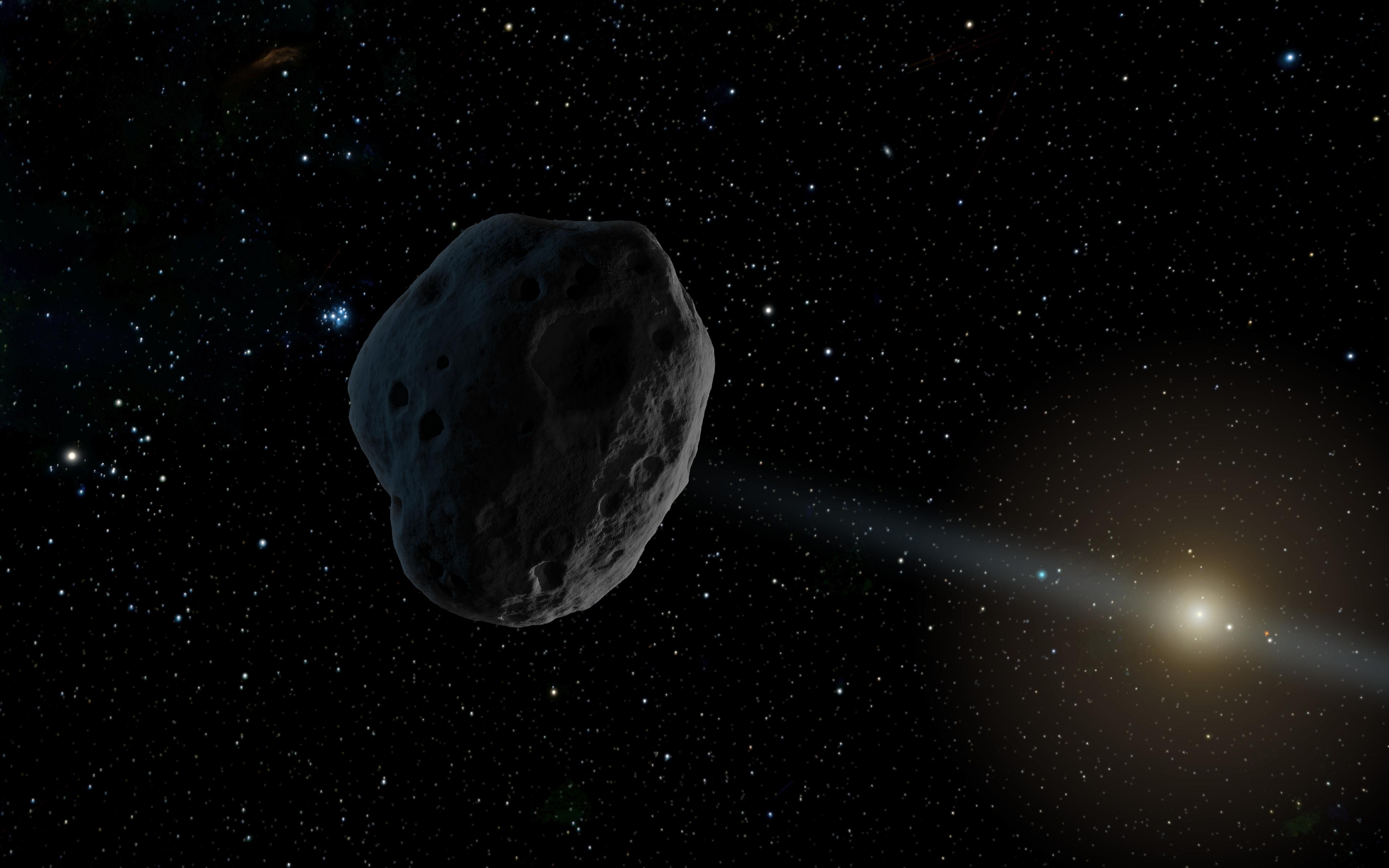
New research led by scientists at NASA’s Jet Propulsion Laboratory in Southern California has revealed the identity of a puzzling near-Earth object by precisely tracking its motion through space and using powerful observatories that image faint celestial objects.
This object has a dual personality: Past images hadn’t revealed obvious cometlike activity, suggesting it might be an asteroid, but its motion recently proved to be irregular like that of a comet. The scientists detailed their findings in a study published in the journal Nature Astronomy.
The puzzle began on Aug. 28, 2025, when the object, provisionally known as the asteroid 1998 SH2, passed safely within 2 million miles (3 million kilometers) of our planet during its 4½-year orbit around the Sun. Researchers looking to observe 1998 SH2 with NASA’s Deep Space Network (DSN) planetary radar system had calculated its position using data from previous orbits and factored in the effects that the gravity of the Sun and planets would have on its path. But when 1998 SH2 didn’t show up where they expected, they realized that something unanticipated had been influencing the object’s motion.
Object trackingBy using optical astrometry to precisely measure the object’s position in the sky, the researchers were able to identify the cause.
“After we measured the nongravitational perturbations affecting the motion of 1998 SH2 and recognized they weren’t compatible with the object being an asteroid, we suspected the object could be an active comet,” said Davide Farnocchia, a navigation engineer with NASA’s Center for Near-Earth Object Studies at JPL and study lead.
Although 1998 SH2’s orbit around the Sun had been well-tracked from 1998 to 2016, the object had completed two solar orbits without additional observations by telescopes until the 2025 DSN attempts. Analyzing all observations collected since the object’s discovery in 1998, researchers determined the perturbations to 1998 SH2’s motion and hypothesized that the object may be generating a small thrust by venting gas into space, causing it to deviate from its predicted path.
This venting results from the Sun heating ice mixed with rocky material, turning the ice into a gas. With regular comets, this activity forms a trademark bright tail and coma — the gas and dust surrounding a comet’s nucleus. But when an object produces gas and dust in much smaller quantities, its tail and coma may not be detectable to most observatories.
Tail, coma emergeThe August 2025 close approach to Earth of 1998 SH2 provided the perfect opportunity for the paper’s authors to gather observational evidence of visible cometary activity. They reached out to astronomers at the Canada-France-Hawaii Telescope, a 3.6-meter (12-foot) optical/infrared telescope near the summit of Mauna Kea, Hawaii, and the 1.5-meter (5-foot) European Southern Observatory’s Danish Telescope in La Silla, Chile, to observe. Astronomers at the powerful European Southern Observatory’s 8.2-meter (27-foot) Very Large Telescope on the Chilean mountain Cerro Paranal also tracked the object.
“The images we collected from these observatories showed a weak but clear tail, thus confirming that 1998 SH2 is, in fact, a comet,” said Olivier Hainaut, an astronomer with the European Southern Observatory and coauthor of the study. “That’s how science works — you form a hypothesis, and you set out to test it. This data is exactly what was needed to confirm our hypothesis that 1998 SH2 was a comet.”
As an outcome of the investigation, 1998 SH2 will receive an additional comet provisional designation, P/1998 SH2.
Planetary defense implicationsThe research also sheds light on another, even more unusual, class of objects called dark comets. Like 1998 SH2, dark comets exhibit significant irregularities, or perturbations, in their trajectory but lack other visible evidence of comet activity — there’s no coma, tail, or visible outgassing. These enigmatic objects fall into two distinct populations: larger ones with orbits similar to those of Jupiter-family comets (short period comets with highly elliptical, or eccentric, orbits), and smaller ones that orbit closer to the Sun. Since the 2016 discovery of the first dark comet, about a dozen more have been identified.
The paper’s authors suggest that many of the larger dark comets, which have orbits like 1998 SH2’s, could turn out to be regular comets if astronomers get the right opportunity to observe them with powerful telescopes capable of imaging incredibly faint objects. And by analyzing the motion of all near-Earth objects using precision astrometry data, researchers may reveal more comets that were previously designated as asteroids if they exhibit cometlike nongravitational perturbations.
“This work shows the importance of continuously tracking near-Earth objects,” said Farnocchia. “Because of outgassing, the motion of comets is more significantly perturbed than that of asteroids. Detecting these perturbations can be an important diagnostic tool for planetary defense that will help understand which objects may be comets rather than asteroids, how their orbits evolve, and how that influences their Earth impact risks.”
Hunting for near-Earth objectsNASA’s upcoming Near-Earth Object (NEO) Surveyor will collect data that can be used to support this effort. The first space survey telescope to be built for planetary defense, this next-generation mission will seek out some of the hardest-to-find near-Earth objects, such as dark asteroids and comets that don’t reflect much visible light.
NASA’s Center for Near Earth Object Studies, the Goldstone Solar System Radar Group, and NEO Surveyor all are managed by JPL and supported by the agency’s Planetary Defense Coordination Office in Washington. Caltech in Pasadena manages JPL for NASA. The DSN receives programmatic oversight from the SCaN (Space Communications and Navigation) program office, also at NASA headquarters.
More information about planetary radar, NASA’s Center for Near Earth Object Studies, and near-Earth objects can be found at:
https://www.jpl.nasa.gov/asteroid-watch
News Media Contacts
Ian J. O’Neill
Jet Propulsion Laboratory, Pasadena, Calif.
818-354-2649
ian.j.oneill@jpl.nasa.gov
Karen Fox / Molly Wasser
NASA Headquarters, Washington
202-358-1600
karen.c.fox@nasa.gov / molly.l.wasser@nasa.gov
2026-046
Share Details Last Updated Jul 16, 2026 Related Terms Explore More 6 min read NASA Study of Pristine Meteorite Adds to Story of Ancient AsteroidsA meteorite recovered immediately upon its fall to Earth on July 16, 2024, is helping…
Article 2 days ago 5 min read NASA’s Perseverance Rover Reads Record of Ancient Mars Impacts Article 2 days ago 4 min read Where Venezuela’s Earthquakes Shifted the GroundRadar data from the NISAR satellite show that La Guaira and nearby areas experienced significant…
Article 1 week ago Keep Exploring Discover Related Topics Asteroids, Comets & MeteorsAsteroids, comets, and meteoroids are chunks of rock, ice, and metal left over from the formation of our solar system…
Near-Earth Observations (NEO) ProgramThe Near-Earth Object (NEO) Observations Program is a key element of NASA’s Planetary Defense Program, funding efforts to search for undiscovered…
CometsIntroduction Comets are cosmic snowballs of frozen gases, rock, and dust that orbit the Sun. When frozen, they are the…
NEO SurveyorOverview Building on the success of NASA’s NEOWISE space telescope, the agency’s NEO Surveyor will be the first spacecraft built…
NASA Study Finds Near-Earth Asteroid Is Actually Comet
5 min read
Preparations for Next Moonwalk Simulations Underway (and Underwater) This artist’s concept depicts a near-Earth asteroid with an elongated orbit. A few objects such as these can exhibit significant perturbations in their motion around the Sun and, like the asteroid 1998 SH2, could turn out to be regular comets with a weak tail and coma (the gas and dust around a comet’s nucleus).NASA/JPL-CaltechNew research led by scientists at NASA’s Jet Propulsion Laboratory in Southern California has revealed the identity of a puzzling near-Earth object by precisely tracking its motion through space and using powerful observatories that image faint celestial objects.
This object has a dual personality: Past images hadn’t revealed obvious cometlike activity, suggesting it might be an asteroid, but its motion recently proved to be irregular like that of a comet. The scientists detailed their findings in a study published in the journal Nature Astronomy.
The puzzle began on Aug. 28, 2025, when the object, provisionally known as the asteroid 1998 SH2, passed safely within 2 million miles (3 million kilometers) of our planet during its 4½-year orbit around the Sun. Researchers looking to observe 1998 SH2 with NASA’s Deep Space Network (DSN) planetary radar system had calculated its position using data from previous orbits and factored in the effects that the gravity of the Sun and planets would have on its path. But when 1998 SH2 didn’t show up where they expected, they realized that something unanticipated had been influencing the object’s motion.
Object trackingBy using optical astrometry to precisely measure the object’s position in the sky, the researchers were able to identify the cause.
“After we measured the nongravitational perturbations affecting the motion of 1998 SH2 and recognized they weren’t compatible with the object being an asteroid, we suspected the object could be an active comet,” said Davide Farnocchia, a navigation engineer with NASA’s Center for Near-Earth Object Studies at JPL and study lead.
Although 1998 SH2’s orbit around the Sun had been well-tracked from 1998 to 2016, the object had completed two solar orbits without additional observations by telescopes until the 2025 DSN attempts. Analyzing all observations collected since the object’s discovery in 1998, researchers determined the perturbations to 1998 SH2’s motion and hypothesized that the object may be generating a small thrust by venting gas into space, causing it to deviate from its predicted path.
This venting results from the Sun heating ice mixed with rocky material, turning the ice into a gas. With regular comets, this activity forms a trademark bright tail and coma — the gas and dust surrounding a comet’s nucleus. But when an object produces gas and dust in much smaller quantities, its tail and coma may not be detectable to most observatories.
Tail, coma emergeThe August 2025 close approach to Earth of 1998 SH2 provided the perfect opportunity for the paper’s authors to gather observational evidence of visible cometary activity. They reached out to astronomers at the Canada-France-Hawaii Telescope, a 3.6-meter (12-foot) optical/infrared telescope near the summit of Mauna Kea, Hawaii, and the 1.5-meter (5-foot) European Southern Observatory’s Danish Telescope in La Silla, Chile, to observe. Astronomers at the powerful European Southern Observatory’s 8.2-meter (27-foot) Very Large Telescope on the Chilean mountain Cerro Paranal also tracked the object.
“The images we collected from these observatories showed a weak but clear tail, thus confirming that 1998 SH2 is, in fact, a comet,” said Olivier Hainaut, an astronomer with the European Southern Observatory and coauthor of the study. “That’s how science works — you form a hypothesis, and you set out to test it. This data is exactly what was needed to confirm our hypothesis that 1998 SH2 was a comet.”
As an outcome of the investigation, 1998 SH2 will receive an additional comet provisional designation, P/1998 SH2.
Planetary defense implicationsThe research also sheds light on another, even more unusual, class of objects called dark comets. Like 1998 SH2, dark comets exhibit significant irregularities, or perturbations, in their trajectory but lack other visible evidence of comet activity — there’s no coma, tail, or visible outgassing. These enigmatic objects fall into two distinct populations: larger ones with orbits similar to those of Jupiter-family comets (short period comets with highly elliptical, or eccentric, orbits), and smaller ones that orbit closer to the Sun. Since the 2016 discovery of the first dark comet, about a dozen more have been identified.
The paper’s authors suggest that many of the larger dark comets, which have orbits like 1998 SH2’s, could turn out to be regular comets if astronomers get the right opportunity to observe them with powerful telescopes capable of imaging incredibly faint objects. And by analyzing the motion of all near-Earth objects using precision astrometry data, researchers may reveal more comets that were previously designated as asteroids if they exhibit cometlike nongravitational perturbations.
“This work shows the importance of continuously tracking near-Earth objects,” said Farnocchia. “Because of outgassing, the motion of comets is more significantly perturbed than that of asteroids. Detecting these perturbations can be an important diagnostic tool for planetary defense that will help understand which objects may be comets rather than asteroids, how their orbits evolve, and how that influences their Earth impact risks.”
Hunting for near-Earth objectsNASA’s upcoming Near-Earth Object (NEO) Surveyor will collect data that can be used to support this effort. The first space survey telescope to be built for planetary defense, this next-generation mission will seek out some of the hardest-to-find near-Earth objects, such as dark asteroids and comets that don’t reflect much visible light.
NASA’s Center for Near Earth Object Studies, the Goldstone Solar System Radar Group, and NEO Surveyor all are managed by JPL and supported by the agency’s Planetary Defense Coordination Office in Washington. Caltech in Pasadena manages JPL for NASA. The DSN receives programmatic oversight from the SCaN (Space Communications and Navigation) program office, also at NASA headquarters.
More information about planetary radar, NASA’s Center for Near Earth Object Studies, and near-Earth objects can be found at:
https://www.jpl.nasa.gov/asteroid-watch
News Media Contacts
Ian J. O’Neill
Jet Propulsion Laboratory, Pasadena, Calif.
818-354-2649
ian.j.oneill@jpl.nasa.gov
Karen Fox / Molly Wasser
NASA Headquarters, Washington
202-358-1600
karen.c.fox@nasa.gov / molly.l.wasser@nasa.gov
2026-046
Share Details Last Updated Jul 16, 2026 Related Terms Explore More 6 min read NASA Study of Pristine Meteorite Adds to Story of Ancient AsteroidsA meteorite recovered immediately upon its fall to Earth on July 16, 2024, is helping…
Article 1 day ago 5 min read NASA’s Perseverance Rover Reads Record of Ancient Mars Impacts Article 1 day ago 4 min read Where Venezuela’s Earthquakes Shifted the GroundRadar data from the NISAR satellite show that La Guaira and nearby areas experienced significant…
Article 7 days ago Keep Exploring Discover Related Topics Asteroids, Comets & MeteorsAsteroids, comets, and meteoroids are chunks of rock, ice, and metal left over from the formation of our solar system…
Near-Earth Observations (NEO) ProgramThe Near-Earth Object (NEO) Observations Program is a key element of NASA’s Planetary Defense Program, funding efforts to search for undiscovered…
CometsIntroduction Comets are cosmic snowballs of frozen gases, rock, and dust that orbit the Sun. When frozen, they are the…
NEO SurveyorOverview Building on the success of NASA’s NEOWISE space telescope, the agency’s NEO Surveyor will be the first spacecraft built…
A super-Earth exoplanet’s leaking helium could be evidence of a complex atmosphere
The planet LHS 1140 b lies in its star’s habitable zone, which already made it a prime candidate as a possible host for life
First Atmosphere Detected on a Terrestrial World
A team of astronomers have discovered helium escaping from a rocky planet, marking the first detection of an atmosphere on a rocky world.
The post First Atmosphere Detected on a Terrestrial World appeared first on Sky & Telescope.
What's It Like to Travel Near the Speed of Light? Part 2: The Warped View
Move fast enough and the entire universe compresses into a searing, blueshifted cone of light aimed at your face. How relativistic aberration and the Doppler effect warp your view of the cosmos as you approach lightspeed.
Speeding may be costing drivers far more than a ticket
Shaving under a minute off our daily commutes costs Americans $22 million daily
Young Galaxy Cluster
Young Galaxy Cluster
NASA’s James Webb Space Telescope takes us 4.4 billion years in the past with this July 3, 2026, image of a young galaxy cluster, MACS J0553.4-3342. The cluster is composed of two actively merging sub-clusters, roughly equal in mass. Each sub-cluster is anchored on an immensely bright and massive elliptical galaxy, easily identifiable as the two brightest points in the center of this scene with the largest glowing halos around them.
Image credit: ESA/Webb, NASA & CSA, S. Fujimoto
Young Galaxy Cluster
NASA’s James Webb Space Telescope takes us 4.4 billion years in the past with this July 3, 2026, image of a young galaxy cluster, MACS J0553.4-3342. The cluster is composed of two actively merging sub-clusters, roughly equal in mass. Each sub-cluster is anchored on an immensely bright and massive elliptical galaxy, easily identifiable as the two brightest points in the center of this scene with the largest glowing halos around them.
Image credit: ESA/Webb, NASA & CSA, S. Fujimoto
U.S. approval of giant ‘space mirror’ satellite alarms astronomers
A controversial new ruling from the Federal Communications Commission leaves no one responsible for regulating light pollution and other ill effects from skyrocketing numbers of satellites
FDA approves cholesterol pill more powerful than statins
Most adults have levels of a dangerous type of cholesterol that are above 100, but this new drug can reduce levels to around 50
Expedition Sound podcast series
Expedition Sound is a podcast series by the European Space Agency (ESA) in which you’re invited to explore the Universe through your ears. Guided by sonifications – the translation of data into sound – host Zsófi Szalavári travels from our Sun out into the depths of space to uncover what the space telescopes of ESA’s science missions teach us about the Universe.
Watch SpaceX’s Starship Flight 13 launch tonight
SpaceX is launching the latest version of its Starship megarocket for a test flight that—if all goes to plan—should look a lot like the last one
FLEX and Sentinel-3C arrive at Europe’s Spaceport
With liftoff scheduled for September, excitement is building at Europe’s Spaceport in French Guiana as two cutting-edge Earth observation satellites, FLEX and Copernicus Sentinel-3C, have arrived to begin their launch campaigns.
Over the coming weeks, engineers and mission teams will carry out a series of rigorous inspections and prepare the satellites to be installed atop their Vega-C rocket for their journey into orbit.
Ontario Wildfire Smoke Moves East
- Earth
- Earth Observatory
- Image of the Day
- EO Explorer
- Topics
- More Content
- About
Ontario Wildfire Smoke Moves East
- Earth
- Earth Observatory
- Image of the Day
- EO Explorer
- Topics
- More Content
- About