

Feed aggregator
Total Solar Eclipse in Sunflower Field
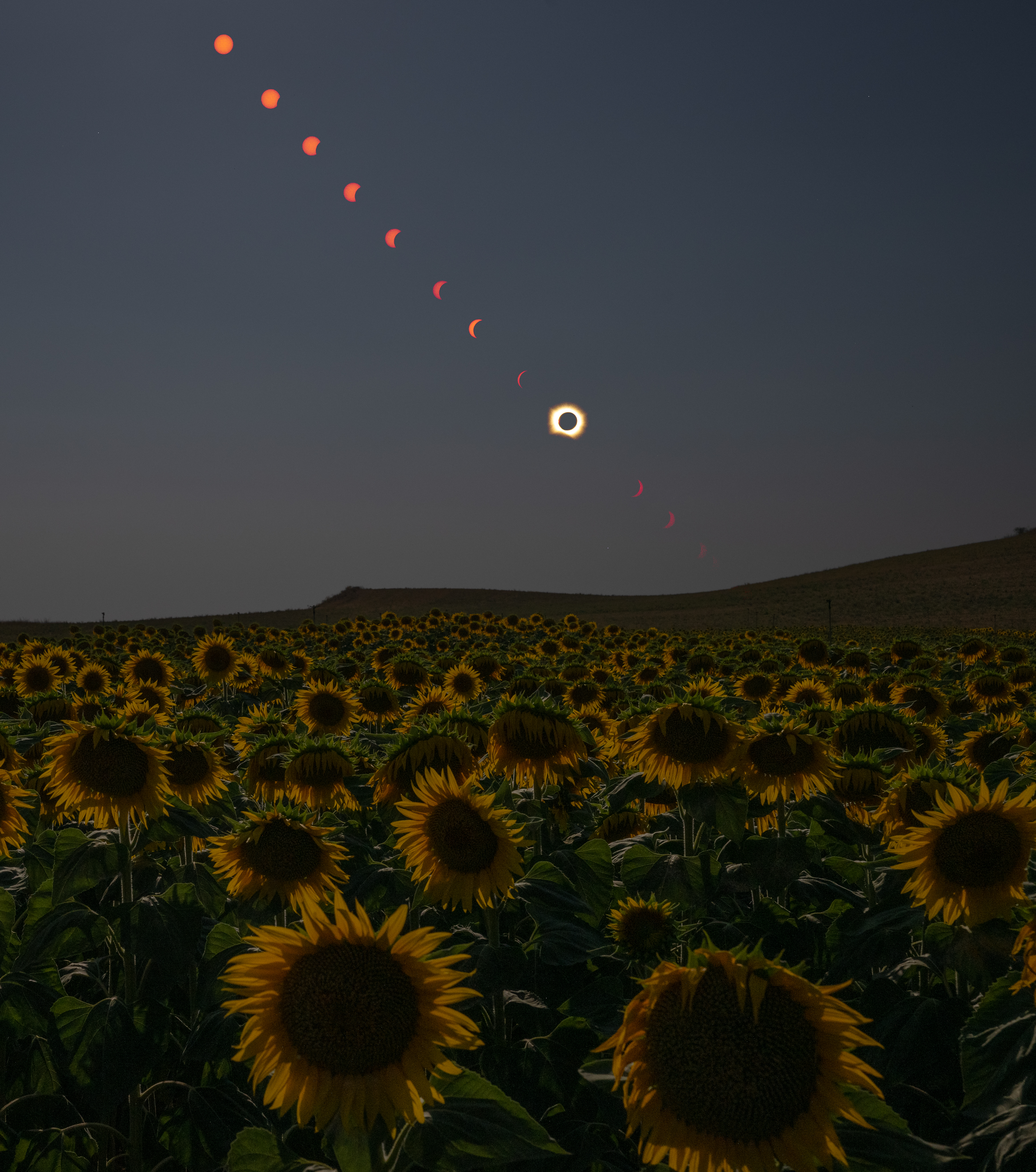
This composite image shows the progression of a total solar eclipse over San Millán de los Caballeros, Spain on, Wednesday, Aug. 12, 2026.
A total solar eclipse swept across parts of Greenland, Iceland, northern Russia, the Atlantic Ocean, Spain, and a small corner of Portugal. A partial eclipse was visible in parts of the U.S., most of Canada, much of Europe, and northwest Africa.
Image credit: NASA/Bill Ingalls
On this day in space! Aug. 14, 1992: Meteorite shower hits Uganda
On Aug. 14, 1992, a space rock entered the atmosphere over Mbale, Uganda and exploded into hundreds of pieces!
Debris from this meteorite shower was strewn over an area of about 2 by 4 miles (3.2 to 6.4 kilometers), and the biggest piece weighed more than 60 pounds (27 kilograms)! Scientists estimated that the original space rocket weighed more than 2,000 pounds (900 kg). A young boy was hit in the head with a small meteorite fragment, but thankfully no one was seriously injured or killed by any of the falling space rocks.
In October 2012, a fragment of the Mbale meteorite was put up for sale by Heritage Auctions in New York City.
This image shows a fireball over California on Oct. 17, 2012. (Image credit: Paola-Castillo)Why it matteredThe Mbale meteorite provided scientists with a glimpse of how space rocks of this size can impact communities where they happen to land, and allowed researchers a look at large fragments found by recovery expeditions for radionuclide studies within just 12 days of falling to Earth.
NASA classified Mbale as a type L5/6 ordinary chondrite, and calculated that its breakup in Earth's atmosphere occurred between about 15.5 miles (25 km) and 6 miles (10 km) in altitude. By October 1993, 863 fragments of the meteorite had been recovered, with an overall estimate of 330 pounds (150 kg) of material surviving the atmospheric plunge to reach Earth's surface.
ISS photobombs the sun during solar eclipse | Space photo of the day for Aug. 14, 2026
This week's total solar eclipse captured the world's attention, and millions of skywatchers looked up (with the correct protective eyewear, hopefully) to experience the moon blocking out our star's light. And, as you can see in this image, even the International Space Station (ISS) itself got in on the fun.
What is it?On Aug. 12, 2026, the moon completely blocked out the sun's light for millions of lucky skywatchers witnessing a total solar eclipse.
But the moon isn't the only thing orbiting Earth. Tons of satellites and probes do too, and that includes the ISS. This created a truly remarkable moment for some skywatchers. With the right equipment, it was possible to see the silhouette of the ISS in front of the sun.
This composite image shows eight different frames of the ISS silhouetted on the sun's face as the moon takes a "bite" out of our star to create a partial eclipse.
This gif shows the ISS' silhouette moving across the sun's face during a partial solar eclipse on Aug. 12, 2026. (Image credit: NASA/Joel Kowsky)Why is it incredible?Solar eclipses like this week's total solar eclipse really bring people together. It creates opportunities for humans to come together and gather for a common goal.
And while the ISS is featured in this image, we may also want to consider the astronauts aboard. In other words, people on Earth weren't the only ones who got to participate in the marvel.
The Expedition 75 astronauts on the ISS (NASA astronauts Jessica Meir, Anil Menon, and Jack Hathaway; ESA (European Space Agency) astronaut Sophie Adenot; and Roscosmos cosmonauts Pyotr Dubrov, Andrey Fedyaev and Anna Kikina) caught the show too as they orbited our planet. There they were, in between Earth and the moon, as our planet's neighbor blocked out our star.
The X-Files creator Chris Carter on Scully, science and the truth that’s still out there
The creator of The X-Files discusses what Frankenstein elements are in the newly released director’s cut of The X-Files: I Want to Believe and how Mary Shelley’s classic influenced the movie’s story
Week in images: 10-14 August 2026
Week in images: 10-14 August 2026
Discover our week through the lens
India-US space ties deepen as NASA invites ISRO to join moon base program
NASA has formally invited India to participate in its effort to build a permanent base near the moon's south pole, adding a new dimension to the deep-space cooperation between the two countries.
The invitation was extended last week at the Indian space agency ISRO's headquarters in Bengaluru during the ninth meeting of the U.S.-India Civil Space Joint Working Group. The CSJWG was established in 2005 as a mechanism for bilateral space cooperation and for addressing challenges and pursuing mutual spaceflight goals.
"Building on our successful collaboration in science, NASA reaffirmed its interest in @ISRO joining Moon Base. We're going back to the moon to stay — and we're bringing our partners with us," NASA officials said via X on Tuesday (Aug. 11).
Building on our successful collaboration in science, NASA reaffirmed its interest in @ISRO joining Moon Base. We're going back to the Moon to stay — and we're bringing our partners with us. https://t.co/hU9ssn24FPAugust 11, 2026
Beyond the lunar base invitation, "the two sides also agreed to advance discussions for cooperation on open scientific data sharing under the Accords," reads a Tuesday statement by the U.S. Embassy in India.
"The Accords" are the Artemis Accords, the U.S.-led diplomatic framework outlining principles for safe and responsible exploration of the moon and beyond. India signed on as the 27th signatory in 2023, joining a coalition that has now grown to 70 nations.
Official statements have provided few details on what India's participation in the Moon Base program would entail in practice. The meeting, however, brought together senior space officials from both countries, including V. Narayanan, the chairman of ISRO and secretary of India's Department of Space, and Sergio Gor, the U.S. Ambassador to India, who addressed the opening session, according to the statement.
The meeting was co-chaired by M. Sankaran, director of ISRO's U.R. Rao Satellite Centre, on the Indian side, and two people on the U.S. side — Wesley Brooks, assistant secretary of state for the U.S. Department of State's Oceans and International Environmental and Scientific Affairs, and Kathleen Karika, NASA associate administrator for International and Interagency Relations, the statement reads.
Over the coming decade, via its Artemis program, NASA plans to build out a sprawling, city-like base near the moon's south pole, a region of particular interest thanks to permanently shadowed craters there that are thought to contain substantial deposits of water ice.
Details of the planned architecture shared by NASA in May envision hilltop habitats to take advantage of sunlight and nuclear power systems located farther away to mitigate radiation risks. The space agency also plans to use small, hopping robots starting in 2028 to scout the south polar region ahead of moon base construction.
This effort to gather information and secure access to the surface is the first of three planned phases. Phase 2, from 2029-2032, is intended to establish the base's initial operating capability. Phase 3, from 2032 onward, aims to achieve a semi-permanent crew presence on the lunar surface, NASA said during the May update.
Senior space officials from India and the U.S. at the ninth meeting of the India-U.S. Civil Space Joint Working Group at ISRO headquarters in Bengaluru on Aug. 5-6, 2026, where NASA invited ISRO to join its Moon Base program. (Image credit: ISRO)To prioritize infrastructure that supports sustained operations on the moon's surface, increase launch cadence and keep pace with China's lunar ambitions, NASA earlier this year paused development of its long-planned Gateway space station.
For India, the invitation to join NASA's Moon Base program comes as the country pursues its own ambitious lunar exploration and human spaceflight roadmap. Its plans for the 2040s include developing a moon base, establishing a space station in lunar orbit and sending Indian astronauts to the moon, with the broader goal of building long-term human presence beyond Earth.
What the mathematics of billiards can tell us about loving and letting go
A mathematician may have solved a 250-year-old question about whether every polygon contains a path home
When will Betelgeuse go supernova?
Betelgeuse, the sky’s most famous red supergiant, is well studied but poorly understood
SpaceX rocket's moon crash highlights 'a tangible operational risk' of lunar settlement
The moon dust has settled after a 4.5-ton SpaceX rocket body slammed into terrain near Einstein Crater on Aug. 5.
That impact site was imaged by South Korea's moon-orbiting Danuri spacecraft, as well as by NASA's Lunar Reconnaissance Orbiter (LRO). Reportedly, a Chinese commercial space debris monitoring satellite tracked and recorded the 5,400-mph (8,690-kph) moon punch, too.
Wandering through space for over a year, the leftover Falcon 9 upper stage had sent Firefly Aerospace's Blue Ghost-1 lander on its way to the moon back on Jan. 15, 2025. Also sent moonward on that flight was the Hakuto-R Mission 2's Resilience, a robotic lunar lander developed by the Japanese company ispace. While the moon has reclaimed its serenity, the implications of the uncontrolled collision continue to reverberate.
Close encounterInterestingly, there was also the prospect of a too-close-for-comfort conjunction of the Falcon 9 upper stage and Danuri.
"We noticed roughly late June that there is an incoming Falcon 9 upper stage toward the moon, and also knew that it would be close to Danuri," Eunhyeuk Kim, a senior researcher at the Korea Aerospace Research Institute (KARI), told Space.com.
There was a huge uncertainty in the predicted trajectory of the upper stage, Kim said, while the orbit information of South Korea's Danuri lunar orbiter was quite accurate. "Therefore, we could not neglect the probability of an incoming and close encounter."
Before-and-after imagery of the impact site. (Image credit: KARI)Spacecraft maneuverHowever, around mid July, the KARI/Danuri team performed a maneuver of the spacecraft in preparation of a near-total lunar eclipse on Aug. 28, said Kim. That eclipse will see 96% of the moon's visible surface passing through Earth's dark umbral shadow.
Kim said that the orbiter's maneuver brought a slight change in the phase of the spacecraft's orbit, which canceled the probable conjunction between the upper stage and Danuri.
At the time of the Aug. 5 impact, Danuri was flying over the moon's south pole area, far away from the hit zone, said Kim.
Illustration of the moon, with an arrow pointing to the Falcon 9's upper stage impact site on Aug. 5, 2026. (Image credit: Bill Gray/Project Pluto)High-speed ejectaDean Sladen is a quality manager and aerospace engineer in the United Kingdom for Accu Components, a high-precision manufacturing firm.
"As space agencies and private companies build out permanent lunar infrastructure, uncontrolled rocket stages evolve from a minor nuisance into a tangible operational risk," Sladen told Space.com. "A direct hit is the obvious worst-case scenario, but distant impacts also generate ground shocks and high-speed ejecta that can degrade sensitive equipment over time."
Sladen noted that lunar impacts have been a constant throughout history, with meteorites and comets bombarding the surface unhindered by an atmosphere. "Over the past 65 years, artificial objects have added a new dynamic to these events," he added.
An artist’s concept of astronauts working on the lunar surface. (Image credit: NASA)Genuine hazardEven modest hardware impacts permanently alter the lunar landscape, said Sladen. Given the moon's lack of a substantial atmosphere, there is no air resistance to slow debris down. An impact therefore hurls high-speed ejecta (fine regolith and rock fragments) across vast distances at bullet-like speeds.
"While this isn't a major threat to isolated missions today, as we establish permanent lunar infrastructure, high-velocity ejecta poses a genuine hazard to surface habitats, solar arrays and working astronauts," Sladen said.
To mitigate this issue, Sladen suggested that the industry will likely need designated impact zones or strictly controlled, targeted de-orbit protocols to ensure that spent hardware lands far from active installations.
"That said, human-made debris is only half the equation," Sladen continued. "Natural meteorites remain an ongoing background threat, and, while massive natural strikes are rare, they hit at significantly higher speeds and carry far more energy," Sladen said. "Controlling our own hardware is simply the part of the risk profile we actually have the power to manage."
Plume detectionsIn the meantime, while the Falcon 9 impact was tough to see from Earth, several observations from our planet reported the detection of sodium and lithium gas above the crash site.
The European Southern Observatory's (ESO) Very Large Telescope (VLT) in Chile, for example, saw the aftermath of the impact. The ESO reported that a chemical fingerprint of the impact was visible for five to 10 minutes, with an enormous plume of lunar material stirred up due to the hard-hitting hardware.
"I'm happy that ESO recorded some evidence of it through VLT, and Danuri has found the exact impact location," said William Jo, a graduate research assistant at the University of Texas, Austin who performed some pre-strike computer simulations.
"What we've learned so far is that the plume was too faint to see against the bright lunar surface, and only a large observatory telescope could pick some parts of it out against the dark sky, which is exactly what happened," Jo told Space.com. "The plume must have shot out high," he said, "and I'd like to know how high, or even whether we can replicate the signals."
Targets of opportunity"Telescopes make the best spaceships," pointed out Elaina Hyde, director of the Allan I Carswell Observatory at York University in Canada. "We are always on the lookout for 'targets of opportunity' like this event."
Hyde organized a livestream event, training the observatory on the collision locale. They were unable to spot the impact, however.
"The lunar collision was not on our regular research program, but when it happened, we put it as a high-priority item to observe if the weather was clear," Hyde said. "Anything that happens quickly like this is often a target of opportunity, because you do not get a long time to plan the observation."
"However, since it was not visible from our location in Toronto, our 'null' or non detection can actually help to limit the estimates on how big the dust plume was and perhaps some of its properties," said Hyde.
(Image credit: Lowell Observatory)Impact responseAlso on the moon impact watch were observers using Lowell Observatory equipment in Arizona.
These researchers managed to measure a response from the rocket stage impact, spotting a sizable sodium and lithium gas plume that lasted between five and 10 minutes after impact, reported Carl Schmidt, an assistant research professor at Boston University's Center for Space Physics.
Observers at the 4.3-meter Lowell Discovery Telescope (LDT) in Happy Jack, Arizona used a long slit spectrograph to detect the plume. Graduate students from Boston University continue to analyze data gleaned from the moon wallop.
Bright lithium plume"At LDT, we saw a bright lithium plume from the rocket body and fainter sodium [signature], likely from the surface itself," Patrick Lierle of Boston University told Space.com. "The bright lithium plume extends more than halfway up our field of view." The LDT results are also credited to Emma Lovett, a Boston University graduate student.
William Jo said he's looking forward to the release of observational data about the impact before he and colleagues can refine their lunar ejecta simulation model.
"That data, combined with our simulations, could tell us things like the composition of the lunar material, what orientation the impact hit at, and so on," Jo said.
A look back at the 2026 total solar eclipse
On 12 August 2026, Europe witnessed the first total solar eclipse in over two decades. Millions of people were awed by the Moon completely covering the Sun's bright disc, briefly turning day into night and revealing the Sun's outer atmosphere. Totality could be seen from Greenland, Iceland, Spain and Portugal, while most of the rest of Europe saw a partial eclipse.
A nonspeaking person is the star of this opera. AI made that possible
What if artificial intelligence is used to amplify human creativity rather than replace it?
This Week's Sky at a Glance, August 14 – 23
After eclipsing the Sun last Wednesday, the Moon returns to the evening sky as a crescent low in twilight. Watch it pass Venus, then Spica.
The post This Week's Sky at a Glance, August 14 – 23 appeared first on Sky & Telescope.
Our expert thinks this portable Celestron telescope will delight beginners and younger stargazers
Small telescopes have really come on leaps and bounds in recent years. There was a time when refractors with apertures smaller than 4 inches were seldom to be recommended, but manufacturers have been pushing the capabilities of smaller apertures ever further, with optical coatings and high quality, mass-produced optics helping to eke out every little bit of capability from these pocket-sized instruments.
While still aperture-limited — a smaller aperture makes less light received, which makes faint objects harder to see and details harder to resolve — a good small telescope can excel at the things it can do. This include showing fabulous views of the whole moon, revealing the phases of Mercury and Venus, showing surface features on Mars when the Red Planet is at a close opposition, tracking the Galilean moons of Jupiter, splitting double stars, showcasing open star clusters and revealing the very brightest deep-sky objects, including the Orion Nebula and the Andromeda Galaxy.
The Celestron Moon Mission Travel-scope 70 portable telescope is a re-skin of the plain Celestron Travel-scope 70, and is labelled as a lunar telescope. The moon is what it excels at, which is particularly handy in the year that humans went back to the moon for the first time since 1972, drumming up all kinds of excitement about our nearest neighbor.
Its affordable price and simplicity of use further increase its attraction for children. How many young astronomers will find a passion for space after being excited by the Artemis II mission and then seeing the moon for themselves through the eyepiece of this easy-to-use telescope?
Celestron Moon Mission Travel-scope 70 reviewCelestron Moon Mission Travel-scope 70: DesignThe Celestron Moon Mission Travel Scope 70 comes with everything you need to get started. (Image credit: Gemma Lavender)- Quick and simple set-up
- Comes with all the accessories to get started
- Lightweight and portable
Inside the box we found the telescope tube, which is just 17 inches (44 centimeters) long, kept within a protective travel bag. Also present were the two eyepieces (10mm and 20mm), a 3x Barlow lens, a moon filter, a star diagonal, a finderscope with crosshairs and a useful moon map poster. There are even free download options for the well-known Starry Night planetarium software and Celestron’s Sky Portal mobile app. All in all, it’s a complete package for anyone wanting to get started in astronomy. The only thing it doesn’t come with is guaranteed clear nights!
Everything is lightweight, so there is no risk of children hurting themselves if they drop anything (though one would advise not dropping the telescope tube!). No tools are required for assembly, which is an additional advantage when aiming a telescope at children. The finderscope is attached by chunky thumb screws, the telescope tube screws onto the pan of the mount, and the tripod legs extend via a series of latches.
It may be aimed at beginners and younger stargazers, but this is no toy. (Image credit: Gemma Lavender)SpecificationsOptical design: Refractor
Aperture: 2.8-inch (70 mm)
Focal length: 15.7-inches (400mm)
Focal ratio: f/5.7
Eyepiece focal lengths and magnification: 20mm (20x) and 10mm (40x)
Accessories: 3x Barlow lens, moon filter, moon map, 5x24 finderscope
Tripod: Manual alt-azimuth with pan-handle head
Weight: 3.3 lbs (1.5 kg)
The mount is a simple, manual alt-azimuth with a pan handle for easy control. The tripod can extend from 22 to 52 inches (56 to 132cm), and it’s a good height for sitting down while observing or standing up — whichever you prefer. The whole set-up process takes a couple of minutes — perfect for impatient children (and the occasional impatient adult!).
Celestron Moon Mission Travel-scope 70: PerformanceYou'll get superb views of the moon through this scope but you don't need to stop there. (Image credit: Gemma Lavender)- The moon looks superb through both eyepieces
- Ideal for following Jupiter’s moons
- Open star cluster Messier 35 was easily shown
The view of the crescent moon while it was in the constellation of Gemini, the Twins, and near Jupiter, was impressive. First using the 20mm eyepiece at 20x, the whole moon easily fit into the field of view. Though the moon’s phase was two days away from first quarter, through the eyepiece we could easily see the silhouette of the whole moon’s disk thanks to earthshine.
During the time we observed the moon, the day/night terminator cut close to the crater trio of Theophilus, Cyrillus and Catharina around the edge of Mare Nectaris. Other lunar seas including Mare Crisium, Mare Tranquilitatis (landing site of Apollo 11) and Mare Serenitatis were nicely displayed.
Through the 8mm eyepiece at 40x, the moon filled the field of view. The low-angled sun cast dark shadows below the crater walls, which contrasted nicely with the bright surface. Just beyond the terminator, the peaks of crater walls and highlands caught the sun, islands of daylight on the edge of night. All in all, it was a very pleasing view.
The Celestron Moon Mission Travel Scope 70 has enough power to pick out solar bodies and star clusters. (Image credit: Gemma Lavender)A short hop brought us to Jupiter, the moon’s close neighbor for the night. As expected, we found the sub-3-inch aperture unsuitable for revealing any details in Jupiter’s atmosphere — the gas giant just appeared as a bright disk. Its four Galilean moons could be seen to either side, however. We tried with both the 20mm and the 8mm eyepiece: Jupiter’s moons were evident in both and filled the view in the 8mm, appearing as points of light accompanying Jupiter.
Close by in Gemini was Messier 35, an open star cluster that is technically visible with the naked eye, but only from the darkest sites in a moonless sky. Through a 70mm telescope it should be much easier to see, and it was, appearing as a faint smattering of stars against the night sky.
We could not, however, see NGC 2158 — a neighboring open star cluster that is much fainter at magnitude +8.6. This revealed the limitations of a 70mm telescope as opposed to a 100mm (4-inch) or 127mm (5-inch) aperture.
Celestron Moon Mission Travel-scope 70: FunctionalityWe'd have preferred if the tripod was a little more stable. (Image credit: Gemma Lavender)- Wobbly tripod
- Accessories are a mixed bag
The actual telescope is as smooth as they come. We found the focuser is good enough for the price point, the two supplied eyepieces aren’t at all bad, and the optics were pretty crystal-clear. For more experienced users with larger telescopes, this 70mm telescope would make a fine finderscope. But what massively lets down the Celestron Moon Mission Travel-scope 70 portable telescope is the tripod that comes with it.
We found the tripod to be incredibly flimsy, and this resulted in vibrations that would shake and blur the view through the eyepiece. Every time we used the pan-handle to turn the telescope and mount head, the tripod would wobble, setting up a feedback of vibrations which we would then have to wait to settle down. The same happened whenever we adjusted focus. While budget telescopes typically do come with poor tripods, we definitely recommend investing in a better tripod as soon as you can.
The 3x Barlow lens also felt like overkill to us. For a 70mm aperture we would not recommend pushing the magnification too high: the telescope simply does not have sufficient aperture to capture enough light for such high magnifications, and the view just becomes a blur. Anything above 100x for a 70mm aperture is too much in our view, yet when used with the 10mm eyepiece (which has a power of 40x) the Barlow lens pushed the magnification up to 120x. We think a 2x Barlow lens would have sufficed.
The Celestron Moon Mission Travel Scope 70 is a very capable scope, considering the price. (Image credit: Gemma Lavender)We were indifferent to the moon filter. When screwed into the eyepiece it just dulled the moon and made it look red and drab, similar to how it might appear during a lunar eclipse. Admittedly it might be more useful when looking at a full moon rather than a crescent, when there are no shadows or contrast on the surface, but we found we preferred not to bother with the filter.
Overall, the telescope’s engineering is decent for the price, but replacing most or all of the accessories would not be unwarranted. But given how much it would cost to do so, if you are intending to spend that money then it would be better just to buy a more expensive, larger-aperture and better quality telescope.
Should you buy the Celestron Moon Mission Travel-scope 70 portable telescope?Buy it if:✅ You want an affordable telescope for a youngster or beginner that is easy to use and set-up
✅ You are interested in viewing the moon and following its changing phases, and how the illumination alters the view of the lunar surface
Don't buy it if:❌ You are a deep-sky observer hoping to track down faint fuzzies
❌ You hope to do astrophotography (beyond simple afocal photography at the eyepiece).
If the Celestron Moon Mission Travel-scope 70 portable telescope isn't for youIf you are looking for a telescope for astrophotography that is also relatively simple to use and won’t break the bank, consider ZWO’s SeeStar S30 smart telescope.
If you are looking for something that’s still affordable, but with a little more aperture, try Sky-Watcher’s Explorer 130 EQ2 telescope.
If you want a telescope that has the same 70mm aperture but is a little more high-tech, go for Celestron’s StarSense Explorer LT70AZ refractor, which uses Celestron’s StarSense mobile app technology.
If you want a lot more aperture to track down faint deep-sky objects or to clearly see the belts and rings of Jupiter and Saturn, go for Celestron’s StarSense Explorer 8-inch Dobsonian.
User reviewsThere were not many customer reviews of the Celestron Moon Mission Travel-scope 70 portable telescope available at the time of writing, but as it is identical in all but aesthetics and a few accessories to the standard Celestron Travel-scope 70, we can use reviews of the latter as a guide.
The consensus on Amazon was that users were mostly delighted by the telescope, valuing how easy it is to set up and use, as well as its portability and appropriateness for children. However, they shared our concerns about the flimsiness of the tripod.
How we tested the Celestron Moon Mission Travel-scope 70 portable telescopeWe took advantage of the clear, mild spring weather that the southwest of England enjoyed in the week beginning April 20, observing around 9.30pm. In particular, we took time to study the moon on the evening of April 22, from a south- and southwest-facing garden.
Related articlesWant help choosing the right stargazing equipment? We have guides to the:
Best telescopes
Best telescopes for kids
Best telescopes for beginners
Best smart telescopes
Best telescopes for deep space
APOD: 2026 August 14 – Total Solar Eclipse from Greenland
APOD
Astronomy Picture of the Day
Discover the cosmos! Each day a different image or photograph of our fascinating universe is featured, along with a brief explanation written by a professional astronomer.
Total Solar Eclipse from Greenland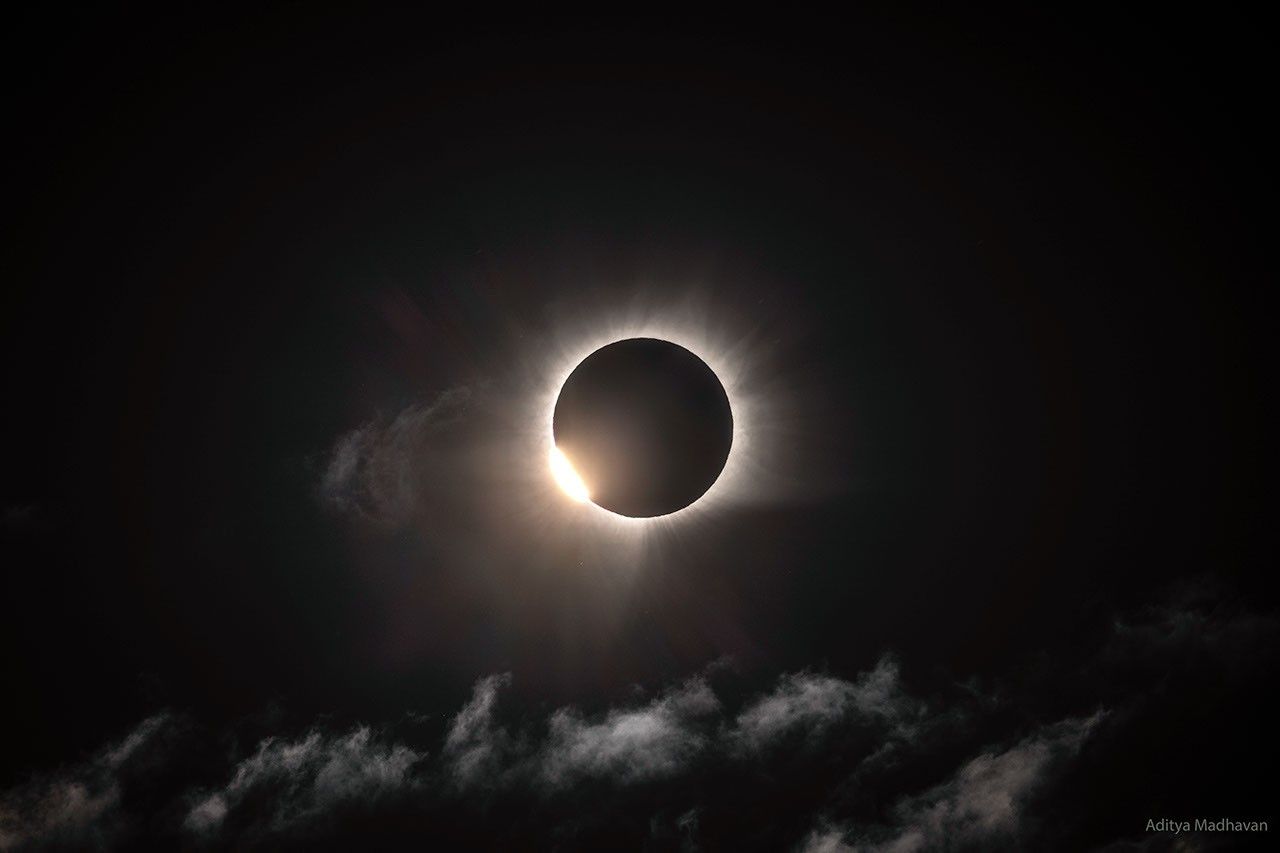
Explanation: On August 12, the Moon’s shadow reached out to touch our fair planet. Beginning in the Arctic Ocean, it swept along a narrow track that led the dark lunar umbra across parts of Greenland, Iceland, the Atlantic, Portugal, and northern Spain. And for a moment, denizens of Earth who found themselves with clear skies under the shadow of the Moon could witness a total solar eclipse. After dodging the weather by sea and making a landing along Rype Fjord on the Greenland east coast (at 71.07055N, 27.71252W), this hard-won snapshot was captured at 17:33:26 UTC. That’s near the initial reach of clearing skies along the path of totality, so the image is likely one of the first unobstructed views of the totally eclipsed Sun. Through a break in the clouds, the stunning photo also records one of this eclipse’s transient diamond rings and the magnificent solar corona emerging near the moment totality began.
More spectacular eclipse images: Solar Eclipse of 2026 August 12
Tomorrow’s picture: perhaps a Perseid
NASA Science Activation & Michigan Tech. U.
Random APOD Generator
Yesterday’s Image APOD: 2026 August 13 – Total Solar Eclipse Over Spain
Tomorrow’s Image
APOD: 2026 August 14 – Total Solar Eclipse from Greenland
APOD
Astronomy Picture of the Day
Discover the cosmos! Each day a different image or photograph of our fascinating universe is featured, along with a brief explanation written by a professional astronomer.
Total Solar Eclipse from GreenlandExplanation: On August 12, the Moon’s shadow reached out to touch our fair planet. Beginning in the Arctic Ocean, it swept along a narrow track that led the dark lunar umbra across parts of Greenland, Iceland, the Atlantic, Portugal, and northern Spain. And for a moment, denizens of Earth who found themselves with clear skies under the shadow of the Moon could witness a total solar eclipse. After dodging the weather by sea and making a landing along Rype Fjord on the Greenland east coast (at 71.07055N, 27.71252W), this hard-won snapshot was captured at 17:33:26 UTC. That’s near the initial reach of clearing skies along the path of totality, so the image is likely one of the first unobstructed views of the totally eclipsed Sun. Through a break in the clouds, the stunning photo also records one of this eclipse’s transient diamond rings and the magnificent solar corona emerging near the moment totality began.
More spectacular eclipse images: Solar Eclipse of 2026 August 12
Tomorrow’s picture: perhaps a Perseid
NASA Science Activation & Michigan Tech. U.
Random APOD Generator
Yesterday’s Image APOD: 2026 August 13 – Total Solar Eclipse Over Spain
Tomorrow’s Image
A Sunflower’s View of Totality
- Earth
- Earth Observatory
- Image of the Day
- EO Explorer
- Topics
- More Content
- About
A Sunflower’s View of Totality
- Earth
- Earth Observatory
- Image of the Day
- EO Explorer
- Topics
- More Content
- About
A Rare Extragalactic Stellar Stream Reveals Hidden Dark Matter
Scientists have discovered a rare star formation hidden in a distant galaxy, unlike anything seen before beyond the Milky Way. What’s more, the discovery offers a brand new way to measure the distribution of dark matter in distant galaxies.
The Rooms We Build To Survive In, And The Ones We Build To Live In
What does a home actually need to do for us, beyond keeping the weather out? Engineers at MIT have started mapping the answer for astronauts heading to the Moon and Mars, tracing exactly how the walls, layouts and lighting around a person shape their stress, their loneliness and their sense of belonging. It turns out the science of surviving a place and the science of living in one are not the same thing at all, and I have spent enough of the last year thinking about that difference to know how much it matters.
The Ingredients For Planets Turned Up Astonishingly Early
Planet building was supposed to be one of the universe's slow projects, something that only got going billions of years after the Big Bang. New research suggests otherwise. The raw materials for rocky worlds, and perhaps even the water needed for life, may have been ready to go just 100 million years after the Big Bang, long before the first galaxies had even taken shape.