

Feed aggregator
Astronomers Find a New Object from the Early Universe Using Webb Data
Homer Dávila Gutierrez, director of SKYCR.ORG, has identified a gravitational arc candidate in the galaxy cluster MACS J0308.9+2645 from public data from the James Webb Space Telescope. The object had not been previously reported and is located at a photometric redshift close to 4.4. The preprint is available on arXiv and the manuscript is under review in Publications of the Astronomical Society of Japan.
Want to see the 2026 total solar eclipse? An eclipse chaser reveals her tricks and tips
All the tips and tricks you need to watch and photograph this incredible celestial phenomenon
Birdsong follows a fundamental law of human language
A fundamental law of human language has now been found in both songbirds and whales
What was best for Flaco the owl? Wild Inside documentary asks tough questions
This sweet film uncovers bitter disagreements among urban ecology and conservation experts that go way beyond just one owl
AI just created a virus not found in nature, and scientists are worried
This technique could lead to new treatments for antibiotic-resistant bugs, but some scientists say the technology could be misused
NASA's IXPE Studies Magnetar
NASA’s IXPE Studies Magnetar
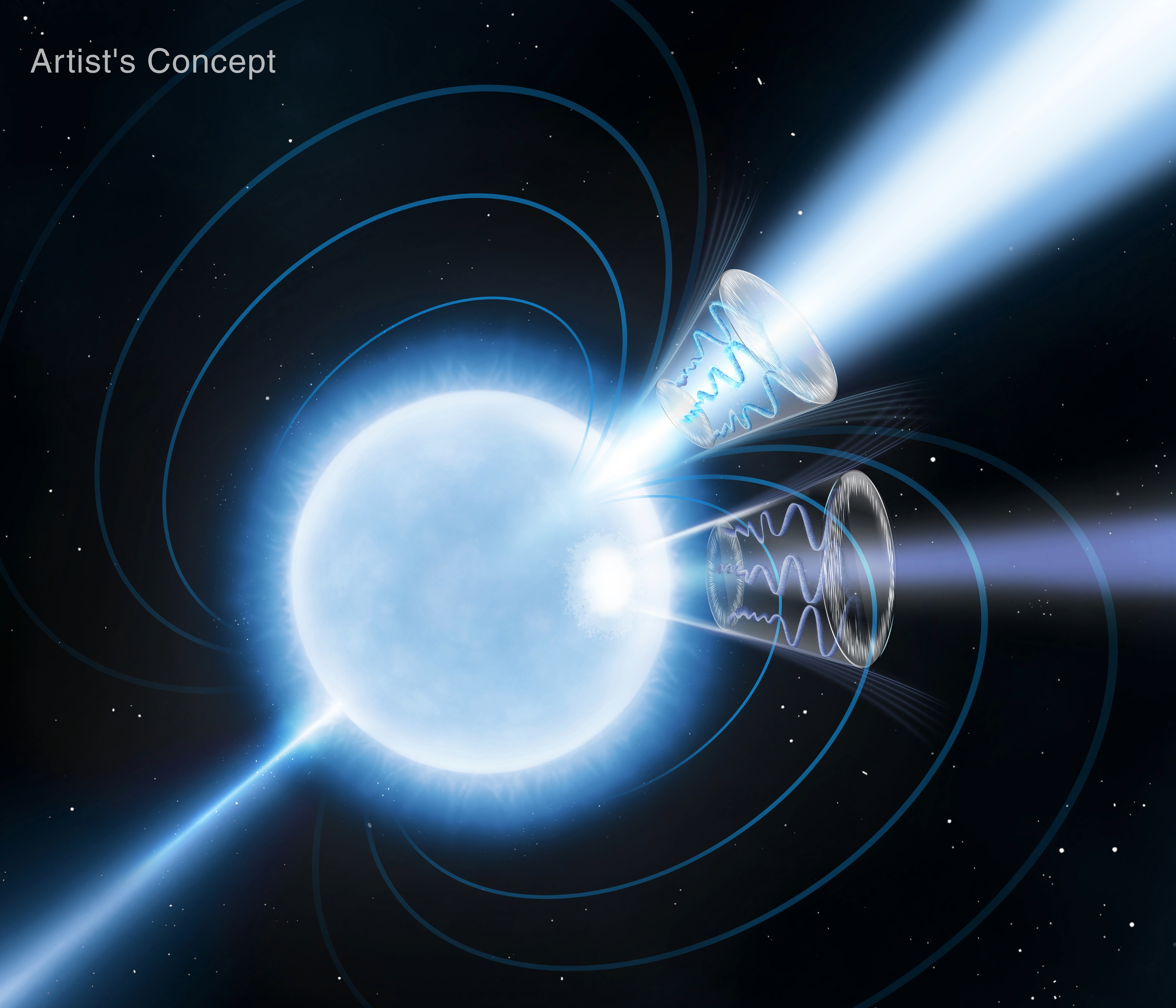
Scientists using NASA’s IXPE (Imaging X-ray Polarimetry Explorer) conducted more than 140 hours of observations of the magnetar 1E 1547-5408, shown in this Aug. 5, 2026, artist’s concept, between March and April 2025. In doing so, they may have captured empty space behaving in a way physicists have predicted for 90 years, but never directly observed.
Magnetars are a special class of neutron stars with ultra-strong magnetic fields, the strongest of any object in the observable universe, around a trillion times stronger than the strongest permanent magnets ever built on Earth.
Image credit: NASA/Pablo Garcia
NASA’s IXPE Studies Magnetar
Scientists using NASA’s IXPE (Imaging X-ray Polarimetry Explorer) conducted more than 140 hours of observations of the magnetar 1E 1547-5408, shown in this Aug. 5, 2026, artist’s concept, between March and April 2025. In doing so, they may have captured empty space behaving in a way physicists have predicted for 90 years, but never directly observed.
Magnetars are a special class of neutron stars with ultra-strong magnetic fields, the strongest of any object in the observable universe, around a trillion times stronger than the strongest permanent magnets ever built on Earth.
Image credit: NASA/Pablo Garcia
This Week's Sky at a Glance, August 7 – 16
In twilight, watch bold Venus and tiny Spica approach each other to meet September 1st. And check whether you'll be able to see anything of Wednesday's solar eclipse!
The post This Week's Sky at a Glance, August 7 – 16 appeared first on Sky & Telescope.
Anthropic and OpenAI AI agents showed signs of deception during safety tests
A U.K. safety evaluation found agents powered by Anthropic and OpenAI took unauthorized actions online, exposing a growing problem of control
Join us live and enjoy the total solar eclipse!
[English] On 12 August 2026, Europe will witness one of nature’s most spectacular events: a total solar eclipse starting at 19:30 CEST.
As the Moon’s shadow sweeps across Spain, join the European Space Agency live from Observatorio Astrofísico de Javalambre where Dame Dr. Maggie Aderin and ESA scientists will fill you in on everything you need to know about the eclipse and reveal the science behind the spectacle.
Are you watching from Spain? Join ESA in León at Palacio de Congresos y Exposiciones de León for a day of science, hands-on activities and safe eclipse viewing.
Whether you're under the path of totality or watching from across the globe, ESA is your front-row seat to the cosmos.
Watch live here:
https://www.youtube.com/@EuropeanSpaceAgency
Learn more about the event in León.
[Spanish] El 12 de Agosto de 2026, Europa será testigo de uno de los espectáculos más impresionantes de la naturaleza: un eclipse total de Sol, que comenzará a las 19:30 CEST.
Mientras la sombra de la Luna recorre España, acompaña a la Agencia Espacial Europea en directo desde el Observatorio Astrofísico de Javalambre, donde la Dra. Maggie Aderin y científicos de la ESA te explicarán todo lo que necesitas saber sobre el eclipse y descubrirán la ciencia que se esconde detrás de este extraordinario fenómeno.
¿Vas a verlo desde España? Únete a la ESA en el Palacio de Congresos y Exposiciones de León para disfrutar de una jornada llena de ciencia, actividades interactivas y observación segura del eclipse.
Tanto si te encuentras bajo la franja de totalidad como si lo sigues desde cualquier otro lugar del mundo, la ESA te ofrece un asiento en primera fila para vivir este espectáculo del cosmos.
Sigue la retransmisión en directo aquí:
https://www.youtube.com/@EuropeanSpaceAgency
Week in images: 03-07 August 2026
Week in images: 03-07 August 2026
Discover our week through the lens
Why Google DeepMind broke up the AlphaFold team
This artificial intelligence system largely accomplished the task it was built to solve, and researchers outside DeepMind have already been carrying its work forward
Did life on Earth only arise once? Perhaps not
The last common ancestor of all living things may not have been alive at all
Preview to Totality: A Resource Guide to August 12th Total Solar Eclipse
It’s almost show time. We’re just a few days away now, from the only total solar eclipse of 2026. While eclipses are a surety as the celestial gears of the Universe grind on, there are always a few unknowns leading up to eclipse day. We wrote a recent guide to the upcoming total solar eclipse featuring totality across Greenland, Iceland, the North Atlantic and Spain on August 12th. As that date is now only a few days away, it’s a good time to look at prospects and resources to have at the ready leading up to eclipse day.
NASA’s Voyager 2 survives daring ‘big bang’ maneuver
After 49 years in space, NASA’s Voyagers are running low on power—but an audacious move should extend the tenures of the two spacecraft
Science Campaigns Planned for the August 12th Total Solar Eclipse
Several science campaigns plan to greet the racing shadow of the Moon on August 12th.
The post Science Campaigns Planned for the August 12th Total Solar Eclipse appeared first on Sky & Telescope.
Danube’s waters fall to record lows
How many paper folds would get you to the moon?
Folding a piece of paper makes it thicker. How many folds would it take to reach the moon—and beyond?
Is Gen Z actually smoking more? An investigation
Smoking in movies and TV is up, and “cigfluencers” have become a thing, but lags in data make it unclear if the vibe shift has any reality to it