
Feed aggregator
ESA releases 2026 Space Economy Report
The European Space Agency’s (ESA) newly released Space Economy Report gives a comprehensive overview of the latest developments shaping Europe's space sector.
NASA’s Hubble Discovers First of Star Cluster’s Missing Black Holes
- Hubble Home
- Overview
- Impact & Benefits
- Science
- Observatory
- Team
- Multimedia
- News
- More
Science: Maximilian Häberle (MPIA)
The massive globular star cluster Omega Centauri has puzzled astronomers for decades. It should be filled with black holes left behind by exploding stars, yet evidence for them is scarce. Now, astronomers using archival data from NASA’s Hubble Space Telescope and supportive observations from NASA’s James Webb Space Telescope have finally located their first stellar-mass black hole in this cluster. Discovering the first of this missing black hole population will help refine current theories on black hole formation within environments such as Omega Centauri. The team’s findings published Monday in The Astrophysical Journal Letters.
Omega Centauri is composed of 10 million gravitationally bound stars. Though the astronomical community previously found evidence with Hubble that an intermediate-mass black hole lurks at its center, models suggest this star cluster should also contain about 10,000 smaller, stellar-mass black holes. This notable population of black holes evaded detection in previous observational studies, which used the radial velocity method or looked for radio and X-ray emission from material falling onto black holes.
This new discovery features a different approach, known as astrometry, to measure very small movements of stars over time. By sifting through more than 20 years of Hubble archival data and pulling in recent Webb data to further refine their astrometric measurements, the team located a star orbiting an invisible object so hefty that it has to be a black hole. Dubbed oMEGACat BH-2, it is the first stellar-mass black hole detected in Omega Centauri, and it has some surprising qualities. oMEGACat BH-2 has a lower-than-expected mass and, with its visible star companion, the black hole-star duo has the longest orbital period of any black hole binary system known to date.
“With Hubble and Webb data, we were able to see the motion of the visible main sequence star that is part of this binary, which is about 18,000 light-years away in the dense environment of Omega Centauri,” said Matthew Whitaker of the University of Utah, Salt Lake City, lead author of the paper. “The precision of these measurements is incredible, down to a fraction of a pixel on Hubble and Webb’s detectors. It would not have been possible to find this black hole without these two space telescopes.”
Astronomers found Omega Centauri’s first stellar-mass black hole, which has a visible star companion that is shown in greater detail. They used 20-plus years of data from NASA’s Hubble Space Telescope and recent data from NASA’s James Webb Space Telescope to make the discovery. Image: ESA, NASA, Maximilian Häberle (MPIA), Joseph DePasquale (STScI)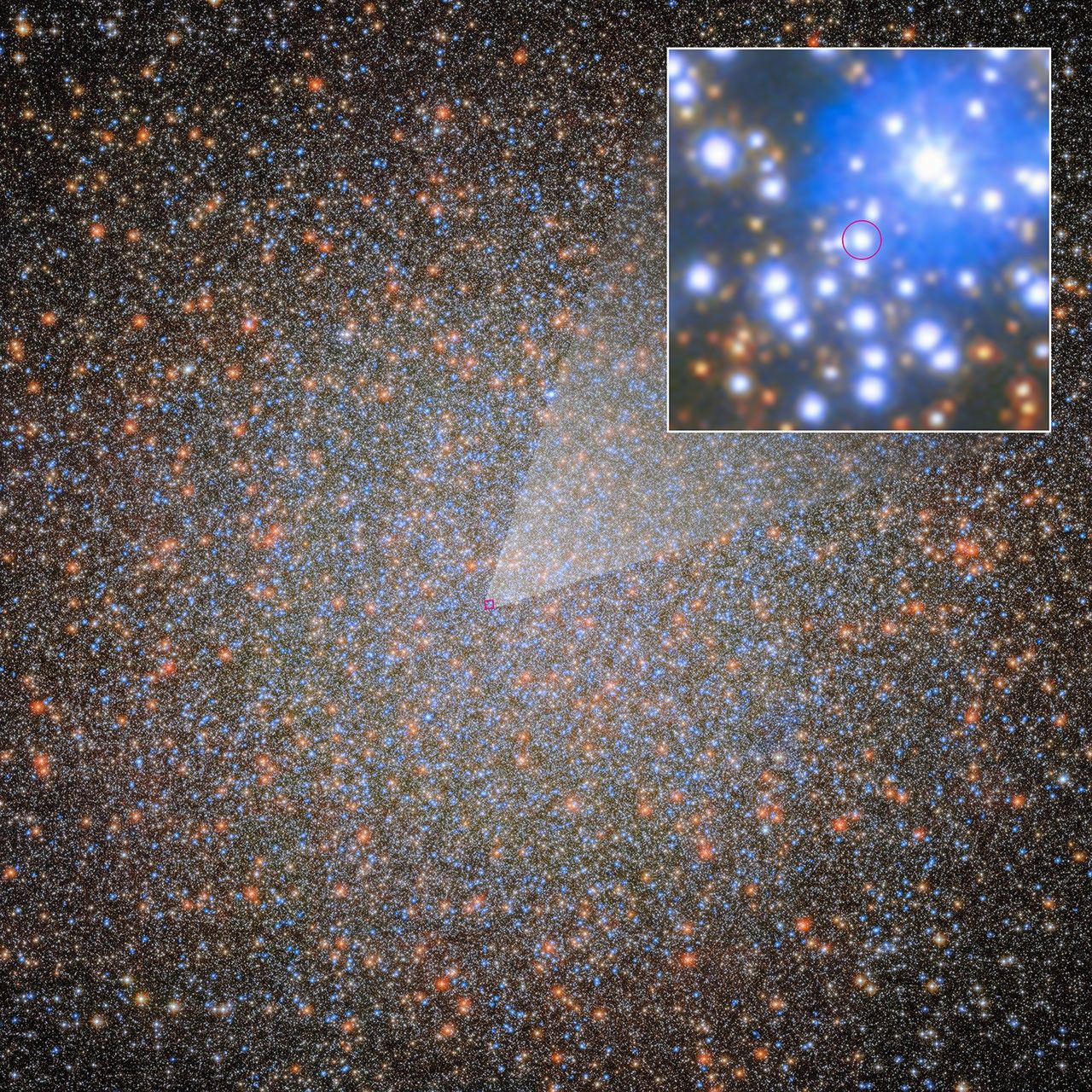
The team’s findings refine a past study by a different group of scientists that suggested this binary system included a neutron star. By expanding Hubble data from the earlier investigation with archival Hubble astrometric measurements from 2002 to 2023, and pulling in Webb near-infrared data to improve precision, the University of Utah-led team was able to better constrain the mass of the visible star’s dark companion, ruling out the neutron star possibility.
“While we already knew that the star was 0.78 solar masses, we can now calculate the black hole’s mass, which is 4.46 solar masses and therefore too heavy to be a neutron star. However, its mass is much lower than would be expected in a metal-poor environment like Omega Centauri. This is surprising and exciting,” said Anil Seth of the University of Utah, a coauthor of the study. “We now know that a metal-poor star is able to form a black hole like this, and we need to figure out how that happens. This detection is providing some data to those who do that kind of modeling.”
Long time comingBased on the precise data from Hubble and Webb, the team could chart the star’s path over 20-plus years, during its closest approach to its black hole companion when it moved the fastest across the sky. From the extensive data, the team determined that the visible star orbits oMEGACat BH-2 once every 94 years, making it the longest-period black hole binary ever known.
Its long orbital period also gives a clue to the origin of this binary system. It was probably dynamically formed, meaning the star and its black hole companion did not start out together but rather found each other in this cluster. The researchers calculated that a system like oMEGACat BH-2 will survive for less than a billion years before it is torn apart by encounters with nearby stars, a much shorter span than the age of the cluster (approximately 12 billion years old).
“It’s important to understand black hole populations in globular clusters because there’s uncertainty about their physics and formation,” said Seth. “More specifically, understanding the process of forming black holes and then dynamically forming binaries is vital, because it affects our ability to interpret and understand gravitational wave events. Environments like Omega Centauri are the primary places where we think binaries are merging and creating these waves.”
The team’s discovery of stellar-mass black hole oMEGACat BH-2 with the Hubble-Webb dataset is just the start of finding these evasive black hole populations in globular star clusters.
“With Hubble and Webb, we can continue to look at Omega Centauri and expand our search for similar systems within other clusters,” said Whitaker. “We’re also very excited for the launch of NASA’s Nancy Grace Roman Space Telescope because it will image the crowded galactic bulge, including the galactic center, very regularly with Hubble-like resolution and with a much wider field of view. We’re hoping we’ll be able to find black hole binary systems like this one because of the regular cadence of Roman’s observations.”
The Hubble Space Telescope has been operating for over three decades and continues to make ground-breaking discoveries that shape our fundamental understanding of the universe. Hubble is a project of international cooperation between NASA and ESA (European Space Agency). NASA’s Goddard Space Flight Center in Greenbelt, Maryland, manages the telescope and mission operations. Lockheed Martin Space, based in Denver, also supports mission operations at Goddard. The Space Telescope Science Institute in Baltimore, which is operated by the Association of Universities for Research in Astronomy, conducts Hubble science operations for NASA.
Facebook logo @NASAHubble @NASAHubble Instagram logo @NASAHubble Related Images & Videos Omega Centauri Context ImageAstronomers found Omega Centauri’s first stellar-mass black hole, which has a visible star companion that is shown in greater detail. They used 20-plus years of data from NASA’s Hubble Space Telescope and recent data from NASA’s James Webb Space Telescope to make the discovery.
Star Orbiting Black Hole Animation
The precise data collected by NASA’s Hubble and James Webb space telescopes enabled a team of astronomers to chart the visible star’s orbital path over a 20 year-plus period.
Claire Andreoli
NASA’s Goddard Space Flight Center
Greenbelt, Maryland
claire.andreoli@nasa.gov
- Academic Paper: A Long Period Stellar-mass Black Hole Binary in Omega Centauri
- This release on the ESA/Hubble website.
Keep Exploring Discover More Topics From Hubble Hubble Space Telescope
Since its 1990 launch, the Hubble Space Telescope has changed our fundamental understanding of the universe.
Hubble Science Highlights
Hubble’s most notable scientific discoveries reflect the broad range of research and the breakthroughs it has achieved.
Hubble Images
Explore Hubble’s iconic images of the universe, and view photos of mission operations and astronauts servicing Hubble in space.
Caldwell 80
Better known as Omega Centauri, Caldwell 80 is home to around 10 million stars.
NASA’s Hubble Discovers First of Star Cluster’s Missing Black Holes
- Hubble Home
- Overview
- Impact & Benefits
- Science
- Observatory
- Team
- Multimedia
- News
- More
Science: Maximilian Häberle (MPIA)
The massive globular star cluster Omega Centauri has puzzled astronomers for decades. It should be filled with black holes left behind by exploding stars, yet evidence for them is scarce. Now, astronomers using archival data from NASA’s Hubble Space Telescope and supportive observations from NASA’s James Webb Space Telescope have finally located their first stellar-mass black hole in this cluster. Discovering the first of this missing black hole population will help refine current theories on black hole formation within environments such as Omega Centauri. The team’s findings published Monday in The Astrophysical Journal Letters.
Omega Centauri is composed of 10 million gravitationally bound stars. Though the astronomical community previously found evidence with Hubble that an intermediate-mass black hole lurks at its center, models suggest this star cluster should also contain about 10,000 smaller, stellar-mass black holes. This notable population of black holes evaded detection in previous observational studies, which used the radial velocity method or looked for radio and X-ray emission from material falling onto black holes.
This new discovery features a different approach, known as astrometry, to measure very small movements of stars over time. By sifting through more than 20 years of Hubble archival data and pulling in recent Webb data to further refine their astrometric measurements, the team located a star orbiting an invisible object so hefty that it has to be a black hole. Dubbed oMEGACat BH-2, it is the first stellar-mass black hole detected in Omega Centauri, and it has some surprising qualities. oMEGACat BH-2 has a lower-than-expected mass and, with its visible star companion, the black hole-star duo has the longest orbital period of any black hole binary system known to date.
“With Hubble and Webb data, we were able to see the motion of the visible main sequence star that is part of this binary, which is about 18,000 light-years away in the dense environment of Omega Centauri,” said Matthew Whitaker of the University of Utah, Salt Lake City, lead author of the paper. “The precision of these measurements is incredible, down to a fraction of a pixel on Hubble and Webb’s detectors. It would not have been possible to find this black hole without these two space telescopes.”
Astronomers found Omega Centauri’s first stellar-mass black hole, which has a visible star companion that is shown in greater detail. They used 20-plus years of data from NASA’s Hubble Space Telescope and recent data from NASA’s James Webb Space Telescope to make the discovery. Image: ESA, NASA, Maximilian Häberle (MPIA), Joseph DePasquale (STScI)The team’s findings refine a past study by a different group of scientists that suggested this binary system included a neutron star. By expanding Hubble data from the earlier investigation with archival Hubble astrometric measurements from 2002 to 2023, and pulling in Webb near-infrared data to improve precision, the University of Utah-led team was able to better constrain the mass of the visible star’s dark companion, ruling out the neutron star possibility.
“While we already knew that the star was 0.78 solar masses, we can now calculate the black hole’s mass, which is 4.46 solar masses and therefore too heavy to be a neutron star. However, its mass is much lower than would be expected in a metal-poor environment like Omega Centauri. This is surprising and exciting,” said Anil Seth of the University of Utah, a coauthor of the study. “We now know that a metal-poor star is able to form a black hole like this, and we need to figure out how that happens. This detection is providing some data to those who do that kind of modeling.”
Long time comingBased on the precise data from Hubble and Webb, the team could chart the star’s path over 20-plus years, during its closest approach to its black hole companion when it moved the fastest across the sky. From the extensive data, the team determined that the visible star orbits oMEGACat BH-2 once every 94 years, making it the longest-period black hole binary ever known.
Its long orbital period also gives a clue to the origin of this binary system. It was probably dynamically formed, meaning the star and its black hole companion did not start out together but rather found each other in this cluster. The researchers calculated that a system like oMEGACat BH-2 will survive for less than a billion years before it is torn apart by encounters with nearby stars, a much shorter span than the age of the cluster (approximately 12 billion years old).
“It’s important to understand black hole populations in globular clusters because there’s uncertainty about their physics and formation,” said Seth. “More specifically, understanding the process of forming black holes and then dynamically forming binaries is vital, because it affects our ability to interpret and understand gravitational wave events. Environments like Omega Centauri are the primary places where we think binaries are merging and creating these waves.”
The team’s discovery of stellar-mass black hole oMEGACat BH-2 with the Hubble-Webb dataset is just the start of finding these evasive black hole populations in globular star clusters.
“With Hubble and Webb, we can continue to look at Omega Centauri and expand our search for similar systems within other clusters,” said Whitaker. “We’re also very excited for the launch of NASA’s Nancy Grace Roman Space Telescope because it will image the crowded galactic bulge, including the galactic center, very regularly with Hubble-like resolution and with a much wider field of view. We’re hoping we’ll be able to find black hole binary systems like this one because of the regular cadence of Roman’s observations.”
The Hubble Space Telescope has been operating for over three decades and continues to make ground-breaking discoveries that shape our fundamental understanding of the universe. Hubble is a project of international cooperation between NASA and ESA (European Space Agency). NASA’s Goddard Space Flight Center in Greenbelt, Maryland, manages the telescope and mission operations. Lockheed Martin Space, based in Denver, also supports mission operations at Goddard. The Space Telescope Science Institute in Baltimore, which is operated by the Association of Universities for Research in Astronomy, conducts Hubble science operations for NASA.
Facebook logo @NASAHubble @NASAHubble Instagram logo @NASAHubble Related Images & Videos Omega Centauri Context ImageAstronomers found Omega Centauri’s first stellar-mass black hole, which has a visible star companion that is shown in greater detail. They used 20-plus years of data from NASA’s Hubble Space Telescope and recent data from NASA’s James Webb Space Telescope to make the discovery.
Star Orbiting Black Hole Animation
The precise data collected by NASA’s Hubble and James Webb space telescopes enabled a team of astronomers to chart the visible star’s orbital path over a 20 year-plus period.
Claire Andreoli
NASA’s Goddard Space Flight Center
Greenbelt, Maryland
claire.andreoli@nasa.gov
- Academic Paper: A Long Period Stellar-mass Black Hole Binary in Omega Centauri
- This release on the ESA/Hubble website.
Keep Exploring Discover More Topics From Hubble Hubble Space Telescope
Since its 1990 launch, the Hubble Space Telescope has changed our fundamental understanding of the universe.
Hubble Science Highlights
Hubble’s most notable scientific discoveries reflect the broad range of research and the breakthroughs it has achieved.
Hubble Images
Explore Hubble’s iconic images of the universe, and view photos of mission operations and astronauts servicing Hubble in space.
Caldwell 80
Better known as Omega Centauri, Caldwell 80 is home to around 10 million stars.
Mathematicians still don’t know the fastest way to multiply numbers
A 23-year-old student overturned an ancient conjecture about one of math’s simplest operations
ESA and Poland to establish a new civil security and resilience centre in Warsaw
The European Space Agency (ESA) and the Republic of Poland have announced that a new ESA centre focusing on civil security and resilience will be located in Warsaw, supporting the efficient and coordinated development of European capabilities in these strategically important fields.
Euclid Telescope Finds Quasars Within 700 Million Years of the Big Bang
The sharp-eyed and far-seeing Euclid space telescope has picked up 31 early quasars that have evaded detection until now.
The post Euclid Telescope Finds Quasars Within 700 Million Years of the Big Bang appeared first on Sky & Telescope.
ESA welcomes new UK space and defence gateway
His Majesty King Charles III visited the UK’s largest space cluster on 10 July to launch a new initiative designed to shape the future of the space and defence economy.
Scientists catch bacteria sharing proteins to survive antibiotics
Bacteria send protein packages to dormant neighbors to endure antibiotic attack
Watching Dawn and Dusk on a Distant Hot Jupiter
Astronomers using the James Webb Space Telescope have caught an extreme, tidally locked exoplanet in the act of showing two very different faces at once, a fierce, wind battered hemisphere and a comparatively gentler half. The discovery not only reveals a planet with a genuine weather system violent enough to tear water apart, it hints at a missing ingredient in how scientists model alien atmospheres altogether.
Listening for the Universe's Faintest Whispers, a Billion Supernovae at Once
Buried a kilometre underground in Japan, one of the world's most sensitive detectors may have caught its first faint trace of a sound scientists have been straining to hear for decades, the combined whisper of every supernova that has ever exploded across the universe. It is not yet a confirmed discovery, but if it holds up, it could rewrite how we trace the life and death of stars.
Wild, Scenic, and Increasingly Rusty
- Earth
- Earth Observatory
- Image of the Day
- EO Explorer
- Topics
- More Content
- About
Wild, Scenic, and Increasingly Rusty
- Earth
- Earth Observatory
- Image of the Day
- EO Explorer
- Topics
- More Content
- About
Most Of Moon’s Water Likely Remains Chemically Bound In Its Deep Interior
Aside from an unknown quantity of water in the Moon’s permanently shaded polar craters, the lion’s share of what water the Moon may have is likely chemically bound in its deep interior.
China Successfully Tests Reusable Long March-10B
On Friday, July 10th, China achieved a major milestone as its Long March-10B completed a its maiden test flight, which included the retrieval of its first stage booster.
A Day In The Sun: 11th July 24 Hours of Solar Activity in 80 Seconds | NASA SDO
Deadly meat allergies from tick bites are on the rise. Should you be worried?
Alpha-gal syndrome is increasing across the U.S., driven by lone star ticks
Is it a problem for cats to eat insects? Researchers are probing feline diets to find out
The sheer amount of insects that free-range cats consume might surprise you