

Feed aggregator
Elite Maya people had teeth placed in a cave far from their tombs
Parenting may permanently improve brain health for mums and dads
Parenting may permanently improve brain health for mums and dads
SpaceX's secretive plans to deliver cargo to Earth from space
SpaceX's secretive plans to deliver cargo to Earth from space
2026 ALA Hyperwall Schedule
2 min read
2026 ALA Hyperwall ScheduleAmerican Library Association (ALA) Annual Conference, June 25-29, 2026
Join NASA in the Exhibit Hall (Booth #2243) for Hyperwall Storytelling by NASA experts. Full Hyperwall Agenda below.
FRIDAY, JUNE 26
- 5:45 PM ——Roman Space Telescope Quiz! —— Peter Sooy
- 6:00 PM ——NASA’s Next Flagship is Launching Soon! Share in the Excitement with Roman Community Events —— Martha Irene Saladino
- 6:15 PM ——Open Science Resources for Libraries ——Amanda Adams
- 6:30 PM ——Launching NASA Earth Science Exhibits in Libraries Across America ——Eleanor Stokes
- 6:45 PM ——NASA Citizen Science Projects——Sarah Kirn
SATURDAY, JUNE 27
- 10:00 AM——Heliophysics Jeopardy!——Erin Mahoney
- 10:15 AM——NASA’s Next Flagship is Launching Soon! Share in the Excitement with Roman Community Events——Martha Irene Saladino
- 10:30 AM——Nancy Grace Roman: The Person——Courtney Lee
- 10:45 AM——Cosmic Canvas: Exploring the Process of Science Through Art and Astronomy——Tim Rhue
- 12:30 PM——Roman Space Telescope Quiz! —— Peter Sooy
- 1:00 PM——“Our Friend Orion” Children’s Book Reading——Lane Polak
- 2:30 PM——Heliophysics Jeopardy!——Erin Mahoney
- 3:00 PM——”The Adventure of Echo the Bat” Book Reading——Ginger Butcher
- 3:30 PM——Bring a NASA Solar System Ambassador to YOUR Library!——Danielle Diamond
- 3:45 PM——Journey Through the Heliosphere: The Sun-Earth System in Color——Christine Milotte
SUNDAY, JUNE 28
- 10:00 AM——Webb Space Telescope Quiz!——Peter Sooy
- 10:15 AM——Journey Through the Heliosphere: The Sun-Earth System in Color——Christine Milottet
- 10:30 AM——Science Explorer (SciX) Demo——Daniel Chivvis
- 10:45 AM——NASA Data and Open Science Quiz!——Adam Farragut
- 12:30 PM——Heliophysics Jeopardy!——Erin Mahoney
- 1:00 PM——“There and Back with EGS” Children’s Book Reading——Lane Polak
- 2:30 PM——Real NASA Research Projects Open to Everyone——Sarah Kirn
- 3:00 PM——Cosmic Canvas: Exploring the Process of Science Through Art and Astronomy——Tim Rhue
- 3:30 PM——NASA’s Next Flagship is Launching Soon! Share in the Excitement with Roman Community Events—— Martha Irene Saladino
- 3:45 PM——Journey Through the Heliosphere: The Sun-Earth System in Color——Milotte
MONDAY, JUNE 29
- 9:45 AM——Webb Space Telescope Quiz!——Peter Sooy
- 10:00 AM——“Hooray for SLS” Children’s——Lane Polak
- 10:30 AM——Bring a NASA Solar System Ambassador to YOUR Library!——Mark Benson
2026 ALA Hyperwall Schedule
2 min read
2026 ALA Hyperwall ScheduleAmerican Library Association (ALA) Annual Conference, June 25-29, 2026
Join NASA in the Exhibit Hall (Booth #2243) for Hyperwall Storytelling by NASA experts. Full Hyperwall Agenda below.
FRIDAY, JUNE 26
- 5:45 PM ——Roman Space Telescope Quiz! —— Peter Sooy
- 6:00 PM ——NASA’s Next Flagship is Launching Soon! Share in the Excitement with Roman Community Events —— Martha Irene Saladino
- 6:15 PM ——Open Science Resources for Libraries ——Amanda Adams
- 6:30 PM ——Launching NASA Earth Science Exhibits in Libraries Across America ——Eleanor Stokes
- 6:45 PM ——NASA Citizen Science Projects——Sarah Kirn
SATURDAY, JUNE 27
- 10:00 AM——Heliophysics Jeopardy!——Erin Mahoney
- 10:15 AM——NASA’s Next Flagship is Launching Soon! Share in the Excitement with Roman Community Events——Martha Irene Saladino
- 10:30 AM——Nancy Grace Roman: The Person——Courtney Lee
- 10:45 AM——Cosmic Canvas: Exploring the Process of Science Through Art and Astronomy——Tim Rhue
- 12:30 PM——Roman Space Telescope Quiz! —— Peter Sooy
- 1:00 PM——“Our Friend Orion” Children’s Book Reading——Lane Polak
- 2:30 PM——Heliophysics Jeopardy!——Erin Mahoney
- 3:00 PM——”The Adventure of Echo the Bat” Book Reading——Ginger Butcher
- 3:30 PM——Bring a NASA Solar System Ambassador to YOUR Library!——Danielle Diamond
- 3:45 PM——Journey Through the Heliosphere: The Sun-Earth System in Color——Christine Milotte
SUNDAY, JUNE 28
- 10:00 AM——Webb Space Telescope Quiz!——Peter Sooy
- 10:15 AM——Journey Through the Heliosphere: The Sun-Earth System in Color——Christine Milottet
- 10:30 AM——Science Explorer (SciX) Demo——Daniel Chivvis
- 10:45 AM——NASA Data and Open Science Quiz!——Adam Farragut
- 12:30 PM——Heliophysics Jeopardy!——Erin Mahoney
- 1:00 PM——“There and Back with EGS” Children’s Book Reading——Lane Polak
- 2:30 PM——Real NASA Research Projects Open to Everyone——Sarah Kirn
- 3:00 PM——Cosmic Canvas: Exploring the Process of Science Through Art and Astronomy——Tim Rhue
- 3:30 PM——NASA’s Next Flagship is Launching Soon! Share in the Excitement with Roman Community Events—— Martha Irene Saladino
- 3:45 PM——Journey Through the Heliosphere: The Sun-Earth System in Color——Milotte
MONDAY, JUNE 29
- 9:45 AM——Webb Space Telescope Quiz!——Peter Sooy
- 10:00 AM——“Hooray for SLS” Children’s——Lane Polak
- 10:30 AM——Bring a NASA Solar System Ambassador to YOUR Library!——Mark Benson
This is How NASA Flight Tests New Technology
Flight tests are a big part of how NASA turns breakthrough ideas into reality. From flying humans faster than the speed of sound to proving designs that helped shape the space shuttle, flight testing transforms bold concepts into safer, more efficient technologies that benefit the public.
“Flight tests are a way to safely and effectively prove new technology, which helps certification authorities certify equipment,” said Wayne Ringelberg, chief pilot at NASA’s Armstrong Flight Research Center in Edwards, California. “It helps industry iterate and make systems better, and it promotes research in areas where new ideas can be developed.”
For nearly 80 years, teams at NASA Armstrong have used flight testing in the Southern California desert to push the limits of aerodynamics and advance aviation. Thanks to that work, NASA-developed innovations are aboard every U.S. commercial aircraft and inside every control tower today.
“The space side of NASA uses flight test, too. Every mission, like Artemis II, is never routine,” Ringelberg said. “Everything we’re doing when flying a test mission is something new or different.”
NASA test pilots Jim Less, left, and Nils Larson walk away from a hangar at NASA’s Armstrong Flight Research Center in Edwards, California, on Thursday, Feb. 4, 2026. The pilots support the agency’s Crossflow Attenuated Natural Laminar Flow (CATNLF) project, which aims to lower fuel costs for future commercial aircraft by testing a scale-model wing designed to improve laminar flow.NASA/Christopher LC Clark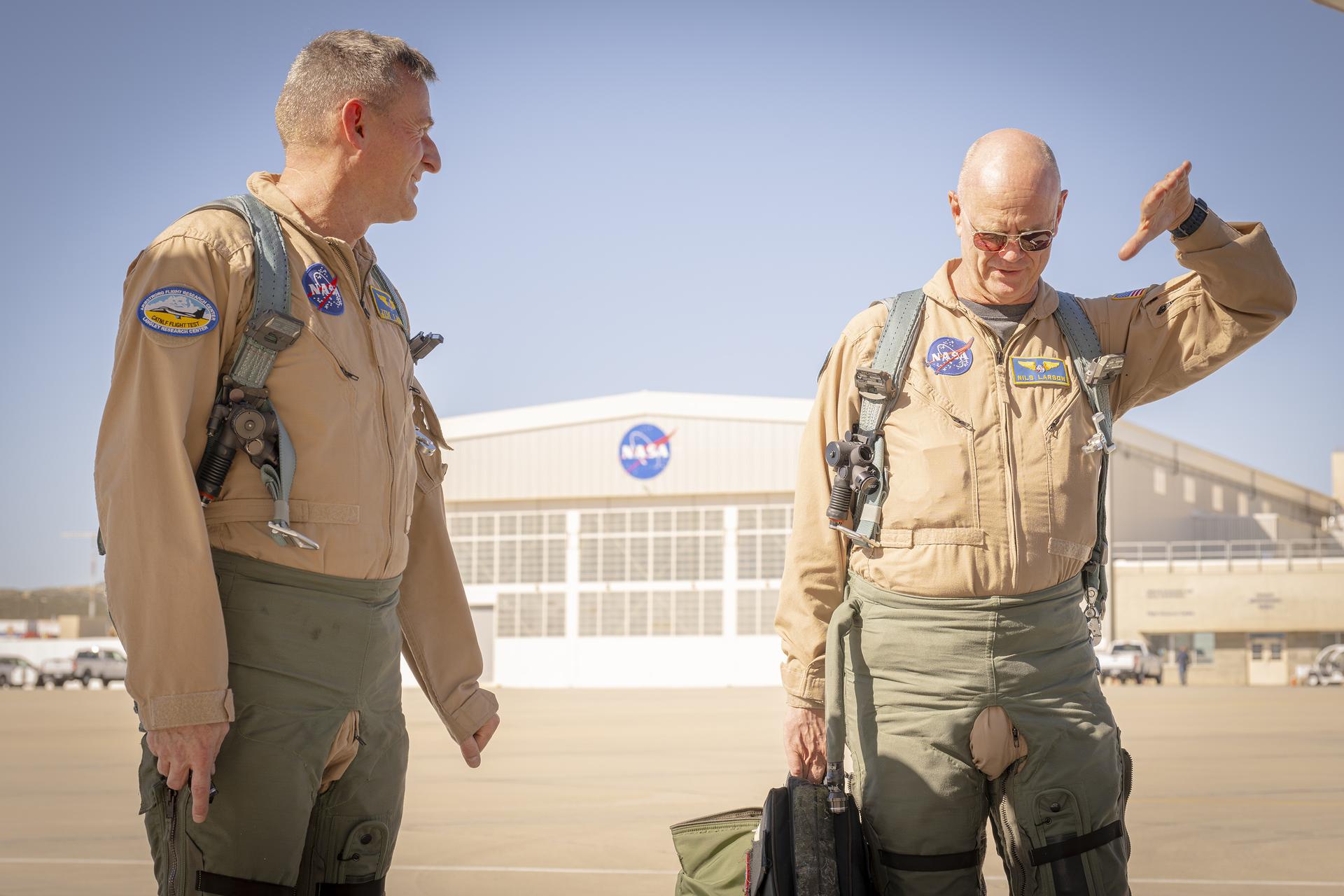
Every NASA test flight — whether it’s studying new software, hardware, or the revolutionary technology of an experimental X-plane — relies on engineers, researchers, pilots, maintenance crew, control room operators, and many others working together.
“Experienced operators and engineers evaluate how things work in flight,” Ringelberg said. “Most new technologies are designed to work in a lab or can be tested in a wind tunnel or other facility, but you never really know how they’ll perform until you fly them.”
Preflight tests often include computer analysis, simulation, wind tunnel testing, and ground tests focused on an aircraft’s ability to withstand the forces of flight and the environments through which it may fly. After hardware or software is deemed safe to fly, researchers turn the mission over to the flight test team.
To support testing, NASA Armstrong maintains an aircraft fleet modified to create space for new hardware or instruments, as well as the ability to integrate new software. These aircraft are flying laboratories, and pilots are trained to accomplish experimental missions.
An F-15 research aircraft sits on the ramp at NASA’s Armstrong Flight Research Center in Edwards, California, on Tuesday, March 17, 2026. NASA pilots Jim Less, front seat, and Carrie Worth prepare for the flight. The agency’s Crossflow Attenuated Natural Laminar Flow (CATNLF) test article is attached to the bottom of the F-15. The project aims to lower fuel costs for future commercial aircraft by testing a scale-model wing designed to improve laminar flow.NASA/Carla Escamilla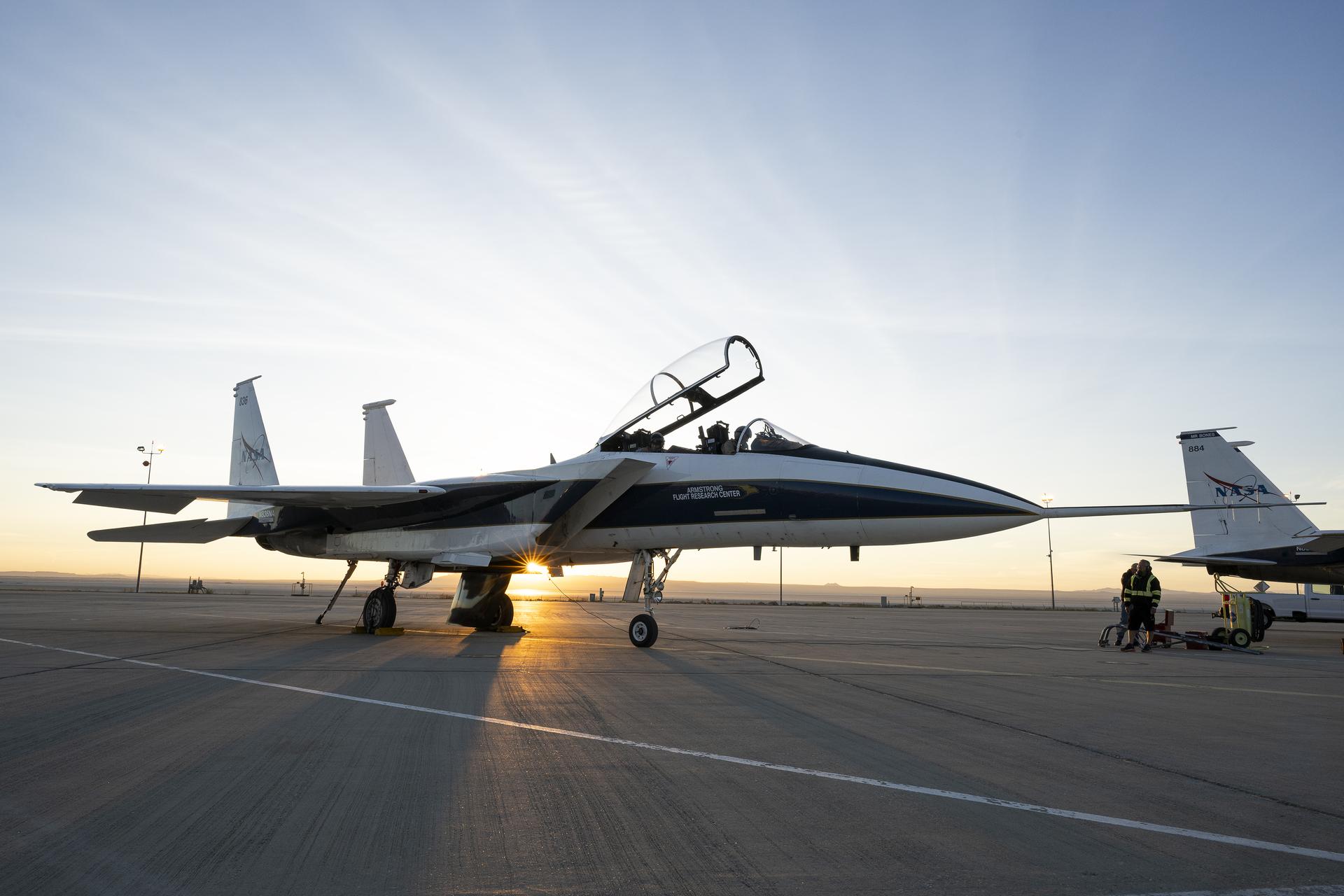
For example, flight testing recently helped NASA gather critical data on laminar flow, or the smooth flow of air, over a wing. The work could lower fuel costs for future airliners. Computer modeling, wind tunnel tests, and other methods helped advance the research, but to find out even more about how the wing concept could reduce drag for future airliners, NASA used a scale model in actual flight.
NASA researchers strapped the Crossflow Attenuated Natural Laminar Flow (CATNLF) model wing to the belly of one of NASA Armstrong’s F-15s. The arrangement allowed them to collect all the information they would need without doing the extensive, costly modifications required to install a full-scale wing on an aircraft.
After a flight series is complete, engineers and researchers analyze the data. Did the instrument work as designed? Did the experimental aircraft perform safely at a high altitude? Did the software operate as planned? Each test raises its own set of questions to evaluate.
NASA continues working with academia, the Department of War, and industry partners to advance U.S. aviation through flight test and bring new benefits to the flying public.
Share Details Last Updated Jun 22, 2026 EditorDede DiniusContactTeresa Whitingteresa.whiting@nasa.gov Related Terms Explore More 9 min read ARMD Research Solicitations (Updated June 23) Article 11 hours ago 3 min read NASA’s Experimental Fabrication Branch Fuels Aircraft Innovation Article 1 day ago 5 min read NASA, USGS Scientists Go Rock Hounding in California’s High Desert Article 2 weeks ago Keep Exploring Discover More Topics From NASAMissions
Humans in Space
Climate Change
Solar System
This is How NASA Flight Tests New Technology
Flight tests are a big part of how NASA turns breakthrough ideas into reality. From flying humans faster than the speed of sound to proving designs that helped shape the space shuttle, flight testing transforms bold concepts into safer, more efficient technologies that benefit the public.
“Flight tests are a way to safely and effectively prove new technology, which helps certification authorities certify equipment,” said Wayne Ringelberg, chief pilot at NASA’s Armstrong Flight Research Center in Edwards, California. “It helps industry iterate and make systems better, and it promotes research in areas where new ideas can be developed.”
For nearly 80 years, teams at NASA Armstrong have used flight testing in the Southern California desert to push the limits of aerodynamics and advance aviation. Thanks to that work, NASA-developed innovations are aboard every U.S. commercial aircraft and inside every control tower today.
“The space side of NASA uses flight test, too. Every mission, like Artemis II, is never routine,” Ringelberg said. “Everything we’re doing when flying a test mission is something new or different.”
NASA test pilots Jim Less, left, and Nils Larson walk away from a hangar at NASA’s Armstrong Flight Research Center in Edwards, California, on Thursday, Feb. 4, 2026. The pilots support the agency’s Crossflow Attenuated Natural Laminar Flow (CATNLF) project, which aims to lower fuel costs for future commercial aircraft by testing a scale-model wing designed to improve laminar flow.NASA/Christopher LC ClarkEvery NASA test flight — whether it’s studying new software, hardware, or the revolutionary technology of an experimental X-plane — relies on engineers, researchers, pilots, maintenance crew, control room operators, and many others working together.
“Experienced operators and engineers evaluate how things work in flight,” Ringelberg said. “Most new technologies are designed to work in a lab or can be tested in a wind tunnel or other facility, but you never really know how they’ll perform until you fly them.”
Preflight tests often include computer analysis, simulation, wind tunnel testing, and ground tests focused on an aircraft’s ability to withstand the forces of flight and the environments through which it may fly. After hardware or software is deemed safe to fly, researchers turn the mission over to the flight test team.
To support testing, NASA Armstrong maintains an aircraft fleet modified to create space for new hardware or instruments, as well as the ability to integrate new software. These aircraft are flying laboratories, and pilots are trained to accomplish experimental missions.
An F-15 research aircraft sits on the ramp at NASA’s Armstrong Flight Research Center in Edwards, California, on Tuesday, March 17, 2026. NASA pilots Jim Less, front seat, and Carrie Worth prepare for the flight. The agency’s Crossflow Attenuated Natural Laminar Flow (CATNLF) test article is attached to the bottom of the F-15. The project aims to lower fuel costs for future commercial aircraft by testing a scale-model wing designed to improve laminar flow.NASA/Carla EscamillaFor example, flight testing recently helped NASA gather critical data on laminar flow, or the smooth flow of air, over a wing. The work could lower fuel costs for future airliners. Computer modeling, wind tunnel tests, and other methods helped advance the research, but to find out even more about how the wing concept could reduce drag for future airliners, NASA used a scale model in actual flight.
NASA researchers strapped the Crossflow Attenuated Natural Laminar Flow (CATNLF) model wing to the belly of one of NASA Armstrong’s F-15s. The arrangement allowed them to collect all the information they would need without doing the extensive, costly modifications required to install a full-scale wing on an aircraft.
After a flight series is complete, engineers and researchers analyze the data. Did the instrument work as designed? Did the experimental aircraft perform safely at a high altitude? Did the software operate as planned? Each test raises its own set of questions to evaluate.
NASA continues working with academia, the Department of War, and industry partners to advance U.S. aviation through flight test and bring new benefits to the flying public.
Share Details Last Updated Jun 22, 2026 EditorDede DiniusContactTeresa Whitingteresa.whiting@nasa.gov Related Terms Explore More 9 min read ARMD Research Solicitations (Updated June 23) Article 5 hours ago 3 min read NASA’s Experimental Fabrication Branch Fuels Aircraft Innovation Article 1 day ago 5 min read NASA, USGS Scientists Go Rock Hounding in California’s High Desert Article 2 weeks ago Keep Exploring Discover More Topics From NASAMissions
Humans in Space
Climate Change
Solar System
Hanging in the Balance
Hanging in the Balance
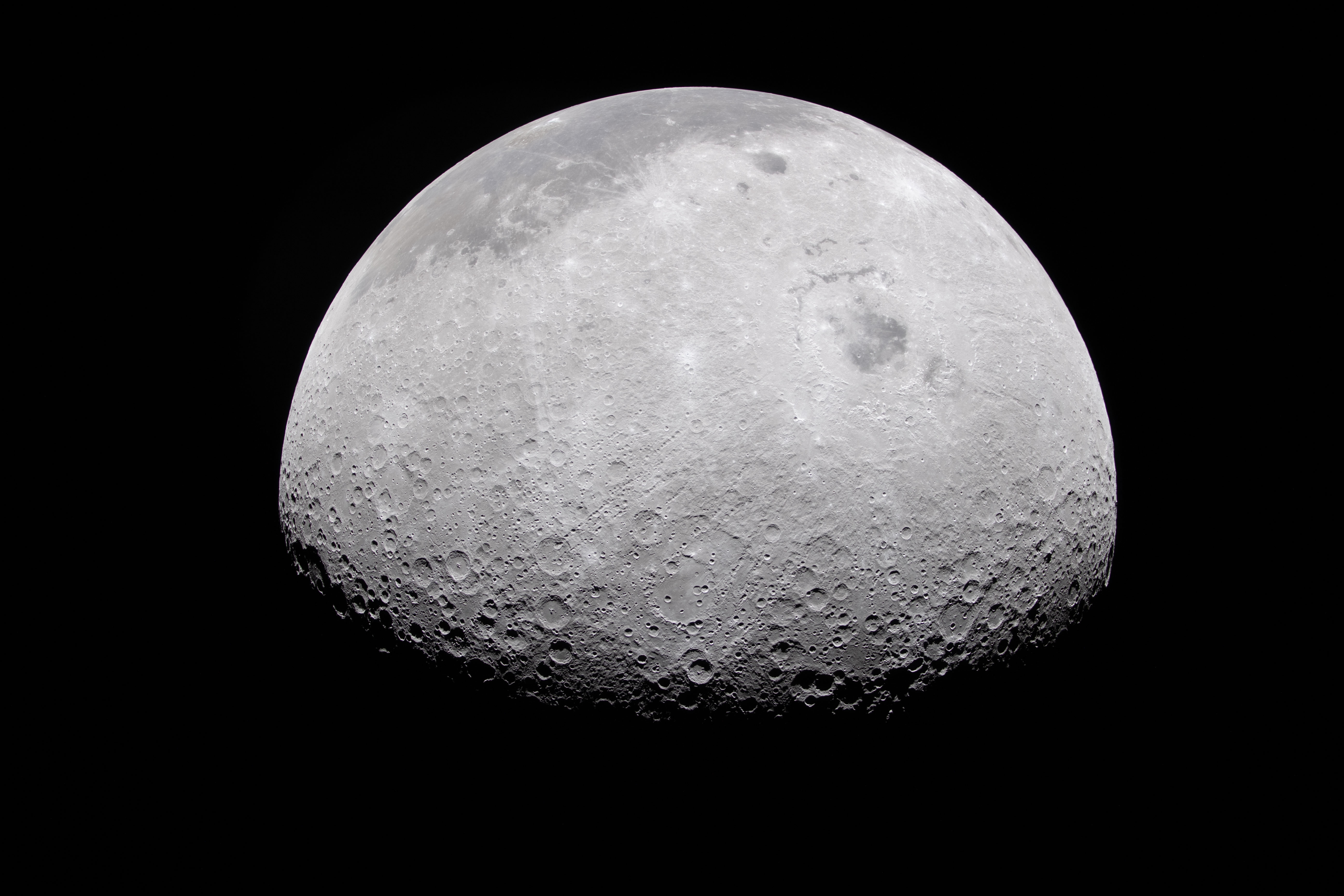
The Moon appears half-illuminated in this photo captured by the Artemis II crew on flight day 6. The terminator – the difference between light and darkness – provides a stark contrast and even greater perspective of the Moon’s rocky, uneven, and otherworldly surface features. The near side, which is what we can see from Earth, appears in the dark gray regions at the top of this image.
Revisit imagery from the Artemis II mission.
Image credit: NASA
Hanging in the Balance
The Moon appears half-illuminated in this photo captured by the Artemis II crew on flight day 6. The terminator – the difference between light and darkness – provides a stark contrast and even greater perspective of the Moon’s rocky, uneven, and otherworldly surface features. The near side, which is what we can see from Earth, appears in the dark gray regions at the top of this image.
Revisit imagery from the Artemis II mission.
Image credit: NASA
ARMD Research Solicitations (Updated June 23)
9 min read
Preparations for Next Moonwalk Simulations Underway (and Underwater) NASA / Lillian Gipson/Getty Images
THIS PAGE WAS UPDATED ON JUNE 23, 2026
This Aeronautics Research Mission Directorate (ARMD) solicitations page compiles the opportunities to collaborate with NASA’s aeronautical innovators and/or contribute to their research to enable new and improved air transportation systems.
Most opportunities to participate in research are officially announced through the Web-based NASA Solicitation and Proposal Integrated Review and Evaluation System, better known as NSPIRES. You are encouraged to visit the NSPIRES web site, create an account, and sign up for automated email announcements.
Other types of collaborative opportunities, such as those involving Requests for Information or academic research contests, also are included on this page.
This ARMD Solicitations page has four major sections:
- Quick list of open solicitations with key dates listed.
- Current open solicitations with more details and helpful links.
- Closed solicitations in case it is helpful to see other examples of the kind of research opportunities NASA Aeronautics makes available.
- Summary of NASA’s Research Opportunities in Aeronautics (ROA) NASA Research Announcement (NRA) selection process.
August 3, 2026
Deadline for proposals on Open Fan Flight Demonstrations NRA
As part of NASA’s Advanced Air Vehicles Program, the Subsonic Vehicle Technologies and Tools project endeavors to advance knowledge, technologies, and concepts that enable accelerated introduction of radical aircraft and engine technologies across a range of vehicle classes.
This is achieved through partnerships with industry to ensure that these technologies are applicable to planned products to increase the chances of inclusion in future aircraft systems.
This research announcement solicits proposals for providing an open fan flight demonstration plan with optional accompanying risk reduction activities. The flight demonstration plan will inform the project of the scope of a possible future flight demonstration and provide insight into the roadmap, risk reduction areas, and areas of potential investment.
See the full research announcement text on SAM.gov.
Proposals Due: August 3, 2026, by 5:00 PM EDT
The Project F.I.R.E. team receives their “Future Game-Changer” award during the 2024 Gateways to Blue Skies forum held at NASA’s Ames Research Center in California. Gateways to Blue Skies is one of several Aeronautics Innovation Challenges open to the academic community.NASA / Brandon Torres Aeronautics Innovation Challenges – OPEN
NASA’s nationwide team of aeronautical innovators are committed to giving students of all ages opportunities to solve some of the biggest technical challenges facing the aviation community today. Through NASA-sponsored challenges and competitions, students representing multiple disciplines will put their skills to work by designing and building solutions to real-world problems.
See the Complete List of Challenges Currently Closed Solicitations NASA’s X-59 quiet supersonic research aircraft lifts off for its first flight Tuesday, Oct. 28, 2025, from U.S. Air Force Plant 42 in Palmdale, California. The aircraft’s first flight marks the start of flight testing for NASA’s Quesst mission, the result of years of design, integration, and ground testing and begins a new chapter in NASA’s aeronautics research legacy.NASA/Lori Losey NASA ARMD Aeronautics Flight Accelerator – CLOSED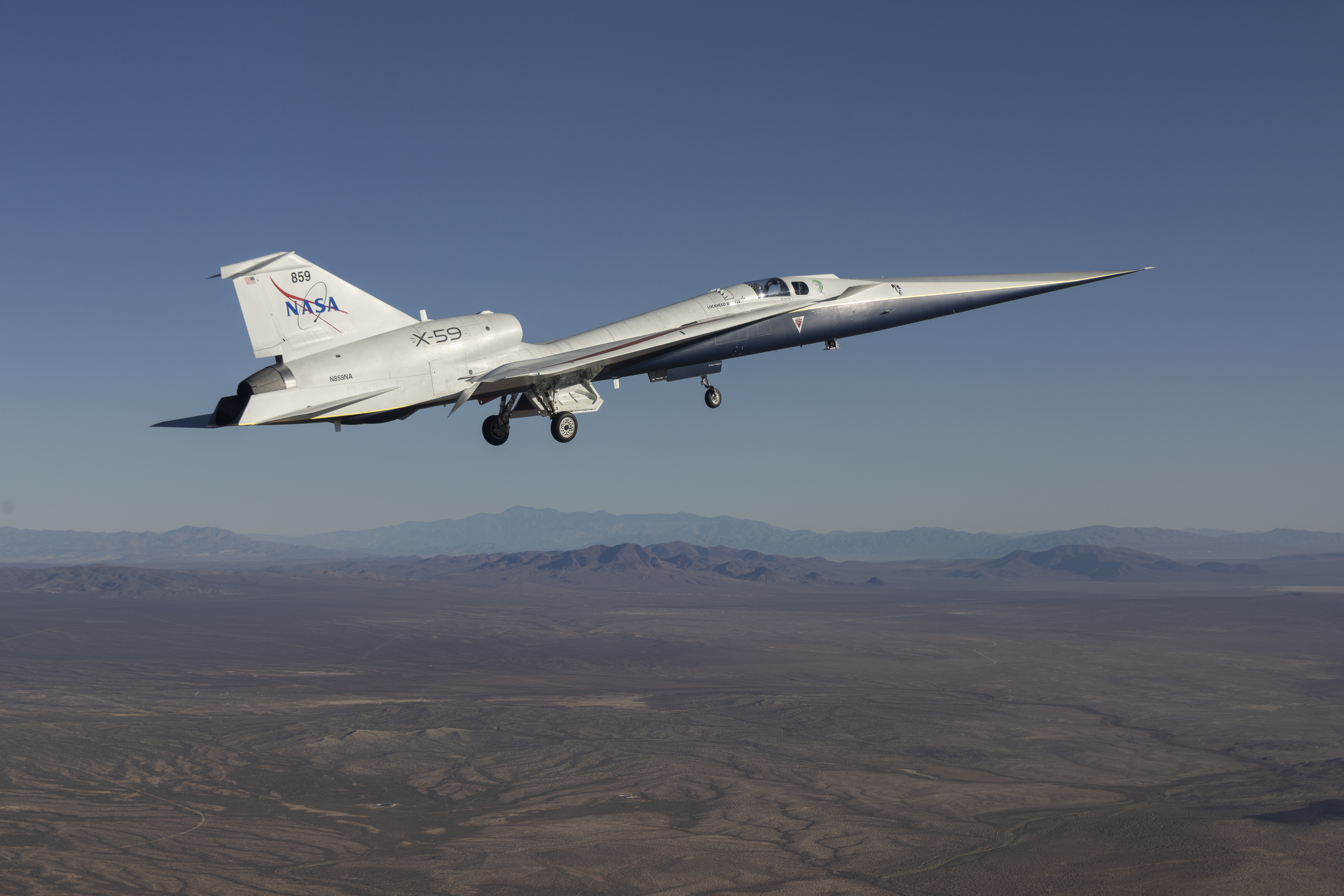
NASA’s Aeronautics Research Mission Directorate is seeking information from U.S. industry, academia, and government organizations regarding potential partnerships for research, development, and flight testing under the Aeronautics Flight Accelerator initiative. NASA is requesting input on technologies, concepts, and flight test campaigns suitable for cost shared maturation leading to flight within the next three years. Areas of interest span subsonic (including vertical lift), supersonic, and hypersonic flight technologies.
THIS IS NOT A REQUEST FOR PROPOSAL. NO PROPOSALS SHOULD BE SUBMITTED.
RFI Release Date: April 7, 2026
Responses Were Due: May 7, 2026, 1:00PM Pacific Daylight Time (PDT)
For more detailed information, see the RFI listing on SAM.gov.
High school students visit the Glenn Research Center Manufacturing Facility and learn about careers in the STEM manufacturing field.NASA/Marvin Smith FY26 NASA Aerospace Skilled Technical Workforce Hubs (NAS_Hub) – CLOSED
This opportunity seeks proposals to establish state or regionally focused Skilled Technical Workforce Hubs (NAS_Hubs) that will serve as strategic centers for developing and sustaining a skilled technical workforce aligned with aerospace industry and NASA mission needs. The NAS_Hub Notice of Funding Opportunity has been released and may be found in NASA’s Solicitation and Proposal Integrated Review and Evaluation System (NSPIRES) on the NAS_Hub landing page.
Key Dates
- Pre-Proposal Webinar: February 18, 2026, 2:00 to 3:00 p.m. ET
- Office Hours Session: March 3, 2026, 2:00 to 3:00 p.m. ET
- Proposal Deadline: March 23, 2026, at 11:59 p.m. ET
- Anticipated Award Notification: June 2026
About the Opportunity
The rapid expansion of the space economy and renewed national priorities in human space exploration have created an urgent demand for a robust skilled technical workforce—individuals in critical science- and engineering-based roles who do not require a bachelor’s degree. To address nationwide shortages and ensure U.S. competitiveness in aerospace and defense, NASA’s Office of STEM Engagement is launching the NASA Aerospace Skilled Technical Workforce Hubs (NAS_Hub) initiative.
Through this notice NASA seeks lead organizations to establish hubs that:
- Collaborate with aerospace employers to align education and training with industry-defined workforce needs.
- Partner with community colleges and high school Career and Technical Education programs to deliver hands-on, industry-aligned learning experiences.
- Coordinate with state or regional workforce development system.
- Build clear and sustainable employment pathways into high-demand aerospace technical careers.
NAS_Hubs will serve as focal points for aligning education, workforce, industry, and government partners to accelerate workforce readiness over a three-year period of performance.
Eligibility
Eligible applicants include:
- State, county, city, township, special district, and tribal governments
- Public and private institutions of higher education
- Nonprofit organizations
- For-profit organizations and small businesses
Proposals must include partnerships with, at a minimum:
- Three aerospace industry collaborators supporting NASA’s work
- Community college career and technical education program
- High school career and technical education program
- State or regional workforce development system
- NASA Center or other NASA facility
Award Information
- Maximum Annual Award: $500,000
- Maximum Total Award: $1,500,000 over three years
- Cost Sharing: Not required
How to Apply
Proposals must be submitted electronically via NSPIRES. Registration in NSPIRES and an active SAM.gov registration are required.
Pre-Proposal Webinar and Technical Assistance
NASA will host an interactive pre-proposal webinar for the NAS_Hub opportunity on Feb. 18, 2026, from 2:00 to 3:00 p.m. ET. This session will provide an in-depth overview of this funding opportunity, including program goals, eligibility requirements, proposal preparation guidance, and submission tips. Proposers will also have the opportunity to receive technical assistance and clarification from NASA staff. Prior to attending a webinar, proposers are strongly encouraged to review the full NAS_Hub notice and to check the NAS_Hub landing page in NSPIRES regularly for updates and additional guidance.
Please note that registration is required for the webinar. Connection details will be provided upon completion of registration. Webinar dates, times, registration links, and connection information will be posted on the NAS_Hub landing page in NSPIRES, which also will feature recordings and presentation materials from the webinar after the event for those unable to attend.
Office Hours Session
March 3, 2026, 2:00 to 3:00 p.m. ET
Last opportunity for questions prior to the proposal deadline. Join the office hours session here.
Contact Information
For technical assistance with NSPIRES
NSPIRES Help Desk available Monday–Friday, 8:00 AM–6:00 PM ET
(202) 479-9376
nspires-help@nasaprs.com
Program Contact
Maria Arredondo
Next Gen STEM Program Manager
NASA Office of STEM Engagement
Mary W. Jackson NASA Headquarters
Email: NAS_Hub@nasaprs.com
Advanced Capabilities for Emergency Response Operations RFI – CLOSEDView the full ACERO RFI announcement here.
NASA’s Advanced Capabilities for Emergency Response Operations (ACERO) project used this request for information to identify technologies that addressed current challenges facing the wildland firefighting community. NASA was seeking information on data collection, airborne connectivity and communications solutions, unmanned aircraft systems traffic management, aircraft operations and autonomy, and more. This would support development of a partnership strategy for future collaborative demonstrations.
Interested parties were requested to respond to this notice with an information package submitted via https://nari.arc.nasa.gov/acero-rfi no later than 4 pm ET, October 15, 2023. Submissions were accepted only from U.S. companies.
Advanced Air Mobility Mission RFI – CLOSEDView the full AAM RFI announcement here.
This request for information is being used to gather market research for NASA to make informed decisions regarding potential partnership strategies and future research to enable Advanced Air Mobility (AAM). NASA is seeking information from public, private, and academic organizations to determine technical needs and community interests that may lead to future solicitations regarding AAM research and development.
This particular RFI is just one avenue of multiple planned opportunities for formal feedback on or participation in NASA’s AAM Mission-related efforts to develop these requirements and help enable AAM.
The respond by date for this RFI closed on Feb. 1, 2025, at 6 p.m. EST.
ROA-2025 NRA Amendment 1 – CLOSEDAdvanced Air Vehicles Program Fellowship Opportunities
(View the full ROA-2025 NRA Amendment 1 text here.)
This announcement solicits proposals from accredited U.S. institutions for research training grants to begin the academic year. This Notice of Funding Opportunity is designed to support independently conceived research projects by highly qualified graduate students in disciplines needed to help advance NASA’s mission, thus affording these students the opportunity to directly contribute to advancements in STEM-related areas of study. These opportunities are focused on innovation and the generation of measurable research results that contribute to NASA’s current and future science and technology goals.
Research proposals are sought to address the key challenges summarized in the Elements section at the end of the Amendment 1 document, and which reference NASA’s Hypersonic Technology project.
Reflecting the Fiscal Year 2026 budget changes, the Transformational Tools & Technologies project opportunities originally described in this announcement were cancelled. Proposals citing this project will not be evaluated.
Notices of Intent are not required.
A budget breakdown for each proposal is required, detailing the allocation of the award funds by year. The budget document may adhere to any format or template provided by the applicant’s institution. Two pre-proposal teleconferences for potential proposers will be held and meeting links will be posted on NSPIRES.
Proposals were due by 5 p.m. EDT on June 11, 2025.
NASA Research Opportunities in AeronauticsCompetition for NRA awards is open to both academia and industry.
The current open solicitations for ARMD Research Opportunities are ROA-2024 and ROA-2025.
Here is some general information to know about the NRA process.
- NRA solicitations are released by NASA Headquarters through the Web-based NASA Solicitation and Proposal Integrated Review and Evaluation System (NSPIRES).
- All NRA technical work is defined and managed by project teams within these four programs: Advanced Air Vehicles Program, Airspace Operations and Safety Program, Integrated Aviation Systems Program, and Transformative Aeronautics Concepts Program.
- NRA awards originate from NASA’s Langley Research Center in Virginia, Ames Research Center in California, Glenn Research Center in Cleveland, and Armstrong Flight Research Center in California.
- Competition for NRA awards is full and open.
- Participation is open to all categories of organizations, including educational institutions, industry, and nonprofits.
- Any updates or amendments to an NRA is posted on the appropriate NSPIRES web pages as noted in the Amendments detailed below.
- ARMD sends notifications of NRA updates through the NSPIRES email system. In order to receive these email notifications, you must be a Registered User of NSPIRES. However, note that NASA is not responsible for inadvertently failing to provide notification of a future NRA. Parties are responsible for regularly checking the NSPIRES website for updated NRAs.
Missions
Artemis
Aeronautics STEM
Explore NASA’s History
Share Details Last Updated Jun 23, 2026 EditorJim BankeContactJim Bankejim.banke@nasa.gov Related TermsPaxi and the European Space Agency
English: Paxi and the European Space Agency
Did you know that space affects your life every single day? Join Paxi to discover all the ways the European Space Agency (ESA) makes life on Earth better every day and explores space, from the satellites above your head to missions looking deep into the universe. Paxi also shares ways you can be a part of Europe's space team.
Greek: Ο Πάξι και ο Ευρωπαϊκός Οργανισμός Διαστήματος
Γνωρίζατε ότι το διάστημα επηρεάζει τη ζωή σας κάθε μέρα; Γίνετε μέλος του Paxi για να ανακαλύψετε όλους τους τρόπους με τους οποίους ο Ευρωπαϊκός Οργανισμός Διαστήματος (ESA) βελτιώνει την καθημερινή ζωή στη Γη και εξερευνά το διάστημα, από τους δορυφόρους πάνω από το κεφάλι σας μέχρι τις αποστολές που κοιτάζουν βαθιά στο σύμπαν. Ο Paxi μοιράζεται επίσης τρόπους με τους οποίους μπορείτε να γίνετε μέλος της διαστημικής ομάδας της Ευρώπης.
German: Paxi und die Europäische Weltraumorganisation
Wusstest du, dass der Weltraum dein Leben jeden einzelnen Tag beeinflusst? Begleite Paxi und entdecke, wie die Europäische Weltraumorganisation (ESA) das Leben auf der Erde jeden Tag verbessert und den Weltraum erforscht – von den Satelliten über deinem Kopf μέχρι hin zu Missionen, die tief ins Universum blicken. Paxi zeigt dir auch, wie du selbst Teil des europäischen Weltraumteams werden kannst.
Spanish: Paxi y la Agencia Espacial Europea
¿Sabías que el espacio afecta a tu vida todos los días? Únete a Paxi για descubrir todas las formas en que la Agencia Espacial Europea (ESA) mejora la vida en la Tierra cada día y explora el espacio, desde los satélites que vuelan sobre tu cabeza hasta las misiones que profundizan en el universo. Paxi también te cuenta cómo puedes formar parte del equipo espacial de Europa.
Dutch: Paxi en het Europees Ruimteagentschap
Wist je dat de ruimte elke dag invloed heeft op je leven? Ga met Paxi op ontdekkingstocht en zie hoe de Europese Ruimtevaartorganisatie (ESA) het leven op aarde elke dag beter maakt en de ruimte verkent, van de satellieten boven je hoofd tot missies die diep in het heelal kijken. Paxi laat je ook zien hoe jij deel kunt uitmaken van het Europese ruimteteam.
Nowegian: Paxi og Den europeiske romfartsorganisasjon
Visste du at verdensrommet påvirker livet ditt hver eneste dag? Bli med Paxi for å oppdage alle måtene den europeiske romfartsorganisasjonen (ESA) gjør livet på jorden bedre hver dag og utforsker verdensrommet, fra satellittene over hodet ditt til oppdrag som ser dypt inn i universet. Paxi deler også måter du kan bli en del av Europas romteam på.
Estonian: Paxi ja Euroopa Kosmoseagentuur
Kas teadsid, et kosmos mõjutab Sinu elu iga jumala päev? Liitu Paxiga, et avastada kõiki viise, kuidas Euroopa Kosmoseagentuur (ESA) muudab elu Maal iga päev paremaks ja uurib kosmost, alates Sinu pea kohal olevatest satelliitidest kuni missioonideni, mis vaatavad sügavale universumisse. Paxi jagab ka viise, kuidas Sina saad olla osa Euroopa kosmosemeeskonnast.
Portuguese: Paxi e a Agência Espacial Europeia
Sabias que o espaço afeta a tua vida todos os dias? Junta-te ao Paxi para descobrires todas as formas como a Agência Espacial Europeia (ESA) melhora a vida na Terra todos os dias e explora o espaço, desde os satélites acima da tua cabeça até às missões que olham bem fundo no universo. O Paxi também partilha formas de como podes fazer parte da equipa espacial da Europa.
Polish: Paxi i Europejska Agencja Kosmiczna
Czy wiesz, że kosmos ma wpływ na Twoje życie każdego dnia? Dołącz do Paxiego, aby odkryć, na jak wiele sposobów Europejska Agencja Kosmiczna (ESA) każdego dnia ulepsza życie na Ziemi i bada kosmos – od satelitów nad Twoją głową po misje zaglądające w głąb wszechświata. Paxi podpowie Ci również, jak możesz stać się częścią europejskiego zespołu kosmicznego.
Romanian: Paxi și Agenția Spațială Europeană
Știai că spațiul îți influențează viața în fiecare zi? Alătură-te lui Paxi pentru a descoperi toate modurile în care Agenția Spațială Europeană (ESA) face viața pe Pământ mai bună în fiecare zi și explorează spațiul, de la sateliții de deasupra capului tău până la misiunile care privesc adânc în univers. Paxi îți arată, de asemenea, cum poți face parte din echipa spațială a Europei.
Slovenian: Paxi in Evropska vesoljska agencija
Ali ste vedeli, da vesolje vsak dan vpliva na vaše življenje? Pridružite se Paxiju in odkrijte vse načine, kako Evropska vesoljska agencija (ESA) vsak dan izboljšuje življenje na Zemlji in raziskuje vesolje, od satelitov nad vašo glavo do misij, ki gledajo globoko v vesolje. Paxi deli tudi načine, kako lahko postanete del evropske vesoljske ekipe.
Hungarian: A Paxi és az Európai Űrügynökség
Tudtad, hogy az űr minden egyes nap hatással van az életedre? Tarts Paxival, és fedezd fel, mi mindennel teszi jobbá az Európai Űrügynökség (ESA) a földi életet nap mint nap, és hogyan kutatja a világűrt a fejed felett elhaladó műholdaktól kezdve egészen az univerzum mélyét fürkésző missziókig. Paxi azt is megmutatja, hogyan válhatsz te is Európa űrcsapatának tagjává.
Czech: Paxi a Evropská kosmická agentura
Věděli jste, že vesmír ovlivňuje váš život každý den? Připojte se k Paximu a zjistěte, jakými všemi způsoby Evropská vesmírná agentura (ESA) každodenně zlepšuje život na Zemi a zkoumá vesmír – od družic nad vašimi hlavami až po mise nahlížející hluboko do vesmíru. Paxi vám také ukáže, jak se můžete stát součástí evropského vesmírného týmu.
Finnish: Paxi ja Euroopan avaruusjärjestö
Tiesitkö, että avaruus vaikuttaa elämääsi joka ikinen päivä? Lähde Paxin mukaan ottamaan selvää kaikista niistä tavoista, joilla Euroopan avaruusjärjestö (ESA) parantaa elämää maapallolla päivittäin ja tutkii avaruutta – aina pääsi yläpuolella olevista satelliiteista aina maailmankaikkeuden syvyyksiin katsoviin tutkimusretkiin. Paxi kertoo myös, miten sinä voit tulla osaksi Euroopan avaruustiimiä.
Danish: Paxi og Den Europæiske Rumorganisation
Vidste du, at rummet påvirker dit liv hver eneste dag? Tag med Paxi for at opdage alle de måder, hvorpå Den Europæiske Rumorganisation (ESA) gør livet på Jorden bedre hver dag og udforsker rummet, lige fra satellitterne over dit hoved til missioner, der kigger dybt ind i universet. Paxi fortæller også, hvordan du kan blive en del af Europas rumteam.
Swedish: Paxi och den Europeiska rymdorganisationen
Visste du att rymden påverkar ditt liv varje dag? Följ med Paxi för att upptäcka alla sätt som Europeiska rymdorganisationen (ESA) gör livet på jorden bättre varje dag och utforskar rymden, från satelliterna ovanför ditt huvud till uppdrag som blickar djupt in i universum. Paxi berättar också hur du kan bli en del av Europas rymdteam.
Italian: Paxi e l’Agenzia Spaziale Europea
Sapevi che lo spazio influenza la tua vita ogni singolo giorno? Unisciti a Paxi per scoprire tutti i modi in care l'Agenzia Spaziale Europea (ESA) rende migliore la vita sulla Terra ogni giorno ed esplora lo spazio, dai satelliti sopra la tua testa alle missioni che guardano nelle profondità dell'universo. Paxi ti spiega anche come puoi entrare a far parte del team spaziale europeo.
French: Paxi et l’Agence spatiale européenne
Saviez-vous que l'espace influence votre vie de tous les jours ? Rejoignez Paxi pour découvrir comment l'Agence spatiale européenne (ESA) améliore le quotidien sur Terre et explore l'espace, des satellites au-dessus de votre tête aux missions qui sondent les profondeurs de l'univers. Paxi vous explique également comment faire partie de l'équipe spatiale européenne.
ARMD Research Solicitations (Updated June 23)
9 min read
Preparations for Next Moonwalk Simulations Underway (and Underwater) NASA / Lillian Gipson/Getty ImagesTHIS PAGE WAS UPDATED ON JUNE 23, 2026
This Aeronautics Research Mission Directorate (ARMD) solicitations page compiles the opportunities to collaborate with NASA’s aeronautical innovators and/or contribute to their research to enable new and improved air transportation systems.
Most opportunities to participate in research are officially announced through the Web-based NASA Solicitation and Proposal Integrated Review and Evaluation System, better known as NSPIRES. You are encouraged to visit the NSPIRES web site, create an account, and sign up for automated email announcements.
Other types of collaborative opportunities, such as those involving Requests for Information or academic research contests, also are included on this page.
This ARMD Solicitations page has four major sections:
- Quick list of open solicitations with key dates listed.
- Current open solicitations with more details and helpful links.
- Closed solicitations in case it is helpful to see other examples of the kind of research opportunities NASA Aeronautics makes available.
- Summary of NASA’s Research Opportunities in Aeronautics (ROA) NASA Research Announcement (NRA) selection process.
August 3, 2026
Deadline for proposals on Open Fan Flight Demonstrations NRA
As part of NASA’s Advanced Air Vehicles Program, the Subsonic Vehicle Technologies and Tools project endeavors to advance knowledge, technologies, and concepts that enable accelerated introduction of radical aircraft and engine technologies across a range of vehicle classes.
This is achieved through partnerships with industry to ensure that these technologies are applicable to planned products to increase the chances of inclusion in future aircraft systems.
This research announcement solicits proposals for providing an open fan flight demonstration plan with optional accompanying risk reduction activities. The flight demonstration plan will inform the project of the scope of a possible future flight demonstration and provide insight into the roadmap, risk reduction areas, and areas of potential investment.
See the full research announcement text on SAM.gov.
Proposals Due: August 3, 2026, by 5:00 PM EDT
The Project F.I.R.E. team receives their “Future Game-Changer” award during the 2024 Gateways to Blue Skies forum held at NASA’s Ames Research Center in California. Gateways to Blue Skies is one of several Aeronautics Innovation Challenges open to the academic community.NASA / Brandon Torres Aeronautics Innovation Challenges – OPENNASA’s nationwide team of aeronautical innovators are committed to giving students of all ages opportunities to solve some of the biggest technical challenges facing the aviation community today. Through NASA-sponsored challenges and competitions, students representing multiple disciplines will put their skills to work by designing and building solutions to real-world problems.
See the Complete List of Challenges Currently Closed Solicitations NASA’s X-59 quiet supersonic research aircraft lifts off for its first flight Tuesday, Oct. 28, 2025, from U.S. Air Force Plant 42 in Palmdale, California. The aircraft’s first flight marks the start of flight testing for NASA’s Quesst mission, the result of years of design, integration, and ground testing and begins a new chapter in NASA’s aeronautics research legacy.NASA/Lori Losey NASA ARMD Aeronautics Flight Accelerator – CLOSEDNASA’s Aeronautics Research Mission Directorate is seeking information from U.S. industry, academia, and government organizations regarding potential partnerships for research, development, and flight testing under the Aeronautics Flight Accelerator initiative. NASA is requesting input on technologies, concepts, and flight test campaigns suitable for cost shared maturation leading to flight within the next three years. Areas of interest span subsonic (including vertical lift), supersonic, and hypersonic flight technologies.
THIS IS NOT A REQUEST FOR PROPOSAL. NO PROPOSALS SHOULD BE SUBMITTED.
RFI Release Date: April 7, 2026
Responses Were Due: May 7, 2026, 1:00PM Pacific Daylight Time (PDT)
For more detailed information, see the RFI listing on SAM.gov.
High school students visit the Glenn Research Center Manufacturing Facility and learn about careers in the STEM manufacturing field.NASA/Marvin Smith FY26 NASA Aerospace Skilled Technical Workforce Hubs (NAS_Hub) – CLOSEDThis opportunity seeks proposals to establish state or regionally focused Skilled Technical Workforce Hubs (NAS_Hubs) that will serve as strategic centers for developing and sustaining a skilled technical workforce aligned with aerospace industry and NASA mission needs. The NAS_Hub Notice of Funding Opportunity has been released and may be found in NASA’s Solicitation and Proposal Integrated Review and Evaluation System (NSPIRES) on the NAS_Hub landing page.
Key Dates
- Pre-Proposal Webinar: February 18, 2026, 2:00 to 3:00 p.m. ET
- Office Hours Session: March 3, 2026, 2:00 to 3:00 p.m. ET
- Proposal Deadline: March 23, 2026, at 11:59 p.m. ET
- Anticipated Award Notification: June 2026
About the Opportunity
The rapid expansion of the space economy and renewed national priorities in human space exploration have created an urgent demand for a robust skilled technical workforce—individuals in critical science- and engineering-based roles who do not require a bachelor’s degree. To address nationwide shortages and ensure U.S. competitiveness in aerospace and defense, NASA’s Office of STEM Engagement is launching the NASA Aerospace Skilled Technical Workforce Hubs (NAS_Hub) initiative.
Through this notice NASA seeks lead organizations to establish hubs that:
- Collaborate with aerospace employers to align education and training with industry-defined workforce needs.
- Partner with community colleges and high school Career and Technical Education programs to deliver hands-on, industry-aligned learning experiences.
- Coordinate with state or regional workforce development system.
- Build clear and sustainable employment pathways into high-demand aerospace technical careers.
NAS_Hubs will serve as focal points for aligning education, workforce, industry, and government partners to accelerate workforce readiness over a three-year period of performance.
Eligibility
Eligible applicants include:
- State, county, city, township, special district, and tribal governments
- Public and private institutions of higher education
- Nonprofit organizations
- For-profit organizations and small businesses
Proposals must include partnerships with, at a minimum:
- Three aerospace industry collaborators supporting NASA’s work
- Community college career and technical education program
- High school career and technical education program
- State or regional workforce development system
- NASA Center or other NASA facility
Award Information
- Maximum Annual Award: $500,000
- Maximum Total Award: $1,500,000 over three years
- Cost Sharing: Not required
How to Apply
Proposals must be submitted electronically via NSPIRES. Registration in NSPIRES and an active SAM.gov registration are required.
Pre-Proposal Webinar and Technical Assistance
NASA will host an interactive pre-proposal webinar for the NAS_Hub opportunity on Feb. 18, 2026, from 2:00 to 3:00 p.m. ET. This session will provide an in-depth overview of this funding opportunity, including program goals, eligibility requirements, proposal preparation guidance, and submission tips. Proposers will also have the opportunity to receive technical assistance and clarification from NASA staff. Prior to attending a webinar, proposers are strongly encouraged to review the full NAS_Hub notice and to check the NAS_Hub landing page in NSPIRES regularly for updates and additional guidance.
Please note that registration is required for the webinar. Connection details will be provided upon completion of registration. Webinar dates, times, registration links, and connection information will be posted on the NAS_Hub landing page in NSPIRES, which also will feature recordings and presentation materials from the webinar after the event for those unable to attend.
Office Hours Session
March 3, 2026, 2:00 to 3:00 p.m. ET
Last opportunity for questions prior to the proposal deadline. Join the office hours session here.
Contact Information
For technical assistance with NSPIRES
NSPIRES Help Desk available Monday–Friday, 8:00 AM–6:00 PM ET
(202) 479-9376
nspires-help@nasaprs.com
Program Contact
Maria Arredondo
Next Gen STEM Program Manager
NASA Office of STEM Engagement
Mary W. Jackson NASA Headquarters
Email: NAS_Hub@nasaprs.com
Advanced Capabilities for Emergency Response Operations RFI – CLOSEDView the full ACERO RFI announcement here.
NASA’s Advanced Capabilities for Emergency Response Operations (ACERO) project used this request for information to identify technologies that addressed current challenges facing the wildland firefighting community. NASA was seeking information on data collection, airborne connectivity and communications solutions, unmanned aircraft systems traffic management, aircraft operations and autonomy, and more. This would support development of a partnership strategy for future collaborative demonstrations.
Interested parties were requested to respond to this notice with an information package submitted via https://nari.arc.nasa.gov/acero-rfi no later than 4 pm ET, October 15, 2023. Submissions were accepted only from U.S. companies.
Advanced Air Mobility Mission RFI – CLOSEDView the full AAM RFI announcement here.
This request for information is being used to gather market research for NASA to make informed decisions regarding potential partnership strategies and future research to enable Advanced Air Mobility (AAM). NASA is seeking information from public, private, and academic organizations to determine technical needs and community interests that may lead to future solicitations regarding AAM research and development.
This particular RFI is just one avenue of multiple planned opportunities for formal feedback on or participation in NASA’s AAM Mission-related efforts to develop these requirements and help enable AAM.
The respond by date for this RFI closed on Feb. 1, 2025, at 6 p.m. EST.
ROA-2025 NRA Amendment 1 – CLOSEDAdvanced Air Vehicles Program Fellowship Opportunities
(View the full ROA-2025 NRA Amendment 1 text here.)
This announcement solicits proposals from accredited U.S. institutions for research training grants to begin the academic year. This Notice of Funding Opportunity is designed to support independently conceived research projects by highly qualified graduate students in disciplines needed to help advance NASA’s mission, thus affording these students the opportunity to directly contribute to advancements in STEM-related areas of study. These opportunities are focused on innovation and the generation of measurable research results that contribute to NASA’s current and future science and technology goals.
Research proposals are sought to address the key challenges summarized in the Elements section at the end of the Amendment 1 document, and which reference NASA’s Hypersonic Technology project.
Reflecting the Fiscal Year 2026 budget changes, the Transformational Tools & Technologies project opportunities originally described in this announcement were cancelled. Proposals citing this project will not be evaluated.
Notices of Intent are not required.
A budget breakdown for each proposal is required, detailing the allocation of the award funds by year. The budget document may adhere to any format or template provided by the applicant’s institution. Two pre-proposal teleconferences for potential proposers will be held and meeting links will be posted on NSPIRES.
Proposals were due by 5 p.m. EDT on June 11, 2025.
NASA Research Opportunities in AeronauticsCompetition for NRA awards is open to both academia and industry.
The current open solicitations for ARMD Research Opportunities are ROA-2024 and ROA-2025.
Here is some general information to know about the NRA process.
- NRA solicitations are released by NASA Headquarters through the Web-based NASA Solicitation and Proposal Integrated Review and Evaluation System (NSPIRES).
- All NRA technical work is defined and managed by project teams within these four programs: Advanced Air Vehicles Program, Airspace Operations and Safety Program, Integrated Aviation Systems Program, and Transformative Aeronautics Concepts Program.
- NRA awards originate from NASA’s Langley Research Center in Virginia, Ames Research Center in California, Glenn Research Center in Cleveland, and Armstrong Flight Research Center in California.
- Competition for NRA awards is full and open.
- Participation is open to all categories of organizations, including educational institutions, industry, and nonprofits.
- Any updates or amendments to an NRA is posted on the appropriate NSPIRES web pages as noted in the Amendments detailed below.
- ARMD sends notifications of NRA updates through the NSPIRES email system. In order to receive these email notifications, you must be a Registered User of NSPIRES. However, note that NASA is not responsible for inadvertently failing to provide notification of a future NRA. Parties are responsible for regularly checking the NSPIRES website for updated NRAs.
Missions
Artemis
Aeronautics STEM
Explore NASA’s History
Share Details Last Updated Jun 23, 2026 EditorJim BankeContactJim Bankejim.banke@nasa.gov Related TermsExploding Stars Sprinkled Ancient Earth With Radioactive Iron and Plutonium
Exploding stars have left their radioactive mark on our planet. Now scientists have found more evidence of a particularly violent event in Earth’s more ancient past.
The post Exploding Stars Sprinkled Ancient Earth With Radioactive Iron and Plutonium appeared first on Sky & Telescope.
I Am Artemis: Jason Peterson
Jason Peterson’s responsibilities for NASA’s Artemis II mission went beyond his usual role as the range operations manager at NASA’s Stennis Space Center near Bay St. Louis, Mississippi.
For Peterson, working at NASA is a surreal full-circle moment.
“I grew up in DeLisle, Mississippi, right down the road from NASA,” said Peterson. “You would hear NASA testing, the windows would shake, and you knew they were out there. Not in a million years would I have ever dreamed I would work with NASA.”
His career journey took a few turns before reaching the space agency.
“I got out of school, welded, went to college and then to the Air Force. The path to NASA really started to develop from there,” said Peterson.
Peterson spent 24 years in the U.S. Air Force and Air National Guard, working in airfield and air-to-ground range operations, followed by a few years working as an aircraft dispatcher at Airbus Final Assembly Line.
Peterson credits his military experience with preparing him for the 12-to-16-hour workdays that helped bring the Artemis II test flight around the Moon and into view for audiences around the world.
He supported the team responsible for delivering video and communication feeds for the launch of NASA’s SLS (Space Launch System) rocket with the Artemis II crew aboard the Orion spacecraft, and then splashdown in the Pacific Ocean.
During the nearly 10-day mission, NASA astronauts Reid Wiseman, Victor Glover, Christina Koch, and CSA (Canadian Space Agency) astronaut Jeremy Hansen completed a record-setting lunar flyby, taking them 252,756 miles at their farthest distance from Earth.
Aboard the USS John P. Murtha, Peterson was the first on the ship to spot the capsule returning with the crew.
“The sonic boom was the moment it truly hit me. Even though I was tracking the capsule, it did not fully register until then. Chills went down my neck and back. You realize our astronauts are coming home. It was an incredible and emotional moment.”JASON PETERSON
Range Operations Manager for NASA Stennis
Jason Peterson, NASA Stennis range operations manager, is shown with the Orion spacecraft aboard the USS John P. Murtha on April 13, 2026. Peterson was the first to spot the capsule returning with the Artemis II crew as he supported the team responsible for delivering video and communication feeds during splashdown operations. Credits: NASANASA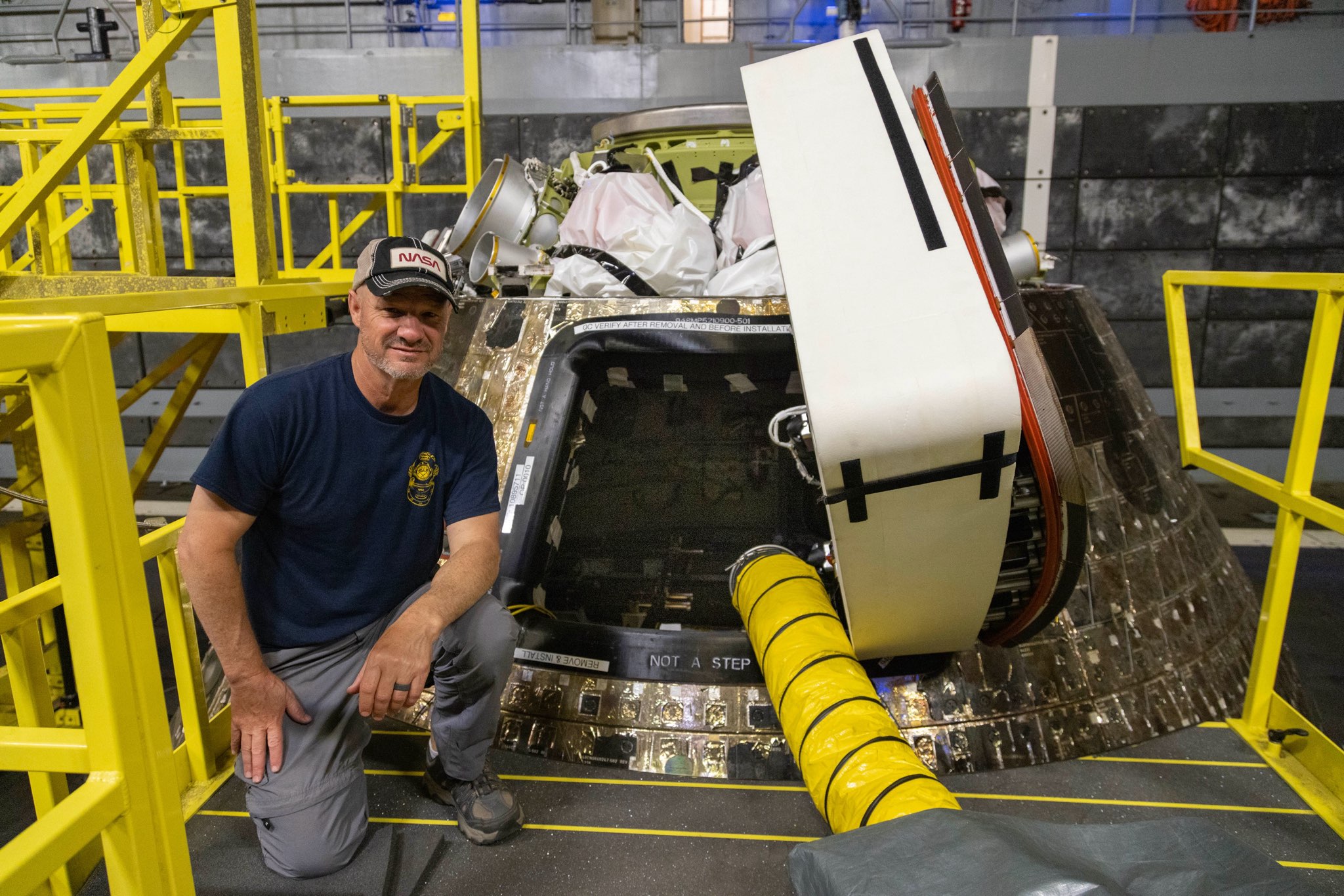
Peterson operated one of six cameras providing live coverage by using a high‑resolution, multi‑sensor system with thermal capabilities. Using the ship’s heading and Orion’s predicted trajectory, he located the capsule within minutes and began tracking it.
Orion entered Earth’s atmosphere at about 400,000 feet above the planet’s surface, traveling nearly 35 times the speed of sound and about 1,956 statute miles from its splashdown point off the coast of California. Peterson tracked Orion from the release of the small parachutes that first slow and steady the capsule, through the main parachutes opening, and all the way to splashdown.
“You are fully locked in, keeping it centered, in focus, and steady,” said Peterson.
Peterson’s focus on the mission began weeks earlier at NASA’s Kennedy Space Center in Florida.
In the days leading to launch, Peterson worked with the team running full systems checks, staging communications gear, and preparing drones and fixed‑wing camera assets. He helped configure and operate the systems that ensured live video flowed from the launch pad, the crowds, and surrounding air and ground platforms.
On April 1, the launch day of Artemis II, the team unloaded and set up high‑resolution sensors, connection terminals, routers, monitors, fiber lines, and drone equipment. They flew drones to capture crowd scenes and aerial views before liftoff.
As the SLS rocket launched, Peterson’s full attention was on positioning the drone and maintaining the shot.
“There is not much time to step back and take in the moment, as you are concentrating on precision,” said Peterson.
As the mission got underway, Peterson and the team packed up, returned to the facility, and downloaded the day’s footage.
The Artemis II crew were more than halfway to the Moon as Peterson arrived in San Diego on April 4. In the days leading to splashdown, the team loaded and installed high‑fidelity cameras and supporting equipment, all to help the world witness a historic milestone when the Artemis II crew returned to Earth on April 10.
Next up will be Artemis III. NASA will launch four astronauts from NASA Kennedy aboard the Orion spacecraft on the SLS rocket. Building on the successful Artemis II crewed test flight in April, Artemis III will pave the way for future surface missions, with experts like Peterson helping every step of the way.
About the AuthorBo BlackCommunications Strategist Share Details Last Updated Jun 23, 2026 EditorCatherine Ragin Williams Related Terms Explore More 2 min read NASA Astronauts to Answer Questions from New Jersey Students Article 1 week ago 3 min read I Am Artemis: Elkin Norena Article 2 weeks ago 5 min read NASA’s Artemis II Moon Mission Research Continues on EarthResults from Artemis II’s science investigations will help support safe human exploration of deep space…
Article 3 weeks ago Keep Exploring Discover More Topics From NASAMissions
Humans in Space
Climate Change
Solar System
I Am Artemis: Jason Peterson
Jason Peterson’s responsibilities for NASA’s Artemis II mission went beyond his usual role as the range operations manager at NASA’s Stennis Space Center near Bay St. Louis, Mississippi.
For Peterson, working at NASA is a surreal full-circle moment.
“I grew up in DeLisle, Mississippi, right down the road from NASA,” said Peterson. “You would hear NASA testing, the windows would shake, and you knew they were out there. Not in a million years would I have ever dreamed I would work with NASA.”
His career journey took a few turns before reaching the space agency.
“I got out of school, welded, went to college and then to the Air Force. The path to NASA really started to develop from there,” said Peterson.
Peterson spent 24 years in the U.S. Air Force and Air National Guard, working in airfield and air-to-ground range operations, followed by a few years working as an aircraft dispatcher at Airbus Final Assembly Line.
Peterson credits his military experience with preparing him for the 12-to-16-hour workdays that helped bring the Artemis II test flight around the Moon and into view for audiences around the world.
He supported the team responsible for delivering video and communication feeds for the launch of NASA’s SLS (Space Launch System) rocket with the Artemis II crew aboard the Orion spacecraft, and then splashdown in the Pacific Ocean.
During the nearly 10-day mission, NASA astronauts Reid Wiseman, Victor Glover, Christina Koch, and CSA (Canadian Space Agency) astronaut Jeremy Hansen completed a record-setting lunar flyby, taking them 252,756 miles at their farthest distance from Earth.
Aboard the USS John P. Murtha, Peterson was the first on the ship to spot the capsule returning with the crew.
“The sonic boom was the moment it truly hit me. Even though I was tracking the capsule, it did not fully register until then. Chills went down my neck and back. You realize our astronauts are coming home. It was an incredible and emotional moment.”JASON PETERSON
Range Operations Manager for NASA Stennis
Jason Peterson, NASA Stennis range operations manager, is shown with the Orion spacecraft aboard the USS John P. Murtha on April 13, 2026. Peterson was the first to spot the capsule returning with the Artemis II crew as he supported the team responsible for delivering video and communication feeds during splashdown operations. Credits: NASANASAPeterson operated one of six cameras providing live coverage by using a high‑resolution, multi‑sensor system with thermal capabilities. Using the ship’s heading and Orion’s predicted trajectory, he located the capsule within minutes and began tracking it.
Orion entered Earth’s atmosphere at about 400,000 feet above the planet’s surface, traveling nearly 35 times the speed of sound and about 1,956 statute miles from its splashdown point off the coast of California. Peterson tracked Orion from the release of the small parachutes that first slow and steady the capsule, through the main parachutes opening, and all the way to splashdown.
“You are fully locked in, keeping it centered, in focus, and steady,” said Peterson.
Peterson’s focus on the mission began weeks earlier at NASA’s Kennedy Space Center in Florida.
In the days leading to launch, Peterson worked with the team running full systems checks, staging communications gear, and preparing drones and fixed‑wing camera assets. He helped configure and operate the systems that ensured live video flowed from the launch pad, the crowds, and surrounding air and ground platforms.
On April 1, the launch day of Artemis II, the team unloaded and set up high‑resolution sensors, connection terminals, routers, monitors, fiber lines, and drone equipment. They flew drones to capture crowd scenes and aerial views before liftoff.
As the SLS rocket launched, Peterson’s full attention was on positioning the drone and maintaining the shot.
“There is not much time to step back and take in the moment, as you are concentrating on precision,” said Peterson.
As the mission got underway, Peterson and the team packed up, returned to the facility, and downloaded the day’s footage.
The Artemis II crew were more than halfway to the Moon as Peterson arrived in San Diego on April 4. In the days leading to splashdown, the team loaded and installed high‑fidelity cameras and supporting equipment, all to help the world witness a historic milestone when the Artemis II crew returned to Earth on April 10.
Next up will be Artemis III. NASA will launch four astronauts from NASA Kennedy aboard the Orion spacecraft on the SLS rocket. Building on the successful Artemis II crewed test flight in April, Artemis III will pave the way for future surface missions, with experts like Peterson helping every step of the way.
About the AuthorBo BlackCommunications Strategist Share Details Last Updated Jun 23, 2026 EditorCatherine Ragin Williams Related Terms Explore More 2 min read NASA Astronauts to Answer Questions from New Jersey Students Article 1 week ago 3 min read I Am Artemis: Elkin Norena Article 2 weeks ago 5 min read NASA’s Artemis II Moon Mission Research Continues on EarthResults from Artemis II’s science investigations will help support safe human exploration of deep space…
Article 3 weeks ago Keep Exploring Discover More Topics From NASAMissions
Humans in Space
Climate Change
Solar System
Hubble Details Early Galaxy Transforming Neighborhood
- Hubble Home
- Overview
- Impact & Benefits
- Science
- Observatory
- Team
- Multimedia
- News
- More
Image: NASA, ESA, CSA, STScI, Ilias Goovaerts (STScI), Marc Rafelski (STScI, JHU), Anton Koekemoer (STScI); Image Processing: Alyssa Pagan (STScI)
Astronomers using NASA’s Hubble Space Telescope have found something they never expected — ultraviolet light from a galaxy that existed just 1.4 billion years after the big bang. That galaxy contains tightly clustered young stars that produce ionizing light capable of transforming the opaque, neutral gas within and immediately around the galaxy, clearing our view. This suggests that similar galaxies in the early universe were responsible for clearing the neutral fog of hydrogen gas that once filled the cosmos.
A paper describing this discovery was published June 23 in the Astrophysical Journal.
The galaxy, cataloged MXDFz4.4, existed at the end of the Era of Reionization, a transformative period in our universe. During roughly the first billion years of the cosmos, the gas between stars and galaxies was opaque to energetic ultraviolet light. As time wore on, gas everywhere became transparent or ionized. The changeover was not like an on/off switch, but likely took hundreds of millions of years. Researchers are still collecting evidence to fully understand how this happened, which is why MXDFz4.4 sets a critical precedent.
“Observing a galaxy like this was thought to be impossible,” said lead author Ilias Goovaerts, a postdoctoral fellow at the Space Telescope Science Institute (STScI) in Baltimore. “Researchers expected the ‘fog’ or neutral hydrogen that filled the early universe would be too thick and obscure our view of its ionizing light. Hubble not only spotted that light, but it also helped reveal incredible details about the galaxy’s characteristics.”
Detailed visible-light images from Hubble reveal that several bursts of younger stars cleared the space in and around galaxy MXDFz4.4. Astronomers have long sought evidence to explain this transition — and Hubble has provided the first example in this time period. Image: NASA, ESA, CSA, STScI, Ilias Goovaerts (STScI), Marc Rafelski (STScI, JHU), Anton Koekemoer (STScI); Image Processing: Alyssa Pagan (STScI) Great light ‘escape’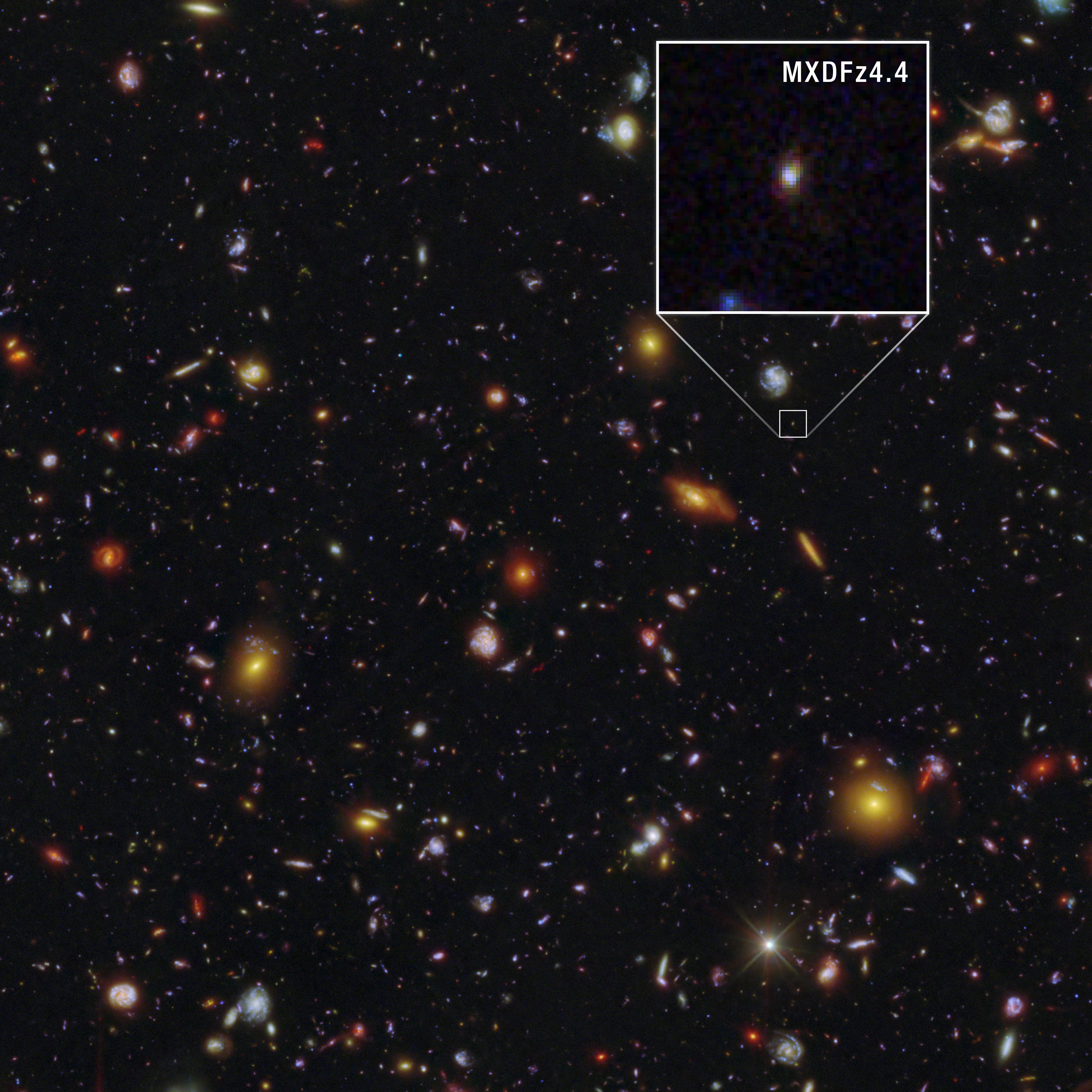
Young, massive stars emit ultraviolet light capable of ionizing hydrogen atoms. As this light traveled for over 12 billion years to reach Hubble, space expanded, and the light stretched or redshifted into visible light. Hubble’s wavelength coverage, combined with the sensitivity and resolution of its space-based vantage point, makes it the only telescope capable of capturing this ultraviolet light from the early universe.
“Astronomers have found many galaxies that existed at this point in the history of the universe, but we haven’t detected ionizing photons from any of them, making MXDFz4.4 one of a kind,” said Marc Rafelski, a co-author and Hubble deputy mission head at STScI.
Hubble’s long exposures, pulled from several existing surveys, revealed that the galaxy’s young, massive stars are the source of the ultraviolet light, which cleared the surrounding space. These stars formed in bursts within the last few million years of MXDFz4.4’s existence and are crammed together.
Amplifying this crowding effect, MXDFz4.4 is about 100 times smaller by area than our Milky Way galaxy, but is forming stars 10 times faster.
“A lot of young, hot, massive stars in a small space do a better job of blasting through opaque gas,” Goovaerts said. The researchers estimate that 50 to 100% of the young stars’ energetic ionizing light is escaping the surrounding gas.
Massive stars’ lifetimes also play a role, since they live for only a few million years. Many explode as supernovae, releasing gigantic amounts of energy and blowing colossal holes that allow even more light to escape.
This illustration portrays galaxy MXDFz4.4 when it existed 1.4 billion years after the big bang. At this time, the universe was still a mix of opaque and transparent gas as the Era of Reionization was gradually ending. Illustration: NASA, ESA, Leah Hustak (STScI) Partnering with other observatories
Hubble could not do this alone. These conclusions are supported by survey data taken by NASA’s James Webb Space Telescope in near-infrared light and the MUSE eXtremely Deep Field or MXDF, the galaxy’s namesake, captured by the European Southern Observatory’s Very Large Telescope (VLT) in visible light.
The team used Webb’s data to determine the galaxy’s mass, analyze its older stars, and measure the galaxy’s star formation history. The galaxy’s older stars are less massive and cooler, and therefore not responsible for changing the gas around them.
Comparing Hubble and Webb data also showed that recent star formation happened in bursts. “Without Webb to clarify what we saw in Hubble’s images, we couldn’t make these conclusions,” Rafelski said.
Data from the VLT pinpointed when MXDFz4.4 existed: 1.4 billion years after the big bang. Before this discovery, researchers had only identified a galaxy emitting ionized light from a time when the universe was 1.6 billion years old. Only a few additional examples have been identified, and those existed when the universe was about 2 billion years old. MXDFz4.4 brings researchers closer to drawing firm conclusions about how the Era of Reionization unfolded.
Credit: NASA’s Goddard Space Flight Center; Lead Producer: Paul Morris Expanding what we knowStudying the Era of Reionization is a decades-old endeavor. Researchers use statistics about star populations in nearby galaxies, which we can observe in great detail, to make well-informed assumptions about what might be happening in galaxies in the early universe, in part because their star populations are too distant to resolve in any detail.
In 2023, researchers using Webb showed that galaxies’ stars emitted enough light to heat and ionize the gas around them 900 million years after the big bang. This was a breakthrough, but astronomers need galaxies like MXDFz4.4 to fully explain how the process happened, since it shows how the high-energy light from young stars managed to escape the gas and dust within the galaxy itself.
It’s possible other galaxies like MXDFz4.4 are waiting to be discovered.
“Hubble’s observations of MXDFz4.4 let us test our hypotheses much closer to the Era of Reionization than ever before,” Rafelski said. “Finding more galaxies, especially at slightly later cosmic times where larger samples are within reach, would let us refine these measurements and figure out what cleared our view as that era was ending.”
The Hubble Space Telescope has been operating for over three decades and continues to make ground-breaking discoveries that shape our fundamental understanding of the universe. Hubble is a project of international cooperation between NASA and ESA (European Space Agency). NASA’s Goddard Space Flight Center in Greenbelt, Maryland, manages the telescope and mission operations. Lockheed Martin Space, based in Denver, also supports mission operations at Goddard. The Space Telescope Science Institute in Baltimore, which is operated by the Association of Universities for Research in Astronomy, conducts Hubble science operations for NASA.
Facebook logo @NASAHubble @NASAHubble Instagram logo @NASAHubble Related Images & Videos Galaxy MXDFz4.4 (Hubble and Webb Image)Detailed visible-light images from Hubble reveal that several bursts of younger stars cleared the space in and around galaxy MXDFz4.4. Astronomers have long sought evidence to explain this transition — and Hubble has provided the first example in this time period.
Galaxy MXDFz4.4 (Artist’s Concept)
This illustration portrays galaxy MXDFz4.4 when it existed 1.4 billion years after the big bang. At this time, the universe was still a mix of opaque and transparent gas as the Era of Reionization was gradually ending.
Galaxy MXDFz4.4 (Hubble and Webb Compass Image)
This shows the galaxy MXDFz4.4, enlarged at right, in the Hubble Ultra Deep Field (HUDF), captured by both the Hubble Space Telescope’s Advanced Camera for Surveys (ACS) and the James Webb Space Telescope’s NIRCam (Near-Infrared Camera).
Claire Andreoli
NASA’s Goddard Space Flight Center
Greenbelt, Maryland
claire.andreoli@nasa.gov
Claire Blome, Christine Pulliam
Space Telescope Science Institute
Baltimore, Maryland
Keep Exploring Discover More Topics From Hubble Hubble Space Telescope
Since its 1990 launch, the Hubble Space Telescope has changed our fundamental understanding of the universe.
Hubble Science Highlights
Hubble Images
Hubble News