
Feed aggregator
Too many sleepless nights may lead to weight gain
Getting as little as 90 minutes less sleep than usual may lead to gaining weight and becoming more sedentary, a new study finds
Bumblebee facial movements give clues to their inner lives
Bumblebee facial movements give clues to their inner lives
Artefacts hint at cultural exchange between Neanderthals and humans
Artefacts hint at cultural exchange between Neanderthals and humans
Did our modern human ancestors and Neanderthals share a common culture?
Both Neanderthals and Homo sapiens may have shared tools and behavioral practices, new research suggests
Andromeda's Newest Dwarf Galaxy is Extremely Dim
Astronomers have discovered an extremely low-mass and dim dwarf galaxy around Andromeda. Called And 35, it's an Ultra-Faint Dwarf Galaxy (UFDG) and so far, the researchers have detected only 46 of its stars. Lambda-CDM predicts that there should be many UFDGs around galaxies like Andromeda and the Milky Way, so finding more of them is important.
NASA Takes Flight For America's 250th
NASA Takes Flight For America’s 250th

NASA Administrator Jared Isaacman leads a flyover featuring his personally owned Northrop F-5 Tiger during the Great American State Fair on July 4, 2026, on the National Mall in Washington, D.C.
For 250 years, America has pushed the boundaries of what’s possible. From the earliest days of exploration, to the first steps on the Moon and the missions shaping our future, NASA represents the spirit of discovery that defines our nation.
As the United States celebrates its semiquincentennial, Freedom 250 highlights how innovation, courage, and scientific leadership have carried America forward — and how NASA continues to expand the frontier for the next generation.
NASA Takes Flight For America’s 250th
NASA Administrator Jared Isaacman leads a flyover featuring his personally owned Northrop F-5 Tiger during the Great American State Fair on July 4, 2026, on the National Mall in Washington, D.C.
For 250 years, America has pushed the boundaries of what’s possible. From the earliest days of exploration, to the first steps on the Moon and the missions shaping our future, NASA represents the spirit of discovery that defines our nation.
As the United States celebrates its semiquincentennial, Freedom 250 highlights how innovation, courage, and scientific leadership have carried America forward — and how NASA continues to expand the frontier for the next generation.
New Horizons Watches the Solar Wind as it Slows Down
Where does the Solar System end and interstellar space begin? That's a question scientists have been working to answer using spacecraft traveling out beyond the Sun's influence. A team of researchers from the Southwest Research Institute led by Heather Elliott, is using the Solar Wind around Pluto instrument onboard New Horizons to track the solar wind in the outer reachers of the Solar System.
Wordle, but for art history—Anthropeum turns the Met Museum into an online game
Anthropeum is a daily game that uses the Met’s open-access data to showcase underrepresented art and artifacts
How healthy is your brain? We now know how to find out
How healthy is your brain? We now know how to find out
A New Net-Membrane Could Clean Up Some Tricky Space Debris
We’ve reported on all kinds of wacky ideas for capturing and deorbiting space debris safely. From electric tethers to lasers, engineers and scientists have been trying everything they can think of to deal with the ever-increasing orbital debris problem. But one simple design keeps popping up over and over again - a net. A new paper from researchers at the Chinese Academy of Sciences and the University of Electronic Science and Technology of China details one of the most advanced net concepts yet - but whether we can actually build one remains to be seen.
NASA Seeks Industry Input on Second Phase of Commercial Space Stations
On Monday, NASA released a draft Request for Proposals (RFP) seeking feedback from American companies on the next phase of its commercial space stations strategy, aimed at ensuring a seamless transition of activities in low Earth orbit from the International Space Station.
“NASA’s review reflects what we’ve been hearing from industry throughout this process. Industry believes it can meet the timelines and that a viable commercial marketplace exists where NASA is one customer among many,” said NASA Administrator Jared Isaacman. “We’re focused on supporting those efforts, enabling the capabilities that make this transition possible, and doing all we can to ensure the United States maintains a continuous human presence in low Earth orbit.”
The draft RFP builds on the agency’s request for information released March 25. Based on industry’s input, NASA will proceed with its original plan to procure commercial services through FAR-based contract(s) awarded via full and open competition. Industry has indicated there is significant capital investment behind this approach and expressed high confidence in their ability to attract additional capital investment and expand future market opportunities after NASA makes an award.
NASA intends to award firm-fixed-price, multi-award, indefinite-delivery/indefinite-quantity contracts supporting development, certification, and services. This approach would allow NASA to select two or more contractors through early development, followed by a competitive task order for final design, test, evaluation, as well as certification and services from one or more contractors.
Industry feedback is due Monday, July 27. NASA also will hold an informational industry briefing on Thursday, July 9, at the agency’s Johnson Space Center in Houston to provide a top-level summary of the documents and expectations.
The draft RFP gives companies the opportunity to review and comment on the planned acquisition approach for future commercial space station services, helping shape the agency’s path forward as it proceeds with its original commercial strategy. This strategy will provide the government with reliable, safe, cost-effective services through commercial partners, enabling NASA to focus on the next step in humanity’s deep space exploration while also continuing to use low Earth orbit as an ideal training environment and proving ground for Artemis missions to the Moon and future human exploration of Mars.
Learn more about commercial space stations at:
Share Details Last Updated Jul 06, 2026 Related TermsNASA Seeks Industry Input on Second Phase of Commercial Space Stations
On Monday, NASA released a draft Request for Proposals (RFP) seeking feedback from American companies on the next phase of its commercial space stations strategy, aimed at ensuring a seamless transition of activities in low Earth orbit from the International Space Station.
“NASA’s review reflects what we’ve been hearing from industry throughout this process. Industry believes it can meet the timelines and that a viable commercial marketplace exists where NASA is one customer among many,” said NASA Administrator Jared Isaacman. “We’re focused on supporting those efforts, enabling the capabilities that make this transition possible, and doing all we can to ensure the United States maintains a continuous human presence in low Earth orbit.”
The draft RFP builds on the agency’s request for information released March 25. Based on industry’s input, NASA will proceed with its original plan to procure commercial services through FAR-based contract(s) awarded via full and open competition. Industry has indicated there is significant capital investment behind this approach and expressed high confidence in their ability to attract additional capital investment and expand future market opportunities after NASA makes an award.
NASA intends to award firm-fixed-price, multi-award, indefinite-delivery/indefinite-quantity contracts supporting development, certification, and services. This approach would allow NASA to select two or more contractors through early development, followed by a competitive task order for final design, test, evaluation, as well as certification and services from one or more contractors.
Industry feedback is due Monday, July 27. NASA also will hold an informational industry briefing on Thursday, July 9, at the agency’s Johnson Space Center in Houston to provide a top-level summary of the documents and expectations.
The draft RFP gives companies the opportunity to review and comment on the planned acquisition approach for future commercial space station services, helping shape the agency’s path forward as it proceeds with its original commercial strategy. This strategy will provide the government with reliable, safe, cost-effective services through commercial partners, enabling NASA to focus on the next step in humanity’s deep space exploration while also continuing to use low Earth orbit as an ideal training environment and proving ground for Artemis missions to the Moon and future human exploration of Mars.
Learn more about commercial space stations at:
Share Details Last Updated Jul 06, 2026 Related TermsNASA’s CAPSTONE Completes Extended Mission Testing Lunar Technologies
As NASA prepares for a sustained human presence on the Moon, missions will increasingly require spacecraft that can navigate and communicate without a direct connection to Earth.
NASA’s Cislunar Autonomous Positioning System Technology Operations and Navigation Experiment, or CAPSTONE, validated and advanced these capabilities.
Designed to test and validate technologies in lunar orbit, CAPSTONE launched in June 2022 and became the first U.S. commercial mission at the Moon. The spacecraft tested operations in three-body orbits around the Moon, using the combined gravity of Earth and the Moon to reduce the fuel needed to maintain a stable lunar path. It became the first spacecraft to fly and characterize this orbit for future exploration and science missions. Owned and operated by Advanced Space, the microwave-sized spacecraft then received a 15-month mission extension, becoming a testbed for advanced communications, networking, autonomous navigation, and software-defined satellite technologies.
Dylan Schmidt, CAPSTONE assembly integration and test lead, right, and Lachlan Moore, systems integration engineer, left, install solar panels onto the CAPSTONE spacecraft at Tyvak Nano-Satellite Systems, Inc., in Irvine, California.NASA/Dominic Hart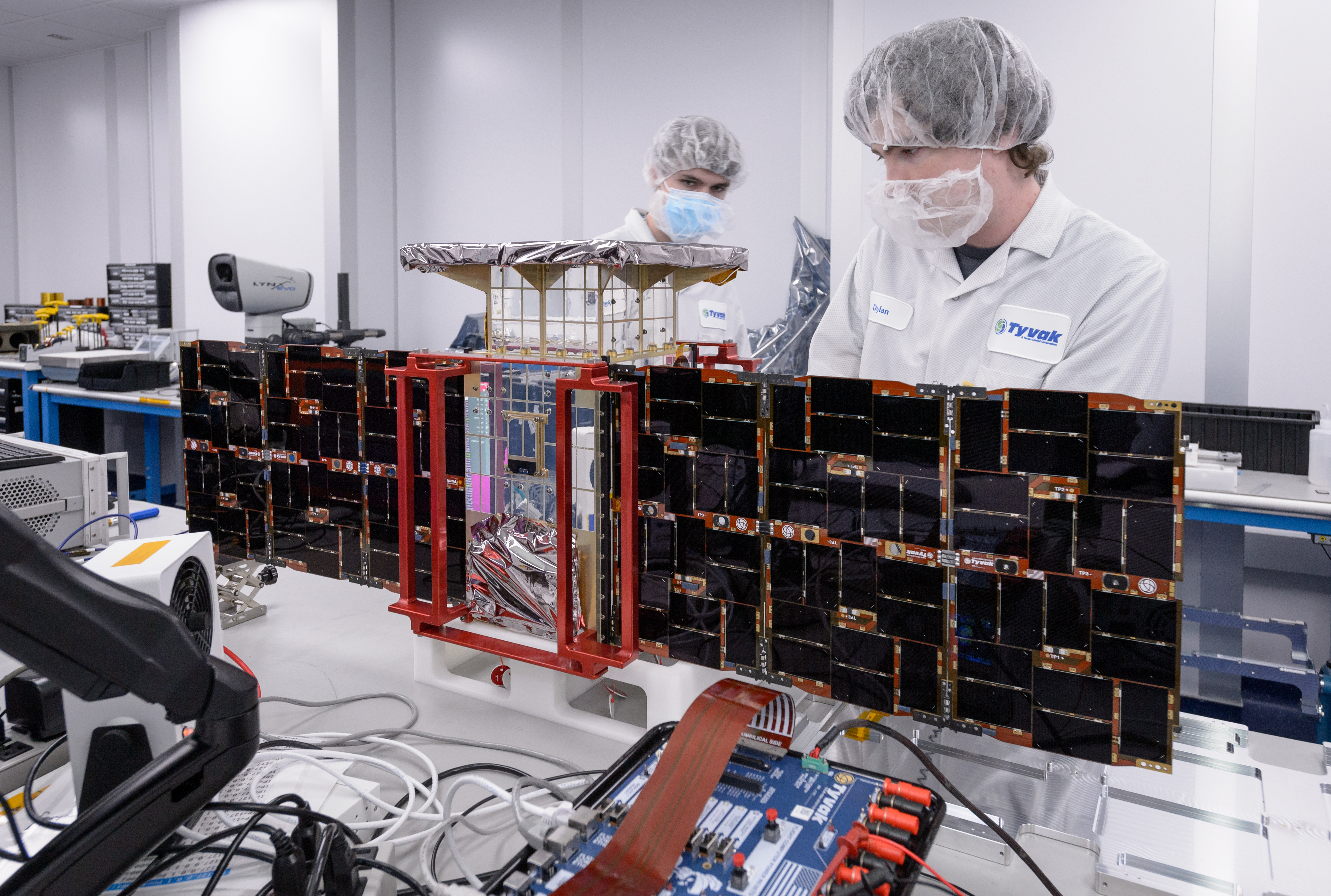
Rather than launch a new satellite, NASA’s Research and Technology Mission Directorate demonstrated that CAPSTONE’s existing hardware could host new applications after launch, transforming the spacecraft into a cost-effective, flexible lunar technology demonstration platform. NASA’s SCaN (Space Communications and Navigation) Division will now use the data to demonstrate innovative networking and navigation techniques on future experiments.
“Operating multiple experiments simultaneously aboard the same spacecraft allows NASA to evaluate how these technologies perform together in a real lunar environment,” said Greg Stover, director of the Advanced Research and Technology Division within NASA’s Research and Technology Mission Directorate at NASA Headquarters in Washington. “Investments in autonomous operations and resilient communications infrastructure are essential to ensuring U.S. leadership as activity around the Moon continues to increase.”
Two experiments aboard CAPSTONE used software-defined infrastructure to advance two future mission essentials: autonomous navigation and deep space communications. The autonomous Navigation, Guidance, and Control software, or autoNGC, is designed to allow a spacecraft to determine where it is, where it is going, and how to get where it needs to be without waiting for instructions from the ground. While portions of the software had previously flown in Earth orbit, CAPSTONE marked the first time autoNGC was tested at the Moon.
“To really demonstrate that something works, you have to fly it,” said Sun Hur-Diaz, principal investigator for the autoNGC technology development project at NASA’s Goddard Space Flight Center in Greenbelt, Maryland. “The real environment is key.”
To really demonstrate that something works you have to fly it. The real environment is key.Sun Hur-Diaz
Principal Investigator for the autoNGC Project, NASA Goddard Space Flight Center
Researchers also evaluated how autoNGC performed with limited contact to Earth. While NASA’s Deep Space Network antennas were supporting the Artemis II crewed test flight around the Moon, CAPSTONE’s communications window dropped to just a few passes per week.
Those gaps became one of the experiment’s most valuable tests. Without data from Earth, autoNGC determined CAPSTONE’s location using an onboard star tracker camera to image the Moon, Earth, and other celestial bodies. The camera-based system, known as optical navigation, at times outperformed ground-based methods for real-time onboard navigation, advancing technologies for future deep-space missions.
Alongside autonomous navigation testing, CAPSTONE also tested delay/disruption tolerant networking (DTN), a communications architecture designed for deep space. Unlike Earth-based internet systems, deep space communications must function despite long delays and frequent signal gaps. The DTN system addresses those challenges by storing information on the spacecraft when no connection is available and automatically forwarding it once communications are restored. With these demonstrations, CAPSTONE became the first to fly the latest DTN protocols beyond Earth orbit and the first to run them in NASA’s core Flight System, an open-source framework that can be implemented on any spacecraft.
In one demonstration, engineers began transmitting data from CAPSTONE to Earth, but the connection ended before the transfer was complete. The spacecraft stored the remaining data until the next communications opportunity, and transmission resumed automatically. Every piece of data made it home.
Artist’s rendering depicting astronauts, habitats, rovers, power systems, and cargo operations supporting sustained human activities at the Moon Base near the lunar South Pole. The technologies CAPSTONE tested may be key to NASA’s growing lunar communications and navigation infrastructure.NASA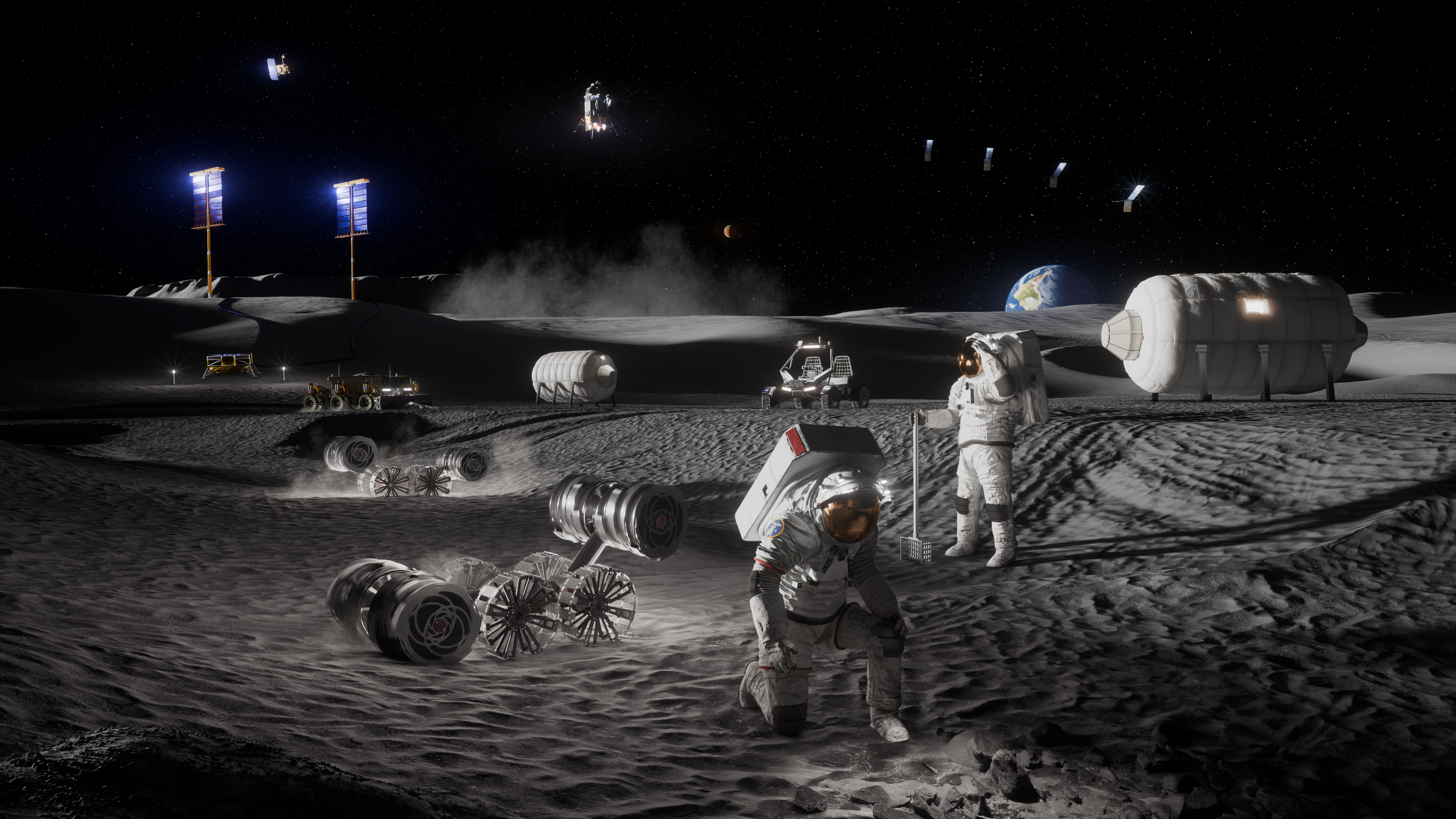
“You can imagine an astronaut walking behind a lunar hill or descending into a crater and temporarily losing connectivity,” said Ben Anderson, a systems engineer for the Near Space Network at NASA’s Goddard Space Flight Center in Greenbelt, Maryland. “This technology allows that data to be automatically retransmitted once communications are restored.”
In addition to its primary achievements, CAPSTONE’s second life as a software-defined testing platform demonstrated that new technologies can be affordably tested and proven directly in their operational environment.
After nearly four years of technology maturation, NASA’s activities on CAPSTONE concluded in June 2026, while Advanced Space will continue to use the spacecraft as a technology development testbed.
The CAPSTONE spacecraft was designed and built by Terran Orbital and is owned and operated by Advanced Space. NASA’s Research and Technology Mission Directorate managed the mission through the Small Spacecraft and Distributed Systems program, based at NASA’s Ames Research Center in California’s Silicon Valley. Elements of the CAPSTONE technology suite were supported by NASA’s Small Business Innovation Research program. The autoNGC and DTN demonstrations conducted during CAPSTONE’s extended mission were managed by NASA’s SCaN Division, based at NASA Headquarters in Washington.
About the AuthorKorine PowersLead Writer and Communications StrategistKorine Powers, Ph.D. is a writer for NASA's SCaN (Space Communications and Navigation) Program office and covers emerging technologies, commercialization efforts, exploration activities, and more.
Share Details Last Updated Jul 06, 2026 EditorJimi RussellContactKorine Powerskorine.powers@nasa.govLocationAmes Research Center Related Terms Explore More 2 min read NASA Transfers ‘Hundred Acre Wood’ to Patuxent Research Refuge Article 1 day ago 3 min read NASA’s New Horizons Spacecraft Wakes from Hibernation in Good HealthFollowing its longest hibernation period ever of nearly a year, NASA’s New Horizons spacecraft has…
Article 1 day ago 6 min read NASA Webb Uncovers Unusual Galaxy Shaped by Cosmic CollisionIn new images from NASA’s James Webb Space Telescope to celebrate its fourth science anniversary,…
Article 2 days ago Keep Exploring Discover More Topics From NASACAPSTONE
Communicating with Missions
SCaN & Moon to Mars
Moon Base
NASA’s CAPSTONE Completes Extended Mission Testing Lunar Technologies
As NASA prepares for a sustained human presence on the Moon, missions will increasingly require spacecraft that can navigate and communicate without a direct connection to Earth.
NASA’s Cislunar Autonomous Positioning System Technology Operations and Navigation Experiment, or CAPSTONE, validated and advanced these capabilities.
Designed to test and validate technologies in lunar orbit, CAPSTONE launched in June 2022 and became the first U.S. commercial mission at the Moon. The spacecraft tested operations in three-body orbits around the Moon, using the combined gravity of Earth and the Moon to reduce the fuel needed to maintain a stable lunar path. It became the first spacecraft to fly and characterize this orbit for future exploration and science missions. Owned and operated by Advanced Space, the microwave-sized spacecraft then received a 15-month mission extension, becoming a testbed for advanced communications, networking, autonomous navigation, and software-defined satellite technologies.
Dylan Schmidt, CAPSTONE assembly integration and test lead, right, and Lachlan Moore, systems integration engineer, left, install solar panels onto the CAPSTONE spacecraft at Tyvak Nano-Satellite Systems, Inc., in Irvine, California.NASA/Dominic HartRather than launch a new satellite, NASA’s Research and Technology Mission Directorate demonstrated that CAPSTONE’s existing hardware could host new applications after launch, transforming the spacecraft into a cost-effective, flexible lunar technology demonstration platform. NASA’s SCaN (Space Communications and Navigation) Division will now use the data to demonstrate innovative networking and navigation techniques on future experiments.
“Operating multiple experiments simultaneously aboard the same spacecraft allows NASA to evaluate how these technologies perform together in a real lunar environment,” said Greg Stover, director of the Advanced Research and Technology Division within NASA’s Research and Technology Mission Directorate at NASA Headquarters in Washington. “Investments in autonomous operations and resilient communications infrastructure are essential to ensuring U.S. leadership as activity around the Moon continues to increase.”
Two experiments aboard CAPSTONE used software-defined infrastructure to advance two future mission essentials: autonomous navigation and deep space communications. The autonomous Navigation, Guidance, and Control software, or autoNGC, is designed to allow a spacecraft to determine where it is, where it is going, and how to get where it needs to be without waiting for instructions from the ground. While portions of the software had previously flown in Earth orbit, CAPSTONE marked the first time autoNGC was tested at the Moon.
“To really demonstrate that something works, you have to fly it,” said Sun Hur-Diaz, principal investigator for the autoNGC technology development project at NASA’s Goddard Space Flight Center in Greenbelt, Maryland. “The real environment is key.”
To really demonstrate that something works you have to fly it. The real environment is key.Sun Hur-Diaz
Principal Investigator for the autoNGC Project, NASA Goddard Space Flight Center
Researchers also evaluated how autoNGC performed with limited contact to Earth. While NASA’s Deep Space Network antennas were supporting the Artemis II crewed test flight around the Moon, CAPSTONE’s communications window dropped to just a few passes per week.
Those gaps became one of the experiment’s most valuable tests. Without data from Earth, autoNGC determined CAPSTONE’s location using an onboard star tracker camera to image the Moon, Earth, and other celestial bodies. The camera-based system, known as optical navigation, at times outperformed ground-based methods for real-time onboard navigation, advancing technologies for future deep-space missions.
Alongside autonomous navigation testing, CAPSTONE also tested delay/disruption tolerant networking (DTN), a communications architecture designed for deep space. Unlike Earth-based internet systems, deep space communications must function despite long delays and frequent signal gaps. The DTN system addresses those challenges by storing information on the spacecraft when no connection is available and automatically forwarding it once communications are restored. With these demonstrations, CAPSTONE became the first to fly the latest DTN protocols beyond Earth orbit and the first to run them in NASA’s core Flight System, an open-source framework that can be implemented on any spacecraft.
In one demonstration, engineers began transmitting data from CAPSTONE to Earth, but the connection ended before the transfer was complete. The spacecraft stored the remaining data until the next communications opportunity, and transmission resumed automatically. Every piece of data made it home.
Artist’s rendering depicting astronauts, habitats, rovers, power systems, and cargo operations supporting sustained human activities at the Moon Base near the lunar South Pole. The technologies CAPSTONE tested may be key to NASA’s growing lunar communications and navigation infrastructure.NASA“You can imagine an astronaut walking behind a lunar hill or descending into a crater and temporarily losing connectivity,” said Ben Anderson, a systems engineer for the Near Space Network at NASA’s Goddard Space Flight Center in Greenbelt, Maryland. “This technology allows that data to be automatically retransmitted once communications are restored.”
In addition to its primary achievements, CAPSTONE’s second life as a software-defined testing platform demonstrated that new technologies can be affordably tested and proven directly in their operational environment.
After nearly four years of technology maturation, NASA’s activities on CAPSTONE concluded in June 2026, while Advanced Space will continue to use the spacecraft as a technology development testbed.
The CAPSTONE spacecraft was designed and built by Terran Orbital and is owned and operated by Advanced Space. NASA’s Research and Technology Mission Directorate managed the mission through the Small Spacecraft and Distributed Systems program, based at NASA’s Ames Research Center in California’s Silicon Valley. Elements of the CAPSTONE technology suite were supported by NASA’s Small Business Innovation Research program. The autoNGC and DTN demonstrations conducted during CAPSTONE’s extended mission were managed by NASA’s SCaN Division, based at NASA Headquarters in Washington.
About the AuthorKorine PowersLead Writer and Communications StrategistKorine Powers, Ph.D. is a writer for NASA's SCaN (Space Communications and Navigation) Program office and covers emerging technologies, commercialization efforts, exploration activities, and more.
Share Details Last Updated Jul 06, 2026 EditorJimi RussellContactKorine Powerskorine.powers@nasa.govLocationAmes Research Center Related Terms Explore More 2 min read NASA Transfers ‘Hundred Acre Wood’ to Patuxent Research Refuge Article 10 hours ago 3 min read NASA’s New Horizons Spacecraft Wakes from Hibernation in Good HealthFollowing its longest hibernation period ever of nearly a year, NASA’s New Horizons spacecraft has…
Article 11 hours ago 6 min read NASA Webb Uncovers Unusual Galaxy Shaped by Cosmic CollisionIn new images from NASA’s James Webb Space Telescope to celebrate its fourth science anniversary,…
Article 2 days ago Keep Exploring Discover More Topics From NASACAPSTONE
Communicating with Missions
SCaN & Moon to Mars
Moon Base
The Square Kilometre Array Will Revolutionize the Hunt for Alien Life
With new technologies come new opportunities. And that is especially true in astronomy - with every new advanced telescope we have the potential to see (or in some cases, listen) further and more clearly than we ever have before. That is certainly the case for the new Square Kilometre Array (SKA), which is currently undergoing a multi-year roll out phase. Despite that drawn out process, astronomers are already excited about its potential, and a new book chapter from Dr. Chenoa Tremblay and her co-authors details how this new technology could be used to answer one of the most fundamental questions - are we alone?