
Feed aggregator
NASA’s Artemis II Breaks Agency Streaming Record
NASA’s live coverage of the Artemis II mission mission drew unprecedented public interest – including more than 149.4 million views of the launch, lunar flyby, splashdown on NASA-owned platforms, including the 24/7 streams covering the mission and the Orion spacecraft views – demonstrating strong, sustained global engagement throughout the mission.
Around the Clock Live BroadcastNASA’s Artemis II Crew Launches to the Moon broadcast set unprecedented viewership records across the agency’s streaming platforms, drawing a combined peak of 3,662,554 viewers—rising to 3.66 million when including more than 411,130 concurrent viewers on X and Twitch—surpassing previous milestones, including the launches of Artemis I (2022) and the James Webb Space Telescope (2021–2022). The launch generated 23.9 million total views across NASA platforms, with 16.6 million people watching live, underscoring the mission’s broad national and global appeal from liftoff onward. NASA en español’s dedicated broadcast also reached a landmark peak of 458,366 concurrent viewers and has since amassed 2.8 million total views, highlighting the mission’s strong resonance with Spanish‑speaking audiences and expanding the global reach of Artemis communications.
NASA’s Artemis II Lunar Flyby broadcast delivered one of the largest peak audiences ever recorded across the agency’s streaming platforms, reaching 1,471,069 total concurrent viewers – driven largely by 897,789 on YouTube, one of NASA’s strongest single platform performances – along with an additional 190,221 viewers on X and Twitch, underscoring the mission’s broad global reach and sustained excitement. Together, the Artemis II launch and Moon flyby broadcasts have redefined NASA’s livestreaming benchmarks, demonstrating record-breaking public interest in humanity’s return to the Moon. As of April 13, the flyby broadcast has accumulated 40 million views across NASA+, YouTube, X, and Twitch, highlighting the intense and enduring engagement surrounding Artemis II.
Pre‑splashdown coverage across major outlets emphasized the “riskiest moments” still ahead—particularly Orion’s reentry and heat‑shield performance—framing the return as the mission’s climax and driving heightened public attention. As anticipation grew, audience interest that had already surged during the record‑setting launch only intensified: Artemis II’s liftoff drew 3,662,554 peak viewers, but global curiosity about the crew’s safe return pushed splashdown viewership even higher to 3,838,418, a 4.8% increase that reflected widespread investment in the mission’s outcome as viewers tuned in to witness the critical reentry sequence, confirm crew safety, and celebrate humanity’s first journey around the Moon in more than 50 years. NASA’s Artemis II Crew Comes Home generated 29.5 million total views across NASA-owned platforms, with an estimated 24.1 million occurring during the live return sequence—an exceptional level of engagement that underscores the deep public interest carried through the mission’s final and most critical moments.
Major entertainment platforms including HBO Max, Netflix, Peacock, and Amazon Prime Video exponentially expanded NASA’s global footprint by placing Artemis II in front of hundreds of millions of potential viewers worldwide, with HBO Max reaching 120–150 million global subscribers; Netflix reaching 325 million paid subscribers and covering 54% of global households; Peacock contributing 36–41 million U.S. subscribers; and Amazon Prime Video reaching up to 275 million global subscribers. Together, these partners enabled NASA to reach mainstream, international, and non-traditional audiences at a scale unattainable through NASA-owned channels alone.
Four astronauts aboard NASA’s Orion spacecraft atop the SLS (Space Launch System) rocket launched on the agency’s Artemis II test flight on Wednesday, April 1, 2026, from Launch Complex 39B at NASA’s Kennedy Space Center in Florida.NASA/Michael DeMocker Websites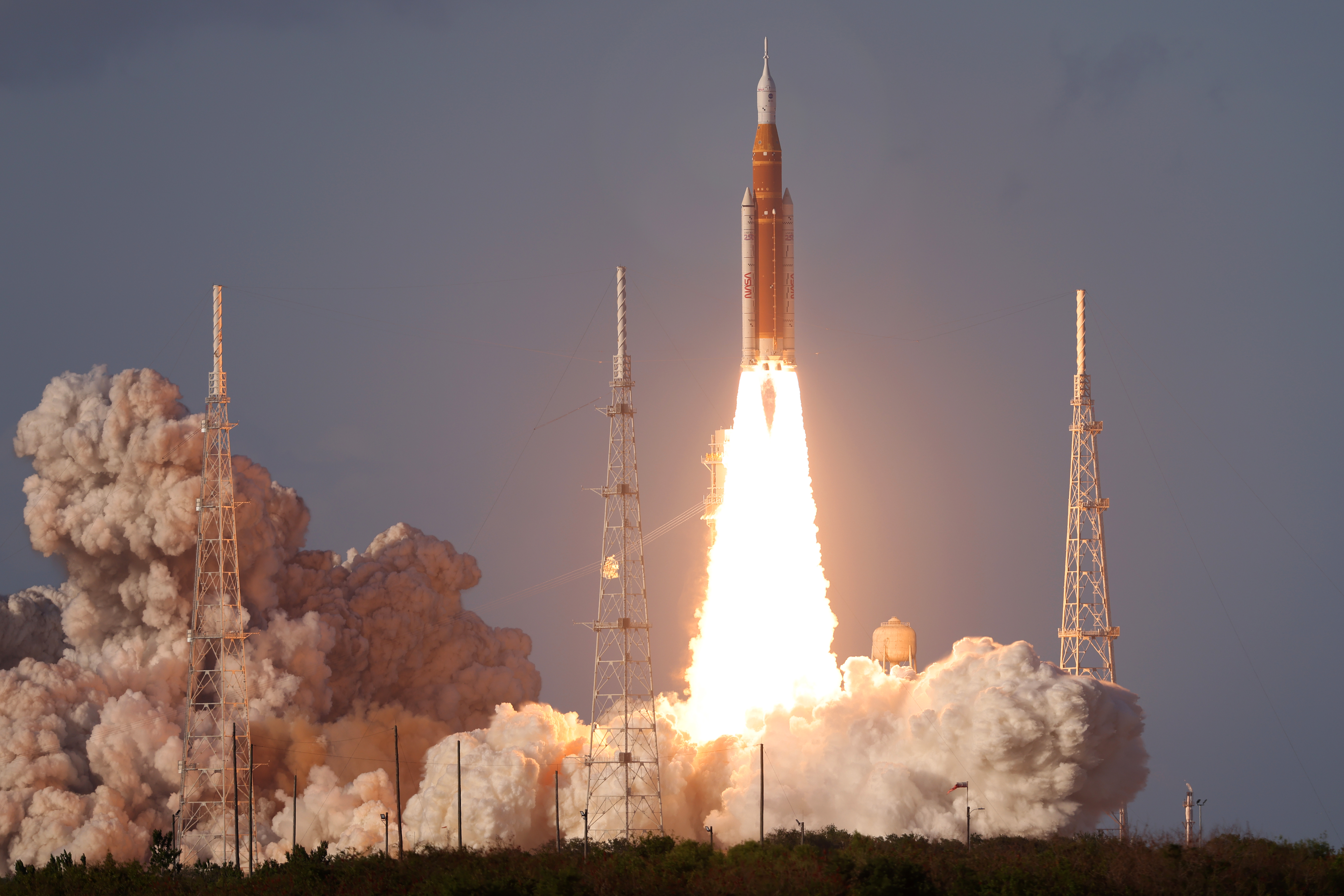
NASA’s Artemis II mission drove a major surge in traffic across the agency’s websites, with NASA.gov recording 125.1 million pageviews between April 1 and 10 – more than double the roughly 50 million logged in all of March – reflecting intense public interest in following the mission in real time. On launch day alone, NASA sites saw 17.6 million pageviews from 8.3 million visitors, with the Artemis Real-Time Orbit Website (AROW) drawing 797,796 pageviews,
Interest spiked again during the April 6 lunar flyby, generating 16.5 million pageviews from 6.2 million visitors; AROW registered 1.9 million pageviews – boosted by more than 440,000 Google referrals – while the NASA homepage reached 2.3 million. Splashdown day brought another surge to NASA-owned websites, with more than 16 million pageviews from 6.1 million visitors as audiences followed the Artemis II crew’s return; AROW drew over 1 million pageviews and surpassed 11 million cumulative views since launch. Together, these metrics show sustained, high-volume engagement across all mission milestones, with live hubs, broadcast pages, and real-time tracking consistently ranking among the most-visited content throughout launch, flyby, and splashdown.
Social MediaPublic reaction to NASA’s Artemis II mission remained largely steady across launch week, with neutral and positive posts dominating the online conversation. Neutral sentiment consistently led daily discussion, ranging from 47 to 60 percent, while positive reactions accounted for 30 to 42 percent, fueled by excitement over the crew’s historic lunar journey, striking mission imagery, and renewed interest in deep space exploration. Engagement spiked around major mission milestones, with NASA accounts generating 35 million engagements on splashdown day content alone and 261 million from March 27 to April 13, underscoring how closely audiences followed each phase. Strong amplification from major news outlets, brands, and international partners, further boosted visibility and cemented Artemis II as a global cultural moment.
NASA’s Artemis II mission drove major social media growth across the agency’s flagship and mission‑specific accounts, with follower numbers climbing steadily from rollout through the lunar flyby and splashdown. Internal tracking shows NASA’s flagship Instagram account added more than 4.6 million followers, while the Artemis‑dedicated Instagram account grew by 2 million—a 66% increase over the course of the mission. Significant gains were also recorded across X, Facebook, and YouTube, including a 2 million increase in YouTube subscribers and NASA’s flagship Facebook page climbing by 1.7 million. Collectively, these gains highlight how Artemis II’s human‑spaceflight narrative, real‑time crew updates, and highly visual moments drew millions of new followers across platforms.
From left: The Artemis II crew—NASA astronaut Christina Koch, CSA (Canadian Space Agency) astronaut Jeremy Hansen, and NASA astronauts Reid Wiseman and Victor Glover—pause for a group photo with their zero-gravity indicator “Rise” inside the Orion spacecraft on April 7, 2026.NASA Mission Images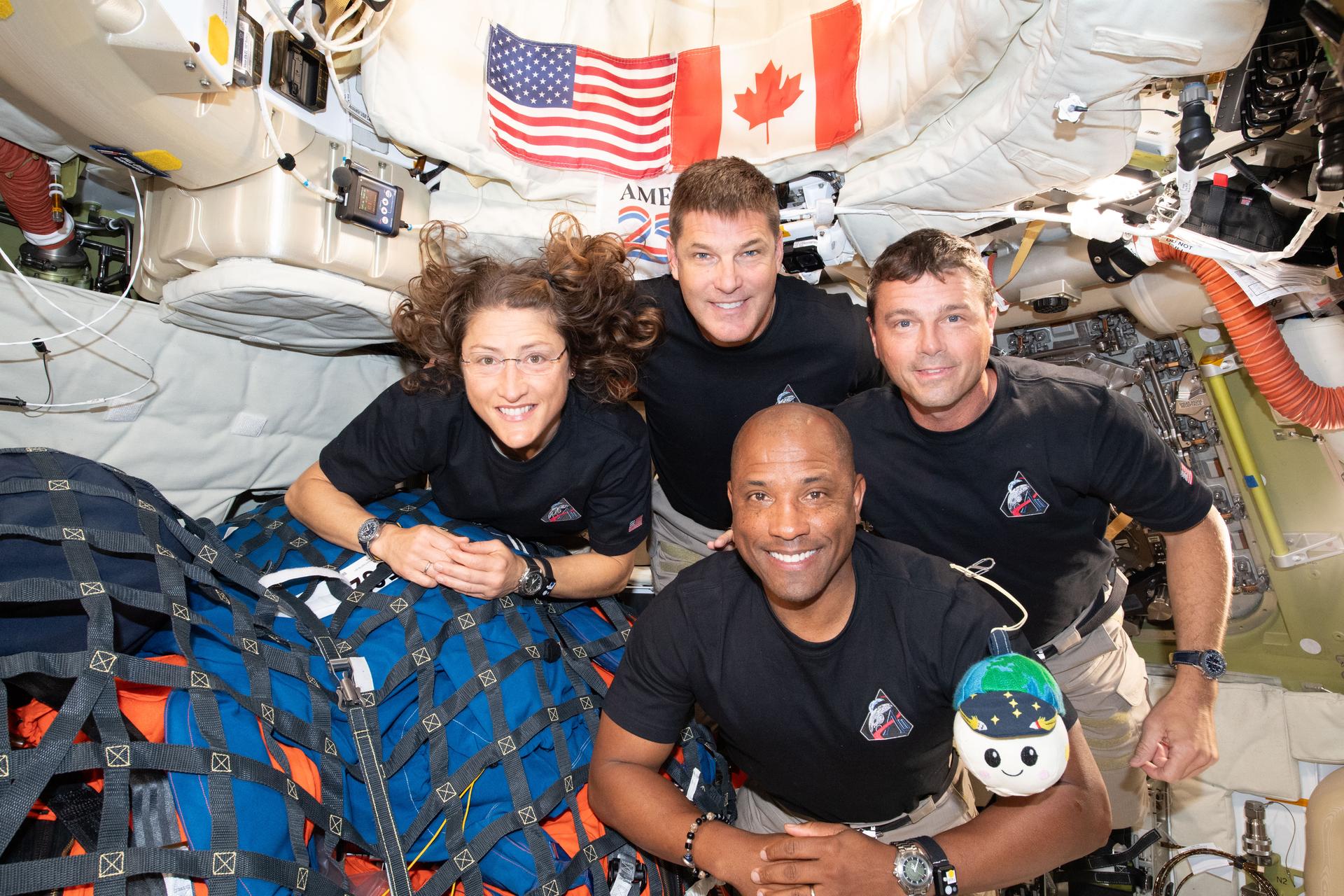
NASA has long shaped its legacy through unforgettable imagery—pictures that don’t just document history but become part of it. Artemis II carries that tradition forward with a growing collection of images capturing every phase of the mission, from the anticipation of launch to the sweep of a lunar flyby and splashdown. For those eager to explore more, the mission’s dedicated image galleries offer a rich visual journey, complemented by additional photos on the NASA Headquarters official Flickr account and the NASA Image and Video Library.
NASA CampaignsMoon Mascot: NASA Artemis II ZGI Design Challenge
Last year, the Moon mascot design contest received thousands of submissions from more than fifty countries for the Artemis II mission’s zero‑gravity indicator. This plush item serves a special purpose — it begins to float once the astronauts reach space, signaling the onset of zero gravity. It also provides a comforting reminder of Earth when the crew is far from home.
Ultimately, the Artemis II astronauts selected “Rise”—inspired by the iconic Earthrise photograph captured during the Apollo 8 mission and designed by Lucas Ye of Mountain View, California—as the zero‑gravity indicator that will accompany them around the Moon. “Rise” also features a small pouch that will carry an SD card containing all 5.6 million names submitted through the Send Your Name with Artemis campaign.
Send Your Name with Artemis II
NASA invited the public to join the agency’s Artemis II test flight as four astronauts ventured around the Moon and back to test the systems and hardware needed for deep space exploration. As part of the agency’s “Send Your Name with Artemis II” effort, anyone could claim their spot by signing up before Jan. 21, 2026. Participants launched their names aboard the Orion spacecraft and SLS (Space Launch System) rocket alongside NASA astronauts Reid Wiseman, Victor Glover, Christina Koch, and CSA (Canadian Space Agency) astronaut Jeremy Hansen.
Online CollaborationsThe April 1, 2026, Google Doodle celebrated the launch of Artemis II, the NASA mission that sent astronauts around the Moon and back for the first time in more than 50 years. During the approximately 10‑day voyage, the crew tested the spacecraft’s systems while traveling farther into deep space than any human had gone since the Apollo program. This critical test flight brought us one step closer to a long‑term return to the Moon and future missions to Mars.
Spotify Playlist: The Artemis II Crew’s Wake-up Songs
NASA’s official playlist for the Artemis II mission featuring songs selected by the crew for their historic 10-day journey around the Moon.
Merriam-Webster highlighted the Artemis II mission on their official Facebook page, engaging with astronauts in deep space to discuss the experience of traveling farther than any human before.
In New York, a digital display on the Nasdaq Marquee and special lights on the Empire State Building marked successful Artemis II mission milestones. In London, Piccadilly Lights celebrated the mission with a digital display following a successful lunar flyby. Offline Collaborations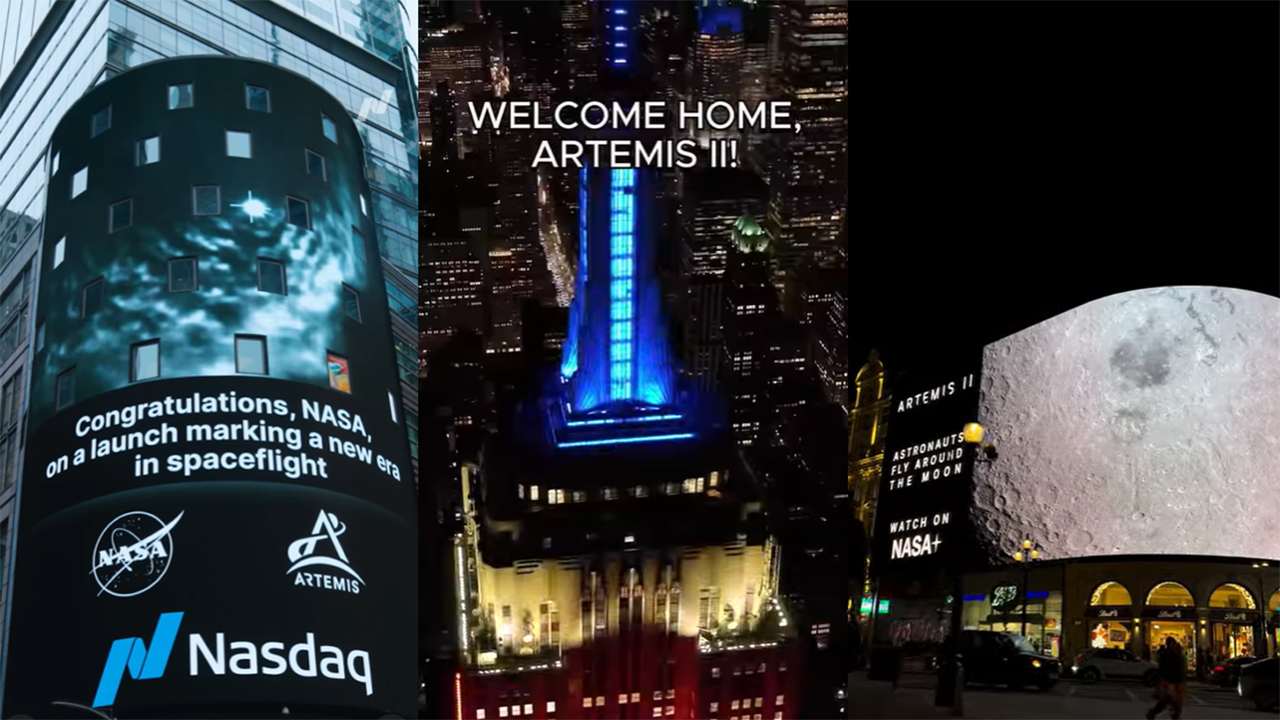
NASDAQ, New York
Nasdaq celebrated the successful launch of NASA’s Artemis II mission, marking humanity’s return to the Moon after more than 50 years.
Empire State Building, New York
Red, white, and blue for the Artemis II crew. Welcome back to Earth.
Sphere, Las Vegas
As the astronauts on Orion reached their closest approach to the Moon, the sphere celebrated this milestone here on Earth. NASA provided the Sphere with a 3D model of the Orion spacecraft and unique soundbites from the April 1, 2026, launch to help design the moon, spacecraft, and flight path to match the real-life version.
London’s Piccadilly Lights celebrated the lunar flyby of Artemis II, where the four astronauts aboard the Orion spacecraft went deeper into space than ever before.
NASA’s Artemis ProgramThe Artemis II mission launched April 1, 2026, on NASA’s SLS (Space Launch System) rocket from Kennedy Space Center in Florida. During the nearly 10‑day test flight, the crew achieved the mission’s primary objectives, including testing its life support systems; manually piloting the Orion spacecraft; performing maneuvers to propel Orion to the Moon and adjust its course; conducting a lunar flyby with unprecedented views of the Moon’s far side; and completing a safe re-entry and recovery. The astronauts also set a record for the farthest distance traveled by humans away from Earth.
As part of a Golden Age of innovation and exploration, NASA will send Artemis astronauts on increasingly challenging missions to explore more of the Moon for scientific discovery, economic benefits, establish an enduring human presence on the lunar surface, and lay the groundwork for sending the first astronauts – American astronauts – to Mars.
Keep Exploring Discover MoreArtemis
Humans In Space
Astronauts
Destinations
NASA’s Artemis II Breaks Agency Streaming Record
NASA’s live coverage of the Artemis II mission mission drew unprecedented public interest – including more than 149.4 million views of the launch, lunar flyby, splashdown on NASA-owned platforms, including the 24/7 streams covering the mission and the Orion spacecraft views – demonstrating strong, sustained global engagement throughout the mission.
Around the Clock Live BroadcastNASA’s Artemis II Crew Launches to the Moon broadcast set unprecedented viewership records across the agency’s streaming platforms, drawing a combined peak of 3,662,554 viewers—rising to 3.66 million when including more than 411,130 concurrent viewers on X and Twitch—surpassing previous milestones, including the launches of Artemis I (2022) and the James Webb Space Telescope (2021–2022). The launch generated 23.9 million total views across NASA platforms, with 16.6 million people watching live, underscoring the mission’s broad national and global appeal from liftoff onward. NASA en español’s dedicated broadcast also reached a landmark peak of 458,366 concurrent viewers and has since amassed 2.8 million total views, highlighting the mission’s strong resonance with Spanish‑speaking audiences and expanding the global reach of Artemis communications.
NASA’s Artemis II Lunar Flyby broadcast delivered one of the largest peak audiences ever recorded across the agency’s streaming platforms, reaching 1,471,069 total concurrent viewers – driven largely by 897,789 on YouTube, one of NASA’s strongest single platform performances – along with an additional 190,221 viewers on X and Twitch, underscoring the mission’s broad global reach and sustained excitement. Together, the Artemis II launch and Moon flyby broadcasts have redefined NASA’s livestreaming benchmarks, demonstrating record-breaking public interest in humanity’s return to the Moon. As of April 13, the flyby broadcast has accumulated 40 million views across NASA+, YouTube, X, and Twitch, highlighting the intense and enduring engagement surrounding Artemis II.
Pre‑splashdown coverage across major outlets emphasized the “riskiest moments” still ahead—particularly Orion’s reentry and heat‑shield performance—framing the return as the mission’s climax and driving heightened public attention. As anticipation grew, audience interest that had already surged during the record‑setting launch only intensified: Artemis II’s liftoff drew 3,662,554 peak viewers, but global curiosity about the crew’s safe return pushed splashdown viewership even higher to 3,838,418, a 4.8% increase that reflected widespread investment in the mission’s outcome as viewers tuned in to witness the critical reentry sequence, confirm crew safety, and celebrate humanity’s first journey around the Moon in more than 50 years. NASA’s Artemis II Crew Comes Home generated 29.5 million total views across NASA-owned platforms, with an estimated 24.1 million occurring during the live return sequence—an exceptional level of engagement that underscores the deep public interest carried through the mission’s final and most critical moments.
Major entertainment platforms including HBO Max, Netflix, Peacock, and Amazon Prime Video exponentially expanded NASA’s global footprint by placing Artemis II in front of hundreds of millions of potential viewers worldwide, with HBO Max reaching 120–150 million global subscribers; Netflix reaching 325 million paid subscribers and covering 54% of global households; Peacock contributing 36–41 million U.S. subscribers; and Amazon Prime Video reaching up to 275 million global subscribers. Together, these partners enabled NASA to reach mainstream, international, and non-traditional audiences at a scale unattainable through NASA-owned channels alone.
Four astronauts aboard NASA’s Orion spacecraft atop the SLS (Space Launch System) rocket launched on the agency’s Artemis II test flight on Wednesday, April 1, 2026, from Launch Complex 39B at NASA’s Kennedy Space Center in Florida.NASA/Michael DeMocker WebsitesNASA’s Artemis II mission drove a major surge in traffic across the agency’s websites, with NASA.gov recording 125.1 million pageviews between April 1 and 10 – more than double the roughly 50 million logged in all of March – reflecting intense public interest in following the mission in real time. On launch day alone, NASA sites saw 17.6 million pageviews from 8.3 million visitors, with the Artemis Real-Time Orbit Website (AROW) drawing 797,796 pageviews,
Interest spiked again during the April 6 lunar flyby, generating 16.5 million pageviews from 6.2 million visitors; AROW registered 1.9 million pageviews – boosted by more than 440,000 Google referrals – while the NASA homepage reached 2.3 million. Splashdown day brought another surge to NASA-owned websites, with more than 16 million pageviews from 6.1 million visitors as audiences followed the Artemis II crew’s return; AROW drew over 1 million pageviews and surpassed 11 million cumulative views since launch. Together, these metrics show sustained, high-volume engagement across all mission milestones, with live hubs, broadcast pages, and real-time tracking consistently ranking among the most-visited content throughout launch, flyby, and splashdown.
Social MediaPublic reaction to NASA’s Artemis II mission remained largely steady across launch week, with neutral and positive posts dominating the online conversation. Neutral sentiment consistently led daily discussion, ranging from 47 to 60 percent, while positive reactions accounted for 30 to 42 percent, fueled by excitement over the crew’s historic lunar journey, striking mission imagery, and renewed interest in deep space exploration. Engagement spiked around major mission milestones, with NASA accounts generating 35 million engagements on splashdown day content alone and 261 million from March 27 to April 13, underscoring how closely audiences followed each phase. Strong amplification from major news outlets, brands, and international partners, further boosted visibility and cemented Artemis II as a global cultural moment.
NASA’s Artemis II mission drove major social media growth across the agency’s flagship and mission‑specific accounts, with follower numbers climbing steadily from rollout through the lunar flyby and splashdown. Internal tracking shows NASA’s flagship Instagram account added more than 4.6 million followers, while the Artemis‑dedicated Instagram account grew by 2 million—a 66% increase over the course of the mission. Significant gains were also recorded across X, Facebook, and YouTube, including a 2 million increase in YouTube subscribers and NASA’s flagship Facebook page climbing by 1.7 million. Collectively, these gains highlight how Artemis II’s human‑spaceflight narrative, real‑time crew updates, and highly visual moments drew millions of new followers across platforms.
From left: The Artemis II crew—NASA astronaut Christina Koch, CSA (Canadian Space Agency) astronaut Jeremy Hansen, and NASA astronauts Reid Wiseman and Victor Glover—pause for a group photo with their zero-gravity indicator “Rise” inside the Orion spacecraft on April 7, 2026.NASA Mission ImagesNASA has long shaped its legacy through unforgettable imagery—pictures that don’t just document history but become part of it. Artemis II carries that tradition forward with a growing collection of images capturing every phase of the mission, from the anticipation of launch to the sweep of a lunar flyby and splashdown. For those eager to explore more, the mission’s dedicated image galleries offer a rich visual journey, complemented by additional photos on the NASA Headquarters official Flickr account and the NASA Image and Video Library.
NASA CampaignsMoon Mascot: NASA Artemis II ZGI Design Challenge
Last year, the Moon mascot design contest received thousands of submissions from more than fifty countries for the Artemis II mission’s zero‑gravity indicator. This plush item serves a special purpose — it begins to float once the astronauts reach space, signaling the onset of zero gravity. It also provides a comforting reminder of Earth when the crew is far from home.
Ultimately, the Artemis II astronauts selected “Rise”—inspired by the iconic Earthrise photograph captured during the Apollo 8 mission and designed by Lucas Ye of Mountain View, California—as the zero‑gravity indicator that will accompany them around the Moon. “Rise” also features a small pouch that will carry an SD card containing all 5.6 million names submitted through the Send Your Name with Artemis campaign.
Send Your Name with Artemis II
NASA invited the public to join the agency’s Artemis II test flight as four astronauts ventured around the Moon and back to test the systems and hardware needed for deep space exploration. As part of the agency’s “Send Your Name with Artemis II” effort, anyone could claim their spot by signing up before Jan. 21, 2026. Participants launched their names aboard the Orion spacecraft and SLS (Space Launch System) rocket alongside NASA astronauts Reid Wiseman, Victor Glover, Christina Koch, and CSA (Canadian Space Agency) astronaut Jeremy Hansen.
Online CollaborationsThe April 1, 2026, Google Doodle celebrated the launch of Artemis II, the NASA mission that sent astronauts around the Moon and back for the first time in more than 50 years. During the approximately 10‑day voyage, the crew tested the spacecraft’s systems while traveling farther into deep space than any human had gone since the Apollo program. This critical test flight brought us one step closer to a long‑term return to the Moon and future missions to Mars.
Spotify Playlist: The Artemis II Crew’s Wake-up Songs
NASA’s official playlist for the Artemis II mission featuring songs selected by the crew for their historic 10-day journey around the Moon.
Merriam-Webster highlighted the Artemis II mission on their official Facebook page, engaging with astronauts in deep space to discuss the experience of traveling farther than any human before.
In New York, a digital display on the Nasdaq Marquee and special lights on the Empire State Building marked successful Artemis II mission milestones. In London, Piccadilly Lights celebrated the mission with a digital display following a successful lunar flyby. Offline CollaborationsNASDAQ, New York
Nasdaq celebrated the successful launch of NASA’s Artemis II mission, marking humanity’s return to the Moon after more than 50 years.
Empire State Building, New York
Red, white, and blue for the Artemis II crew. Welcome back to Earth.
Sphere, Las Vegas
As the astronauts on Orion reached their closest approach to the Moon, the sphere celebrated this milestone here on Earth. NASA provided the Sphere with a 3D model of the Orion spacecraft and unique soundbites from the April 1, 2026, launch to help design the moon, spacecraft, and flight path to match the real-life version.
London’s Piccadilly Lights celebrated the lunar flyby of Artemis II, where the four astronauts aboard the Orion spacecraft went deeper into space than ever before.
NASA’s Artemis ProgramThe Artemis II mission launched April 1, 2026, on NASA’s SLS (Space Launch System) rocket from Kennedy Space Center in Florida. During the nearly 10‑day test flight, the crew achieved the mission’s primary objectives, including testing its life support systems; manually piloting the Orion spacecraft; performing maneuvers to propel Orion to the Moon and adjust its course; conducting a lunar flyby with unprecedented views of the Moon’s far side; and completing a safe re-entry and recovery. The astronauts also set a record for the farthest distance traveled by humans away from Earth.
As part of a Golden Age of innovation and exploration, NASA will send Artemis astronauts on increasingly challenging missions to explore more of the Moon for scientific discovery, economic benefits, establish an enduring human presence on the lunar surface, and lay the groundwork for sending the first astronauts – American astronauts – to Mars.
Keep Exploring Discover MoreArtemis
Humans In Space
Astronauts
Destinations
June heatwave may have killed around 20,000 people in Europe
June heatwave may have killed around 20,000 people in Europe
An Extended Barrage of Asteroid Impacts Made Earth Too Hot to Form Continents
New research shows that repeated impacts on Earth during the Hadean eon prevented thick and stable crustal material from forming. The heat from these impacts penetrated deep into the planet, and along with radiogenic heating, delayed the formation of a solid crust.
Random wobbles in time could finally solve gravity’s greatest mystery
Random wobbles in time could finally solve gravity’s greatest mystery
Male marathoners might be twice as likely to ‘hit the wall’ as women—the reason why might surprise you
The way women use energy while running is fundamentally different from men
Synthetic biology may finally be ready to solve life's biggest mystery
Synthetic biology may finally be ready to solve life's biggest mystery
Geoengineering could expose plane passengers to sulphuric acid
Geoengineering could expose plane passengers to sulphuric acid
The best new popular science books of July 2026
The best new popular science books of July 2026
Good Morning, Earth!
Good Morning, Earth!
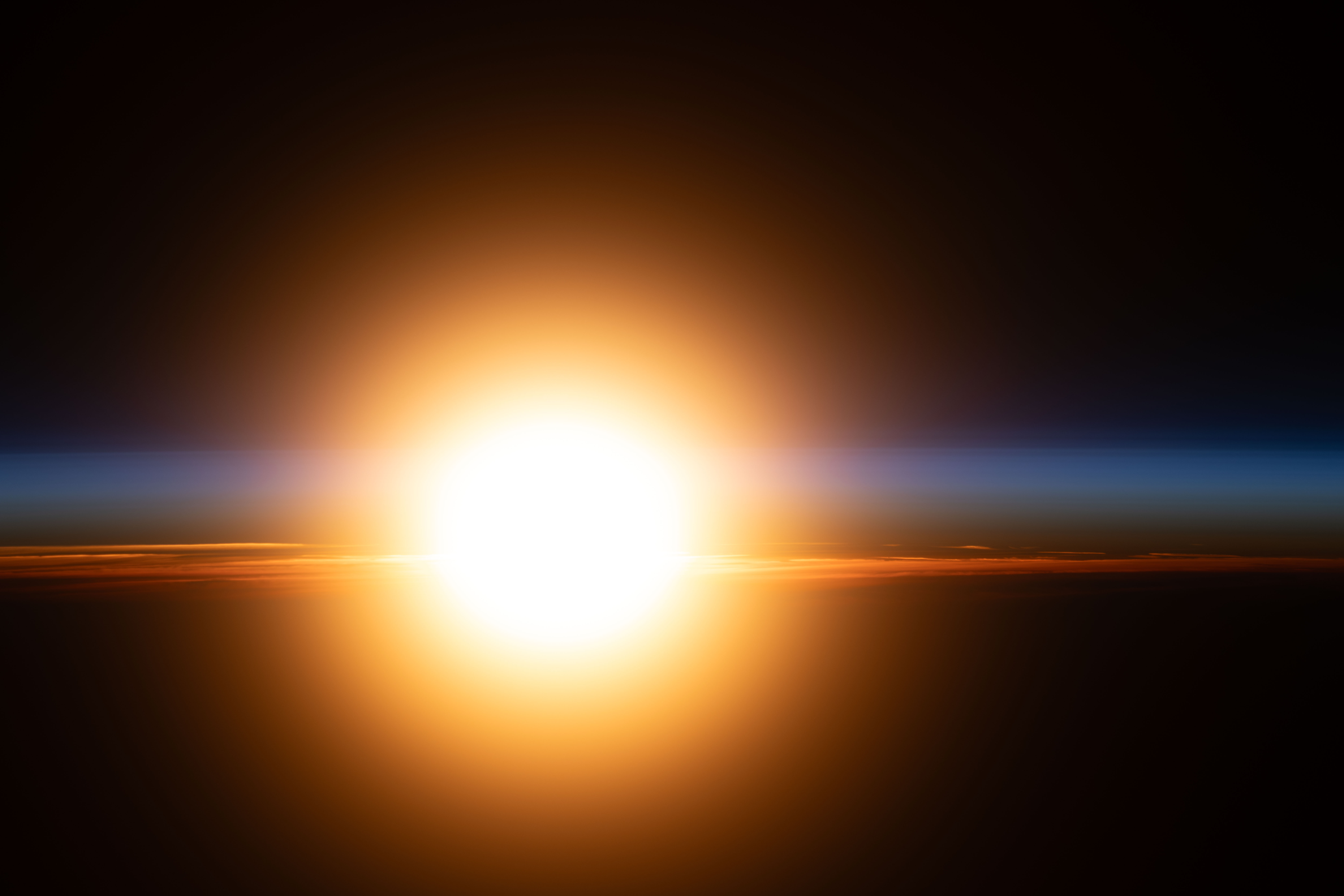
NASA astronaut Chris Williams took this photo of an orbital sunrise from the International Space Station on June 26, 2026. In 24 hours, the space station makes 16 orbits of Earth, traveling through 16 sunrises and sunsets.
Learn more about the orbiting laboratory.
Image credit: NASA/Chris Williams
Good Morning, Earth!
NASA astronaut Chris Williams took this photo of an orbital sunrise from the International Space Station on June 26, 2026. In 24 hours, the space station makes 16 orbits of Earth, traveling through 16 sunrises and sunsets.
Learn more about the orbiting laboratory.
Image credit: NASA/Chris Williams
How to avoid heat illness and stay safe during the mega heat wave
A heat wave over the Fourth of July weekend could put millions at risk of heat-related illnesses. Here’s what to do to stay safe—and why you don’t just need to drink lots of water
NASA’s Webb Reveals Stars Sparking to Life in Cosmic Celebration
- Webb
- News
- Overview
- Science
- Observatory
- Multimedia
- Team
- More
Image: NASA, ESA, CSA, STScI; Image Processing: Alyssa Pagan (STScI)
NASA’s James Webb Space Telescope has captured the infrared light of numerous features that previously were impossible to see beyond the thick dust of the FS Tau star system. In addition to myriad background galaxies that burst into view like fireworks for the United States’ 250th anniversary celebrations, this image flickers with a number of protostars, or baby stars that are formed from dense pockets of gas and dust. These hot, clumpy, and low-mass objects eventually will become full-fledged stars capable of burning hydrogen in their cores, like our Sun. The protostars of FS Tau are about 1 to 3 million years old, which is relatively young in cosmic scales. Our Sun, by contrast, is 4.6 billion years old.
Low-mass stars emit less radiation and have less energetic stellar winds than those with larger masses, which means they disrupt their environment at a much lower level. This makes the FS Tau region incredibly useful for studying low-mass star evolution without the same level of environmental interference seen near higher-mass stars. A pair of protostars that creates the largest diffraction pattern seen slightly to the left of center in the image, called FS Tau A, is about half the mass of our Sun.
Image: FS Tau (Webb Image) In infrared light, NASA’s James Webb Space Telescope reveals bright protostars in star system FS Tau and a tapestry of background galaxies. FS Tau B, the orange protostar slightly right of center, is thought to be responsible for the orange outflows amid the dusty region. Image: NASA, ESA, CSA, STScI; Image Processing: Alyssa Pagan (STScI)
Even though these objects are young and low-mass, they still can impact their surroundings, partially due to the outflows they emit. These outflows, seen as orange and red wisps and wide sheets, are theorized to come from FS Tau B, the protostar slightly to the right of center that has an orange diffraction pattern. As FS Tau B feeds on the surrounding dust and gas to grow, it ejects some of that matter outward. The wider outflows are thought to come from the interaction between the protostar’s magnetic field and superheated matter closest to the protostar within its accretion disk. The disk is seen as a dark band that cuts across at a 30-degree angle.
The gaps between the outflows, newly discovered in this Webb observation, add to growing evidence that protostars accrete matter in discrete episodes. In the periods where protostars gather material and increase in mass, they also eject superheated matter in different directions. In between these episodes, they are relatively quiet.
Image: FS Tau Side-by-Side (Webb and Hubble Image) A comparison between the observations of FS Tau by NASA’s Hubble and James Webb space telescopes. Hubble’s visible-light view shows the star-forming region mostly obscured by thick dust. Webb sees through the dust, revealing how the protostars are shaping their surroundings. Image: NASA, ESA, CSA, STScI; Image Processing: Alyssa Pagan (STScI)
As protostars eject these outflows, they shape their surroundings. This is best shown by the prominent light-blue ridges of dust and gas near FS Tau B. These thicker regions were likely created as outflows struck and compressed matter together. The brightness of these light-blue ridges shows that the nearby protostar’s light is reflected. Moreover, Webb’s sensitivity reveals the varying textures of dust and gas across the entire region.
The range of colors seen in this observation also provides a wealth of information, specifically about where dust is and how much of it obscures the region. Light with bluer wavelengths is absorbed and scattered by dust, while redder-wavelength light is able to slip through. Therefore, background galaxies behind thicker foreground dust appear redder. Alternatively, yellow galaxies have much less dust obscuring them. The few white stars visible in this image are likely in the foreground.
The James Webb Space Telescope is the world’s premier space science observatory. Webb is solving mysteries in our solar system, looking beyond to distant worlds around other stars, and probing the mysterious structures and origins of our universe and our place in it. Webb is an international program led by NASA with its partners, ESA (European Space Agency) and CSA (Canadian Space Agency).
To learn more about Webb, visit:
Downloads & Related InformationThe following sections contain links to download this article’s images and videos in all available resolutions followed by related information links, media contacts, and if available, research paper and Spanish translation links.
Related Images & Videos FS Tau (Webb Image)In infrared light, NASA’s James Webb Space Telescope reveals bright protostars in star system FS Tau and a tapestry of background galaxies. FS Tau B, the orange protostar slightly right of center, is thought to be responsible for the orange outflows amid the dusty region.
FS Tau Side-by-Side (Webb and Hubble Image)
A comparison between the observations of FS Tau by NASA’s Hubble and James Webb space telescopes. Hubble’s visible-light view shows the star-forming region mostly obscured by thick dust. Webb sees through the dust, revealing how the protostars are shaping their surroundings.
FS Tau (Webb Compass Image)
An image of FS Tau captured by Webb’s NIRCam (Near-Infrared Camera), with compass arrows, scale bar, and color key for reference.
Related Links
Read more: Webb’s Star Formation Discoveries
Explore more: ViewSpace | Image Tour: Herbig-Haro 46/47
Watch: Herbig-Haro 49/50 Stellar Jets Visualization
Explore more: ViewSpace | Star formation in the Eagle Nebula
Watch: Celestial Lightsabers: Stellar Jets in HH24
More Webb: News | Images | Science | Home Page
Contact Media
Laura Betz
NASA’s Goddard Space Flight Center
Greenbelt, Maryland
laura.e.betz@nasa.gov
Matthew Brown
Space Telescope Science Institute
Baltimore, Maryland
Abigail Major
Space Telescope Science Institute
Baltimore, Maryland
Related Terms Keep Exploring Related Topics James Webb Space Telescope
Webb is the premier observatory of the next decade, serving thousands of astronomers worldwide. It studies every phase in the…
Stars
Stars Stories
Universe
NASA’s Webb Reveals Stars Sparking to Life in Cosmic Celebration
- Webb
- News
- Overview
- Science
- Observatory
- Multimedia
- Team
- More
Image: NASA, ESA, CSA, STScI; Image Processing: Alyssa Pagan (STScI)
NASA’s James Webb Space Telescope has captured the infrared light of numerous features that previously were impossible to see beyond the thick dust of the FS Tau star system. In addition to myriad background galaxies that burst into view like fireworks for the United States’ 250th anniversary celebrations, this image flickers with a number of protostars, or baby stars that are formed from dense pockets of gas and dust. These hot, clumpy, and low-mass objects eventually will become full-fledged stars capable of burning hydrogen in their cores, like our Sun. The protostars of FS Tau are about 1 to 3 million years old, which is relatively young in cosmic scales. Our Sun, by contrast, is 4.6 billion years old.
Low-mass stars emit less radiation and have less energetic stellar winds than those with larger masses, which means they disrupt their environment at a much lower level. This makes the FS Tau region incredibly useful for studying low-mass star evolution without the same level of environmental interference seen near higher-mass stars. A pair of protostars that creates the largest diffraction pattern seen slightly to the left of center in the image, called FS Tau A, is about half the mass of our Sun.
Image: FS Tau (Webb Image) In infrared light, NASA’s James Webb Space Telescope reveals bright protostars in star system FS Tau and a tapestry of background galaxies. FS Tau B, the orange protostar slightly right of center, is thought to be responsible for the orange outflows amid the dusty region. Image: NASA, ESA, CSA, STScI; Image Processing: Alyssa Pagan (STScI)Even though these objects are young and low-mass, they still can impact their surroundings, partially due to the outflows they emit. These outflows, seen as orange and red wisps and wide sheets, are theorized to come from FS Tau B, the protostar slightly to the right of center that has an orange diffraction pattern. As FS Tau B feeds on the surrounding dust and gas to grow, it ejects some of that matter outward. The wider outflows are thought to come from the interaction between the protostar’s magnetic field and superheated matter closest to the protostar within its accretion disk. The disk is seen as a dark band that cuts across at a 30-degree angle.
The gaps between the outflows, newly discovered in this Webb observation, add to growing evidence that protostars accrete matter in discrete episodes. In the periods where protostars gather material and increase in mass, they also eject superheated matter in different directions. In between these episodes, they are relatively quiet.
Image: FS Tau Side-by-Side (Webb and Hubble Image) A comparison between the observations of FS Tau by NASA’s Hubble and James Webb space telescopes. Hubble’s visible-light view shows the star-forming region mostly obscured by thick dust. Webb sees through the dust, revealing how the protostars are shaping their surroundings. Image: NASA, ESA, CSA, STScI; Image Processing: Alyssa Pagan (STScI)As protostars eject these outflows, they shape their surroundings. This is best shown by the prominent light-blue ridges of dust and gas near FS Tau B. These thicker regions were likely created as outflows struck and compressed matter together. The brightness of these light-blue ridges shows that the nearby protostar’s light is reflected. Moreover, Webb’s sensitivity reveals the varying textures of dust and gas across the entire region.
The range of colors seen in this observation also provides a wealth of information, specifically about where dust is and how much of it obscures the region. Light with bluer wavelengths is absorbed and scattered by dust, while redder-wavelength light is able to slip through. Therefore, background galaxies behind thicker foreground dust appear redder. Alternatively, yellow galaxies have much less dust obscuring them. The few white stars visible in this image are likely in the foreground.
The James Webb Space Telescope is the world’s premier space science observatory. Webb is solving mysteries in our solar system, looking beyond to distant worlds around other stars, and probing the mysterious structures and origins of our universe and our place in it. Webb is an international program led by NASA with its partners, ESA (European Space Agency) and CSA (Canadian Space Agency).
To learn more about Webb, visit:
Downloads & Related InformationThe following sections contain links to download this article’s images and videos in all available resolutions followed by related information links, media contacts, and if available, research paper and Spanish translation links.
Related Images & Videos FS Tau (Webb Image)In infrared light, NASA’s James Webb Space Telescope reveals bright protostars in star system FS Tau and a tapestry of background galaxies. FS Tau B, the orange protostar slightly right of center, is thought to be responsible for the orange outflows amid the dusty region.
FS Tau Side-by-Side (Webb and Hubble Image)
A comparison between the observations of FS Tau by NASA’s Hubble and James Webb space telescopes. Hubble’s visible-light view shows the star-forming region mostly obscured by thick dust. Webb sees through the dust, revealing how the protostars are shaping their surroundings.
FS Tau (Webb Compass Image)
An image of FS Tau captured by Webb’s NIRCam (Near-Infrared Camera), with compass arrows, scale bar, and color key for reference.
Related Links
Read more: Webb’s Star Formation Discoveries
Explore more: ViewSpace | Image Tour: Herbig-Haro 46/47
Watch: Herbig-Haro 49/50 Stellar Jets Visualization
Explore more: ViewSpace | Star formation in the Eagle Nebula
Watch: Celestial Lightsabers: Stellar Jets in HH24
More Webb: News | Images | Science | Home Page
Contact Media
Laura Betz
NASA’s Goddard Space Flight Center
Greenbelt, Maryland
laura.e.betz@nasa.gov
Matthew Brown
Space Telescope Science Institute
Baltimore, Maryland
Abigail Major
Space Telescope Science Institute
Baltimore, Maryland
Related Terms Keep Exploring Related Topics James Webb Space Telescope
Webb is the premier observatory of the next decade, serving thousands of astronomers worldwide. It studies every phase in the…
Stars
Stars Stories
Universe