

Feed aggregator
Did Gravitational Tides Cause Earth's Extinctions?
Many of Earth's mass extinctions await clear explanations. We know an impact wiped out the dinosaurs, but what about the planet's other extinction events? New research says flybys of planetary mass objects could've been responsible.
CSDA Selects Eight Commercial Satellite Data Providers for On-Ramp 2 Contract Awards
NASA’s Commercial Satellite Data Acquisition program (CSDA) announced contract awards with eight commercial satellite data providers offering a range of data types to support the agency’s Earth science research and application goals.
The CSDA program On-Ramp 2 Multiple Award contract is a firm-fixed-price indefinite-delivery/indefinite-quantity (IDIQ) multiple-award contract with a maximum cumulative value of $476 million and a performance period through November 2028.
The CSDA IDIQ contract includes an on‑ramp provision that allows NASA to periodically reopen the solicitation, giving new vendors the opportunity to submit proposals. This mechanism also enables existing CSDA vendors to propose new data products, whether newly developed or derived from new instruments, that were not available during the original proposal period.
Newly Added Contract Holders
Vendor Sensor HydroSat Thermal Infrared Visible and Near-Infrared (VNIR) Ororatech Thermal Infrared – Medium Wavelength Infrared (MWIR) and Long Wavelength Infrared (LWIR) ImageSat Optical Multispectral Instrument (MSI) Satlantis Optical MSI / Greenhouse Gas (GHG) Emissions Kuva Space Hyperspectral – VNIR and Short Wavelength Infrared (SWIR) Wyvern Hyperspectral – VNIR Orbital Sidekick Hyperspectral – VNIR and SWIR Muon Space Global Navigation Satellite System – Radar (GNSS-R)Current CSDA Contract Holders with New Products
Vendor Sensor Airbus Optical MSI / Synthetic Aperture Radar (SAR) ICEYE SAR GHGSat GHG Emissions Planet Labs Optical MSI / Hyperspectral PlanetiQ Global Navigation Satellite System – Radio Occultation (GNSS-RO) Tomorrow.io Microwave Sounder“NASA’s Earth science community relies on a diverse suite of observations from spaceborne, airborne, and in situ assets to better understand our changing planet,” said CSDA Project Manager Dana Ostrenga. “The commercial providers added through this latest CSDA contract on-ramp complement NASA’s existing Earth observation capabilities and our current portfolio of commercial partners, expanding the range of data available for evaluation and use. Together, these observations provide researchers with a more comprehensive view of Earth’s atmosphere, land, oceans, cryosphere, and solid Earth, helping advance scientific discovery and applications that benefit our communities.”
Following issuance of the contract awards, the selected vendors’ data products will be made available to authorized CSDA data users via the Satellite Data Explorer (SDX), CSDA’s web-based data discovery and data access tool that allows approved users to search, discover, access, task, and download the data the program has acquired from its commercial partners.
The Vendor Selection ProcessThe award process begins with the CSDA issuing a request for proposals that is posted on Sam.gov, the U.S. government’s official system for managing federal contract proposals. Interested companies then submit proposals to enter into an IDIQ contract with CSDA. A Solicitation Evaluation Board is formed to determine whether the proposals are competitive and meet the CSDA’s technical requirements for continuous observations, orbit platforms, and data that aligns with NASA Earth Science Division (ESD) goals. The CSDA makes its selections from the proposals that meet the requirements and then submits them to NASA leadership for approval. Once approved, the contracts are then awarded and the companies are able to get their data evaluated by CSDA. Once the evaluations are complete, the commercial data providers can then compete for competitive task orders through CSDA.
About the CSDA ProgramNASA’s Earth Science Division (ESD) established the CSDA Program as the agency’s central mechanism for identifying, acquiring, and evaluating commercial Earth observation (EO) data. The program augments NASA’s and partner agencies’ Earth-observing capabilities by acquiring commercial satellite data that offer higher spatial resolution, increased revisit frequency, complementary measurement capabilities, and taskable observations. To learn more about the program, its commercial partners, data evaluation process, and more, visit the CSDA website.
Become an Authorized Data UserCommercial data discoverable through the SDX is made available to CSDA authorized data users. To become an authorized user, fill out the CSDA Program Data Authorization Form. Note: Use of SDX also requires an Earthdata Login.
CSDA Selects Eight Commercial Satellite Data Providers for On-Ramp 2 Contract Awards
NASA’s Commercial Satellite Data Acquisition program (CSDA) announced contract awards with eight commercial satellite data providers offering a range of data types to support the agency’s Earth science research and application goals.
The CSDA program On-Ramp 2 Multiple Award contract is a firm-fixed-price indefinite-delivery/indefinite-quantity (IDIQ) multiple-award contract with a maximum cumulative value of $476 million and a performance period through November 2028.
The CSDA IDIQ contract includes an on‑ramp provision that allows NASA to periodically reopen the solicitation, giving new vendors the opportunity to submit proposals. This mechanism also enables existing CSDA vendors to propose new data products, whether newly developed or derived from new instruments, that were not available during the original proposal period.
Newly Added Contract Holders
Vendor Sensor HydroSat Thermal Infrared Ororatech Thermal Infrared (Medium Wave Infrared (MWIR) and Longwave Infrared (LWIR)) ImageSat Optical Multispectral Instrument (MSI) Satlantis Optical MSI / Greenhouse Gas (GHG) Emissions Kuva Space Hyperspectral (Visible and Near-Infrared (VNIR) and Shortwave Infrared (SWIR) Wyvern Hyperspectral Orbital Sidekick Hyperspectral (VNIR-SWIR) Muon Space Global Navigation Satellite System – Radar (GNSS-R)Current CSDA Contract Holders with New Products
Vendor Sensor Airbus Optical MSI / Synthetic Aperture Radar (SAR) ICEYE SAR GHGSat GHG Emissions Planet Labs Optical MSI / Hyperspectral PlanetiQ Global Navigation Satellite System – Radio Occultation (GNSS-RO) Tomorrow.io Microwave Sounder“NASA’s Earth science community relies on a diverse suite of observations from spaceborne, airborne, and in situ assets to better understand our changing planet,” said CSDA Project Manager Dana Ostrenga. “The commercial providers added through this latest CSDA contract on-ramp complement NASA’s existing Earth observation capabilities and our current portfolio of commercial partners, expanding the range of data available for evaluation and use. Together, these observations provide researchers with a more comprehensive view of Earth’s atmosphere, land, oceans, cryosphere, and solid Earth, helping advance scientific discovery and applications that benefit our communities.”
Following issuance of the contract awards, the selected vendors’ data products will be made available to authorized CSDA data users via the Satellite Data Explorer (SDX), CSDA’s web-based data discovery and data access tool that allows approved users to search, discover, access, task, and download the data the program has acquired from its commercial partners.
The Vendor Selection ProcessThe award process begins with the CSDA issuing a request for proposals that is posted on Sam.gov, the U.S. government’s official system for managing federal contract proposals. Interested companies then submit proposals to enter into an IDIQ contract with CSDA. A Solicitation Evaluation Board is formed to determine whether the proposals are competitive and meet the CSDA’s technical requirements for continuous observations, orbit platforms, and data that aligns with NASA Earth Science Division (ESD) goals. The CSDA makes its selections from the proposals that meet the requirements and then submits them to NASA leadership for approval. Once approved, the contracts are then awarded and the companies are able to get their data evaluated by CSDA. Once the evaluations are complete, the commercial data providers can then compete for competitive task orders through CSDA.
About the CSDA ProgramNASA’s Earth Science Division (ESD) established the CSDA Program as the agency’s central mechanism for identifying, acquiring, and evaluating commercial Earth observation (EO) data. The program augments NASA’s and partner agencies’ Earth-observing capabilities by acquiring commercial satellite data that offer higher spatial resolution, increased revisit frequency, complementary measurement capabilities, and taskable observations. To learn more about the program, its commercial partners, data evaluation process, and more, visit the CSDA website.
Become an Authorized Data UserCommercial data discoverable through the SDX is made available to CSDA authorized data users. To become an authorized user, fill out the CSDA Program Data Authorization Form. Note: Use of SDX also requires an Earthdata Login.
58th Girl Scouts Unite Event
58th Girl Scouts Unite Event, July 23-25, 2026
Join NASA in the Exhibit Hall (Booth #206) for Hyperwall Storytelling by NASA experts. Full Hyperwall Agenda below.
Thursday, July 23
11:00AM – 11:15 AM From Daisy to NASA Engineer Barbara Hilton 11:15AM – 11:30 AM Exploring Mars, The Planet Next Door Lindsay Hays 11:30AM – 11:45 AM Get Ready With Me: Going to the Moon Naoma McCall 11:45Am – 12:00 PM NASA Is for Everyone! (talk about careers at NASA beyond science and engineering) Amy Kaminski 12:00PM – 12:15 PM Finding Asteroids Before They Find Us: Planetary Defense at NASA Kelly Fast
2:15 PM – 2:30 PM How to Nerd Your Way Into Science Communications Karen Romano Young 2:30 PM – 2:45 PM Earth: Exploring our home planet is a team effort Lesley Ott 2:45 PM – 3:00 PM TBD Jenny Mottar 3:00 PM – 3:15 PM The Journey Starts HERE: One CREW, Your HOME, Our MISSION Kaitlin Harbeck 3:15 PM – 3:30PM TBD – Artemis Overview Dominique Brewer 3:45 PM – 4:00 PM Social Media… For Science! Sofie Bates
:
58th Girl Scouts Unite Event
58th Girl Scouts Unite Event, July 23-25, 2026
Join NASA in the Exhibit Hall (Booth #206) for Hyperwall Storytelling by NASA experts. Full Hyperwall Agenda below.
Thursday, July 23
11:00AM – 11:15 AM From Daisy to NASA Engineer Barbara Hilton 11:15AM – 11:30 AM Exploring Mars, The Planet Next Door Lindsay Hays 11:30AM – 11:45 AM Get Ready With Me: Going to the Moon Naoma McCall 11:45Am – 12:00 PM NASA Is for Everyone! (talk about careers at NASA beyond science and engineering) Amy Kaminski 12:00PM – 12:15 PM Finding Asteroids Before They Find Us: Planetary Defense at NASA Kelly Fast
2:15 PM – 2:30 PM How to Nerd Your Way Into Science Communications Karen Romano Young 2:30 PM – 2:45 PM Earth: Exploring our home planet is a team effort Lesley Ott 2:45 PM – 3:00 PM TBD Jenny Mottar 3:00 PM – 3:15 PM The Journey Starts HERE: One CREW, Your HOME, Our MISSION Kaitlin Harbeck 3:15 PM – 3:30PM TBD – Artemis Overview Dominique Brewer 3:45 PM – 4:00 PM Social Media… For Science! Sofie Bates
:
Radio Observations Reveal the Secret of Early Galaxy Growth
Astronomers have discovered a huge reservoir of cold molecular gas, the direct fuel for star formation, in REBELS-25, a massive, star-forming galaxy.The team, led from Leiden University, focused on REBELS-25, seen when the universe was only about 700 million years old, around 5% of its current age. Astronomers use “redshift” to describe this distance, which measures how much the universe’s expansion has stretched a galaxy’s light to redder wavelengths.
How underappreciated mathematician Emmy Noether helped prove physics' most fundamental theories
Noether's work helped prove the conservation of energy in physics, a key foundation for Einstein's theory of relativity
You should turn off fans when it's too hot – but how hot is too hot?
You should turn off fans when it's too hot – but how hot is too hot?
Ariane 6 Sets New Record for Europe with More Powerful Boosters
On 17 June at 09:21 local time (13:21 BST, 14:21 CEST) Ariane 6 flight VA269 soared to orbit from Europe’s Spaceport in French Guiana. 36 satellites for Amazon’s Leo constellation were placed into their orbit just over an hour after liftoff – the eighth successful mission insertion in a row for Europe’s newest rocket.
This is the First Pair of Sibling Supernova Remnants
Astrophysicists have found what is likely the very first pair of sibling supernova remnants. One is the well-known Jellyfish Nebula, and the other was long thought to be hidden in the bright glare from the Jellyfish. The pair are connected by a bright filament of gas.
Elite Maya people had teeth placed in a cave far from their tombs
Elite Maya people had teeth placed in a cave far from their tombs
Parenting may permanently improve brain health for mums and dads
Parenting may permanently improve brain health for mums and dads
SpaceX's secretive plans to deliver cargo to Earth from space
SpaceX's secretive plans to deliver cargo to Earth from space
2026 ALA Hyperwall Schedule
2 min read
2026 ALA Hyperwall ScheduleAmerican Library Association (ALA) Annual Conference, June 25-29, 2026
Join NASA in the Exhibit Hall (Booth #2243) for Hyperwall Storytelling by NASA experts. Full Hyperwall Agenda below.
FRIDAY, JUNE 26
- 5:45 PM ——Roman Space Telescope Quiz! —— Peter Sooy
- 6:00 PM ——NASA’s Next Flagship is Launching Soon! Share in the Excitement with Roman Community Events —— Martha Irene Saladino
- 6:15 PM ——Open Science Resources for Libraries ——Amanda Adams
- 6:30 PM ——Launching NASA Earth Science Exhibits in Libraries Across America ——Eleanor Stokes
- 6:45 PM ——NASA Citizen Science Projects——Sarah Kirn
SATURDAY, JUNE 27
- 10:00 AM——Heliophysics Jeopardy!——Erin Mahoney
- 10:15 AM——NASA’s Next Flagship is Launching Soon! Share in the Excitement with Roman Community Events——Martha Irene Saladino
- 10:30 AM——Nancy Grace Roman: The Person——Courtney Lee
- 10:45 AM——Cosmic Canvas: Exploring the Process of Science Through Art and Astronomy——Tim Rhue
- 12:30 PM——Roman Space Telescope Quiz! —— Peter Sooy
- 1:00 PM——“Our Friend Orion” Children’s Book Reading——Lane Polak
- 2:30 PM——Heliophysics Jeopardy!——Erin Mahoney
- 3:00 PM——”The Adventure of Echo the Bat” Book Reading——Ginger Butcher
- 3:30 PM——Bring a NASA Solar System Ambassador to YOUR Library!——Danielle Diamond
- 3:45 PM——Journey Through the Heliosphere: The Sun-Earth System in Color——Christine Milotte
SUNDAY, JUNE 28
- 10:00 AM——Webb Space Telescope Quiz!——Peter Sooy
- 10:15 AM——Journey Through the Heliosphere: The Sun-Earth System in Color——Christine Milottet
- 10:30 AM——Science Explorer (SciX) Demo——Daniel Chivvis
- 10:45 AM——NASA Data and Open Science Quiz!——Adam Farragut
- 12:30 PM——Heliophysics Jeopardy!——Erin Mahoney
- 1:00 PM——“There and Back with EGS” Children’s Book Reading——Lane Polak
- 2:30 PM——Real NASA Research Projects Open to Everyone——Sarah Kirn
- 3:00 PM——Cosmic Canvas: Exploring the Process of Science Through Art and Astronomy——Tim Rhue
- 3:30 PM——NASA’s Next Flagship is Launching Soon! Share in the Excitement with Roman Community Events—— Martha Irene Saladino
- 3:45 PM——Journey Through the Heliosphere: The Sun-Earth System in Color——Milotte
MONDAY, JUNE 29
- 9:45 AM——Webb Space Telescope Quiz!——Peter Sooy
- 10:00 AM——“Hooray for SLS” Children’s——Lane Polak
- 10:30 AM——Bring a NASA Solar System Ambassador to YOUR Library!——Mark Benson
2026 ALA Hyperwall Schedule
2 min read
2026 ALA Hyperwall ScheduleAmerican Library Association (ALA) Annual Conference, June 25-29, 2026
Join NASA in the Exhibit Hall (Booth #2243) for Hyperwall Storytelling by NASA experts. Full Hyperwall Agenda below.
FRIDAY, JUNE 26
- 5:45 PM ——Roman Space Telescope Quiz! —— Peter Sooy
- 6:00 PM ——NASA’s Next Flagship is Launching Soon! Share in the Excitement with Roman Community Events —— Martha Irene Saladino
- 6:15 PM ——Open Science Resources for Libraries ——Amanda Adams
- 6:30 PM ——Launching NASA Earth Science Exhibits in Libraries Across America ——Eleanor Stokes
- 6:45 PM ——NASA Citizen Science Projects——Sarah Kirn
SATURDAY, JUNE 27
- 10:00 AM——Heliophysics Jeopardy!——Erin Mahoney
- 10:15 AM——NASA’s Next Flagship is Launching Soon! Share in the Excitement with Roman Community Events——Martha Irene Saladino
- 10:30 AM——Nancy Grace Roman: The Person——Courtney Lee
- 10:45 AM——Cosmic Canvas: Exploring the Process of Science Through Art and Astronomy——Tim Rhue
- 12:30 PM——Roman Space Telescope Quiz! —— Peter Sooy
- 1:00 PM——“Our Friend Orion” Children’s Book Reading——Lane Polak
- 2:30 PM——Heliophysics Jeopardy!——Erin Mahoney
- 3:00 PM——”The Adventure of Echo the Bat” Book Reading——Ginger Butcher
- 3:30 PM——Bring a NASA Solar System Ambassador to YOUR Library!——Danielle Diamond
- 3:45 PM——Journey Through the Heliosphere: The Sun-Earth System in Color——Christine Milotte
SUNDAY, JUNE 28
- 10:00 AM——Webb Space Telescope Quiz!——Peter Sooy
- 10:15 AM——Journey Through the Heliosphere: The Sun-Earth System in Color——Christine Milottet
- 10:30 AM——Science Explorer (SciX) Demo——Daniel Chivvis
- 10:45 AM——NASA Data and Open Science Quiz!——Adam Farragut
- 12:30 PM——Heliophysics Jeopardy!——Erin Mahoney
- 1:00 PM——“There and Back with EGS” Children’s Book Reading——Lane Polak
- 2:30 PM——Real NASA Research Projects Open to Everyone——Sarah Kirn
- 3:00 PM——Cosmic Canvas: Exploring the Process of Science Through Art and Astronomy——Tim Rhue
- 3:30 PM——NASA’s Next Flagship is Launching Soon! Share in the Excitement with Roman Community Events—— Martha Irene Saladino
- 3:45 PM——Journey Through the Heliosphere: The Sun-Earth System in Color——Milotte
MONDAY, JUNE 29
- 9:45 AM——Webb Space Telescope Quiz!——Peter Sooy
- 10:00 AM——“Hooray for SLS” Children’s——Lane Polak
- 10:30 AM——Bring a NASA Solar System Ambassador to YOUR Library!——Mark Benson
This is How NASA Flight Tests New Technology
Flight tests are a big part of how NASA turns breakthrough ideas into reality. From flying humans faster than the speed of sound to proving designs that helped shape the space shuttle, flight testing transforms bold concepts into safer, more efficient technologies that benefit the public.
“Flight tests are a way to safely and effectively prove new technology, which helps certification authorities certify equipment,” said Wayne Ringelberg, chief pilot at NASA’s Armstrong Flight Research Center in Edwards, California. “It helps industry iterate and make systems better, and it promotes research in areas where new ideas can be developed.”
For nearly 80 years, teams at NASA Armstrong have used flight testing in the Southern California desert to push the limits of aerodynamics and advance aviation. Thanks to that work, NASA-developed innovations are aboard every U.S. commercial aircraft and inside every control tower today.
“The space side of NASA uses flight test, too. Every mission, like Artemis II, is never routine,” Ringelberg said. “Everything we’re doing when flying a test mission is something new or different.”
NASA test pilots Jim Less, left, and Nils Larson walk away from a hangar at NASA’s Armstrong Flight Research Center in Edwards, California, on Thursday, Feb. 4, 2026. The pilots support the agency’s Crossflow Attenuated Natural Laminar Flow (CATNLF) project, which aims to lower fuel costs for future commercial aircraft by testing a scale-model wing designed to improve laminar flow.NASA/Christopher LC Clark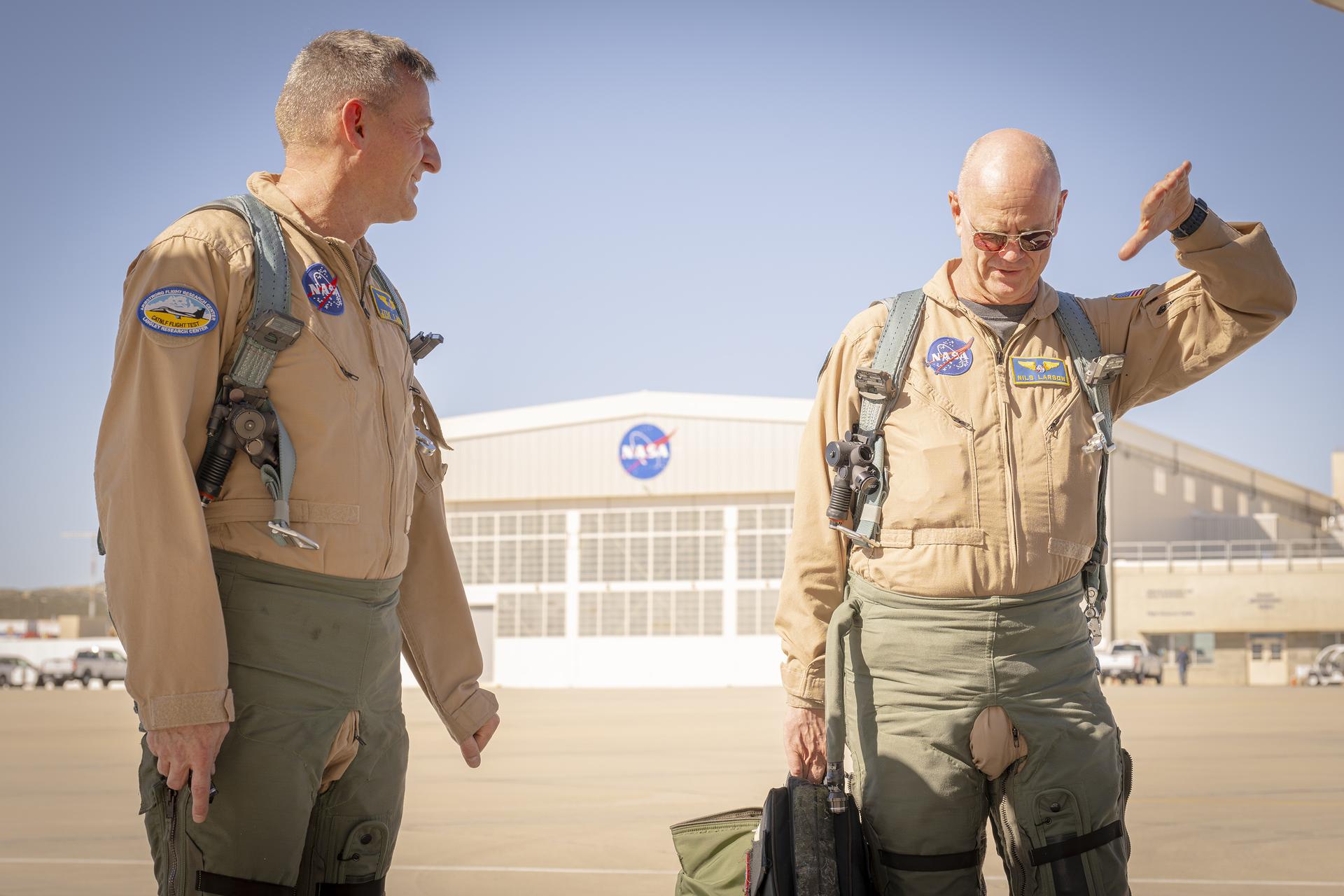
Every NASA test flight — whether it’s studying new software, hardware, or the revolutionary technology of an experimental X-plane — relies on engineers, researchers, pilots, maintenance crew, control room operators, and many others working together.
“Experienced operators and engineers evaluate how things work in flight,” Ringelberg said. “Most new technologies are designed to work in a lab or can be tested in a wind tunnel or other facility, but you never really know how they’ll perform until you fly them.”
Preflight tests often include computer analysis, simulation, wind tunnel testing, and ground tests focused on an aircraft’s ability to withstand the forces of flight and the environments through which it may fly. After hardware or software is deemed safe to fly, researchers turn the mission over to the flight test team.
To support testing, NASA Armstrong maintains an aircraft fleet modified to create space for new hardware or instruments, as well as the ability to integrate new software. These aircraft are flying laboratories, and pilots are trained to accomplish experimental missions.
An F-15 research aircraft sits on the ramp at NASA’s Armstrong Flight Research Center in Edwards, California, on Tuesday, March 17, 2026. NASA pilots Jim Less, front seat, and Carrie Worth prepare for the flight. The agency’s Crossflow Attenuated Natural Laminar Flow (CATNLF) test article is attached to the bottom of the F-15. The project aims to lower fuel costs for future commercial aircraft by testing a scale-model wing designed to improve laminar flow.NASA/Carla Escamilla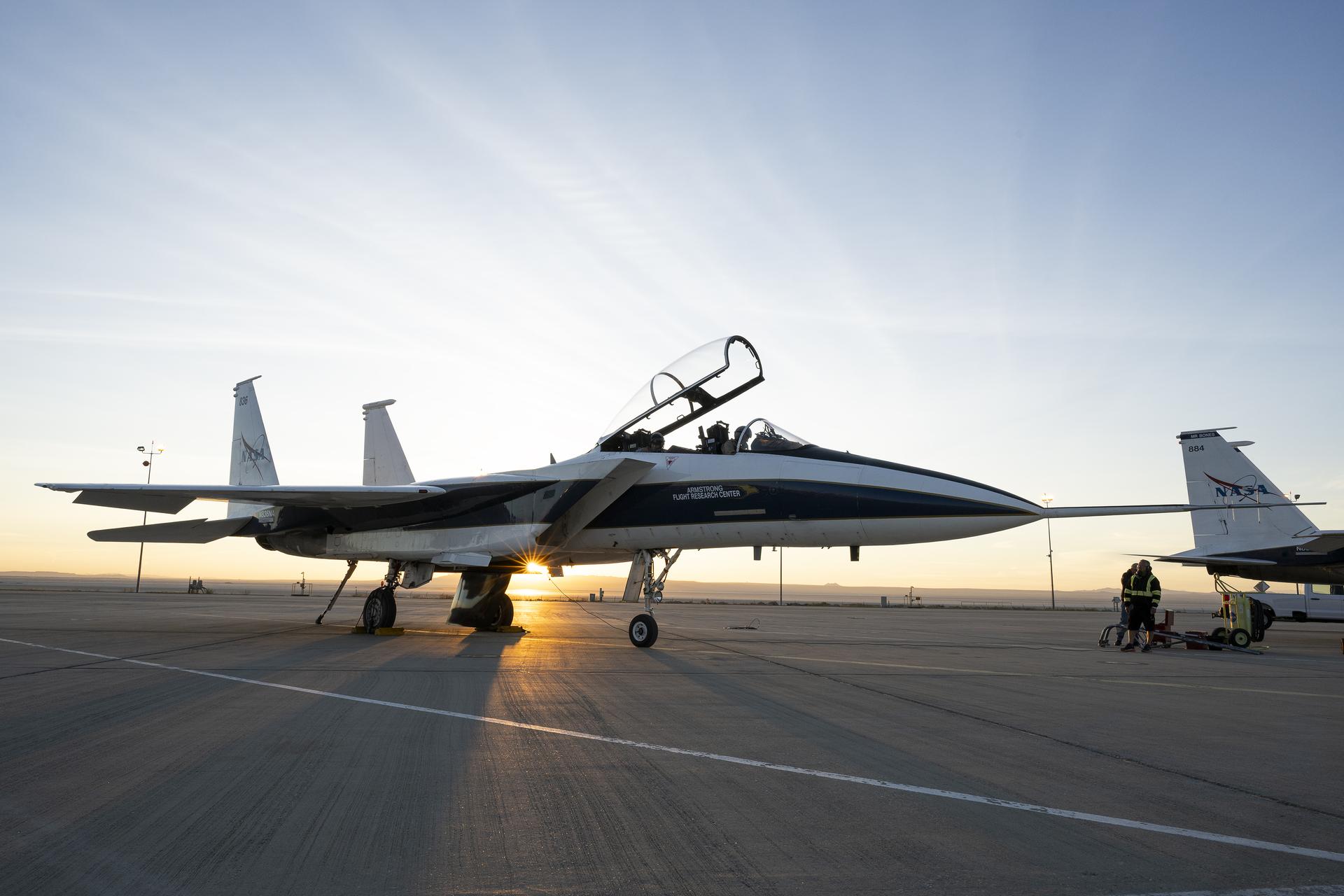
For example, flight testing recently helped NASA gather critical data on laminar flow, or the smooth flow of air, over a wing. The work could lower fuel costs for future airliners. Computer modeling, wind tunnel tests, and other methods helped advance the research, but to find out even more about how the wing concept could reduce drag for future airliners, NASA used a scale model in actual flight.
NASA researchers strapped the Crossflow Attenuated Natural Laminar Flow (CATNLF) model wing to the belly of one of NASA Armstrong’s F-15s. The arrangement allowed them to collect all the information they would need without doing the extensive, costly modifications required to install a full-scale wing on an aircraft.
After a flight series is complete, engineers and researchers analyze the data. Did the instrument work as designed? Did the experimental aircraft perform safely at a high altitude? Did the software operate as planned? Each test raises its own set of questions to evaluate.
NASA continues working with academia, the Department of War, and industry partners to advance U.S. aviation through flight test and bring new benefits to the flying public.
Share Details Last Updated Jun 22, 2026 EditorDede DiniusContactTeresa Whitingteresa.whiting@nasa.gov Related Terms Explore More 9 min read ARMD Research Solicitations (Updated June 23) Article 11 hours ago 3 min read NASA’s Experimental Fabrication Branch Fuels Aircraft Innovation Article 1 day ago 5 min read NASA, USGS Scientists Go Rock Hounding in California’s High Desert Article 2 weeks ago Keep Exploring Discover More Topics From NASAMissions
Humans in Space
Climate Change
Solar System