
Feed aggregator
Astronomers are Hunting Down the Elusive Population III Stars
It’s hard hunting down the oldest stars in the universe. These behemoths, known as Population (or Pop) III stars, are a missing link in cosmology between the primordial soup that was the early universe and the complex, “metal”-rich cosmos we’re familiar with today. But we’re slowly getting a better idea of where to look for them, and a new paper available in pre-print on arXiv from Alessandra Venditti of the University of Texas at Austin and her co-authors, highlights some of the recent advances and potential new surveying techniques that could eventually help us definitively find these massive, bright, early sparks in the universe.
An Ancient Stellar Passage Altered the Orbits of Comets We See Today
A recent study out of the Planetary Science Institute notes that the close passage of the star HD 7977 may have triggered a cascade, sending long-period comets sunward. What’s more, the same uptick in long-period comets may still be underway today. The study was recently presented at the American Astronomical Society Division on Dynamical Astronomy.
Did scientists just create synthetic life?
The SpudCell certainly resembles a living cell, but a key structure inside the cell falls short of the real thing
NASA’s Roman Telescope Will Spot Distant Black Holes That Shred Stars
Lee esta nota de prensa en español aquí.
How do black holes at the center of galaxies form and grow over time? To answer this question, scientists need to detect and study supermassive black holes at great distances, which existed much earlier in the universe’s history. New research suggests NASA’s Nancy Grace Roman Space Telescope, which is on track to launch Aug. 30, 2026, will be able to detect these distant, ancient black holes that existed up to 11 billion years ago.
This artist’s concept portrays a Sun-like star being shredded by a supermassive black hole — a phenomenon known as a tidal disruption event. During these events, the region around a black hole can brighten and become visible across great distances. NASA’s Nancy Grace Roman Space Telescope will be able to spot and study tidal disruption events that occurred early in the universe’s history. By characterizing an earlier population of supermassive black holes, astronomers can learn about their origins.NASA, Ralf Crawford (STScI)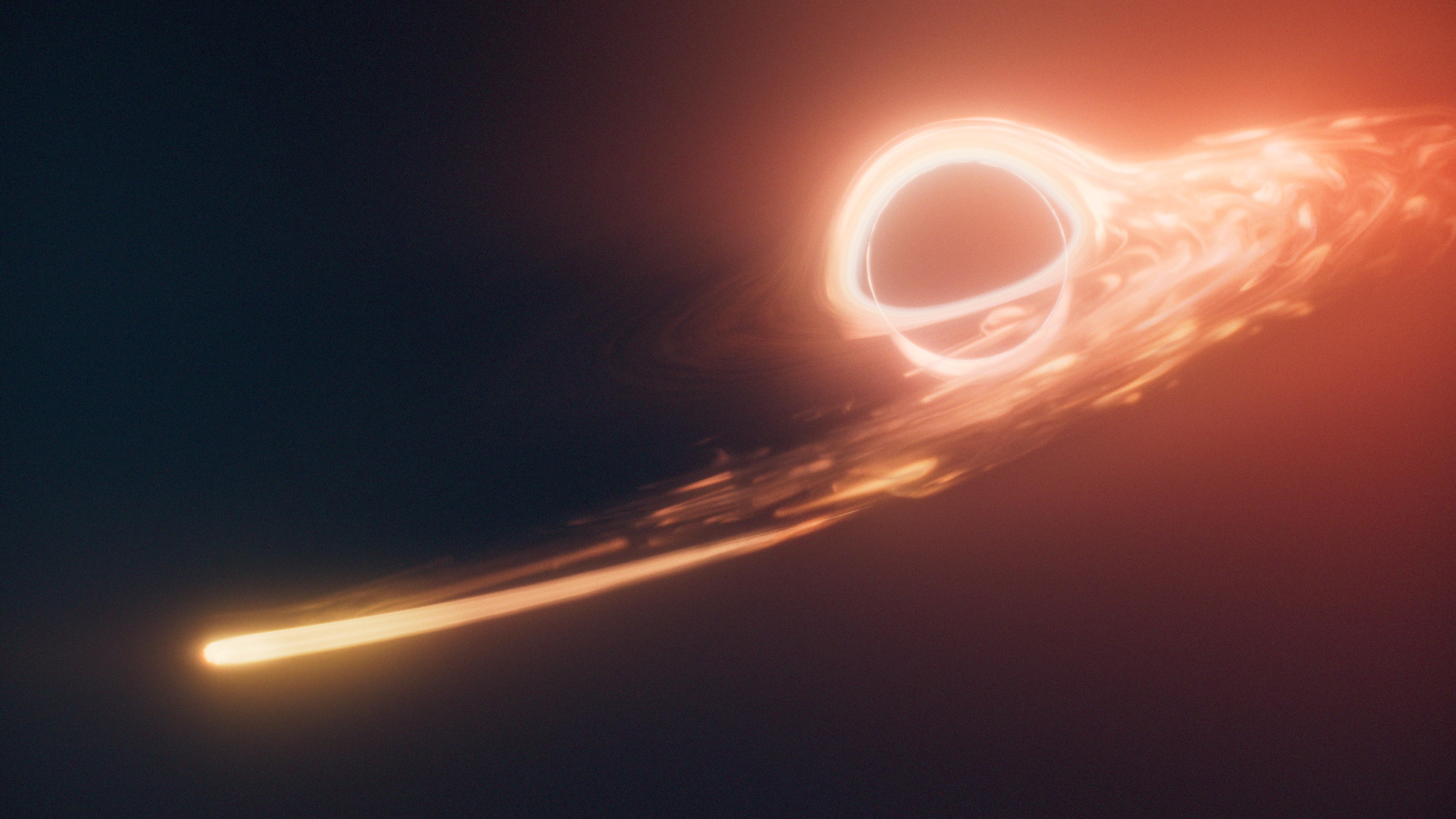
Black holes are best studied by looking for the light emitted from their accretion disk — the matter that swirls around them before being consumed. Lighter supermassive black holes are challenging to observe because they tend to be less luminous due to less accretion. But occasionally, they shred and consume an entire star, brightening to outshine their entire host galaxy — known as a tidal disruption event (TDE). By characterizing that population of early supermassive black holes and how they evolve and grow for billions of years, Roman will provide clues to the ultimate origin of these behemoths.
“The Roman Space Telescope is going to be transformative for transient science,” said lead author Mitchell Karmen of the Johns Hopkins University, a graduate student and National Science Foundation Graduate Research Fellow. “Thanks to Roman’s high sensitivity, we can find multiple tidal disruption events out to greater distances and earlier cosmic times than ever before.”
A paper about this research published Tuesday in The Astrophysical Journal.
Shredding StarsRoman’s High-Latitude Time-Doman Survey, one of three core community surveys, is particularly well suited to find and study TDEs in the early universe. This survey will cover about 18 square degrees on the sky, an area equivalent to 90 full moons, at a regular cadence. By revisiting the same regions repeatedly, astronomers can find large numbers of transient events like TDEs.
Tidal disruption events are phenomena unique to lighter supermassive black holes. Heftier black holes weighing more than 1 billion Suns will swallow incoming stars whole. But lighter black holes of about 100,000 to 100 million Suns can shred a star before consuming it, creating a beacon that brightens over a couple of weeks before gradually fading away.
The rate of TDEs fluctuates over cosmic time. Previous work predicted that the rate of TDEs would decrease with increasing distance because most young black holes were too light to generate a TDE. However, this new research takes into account numerous factors that evolve over time, like the frequency of galaxy (and hence black hole) mergers as well as the number of stars within the core of each galaxy and how closely packed they are.
Karmen and his colleagues modeled these and other effects to predict how many tidal disruption events Roman could observe, as well as other observatories like the ground-based National Science Foundation-Department of Energy Vera C. Rubin Observatory and NASA’s James Webb Space Telescope. The team forecasts that astronomers will see the rate of TDEs increase as Roman probes greater distances and earlier times until “cosmic noon,” about 11 to 12 billion years ago when star formation peaked throughout the universe, before decreasing again.
To view this video please enable JavaScript, and consider upgrading to a web browser that supports HTML5 video
This visualization shows the average number of tidal disruption events NASA’s Nancy Grace Roman Space Telescope is predicted to detect in a year, based on simulations. Roman is expected to record about 100 such events in a year.Video: NASA, STScI. Visualization: Christian Nieves (STScI). Sound: Christian Nieves (STScI). Designer: Dani Player (STScI). Animation: Greg Bacon (STScI) Complementary ObservationsRoman will observe near-infrared wavelengths of light. Light from distant TDEs becomes stretched to longer wavelengths by the expansion of the universe, a phenomenon known as cosmological redshift. As a result, Roman is inherently optimized to detect TDEs whose light traveled anywhere from 8 billion to 11 billion years to reach us.
The Rubin Observatory also will scan large swaths of the sky and pick up many new TDEs. However, it will observe visible light, which limits it to closer TDEs than Roman.
The research by Karmen’s team finds that Rubin will detect thousands to tens of thousands of TDEs per year. While Roman is expected to find up to 100 TDEs per year, those black holes will be much more distant, within the realm of cosmic history that is most important for distinguishing among black hole origin scenarios.
“Just by counting the number of TDEs as a function of redshift, you can put meaningful constraints on the population of million-solar-mass black holes,” said co-author Suvi Gezari, an associate professor of astronomy at the University of Maryland. “Roman will be transformative in that it can probe tidal disruption events out to greater distances, so you can look at how the rate of TDEs evolves over time.”
Origins of supermassive black holesAstronomers have observed truly gargantuan black holes very early in the history of the universe — so early that theories struggle to explain how they could have become so large, so quickly. They must have started smaller and grown over time, but how much smaller?
One theory, known as “light seeds,” begins with black holes that are created from the deaths of massive stars. Such black holes might weigh up to a few hundred times our Sun. These black holes then would merge over time, as well as consume surrounding gas at an astonishing rate. In this scenario, every young galaxy would be expected to have a massive black hole at its center.
A second theory, known as “heavy seeds,” suggests that a black hole could be born with a much higher mass, up to a million times our Sun, through a process such as the direct collapse of a gas cloud. This process should be less common, though, which would result in supermassive black holes being much rarer in early galaxies.
“Tidal disruption events help us probe the population of light supermassive black holes, which can help us discriminate between these models,” Karmen said.
Ultimately, Roman’s tally of tidal disruption events will help researchers trace global effects that impact the black hole population over time.
Once Roman and Rubin begin regular science operations, the team looks forward to comparing their forecasts to the actual detections those observatories make.
“Just like Webb has transformed our understanding of distant, high-redshift galaxies, Roman is poised to transform our understanding of high-redshift transients,” Gezari said.
The Nancy Grace Roman Space Telescope is managed at NASA’s Goddard Space Flight Center in Greenbelt, Maryland, with participation by NASA’s Jet Propulsion Laboratory in Southern California; Caltech/IPAC in Pasadena, California; the Space Telescope Science Institute in Baltimore; and a science team comprising scientists from various research institutions. The primary industrial partners are BAE Systems, Inc. in Boulder, Colorado; L3Harris Technologies in Melbourne, Florida; and Teledyne Scientific & Imaging in Thousand Oaks, California.
By Christine Pulliam
Space Telescope Science Institute, Baltimore, Md.
Media Contact:
Claire Andreoli
NASA’s Goddard Space Flight Center, Greenbelt, Md.
301-286-1940
ChatGPT just proved another 50-year-old math conjecture
What’s the secret to prompting an AI to solve math problems that have left humans stumped? Tell it to believe in itself
Here's the deal with 'corn sweat'—it's not all actually corn's fault
Corn has taken the heat for recent Midwest summer humidity—unjustly, according to corn experts
Artemis II astronauts visit ESA
Yesterday, the four Artemis II astronauts visited ESA’s technical site in the Netherlands, where they met the team behind the European Service Module that powered their Orion spacecraft around the Moon and safely back to Earth.
Fans of the Arctic
- Earth
- Earth Observatory
- Image of the Day
- EO Explorer
- Topics
- More Content
- About
Fans of the Arctic
- Earth
- Earth Observatory
- Image of the Day
- EO Explorer
- Topics
- More Content
- About
Curiosity Blog, Sols 4941-4947: (Pin)Stripes on the Fourth of July
- Curiosity Home
- Science
- News and Features
- Multimedia
- Mars Missions
- Mars Home
4 min read
Curiosity Blog, Sols 4941-4947: (Pin)Stripes on the Fourth of July NASA’s Mars rover Curiosity acquired this image of the “Cerro Castillo” bedrock outcrop with target “Hornillos” at the bottom center. Curiosity used its Left Navigation Camera on July 1, 2026 — Sol 4942, or Martian day 4,942 of the Mars Science Laboratory mission — at 23:50:44 UTC. NASA/JPL-Caltech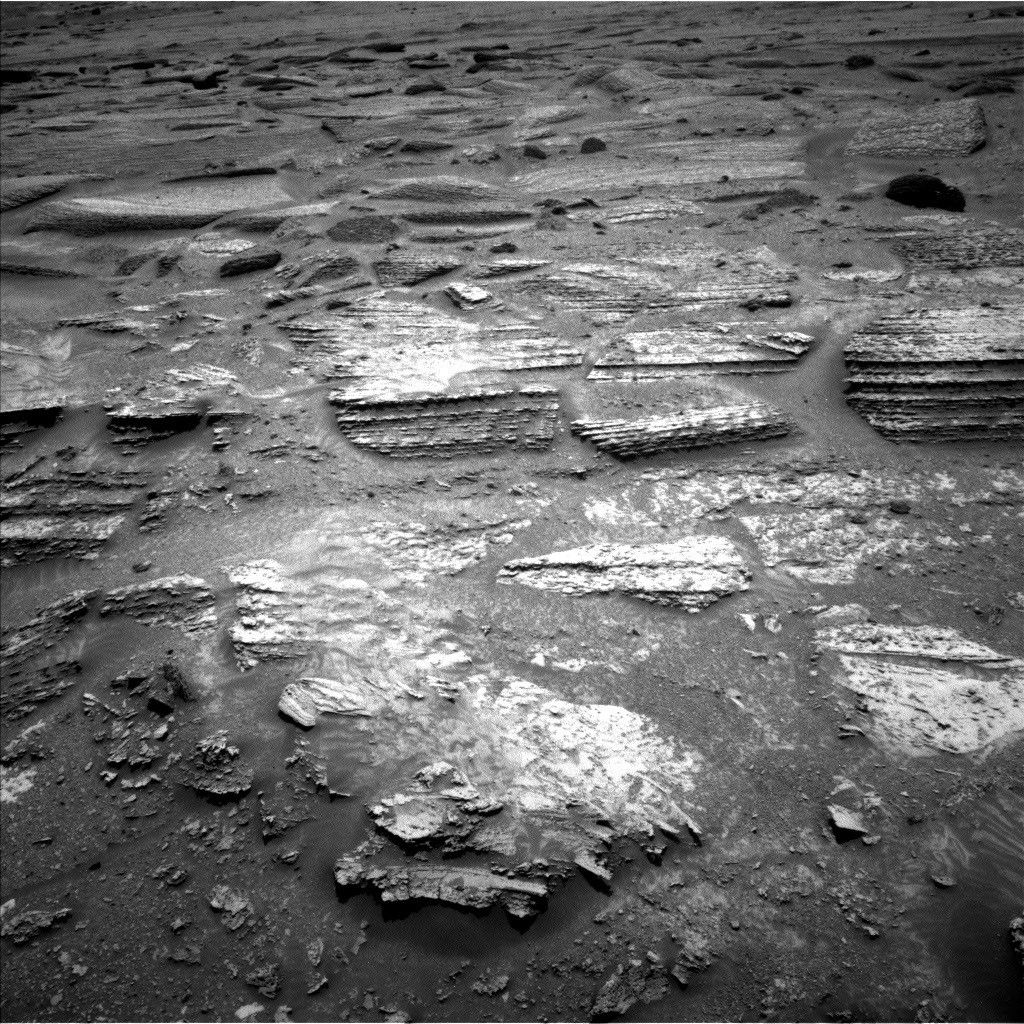
Written by Deborah Padgett, MSL Operations Product Ground System Task Lead at NASA’s Jet Propulsion Laboratory
Earth planning date: Thursday, July 2, 2026
Curiosity spent the week leading up to the Fourth of July holiday approaching a geologic boundary between a very smooth but somewhat sandy region and a rougher bedrock unit.
Leaving the polygonal terrain behind, the rover arrived at the first location of the week on Sol 4939 and, on the following sol, 4940, looked for dust devils with Navcam and performed an AEGIS ChemCam laser-spectroscopy observation and Mastcam imaging of a target selected onboard the rover. Unfortunately, there were no large rocks appropriate for brushing with the DRT at this rover stop.
On Sol 4941, the MAHLI camera imaged “Malpartida” and “Pico del Tunari,” which are both light-colored rock fragments, and APXS performed X-ray spectroscopy on them to determine their composition. ChemCam used active laser spectroscopy to zap the “Kunturiri” light-colored bedrock fragment, while “Mecoyita,” a dark-toned “float” rock, which appears to have been transported into this area from elsewhere, was observed passively. ChemCam also used its telescopic RMI camera to study sedimentary layers at the base of the Cordillera butte. Mastcam obtained several image mosaics on a ridge of sand and rock fragments dubbed “Sitajana.”
On the following sol, 4942, Mastcam continued its study of “Sitajana,” and ChemCam RMI obtained more views of Cordillera butte. Navcam took a suprahorizon cloud movie and dust-devil movie. Finally, ChemCam obtained laser spectroscopy of the dark bedrock fragment “Toconce” with documentation imagery from Mastcam. Mastcam also imaged “Sierra Vicuña Mackenna” to study a partially uncovered rock shedding sand in an area of small dune ripples.
On the afternoon of Sol 4942, Curiosity drove about 36 feet (about 11 meters) to the edge of the geologic contact and took post-drive panoramic mosaics with Navcam and Mastcam. These images revealed a field of exposed bedrock outcrops with beautiful pinstriped layers. A Navcam AEGIS observation was taken for onboard selection of a ChemCam laser spectroscopy target. This soil and rock target was observed by ChemCam with Mastcam documentation on Sol 4943. In addition, Navcam performed a dust-devil movie, and Mastcam took an atmospheric dust observation.
For Sol 4944, two adjacent light bedrock targets “Laguna Fea” and “Laguna Lejia” were selected for DRT brushing, MAHLI imaging, and APXS X-ray spectroscopy to determine composition. ChemCam laser spectroscopy will target the darker ledge of bedrock “Hornillos,” with accompanying Mastcam documentation. The investigation of “Hornillos” will include detailed imaging by MAHLI, but it was determined to be too rough for DRT brushing. Mastcam will take a large mosaic of images on the field of striped bedrock outcrop “Cerro Castillo,” as well as a smaller mosaic of a nearby trough. The ChemCam telescopic RMI camera will target a dark layer on butte Cordillera, which appears to be shedding dark boulders. Navcam will take a dust-devil movie and suprahorizon cloud movie.
On Sol 4945, ChemCham will do laser spectroscopy of “Laguna Lejia” with Mastcam image documentation, and the ChemCam RMI telescopic camera will study another area at the base of butte Cordillera where the location of large stones on the slope suggests that ice processes may have played a role. A Navcam dust-devil survey and Mastcam dust-imaging study will also be done. In the afternoon, there will be a Navcam dust-devil survey, zenith observation, and suprahorizon cloud movie, as well as a Mastcam dust observation and 20×4 mosaic image of butte Mishe Mokwa. Overnight, there will be an APXS atmospheric observation lasting many hours.
During Sol 4945, ChemCam will perform laser spectroscopy of target “La Puntilla” with accompanying Mastcam imaging, followed by a ChemCam passive-sky observation. Curiosity will then drive about 56 feet (17 meters) towards a large, dark boulder in the distance, which may be a meteorite, and do post-drive imaging and Navcam sky flats.
On the following morning, there will be an atmospheric observation including a Navcam zenith movie, suprahorizon cloud movie, and line-of-sight dust observation, as well as a Mastcam dust “tau” observation.
-
Want to read more posts from the Curiosity team?
-
Want to learn more about Curiosity’s science instruments?
Article
2 weeks ago
4 min read Curiosity Blog, Sols 4927–4933: Let’s Drive to That Smooth Area
Article
3 weeks ago
3 min read Curiosity Blog, Sols 4920-4926: Surveying the Bands
Article
4 weeks ago
Keep Exploring Discover More Topics From NASA Mars
Mars is the fourth planet from the Sun, and the seventh largest. It’s the only planet we know of inhabited…
All Mars Resources
Explore this collection of Mars images, videos, resources, PDFs, and toolkits. Discover valuable content designed to inform, educate, and inspire,…
Rover Basics
Each robotic explorer sent to the Red Planet has its own unique capabilities driven by science. Many attributes of a…
Mars Exploration: Science Goals
The key to understanding the past, present or future potential for life on Mars can be found in NASA’s four…
Curiosity Blog, Sols 4941-4947: (Pin)Stripes on the Fourth of July
- Curiosity Home
- Science
- News and Features
- Multimedia
- Mars Missions
- Mars Home
4 min read
Curiosity Blog, Sols 4941-4947: (Pin)Stripes on the Fourth of July NASA’s Mars rover Curiosity acquired this image of the “Cerro Castillo” bedrock outcrop with target “Hornillos” at the bottom center. Curiosity used its Left Navigation Camera on July 1, 2026 — Sol 4942, or Martian day 4,942 of the Mars Science Laboratory mission — at 23:50:44 UTC. NASA/JPL-CaltechWritten by Deborah Padgett, MSL Operations Product Ground System Task Lead at NASA’s Jet Propulsion Laboratory
Earth planning date: Thursday, July 2, 2026
Curiosity spent the week leading up to the Fourth of July holiday approaching a geologic boundary between a very smooth but somewhat sandy region and a rougher bedrock unit.
Leaving the polygonal terrain behind, the rover arrived at the first location of the week on Sol 4939 and, on the following sol, 4940, looked for dust devils with Navcam and performed an AEGIS ChemCam laser-spectroscopy observation and Mastcam imaging of a target selected onboard the rover. Unfortunately, there were no large rocks appropriate for brushing with the DRT at this rover stop.
On Sol 4941, the MAHLI camera imaged “Malpartida” and “Pico del Tunari,” which are both light-colored rock fragments, and APXS performed X-ray spectroscopy on them to determine their composition. ChemCam used active laser spectroscopy to zap the “Kunturiri” light-colored bedrock fragment, while “Mecoyita,” a dark-toned “float” rock, which appears to have been transported into this area from elsewhere, was observed passively. ChemCam also used its telescopic RMI camera to study sedimentary layers at the base of the Cordillera butte. Mastcam obtained several image mosaics on a ridge of sand and rock fragments dubbed “Sitajana.”
On the following sol, 4942, Mastcam continued its study of “Sitajana,” and ChemCam RMI obtained more views of Cordillera butte. Navcam took a suprahorizon cloud movie and dust-devil movie. Finally, ChemCam obtained laser spectroscopy of the dark bedrock fragment “Toconce” with documentation imagery from Mastcam. Mastcam also imaged “Sierra Vicuña Mackenna” to study a partially uncovered rock shedding sand in an area of small dune ripples.
On the afternoon of Sol 4942, Curiosity drove about 36 feet (about 11 meters) to the edge of the geologic contact and took post-drive panoramic mosaics with Navcam and Mastcam. These images revealed a field of exposed bedrock outcrops with beautiful pinstriped layers. A Navcam AEGIS observation was taken for onboard selection of a ChemCam laser spectroscopy target. This soil and rock target was observed by ChemCam with Mastcam documentation on Sol 4943. In addition, Navcam performed a dust-devil movie, and Mastcam took an atmospheric dust observation.
For Sol 4944, two adjacent light bedrock targets “Laguna Fea” and “Laguna Lejia” were selected for DRT brushing, MAHLI imaging, and APXS X-ray spectroscopy to determine composition. ChemCam laser spectroscopy will target the darker ledge of bedrock “Hornillos,” with accompanying Mastcam documentation. The investigation of “Hornillos” will include detailed imaging by MAHLI, but it was determined to be too rough for DRT brushing. Mastcam will take a large mosaic of images on the field of striped bedrock outcrop “Cerro Castillo,” as well as a smaller mosaic of a nearby trough. The ChemCam telescopic RMI camera will target a dark layer on butte Cordillera, which appears to be shedding dark boulders. Navcam will take a dust-devil movie and suprahorizon cloud movie.
On Sol 4945, ChemCham will do laser spectroscopy of “Laguna Lejia” with Mastcam image documentation, and the ChemCam RMI telescopic camera will study another area at the base of butte Cordillera where the location of large stones on the slope suggests that ice processes may have played a role. A Navcam dust-devil survey and Mastcam dust-imaging study will also be done. In the afternoon, there will be a Navcam dust-devil survey, zenith observation, and suprahorizon cloud movie, as well as a Mastcam dust observation and 20×4 mosaic image of butte Mishe Mokwa. Overnight, there will be an APXS atmospheric observation lasting many hours.
During Sol 4945, ChemCam will perform laser spectroscopy of target “La Puntilla” with accompanying Mastcam imaging, followed by a ChemCam passive-sky observation. Curiosity will then drive about 56 feet (17 meters) towards a large, dark boulder in the distance, which may be a meteorite, and do post-drive imaging and Navcam sky flats.
On the following morning, there will be an atmospheric observation including a Navcam zenith movie, suprahorizon cloud movie, and line-of-sight dust observation, as well as a Mastcam dust “tau” observation.
-
Want to read more posts from the Curiosity team?
-
Want to learn more about Curiosity’s science instruments?
Article
2 weeks ago
4 min read Curiosity Blog, Sols 4927–4933: Let’s Drive to That Smooth Area
Article
3 weeks ago
3 min read Curiosity Blog, Sols 4920-4926: Surveying the Bands
Article
4 weeks ago
Keep Exploring Discover More Topics From NASA Mars
Mars is the fourth planet from the Sun, and the seventh largest. It’s the only planet we know of inhabited…
All Mars Resources
Explore this collection of Mars images, videos, resources, PDFs, and toolkits. Discover valuable content designed to inform, educate, and inspire,…
Rover Basics
Each robotic explorer sent to the Red Planet has its own unique capabilities driven by science. Many attributes of a…
Mars Exploration: Science Goals
The key to understanding the past, present or future potential for life on Mars can be found in NASA’s four…
Researchers Prove Black Theory in a Laboratory Setting
Researchers at the Advanced Science Research Center at the CUNY Graduate Center have demonstrated a new approach to wave amplification through interaction with rotating bodies. Rather than mechanically rotating matter, however, the team engineered a radio-frequency device with properties modulated in space and time to mimic spinning.
We finally know the name of a Maya mathematician
The signature of Sak Tahn Waax, or “White-Chested Fox,” was found inscribed in a 1,000-year-old chamber beneath present-day Guatemala
Rebooting a Spacecraft, 140 Million Kilometres From Home.
Engineers have just upgraded the software running a spacecraft 140 million kilometres away, then held their breath through two full reboots with an eight minute delay on every command. The prize for getting it right is a close up look at an asteroid humanity has already changed forever, and the answer to a question nobody has been able to answer since 2022, what did we actually do to it?
NASA Study Points to Smoother Air Taxi Rides
3 min read
Preparations for Next Moonwalk Simulations Underway (and Underwater) Matt Kamlet, an employee at NASA’s Armstrong Flight Research Center in Edwards, California, sits atop the virtual reality passenger ride quality simulator during a study of air taxi motion Monday, Dec. 15, 2025. NASA recently completed a multi-year study to understand how large, sudden air taxi motion affects ride comfort.NASA/Christopher LC Clark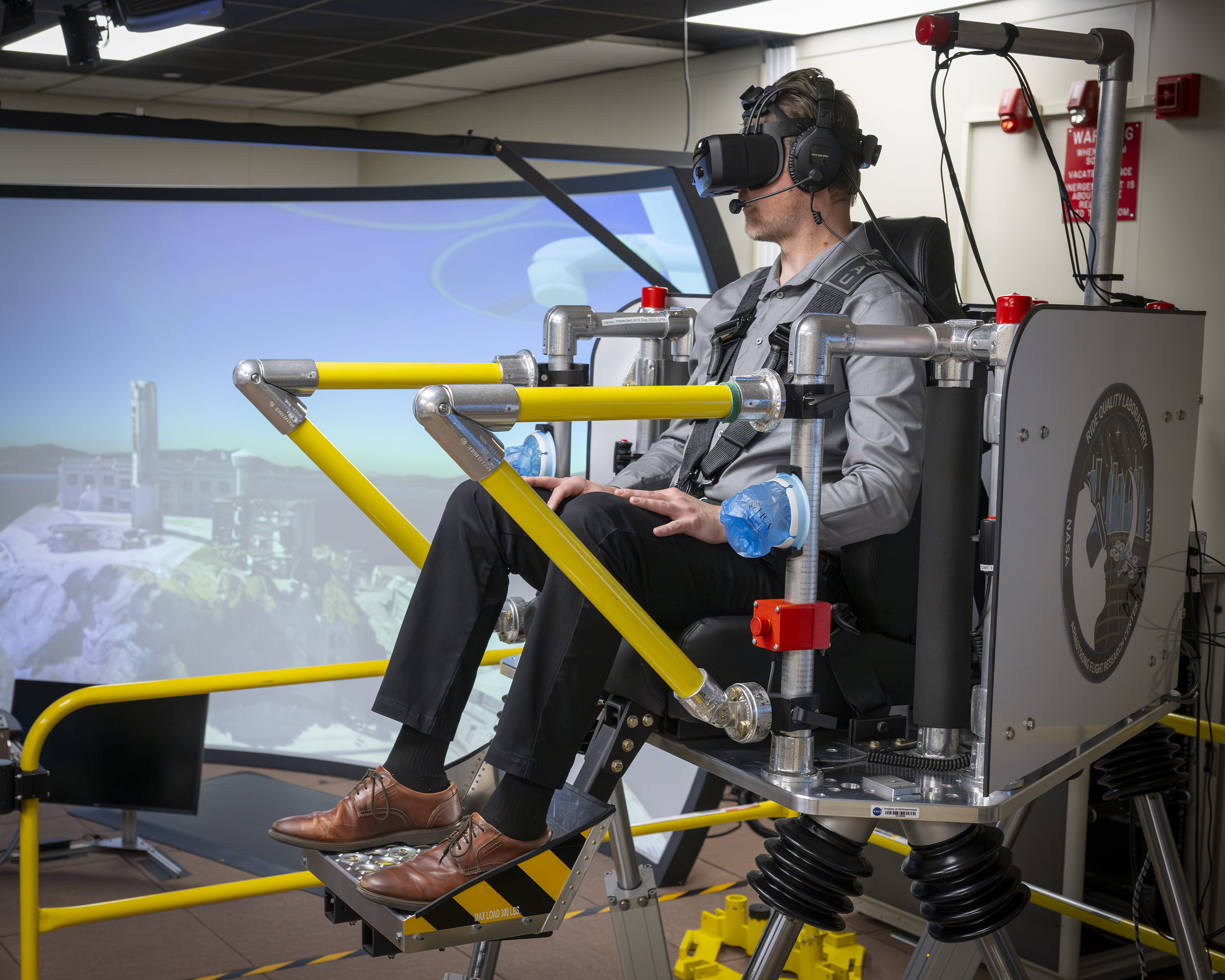
No one wants to get into an uncomfortable aircraft. NASA research could help the emerging industry of air taxis —small, vertical-takeoff-and-landing aircraft meant for short trips — understand the relationship between comfort and willingness to fly.
That’s where NASA comes in, with data that can help identify how to plan air taxi rides that can keep travelers feeling good.
NASA was able to gather that data by putting its own employees through some rough virtual flights. At the agency’s Armstrong Flight Research Center in Edwards, California, volunteers have been strapping into a virtual reality motion simulator to experience the sudden shifts and tilts that tomorrow’s air taxis could encounter, showing researchers those moments feel from a passenger’s point of view.
Their reactions are giving NASA new insight into how aircraft motion influences comfort and confidence in flight — for instance, that certain kinds of large, sudden motions can be especially bothersome. Using that data, the team developed new models linking those sudden motions to passengers’ willingness to fly. The models can help guide future aircraft design and flight operations, letting producers know what maneuvers will be too jarring for future air taxi riders.
Large, sudden movements can also come from gusting winds or landings. The NASA data allows researchers to estimate when passengers may begin to feel uncomfortable as motion increases, giving them the ability to shape aircraft designs and operations to minimize the impact of those situations.
“Through this study and others, we are starting to identify passenger comfort thresholds for aggressive flight motion,” said Curtis Hanson, NASA Armstrong lead researcher for this effort. “We can begin to make predictions about how air taxis should fly so that most passengers will find the experience enjoyable and want to ride again, which will benefit the public and the industry.”
In the simulator, each participant experienced four levels of their aircraft pitching up and down, tilting from side-to-side, rotating, or accelerating quickly into a climb or a dive during flights from downtown San Francisco to Alcatraz Island in California. Even moderate changes in these motions reduced comfort for some participants, while others remained comfortable at higher levels. Participants rated each flight on a five-point scale and identified which motions felt uncomfortable.
Participants were asked whether they would take a real air taxi flight with motion they find uncomfortable. Their answers suggested that today’s travelers may be less tolerant of rough motion than airline passengers 50 years ago, based on comparisons with earlier NASA ride-quality research.
This latest feedback builds on a multiyear NASA study to better understand air taxi passenger comfort. The overall research effort found clear relationships between specific aircraft motions and how comfortable people feel during flight.
This work is currently led under the Subsonic Vehicle Technologies and Tools project in NASA’s Research and Technology Mission Directorate and contributes to the agency’s advanced air mobility research.
Share Details Last Updated Jul 13, 2026 EditorDede DiniusContactTeresa Whitingteresa.whiting@nasa.govLocationArmstrong Flight Research Center Related Terms Explore More 3 min read A Day of Flight Testing at NASA Armstrong Article 2 weeks ago 5 min read NASA’s Newest Wind Tunnel Builds on Legacy of Innovation Article 2 weeks ago 3 min read This is How NASA Flight Tests New Technology Article 3 weeks ago Keep Exploring Discover More Topics From NASAArmstrong Flight Research Center
Aeronautics
Drones & You
Flight Research Innovation