
Feed aggregator
China’s LineShine supercomputer tops global rankings with almost 2 quintillion calculations per second
The speedy machine displaces the U.S.’s Lawrence Livermore National Laboratory’s El Capitan at the top of the TOP500 rankings of the world’s fastest supercomputers
The most detailed survey of the universe ever conducted starts now
The most detailed survey of the universe ever conducted starts now
This physicist is hunting for the biggest black hole in the universe
This physicist is hunting for the biggest black hole in the universe
London botanic gardens digitizes 7 million specimens
As Kew Botanic Gardens completes a scan of its collections, AI tools could help in the fight against biodiversity loss
#799: Heavy Lift Rockets
The Saturn 5 was a monster, capable of sending humans and a lander to the Moon and bringing them back again. But the number of heavy lift rockets since then has gotten pretty sparse. Now, with tens if not hundreds of thousands of satellites in the works, giant new space telescopes and multi-ton lunar landers in development there are heavy lift solutions to match. So let’s talk about them! From yesterday's Saturn V to today's Ariane VI, rockets capable of launching large telescopes or small space stations in a single go are modern marvels. They are also wildly dangerous, and not exactly compatible. Let's look at today's fleet of rockets and just what they're accomplishing.
Earth Microbes Can Survive Individual Martian Hazards—and Evade Astronaut Immune Systems
Hopefully, we’re about to travel back to the Moon relatively soon. And while the original “giant leap for mankind” was taken by a human, Neil Armstrong brought a plethora of other forms of life along with him. Humans themselves are essentially walking ecosystems, and understanding how our microbial companions survive in the harsh environments of space will be critical to ensure the health and safety of future astronauts, no matter where their giant leaps might be. A new PhD thesis from Tommaso Zaccaria at Radboud University showcases just how well-suited to some of these harsh environments terrestrial pathogens actually are.
Apply now to ESA's Junior Professional Programme
Are you passionate about space and looking to build a long-term career in the European space sector? Do you have less than three years of professional experience and a Master’s degree? The European Space Agency is offering a unique opportunity through its Junior Professional Programme (JPP), designed to cultivate the next generation of space professionals. If you dream of contributing to cutting-edge space missions and working in an international, dynamic environment, this programme is your gateway to an exciting future at ESA. Apply now to join us as a Junior Professional!
Starry Chandelier Cluster
Starry Chandelier Cluster
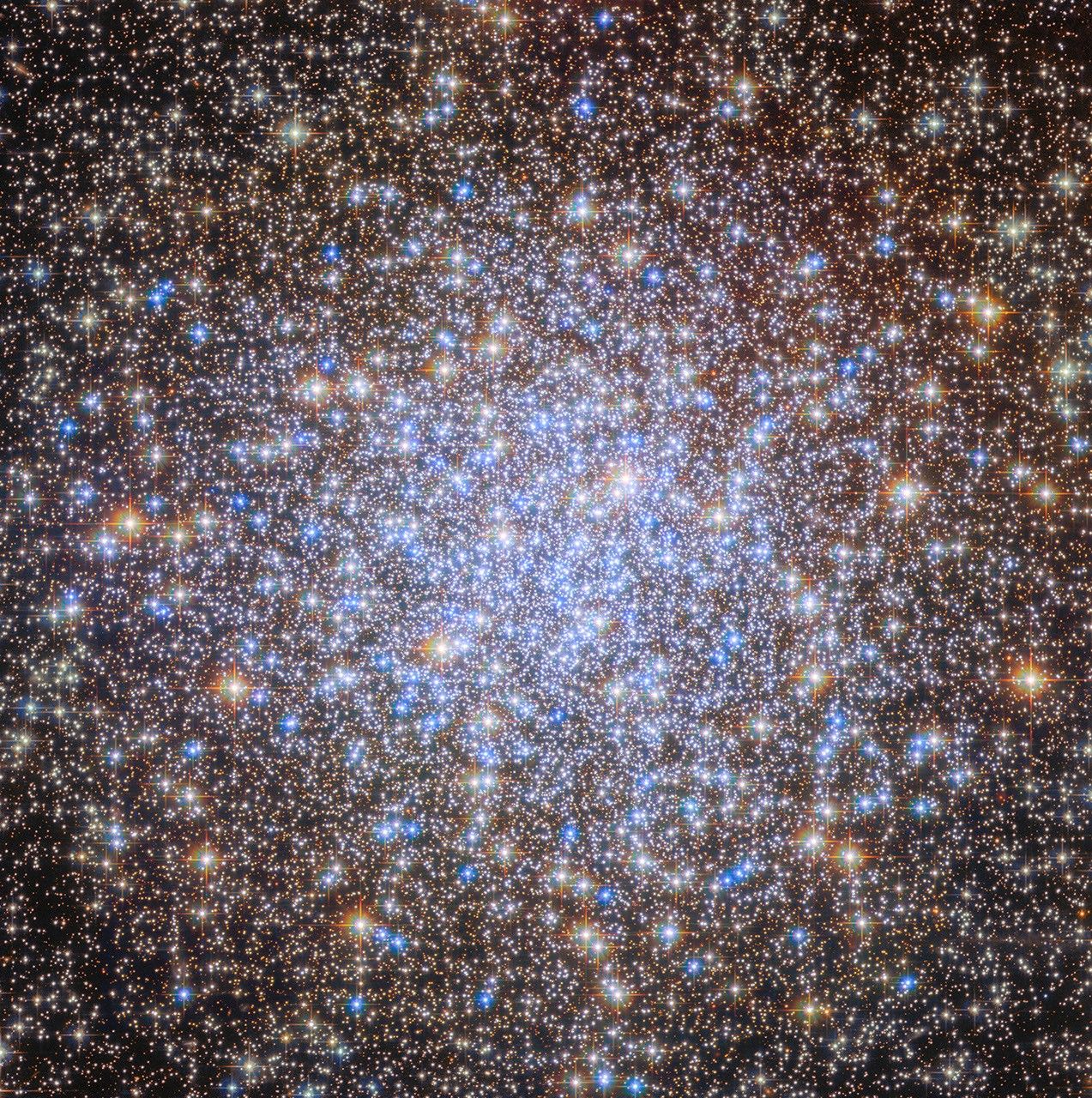
This image released on June 26, 2026, features the globular cluster NGC 6723, sometimes called the Chandelier Cluster. Like its namesake, it sparkles with countless lights. However, each ‘lightbulb’ in this chandelier is an individual star 27,000 light-years away in the constellation Sagittarius (the Archer).
Globular clusters like NGC 6723 contain some of the oldest stars in our galaxy. These clusters have ages that often exceed 10 billion years old, and some are nearly as old as the universe itself. Astronomers think globular clusters are some of the first structures that formed in our galaxy, coalescing potentially billions of years before the thin disk of stars in which our Sun orbits. The details of how globular clusters formed, however, are not yet certain.
Learn more about the Chandelier Cluster.
Image credit: ESA/Hubble & NASA, A. Sarajedini, G. Piotto
Starry Chandelier Cluster
This image released on June 26, 2026, features the globular cluster NGC 6723, sometimes called the Chandelier Cluster. Like its namesake, it sparkles with countless lights. However, each ‘lightbulb’ in this chandelier is an individual star 27,000 light-years away in the constellation Sagittarius (the Archer).
Globular clusters like NGC 6723 contain some of the oldest stars in our galaxy. These clusters have ages that often exceed 10 billion years old, and some are nearly as old as the universe itself. Astronomers think globular clusters are some of the first structures that formed in our galaxy, coalescing potentially billions of years before the thin disk of stars in which our Sun orbits. The details of how globular clusters formed, however, are not yet certain.
Learn more about the Chandelier Cluster.
Image credit: ESA/Hubble & NASA, A. Sarajedini, G. Piotto
Vera C. Rubin Observatory Begins Its Long-Awaited All-Sky Survey
The telescope should spot billions of astronomical objects in the next 10 years.
The post Vera C. Rubin Observatory Begins Its Long-Awaited All-Sky Survey appeared first on Sky & Telescope.
Babies are born with the neural foundations for maths
Babies are born with the neural foundations for maths
Weaving the Future of Space Suits
The famous opening scene of the Martian has Mark Watney stabbed in the torso with a communications antenna. While this accident sets up the plot for what is widely regarded as a modern classic of sci-fi storytelling, what if he was wearing a space suit that would have stopped the impact altogether? That’s the idea behind a recent NASA Small Business Innovation Research (SBIR) Phase I program run by researchers from Materials Research & Design, Fiber Materials, Inc, and NASA’s Johnson Space Center. Their work, which was recently presented at the National Space & Missile Materials Symposium, showcased a type of advanced 3D-reinforced fabric that could have saved Watney and his compatriots a whole lot of trouble.
Stunning new image of the Milky Way reveals its glittering heart
This brilliant new image, taken by Europe’s Euclid space telescope, offers a preview of the kind of imaging that will be possible with NASA’s upcoming Roman telescope
I’m the first person whose life was saved by CRISPR base editing
I’m the first person whose life was saved by CRISPR base editing
Time to say goodbye to Sentinel-1A
After 12 years of exceptional service, the pioneering Copernicus Sentinel-1A radar satellite has reached the end of its mission. Originally designed for a seven-year life in orbit, the satellite has exceeded expectations, not only by its longevity, but through the extraordinary impact of its data, which have deepened our understanding of our changing planet and supported a wide range of operational services and laid the foundation for scientific discoveries.