
Feed aggregator
A type of fibre that stimulates GLP-1 release approved for use in food
A type of fibre that stimulates GLP-1 release approved for use in food
Supreme Court limits police searches of phone location data
A new decision rules that geofence warrants are Fourth Amendment searches, but it stops short of banning police access to location histories
Mediterranean Sea breaks June surface heat record
Why this 98-qubit quantum computer is a big deal
A new quantum computer sets a high watermark for accuracy. Are we on the verge of a big breakthrough?
NASA’s TESS Mission Finds Planetary System in New Way
NASA’s Goddard Space Flight Center
For the first time, NASA’s TESS (Transiting Exoplanet Survey Satellite) mission has identified a planet orbiting a distant star thanks to ripples in space-time. Unlike the star-hugging transiting planets TESS regularly reveals, the newfound world is a super-Jupiter orbiting far from its host star.
“When TESS launched, no one expected it to ever be capable of finding this kind of planet,” said Diana Dragomir, a professor at the University of New Mexico in Albuquerque and co-author of a paper describing the results. At 1.6 times Jupiter’s mass and a similar orbital distance, it would be extremely unlikely to find such a planet via the primary detection method TESS was designed for. “The discovery implies that there are probably other so-called microlensing planets hiding in TESS’s data that we hadn’t previously thought to look for.”
This artist’s concept visualizes Gaia23bra b, the first microlensing planet orbiting a distant star found by NASA’s TESS (Transiting Exoplanet Survey Satellite). This super-Jupiter orbits an orange dwarf star at a distance similar to Jupiter’s distance from the Sun. NASA’s Goddard Space Flight Center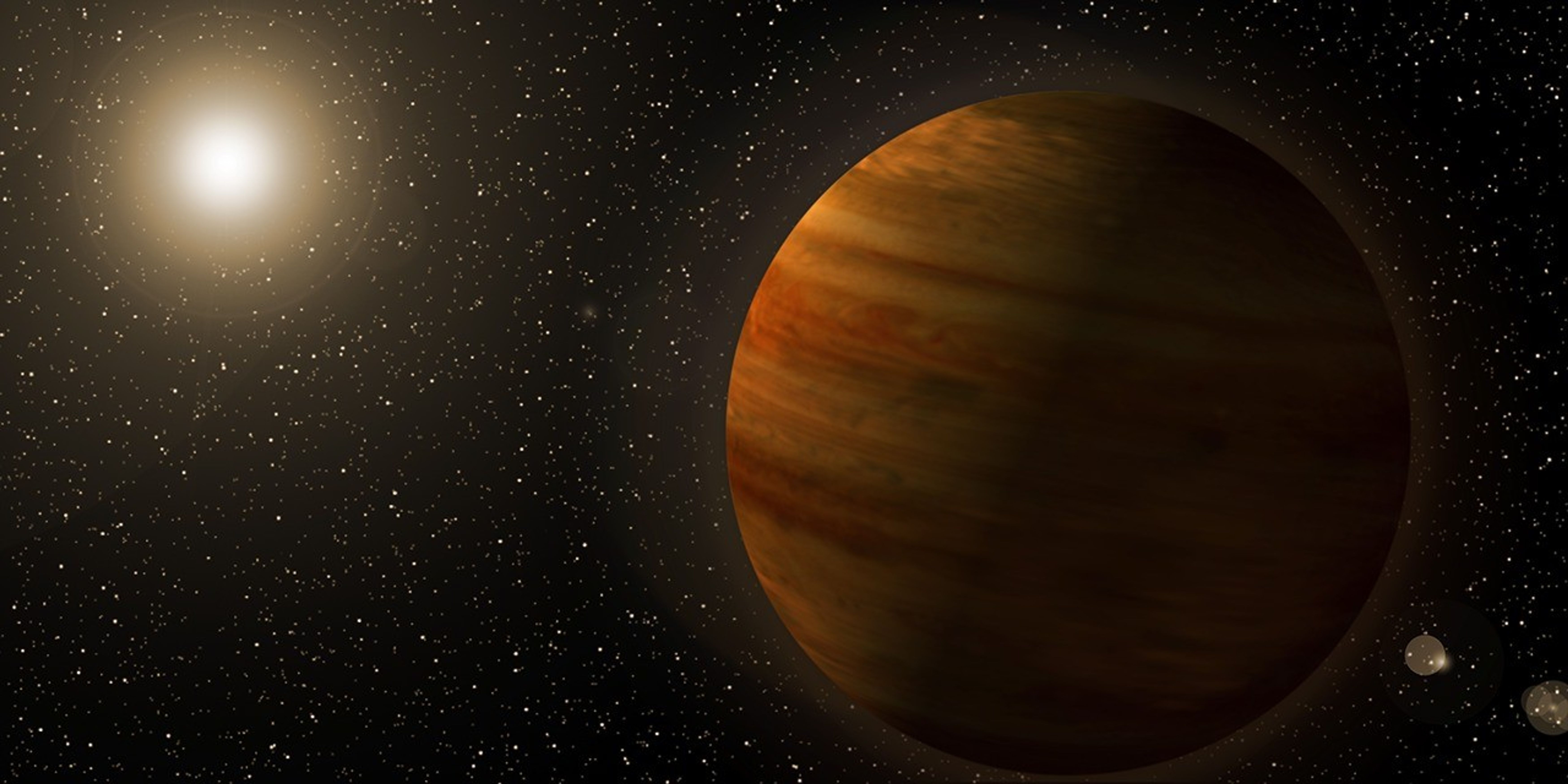
Astronomers found the first hint of the planet, called Gaia23bra b, in 2023 using ESA’s (European Space Agency) now-retired Gaia space telescope. Gaia’s alert system flagged a star that brightened — something that can happen when a foreground star passes in front of a more distant one and magnifies its light through gravitational microlensing.
Researchers later looked back through archived TESS data and found TESS had caught it too.
“Gaia’s observations were too sparse to pick up on the planet,” said Mallory Harris, a Ph.D. candidate at the University of New Mexico, who led the study. “The TESS spacecraft happened to be monitoring the same area of the sky during the event, and its denser time coverage showed extra features in the light curve caused by a planet.”
The team’s analysis, published July 1 in The Astrophysical Journal Letters, revealed that Gaia23bra b, which orbits an orange dwarf star that’s about 80 percent of the Sun’s mass, is nearly 40,000 light-years away from Earth, far exceeding TESS’s usual search radius of about 150 light-years.
Microlensing 101Out of more than 6,000 known exoplanets (worlds outside our solar system), about three-fourths were discovered via the transit method, TESS’s typical planet-hunting technique. Astronomers monitor hordes of stars, watching for ones that periodically dim as orbiting planets cross in front of them — an event called a transit.
This animation illustrates the concept of gravitational microlensing. When one star in the sky (shown in the center of the animation) appears to pass nearly in front of another (located in the dashed circle at the right) from our vantage point, the light rays of the background star become bent due to the warped space-time around the foreground star. This star acts like a virtual magnifying glass, amplifying the brightness of the background star and causing its position to appear to slightly shift. If the nearer star harbors a planetary system, then those planets can also act as lenses, each one producing a short deviation in the brightness of the source. When astronomers find planets this way, they can measure their mass and orbital distance from their host star. NASA’s Goddard Space Flight Center/CI Lab
Microlensing has revealed less than 5% of known exoplanets. This light-bending phenomenon occurs when two stars align closely from our vantage point. Light from the more distant star curves as it travels through the warped space-time caused by the nearer star’s mass.
If the alignment is especially close, the nearer star acts like a cosmic lens, focusing and magnifying light from the background star. Planets orbiting the foreground star may also modify the distant star’s light, acting as their own tiny lenses. Astronomers see the effect as a spike in the star’s brightness.
The transit method is best at finding large planets orbiting very close to their host stars; large planets block the most starlight, while close-in planets are more likely to pass in front of the host star. These gargantuan, steamy worlds are fascinating to scientists, but astronomers want to find planets like those in our solar system, too. That’s microlensing’s specialty.
With microlensing, we can find smaller planets with greater orbital distances, including worlds in the habitable zone of their star and even farther away.Mallory harris
Ph.D. candidate at the University of New Mexico
Microlensing isn’t well suited to finding huge, close-in planets because their gravitational signals would just blur together.
“Transits and microlensing are complementary because they each reveal a category of planet the other may not be able to detect,” Dragomir said. “And they offer different details. Transits give us the size of a planet, and in concert with other methods we can determine its mass and density. Microlensing gives us masses and orbital distances for planets we’d otherwise never see.”
This graphic highlights the search areas of three planet-hunting missions: NASA’s upcoming Nancy Grace Roman Space Telescope, the retired Kepler Space Telescope, and NASA’s TESS (Transiting Exoplanet Survey Satellite). While TESS discovers transiting planets within a 150-light-year radius of Earth, it recently detected a planet about 40,000 light-years away (marked by the star symbol) via another method, called microlensing. NASA’s Goddard Space Flight Center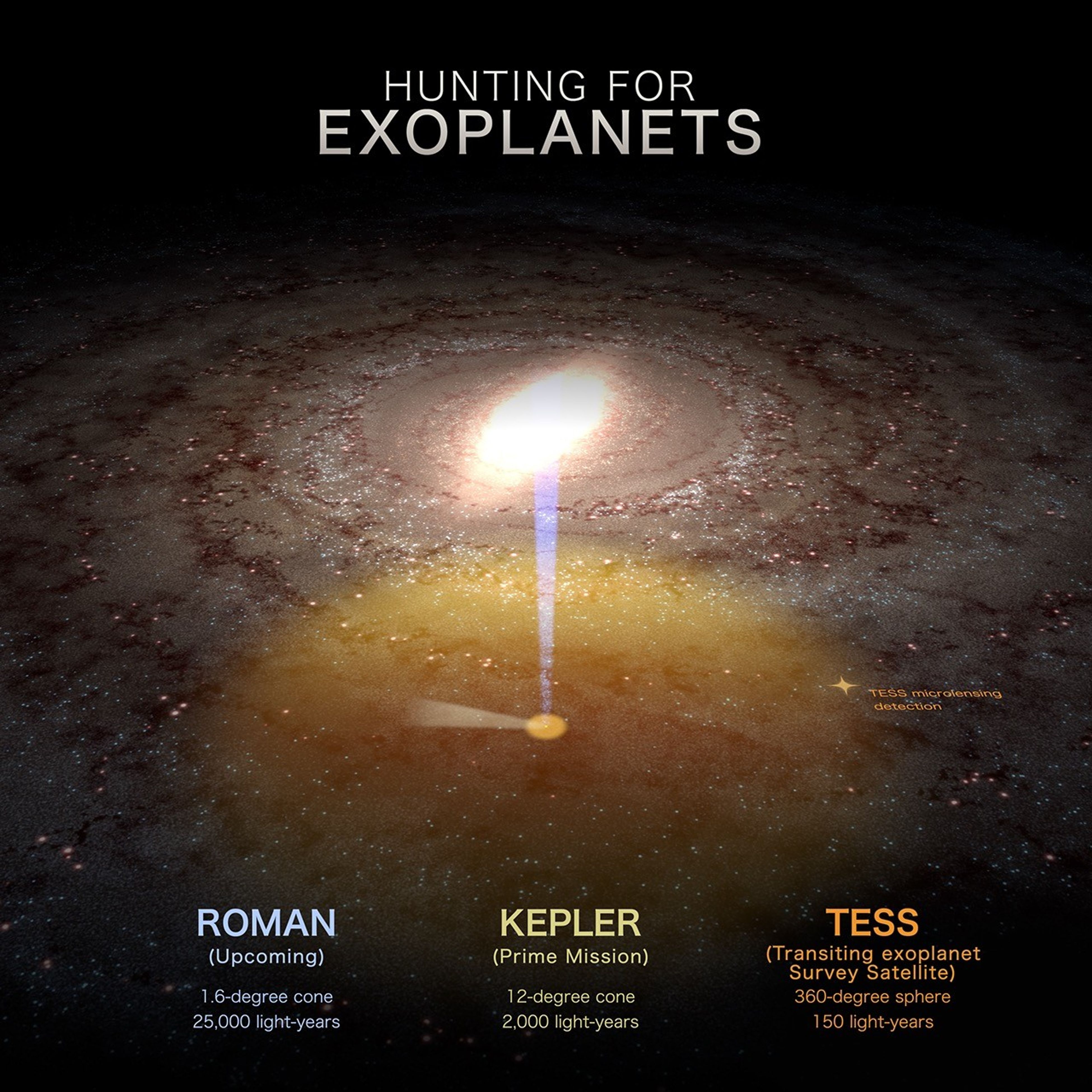
But microlensing observations are time-limited opportunities.
Microlensing events happen once and they’re gone — they don’t repeat. I like to joke that we’ll probably find the first Earth analog with microlensing, and then wave at it as it goes by because we’ll never see it again.Mallory Harris
Ph.D. candidate at the University of New Mexico
That makes detailed observations of microlensing planets tough. However, the method can serve as a powerful demographics tool that offers broad information about planetary populations.
“This is a bit like a preview of the microlensing NASA’s Nancy Grace Roman Space Telescope will do,” said Michael Fausnaugh, a professor at Texas Tech University in Lubbock and a co-author of the study. On track for launch on August 30, 2026, Roman will observe the center of the Milky Way galaxy for one of its core surveys, revealing an estimated 1,000 microlensing planets and around 100,000 transiting planets.
Roman will specifically target the heart of the galaxy because stars are packed so tightly together there, increasing the odds of seeing microlensing events. While that crowding would make many stars blend together in TESS’s larger pixels, TESS looks at nearly the whole sky, where stars are more spread out.
“Since TESS looks elsewhere in the galactic plane, it can naturally find microlensing planets in other parts of the galaxy, as demonstrated by this first microlensing planetary system,” Dragomir said. “That means it could help us study planets in regions with different conditions.”
That could have implications for the search for habitable worlds. The bustling galaxy center is rife with radiation from more frequent supernova explosions, which could sterilize planets. And gravitational encounters between crowded stars may disrupt planetary systems. Observations from TESS focus on a milder part of the galaxy.
“The key to Roman’s microlensing survey is its dense time coverage targeting the galactic bulge,” Fausnaugh said. “The TESS mission uniquely provides these rapid observations for stars in other parts of the galaxy, and pairing the two opens up prospects for understanding planet formation in a diverse population of stars. Since microlensing finds solar system-like planets, this offers a new chance to understand how planetary systems like our own vary in different regions of the galaxy.”
To learn more about the TESS mission, visit:
Media contact:
Claire Andreoli
NASA’s Goddard Space Flight Center, Greenbelt, Md.
301-286-1940
Ashley is the lead science writer for NASA’s Nancy Grace Roman Space Telescope.
Share Details Last Updated Jul 01, 2026 Editor Ashley Balzer Contact Ashley Balzer ashley.m.balzer@nasa.gov Location Goddard Space Flight Center Related Terms Explore More 9 min read Citizen Scientists Spot Jupiter-like Planet in NASA TESS DataArticle
4 years ago
3 min read NASA’s Planet-Hunting TESS Reveals Dazzling Night Sky
NASA’s TESS has released its most complete view of the starry sky to date
Article
2 months ago
7 min read Journey to Center of Milky Way With Upcoming NASA Roman Core Survey
At the heart of our own galaxy, there is a dense thicket of stars with…
Article
5 months ago
6 min read Why NASA’s Roman Mission Will Study Milky Way’s Flickering Lights
NASA’s Nancy Grace Roman Space Telescope will provide one of the deepest-ever views into the…
Article
3 years ago
5 min read NASA’s TESS Finds Intriguing World Sized Between Earth, Venus
Article
2 years ago
Keep Exploring Discover More Topics From NASA
Missions
Humans in Space
Climate Change
Solar System
NASA’s TESS Mission Finds Planetary System in New Way
NASA’s Goddard Space Flight Center
For the first time, NASA’s TESS (Transiting Exoplanet Survey Satellite) mission has identified a planet orbiting a distant star thanks to ripples in space-time. Unlike the star-hugging transiting planets TESS regularly reveals, the newfound world is a super-Jupiter orbiting far from its host star.
“When TESS launched, no one expected it to ever be capable of finding this kind of planet,” said Diana Dragomir, a professor at the University of New Mexico in Albuquerque and co-author of a paper describing the results. At 1.6 times Jupiter’s mass and a similar orbital distance, it would be extremely unlikely to find such a planet via the primary detection method TESS was designed for. “The discovery implies that there are probably other so-called microlensing planets hiding in TESS’s data that we hadn’t previously thought to look for.”
This artist’s concept visualizes Gaia23bra b, the first microlensing planet orbiting a distant star found by NASA’s TESS (Transiting Exoplanet Survey Satellite). This super-Jupiter orbits an orange dwarf star at a distance similar to Jupiter’s distance from the Sun. NASA’s Goddard Space Flight CenterAstronomers found the first hint of the planet, called Gaia23bra b, in 2023 using ESA’s (European Space Agency) now-retired Gaia space telescope. Gaia’s alert system flagged a star that brightened — something that can happen when a foreground star passes in front of a more distant one and magnifies its light through gravitational microlensing.
Researchers later looked back through archived TESS data and found TESS had caught it too.
“Gaia’s observations were too sparse to pick up on the planet,” said Mallory Harris, a Ph.D. candidate at the University of New Mexico, who led the study. “The TESS spacecraft happened to be monitoring the same area of the sky during the event, and its denser time coverage showed extra features in the light curve caused by a planet.”
The team’s analysis, published July 1 in The Astrophysical Journal Letters, revealed that Gaia23bra b, which orbits an orange dwarf star that’s about 80 percent of the Sun’s mass, is nearly 40,000 light-years away from Earth, far exceeding TESS’s usual search radius of about 150 light-years.
Microlensing 101Out of more than 6,000 known exoplanets (worlds outside our solar system), about three-fourths were discovered via the transit method, TESS’s typical planet-hunting technique. Astronomers monitor hordes of stars, watching for ones that periodically dim as orbiting planets cross in front of them — an event called a transit.
This animation illustrates the concept of gravitational microlensing. When one star in the sky (shown in the center of the animation) appears to pass nearly in front of another (located in the dashed circle at the right) from our vantage point, the light rays of the background star become bent due to the warped space-time around the foreground star. This star acts like a virtual magnifying glass, amplifying the brightness of the background star and causing its position to appear to slightly shift. If the nearer star harbors a planetary system, then those planets can also act as lenses, each one producing a short deviation in the brightness of the source. When astronomers find planets this way, they can measure their mass and orbital distance from their host star. NASA’s Goddard Space Flight Center/CI LabMicrolensing has revealed less than 5% of known exoplanets. This light-bending phenomenon occurs when two stars align closely from our vantage point. Light from the more distant star curves as it travels through the warped space-time caused by the nearer star’s mass.
If the alignment is especially close, the nearer star acts like a cosmic lens, focusing and magnifying light from the background star. Planets orbiting the foreground star may also modify the distant star’s light, acting as their own tiny lenses. Astronomers see the effect as a spike in the star’s brightness.
The transit method is best at finding large planets orbiting very close to their host stars; large planets block the most starlight, while close-in planets are more likely to pass in front of the host star. These gargantuan, steamy worlds are fascinating to scientists, but astronomers want to find planets like those in our solar system, too. That’s microlensing’s specialty.
With microlensing, we can find smaller planets with greater orbital distances, including worlds in the habitable zone of their star and even farther away.Mallory harris
Ph.D. candidate at the University of New Mexico
Microlensing isn’t well suited to finding huge, close-in planets because their gravitational signals would just blur together.
“Transits and microlensing are complementary because they each reveal a category of planet the other may not be able to detect,” Dragomir said. “And they offer different details. Transits give us the size of a planet, and in concert with other methods we can determine its mass and density. Microlensing gives us masses and orbital distances for planets we’d otherwise never see.”
This graphic highlights the search areas of three planet-hunting missions: NASA’s upcoming Nancy Grace Roman Space Telescope, the retired Kepler Space Telescope, and NASA’s TESS (Transiting Exoplanet Survey Satellite). While TESS discovers transiting planets within a 150-light-year radius of Earth, it recently detected a planet about 40,000 light-years away (marked by the star symbol) via another method, called microlensing. NASA’s Goddard Space Flight CenterBut microlensing observations are time-limited opportunities.
Microlensing events happen once and they’re gone — they don’t repeat. I like to joke that we’ll probably find the first Earth analog with microlensing, and then wave at it as it goes by because we’ll never see it again.Mallory Harris
Ph.D. candidate at the University of New Mexico
That makes detailed observations of microlensing planets tough. However, the method can serve as a powerful demographics tool that offers broad information about planetary populations.
“This is a bit like a preview of the microlensing NASA’s Nancy Grace Roman Space Telescope will do,” said Michael Fausnaugh, a professor at Texas Tech University in Lubbock and a co-author of the study. On track for launch on August 30, 2026, Roman will observe the center of the Milky Way galaxy for one of its core surveys, revealing an estimated 1,000 microlensing planets and around 100,000 transiting planets.
Roman will specifically target the heart of the galaxy because stars are packed so tightly together there, increasing the odds of seeing microlensing events. While that crowding would make many stars blend together in TESS’s larger pixels, TESS looks at nearly the whole sky, where stars are more spread out.
“Since TESS looks elsewhere in the galactic plane, it can naturally find microlensing planets in other parts of the galaxy, as demonstrated by this first microlensing planetary system,” Dragomir said. “That means it could help us study planets in regions with different conditions.”
That could have implications for the search for habitable worlds. The bustling galaxy center is rife with radiation from more frequent supernova explosions, which could sterilize planets. And gravitational encounters between crowded stars may disrupt planetary systems. Observations from TESS focus on a milder part of the galaxy.
“The key to Roman’s microlensing survey is its dense time coverage targeting the galactic bulge,” Fausnaugh said. “The TESS mission uniquely provides these rapid observations for stars in other parts of the galaxy, and pairing the two opens up prospects for understanding planet formation in a diverse population of stars. Since microlensing finds solar system-like planets, this offers a new chance to understand how planetary systems like our own vary in different regions of the galaxy.”
To learn more about the TESS mission, visit:
Media contact:
Claire Andreoli
NASA’s Goddard Space Flight Center, Greenbelt, Md.
301-286-1940
Ashley is the lead science writer for NASA’s Nancy Grace Roman Space Telescope.
Share Details Last Updated Jul 01, 2026 Editor Ashley Balzer Contact Ashley Balzer ashley.m.balzer@nasa.gov Location Goddard Space Flight Center Related Terms Explore More 9 min read Citizen Scientists Spot Jupiter-like Planet in NASA TESS DataArticle
4 years ago
3 min read NASA’s Planet-Hunting TESS Reveals Dazzling Night Sky
NASA’s TESS has released its most complete view of the starry sky to date
Article
2 months ago
7 min read Journey to Center of Milky Way With Upcoming NASA Roman Core Survey
At the heart of our own galaxy, there is a dense thicket of stars with…
Article
5 months ago
6 min read Why NASA’s Roman Mission Will Study Milky Way’s Flickering Lights
NASA’s Nancy Grace Roman Space Telescope will provide one of the deepest-ever views into the…
Article
3 years ago
5 min read NASA’s TESS Finds Intriguing World Sized Between Earth, Venus
Article
2 years ago
Keep Exploring Discover More Topics From NASA
Missions
Humans in Space
Climate Change
Solar System
Europe’s Future Circular Collider could revolutionize particle physics—if it’s ever built
After decades of debate, the scientific case is clear for Europe’s Future Circular Collider, a colossal successor to the Large Hadron Collider. But transforming this megaproject from vision to reality is far from guaranteed
XMM-Newton helps revise distance to outer spiral arms
The European Space Agency’s XMM-Newton and NASA’s Chandra X-ray space telescopes have spotted the aftermath of three bright explosions echoing through the outer spiral arms of our galaxy, the Milky Way. By measuring the distance to these echoes, they find the outer arms to be up to 10% further away than we thought.
The best new science-fiction novels published in July 2026
The best new science-fiction novels published in July 2026
The Quiet Conversation Between Muscle and Gravity, and What Happens When It Stops
Every muscle in the human body is, in a sense, in constant conversation with gravity, sensing load and responding accordingly to stay strong. Remove that conversation, as happens to astronauts in orbit, and the consequences unfold at a molecular level long before they become visible. New NASA-supported research is tracing exactly how that breakdown happens, using a purpose-built model that mimics weightlessness here on Earth. The surprising twist is where else this knowledge might apply
Slowdown of AMOC ocean current may be gradual and reversible
Slowdown of AMOC ocean current may be gradual and reversible
A Star’s Death Throes Involves a Lot of Kicking
When stars like the Sun reach the end of their lives, the textbook story has them puffing up and quietly shedding their outer layers to leave a white dwarf behind. A new model suggests it is far less serene than that. As dying stars eject mass asymmetrically, each burst delivers a tiny recoil, and over hundreds of thousands of years roughly ten thousand of these kicks add up to send the star drifting through space at a respectable speed. The idea neatly explains why wide binary star systems tend to fall apart once one star becomes a white dwarf, and it hints at something more dramatic still waiting to be confirmed
Galaxy Groups Hiding in the Universe’s Emptiest Places
Even the universe’s emptiest regions, the vast voids that make up most of the volume of space, are not entirely empty. A new study using the CAVITY survey hunts for galaxy groups hiding within these voids, applying a friends of friends technique to chart how nearby galaxies cluster together despite the surrounding emptiness. The results paint a striking picture that most void galaxies actually live entirely solitary lives, yet where groups do form, they are small, loose and curiously indifferent to just how empty their void actually is. It raises a deceptively simple question that turns out to be anything but: in the universe’s quietest neighbourhoods, what makes some galaxies choose company while most remain alone?
Thousands of planets are hidden in this photo
Millions of stars. Thousands of hidden worlds. One unprecedented view of our galaxy.
Three years since launch, ESA’s Euclid space telescope reveals the Milky Way galaxy’s centre in extraordinary detail: a mosaic of tens of millions of stars captured in just 26 hours.But this is more than an image. It is a map of stellar evolution, from dark clouds where stars are being born to ancient populations packed into the galactic bulge.
And hidden within this dense field of light are planets we cannot see directly.
Through gravitational microlensing, astronomers detect distant worlds by measuring tiny, temporary changes in light as stars pass in front of one another, revealing planets and even their masses through gravity alone.
Euclid, originally built to explore dark matter and dark energy, is now helping open a new window on our own galaxy, and the unseen worlds within it.
July Podcast: Spotlight on Spica
This month’s episode highlights the bright star Spica, now prominent high in the southwest after evening twilight. It’s leading the parade of constellations, along with the brilliant planet Venus, that will grace the Northern Hemisphere’s summer skies. You'll also get to know other brights stars in Spica’s vicinity, along with excellent tips on how to be a better stargazer. So grab curiosity and come along on this month’s Sky Tour.
The post July Podcast: Spotlight on Spica appeared first on Sky & Telescope.
The space under
Five explorers from three space agencies have successfully completed ESA’s CAVES training course in Italy.
ESA Outlines High-Tech Lander Instruments for 2050 Enceladus
Saturn’s moon, Enceladus, has become a prime solar system target for astrobiologists. This is because the small moon, which is just over 10 percent the diameter of Earth’s Moon, harbors a vast subsurface ocean beneath its icy crust. This subsurface ocean combined with the geysers at Enceladus’ south pole that discharges bits of this ocean into the void provides scientists with a treasure trove of opportunities for scientific research into whether Enceladus could harbor ingredients for life as we know it, or even direct evidence for life.