
Feed aggregator
How to avoid heat illness and stay safe during the mega heat wave
A heat wave over the Fourth of July weekend could put millions at risk of heat-related illnesses. Here’s what to do to stay safe—and why you don’t just need to drink lots of water
NASA’s Webb Reveals Stars Sparking to Life in Cosmic Celebration
- Webb
- News
- Overview
- Science
- Observatory
- Multimedia
- Team
- More
Image: NASA, ESA, CSA, STScI; Image Processing: Alyssa Pagan (STScI)
NASA’s James Webb Space Telescope has captured the infrared light of numerous features that previously were impossible to see beyond the thick dust of the FS Tau star system. In addition to myriad background galaxies that burst into view like fireworks for the United States’ 250th anniversary celebrations, this image flickers with a number of protostars, or baby stars that are formed from dense pockets of gas and dust. These hot, clumpy, and low-mass objects eventually will become full-fledged stars capable of burning hydrogen in their cores, like our Sun. The protostars of FS Tau are about 1 to 3 million years old, which is relatively young in cosmic scales. Our Sun, by contrast, is 4.6 billion years old.
Low-mass stars emit less radiation and have less energetic stellar winds than those with larger masses, which means they disrupt their environment at a much lower level. This makes the FS Tau region incredibly useful for studying low-mass star evolution without the same level of environmental interference seen near higher-mass stars. A pair of protostars that creates the largest diffraction pattern seen slightly to the left of center in the image, called FS Tau A, is about half the mass of our Sun.
Image: FS Tau (Webb Image) In infrared light, NASA’s James Webb Space Telescope reveals bright protostars in star system FS Tau and a tapestry of background galaxies. FS Tau B, the orange protostar slightly right of center, is thought to be responsible for the orange outflows amid the dusty region. Image: NASA, ESA, CSA, STScI; Image Processing: Alyssa Pagan (STScI)
Even though these objects are young and low-mass, they still can impact their surroundings, partially due to the outflows they emit. These outflows, seen as orange and red wisps and wide sheets, are theorized to come from FS Tau B, the protostar slightly to the right of center that has an orange diffraction pattern. As FS Tau B feeds on the surrounding dust and gas to grow, it ejects some of that matter outward. The wider outflows are thought to come from the interaction between the protostar’s magnetic field and superheated matter closest to the protostar within its accretion disk. The disk is seen as a dark band that cuts across at a 30-degree angle.
The gaps between the outflows, newly discovered in this Webb observation, add to growing evidence that protostars accrete matter in discrete episodes. In the periods where protostars gather material and increase in mass, they also eject superheated matter in different directions. In between these episodes, they are relatively quiet.
Image: FS Tau Side-by-Side (Webb and Hubble Image) A comparison between the observations of FS Tau by NASA’s Hubble and James Webb space telescopes. Hubble’s visible-light view shows the star-forming region mostly obscured by thick dust. Webb sees through the dust, revealing how the protostars are shaping their surroundings. Image: NASA, ESA, CSA, STScI; Image Processing: Alyssa Pagan (STScI)
As protostars eject these outflows, they shape their surroundings. This is best shown by the prominent light-blue ridges of dust and gas near FS Tau B. These thicker regions were likely created as outflows struck and compressed matter together. The brightness of these light-blue ridges shows that the nearby protostar’s light is reflected. Moreover, Webb’s sensitivity reveals the varying textures of dust and gas across the entire region.
The range of colors seen in this observation also provides a wealth of information, specifically about where dust is and how much of it obscures the region. Light with bluer wavelengths is absorbed and scattered by dust, while redder-wavelength light is able to slip through. Therefore, background galaxies behind thicker foreground dust appear redder. Alternatively, yellow galaxies have much less dust obscuring them. The few white stars visible in this image are likely in the foreground.
The James Webb Space Telescope is the world’s premier space science observatory. Webb is solving mysteries in our solar system, looking beyond to distant worlds around other stars, and probing the mysterious structures and origins of our universe and our place in it. Webb is an international program led by NASA with its partners, ESA (European Space Agency) and CSA (Canadian Space Agency).
To learn more about Webb, visit:
Downloads & Related InformationThe following sections contain links to download this article’s images and videos in all available resolutions followed by related information links, media contacts, and if available, research paper and Spanish translation links.
Related Images & Videos FS Tau (Webb Image)In infrared light, NASA’s James Webb Space Telescope reveals bright protostars in star system FS Tau and a tapestry of background galaxies. FS Tau B, the orange protostar slightly right of center, is thought to be responsible for the orange outflows amid the dusty region.
FS Tau Side-by-Side (Webb and Hubble Image)
A comparison between the observations of FS Tau by NASA’s Hubble and James Webb space telescopes. Hubble’s visible-light view shows the star-forming region mostly obscured by thick dust. Webb sees through the dust, revealing how the protostars are shaping their surroundings.
FS Tau (Webb Compass Image)
An image of FS Tau captured by Webb’s NIRCam (Near-Infrared Camera), with compass arrows, scale bar, and color key for reference.
Related Links
Read more: Webb’s Star Formation Discoveries
Explore more: ViewSpace | Image Tour: Herbig-Haro 46/47
Watch: Herbig-Haro 49/50 Stellar Jets Visualization
Explore more: ViewSpace | Star formation in the Eagle Nebula
Watch: Celestial Lightsabers: Stellar Jets in HH24
More Webb: News | Images | Science | Home Page
Contact Media
Laura Betz
NASA’s Goddard Space Flight Center
Greenbelt, Maryland
laura.e.betz@nasa.gov
Matthew Brown
Space Telescope Science Institute
Baltimore, Maryland
Abigail Major
Space Telescope Science Institute
Baltimore, Maryland
Related Terms Keep Exploring Related Topics James Webb Space Telescope
Webb is the premier observatory of the next decade, serving thousands of astronomers worldwide. It studies every phase in the…
Stars
Stars Stories
Universe
NASA’s Webb Reveals Stars Sparking to Life in Cosmic Celebration
- Webb
- News
- Overview
- Science
- Observatory
- Multimedia
- Team
- More
Image: NASA, ESA, CSA, STScI; Image Processing: Alyssa Pagan (STScI)
NASA’s James Webb Space Telescope has captured the infrared light of numerous features that previously were impossible to see beyond the thick dust of the FS Tau star system. In addition to myriad background galaxies that burst into view like fireworks for the United States’ 250th anniversary celebrations, this image flickers with a number of protostars, or baby stars that are formed from dense pockets of gas and dust. These hot, clumpy, and low-mass objects eventually will become full-fledged stars capable of burning hydrogen in their cores, like our Sun. The protostars of FS Tau are about 1 to 3 million years old, which is relatively young in cosmic scales. Our Sun, by contrast, is 4.6 billion years old.
Low-mass stars emit less radiation and have less energetic stellar winds than those with larger masses, which means they disrupt their environment at a much lower level. This makes the FS Tau region incredibly useful for studying low-mass star evolution without the same level of environmental interference seen near higher-mass stars. A pair of protostars that creates the largest diffraction pattern seen slightly to the left of center in the image, called FS Tau A, is about half the mass of our Sun.
Image: FS Tau (Webb Image) In infrared light, NASA’s James Webb Space Telescope reveals bright protostars in star system FS Tau and a tapestry of background galaxies. FS Tau B, the orange protostar slightly right of center, is thought to be responsible for the orange outflows amid the dusty region. Image: NASA, ESA, CSA, STScI; Image Processing: Alyssa Pagan (STScI)Even though these objects are young and low-mass, they still can impact their surroundings, partially due to the outflows they emit. These outflows, seen as orange and red wisps and wide sheets, are theorized to come from FS Tau B, the protostar slightly to the right of center that has an orange diffraction pattern. As FS Tau B feeds on the surrounding dust and gas to grow, it ejects some of that matter outward. The wider outflows are thought to come from the interaction between the protostar’s magnetic field and superheated matter closest to the protostar within its accretion disk. The disk is seen as a dark band that cuts across at a 30-degree angle.
The gaps between the outflows, newly discovered in this Webb observation, add to growing evidence that protostars accrete matter in discrete episodes. In the periods where protostars gather material and increase in mass, they also eject superheated matter in different directions. In between these episodes, they are relatively quiet.
Image: FS Tau Side-by-Side (Webb and Hubble Image) A comparison between the observations of FS Tau by NASA’s Hubble and James Webb space telescopes. Hubble’s visible-light view shows the star-forming region mostly obscured by thick dust. Webb sees through the dust, revealing how the protostars are shaping their surroundings. Image: NASA, ESA, CSA, STScI; Image Processing: Alyssa Pagan (STScI)As protostars eject these outflows, they shape their surroundings. This is best shown by the prominent light-blue ridges of dust and gas near FS Tau B. These thicker regions were likely created as outflows struck and compressed matter together. The brightness of these light-blue ridges shows that the nearby protostar’s light is reflected. Moreover, Webb’s sensitivity reveals the varying textures of dust and gas across the entire region.
The range of colors seen in this observation also provides a wealth of information, specifically about where dust is and how much of it obscures the region. Light with bluer wavelengths is absorbed and scattered by dust, while redder-wavelength light is able to slip through. Therefore, background galaxies behind thicker foreground dust appear redder. Alternatively, yellow galaxies have much less dust obscuring them. The few white stars visible in this image are likely in the foreground.
The James Webb Space Telescope is the world’s premier space science observatory. Webb is solving mysteries in our solar system, looking beyond to distant worlds around other stars, and probing the mysterious structures and origins of our universe and our place in it. Webb is an international program led by NASA with its partners, ESA (European Space Agency) and CSA (Canadian Space Agency).
To learn more about Webb, visit:
Downloads & Related InformationThe following sections contain links to download this article’s images and videos in all available resolutions followed by related information links, media contacts, and if available, research paper and Spanish translation links.
Related Images & Videos FS Tau (Webb Image)In infrared light, NASA’s James Webb Space Telescope reveals bright protostars in star system FS Tau and a tapestry of background galaxies. FS Tau B, the orange protostar slightly right of center, is thought to be responsible for the orange outflows amid the dusty region.
FS Tau Side-by-Side (Webb and Hubble Image)
A comparison between the observations of FS Tau by NASA’s Hubble and James Webb space telescopes. Hubble’s visible-light view shows the star-forming region mostly obscured by thick dust. Webb sees through the dust, revealing how the protostars are shaping their surroundings.
FS Tau (Webb Compass Image)
An image of FS Tau captured by Webb’s NIRCam (Near-Infrared Camera), with compass arrows, scale bar, and color key for reference.
Related Links
Read more: Webb’s Star Formation Discoveries
Explore more: ViewSpace | Image Tour: Herbig-Haro 46/47
Watch: Herbig-Haro 49/50 Stellar Jets Visualization
Explore more: ViewSpace | Star formation in the Eagle Nebula
Watch: Celestial Lightsabers: Stellar Jets in HH24
More Webb: News | Images | Science | Home Page
Contact Media
Laura Betz
NASA’s Goddard Space Flight Center
Greenbelt, Maryland
laura.e.betz@nasa.gov
Matthew Brown
Space Telescope Science Institute
Baltimore, Maryland
Abigail Major
Space Telescope Science Institute
Baltimore, Maryland
Related Terms Keep Exploring Related Topics James Webb Space Telescope
Webb is the premier observatory of the next decade, serving thousands of astronomers worldwide. It studies every phase in the…
Stars
Stars Stories
Universe
Why digital government records are so hard to preserve
Chat apps, e-mail, and cloud files have become the primary record of how power is exercised. Archivists are trying to preserve them before formats go dark or messages disappear without a trace
Cotton-Candy Exoplanets: Two for the Price of One!
NASA’s Transiting Exoplanet Survey Satellite has found two “super-puff” planets in the same system, each one as light as cotton candy.
The post Cotton-Candy Exoplanets: Two for the Price of One! appeared first on Sky & Telescope.
The White House goes all in on aliens with new UAP Science Advisory Council
This new group, which is led by Harvard professor Avi Loeb, aims to advise the Trump administration and the U.S. intelligence community, as well as to publish its findings in peer-reviewed journals
Surface CubeSat contracted for Ramses asteroid mission
The European Space Agency has contracted Spanish company EMXYS for the first CubeSat designed to operate on the surface of an asteroid. Don Quijote is a shoebox-sized spacecraft that will be deployed onto the Apophis asteroid by ESA’s Ramses mission before the asteroid flies by Earth on 13 April 2029.
Authorisation paves the way for Aeolus-2 wind mission
Building on the remarkable success of the Earth Explorer Aeolus wind mission, the European Space Agency has given Airbus Defence and Space in the UK the authorisation to proceed to begin the development of Aeolus’ successor, Aeolus-2 – which is set to be built to enhance operational weather forecasts.
Ancient cave paintings can harbor human DNA for millennia, scientists find
The breakthrough could reveal previously hidden ancient human activity inside caves acting as “genetic archives”
What’s Up: July 2026 Skywatching Tips from NASA
A predawn Moon-and-planets meetup, a returning comet, a great chance to see the Milky Way, and Saturn’s rings at a new angle.
Skywatching Highlights- July 7: Last Quarter Moon
- July 11 + 12: Dawn alignment of the Moon, Mars, Saturn, and Uranus
- July 14: New Moon; best dark-sky window for Comet 10P/Tempel 2 and the Milky Way
- Later in July: Saturn’s unusually thin rings are a rewarding telescope target
- July 21: First Quarter Moon
- July 29: Full Moon
An early morning hangout with the Moon and planets, a comet swings by, prime time for the Milky Way, and Saturn’s rings shine at a new angle. That’s What’s Up for July.
Before sunrise on July 11 and 12, look toward the eastern sky for a lineup of the Moon and planets. On these mornings, the waning crescent Moon helps point the way to Mars, with Saturn shining nearby in the morning sky.
Uranus is in the same general part of the sky, too, but it is much fainter, so you will need binoculars or a telescope to see it.
Mars will look like a small reddish point of light, Saturn is brighter and easier to spot, and the Moon makes the whole scene easy to locate.
Before sunrise on July 11 and 12, the Moon, Mars, Saturn, and Uranus will parade in the eastern sky. NASA/JPL-Caltech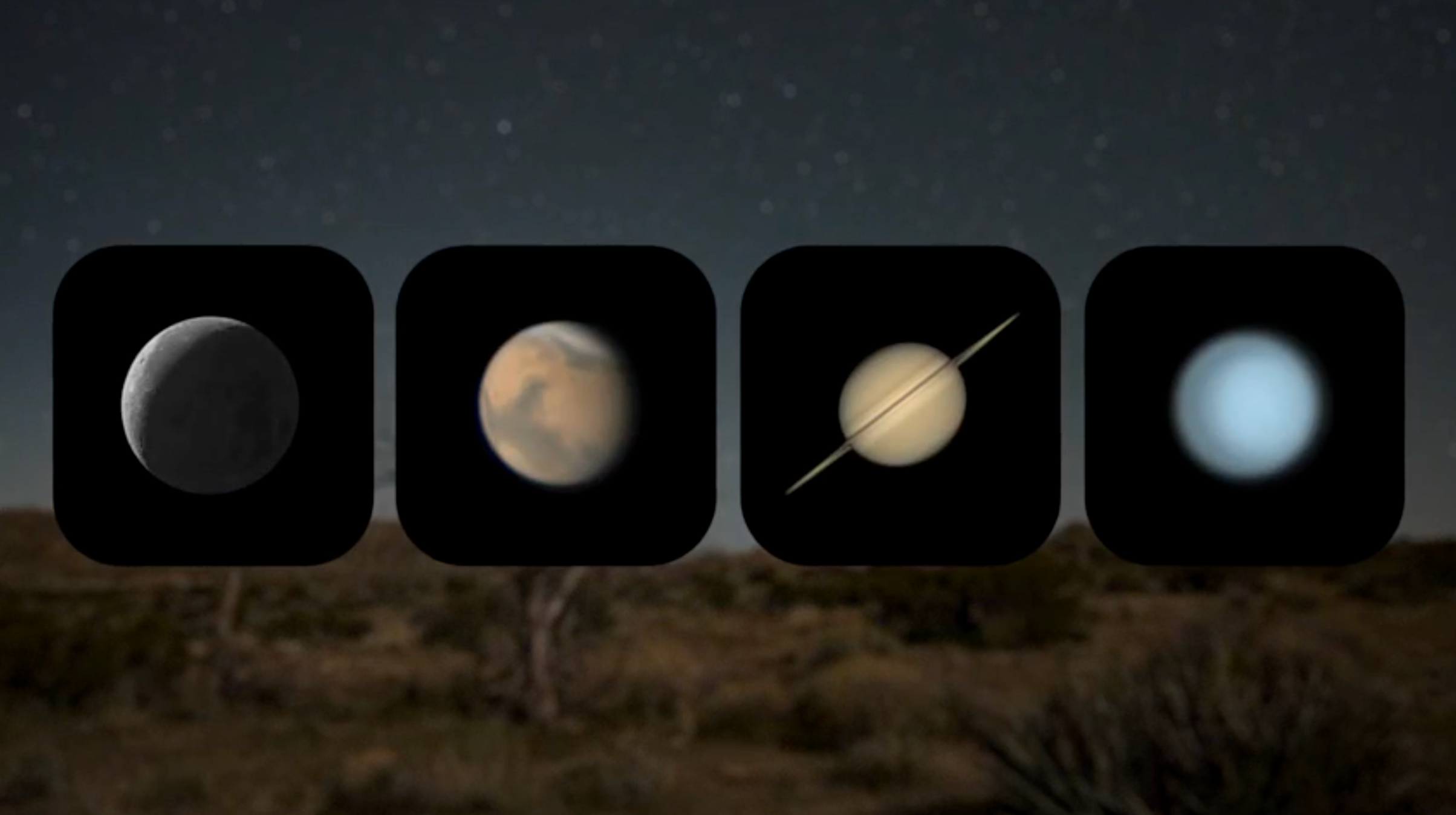
Around the New Moon on July 14, Comet 10P/Tempel 2 swings by.
This is a short-period comet, meaning it returns to the inner solar system on a regular orbit. In this case, it comes back about every 5½ years. It is not a dramatic comet that you see just by looking up at the sky, though.
Through binoculars or a telescope, find the constellation Capricornus and look for a small fuzzy glow nearby, possibly with a brighter central knot and a short, broad, fan-shaped tail.
For the best chance to view the comet, head somewhere dark, away from city lights. Start looking once the sky is fully dark, ideally about 45 to 60 minutes after sunset.
NASA/JPL-Caltech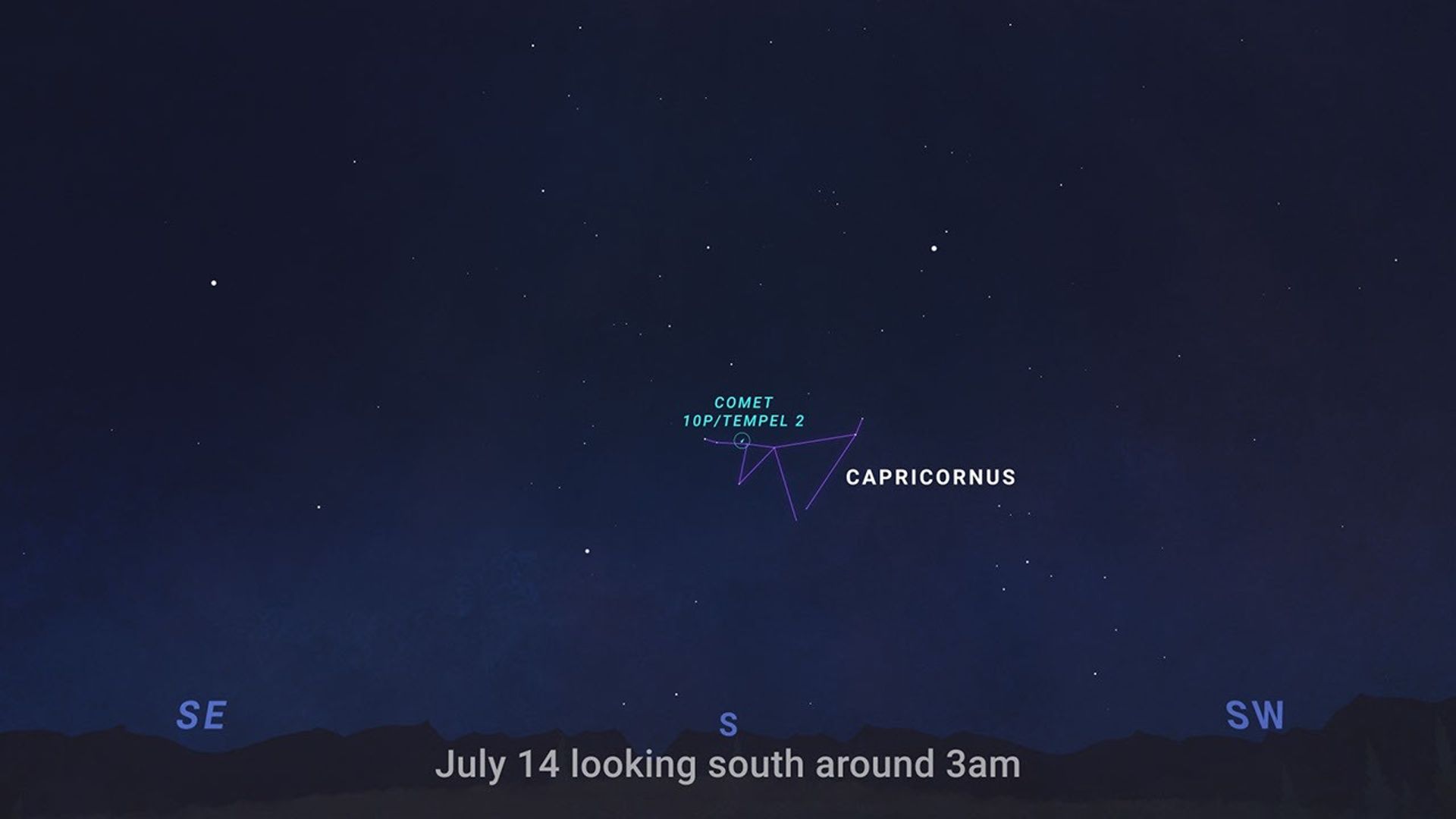
Those same dark nights around the July 14 New Moon are also the best time this month to look for the Milky Way.
From a dark location, away from city lights, the Milky Way appears as a pale, cloudy band across the summer sky. The bright, cloudy region of the Milky Way marks the direction of the galactic center. It looks so dense because we’re looking toward one of the most crowded parts of our galaxy, where countless stars glow behind dark clouds of cosmic dust.
Late in the evening, look low in the southern sky for a group of stars shaped like a big hook or scorpion tail. That’s Scorpius. The bright, cloudy part of the Milky Way is nearby, close to another group of stars called Sagittarius.
For the best chance to see the Milky Way, go somewhere dark, give your eyes time to adjust, and try not to look at your phone.
NASA/JPL-Caltech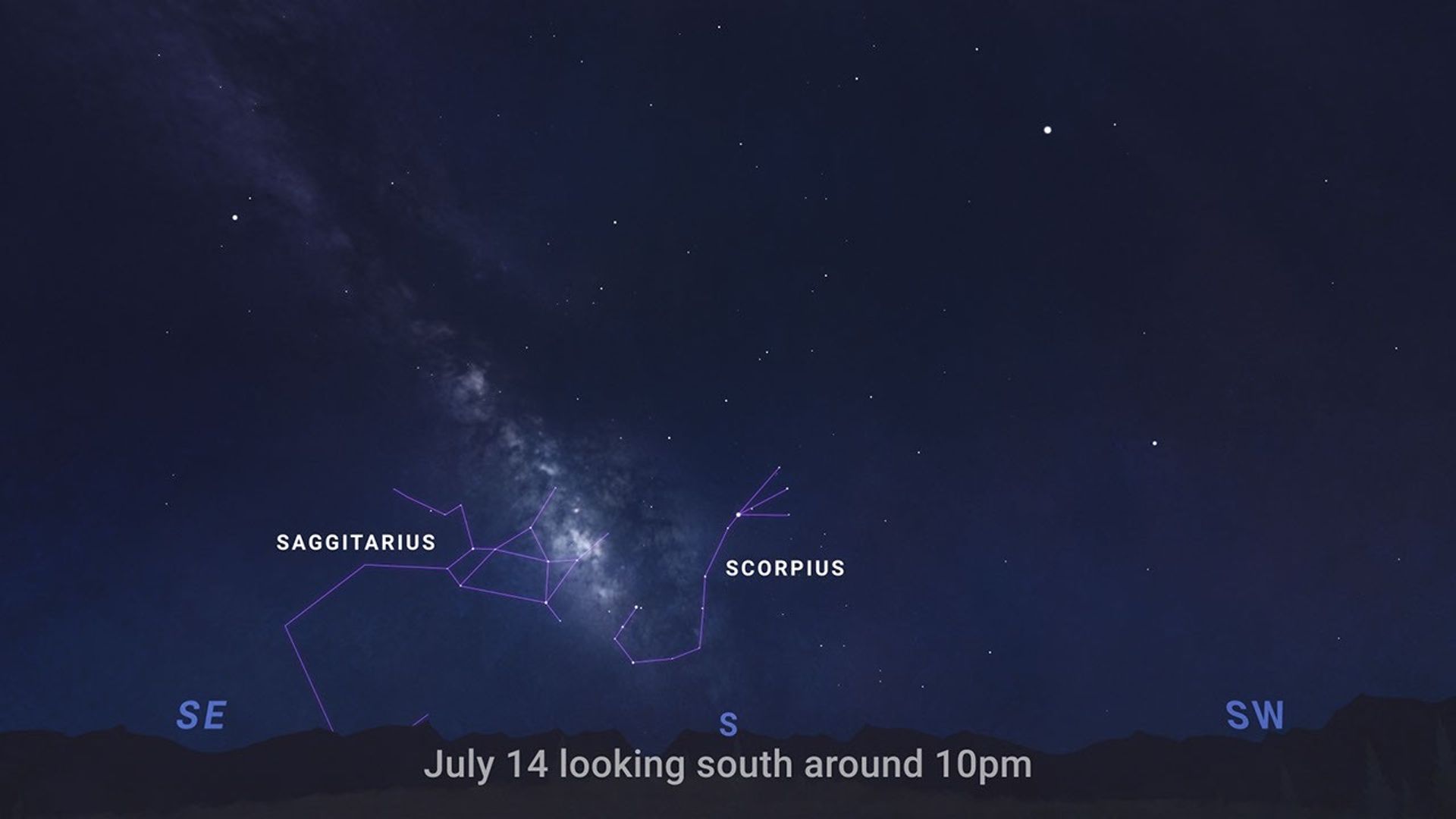
Later in July, Saturn is a rewarding target for telescope users.
Saturn’s rings are still tilted at a very shallow angle from our point of view, making them look unusually thin. The rings aren’t disappearing, but how they appear from Earth is changing. It’s a great reminder that our view of the solar system is always in motion.
Saturn is famous for the intriguing rings that encircle it. As Saturn orbits the Sun, though, our view of its rings changes. Roughly every 15 years (halfway through Saturn’s almost-30-year orbit), Saturn’s rings appear edge-on, sometimes seeming to disappear altogether. On Feb. 24, 2009, when Saturn’s rings were nearly edge-on, Hubble tracked four of Saturn’s moons as they passed across the face of the giant ringed planet. NASA, ESA, and the Hubble Heritage Team (STScI/AURA)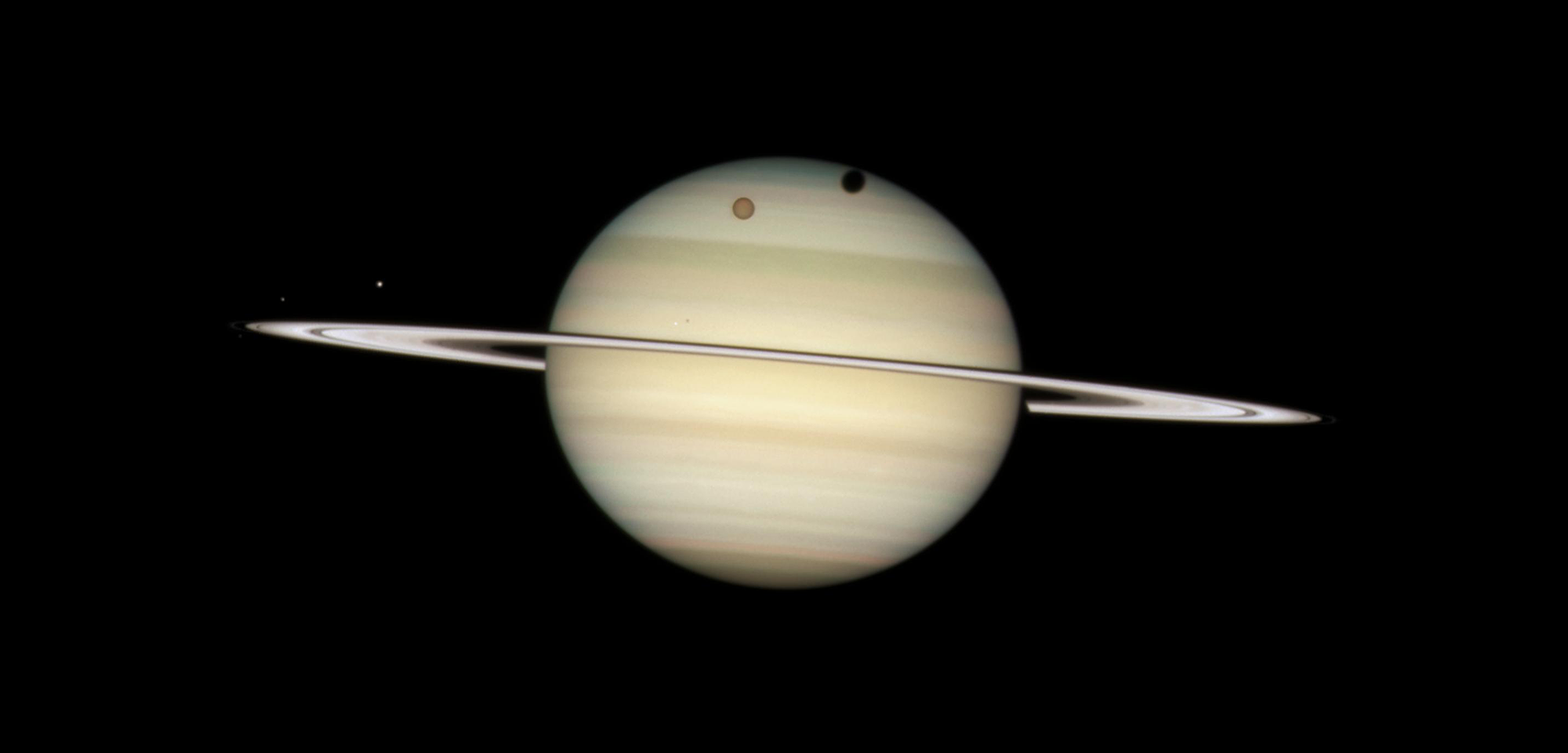
Here are the phases of the Moon for July.
NASA/JPL-Caltech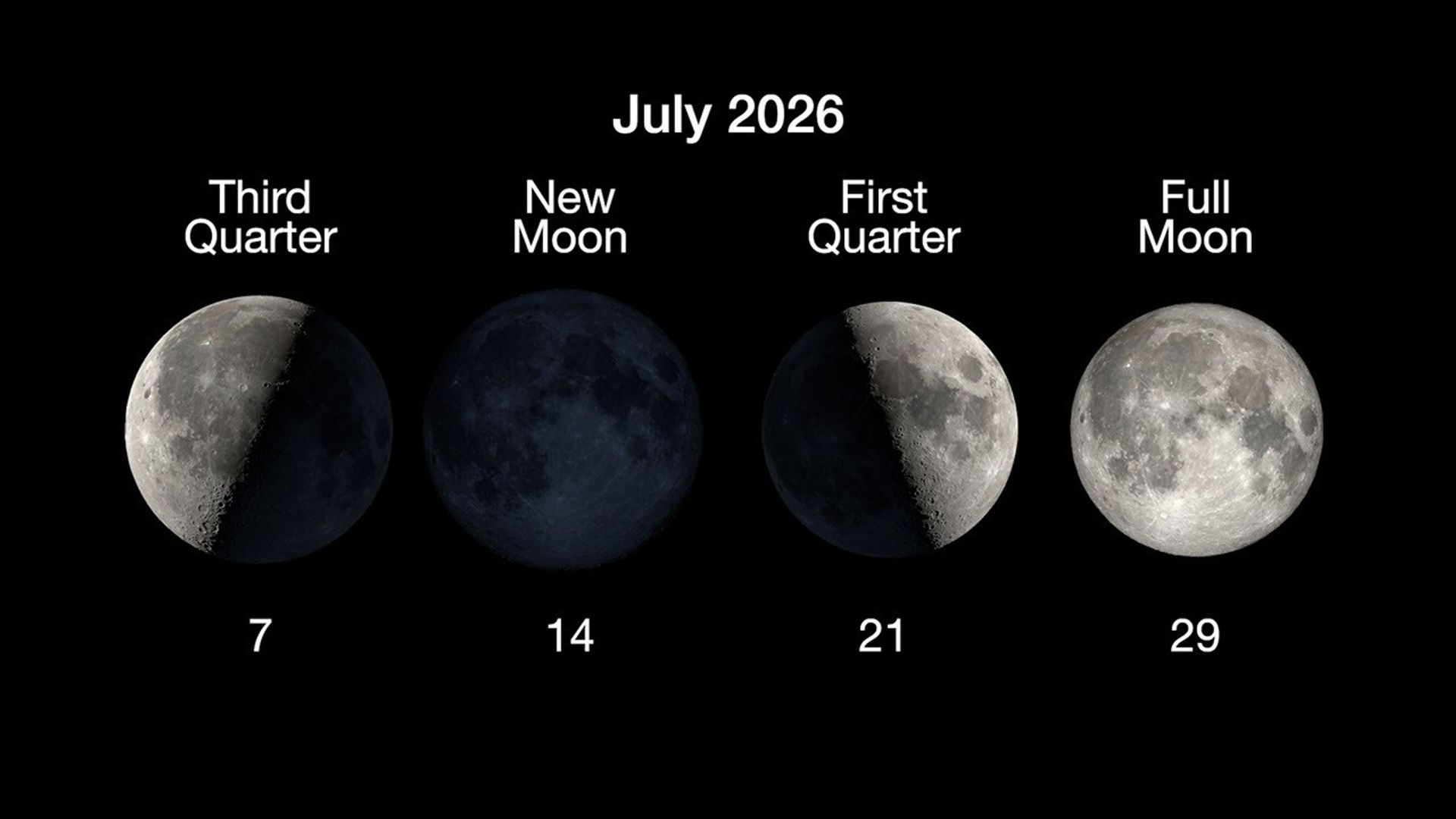
You can stay up to date on all of NASA’s missions exploring the solar system and beyond at science.nasa.gov. I’m Raquel Villanueva from NASA’s Jet Propulsion Laboratory, and that’s What’s Up for this month.
Find skywatching events and clubs with NASA’s Night Sky Network
More skywatching resources from NASA
Keep Exploring Discover More Topics From NASA
What’s Up
Skywatching
Galaxies
Stars
What’s Up: July 2026 Skywatching Tips from NASA
A predawn Moon-and-planets meetup, a returning comet, a great chance to see the Milky Way, and Saturn’s rings at a new angle.
Skywatching Highlights- July 7: Last Quarter Moon
- July 11 + 12: Dawn alignment of the Moon, Mars, Saturn, and Uranus
- July 14: New Moon; best dark-sky window for Comet 10P/Tempel 2 and the Milky Way
- Later in July: Saturn’s unusually thin rings are a rewarding telescope target
- July 21: First Quarter Moon
- July 29: Full Moon
An early morning hangout with the Moon and planets, a comet swings by, prime time for the Milky Way, and Saturn’s rings shine at a new angle. That’s What’s Up for July.
Before sunrise on July 11 and 12, look toward the eastern sky for a lineup of the Moon and planets. On these mornings, the waning crescent Moon helps point the way to Mars, with Saturn shining nearby in the morning sky.
Uranus is in the same general part of the sky, too, but it is much fainter, so you will need binoculars or a telescope to see it.
Mars will look like a small reddish point of light, Saturn is brighter and easier to spot, and the Moon makes the whole scene easy to locate.
Before sunrise on July 11 and 12, the Moon, Mars, Saturn, and Uranus will parade in the eastern sky. NASA/JPL-CaltechAround the New Moon on July 14, Comet 10P/Tempel 2 swings by.
This is a short-period comet, meaning it returns to the inner solar system on a regular orbit. In this case, it comes back about every 5½ years. It is not a dramatic comet that you see just by looking up at the sky, though.
Through binoculars or a telescope, find the constellation Capricornus and look for a small fuzzy glow nearby, possibly with a brighter central knot and a short, broad, fan-shaped tail.
For the best chance to view the comet, head somewhere dark, away from city lights. Start looking once the sky is fully dark, ideally about 45 to 60 minutes after sunset.
NASA/JPL-CaltechThose same dark nights around the July 14 New Moon are also the best time this month to look for the Milky Way.
From a dark location, away from city lights, the Milky Way appears as a pale, cloudy band across the summer sky. The bright, cloudy region of the Milky Way marks the direction of the galactic center. It looks so dense because we’re looking toward one of the most crowded parts of our galaxy, where countless stars glow behind dark clouds of cosmic dust.
Late in the evening, look low in the southern sky for a group of stars shaped like a big hook or scorpion tail. That’s Scorpius. The bright, cloudy part of the Milky Way is nearby, close to another group of stars called Sagittarius.
For the best chance to see the Milky Way, go somewhere dark, give your eyes time to adjust, and try not to look at your phone.
NASA/JPL-CaltechLater in July, Saturn is a rewarding target for telescope users.
Saturn’s rings are still tilted at a very shallow angle from our point of view, making them look unusually thin. The rings aren’t disappearing, but how they appear from Earth is changing. It’s a great reminder that our view of the solar system is always in motion.
Saturn is famous for the intriguing rings that encircle it. As Saturn orbits the Sun, though, our view of its rings changes. Roughly every 15 years (halfway through Saturn’s almost-30-year orbit), Saturn’s rings appear edge-on, sometimes seeming to disappear altogether. On Feb. 24, 2009, when Saturn’s rings were nearly edge-on, Hubble tracked four of Saturn’s moons as they passed across the face of the giant ringed planet. NASA, ESA, and the Hubble Heritage Team (STScI/AURA)Here are the phases of the Moon for July.
NASA/JPL-CaltechYou can stay up to date on all of NASA’s missions exploring the solar system and beyond at science.nasa.gov. I’m Raquel Villanueva from NASA’s Jet Propulsion Laboratory, and that’s What’s Up for this month.
Find skywatching events and clubs with NASA’s Night Sky Network
More skywatching resources from NASA
Keep Exploring Discover More Topics From NASA
What’s Up
Skywatching
Galaxies
Stars
What is 'SpudCell'? Arguably the greatest bioengineering feat yet
What is 'SpudCell'? Arguably the greatest bioengineering feat yet
Have scientists really made a living cell from scratch? Not quite
NASA’s Chandra Examines Milky Way at Arms’ Length
5 min read
NASA’s Chandra Examines Milky Way at Arms’ LengthTo view this video please enable JavaScript, and consider upgrading to a web browser that
supports HTML5 video
A new result using NASA’s Chandra X-ray Observatory shows that the outer spiral arms in the Milky Way galaxy may reach wider than previously thought. This finding may lead astronomers to adjust their understanding of our home galaxy’s structure.
A team of astronomers made this discovery by making precise measurements of distances to dust clouds in the Milky Way’s spiral arms using data from both NASA’s Chandra and XMM-Newton, an ESA (European Space Agency) mission with NASA contributions. The results are described in a new paper published Wednesday in the Astronomy & Astrophysics journal.
The researchers determined the distances by studying rings around gamma-ray bursts, some of the brightest bursts of light in the universe, which arise from the collapse of massive stars or the merger of neutron stars. They are located at enormous distances, well beyond the confines of our galaxy.
An artist’s concept showing the Milky Way galaxy as seen from above, with the estimated positions of spiral arms based on previous data, in blue. Overlaid on this is an updated view of the Milky Way showing different positions for the two outermost spiral arms, shown in red and bordered by dashed lines. Both arms may be more distant than previously thought, based on newly processed X-ray data from Chandra and XMM. NASA/CXC/SAO/M.Weiss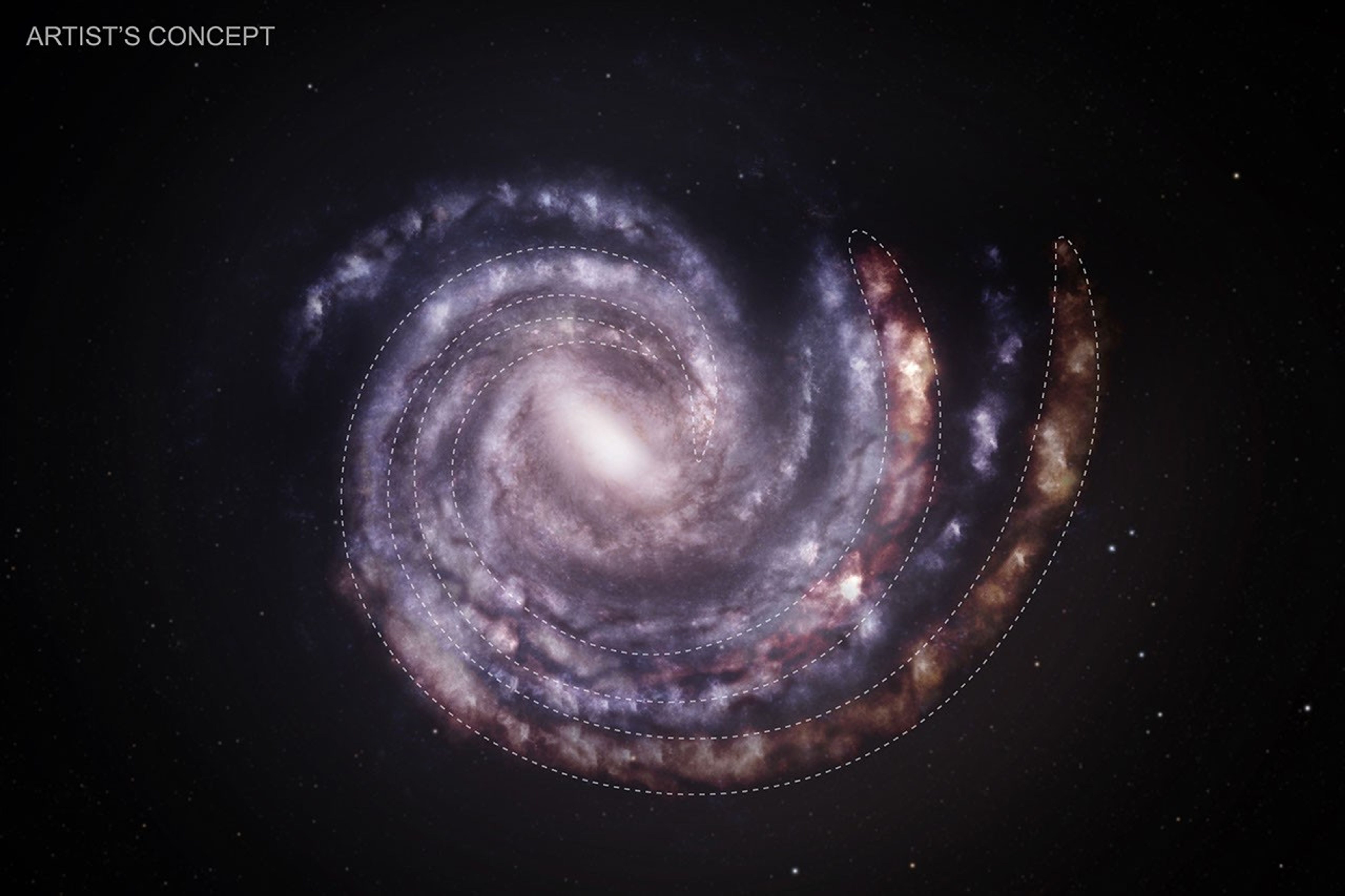
This distance measurement technique capitalized on the phenomenon of light echoes, where the light from the gamma-ray burst bounced off dust clouds in the spiral arms. The diameters of the rings in X-rays give the distances to Earth, with larger rings being generated by dust clouds closer to us.
“This is a very direct way – relying only on geometry – to precisely measure distances to the Milky Way’s spiral arms,” said Beatrice Vaia, who led the study while a PhD student in a joint program between Scuola Universitaria Superiore IUSS Pavia and University of Trento in Italy. “Most other methods rely on assumptions about how the Milky Way rotates, which become increasingly uncertain in the outer regions of our galaxy.”
Despite a century of awareness of the Milky Way’s spiral arms, astronomers are still working toward precise characterization of its arms because of Earth’s position within one. Dust and gas also block the view to other arms.
The researchers used three different gamma-ray bursts to determine the distances to three spiral arms in the Milky Way. In order of increasing distances from the Galactic Center, they are the Perseus, the Outer, and the Outer Scutum-Centaurus arms. Along the direction of one of the bursts, they found that both the Outer and Outer Scutum-Centaurus arms are about 10% more distant than astronomers previously thought.
“The differences are small, but any revision of these distances is important because they are so fundamental for understanding our galaxy,” said co-author Ilaria Fornasiero, who was a PhD student in the same program as the leading author. “For example, this could mean that astronomers have to revise estimates of the mass of the galaxy, because that affects how wide the arms stretch.”
The images include X-ray data from Chandra and optical data from Pan-STARRS. The composite image shows X-ray rings generated by a gamma-ray burst (GRB), a bright X-ray source located outside our galaxy. In a phenomenon called light echoes, the X-rays from the GRB bounced off dust clouds in the spiral arms of our galaxy. The diameters of the rings in the Chandra data give the distances of the dust clouds to Earth, with larger rings being generated by dust clouds closer to us. The GRB is located at the center of the circles defining the rings, to the left of the X-ray data outlined by the white square. X-ray: NASA/CXC/INAF/B. Vaia et al.; Optical: Pan-STARRS; Image processing: NASA/CXC/SAO/N.Wolk & P.Edmonds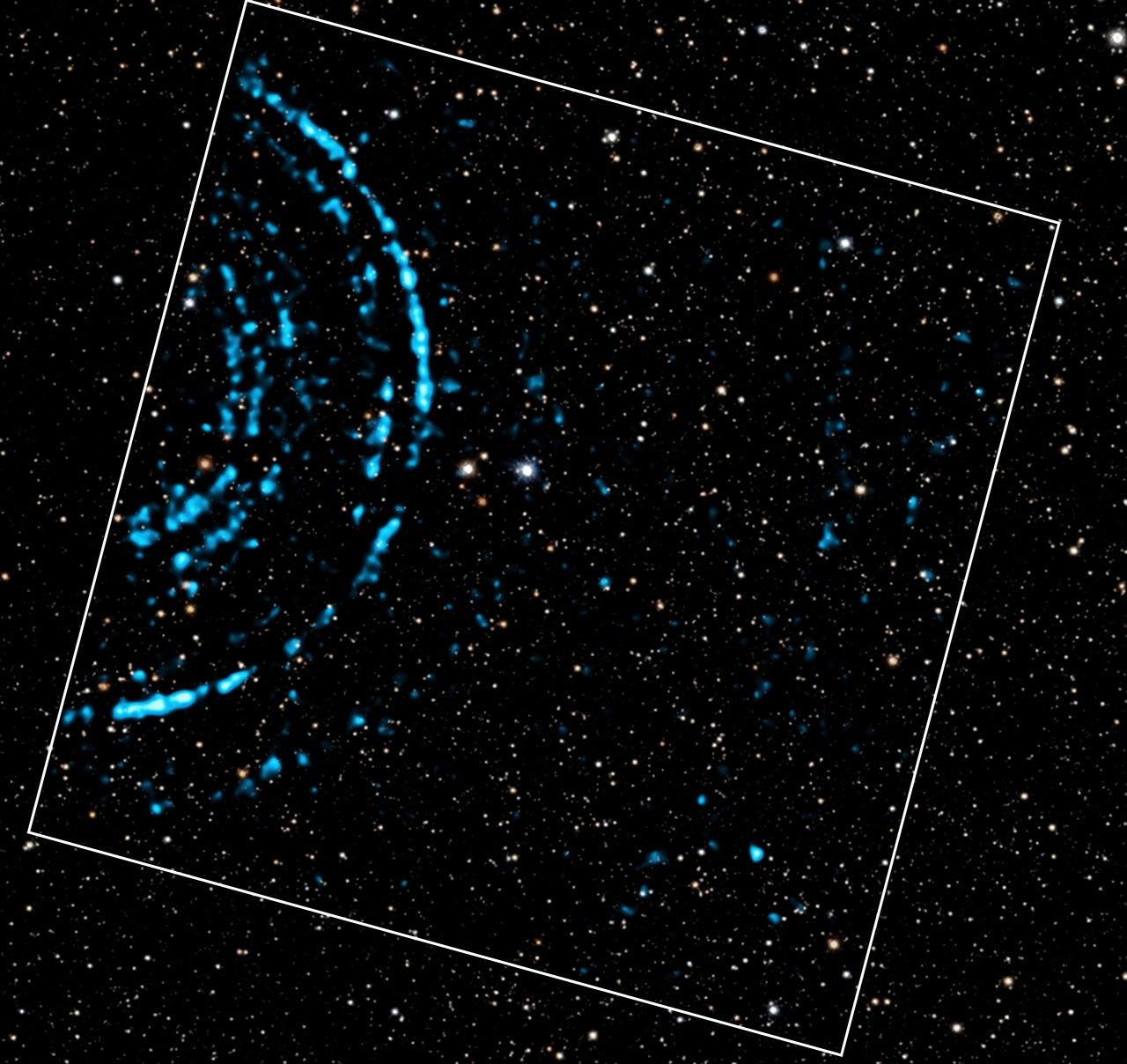
The team also used their data to estimate that the dust cloud in the most distant arm is about 3,500 light-years wide. These findings show that their measurements apply to the full thickness of the spiral arm, rather than a random, isolated dust cloud that may not fully be representative of the arm’s location.
While this technique provided major improvements in accuracy according to the researchers, it may be difficult to use it for further measurements because bright gamma-ray bursts that are visible through the plane of the galaxy are rare.
“We’re relying on the universe to provide us with these events, and so far, over 25 years, we’ve only found a handful that we can use,” said co-author Andrea Tiengo of Scuola Universitaria Superiore IUSS Pavia. “That said, we will continue to be on the lookout for more.”
NASA’s Marshall Space Flight Center in Huntsville, Alabama, manages the Chandra program. The Smithsonian Astrophysical Observatory’s Chandra X-ray Center controls science operations from Cambridge, Massachusetts, and flight operations from Burlington, Massachusetts.
Read more from NASA’s Chandra X-ray Observatory
To learn more about Chandra, visit:
To learn more about NASA’s Chandra mission, visit:
Visual DescriptionThis release features a short video and a series of images, all related to an updated understanding of our home galaxy’s structure. By studying rings of X-ray light echoes, researchers now believe that two of the Milky Way’s spiral arms may be more distant from the center of the galaxy than previously thought.
The updated understanding of the structure of the Milky Way is highlighted in a short video, which compares two artist concept images. In both images, our spiral Milky Way galaxy is shown face-on. It has a bright white core with several arms that spiral out from the center, like long thin clouds corkscrewing counterclockwise. The two longest arms make a full rotation of the spiral galaxy, and curve all the way around to the upper right of the images.
The first image in the video shows the previous understanding of the Milky Way. Here, the two longest arms are curled around the core in a fairly tight spiral. In the second image, which represents the updated understanding, the two longest arms are more loosely spiraled. Visually, this means there is more open space between the curving arms, which are further away from the bright galaxy core. The video fades back and forth between the two artist concept images to illustrate the structural differences between the two understandings.
These findings are further shown by a static image which overlays the new understanding on top of the earlier understanding. In this artist’s concept illustration, dotted lines and different colors are used to differentiate between the two.
A team of astronomers made this discovery by studying gamma-ray bursts that bounce off of dust clouds in the galaxy’s spiral arms. The resulting rings of X-rays, known as light echoes, were detected and mapped by NASA’s Chandra X-ray Observatory and ESA’s XMM-Newton. In a supplemental data image, the light echoes resemble concentric arches of neon blue dots trailing across a speckled sky.
Identifying the position of the Milky Way’s spiral arms through X-ray light echoes has allowed astronomers to use geometry, rather than assumptions about galaxy rotation, to better understand the structure of our galaxy.
Share Details Last Updated Jul 02, 2026 Editor Lee Mohon Contact Joel Wallace Megan Watzke Location Marshall Space Flight Center Related Terms Share Details Last Updated Jul 02, 2026 Editor Lee Mohon Contact Joel Wallace Megan Watzke Location Marshall Space Flight Center Related Terms Explore More 7 min read NASA’s Chandra Reveals ‘Red, White, Blue’ Universe for US 250thArticle
2 days ago
5 min read NASA’s Chandra Discovers Possible Supernova Remnant in Galactic Center
Article
3 weeks ago
5 min read NASA Finds Young Stars Dim in X-rays Surprisingly Quickly
Article
3 months ago
Keep Exploring Discover More Topics From NASA
Chandra X-ray Observatory
James Webb Space Telescope
Webb is the premier observatory of the next decade, serving thousands of astronomers worldwide. It studies every phase in the…
Hubble Space Telescope
Since its 1990 launch, the Hubble Space Telescope has changed our fundamental understanding of the universe.
Solar System
NASA’s Chandra Examines Milky Way at Arms’ Length
5 min read
NASA’s Chandra Examines Milky Way at Arms’ LengthTo view this video please enable JavaScript, and consider upgrading to a web browser that
supports HTML5 video
A new result using NASA’s Chandra X-ray Observatory shows that the outer spiral arms in the Milky Way galaxy may reach wider than previously thought. This finding may lead astronomers to adjust their understanding of our home galaxy’s structure.
A team of astronomers made this discovery by making precise measurements of distances to dust clouds in the Milky Way’s spiral arms using data from both NASA’s Chandra and XMM-Newton, an ESA (European Space Agency) mission with NASA contributions. The results are described in a new paper published Wednesday in the Astronomy & Astrophysics journal.
The researchers determined the distances by studying rings around gamma-ray bursts, some of the brightest bursts of light in the universe, which arise from the collapse of massive stars or the merger of neutron stars. They are located at enormous distances, well beyond the confines of our galaxy.
An artist’s concept showing the Milky Way galaxy as seen from above, with the estimated positions of spiral arms based on previous data, in blue. Overlaid on this is an updated view of the Milky Way showing different positions for the two outermost spiral arms, shown in red and bordered by dashed lines. Both arms may be more distant than previously thought, based on newly processed X-ray data from Chandra and XMM. NASA/CXC/SAO/M.WeissThis distance measurement technique capitalized on the phenomenon of light echoes, where the light from the gamma-ray burst bounced off dust clouds in the spiral arms. The diameters of the rings in X-rays give the distances to Earth, with larger rings being generated by dust clouds closer to us.
“This is a very direct way – relying only on geometry – to precisely measure distances to the Milky Way’s spiral arms,” said Beatrice Vaia, who led the study while a PhD student in a joint program between Scuola Universitaria Superiore IUSS Pavia and University of Trento in Italy. “Most other methods rely on assumptions about how the Milky Way rotates, which become increasingly uncertain in the outer regions of our galaxy.”
Despite a century of awareness of the Milky Way’s spiral arms, astronomers are still working toward precise characterization of its arms because of Earth’s position within one. Dust and gas also block the view to other arms.
The researchers used three different gamma-ray bursts to determine the distances to three spiral arms in the Milky Way. In order of increasing distances from the Galactic Center, they are the Perseus, the Outer, and the Outer Scutum-Centaurus arms. Along the direction of one of the bursts, they found that both the Outer and Outer Scutum-Centaurus arms are about 10% more distant than astronomers previously thought.
“The differences are small, but any revision of these distances is important because they are so fundamental for understanding our galaxy,” said co-author Ilaria Fornasiero, who was a PhD student in the same program as the leading author. “For example, this could mean that astronomers have to revise estimates of the mass of the galaxy, because that affects how wide the arms stretch.”
The images include X-ray data from Chandra and optical data from Pan-STARRS. The composite image shows X-ray rings generated by a gamma-ray burst (GRB), a bright X-ray source located outside our galaxy. In a phenomenon called light echoes, the X-rays from the GRB bounced off dust clouds in the spiral arms of our galaxy. The diameters of the rings in the Chandra data give the distances of the dust clouds to Earth, with larger rings being generated by dust clouds closer to us. The GRB is located at the center of the circles defining the rings, to the left of the X-ray data outlined by the white square. X-ray: NASA/CXC/INAF/B. Vaia et al.; Optical: Pan-STARRS; Image processing: NASA/CXC/SAO/N.Wolk & P.EdmondsThe team also used their data to estimate that the dust cloud in the most distant arm is about 3,500 light-years wide. These findings show that their measurements apply to the full thickness of the spiral arm, rather than a random, isolated dust cloud that may not fully be representative of the arm’s location.
While this technique provided major improvements in accuracy according to the researchers, it may be difficult to use it for further measurements because bright gamma-ray bursts that are visible through the plane of the galaxy are rare.
“We’re relying on the universe to provide us with these events, and so far, over 25 years, we’ve only found a handful that we can use,” said co-author Andrea Tiengo of Scuola Universitaria Superiore IUSS Pavia. “That said, we will continue to be on the lookout for more.”
NASA’s Marshall Space Flight Center in Huntsville, Alabama, manages the Chandra program. The Smithsonian Astrophysical Observatory’s Chandra X-ray Center controls science operations from Cambridge, Massachusetts, and flight operations from Burlington, Massachusetts.
Read more from NASA’s Chandra X-ray Observatory
To learn more about Chandra, visit:
To learn more about NASA’s Chandra mission, visit:
Visual DescriptionThis release features a short video and a series of images, all related to an updated understanding of our home galaxy’s structure. By studying rings of X-ray light echoes, researchers now believe that two of the Milky Way’s spiral arms may be more distant from the center of the galaxy than previously thought.
The updated understanding of the structure of the Milky Way is highlighted in a short video, which compares two artist concept images. In both images, our spiral Milky Way galaxy is shown face-on. It has a bright white core with several arms that spiral out from the center, like long thin clouds corkscrewing counterclockwise. The two longest arms make a full rotation of the spiral galaxy, and curve all the way around to the upper right of the images.
The first image in the video shows the previous understanding of the Milky Way. Here, the two longest arms are curled around the core in a fairly tight spiral. In the second image, which represents the updated understanding, the two longest arms are more loosely spiraled. Visually, this means there is more open space between the curving arms, which are further away from the bright galaxy core. The video fades back and forth between the two artist concept images to illustrate the structural differences between the two understandings.
These findings are further shown by a static image which overlays the new understanding on top of the earlier understanding. In this artist’s concept illustration, dotted lines and different colors are used to differentiate between the two.
A team of astronomers made this discovery by studying gamma-ray bursts that bounce off of dust clouds in the galaxy’s spiral arms. The resulting rings of X-rays, known as light echoes, were detected and mapped by NASA’s Chandra X-ray Observatory and ESA’s XMM-Newton. In a supplemental data image, the light echoes resemble concentric arches of neon blue dots trailing across a speckled sky.
Identifying the position of the Milky Way’s spiral arms through X-ray light echoes has allowed astronomers to use geometry, rather than assumptions about galaxy rotation, to better understand the structure of our galaxy.
Share Details Last Updated Jul 02, 2026 Editor Lee Mohon Contact Joel Wallace Megan Watzke Location Marshall Space Flight Center Related Terms Share Details Last Updated Jul 02, 2026 Editor Lee Mohon Contact Joel Wallace Megan Watzke Location Marshall Space Flight Center Related Terms Explore More 7 min read NASA’s Chandra Reveals ‘Red, White, Blue’ Universe for US 250thArticle
2 days ago
5 min read NASA’s Chandra Discovers Possible Supernova Remnant in Galactic Center
Article
3 weeks ago
5 min read NASA Finds Young Stars Dim in X-rays Surprisingly Quickly
Article
3 months ago
Keep Exploring Discover More Topics From NASA
Chandra X-ray Observatory
James Webb Space Telescope
Webb is the premier observatory of the next decade, serving thousands of astronomers worldwide. It studies every phase in the…
Hubble Space Telescope
Since its 1990 launch, the Hubble Space Telescope has changed our fundamental understanding of the universe.
Solar System
Global ocean temperatures are entering ‘uncharted territory,’ climate scientists say
Sea surface temperatures in late June reached nearly 70 degrees Fahrenheit on average, shattering records
Earth is home to 20 million insect species—three times more than we thought
Some creative calculations using bug traps, epidemiology and trees suggest there are some 20 million unique insect species on Earth