

Feed aggregator
NASA Welcomes Botswana as 68th Artemis Accords Signatory
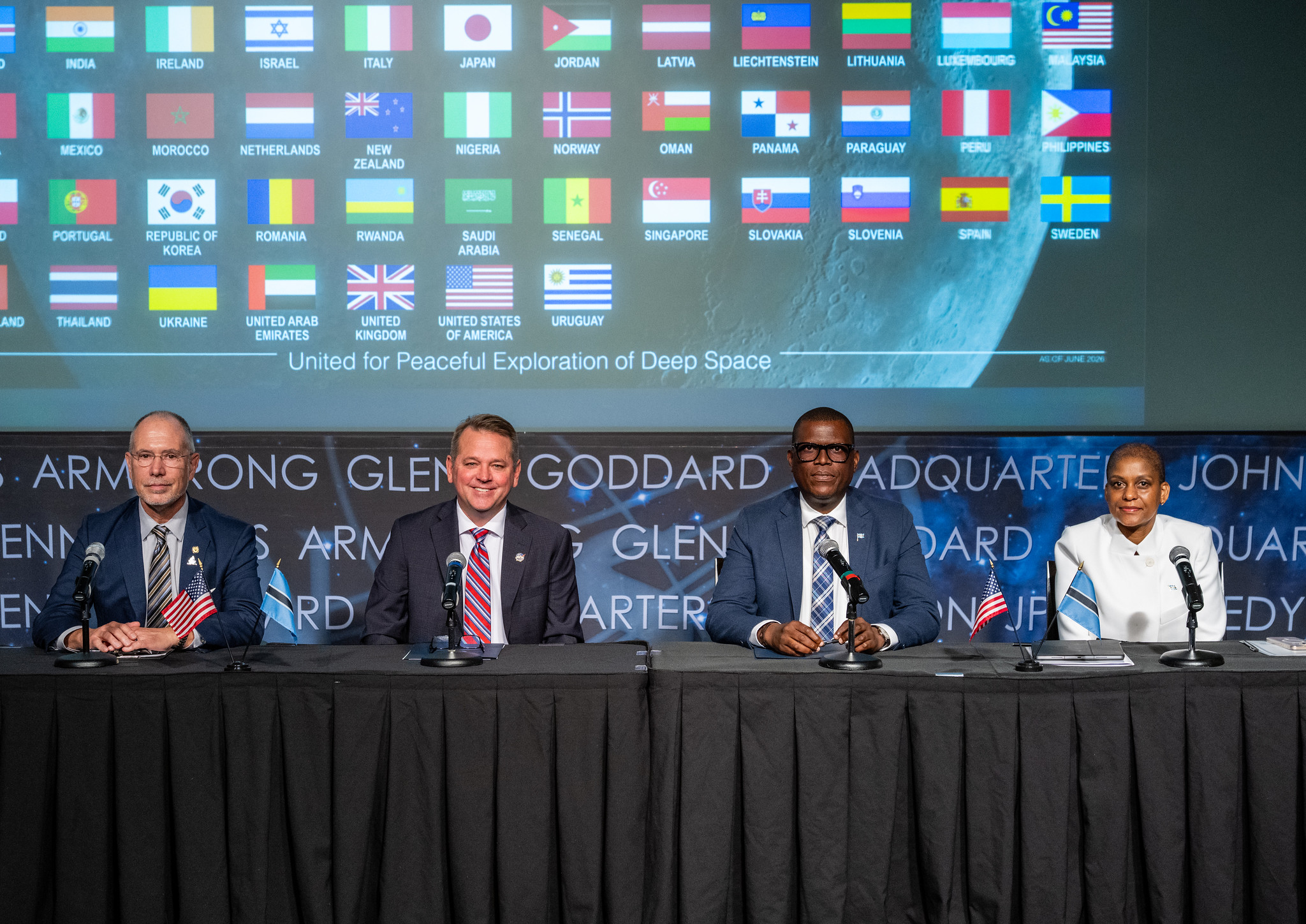
The Republic of Botswana signed the Artemis Accords Thursday during a ceremony hosted by NASA at the agency’s headquarters in Washington, becoming the sixth African nation to join a growing community of nations committed to the peaceful, transparent, and responsible exploration of space.
“It is my privilege to welcome Botswana as the newest signatory of the Artemis Accords,” said NASA Deputy Administrator Matt Anderson. “Today marks an important milestone in our international partnership and in the continued growth of the Artemis community. Botswana joins at an important moment. Earlier this month, we announced the crew of Artemis III and, as we speak, their spacecraft is being assembled as they prepare to play their part in mankind’s greatest adventure.”
Botswana’s Minister of Communications and Innovation David Tshere signed on behalf of the country. U.S. Department of State Senior Advisor for Space Gregory Autry, and Mabedi Ngwenya, acting ambassador of the Republic of Botswana to the United States, also participated in the ceremony.
“Botswana like many countries, we have interest in space exploration, found it important to become a signatory to the Artemis Accords to promote the safe, transparent, and sustainable civil space exploration, and to advance international cooperation, and a shared framework for responsible activities in the space,” said Tshere.
This new chapter builds on Botswana’s long history of collaboration with the United States in space-based Earth observation. In the early 1970s, Botswana participated in the satellite program later known as Landsat, joining dozens of other nations in pioneering satellite-based environmental observation. Botswana marked another milestone with the launch of its first Earth observation satellite, Botswana Satellite 1, in March 2025, aboard a SpaceX Falcon 9.
In 2020, during the first Trump Administration, the United States, led by NASA and the State Department, joined with seven other founding nations to establish the Artemis Accords, responding to the growing interest in lunar activities by both governments and private companies. The Artemis Accords introduced the first set of practical principles aimed at enhancing the safety and coordination between like-minded nations as they explore the Moon, Mars, and beyond.
Signing the Artemis Accords means committing to explore peaceably and transparently, to render aid to those in need, to enable access to scientific data that all of humanity can learn from, to ensure activities do not interfere with those of others, and to preserve historically significant sites and artifacts by developing best practices for space exploration for the benefit of all.
More countries are expected to sign the Artemis Accords in the months and years ahead, as NASA continues its work to establish a safe, peaceful, and prosperous future in space.
Learn more about the Artemis Accords at:
Share Details Last Updated Jun 25, 2026 Related TermsNASA Selects Rocket Lab to Launch Sun, Earth Science Missions
NASA has selected Rocket Lab to provide the launch service for both the agency’s PolSIR (Polarized Submillimeter Ice-cloud Radiometer) and Total and Spectral Solar Irradiance Sensor-2 (TSIS-2) missions.
The two selections are part of NASA’s Venture-Class Acquisition of Dedicated and Rideshare (VADR) launch services contract. This contract allows the agency to award fixed-price indefinite-delivery/indefinite-quantity launch service task orders during VADR’s 10-year ordering period, with a maximum total contract value of $300 million.
The PoISIR mission will help provide a better understanding of ice clouds that form at high altitudes throughout tropical and subtropical regions. Rocket Lab will launch PolSIR aboard two of its dedicated Electron rockets no earlier than June 2027 from Launch Complex 1 in Mahia, New Zealand.
Consisting of two small satellites, both of PoISIR’s 16U CubeSats have a scientific instrument designed to measure a specific spectrum of electromagnetic radiation, which will determine how the amount of ice in tropical clouds rises and falls during the day, as well as how the ice changes connect to larger storms. The instruments also will help determine how ice clouds affect sunlight and heat radiation throughout the day. The pair of CubeSats will fly in orbits separated by several hours to observe the pattern of cloud ice content changes over a day. This information will help researchers make more accurate weather predictions.
The PolSIR mission’s principal investigator is Vanderbilt University in Nashville. Science operations will be conducted by the Space Science and Engineering Center at the University of Wisconsin in Madison. The two spacecraft are being built by Blue Canyon Technologies.
The TSIS-2 mission will measure the Sun’s energy input to Earth. The spacecraft will provide critical data for understanding our planet’s ocean currents, seasons, and weather. The mission will continue NASA’s work to study and protect our home planet by providing insights that can only be gathered from space. Rocket Lab will launch TSIS-2 aboard an Electron rocket in early 2027 from Launch Complex 1 in Mahia.
The satellite measures Earth’s solar energy input, both the total irradiance, which is the Sun’s overall brightness at the top of Earth’s atmosphere, and the spectral irradiance, or how that energy is distributed across ultraviolet, visible, and infrared wavelengths. The satellite’s two instruments, the Total Irradiance Monitor and the Spectral Irradiance Monitor, are similar to those used for TSIS-1. Together, they cover a wavelength range that includes 96% of the energy in the solar spectrum. While TSIS‑1 works from the International Space Station, TSIS‑2 will operate from a free‑flying spacecraft.
Managed by NASA’s Goddard Space Flight Center in Greenbelt, Maryland, TSIS-2 includes instruments provided by the Laboratory for Atmospheric and Space Physics at the University of Colorado, Boulder, and the spacecraft is provided by General Atomics – Electromagnetic Systems.
NASA’s Launch Services Program, based at the agency’s Kennedy Space Center in Florida, manages the VADR contract.
Learn more about VADR online:
https://www.nasa.gov/vadr-venture-class-acquisition-of-dedicated-and-rideshare-launch-services
NASA Selects Rocket Lab to Launch Sun, Earth Science Missions
NASA has selected Rocket Lab to provide the launch service for both the agency’s PolSIR (Polarized Submillimeter Ice-cloud Radiometer) and Total and Spectral Solar Irradiance Sensor-2 (TSIS-2) missions.
The two selections are part of NASA’s Venture-Class Acquisition of Dedicated and Rideshare (VADR) launch services contract. This contract allows the agency to award fixed-price indefinite-delivery/indefinite-quantity launch service task orders during VADR’s 10-year ordering period, with a maximum total contract value of $300 million.
The PoISIR mission will help provide a better understanding of ice clouds that form at high altitudes throughout tropical and subtropical regions. Rocket Lab will launch PolSIR aboard two of its dedicated Electron rockets no earlier than June 2027 from Launch Complex 1 in Mahia, New Zealand.
Consisting of two small satellites, both of PoISIR’s 16U CubeSats have a scientific instrument designed to measure a specific spectrum of electromagnetic radiation, which will determine how the amount of ice in tropical clouds rises and falls during the day, as well as how the ice changes connect to larger storms. The instruments also will help determine how ice clouds affect sunlight and heat radiation throughout the day. The pair of CubeSats will fly in orbits separated by several hours to observe the pattern of cloud ice content changes over a day. This information will help researchers make more accurate weather predictions.
The PolSIR mission’s principal investigator is Vanderbilt University in Nashville. Science operations will be conducted by the Space Science and Engineering Center at the University of Wisconsin in Madison. The two spacecraft are being built by Blue Canyon Technologies.
The TSIS-2 mission will measure the Sun’s energy input to Earth. The spacecraft will provide critical data for understanding our planet’s ocean currents, seasons, and weather. The mission will continue NASA’s work to study and protect our home planet by providing insights that can only be gathered from space. Rocket Lab will launch TSIS-2 aboard an Electron rocket in early 2027 from Launch Complex 1 in Mahia.
The satellite measures Earth’s solar energy input, both the total irradiance, which is the Sun’s overall brightness at the top of Earth’s atmosphere, and the spectral irradiance, or how that energy is distributed across ultraviolet, visible, and infrared wavelengths. The satellite’s two instruments, the Total Irradiance Monitor and the Spectral Irradiance Monitor, are similar to those used for TSIS-1. Together, they cover a wavelength range that includes 96% of the energy in the solar spectrum. While TSIS‑1 works from the International Space Station, TSIS‑2 will operate from a free‑flying spacecraft.
Managed by NASA’s Goddard Space Flight Center in Greenbelt, Maryland, TSIS-2 includes instruments provided by the Laboratory for Atmospheric and Space Physics at the University of Colorado, Boulder, and the spacecraft is provided by General Atomics – Electromagnetic Systems.
NASA’s Launch Services Program, based at the agency’s Kennedy Space Center in Florida, manages the VADR contract.
Learn more about VADR online:
https://www.nasa.gov/vadr-venture-class-acquisition-of-dedicated-and-rideshare-launch-services
Beyond Fermi's Paradox XVIII: What if We Make Contact?
Welcome to the final installment in the Fermi series, where we look at the impact that making contact with extraterrestrials could have and the rules governing how such an event should be treated.
Crystalline Clocks Confirm Earth's Oldest Crater
A chip of zircon found in Western Australian rocks at a place called North Pole Dome revealed the age of Earth's oldest known impact crater. The team that found it was working on age-dating the crater, which is located in a region called the Pilbara Craton. They used mineral dating to pinpoint the exact time it was dug out by an impactor. Team lead Chris Kirkland from the Timescales of Minerals Systems Group within Curtin University's School of Earth and Planetary Sciences, said the findings help resolve a longstanding question about the timing of the impact. The results of the team's analysis of several minerals at the site, along with zircon, indicated that the North Pole Dome impact occurred at 3.024 billion years ago (plus or minus a few million years).
Magnetic Fields Channel Gas Through Filaments into Star Formation Sites
Stars form inside molecular clouds where cold gas collapses gravitationally on itself. But there's more to this process than gravity. New research shows how magnetic field lines funnel gas through sub-filaments into star formation sites.
Can home batteries help save the climate and save you money?
Can home batteries help save the climate and save you money?
Millions of Stars in Cigar Galaxy
Millions of Stars in Cigar Galaxy

NASA’s James Webb Space Telescope recently observed edge-on starburst galaxy Messier 82 (M82), nicknamed the Cigar Galaxy. Webb’s new view of M82, added to archival data from NASA’s Hubble Space Telescope, gives us a more complete picture of this starburst galaxy. Because Webb can see infrared light, it is able to peer through clouds of dust and gas to see the shape of this edge-on galaxy, as well as approximately 16.5 million of its stars.
M82’s rapid star formation, thought to be the result of its merger with another galaxy, will only be a (relatively) brief period in its history. Ironically, the extreme star formation is causing plumes of material to be ejected above and below the disk of the galaxy – something that will disrupt future stellar birth.
Image credit: NASA, ESA, CSA, Adam Smercina (STScI, Tufts), Thomas Williams (University of Manchester); Image processing: Alyssa Pagan (STScI)
Millions of Stars in Cigar Galaxy
NASA’s James Webb Space Telescope recently observed edge-on starburst galaxy Messier 82 (M82), nicknamed the Cigar Galaxy. Webb’s new view of M82, added to archival data from NASA’s Hubble Space Telescope, gives us a more complete picture of this starburst galaxy. Because Webb can see infrared light, it is able to peer through clouds of dust and gas to see the shape of this edge-on galaxy, as well as approximately 16.5 million of its stars.
M82’s rapid star formation, thought to be the result of its merger with another galaxy, will only be a (relatively) brief period in its history. Ironically, the extreme star formation is causing plumes of material to be ejected above and below the disk of the galaxy – something that will disrupt future stellar birth.
Image credit: NASA, ESA, CSA, Adam Smercina (STScI, Tufts), Thomas Williams (University of Manchester); Image processing: Alyssa Pagan (STScI)
We’ve uncovered a master gene that switches on human development
We’ve uncovered a master gene that switches on human development
The race to understand how and when Thwaites glacier will collapse
The race to understand how and when Thwaites glacier will collapse
The Universe's First Stars Were Shaped By Turbulence and Were Not As Massive as Thought
For a long time, astrophysicists thought that the Universe's first stars, called Population III stars, were uniformly massive. It seemed like the conditions they formed in were calm and serene, which favoured massive stars. But new research based on high-resolution simulations show that conditions were more chaotic than thought, and gas cloud turbulence means that Population III stars were not all massive. This affected the metallicity of the next stars to form.
Where, when and how to watch the 2026 solar eclipse
Where, when and how to watch the 2026 solar eclipse
France just hit its hottest day ever recorded
Scorching temperatures across France rose to a record-breaking average 30 degrees on Wednesday