

Feed aggregator
Fluctuating oestrogen levels may alter how drugs enter women's brains
Career Spotlight: Electrician (Ages 14-18)
Electricity powers the world, and electricians are the ones who get it where it needs to go. An electrician is an expert who is trained to make sure electrical systems and equipment are installed safely and working correctly. Electricians are involved in a variety of systems, including power, lighting, communications, and more – anything that needs electricity to run.
While electricians ensure systems and equipment have the power they need, electrical technicians focus on building, modifying, or testing electronic devices.
What are some of the different types of work electricians and electrical technicians do at NASA?At NASA, electricians keep the lights on and the power flowing for rocket launches, scientific research, and everything in between. Their skills support engineers and scientists in building and testing spacecraft, aircraft, satellites, telescopes, and the equipment that makes human spaceflight possible. Electricians make sure all facilities and equipment have the power and functionality they need to be safe and ready to support NASA’s missions.
Electrical technicians at the agency help bring big ideas to life. They might build and wire control systems, connect tiny sensors to circuit boards, or write the software to make a device work in a specific way. They also test instruments in conditions that mimic space – extreme temperatures, intense vibrations, and even a vacuum – to make sure they will survive and perform well during their missions. Technicians use specialized tools, earn certifications, and work with incredible precision.
Being an electrician or electrical technician at NASA is careful, hands‑on work carried out with expertise. Because space hardware is headed to places like low-Earth orbit, the Moon, or even Mars, every detail has to be perfect.
What are the different certification levels for electricians?The information below is a general overview of the career path of an electrician. Specific guidelines for these roles vary from state to state. It’s important to look up the license requirements in your state.
- Apprentice electrician: This four-year job training program provides an entry into the industry. An apprentice works as an assistant to an experienced supervisor, gaining vital hands-on experience to move ahead as an electrician.
- Journeyman electrician: A journeyman is an electrician who has finished an apprenticeship, then passed a test. At this stage, the electrician is licensed and allowed to work without supervision.
- Master electrician: This is the highest certification possible for an electrician. Typically, a master electrician is someone who has completed approximately 4,000 hours as a journeyman, then passed a licensing exam. These electricians are qualified to work on complicated projects. They can also serve as supervisors for apprentices or journeymen following in their footsteps.
There are many options that provide the training needed to get started as an electrician or electrical technician.
Many community colleges, trade schools, and technical institutes offer a two-year program leading to an associate degree in electrical technology. Additionally, trade unions and apprenticeship programs provide real-world experience in the field.
Additionally, all branches of the U.S. military offer electronics training that may be transferrable to college credits or civilian certifications.
How can I start preparing today to become an electrician?It’s never too early to set the stage for an electrifying career! In high school, you can take courses in math, science, and technical education. At the same time, you can start learning about basic electrical concepts such as circuitry and safety.
Begin researching associate degree programs and apprenticeship opportunities so you can consider which pathway seems right for you. Weighing these options now will help you understand program requirements and ensure you’re ready to take the next step.
You can also gain useful experience through part-time work, or shadowing electricians on the job.
What skills will I need to be a successful electrician?Technical skills focus on the basics – how electricity works, how to stay safe, and how to read schematics and wiring diagrams. Some jobs also call for special hands‑on abilities, like soldering tiny components, putting together cables, or even having some familiarity with chemistry.
Being curious, open‑minded, and a good communicator matters, too. Any time you’re building or improving a device, you must understand who will use it and what they need it to do. Asking questions, sharing ideas, and being able to take feedback are essential to consistently building systems and devices that work well.
David McClaeb, electronic technician, NASA’s Goddard Space Flight Center in Greenbelt, Maryland Advice from NASA electricians and electronic technicians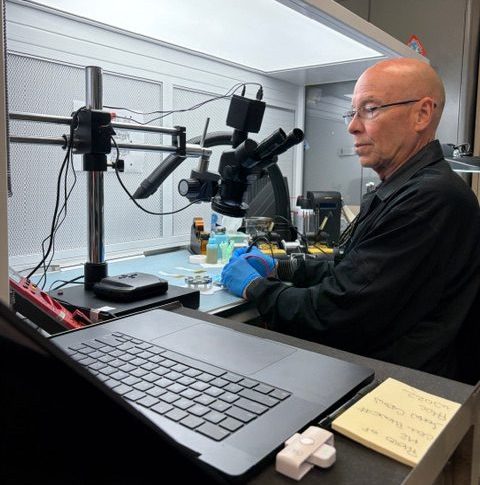
“As an aerospace technician, you have the opportunity to make a big difference. You can make a really big impact.” – Christopher Johnson, aerospace electrical engineering technician, NASA’s Kennedy Space Center in Florida
“What I wish I knew in high school is how many opportunities there are for electricians. I didn’t realize how big of a scale it really was. Everything needs electricity, and the sky’s the limit on what you can do with it. NASA needs electricians for everything from their testing campaigns to keeping their facilities running.” – Levi James, electrician apprentice, NASA’s Glenn Research Center at Armstrong Test Facility in Sandusky, Ohio
“It’s so gratifying when somebody comes in and says, ‘Hey, we want to build this, but it looks really difficult,’ and we say, ‘Yeah, it looks difficult, but we can do it’ – and we build it and then we hand it over to them, and then we’re on to the next thing. It’s a challenge, and I’m telling you, it is just so fun.” – David McClaeb, electronic technician, NASA’s Goddard Space Flight Center in Greenbelt, Maryland
Additional resources- Occupational Outlook for Electricians: Pay, Education, Job Outlook, and More (From the U.S. Bureau of Labor Statistics)
- NASA Careers
- Career Spotlight: Welder
- Career Spotlight: Engineer
- Career Spotlight: Scientist
- Career Spotlight: Technologist
- Career Spotlight: Mathematician
For Students Grades 9-12
NASA STEM Opportunities and Activities For Students
Next Gen STEM for Careers
For Colleges and Universities
Career Spotlight: Electrician (Ages 14-18)
Electricity powers the world, and electricians are the ones who get it where it needs to go. An electrician is an expert who is trained to make sure electrical systems and equipment are installed safely and working correctly. Electricians are involved in a variety of systems, including power, lighting, communications, and more – anything that needs electricity to run.
While electricians ensure systems and equipment have the power they need, electrical technicians focus on building, modifying, or testing electronic devices.
What are some of the different types of work electricians and electrical technicians do at NASA?At NASA, electricians keep the lights on and the power flowing for rocket launches, scientific research, and everything in between. Their skills support engineers and scientists in building and testing spacecraft, aircraft, satellites, telescopes, and the equipment that makes human spaceflight possible. Electricians make sure all facilities and equipment have the power and functionality they need to be safe and ready to support NASA’s missions.
Electrical technicians at the agency help bring big ideas to life. They might build and wire control systems, connect tiny sensors to circuit boards, or write the software to make a device work in a specific way. They also test instruments in conditions that mimic space – extreme temperatures, intense vibrations, and even a vacuum – to make sure they will survive and perform well during their missions. Technicians use specialized tools, earn certifications, and work with incredible precision.
Being an electrician or electrical technician at NASA is careful, hands‑on work carried out with expertise. Because space hardware is headed to places like low-Earth orbit, the Moon, or even Mars, every detail has to be perfect.
What are the different certification levels for electricians?The information below is a general overview of the career path of an electrician. Specific guidelines for these roles vary from state to state. It’s important to look up the license requirements in your state.
- Apprentice electrician: This four-year job training program provides an entry into the industry. An apprentice works as an assistant to an experienced supervisor, gaining vital hands-on experience to move ahead as an electrician.
- Journeyman electrician: A journeyman is an electrician who has finished an apprenticeship, then passed a test. At this stage, the electrician is licensed and allowed to work without supervision.
- Master electrician: This is the highest certification possible for an electrician. Typically, a master electrician is someone who has completed approximately 4,000 hours as a journeyman, then passed a licensing exam. These electricians are qualified to work on complicated projects. They can also serve as supervisors for apprentices or journeymen following in their footsteps.
There are many options that provide the training needed to get started as an electrician or electrical technician.
Many community colleges, trade schools, and technical institutes offer a two-year program leading to an associate degree in electrical technology. Additionally, trade unions and apprenticeship programs provide real-world experience in the field.
Additionally, all branches of the U.S. military offer electronics training that may be transferrable to college credits or civilian certifications.
How can I start preparing today to become an electrician?It’s never too early to set the stage for an electrifying career! In high school, you can take courses in math, science, and technical education. At the same time, you can start learning about basic electrical concepts such as circuitry and safety.
Begin researching associate degree programs and apprenticeship opportunities so you can consider which pathway seems right for you. Weighing these options now will help you understand program requirements and ensure you’re ready to take the next step.
You can also gain useful experience through part-time work, or shadowing electricians on the job.
What skills will I need to be a successful electrician?Technical skills focus on the basics – how electricity works, how to stay safe, and how to read schematics and wiring diagrams. Some jobs also call for special hands‑on abilities, like soldering tiny components, putting together cables, or even having some familiarity with chemistry.
Being curious, open‑minded, and a good communicator matters, too. Any time you’re building or improving a device, you must understand who will use it and what they need it to do. Asking questions, sharing ideas, and being able to take feedback are essential to consistently building systems and devices that work well.
David McClaeb, electronic technician, NASA’s Goddard Space Flight Center in Greenbelt, Maryland Advice from NASA electricians and electronic technicians“As an aerospace technician, you have the opportunity to make a big difference. You can make a really big impact.” – Christopher Johnson, aerospace electrical engineering technician, NASA’s Kennedy Space Center in Florida
“What I wish I knew in high school is how many opportunities there are for electricians. I didn’t realize how big of a scale it really was. Everything needs electricity, and the sky’s the limit on what you can do with it. NASA needs electricians for everything from their testing campaigns to keeping their facilities running.” – Levi James, electrician apprentice, NASA’s Glenn Research Center at Armstrong Test Facility in Sandusky, Ohio
“It’s so gratifying when somebody comes in and says, ‘Hey, we want to build this, but it looks really difficult,’ and we say, ‘Yeah, it looks difficult, but we can do it’ – and we build it and then we hand it over to them, and then we’re on to the next thing. It’s a challenge, and I’m telling you, it is just so fun.” – David McClaeb, electronic technician, NASA’s Goddard Space Flight Center in Greenbelt, Maryland
Additional resources- Occupational Outlook for Electricians: Pay, Education, Job Outlook, and More (From the U.S. Bureau of Labor Statistics)
- NASA Careers
- Career Spotlight: Welder
- Career Spotlight: Engineer
- Career Spotlight: Scientist
- Career Spotlight: Technologist
- Career Spotlight: Mathematician
For Students Grades 9-12
NASA STEM Opportunities and Activities For Students
Next Gen STEM for Careers
For Colleges and Universities
Hidden black hole could explain mystery at the heart of our galaxy
Hidden black hole could explain mystery at the heart of our galaxy
Extreme heat is muddling animals’ brains—and even triggering aggression
As temperatures rise, some creatures pick fights while others struggle to learn
Curiosity Blog, Sols 4927–4933: Let’s Drive to That Smooth Area
- Curiosity Home
- Science
- News and Features
- Multimedia
- Mars Missions
- Mars Home
4 min read
Curiosity Blog, Sols 4927–4933: Let’s Drive to That Smooth Area NASA’s Mars rover Curiosity acquired this image showing a breathtaking diversity of polygons, veins, and other textural features waiting for investigation by the Mars Science Laboratory team. Curiosity captured the image using its Left Navigation Camera on June 17, 2026 – Sol 4928, or Martian day 4,928 of the Mars Science Laboratory mission – at 17:47:52 UTC. NASA/JPL-Caltech
By Susanne P. Schwenzer, Professor of Planetary Mineralogy at The Open University, UK
Earth planning date: Thursday, June 18, 2026
In the area Curiosity is currently exploring, the science team has mapped several areas with different-looking surface texture on the orbital images. If you wanted to have a look yourself at what there is to see, check the “Where is Curiosity?” map. You’ll discover different shades of orange and beige as well as more rough and more smooth-looking textures. This is what the geomorphologists in our team use to map the areas for exploration by the rover. Of course, we then supplement this all with ground-based images, including bespoke “drive direction imaging,” which is taken after each drive by the Mast Camera. Drive planning is done using a combination of all this information. So there shouldn’t be any surprises, right?
On Monday the team planned three sols in preparation for a Thursday planning to account for the U.S. federal holiday weekend. The workspace turned out to be a little spiky, so we could not find an area we could DRT. APXS still found one good bedrock target, “Rio Baker,” which also had MAHLI documentation. In addition, ChemCam investigated “Rica Aventura,” a textured bedrock, and “Tabebuia,” a darker-looking individual block, using its LIBS and conducted a passive spectral observation on a second dark float block called “Lago Ranco.” Of course, the team also wanted to look into the distance with ChemCam remote imaging, extending our investigation of the Cordillera base outcrop.
Imaging is always high on the list. In Monday’s plan Mastcam is looking into the modern dunes with the “Tacaza” mosaic, and with more mosaics looking forward to the future parking areas, some of which looked really smooth from that vantage point. We also continue our environmental and atmospheric observations looking for dust devils, the opacity of the atmosphere, and monitoring pressure and temperature. After all this, the rover drove about 35 meters (about 115 feet) to an area that looked really smooth in all images we had available at that point. So we were hoping for a good spot to deploy the DRT, but didn’t think we could be in for a surprise.
The drive ended exactly as planned, spot-on in the middle of that — from a distance — smooth-looking area. But when we opened the post-drive images on Thursday morning, we were all reacting with a lot of surprise. From up close, the parking spot looks anything but smooth. You can see the surprise in the title image of this blog. There are polygons, veins, lamination, and probably more, once we inspect the higher-resolution images taken today. “Higher-resolution” is the key for why we were in for such a surprise! The features are quite small, a few centimeters across, and therefore we could not see them in the orbital images or from a distance in our navigation and mast camera images. The camera resolution from a distance just isn’t enough to see them. But up close, the terrain revealed all its beauty! And I am sure there will be more in the even higher resolution of today’s MAHLI and ChemCam RMI imager images!
So, what did we plan after we caught our breath on Thursday? First, you guessed it, images, images, and more images. Mastcam takes a full panorama with its “left eye” and adds a range of closer-up mosaics with its higher-resolution “right eye.” In addition there is a ChemCam Remote Micro Imager image to document structures further afield at high resolution. ChemCam is investigating three targets using LIBS: “Rio Chimore” is a lighter-toned band; you can see some of those in the cover image of this blog, too. The other two LIBS targets are “Rio de Lava,” a vein target, and “Rio de Salta,” one of the polygons. APXS is also looking at the bedrock and the ridges, at the targets “Pampa Grande” and “Iquique Ridge.” MAHLI is having the above-mentioned close “hand lens” look. Let’s see what we will discover when we get those images.
Finally, Curiosity drove up the hill along very smooth-looking terrain that is just littered with tiny polygons. Let’s see if we are in for another surprise reverberating around all our offices — and across two continents, as I had the good fortune to be among the first ones, here in England (Or maybe it was our French ChemCam colleagues, who are in a time zone one hour ahead of me?). Whichever it is, this terrain has a lot to say about the geologic history of Mars!
-
Want to read more posts from the Curiosity team?
-
Want to learn more about Curiosity’s science instruments?
Article
5 days ago
3 min read Curiosity Blog: Sols 4913-4919: Planetary Explorers, Freewheeling to the Yardang Unit!
Article
2 weeks ago
5 min read Curiosity Blog, Sols 4908-4912: Goodbye Campo Marte, It’s Been Fun!
Article
3 weeks ago
Keep Exploring Discover More Topics From NASA Mars
Mars is the fourth planet from the Sun, and the seventh largest. It’s the only planet we know of inhabited…
All Mars Resources
Explore this collection of Mars images, videos, resources, PDFs, and toolkits. Discover valuable content designed to inform, educate, and inspire,…
Rover Basics
Each robotic explorer sent to the Red Planet has its own unique capabilities driven by science. Many attributes of a…
Mars Exploration: Science Goals
The key to understanding the past, present or future potential for life on Mars can be found in NASA’s four…
Curiosity Blog, Sols 4927–4933: Let’s Drive to That Smooth Area
- Curiosity Home
- Science
- News and Features
- Multimedia
- Mars Missions
- Mars Home
4 min read
Curiosity Blog, Sols 4927–4933: Let’s Drive to That Smooth Area NASA’s Mars rover Curiosity acquired this image showing a breathtaking diversity of polygons, veins, and other textural features waiting for investigation by the Mars Science Laboratory team. Curiosity captured the image using its Left Navigation Camera on June 17, 2026 – Sol 4928, or Martian day 4,928 of the Mars Science Laboratory mission – at 17:47:52 UTC. NASA/JPL-CaltechBy Susanne P. Schwenzer, Professor of Planetary Mineralogy at The Open University, UK
Earth planning date: Thursday, June 18, 2026
In the area Curiosity is currently exploring, the science team has mapped several areas with different-looking surface texture on the orbital images. If you wanted to have a look yourself at what there is to see, check the “Where is Curiosity?” map. You’ll discover different shades of orange and beige as well as more rough and more smooth-looking textures. This is what the geomorphologists in our team use to map the areas for exploration by the rover. Of course, we then supplement this all with ground-based images, including bespoke “drive direction imaging,” which is taken after each drive by the Mast Camera. Drive planning is done using a combination of all this information. So there shouldn’t be any surprises, right?
On Monday the team planned three sols in preparation for a Thursday planning to account for the U.S. federal holiday weekend. The workspace turned out to be a little spiky, so we could not find an area we could DRT. APXS still found one good bedrock target, “Rio Baker,” which also had MAHLI documentation. In addition, ChemCam investigated “Rica Aventura,” a textured bedrock, and “Tabebuia,” a darker-looking individual block, using its LIBS and conducted a passive spectral observation on a second dark float block called “Lago Ranco.” Of course, the team also wanted to look into the distance with ChemCam remote imaging, extending our investigation of the Cordillera base outcrop.
Imaging is always high on the list. In Monday’s plan Mastcam is looking into the modern dunes with the “Tacaza” mosaic, and with more mosaics looking forward to the future parking areas, some of which looked really smooth from that vantage point. We also continue our environmental and atmospheric observations looking for dust devils, the opacity of the atmosphere, and monitoring pressure and temperature. After all this, the rover drove about 35 meters (about 115 feet) to an area that looked really smooth in all images we had available at that point. So we were hoping for a good spot to deploy the DRT, but didn’t think we could be in for a surprise.
The drive ended exactly as planned, spot-on in the middle of that — from a distance — smooth-looking area. But when we opened the post-drive images on Thursday morning, we were all reacting with a lot of surprise. From up close, the parking spot looks anything but smooth. You can see the surprise in the title image of this blog. There are polygons, veins, lamination, and probably more, once we inspect the higher-resolution images taken today. “Higher-resolution” is the key for why we were in for such a surprise! The features are quite small, a few centimeters across, and therefore we could not see them in the orbital images or from a distance in our navigation and mast camera images. The camera resolution from a distance just isn’t enough to see them. But up close, the terrain revealed all its beauty! And I am sure there will be more in the even higher resolution of today’s MAHLI and ChemCam RMI imager images!
So, what did we plan after we caught our breath on Thursday? First, you guessed it, images, images, and more images. Mastcam takes a full panorama with its “left eye” and adds a range of closer-up mosaics with its higher-resolution “right eye.” In addition there is a ChemCam Remote Micro Imager image to document structures further afield at high resolution. ChemCam is investigating three targets using LIBS: “Rio Chimore” is a lighter-toned band; you can see some of those in the cover image of this blog, too. The other two LIBS targets are “Rio de Lava,” a vein target, and “Rio de Salta,” one of the polygons. APXS is also looking at the bedrock and the ridges, at the targets “Pampa Grande” and “Iquique Ridge.” MAHLI is having the above-mentioned close “hand lens” look. Let’s see what we will discover when we get those images.
Finally, Curiosity drove up the hill along very smooth-looking terrain that is just littered with tiny polygons. Let’s see if we are in for another surprise reverberating around all our offices — and across two continents, as I had the good fortune to be among the first ones, here in England (Or maybe it was our French ChemCam colleagues, who are in a time zone one hour ahead of me?). Whichever it is, this terrain has a lot to say about the geologic history of Mars!
-
Want to read more posts from the Curiosity team?
-
Want to learn more about Curiosity’s science instruments?
Article
5 days ago
3 min read Curiosity Blog: Sols 4913-4919: Planetary Explorers, Freewheeling to the Yardang Unit!
Article
2 weeks ago
5 min read Curiosity Blog, Sols 4908-4912: Goodbye Campo Marte, It’s Been Fun!
Article
3 weeks ago
Keep Exploring Discover More Topics From NASA Mars
Mars is the fourth planet from the Sun, and the seventh largest. It’s the only planet we know of inhabited…
All Mars Resources
Explore this collection of Mars images, videos, resources, PDFs, and toolkits. Discover valuable content designed to inform, educate, and inspire,…
Rover Basics
Each robotic explorer sent to the Red Planet has its own unique capabilities driven by science. Many attributes of a…
Mars Exploration: Science Goals
The key to understanding the past, present or future potential for life on Mars can be found in NASA’s four…
Playing the Moon Game
- Earth
- Earth Observatory
- Image of the Day
- EO Explorer
- Topics
- More Content
- About
Playing the Moon Game
- Earth
- Earth Observatory
- Image of the Day
- EO Explorer
- Topics
- More Content
- About
Hot Jupiter Endures Star-Powered Barbecue
You’re the grillmaster at the annual family 4th of July BBQ and you’re sweating bullets standing over the grill in the sweltering summer heat. You’re trying to stay cool by pressing a cold beer can on your forehead, but to no avail. You can’t go inside because, once again, you’re the grillmaster and need to watch the food simmering on your freshly cleaned grill. Your brother-in-law is a university astronomy professor and walks over asking how you’re doing. You say, “This heat is killing me. I feel hotter than the barbeque!” Your science teacher brother-in-law slyly says, “Try being an exoplanet.” You roll your eyes.
Huge crater in Australia may be the oldest impact structure on Earth
Huge crater in Australia may be the oldest impact structure on Earth
The Long-Lived Chicxulub Hydrothermal System Lasted 8 Million Years
The asteroid that caused the extinction of the dinosaurs also created an underground environment suited to supporting new life, and new research suggests it lasted for millions of years longer than previously suspected. While previous research showed the buried hydrothermal system of porous rock, hot water, and chemical nutrients may have lasted 2 million years, new research says it lasted for 8 million years.
NASA Names Sean Gallagher as Chief Information Officer

NASA has selected Sean Gallagher as the agency’s chief information officer (CIO). In this role, he is responsible for the agency’s entire portfolio of Information Technology products and services. Gallagher has been serving in an acting capacity since January and his permanent role is effective immediately.
“Sean Gallagher’s leadership has been instrumental in strengthening NASA’s IT foundation and ensuring our workforce has the secure, modern tools needed to enable groundbreaking missions every day,” said NASA Deputy Administrator Matt Anderson. “As CIO, Sean will continue advancing the agency’s technology capabilities to support discovery, innovation, and mission success across NASA.”
Most recently, Gallagher also has served as the deputy chief information officer for Operations in the Office of the Chief Information Officer at NASA Headquarters in Washington, as well as a senior advisor for Transformation. This team provides services to tens of thousands of end users located in the U.S. and abroad in support of NASA missions, enabling discoveries, faster data sharing, increased workforce productivity, and more. Gallagher has worked with all NASA centers to implement efficient and effective IT operating models.
Previously, Gallagher was the CIO of NASA’s Glenn Research Center in Cleveland, leading IT initiatives for aeronautics, space, research and engineering, and test missions. He joined NASA in 2012 as Glenn’s deputy CIO and previously worked at Booz Allen Hamilton as a senior associate supporting a variety of federal, defense, and commercial customers.
Gallagher developed his leadership and management experience as a Signal Corps officer in the United States Army. He also served as a platoon leader managing the combat service support readiness of a tactical communications unit, a human resource manager for the 40th Signal Battalion, and as a network engineer for the 11th Signal Brigade. He has a bachelor’s degree in physics from John Carroll University and a master’s degree in computer information systems from the University of Phoenix.
For more information about NASA’s missions, visit:
-end-
Camille Gallo / Cheryl Warner
Headquarters, Washington
202-358-1600
camille.m.gallo@nasa.gov / cheryl.m.warner@nasa.gov
NASA Names Sean Gallagher as Chief Information Officer
NASA has selected Sean Gallagher as the agency’s chief information officer (CIO). In this role, he is responsible for the agency’s entire portfolio of Information Technology products and services. Gallagher has been serving in an acting capacity since January and his permanent role is effective immediately.
“Sean Gallagher’s leadership has been instrumental in strengthening NASA’s IT foundation and ensuring our workforce has the secure, modern tools needed to enable groundbreaking missions every day,” said NASA Deputy Administrator Matt Anderson. “As CIO, Sean will continue advancing the agency’s technology capabilities to support discovery, innovation, and mission success across NASA.”
Most recently, Gallagher also has served as the deputy chief information officer for Operations in the Office of the Chief Information Officer at NASA Headquarters in Washington, as well as a senior advisor for Transformation. This team provides services to tens of thousands of end users located in the U.S. and abroad in support of NASA missions, enabling discoveries, faster data sharing, increased workforce productivity, and more. Gallagher has worked with all NASA centers to implement efficient and effective IT operating models.
Previously, Gallagher was the CIO of NASA’s Glenn Research Center in Cleveland, leading IT initiatives for aeronautics, space, research and engineering, and test missions. He joined NASA in 2012 as Glenn’s deputy CIO and previously worked at Booz Allen Hamilton as a senior associate supporting a variety of federal, defense, and commercial customers.
Gallagher developed his leadership and management experience as a Signal Corps officer in the United States Army. He also served as a platoon leader managing the combat service support readiness of a tactical communications unit, a human resource manager for the 40th Signal Battalion, and as a network engineer for the 11th Signal Brigade. He has a bachelor’s degree in physics from John Carroll University and a master’s degree in computer information systems from the University of Phoenix.
For more information about NASA’s missions, visit:
-end-
Camille Gallo / Cheryl Warner
Headquarters, Washington
202-358-1600
camille.m.gallo@nasa.gov / cheryl.m.warner@nasa.gov