
Feed aggregator
I have a 100 per cent chance of getting cancer due to a rare gene
I have a 100 per cent chance of getting cancer due to a rare gene
From Lab to Orbit | Turning Space Science into Reality | ESA Explores #21
Go behind the scenes at ESA’s European Astronaut Centre in Cologne, Germany, and discover how space experiments are prepared long before they reach orbit. Meet the ECOS team, as Deputy Manager Salvi Verma shares how they work with scientists, engineers and astronauts to turn ideas into real missions aboard the International Space Station. From early planning on the ground to supporting astronauts like ESA astronaut Sophie Adenot during her Epsilon mission, this is how space science becomes reality.
This interview was recorded in March 2026.
Cosmic imposters show astronomers sometimes get things hilariously wrong
Sometimes we mistake one kind of object with another to disastrous effect
Bringing Signals to NASA
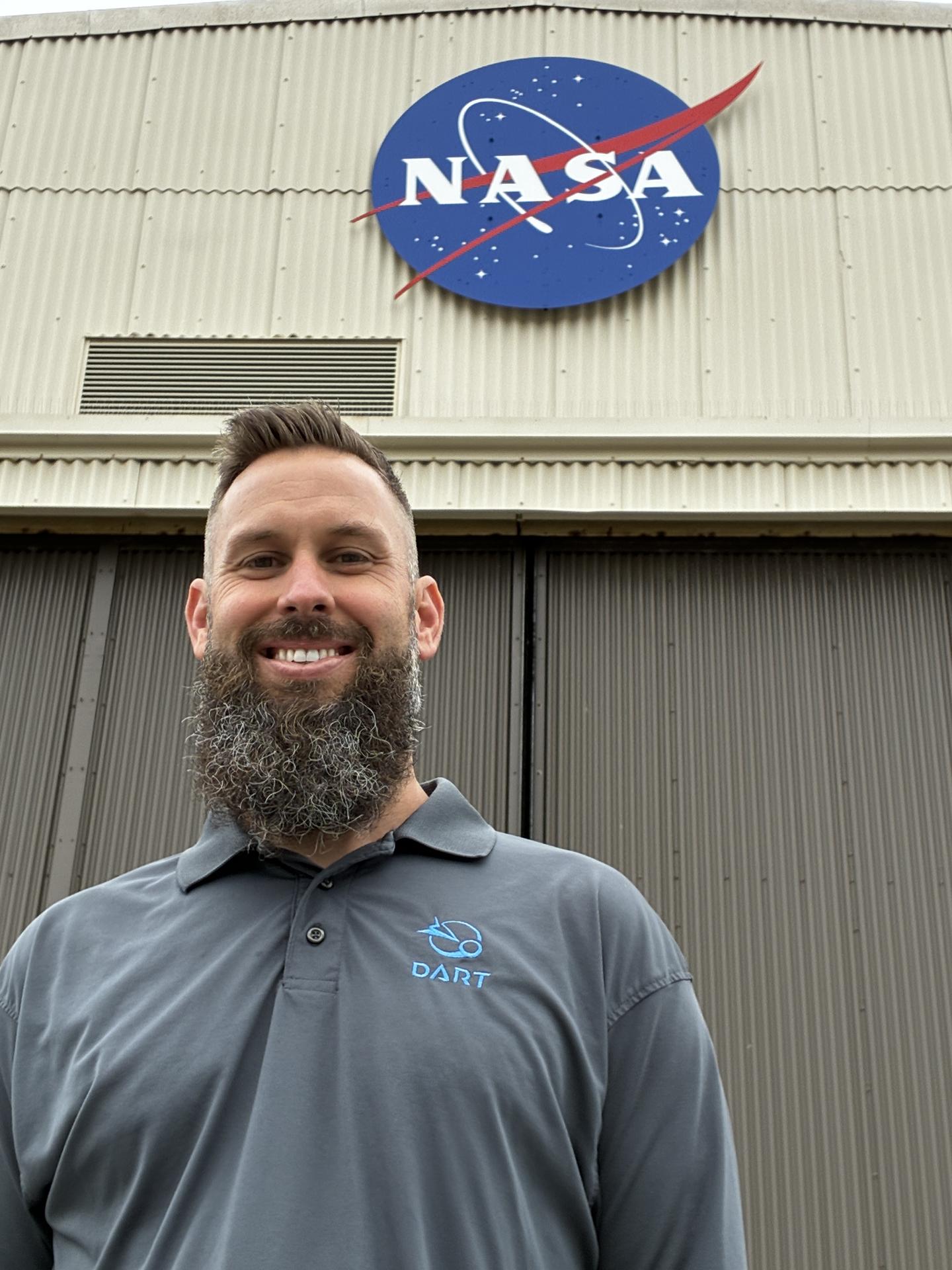
Growing up on the central California coast, watching rocket launches with his father was part of Eric Fernandez’s childhood routine. Fernandez had posters of rockets on the wall, but despite being fascinated by them, he never imagined one day this would be his career. Because both of his grandparents had served at Vandenberg Air Force Base (later renamed to Vandenberg Space Force Base), he assumed that the launches from there were for the military. NASA didn’t cross his mind. The space agency seemed very far away from a place like Orcutt, California, a small town situated among rolling hills covered with farms and vineyards.
Fernandez had been part of a painting crew for several years after high school. While it paid the rent, it wasn’t what he wanted to do with his life. However, he found something he enjoyed. He had started at his future father-in-law’s appliance store, working as a technician, repairing and installing appliances. He excelled at the work and planned to stay there with the goal to eventually run the small business.
Then he got a call.
It was from a friend about an opening for something called telemetry. Fernandez wasn’t sure what that meant. He was happy with his current career path. He nearly declined the offer, but after some persuading, he decided to go for the interview at a NASA building on the military base.
“I walked in the telemetry lab, and I see oscilloscopes, screens with squiggly lines, lots of blinking lights, and things I didn’t know about at the time,” Fernandez recounted. “I was very curious about it, so I was asking a million questions as we toured the lab, and they were asking about me. They really liked my background, especially my electronics experience, my troubleshooting skills, and my ability to solder.”
He received an offer for a technician position from a company that provided support to NASA under the Expendable Launch Vehicle Integrated Support, or ELVIS, contract. Fernandez had to make an important decision about his future.
“I prayed about it and met with my father-in-law,” said Fernandez. “I decided to change career paths and start a new career as a contractor working with NASA, supporting its Launch Services Program.”
That was 17 years ago, and he has been working there ever since, advancing to telemetry engineer in 2019. He has contributed to 27 launches for NASA, supporting scientific and robotic exploration missions. He’s also supported hundreds of launches for the U.S. military and commercial sector, as part of the agency’s efforts to work with its partners to understand the capabilities of the commercial rocket fleet.
At Vandenberg Space Force Base in California, NASA employee Eric Fernandez stands by a preserved concrete section from the Space Launch Complex2 Mobile Service Tower counterweight, saved during demolition to retain the NASA insignia. The artifact was part of Delta and Delta II launches for decades before demolition, with its last launch for the agency being NASA’s ICESat2 on Sept. 15, 2018.NASA/Brandon Satterthwaite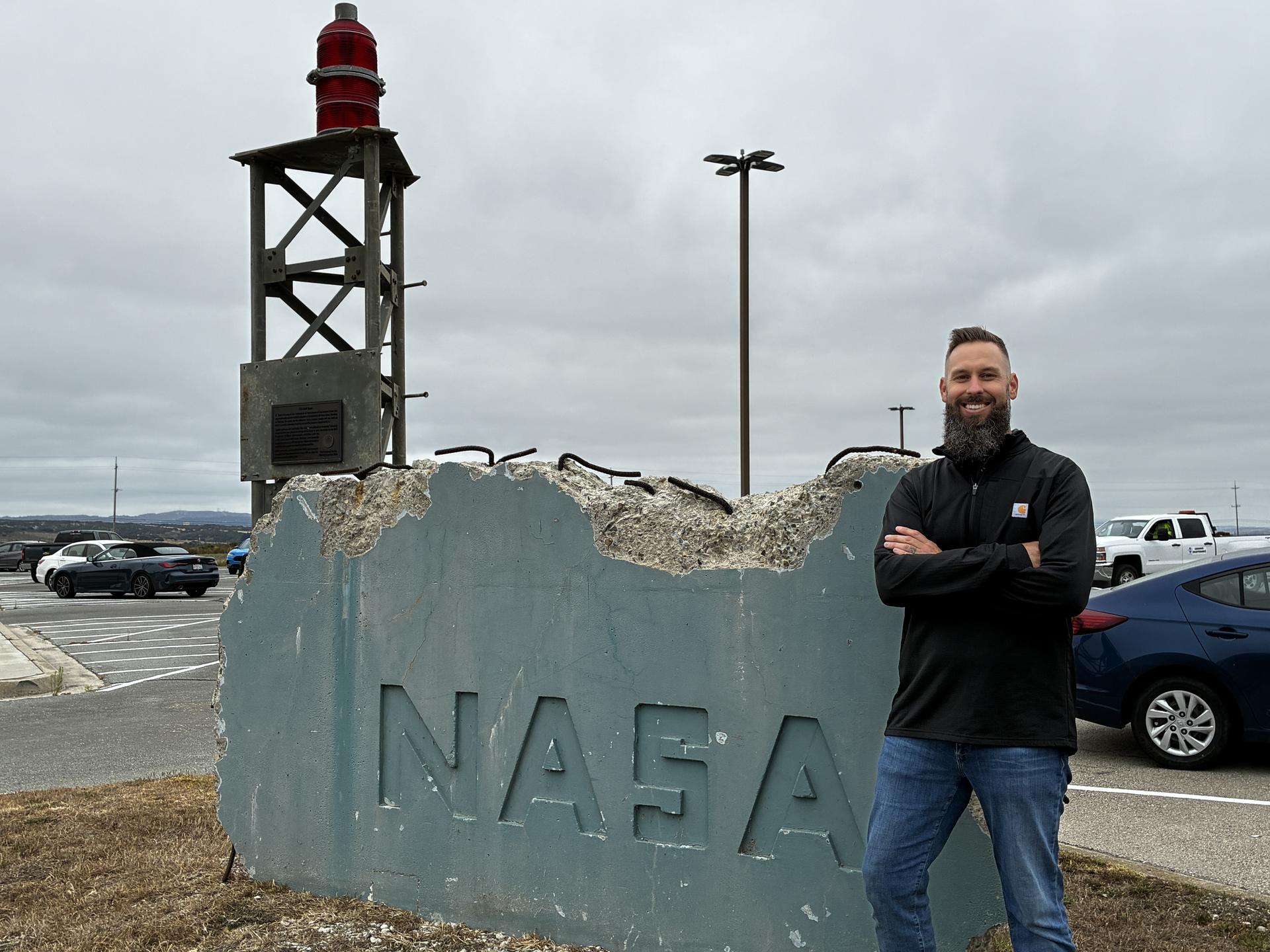
While Fernandez wasn’t planning on making additional changes, a new opportunity presented itself earlier this year. The agency decided to strengthen its core capabilities by bringing mission-critical positions into the civil service.
When he had the opportunity to join the civil service at NASA, Fernandez applied. On June 15, he swore in at Vandenberg bringing his knowledge and experience to the agency, ready to become an official part of a group he already considered family.
“Telemetry is the collection of remote measurements that let us know the rocket is healthy when it’s fueling on the pad, when it’s in flight, and when it’s placing a spacecraft into the proper orbit,” said Fernandez. “It’s our job to make sure decision makers have all the right data to make the right calls in real time. We can’t afford to give them bad data.”
Fernandez’s team has multiple ways of getting the data when a rocket is on the launch pad, including ground data streams and radio frequencies link. Each data path is carefully tested beforehand using tools like bit-error-rate tests, called BERTs, that send pseudo-random patterns to help determine the health of the networks. Once the data is received, the team verifies it using frame sync patterns and word counters, sequenced data embedded in the stream. During ascent, they rely on ground tracking stations and dedicated satellites to relay data. All of it is recorded for posterity and post-flight review. The entire process requires extensive planning, coordination, and constant learning as the industry continues to innovate.
“You’re going to be humbled because the technology is always moving forward, and a new challenge is going to arise,” Fernandez said. “But there’s nothing we haven’t conquered, and there’s not a problem we haven’t figured out yet.”
He credits his teammates. He described his team as “iron sharpening iron.”
Today, Fernandez still lives in Orcutt, seven houses down from where he grew up. His children go to the same schools and play in the same parks he did. He still watches rocket launches, but now he does it with his children when he’s not supporting a launch for the agency.
While he spends his days at work looking ahead to the future, as part of a team that explores the Moon, Mars, and beyond, he hasn’t forgotten where he came from.
“I just wish I could go back and tell little boy Eric, you’re going to love every aspect of working here,” he said. “You’re never going to be bored, because you’ll always be learning new processes and technologies to deliver all these important missions to space.”
Bringing Signals to NASA
Growing up on the central California coast, watching rocket launches with his father was part of Eric Fernandez’s childhood routine. Fernandez had posters of rockets on the wall, but despite being fascinated by them, he never imagined one day this would be his career. Because both of his grandparents had served at Vandenberg Air Force Base (later renamed to Vandenberg Space Force Base), he assumed that the launches from there were for the military. NASA didn’t cross his mind. The space agency seemed very far away from a place like Orcutt, California, a small town situated among rolling hills covered with farms and vineyards.
Fernandez had been part of a painting crew for several years after high school. While it paid the rent, it wasn’t what he wanted to do with his life. However, he found something he enjoyed. He had started at his future father-in-law’s appliance store, working as a technician, repairing and installing appliances. He excelled at the work and planned to stay there with the goal to eventually run the small business.
Then he got a call.
It was from a friend about an opening for something called telemetry. Fernandez wasn’t sure what that meant. He was happy with his current career path. He nearly declined the offer, but after some persuading, he decided to go for the interview at a NASA building on the military base.
“I walked in the telemetry lab, and I see oscilloscopes, screens with squiggly lines, lots of blinking lights, and things I didn’t know about at the time,” Fernandez recounted. “I was very curious about it, so I was asking a million questions as we toured the lab, and they were asking about me. They really liked my background, especially my electronics experience, my troubleshooting skills, and my ability to solder.”
He received an offer for a technician position from a company that provided support to NASA under the Expendable Launch Vehicle Integrated Support, or ELVIS, contract. Fernandez had to make an important decision about his future.
“I prayed about it and met with my father-in-law,” said Fernandez. “I decided to change career paths and start a new career as a contractor working with NASA, supporting its Launch Services Program.”
That was 17 years ago, and he has been working there ever since, advancing to telemetry engineer in 2019. He has contributed to 27 launches for NASA, supporting scientific and robotic exploration missions. He’s also supported hundreds of launches for the U.S. military and commercial sector, as part of the agency’s efforts to work with its partners to understand the capabilities of the commercial rocket fleet.
At Vandenberg Space Force Base in California, NASA employee Eric Fernandez stands by a preserved concrete section from the Space Launch Complex2 Mobile Service Tower counterweight, saved during demolition to retain the NASA insignia. The artifact was part of Delta and Delta II launches for decades before demolition, with its last launch for the agency being NASA’s ICESat2 on Sept. 15, 2018.NASA/Brandon SatterthwaiteWhile Fernandez wasn’t planning on making additional changes, a new opportunity presented itself earlier this year. The agency decided to strengthen its core capabilities by bringing mission-critical positions into the civil service.
When he had the opportunity to join the civil service at NASA, Fernandez applied. On June 15, he swore in at Vandenberg bringing his knowledge and experience to the agency, ready to become an official part of a group he already considered family.
“Telemetry is the collection of remote measurements that let us know the rocket is healthy when it’s fueling on the pad, when it’s in flight, and when it’s placing a spacecraft into the proper orbit,” said Fernandez. “It’s our job to make sure decision makers have all the right data to make the right calls in real time. We can’t afford to give them bad data.”
Fernandez’s team has multiple ways of getting the data when a rocket is on the launch pad, including ground data streams and radio frequencies link. Each data path is carefully tested beforehand using tools like bit-error-rate tests, called BERTs, that send pseudo-random patterns to help determine the health of the networks. Once the data is received, the team verifies it using frame sync patterns and word counters, sequenced data embedded in the stream. During ascent, they rely on ground tracking stations and dedicated satellites to relay data. All of it is recorded for posterity and post-flight review. The entire process requires extensive planning, coordination, and constant learning as the industry continues to innovate.
“You’re going to be humbled because the technology is always moving forward, and a new challenge is going to arise,” Fernandez said. “But there’s nothing we haven’t conquered, and there’s not a problem we haven’t figured out yet.”
He credits his teammates. He described his team as “iron sharpening iron.”
Today, Fernandez still lives in Orcutt, seven houses down from where he grew up. His children go to the same schools and play in the same parks he did. He still watches rocket launches, but now he does it with his children when he’s not supporting a launch for the agency.
While he spends his days at work looking ahead to the future, as part of a team that explores the Moon, Mars, and beyond, he hasn’t forgotten where he came from.
“I just wish I could go back and tell little boy Eric, you’re going to love every aspect of working here,” he said. “You’re never going to be bored, because you’ll always be learning new processes and technologies to deliver all these important missions to space.”
NASA’s PACE Mission Studies Smoke, Fires
3 min read
NASA’s PACE Mission Studies Smoke, FiresWith the North American fire season underway, and a record number of acres already burned nationwide, NASA’s Plankton, Aerosol, Cloud, and ocean Ecosystem (PACE) satellite’s three instruments are observing vegetation precursors to fires, along with plumes of smoke and their movement. This data will help scientists piece together clues that deepen their understanding of wildfires.
“The challenge that we have is to take those clues and use them in a meaningful way, so our models of Earth properly represent what’s happening,” said Kirk Knobelspiesse, a remote sensing scientist working on the PACE mission at NASA’s Goddard Space Flight Center in Greenbelt, Maryland.
Wisps of smoke coming from fires in multiple provinces and territories in Canada travel over the Great Lakes. This image was taken by the Ocean Color Instrument aboard NASA’s PACE satellite on May 31, 2025. NASA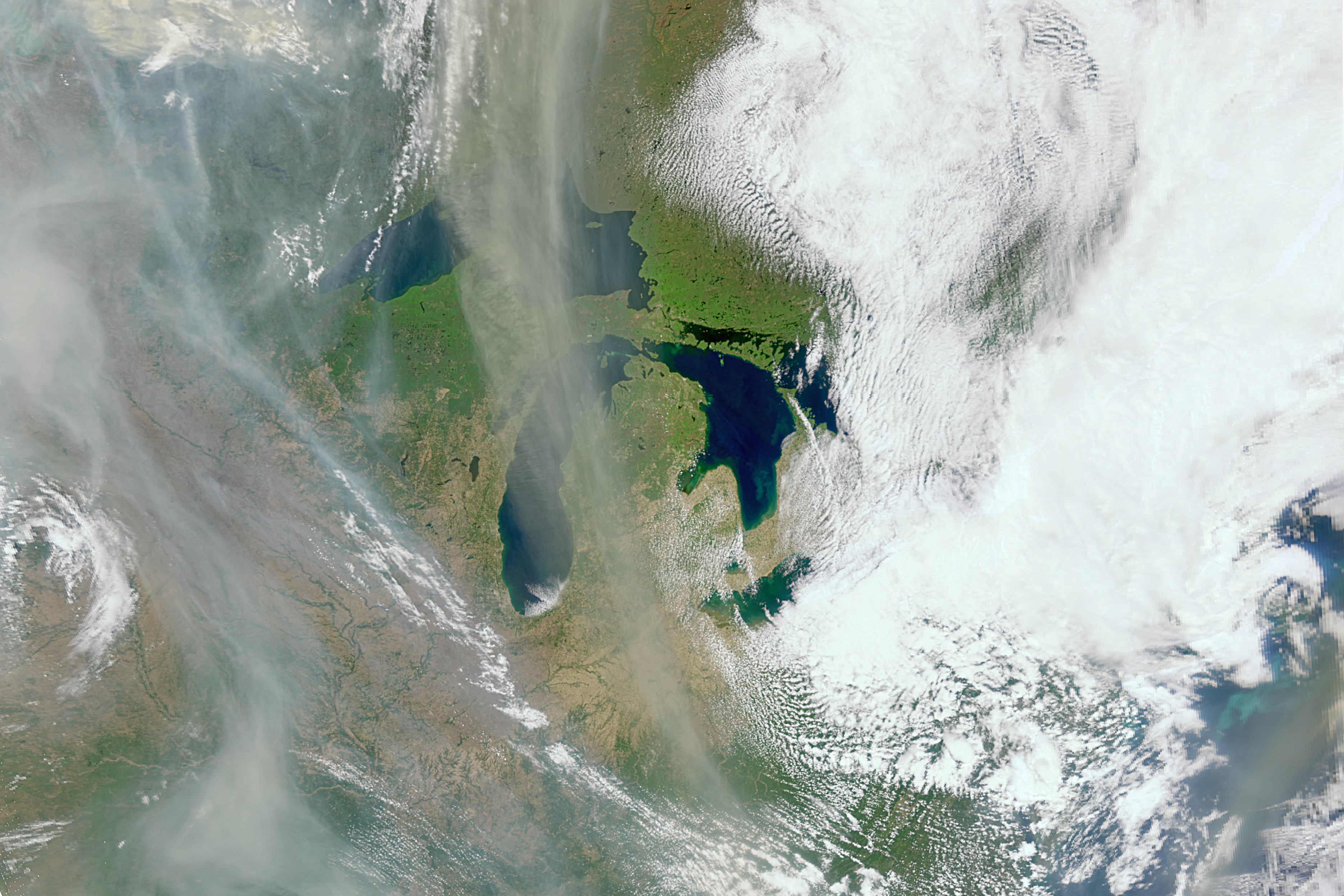
While the satellite, which launched in February 2024, was designed to study Earth’s ocean and atmosphere, it has an unexpected capability: monitoring changes to vegetation. It can also tell us about burn scars, the charred area of land left behind after a wildfire.
“The PACE satellite observes land too, and does it really well,” said Skye Caplan, terrestrial lead for the PACE mission at NASA Goddard. “There is so much to explore with a new hyperspectral data set.”
The Ocean Color Instrument on board PACE is a hyperspectral instrument, observing the planet in several hundred different wavelengths of visible, near infrared, and ultraviolet light. This breadth of the spectrum allows it to gather data on the health of plants, such as their state of stress, dryness, and their relative pigment balance, all of which assist in identifying high fire-risk areas. Land managers can use this data to distribute resources to help mitigate fire risk.
This instrument views the entire Earth daily, with more frequent coverage at high latitudes. With this frequency, on clear days, PACE scientists can quickly assess the aftermath of fires, determining the location and span of a burn scar. Areas that have been burned by wildfire often see increased flood and landslide risk. It’s important to identify these high-risk areas and monitor how they evolve through time, Caplan said.
Using wavelengths in the ultraviolet range, the Ocean Color Instrument can also monitor the smoke after a fire, along with information on how high in the atmosphere these particles drift — height plays a role in how far the particles travel and the systems they impact. The instrument, with its ultraviolet data, expands on fire observations from other satellite instruments, such as the Visible Infrared Imaging Radiometer Suite and the Moderate Resolution Imaging Spectroradiometer.
Thick smoke plumes coming from fires raging in multiple provinces and territories in Canada is visible in this image and affecting a large part of the north of the country. This image was taken by the Ocean Color Instrument aboard NASA’s PACE satellite on Aug. 11, 2024. NASA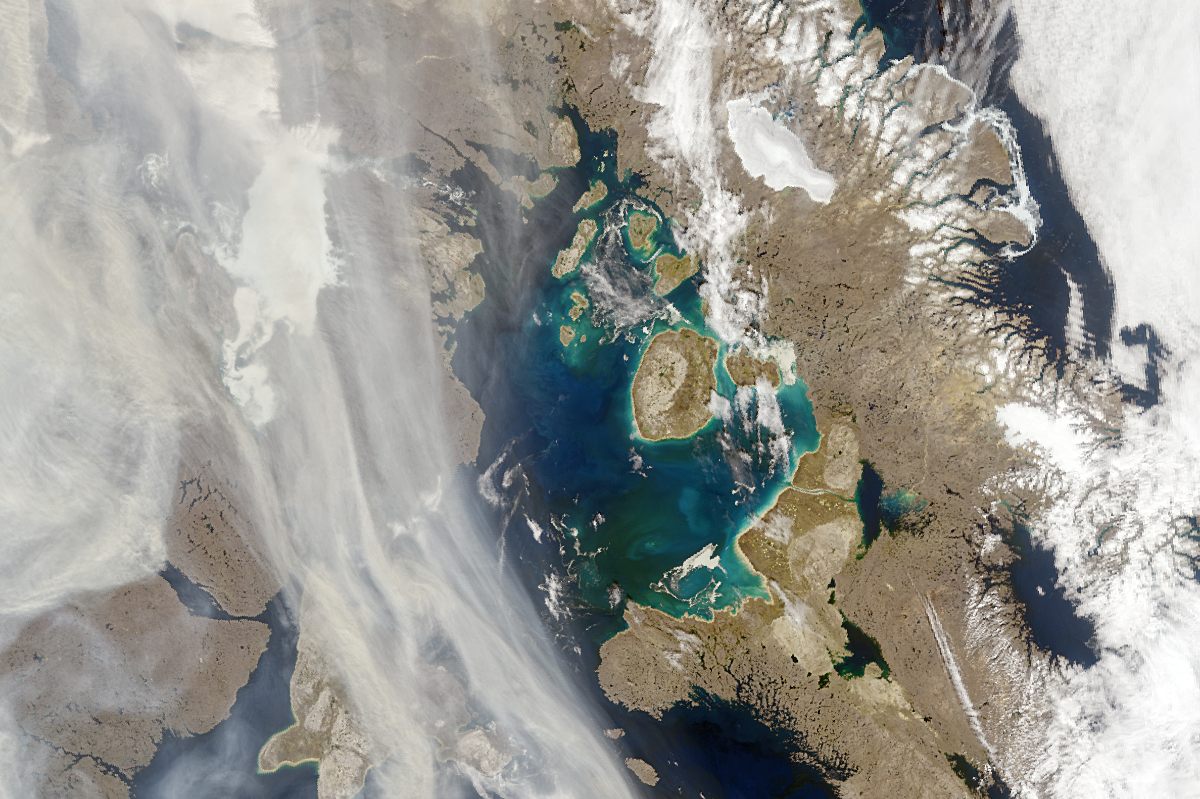
The other two instruments on PACE, the Hyper-Angle Rainbow Polarimeter 2 and the Spectro-polarimeter for Planetary Exploration one, are rich with information about the composition of aerosols from vastly different regions, said Andrew Sayer, PACE project science lead for atmospheres from the Ocean Color Instrument at NASA Goddard.
By measuring characteristics of light as it reflects off particles in the atmosphere, these two instruments can determine the quantity of these particles, along with their chemical properties, color, size, and shape. Scientists use this information to differentiate smoke from other particulates. Smoke particulates are typically light absorbing — appearing gray, black, or brown in color — and are small in size compared to other aerosols PACE views, such as pollutants and dust.
Data from PACE will help scientists create more accurate wildfire models and simulate future events, said Knobelspiesse, the satellite’s polarimeter lead. “We’ll be able to then look at different scenarios of emissions in the future and see how smoke that’s created in one location can impact other parts of the Earth system.”
NASA’s Goddard Space Flight Center, Greenbelt, Md.
Share Details Last Updated Jun 26, 2026 Editor Jenny Marder Contact Erica McNamee erica.s.mcnamee@nasa.gov Location Goddard Space Flight Center Related Terms Explore More 4 min read NASA’s PACE Mission Reveals a Year of Terrestrial Data on Plant HealthA lot can change in a year for Earth’s forests and vegetation, as springtime and…
Article
1 year ago
5 min read New NASA Satellite To Unravel Mysteries About Clouds, Aerosols
Some of the same properties of light and optics that make the sky blue and…
Article
3 years ago
5 min read NASA-Funded Study Shows Wildfire Smoke’s Hidden Ozone Toll
Over the last decade, wildfires have worsened ground-level ozone pollution across much of the contiguous…
Article
3 weeks ago
NASA’s PACE Mission Studies Smoke, Fires
3 min read
NASA’s PACE Mission Studies Smoke, FiresWith the North American fire season underway, and a record number of acres already burned nationwide, NASA’s Plankton, Aerosol, Cloud, and ocean Ecosystem (PACE) satellite’s three instruments are observing vegetation precursors to fires, along with plumes of smoke and their movement. This data will help scientists piece together clues that deepen their understanding of wildfires.
“The challenge that we have is to take those clues and use them in a meaningful way, so our models of Earth properly represent what’s happening,” said Kirk Knobelspiesse, a remote sensing scientist working on the PACE mission at NASA’s Goddard Space Flight Center in Greenbelt, Maryland.
Wisps of smoke coming from fires in multiple provinces and territories in Canada travel over the Great Lakes. This image was taken by the Ocean Color Instrument aboard NASA’s PACE satellite on May 31, 2025. NASAWhile the satellite, which launched in February 2024, was designed to study Earth’s ocean and atmosphere, it has an unexpected capability: monitoring changes to vegetation. It can also tell us about burn scars, the charred area of land left behind after a wildfire.
“The PACE satellite observes land too, and does it really well,” said Skye Caplan, terrestrial lead for the PACE mission at NASA Goddard. “There is so much to explore with a new hyperspectral data set.”
The Ocean Color Instrument on board PACE is a hyperspectral instrument, observing the planet in several hundred different wavelengths of visible, near infrared, and ultraviolet light. This breadth of the spectrum allows it to gather data on the health of plants, such as their state of stress, dryness, and their relative pigment balance, all of which assist in identifying high fire-risk areas. Land managers can use this data to distribute resources to help mitigate fire risk.
This instrument views the entire Earth daily, with more frequent coverage at high latitudes. With this frequency, on clear days, PACE scientists can quickly assess the aftermath of fires, determining the location and span of a burn scar. Areas that have been burned by wildfire often see increased flood and landslide risk. It’s important to identify these high-risk areas and monitor how they evolve through time, Caplan said.
Using wavelengths in the ultraviolet range, the Ocean Color Instrument can also monitor the smoke after a fire, along with information on how high in the atmosphere these particles drift — height plays a role in how far the particles travel and the systems they impact. The instrument, with its ultraviolet data, expands on fire observations from other satellite instruments, such as the Visible Infrared Imaging Radiometer Suite and the Moderate Resolution Imaging Spectroradiometer.
Thick smoke plumes coming from fires raging in multiple provinces and territories in Canada is visible in this image and affecting a large part of the north of the country. This image was taken by the Ocean Color Instrument aboard NASA’s PACE satellite on Aug. 11, 2024. NASAThe other two instruments on PACE, the Hyper-Angle Rainbow Polarimeter 2 and the Spectro-polarimeter for Planetary Exploration one, are rich with information about the composition of aerosols from vastly different regions, said Andrew Sayer, PACE project science lead for atmospheres from the Ocean Color Instrument at NASA Goddard.
By measuring characteristics of light as it reflects off particles in the atmosphere, these two instruments can determine the quantity of these particles, along with their chemical properties, color, size, and shape. Scientists use this information to differentiate smoke from other particulates. Smoke particulates are typically light absorbing — appearing gray, black, or brown in color — and are small in size compared to other aerosols PACE views, such as pollutants and dust.
Data from PACE will help scientists create more accurate wildfire models and simulate future events, said Knobelspiesse, the satellite’s polarimeter lead. “We’ll be able to then look at different scenarios of emissions in the future and see how smoke that’s created in one location can impact other parts of the Earth system.”
NASA’s Goddard Space Flight Center, Greenbelt, Md.
Share Details Last Updated Jun 26, 2026 Editor Jenny Marder Contact Erica McNamee erica.s.mcnamee@nasa.gov Location Goddard Space Flight Center Related Terms Explore More 4 min read NASA’s PACE Mission Reveals a Year of Terrestrial Data on Plant HealthA lot can change in a year for Earth’s forests and vegetation, as springtime and…
Article
1 year ago
5 min read New NASA Satellite To Unravel Mysteries About Clouds, Aerosols
Some of the same properties of light and optics that make the sky blue and…
Article
3 years ago
5 min read NASA-Funded Study Shows Wildfire Smoke’s Hidden Ozone Toll
Over the last decade, wildfires have worsened ground-level ozone pollution across much of the contiguous…
Article
3 weeks ago
Hubble Spies Starry Chandelier
- Hubble Home
- Overview
- Impact & Benefits
- Science
- Observatory
- Team
- Multimedia
- News
- More
3 min read
Hubble Spies Starry Chandelier This NASA/ESA Hubble Space Telescope image features the globular cluster NGC 6723, sometimes called the Chandelier Cluster. ESA/Hubble & NASA, A. Sarajedini, G. Piotto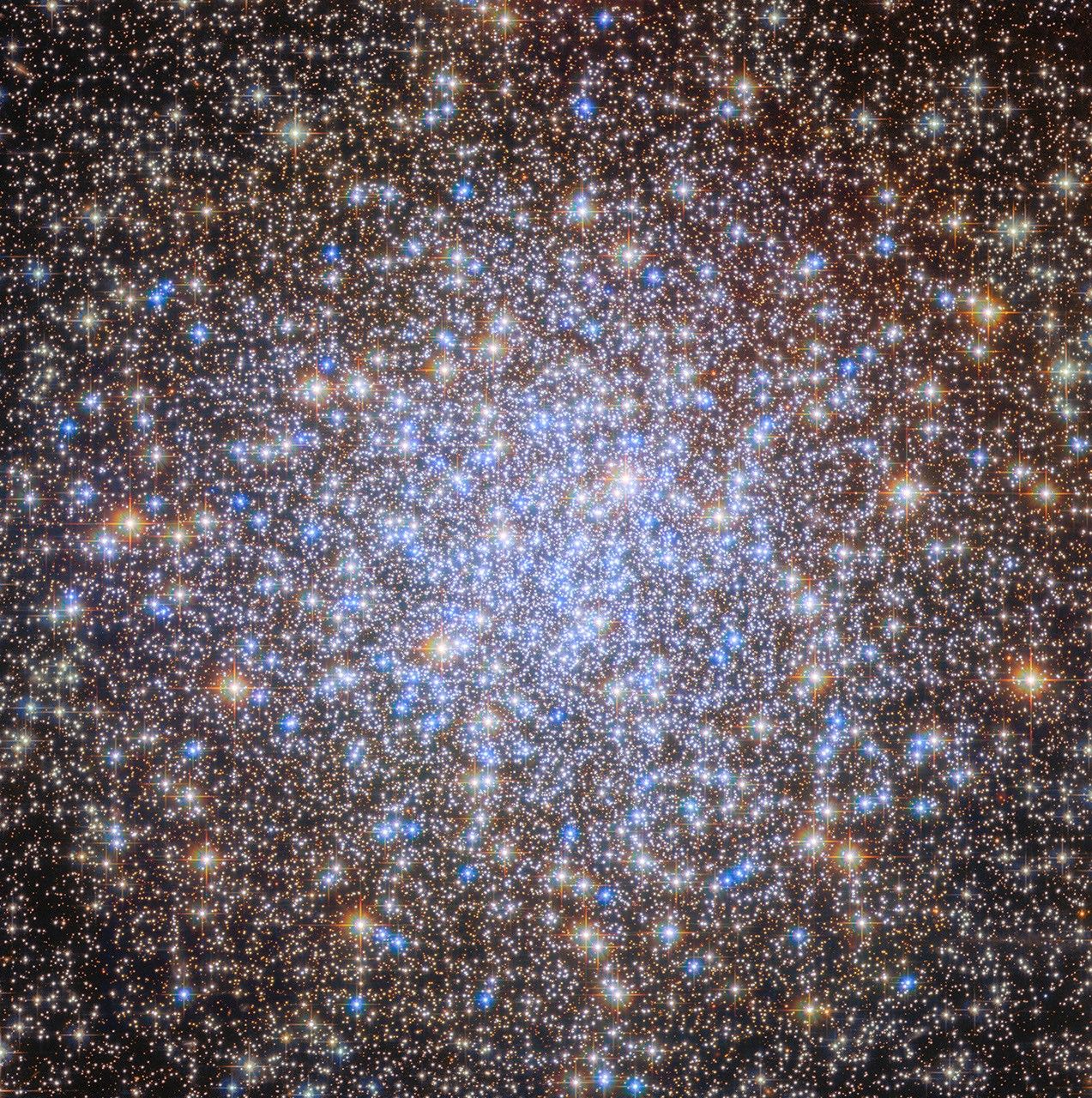
The subject of today’s NASA/ESA Hubble Space Telescope image is an ancient inhabitant of our galaxy. This sparkling scene features a globular cluster: a collection of tens of thousands to millions of stars, all tightly bound together under the influence of gravity. There are more than 150 globular clusters in our galaxy, though there may be others still undiscovered, hidden from view by dust or densely packed fields of stars.
This globular cluster, NGC 6723, sometimes called the Chandelier Cluster, is much like its namesake because it sparkles with countless lights. However, each ‘lightbulb’ in this chandelier is an individual star 27,000 light-years away in the constellation Sagittarius (the Archer).
Globular clusters like NGC 6723 contain some of the oldest stars in our galaxy. These clusters have ages that often exceed 10 billion years old, and some are nearly as old as the universe itself. Astronomers think globular clusters are some of the first structures that formed in our galaxy, coalescing potentially billions of years before the thin disk of stars in which our Sun orbits. The details of how globular clusters formed, however, are not yet certain.
Astronomers initially thought that all stars in a globular cluster formed at the same time in a single flourish of star formation. This would mean that all stars in a globular cluster would be the same age and made of the same mixture of chemical elements. Now, thanks to observations from telescopes like Hubble, researchers know that these seemingly simple stellar populations have more complex histories than originally thought.
Hubble first observed NGC 6723 as part of an ambitious survey dedicated to demystifying the properties of globular clusters in our Milky Way galaxy. In this observing program (#10775, PI: Sarajedini), researchers used Hubble to study 65 globular clusters in our galaxy in visible and near-infrared light. That data allowed researchers to study everything from the ages of globular clusters to the process through which massive stars sink to the center of a star cluster and lower-mass stars drift toward the cluster outskirts. This survey has been immensely scientifically valuable, and these observations have inspired several hundred published research papers.
In a later observing program (#13297, PI: Piotto), researchers set their sights again on many of these same clusters, including NGC 6723. This time, they used Hubble’s unique sensitivity to ultraviolet light to detect the subtle variations in chemical composition between the stars of globular clusters and determine the age spread among the clusters’ stars. For NGC 6723, researchers found evidence of two closely-spaced periods of star formation, the second occurring within 634 million years of the first. (‘Closely-spaced’ is relative; 634 million years is a blink of an eye for a star cluster that is more than 10 billion years old!)
Thanks to these findings, astronomers are on the path to understanding how and when globular clusters formed — and Hubble observations of celestial chandeliers like NGC 6723 are lighting the way.
Text Credit: ESA/Hubble
Facebook logo @NASAHubble @NASAHubble Instagram logo @NASAHubbleMedia Contact:
Claire Andreoli
NASA’s Goddard Space Flight Center, Greenbelt, MD
claire.andreoli@nasa.gov
Since its 1990 launch, the Hubble Space Telescope has changed our fundamental understanding of the universe.
Hubble’s Star Clusters
Hubble e-Books
Hubble’s Cosmic Adventure
Hubble Spies Starry Chandelier
- Hubble Home
- Overview
- Impact & Benefits
- Science
- Observatory
- Team
- Multimedia
- News
- More
3 min read
Hubble Spies Starry Chandelier This NASA/ESA Hubble Space Telescope image features the globular cluster NGC 6723, sometimes called the Chandelier Cluster. ESA/Hubble & NASA, A. Sarajedini, G. PiottoThe subject of today’s NASA/ESA Hubble Space Telescope image is an ancient inhabitant of our galaxy. This sparkling scene features a globular cluster: a collection of tens of thousands to millions of stars, all tightly bound together under the influence of gravity. There are more than 150 globular clusters in our galaxy, though there may be others still undiscovered, hidden from view by dust or densely packed fields of stars.
This globular cluster, NGC 6723, sometimes called the Chandelier Cluster, is much like its namesake because it sparkles with countless lights. However, each ‘lightbulb’ in this chandelier is an individual star 27,000 light-years away in the constellation Sagittarius (the Archer).
Globular clusters like NGC 6723 contain some of the oldest stars in our galaxy. These clusters have ages that often exceed 10 billion years old, and some are nearly as old as the universe itself. Astronomers think globular clusters are some of the first structures that formed in our galaxy, coalescing potentially billions of years before the thin disk of stars in which our Sun orbits. The details of how globular clusters formed, however, are not yet certain.
Astronomers initially thought that all stars in a globular cluster formed at the same time in a single flourish of star formation. This would mean that all stars in a globular cluster would be the same age and made of the same mixture of chemical elements. Now, thanks to observations from telescopes like Hubble, researchers know that these seemingly simple stellar populations have more complex histories than originally thought.
Hubble first observed NGC 6723 as part of an ambitious survey dedicated to demystifying the properties of globular clusters in our Milky Way galaxy. In this observing program (#10775, PI: Sarajedini), researchers used Hubble to study 65 globular clusters in our galaxy in visible and near-infrared light. That data allowed researchers to study everything from the ages of globular clusters to the process through which massive stars sink to the center of a star cluster and lower-mass stars drift toward the cluster outskirts. This survey has been immensely scientifically valuable, and these observations have inspired several hundred published research papers.
In a later observing program (#13297, PI: Piotto), researchers set their sights again on many of these same clusters, including NGC 6723. This time, they used Hubble’s unique sensitivity to ultraviolet light to detect the subtle variations in chemical composition between the stars of globular clusters and determine the age spread among the clusters’ stars. For NGC 6723, researchers found evidence of two closely-spaced periods of star formation, the second occurring within 634 million years of the first. (‘Closely-spaced’ is relative; 634 million years is a blink of an eye for a star cluster that is more than 10 billion years old!)
Thanks to these findings, astronomers are on the path to understanding how and when globular clusters formed — and Hubble observations of celestial chandeliers like NGC 6723 are lighting the way.
Text Credit: ESA/Hubble
Facebook logo @NASAHubble @NASAHubble Instagram logo @NASAHubbleMedia Contact:
Claire Andreoli
NASA’s Goddard Space Flight Center, Greenbelt, MD
claire.andreoli@nasa.gov
Since its 1990 launch, the Hubble Space Telescope has changed our fundamental understanding of the universe.
Hubble’s Star Clusters
Hubble e-Books
Hubble’s Cosmic Adventure
Week in images: 22-26 June 2026
Week in images: 22-26 June 2026
Discover our week through the lens
Ancient human DNA found on cave art for the first time
Ancient human DNA found on cave art for the first time
Astronomers Catch the Glowing Shockwave of a Galaxy on the Move
Astronomers have discovered a galaxy so unlike anything in the textbooks that the researcher who found it, after 25 years studying these objects, says he has never seen its equal. Named RAD-BAARG, it is falling supersonically into a distant cluster of galaxies and ploughing up a glowing arc of radio plasma nearly 1.8 million light years across, shaped uncannily like a bow and arrow. It offers astronomers their clearest view yet of a bow shock, a structure long predicted but almost never glimpsed. And in a final twist, the first person to spot it was not a professional at all, but a student combing through telescope data from a remote hillside in the Himalayas.
How NASA Taught Four Astronauts to Read the Moon
When Artemis II swept around the far side of the Moon this April, carrying the first humans beyond Earth orbit in more than fifty years, NASA had prepared its four astronauts for something more than flying the spacecraft. It had trained them to see. Reid Wiseman, Victor Glover, Christina Koch and Jeremy Hansen spent two years learning to read the Moon like field geologists, hunting through impact rocks in Labrador and volcanic ash in Iceland, so that when they finally gazed down on the terrain, they could describe its colours, shadows and history with a scientist's judgement. It’s a quiet revolution in what we send astronauts to the Moon to do, and a glimpse of how the next explorers will work when they finally land.
How Mbappe, Haaland and Messi use psychology to stay sharp at the World Cup
Sports psychology plays a major role on and off the pitch, helping players manage chaos and stay strategic