
Feed aggregator
NASA Astronaut Andrew Morgan Retires
May 28, 2026
Former NASA astronaut Andrew Morgan waves as he is photographed during an Expedition 61 spacewalk outside the International Space Station. Credit: NASA
After a 12-year career at NASA, U.S. Army Brig. Gen. Andrew R. Morgan has retired from the agency to continue his military service. Morgan spent 272 days in space aboard the International Space Station.
NASA selected Morgan to join its 21st astronaut class in August 2013. He launched to the space station aboard a Soyuz MS-13 spacecraft on July 20, 2019, the same day as the 50th anniversary of the Apollo 11 Moon landing, from the Baikonur Cosmodrome in Kazakhstan.
Morgan served as a flight engineer on International Space Station Expeditions 60, 61, and 62, contributing to hundreds of scientific experiments, technology demonstrations, and space station maintenance activities. He traveled over 115 million miles (about 185 million km) while completing more than 4,300 Earth orbits over the course of his mission.
“Drew’s leadership and commitment to human spaceflight exemplify the very best of NASA,” said Vanessa Wyche, director of NASA’s Johnson Space Center in Houston. “From his service aboard the International Space Station to his continued passion for exploration, Drew’s impact across the agency has been profound. His steadfast dedication to the agency will continue to inspire generations to come.”
During his nine months aboard the station, Morgan conducted seven spacewalks for a total of 45 hours and 48 minutes of spacewalking time, breaking the record for a single spaceflight by a U.S. astronaut. Four of his spacewalks were dedicated to repairing the Alpha Magnetic Spectrometer, a particle physics detector designed to search for evidence of antimatter and dark matter.
“Drew approached every challenge with quiet confidence, sharp judgment, and an unwavering commitment to his team,” said Scott Tingle, chief of the Astronaut Office at NASA Johnson. “Whether serving in orbit or strengthening crew readiness here on the ground, he consistently elevated the people and missions around him. His leadership and example will continue to resonate across the astronaut corps for years to come.”
Morgan’s career at NASA also included serving as the Astronaut Office’s mission support branch chief, crew operations officer, astronaut mission control team liaison for Expeditions 67 and 68, and Army detachment commander. In his final two years at NASA, Morgan served a rotational assignment back to the U.S. Army as commander of U.S. Army Garrison Kwajalein Atoll, and senior military advisor for the U.S. Ambassador to the Republic of the Marshall Islands.
Morgan was born in Morgantown, West Virginia, but considers New Castle, Pennsylvania, his hometown. At the time of his NASA astronaut selection, he was a board-certified emergency physician and had served in elite special forces units around the globe. He is a graduate of the United States Military Academy at West Point, the Uniformed Services University of the Health Sciences, and the U.S. Army War College. He is currently serving as the commanding general of White Sands Missile Range in New Mexico.
“It has been an honor to serve in the nation’s space program,” Morgan said. “I am proud to have represented my country on an international mission that brings the best of humanity together for a shared purpose. I will miss the camaraderie of my incredible NASA teammates and their unparalleled expertise. While leaving the astronaut corps is bittersweet, I’m excited to continue serving our country as a leader in the U.S. Army.”
To learn more about how NASA explores the unknown and innovates for the benefit of humanity, visit:
https://www.nasa.gov/astronauts
-end-
Anna Schneider
Johnson Space Center, Houston
281-483-5111
Going Low and Slow in Testing
Going Low and Slow in Testing
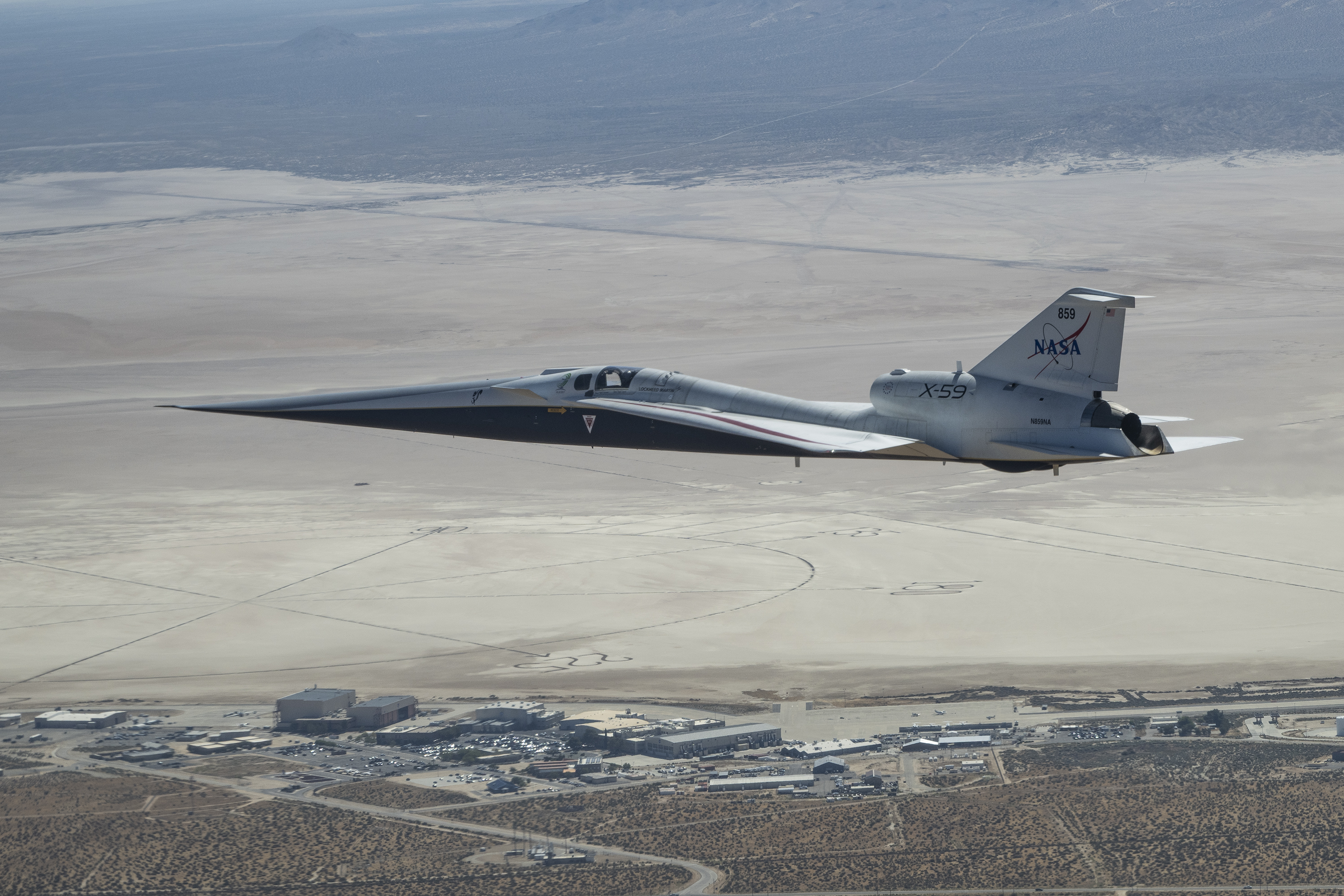
NASA’s X-59 quiet supersonic research aircraft flies above NASA’s Armstrong Flight Research Center in Edwards, California, on April 28, 2026, during testing focused on lower-speed and altitude flight conditions in support of NASA’s Quesst mission.
The X-59 has completed initial test flights at high altitudes and near-supersonic speeds, opening the door for additional flights focused on its full operating range. These more recent, lower-altitude flights at lesser speeds are helping to confirm the X-plane’s performance across a wide range of conditions, including flying with the landing gear both retracted and extended.
Read more about this series of test flights.
Image credit: NASA/Jim Ross
Going Low and Slow in Testing
NASA’s X-59 quiet supersonic research aircraft flies above NASA’s Armstrong Flight Research Center in Edwards, California, on April 28, 2026, during testing focused on lower-speed and altitude flight conditions in support of NASA’s Quesst mission.
The X-59 has completed initial test flights at high altitudes and near-supersonic speeds, opening the door for additional flights focused on its full operating range. These more recent, lower-altitude flights at lesser speeds are helping to confirm the X-plane’s performance across a wide range of conditions, including flying with the landing gear both retracted and extended.
Read more about this series of test flights.
Image credit: NASA/Jim Ross
Mathematical AI helps researchers crack 50-year-old problem
Mathematical AI helps researchers crack 50-year-old problem
Kamala Sohonie: The biochemist who wanted to feed a nation
Biochemist Kamala Baghvat, later known as Kamala Sohonie, forced open the doors of India’s male-only laboratories and used her knowledge to help feed a nation
Are the roots of consciousness hidden in the ancient deep brain?
Some neuroscientists argue that the roots of experience lie deep inside the brain. If they’re right, the consciousness club will get a lot bigger
Trump plan to give start-ups plutonium harvested from Cold War–era nuclear weapons is risky, experts say
Weapons-grade plutonium can fuel nuclear reactors known as mixed oxide reactors, but none of these exist in the U.S.
Start-ups are racing to revolutionise mathematics with AI
Start-ups are racing to revolutionise mathematics with AI
3D-printed lymph nodes could widen access to CAR T-cell therapy
3D-printed lymph nodes could widen access to CAR T-cell therapy
MTG-I2 embarks on journey to Europe’s Spaceport
'The book is in the future, but everything is seeded from our present'
'The book is in the future, but everything is seeded from our present'
The ‘age of gravitational astronomy’ is here
A record-setting collection of precisely measured gravitational waves reveals new information about how black holes behave and evolve