
Feed aggregator
Hubble Sees Swarm of Galaxies
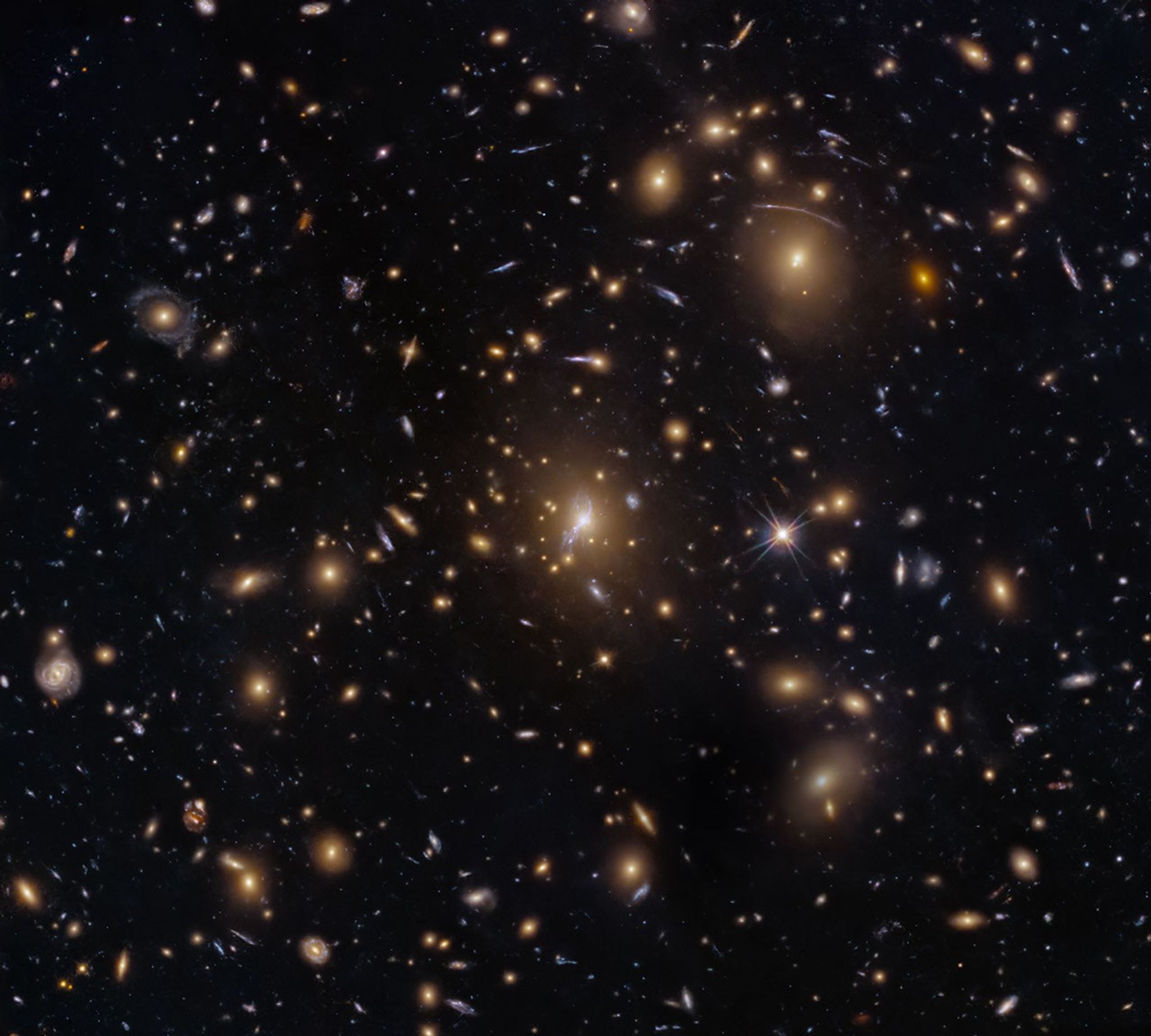
Looking somewhat like a swarm of bees returning to their hive, this NASA Hubble Space Telescope image released on June 12, 2026, features the galaxy cluster MACS0329-0211. Galaxy clusters like MACS0329-0211 are important signposts in the story of how the structure of the universe evolved, and are the ultimate telescopic lenses, placing gravitationally lensed galaxies from the earliest stages of the universe into our view.
Zoom into this galaxy swarm and you will find large, oval-shaped elliptical galaxies, and thin spiral and lenticular galaxies viewed from the edge. We can also see the full, face-on view of spiral galaxies and their curving spiral arms. The image’s upper-right quadrant holds faint arcs of distant galaxies gravitationally lensed by the cluster’s massive gravity. The largest of these arcs appears above the bright oval shape of a giant elliptical galaxy. Closer inspection of the image’s center reveals several bright-white intersecting curves that appear as a distorted figure eight. This may be another distant galaxy whose light was magnified and distorted by this massive cluster’s gravity.
Hubble looked at MACS0329-0211 as part of an observing program of X-ray bright galaxy clusters. Researchers used Hubble’s two main cameras, the Advanced Camera for Surveys and its Wide Field Camera 3, to gather data visible and infrared light from the cluster. Hubble’s ability to see such a broad spectrum of light makes it a valuable tool in understanding the very nature of these galaxy clusters.
Image credit: NASA, ESA, M. Postman (STScI); Image Processing: G. Kober (NASA/Catholic University of America)
'High-Res' is the Secret to Finding Alien Life with the Next Great Space Telescope
We’re still in the definition phase of the Habitable Worlds Observatory (HWO), but it seems like every week a new research group comes out with a paper helping to contribute to what is shaping up to be one of the most important space telescopes of the 2040s. A new paper from a team of researchers led by Daniel Jaffe of the University of Texas at Austin contributes to this ongoing definition work by arguing that it’s time HWO adopted a high-resolution near-IR spectroscopy capability, - which sounds great in practice, but so far hasn’t been attempted due to technological limitations. But, according to the paper, two recent inventions finally make a working version of an extremely high resolution exoplanet hunter viable.
Astronomers discover another galaxy seemingly devoid of dark matter
A galaxy appears to be missing the invisible substance thought to hold such objects together, further challenging long-held assumptions about how galaxies form
First Ariane 6 liftoff with most powerful boosters
On the 17th of June Ariane 6 flight VA269 soared to orbit from Europe's Spaceport in French Guiana. The latest generation of Europe's largest and most powerful rocket launched 36 satellites for Amazon's Leo constellation.
The debut of the four new boosters based on the P160C solid-propellant rocket motor allowed 36 satellites to be launched, four more than the two Leo launches Ariane 6 had delivered before.
Ariane 6 is Europe’s heavy-lift launcher and a key element of ESA’s efforts to ensure autonomous access to space for Europe’s citizens. The new P160C boosters increase considerably performance, payload capacity and competitiveness, allowing for more satellites to be launched, further elevating the future of Europe.
Ancient Skies: The Moon That Returns Once in a Generation
The 18.6-year cycle of the lunar standstill belongs to the Moon. But recognizing it belongs to us. For centuries, people have watched carefully enough, remembered long enough, and taught faithfully enough to discover patterns that unfolded across generations.
The post Ancient Skies: The Moon That Returns Once in a Generation appeared first on Sky & Telescope.
Watch sharks use manta rays to scratch unreachable itches
Galapagos sharks have been spotted scrubbing off parasites with help from manta rays
Neuroscientist Kauê M. Costa redefines how the brain learns
Neuroscientist Kauê M. Costa talks about surprising results that are changing how we think dopamine works and how the brain really learns
ESA Council appoints two new directors
The European Space Agency Council has approved the appointment of two new directors: Christine Klein as Director of Controlling, Finance and Operational Procurement, and Jean-Luc Trullemans as Director of Strategy, Legal and External Affairs.
ESA Impact: a look at ESA’s spring milestones
ESA Impact: a look at ESA’s spring milestones
Dozens of dust devils hidden in plain sight
The European Space Agency’s Mars Express has captured part of Mars’s Mamers Valles: a fascinating valley system speckled with brief, tornado-like whirlwinds known as dust devils.
Low Water at San Carlos Reservoir
- Earth
- Earth Observatory
- Image of the Day
- EO Explorer
- Topics
- More Content
- About
Low Water at San Carlos Reservoir
- Earth
- Earth Observatory
- Image of the Day
- EO Explorer
- Topics
- More Content
- About
Lava planet has hydrogen-rich, active atmosphere
It’s 2158, and you’re chugging away on your PhD in Planetary Volcanology from the University of Utopia Planitia on Mars. Graduate students still get paid a sub-living wage, so you’ve been stuck eating freeze-dried ramen for the past three years. You’ve completed studying Jupiter’s moon, Io, but now you have to leave the solar system for a good exoplanet analog. While Io’s volcanism is caused by tidal heating, you need an exoplanet whose volcanism is caused by extreme heat from its host star. You recently secured funding from the Exoplanet Research Institute for a faster-than-light (FTL) ship, but the exoplanet is required to be less than 50 light-years away.
Proposed White House regulations could kill 5,000 clinical trials, analysis finds
The Trump administration is mulling new rules that would give political appointees final say on research grants
NASA’s Webb Catches Exoplanet Getting Roasted
- Webb
- News
- Overview
- Science
- Observatory
- Multimedia
- Team
- More
Artwork: NASA, ESA, CSA, Joseph Olmsted (STScI)
4 min read
NASA’s Webb Catches Exoplanet Getting RoastedOne well-done gas giant, coming right up! That’s the latest from researchers analyzing NASA’s James Webb Space Telescope’s observations of HD 80606 b, an exoplanet four times the mass of Jupiter with an extremely elliptical orbit that sweeps close by its Sun-like star. The research team is presenting their study and preliminary findings Tuesday at the 248th meeting of the American Astronomical Society in Pasadena, California.
“Hot Jupiters are already considered some of the most extreme exoplanets we know of, but even among that population, HD 80606 b is one of the most extreme,” said Tiffany Kataria, the study’s principal investigator at NASA’s Jet Propulsion Laboratory in Southern California. “We typically think of hot Jupiters as hot gas giants sitting right next to their stars, but this planet’s highly eccentric orbit creates a completely different beast.”
As the planet plunges close to its star, Webb shows its temperature skyrockets by 1,100 degrees Fahrenheit. Previous studies have shown that radical temperature swings can cause an exoplanet’s chemistry and clouds to change in real time. According to the research team, the dynamic conditions of HD 80606 b make the planet an ideal target to observe these changes with Webb’s powerful instruments.
Image: Artist’s concept exoplanet HD 80606 b This artist’s concept shows exoplanet HD 80606 b being “roasted” as its orbit approaches periastron, the point at which it is closest to its host star, which is similar to our Sun. Artwork: NASA, ESA, CSA, Joseph Olmsted (STScI)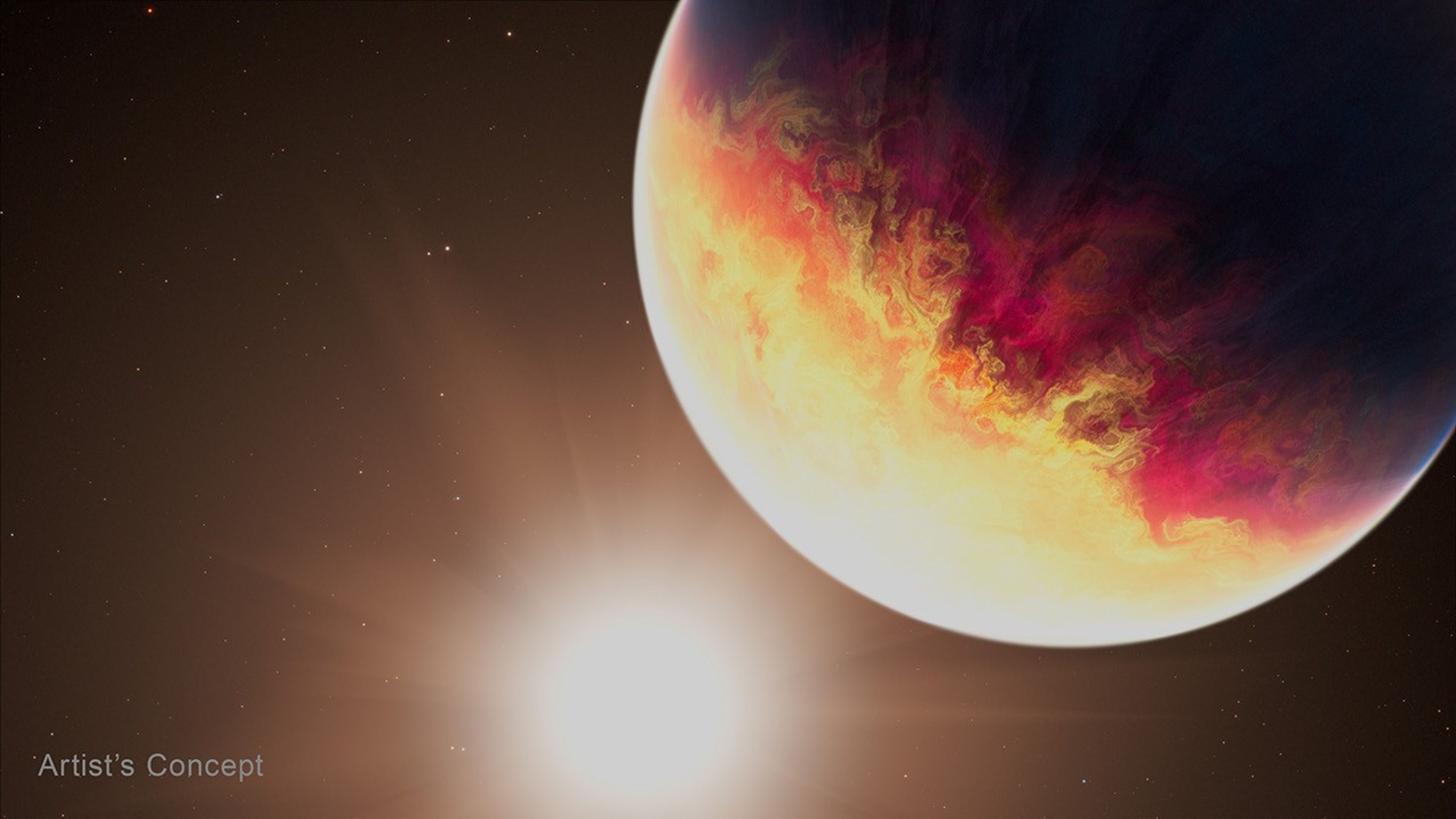
“Observing a planet like HD 80606 b is actually very efficient because its unusual orbit, with the corresponding swings in temperature and chemical composition, allow us to gather data under varying conditions in just hours and apply those findings to other hot Jupiters or more conventional exoplanets,” said Laura C. Mayorga, co-investigator on the study and an exoplanet astronomer at the Johns Hopkins Applied Physics Laboratory in Laurel, Maryland.
Measurements of temperature and chemical composition were done with spectroscopy, a technique scientists use to break light into its component colors to reveal information about the composition, temperature, motion, and physical properties of objects in space. The team used Webb’s MIRI (Mid-Infrared Instrument) for an extended observation of HD 80606 b before, during, and after its periastron, or closest pass by its star. During periastron, the planet also passed behind the star from Webb’s perspective in what’s known as a secondary eclipse. The observation was years in the planning, as scheduling the time to catch the planet at this point was complex given its extremely elliptical 111-day orbit, and Webb’s own restrictions on where it can look during specific times of the year, based on Earth’s position in orbit around the Sun.
Researchers say they have only begun to peel back the layers of an incredibly rich dataset, but they can clearly see a dramatic shift in the exoplanet’s temperature. “Webb has shown that the planet’s increase in temperature was even more extreme than we anticipated based on Spitzer data,” said Kataria.
In fact, the planet had already been dubbed the “roasted exoplanet” and even got its own poster in NASA’s popular series. NASA’s now-retired Spitzer Space Telescope laid the groundwork of infrared observations of HD 80606 b, showing that more detailed spectroscopic data from Webb would be especially compelling.
“Spitzer did amazing work on this exoplanet, and now Webb is building on that legacy by enabling us to drill down to distinguish specific chemical signatures like methane and carbon dioxide, which is just amazing progress,” said Ryan Challener, co-author and research associate at the Cornell Center for Astrophysics and Planetary Science. “There’s so much to learn from this one dataset here — we really are just getting started deciphering what Webb has to tell us.”
The James Webb Space Telescope is the world’s premier space science observatory. Webb is solving mysteries in our solar system, looking beyond to distant worlds around other stars, and probing the mysterious structures and origins of our universe and our place in it. Webb is an international program led by NASA with its partners, ESA (European Space Agency) and CSA (Canadian Space Agency).
For more information on Webb, visit:
Downloads & Related InformationThe following sections contain links to download this article’s images and videos in all available resolutions followed by related information links, media contacts, and if available, research paper and Spanish translation links.
Related Images & Videos HD 80606 b (Artist’s Concept)This artist’s concept shows exoplanet HD 80606 b being “roasted” as its orbit approaches periastron, the point at which it is closest to its host star, which is similar to our Sun.
Related Links
Este Artículo en Español – “Telescopio Webb de la NASA Detecta un Exoplaneto Asandose”
Read: Webb’s Impact on Exoplanet Research
Watch: How to Study Exoplanets: Webb and Challenges
Explore: Eyes on Exoplanets
Print: The Roasted Exoplanet Poster
More Webb: News | Images | Science | Home Page
Laura Betz
NASA’s Goddard Space Flight Center
Greenbelt, Maryland
laura.e.betz@nasa.gov
Leah Ramsay
Space Telescope Science Institute
Baltimore, Maryland
Hannah Braun
Space Telescope Science Institute
Baltimore, Maryland
- Este Artículo en Español – “Telescopio Webb de la NASA Detecta un Exoplaneto Asandose”
- HD 80606 b in NASA Exoplanet Catalog
- Roasted Exoplanet poster
- “Hot Jupiter” exoplanets
Keep Exploring Discover More Topics From Webb James Webb Space Telescope
Webb is the premier observatory of the next decade, serving thousands of astronomers worldwide. It studies every phase in the…
Science Overview
Exoplanets
Webb Image Galleries
NASA’s Webb Catches Exoplanet Getting Roasted
- Webb
- News
- Overview
- Science
- Observatory
- Multimedia
- Team
- More
Artwork: NASA, ESA, CSA, Joseph Olmsted (STScI)
4 min read
NASA’s Webb Catches Exoplanet Getting RoastedOne well-done gas giant, coming right up! That’s the latest from researchers analyzing NASA’s James Webb Space Telescope’s observations of HD 80606 b, an exoplanet four times the mass of Jupiter with an extremely elliptical orbit that sweeps close by its Sun-like star. The research team is presenting their study and preliminary findings Tuesday at the 248th meeting of the American Astronomical Society in Pasadena, California.
“Hot Jupiters are already considered some of the most extreme exoplanets we know of, but even among that population, HD 80606 b is one of the most extreme,” said Tiffany Kataria, the study’s principal investigator at NASA’s Jet Propulsion Laboratory in Southern California. “We typically think of hot Jupiters as hot gas giants sitting right next to their stars, but this planet’s highly eccentric orbit creates a completely different beast.”
As the planet plunges close to its star, Webb shows its temperature skyrockets by 1,100 degrees Fahrenheit. Previous studies have shown that radical temperature swings can cause an exoplanet’s chemistry and clouds to change in real time. According to the research team, the dynamic conditions of HD 80606 b make the planet an ideal target to observe these changes with Webb’s powerful instruments.
Image: Artist’s concept exoplanet HD 80606 b This artist’s concept shows exoplanet HD 80606 b being “roasted” as its orbit approaches periastron, the point at which it is closest to its host star, which is similar to our Sun. Artwork: NASA, ESA, CSA, Joseph Olmsted (STScI)“Observing a planet like HD 80606 b is actually very efficient because its unusual orbit, with the corresponding swings in temperature and chemical composition, allow us to gather data under varying conditions in just hours and apply those findings to other hot Jupiters or more conventional exoplanets,” said Laura C. Mayorga, co-investigator on the study and an exoplanet astronomer at the Johns Hopkins Applied Physics Laboratory in Laurel, Maryland.
Measurements of temperature and chemical composition were done with spectroscopy, a technique scientists use to break light into its component colors to reveal information about the composition, temperature, motion, and physical properties of objects in space. The team used Webb’s MIRI (Mid-Infrared Instrument) for an extended observation of HD 80606 b before, during, and after its periastron, or closest pass by its star. During periastron, the planet also passed behind the star from Webb’s perspective in what’s known as a secondary eclipse. The observation was years in the planning, as scheduling the time to catch the planet at this point was complex given its extremely elliptical 111-day orbit, and Webb’s own restrictions on where it can look during specific times of the year, based on Earth’s position in orbit around the Sun.
Researchers say they have only begun to peel back the layers of an incredibly rich dataset, but they can clearly see a dramatic shift in the exoplanet’s temperature. “Webb has shown that the planet’s increase in temperature was even more extreme than we anticipated based on Spitzer data,” said Kataria.
In fact, the planet had already been dubbed the “roasted exoplanet” and even got its own poster in NASA’s popular series. NASA’s now-retired Spitzer Space Telescope laid the groundwork of infrared observations of HD 80606 b, showing that more detailed spectroscopic data from Webb would be especially compelling.
“Spitzer did amazing work on this exoplanet, and now Webb is building on that legacy by enabling us to drill down to distinguish specific chemical signatures like methane and carbon dioxide, which is just amazing progress,” said Ryan Challener, co-author and research associate at the Cornell Center for Astrophysics and Planetary Science. “There’s so much to learn from this one dataset here — we really are just getting started deciphering what Webb has to tell us.”
The James Webb Space Telescope is the world’s premier space science observatory. Webb is solving mysteries in our solar system, looking beyond to distant worlds around other stars, and probing the mysterious structures and origins of our universe and our place in it. Webb is an international program led by NASA with its partners, ESA (European Space Agency) and CSA (Canadian Space Agency).
For more information on Webb, visit:
Downloads & Related InformationThe following sections contain links to download this article’s images and videos in all available resolutions followed by related information links, media contacts, and if available, research paper and Spanish translation links.
Related Images & Videos HD 80606 b (Artist’s Concept)This artist’s concept shows exoplanet HD 80606 b being “roasted” as its orbit approaches periastron, the point at which it is closest to its host star, which is similar to our Sun.
Related Links
Este Artículo en Español – “Telescopio Webb de la NASA Detecta un Exoplaneto Asandose”
Read: Webb’s Impact on Exoplanet Research
Watch: How to Study Exoplanets: Webb and Challenges
Explore: Eyes on Exoplanets
Print: The Roasted Exoplanet Poster
More Webb: News | Images | Science | Home Page
Laura Betz
NASA’s Goddard Space Flight Center
Greenbelt, Maryland
laura.e.betz@nasa.gov
Leah Ramsay
Space Telescope Science Institute
Baltimore, Maryland
Hannah Braun
Space Telescope Science Institute
Baltimore, Maryland
- Este Artículo en Español – “Telescopio Webb de la NASA Detecta un Exoplaneto Asandose”
- HD 80606 b in NASA Exoplanet Catalog
- Roasted Exoplanet poster
- “Hot Jupiter” exoplanets
Keep Exploring Discover More Topics From Webb James Webb Space Telescope
Webb is the premier observatory of the next decade, serving thousands of astronomers worldwide. It studies every phase in the…
Science Overview
Exoplanets
Webb Image Galleries
Astronaut Jessica Meir Assists With Hardware Updates for NASA’s Cold Atom Lab
NASA Photojournal Navigation Downloads Astronaut Jessica Meir Assists With Hardware Updates for NASA’s Cold Atom Lab
JPEG (4.91 MB)
Description
NASA astronaut Jessica Meir inspects optical fibers while installing hardware updates to the agency’s Cold Atom Lab, or CAL, aboard the International Space Station on May 8, 2026.
About the size of a minifridge and operated from Earth, CAL chills atoms to temperatures below minus 459 degrees Fahrenheit (minus 273.15 degrees Celsius), so close to absolute zero that they form a large quantum object called a Bose-Einstein condensate (BEC) — a fifth state of matter distinct from solids, liquids, gases, and plasma. In a BEC, scientists can observe the quantum properties of atoms at a scale visible to the naked eye. For instance, atoms and particles sometimes behave like solid objects and sometimes behave like waves, a quantum property called “wave-particle duality.”
Managed by Caltech in Pasadena, NASA’s Jet Propulsion Laboratory designed, built, and operates Cold Atom Lab, which is sponsored by the Biological and Physical Sciences (BPS) division of NASA’s Science Mission Directorate at the agency’s headquarters in Washington. The BPS division pioneers scientific discovery and enables exploration by using space environments to conduct investigations that are not possible on Earth. Studying biological and physical phenomena under extreme conditions allows researchers to advance the fundamental scientific knowledge required to go farther and stay longer in space, while also benefiting life on Earth.
To learn more about Cold Atom Lab, visit:
https://coldatomlab.jpl.nasa.gov/
Keep Exploring Discover More Topics From Photojournal
Photojournal
Search Photojournal
Photojournal’s Latest Content
Feedback
Astronaut Jessica Meir Assists With Hardware Updates for NASA’s Cold Atom Lab
NASA Photojournal Navigation Downloads Astronaut Jessica Meir Assists With Hardware Updates for NASA’s Cold Atom Lab
JPEG (4.91 MB)
Description
NASA astronaut Jessica Meir inspects optical fibers while installing hardware updates to the agency’s Cold Atom Lab, or CAL, aboard the International Space Station on May 8, 2026.
About the size of a minifridge and operated from Earth, CAL chills atoms to temperatures below minus 459 degrees Fahrenheit (minus 273.15 degrees Celsius), so close to absolute zero that they form a large quantum object called a Bose-Einstein condensate (BEC) — a fifth state of matter distinct from solids, liquids, gases, and plasma. In a BEC, scientists can observe the quantum properties of atoms at a scale visible to the naked eye. For instance, atoms and particles sometimes behave like solid objects and sometimes behave like waves, a quantum property called “wave-particle duality.”
Managed by Caltech in Pasadena, NASA’s Jet Propulsion Laboratory designed, built, and operates Cold Atom Lab, which is sponsored by the Biological and Physical Sciences (BPS) division of NASA’s Science Mission Directorate at the agency’s headquarters in Washington. The BPS division pioneers scientific discovery and enables exploration by using space environments to conduct investigations that are not possible on Earth. Studying biological and physical phenomena under extreme conditions allows researchers to advance the fundamental scientific knowledge required to go farther and stay longer in space, while also benefiting life on Earth.
To learn more about Cold Atom Lab, visit:
https://coldatomlab.jpl.nasa.gov/
Keep Exploring Discover More Topics From Photojournal
Photojournal
Search Photojournal
Photojournal’s Latest Content
Feedback