
Feed aggregator
Lost in the Star Clouds — A Milky Way Odyssey
I share my "discovery" of a new Milky Way star cloud that's been staring at me for ages.
The post Lost in the Star Clouds — A Milky Way Odyssey appeared first on Sky & Telescope.
Webinar 6/17: Discover, Access, and Task Commercial Data with NASA’s Satellite Data Explorer
- CSDA
- Commercial Data
- CSDA Vendors
- Program Activities
- Learning Resources
- FAQs
- News
1 min read
Webinar 6/17: Discover, Access, and Task Commercial Data with NASA’s Satellite Data Explorer This screen capture shows a multispectral image from Vantor in the CSDA program’s Satellite Data Explorer user interface. Credit: (C) Vantor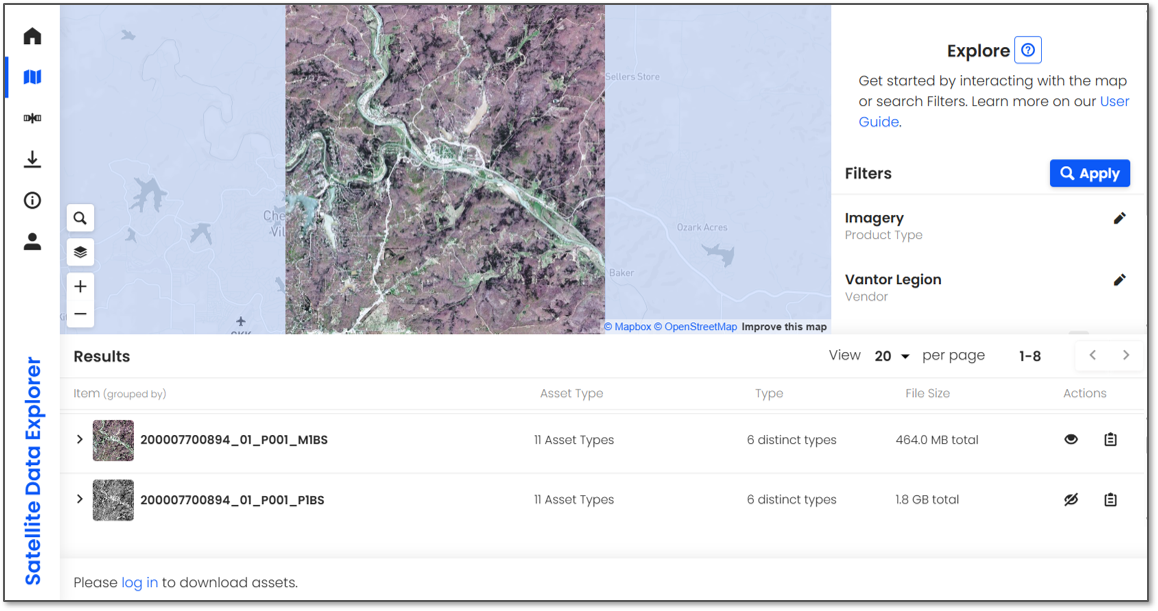
Join us for an NASA Commercial Satellite Data Acquisition (CSDA) program webinar on Wednesday, June 17, 2026, at 2:00 p.m. EDT (-04:00 UTC) to learn how to use the Satellite Data Explorer(SDX) to search, access, and task commercial Earth Observation data available through NASA’s CSDA program.
The SDX is a web-based data discovery, access, and data tasking platform developed under the CSDA program that enables approved users to discover, access, task, and download commercial Earth observation data available through the program.
During this webinar event, data users will learn how to use the SDX to streamline their data workflow. A live demonstration will focus on the key features and functionalities of the tool from searching and filtering capabilities (e.g., by area-of-interest, product type, vendor) to visualizing query results through interactive maps and quick-look browse imagery. Webinar participants will also learn how to use the new Data Acquisition Request System to submit and track commercial data tasking requests for future acquisitions.
Register for WebinarWebinar 6/17: Discover, Access, and Task Commercial Data with NASA’s Satellite Data Explorer
- CSDA
- Commercial Data
- CSDA Vendors
- Program Activities
- Learning Resources
- FAQs
- News
1 min read
Webinar 6/17: Discover, Access, and Task Commercial Data with NASA’s Satellite Data Explorer This screen capture shows a multispectral image from Vantor in the CSDA program’s Satellite Data Explorer user interface. Credit: (C) VantorJoin us for an NASA Commercial Satellite Data Acquisition (CSDA) program webinar on Wednesday, June 17, 2026, at 2:00 p.m. EDT (-04:00 UTC) to learn how to use the Satellite Data Explorer(SDX) to search, access, and task commercial Earth Observation data available through NASA’s CSDA program.
The SDX is a web-based data discovery, access, and data tasking platform developed under the CSDA program that enables approved users to discover, access, task, and download commercial Earth observation data available through the program.
During this webinar event, data users will learn how to use the SDX to streamline their data workflow. A live demonstration will focus on the key features and functionalities of the tool from searching and filtering capabilities (e.g., by area-of-interest, product type, vendor) to visualizing query results through interactive maps and quick-look browse imagery. Webinar participants will also learn how to use the new Data Acquisition Request System to submit and track commercial data tasking requests for future acquisitions.
Register for WebinarGigantic ‘little red dot’ threatens to upend cosmic history
Debate still swirls around the nature of “little red dots,” black holes glimpsed in the early universe by the James Webb Space Telescope. A controversial new weigh-in may settle the matter
Webb reveals black hole that formed before its galaxy
Using the unprecedented imaging and spectroscopic power of the NASA/ESA/CSA James Webb Space Telescope, researchers have mapped the motion and composition of gas orbiting a black hole in the centre of Abell2744-QSO1, a tiny galaxy more than 13 billion light-years away. The results suggest that the 50-million-solar-mass black hole predates its host galaxy, possibly forming within the first second of the Big Bang, and must have been immense from the start.
NASA’s Webb Reveals Black Hole That Formed Before Its Galaxy
- Webb
- News
- Overview
- Science
- Observatory
- Multimedia
- Team
- More
Image: NASA, ESA, CSA, Lukas Furtak (Ben-Gurion University); Image Processing: Alyssa Pagan (STScI)
Which comes first, the galaxy or the black hole? We don’t know, but scientists have long thought it could be the galaxy: Large stars within an existing galaxy consume their fuel and collapse to form black holes, which can gobble up surrounding material and merge over time to form more massive entities.
But it’s hard to figure out how black holes millions to billions of times the mass of the Sun, thousands of which have now been detected in the early universe, could have grown so quickly from such small seeds.
Now, researchers using NASA’s James Webb Space Telescope have detected clear evidence that some supermassive black holes were enormous from the beginning, forming without a stellar collapse phase, and without a significantly more massive host galaxy to feed them.
“This is a remarkable finding,” said Roberto Maiolino of University of Cambridge in the United Kingdom, co-author of studies published in Nature and the Monthly Notices of the Royal Astronomical Society. “It’s a paradigm shift, a total revisiting of the classical scenarios of how black holes form and grow.”
Little Red Dot QSO1The team’s conclusion is based on detailed observations of Abell2744-QSO1 (QSO1), a prototypical Little Red Dot that existed just 700 million years after the big bang.
Although QSO1 is only 1,300 light-years across, and its light has been traveling for more than 13 billion years, it is easier to study than most other Little Red Dots because it is gravitationally lensed by galaxy cluster Abell 2744 (Pandora’s Cluster). QSO1 is both magnified and triply imaged, appearing in three different locations in the sky.
Initial studies of QSO1 revealed compelling evidence that it may be little more than a cloud of glowing hydrogen and helium gas circling a supermassive black hole estimated at 40 million times the mass of the Sun. But as with other early black holes discovered by Webb, there was uncertainty about whether it really was that massive.
“Before now, all of the mass measurements of black holes in the early universe have been indirect, based on assumptions from what we know about them in the local universe. We didn’t know if those assumptions really apply to the distant universe,” said co-author Francesco D’Eugenio, also of the University of Cambridge.
Image: Little Red Dot Abell2744-QSO1 (NIRCam Image) An image from NIRCam on NASA’s James Webb Space Telescope shows Little Red Dot Abell2744-QSO1, magnified and triply imaged by galaxy cluster Abell 2744 (Pandora’s Cluster). Image: NASA, ESA, CSA, Lukas Furtak (Ben-Gurion University); Image Processing: Alyssa Pagan (STScI) Mapping gas composition, velocity
The team recognized that if QSO1’s black hole is as massive as it looks, they should be able to use the integral field unit (IFU) on Webb’s NIRSpec (Near Infrared Spectrograph) to trace the effects of its gravity on the gas swirling around it, while also mapping the distribution of various elements in the gas.
Cambridge graduate student Ignas Juodžbalis and Cosimo Marconcini of the University of Florence, lead authors on one of the studies, used the IFU observations to map motions of hydrogen gas surrounding the black hole. When they plotted the rotation velocity as a function of distance from the center, they found that the gas has Keplerian motion: It orbits a central point in the same way that planets in our solar system orbit the Sun.
“This is important because it tells us that most of the mass of QSO1 is concentrated in the black hole at the center,” said Juodžbalis. “If the mass were more distributed, as it would be if there were a lot of stars, the gas would not have this perfect Keplerian rotation.”
Since Keplerian motion is governed by simple laws of gravity, the team was able to use the gas velocity measurements to calculate the black hole mass directly, a feat that had not previously been possible.
They found that not only is the black hole immense — roughly 50 million solar masses — it makes up, at minimum, an astonishing two-thirds of QSO1’s total mass. This proportion is thousands of times greater than in nearby galaxies, where supermassive black holes make up only a tiny fraction of the host galaxy’s total mass.
The IFU composition maps supported these results, showing that the gas throughout QSO1 is almost entirely hydrogen and helium, with very little of the heavier elements like oxygen that would be expected in a galaxy rich with stars and stellar debris. With a metallicity less than 0.5% of the Sun, QSO1 is one of the most pristine galactic environments ever measured.
“This is a phenomenal result,” said Maiolino. “It is the first direct measurement of a black hole mass within the first billion years after the big bang, and it is consistent with the previous measurements.” The team thinks this is a good sign that the assumptions used for indirect mass measurements are valid and the masses of other black holes in the early universe have not been overestimated.
Supermassive black hole originsThe outsized mass of QSO1 relative to its host galaxy suggests that it can’t have formed gradually from much smaller, stellar-mass black holes merging and feeding. “It seems that we have found a black hole that does not have a substantial host galaxy and that has predated stellar processes,” said Juodžbalis. “This is very exciting because it is evidence for primordial black holes or direct collapse black holes, which have been theorized but not confirmed.”
Whether QSO1’s black hole evolved from a “heavy seed” that formed within the first second of the big bang or somewhat later from the collapse of a giant cloud of gas, it was almost certainly born big, and may be in the early stages of building a galaxy around it.
The team thinks that Little Red Dots like QSO1 cannot have been rare in the early universe, and is in the process of analyzing similar objects to find out whether supermassive black holes actually do predate the galaxies where they currently reside.
The James Webb Space Telescope is the world’s premier space science observatory. Webb is solving mysteries in our solar system, looking beyond to distant worlds around other stars, and probing the mysterious structures and origins of our universe and our place in it. Webb is an international program led by NASA with its partners, ESA (European Space Agency) and CSA (Canadian Space Agency).
To learn more about Webb, visit:
Downloads & Related InformationThe following sections contain links to download this article’s images and videos in all available resolutions followed by related information links, media contacts, and if available, research paper and Spanish translation links.
Related Images & Videos Little Red Dot Abell2744-QSO1 (NIRCam Image)
An image from NIRCam on NASA’s James Webb Space Telescope shows Little Red Dot Abell2744-QSO1, magnified and triply imaged by galaxy cluster Abell 2744 (Pandora’s Cluster).
Little Red Dot Abell2744-QSO1a (NIRCam Image with NIRSpec IFU Velocity Map)
An image detail from NIRCam (left) on NASA’s James Webb Space Telescope shows Little Red Dot Abell2744-QSO1. A map of gas velocity in QSO1 (right), made using the IFU on NIRSpec, shows evidence for a 50-million-solar-mass black hole at the center.
Little Red Dot Abell2744-QSO1 (NIRCam Compass Image)
Image of Abell 2744 and Little Red Dot Abell2744-QSO1, captured by Webb’s NIRCam, with compass arrows, scale bar, and color key for reference.
Little Red Dot Abell2744-QSO1: Sonification of Gas Velocity Around a Supermassive Black Hole (NIRCam and NIRSpec IFU)
A sonification is a translation of data into sound. In this sonification, the velocity of hydrogen gas moving around a black hole in the center of a Little Red Dot known as Abell2744-QSO1 (QSO1) is translated into sounds of varying pitch (or frequency). The faster the gas is movi…
Related Links
Watch: NASA Black Hole Visualization Takes Viewers Beyond the Brink
Explore more: ViewSpace | Black Holes: Searching for the unseen
Read more: Dissecting Supermassive Black Holes
Watch: What Webb Learns from Light
Explore more: NASA’s Universe of Learning: Black Hole Resources
Contact Media
Laura Betz
NASA’s Goddard Space Flight Center
Greenbelt, Maryland
laura.e.betz@nasa.gov
Margaret Carruthers
Space Telescope Science Institute
Baltimore, Maryland
Hannah Braun
Space Telescope Science Institute
Baltimore, Maryland
Related Terms Keep Exploring Related Topics James Webb Space Telescope
Webb is the premier observatory of the next decade, serving thousands of astronomers worldwide. It studies every phase in the…
Galaxies
Black Holes
Universe
NASA’s Webb Reveals Black Hole That Formed Before Its Galaxy
- Webb
- News
- Overview
- Science
- Observatory
- Multimedia
- Team
- More
Image: NASA, ESA, CSA, Lukas Furtak (Ben-Gurion University); Image Processing: Alyssa Pagan (STScI)
Which comes first, the galaxy or the black hole? We don’t know, but scientists have long thought it could be the galaxy: Large stars within an existing galaxy consume their fuel and collapse to form black holes, which can gobble up surrounding material and merge over time to form more massive entities.
But it’s hard to figure out how black holes millions to billions of times the mass of the Sun, thousands of which have now been detected in the early universe, could have grown so quickly from such small seeds.
Now, researchers using NASA’s James Webb Space Telescope have detected clear evidence that some supermassive black holes were enormous from the beginning, forming without a stellar collapse phase, and without a significantly more massive host galaxy to feed them.
“This is a remarkable finding,” said Roberto Maiolino of University of Cambridge in the United Kingdom, co-author of studies published in Nature and the Monthly Notices of the Royal Astronomical Society. “It’s a paradigm shift, a total revisiting of the classical scenarios of how black holes form and grow.”
Little Red Dot QSO1The team’s conclusion is based on detailed observations of Abell2744-QSO1 (QSO1), a prototypical Little Red Dot that existed just 700 million years after the big bang.
Although QSO1 is only 1,300 light-years across, and its light has been traveling for more than 13 billion years, it is easier to study than most other Little Red Dots because it is gravitationally lensed by galaxy cluster Abell 2744 (Pandora’s Cluster). QSO1 is both magnified and triply imaged, appearing in three different locations in the sky.
Initial studies of QSO1 revealed compelling evidence that it may be little more than a cloud of glowing hydrogen and helium gas circling a supermassive black hole estimated at 40 million times the mass of the Sun. But as with other early black holes discovered by Webb, there was uncertainty about whether it really was that massive.
“Before now, all of the mass measurements of black holes in the early universe have been indirect, based on assumptions from what we know about them in the local universe. We didn’t know if those assumptions really apply to the distant universe,” said co-author Francesco D’Eugenio, also of the University of Cambridge.
Image: Little Red Dot Abell2744-QSO1 (NIRCam Image) An image from NIRCam on NASA’s James Webb Space Telescope shows Little Red Dot Abell2744-QSO1, magnified and triply imaged by galaxy cluster Abell 2744 (Pandora’s Cluster). Image: NASA, ESA, CSA, Lukas Furtak (Ben-Gurion University); Image Processing: Alyssa Pagan (STScI) Mapping gas composition, velocityThe team recognized that if QSO1’s black hole is as massive as it looks, they should be able to use the integral field unit (IFU) on Webb’s NIRSpec (Near Infrared Spectrograph) to trace the effects of its gravity on the gas swirling around it, while also mapping the distribution of various elements in the gas.
Cambridge graduate student Ignas Juodžbalis and Cosimo Marconcini of the University of Florence, lead authors on one of the studies, used the IFU observations to map motions of hydrogen gas surrounding the black hole. When they plotted the rotation velocity as a function of distance from the center, they found that the gas has Keplerian motion: It orbits a central point in the same way that planets in our solar system orbit the Sun.
“This is important because it tells us that most of the mass of QSO1 is concentrated in the black hole at the center,” said Juodžbalis. “If the mass were more distributed, as it would be if there were a lot of stars, the gas would not have this perfect Keplerian rotation.”
Since Keplerian motion is governed by simple laws of gravity, the team was able to use the gas velocity measurements to calculate the black hole mass directly, a feat that had not previously been possible.
They found that not only is the black hole immense — roughly 50 million solar masses — it makes up, at minimum, an astonishing two-thirds of QSO1’s total mass. This proportion is thousands of times greater than in nearby galaxies, where supermassive black holes make up only a tiny fraction of the host galaxy’s total mass.
The IFU composition maps supported these results, showing that the gas throughout QSO1 is almost entirely hydrogen and helium, with very little of the heavier elements like oxygen that would be expected in a galaxy rich with stars and stellar debris. With a metallicity less than 0.5% of the Sun, QSO1 is one of the most pristine galactic environments ever measured.
“This is a phenomenal result,” said Maiolino. “It is the first direct measurement of a black hole mass within the first billion years after the big bang, and it is consistent with the previous measurements.” The team thinks this is a good sign that the assumptions used for indirect mass measurements are valid and the masses of other black holes in the early universe have not been overestimated.
Supermassive black hole originsThe outsized mass of QSO1 relative to its host galaxy suggests that it can’t have formed gradually from much smaller, stellar-mass black holes merging and feeding. “It seems that we have found a black hole that does not have a substantial host galaxy and that has predated stellar processes,” said Juodžbalis. “This is very exciting because it is evidence for primordial black holes or direct collapse black holes, which have been theorized but not confirmed.”
Whether QSO1’s black hole evolved from a “heavy seed” that formed within the first second of the big bang or somewhat later from the collapse of a giant cloud of gas, it was almost certainly born big, and may be in the early stages of building a galaxy around it.
The team thinks that Little Red Dots like QSO1 cannot have been rare in the early universe, and is in the process of analyzing similar objects to find out whether supermassive black holes actually do predate the galaxies where they currently reside.
The James Webb Space Telescope is the world’s premier space science observatory. Webb is solving mysteries in our solar system, looking beyond to distant worlds around other stars, and probing the mysterious structures and origins of our universe and our place in it. Webb is an international program led by NASA with its partners, ESA (European Space Agency) and CSA (Canadian Space Agency).
To learn more about Webb, visit:
Downloads & Related InformationThe following sections contain links to download this article’s images and videos in all available resolutions followed by related information links, media contacts, and if available, research paper and Spanish translation links.
Related Images & Videos Little Red Dot Abell2744-QSO1 (NIRCam Image)
An image from NIRCam on NASA’s James Webb Space Telescope shows Little Red Dot Abell2744-QSO1, magnified and triply imaged by galaxy cluster Abell 2744 (Pandora’s Cluster).
Little Red Dot Abell2744-QSO1a (NIRCam Image with NIRSpec IFU Velocity Map)
An image detail from NIRCam (left) on NASA’s James Webb Space Telescope shows Little Red Dot Abell2744-QSO1. A map of gas velocity in QSO1 (right), made using the IFU on NIRSpec, shows evidence for a 50-million-solar-mass black hole at the center.
Little Red Dot Abell2744-QSO1 (NIRCam Compass Image)
Image of Abell 2744 and Little Red Dot Abell2744-QSO1, captured by Webb’s NIRCam, with compass arrows, scale bar, and color key for reference.
Little Red Dot Abell2744-QSO1: Sonification of Gas Velocity Around a Supermassive Black Hole (NIRCam and NIRSpec IFU)
A sonification is a translation of data into sound. In this sonification, the velocity of hydrogen gas moving around a black hole in the center of a Little Red Dot known as Abell2744-QSO1 (QSO1) is translated into sounds of varying pitch (or frequency). The faster the gas is movi…
Related Links
Watch: NASA Black Hole Visualization Takes Viewers Beyond the Brink
Explore more: ViewSpace | Black Holes: Searching for the unseen
Read more: Dissecting Supermassive Black Holes
Watch: What Webb Learns from Light
Explore more: NASA’s Universe of Learning: Black Hole Resources
Contact Media
Laura Betz
NASA’s Goddard Space Flight Center
Greenbelt, Maryland
laura.e.betz@nasa.gov
Margaret Carruthers
Space Telescope Science Institute
Baltimore, Maryland
Hannah Braun
Space Telescope Science Institute
Baltimore, Maryland
Related Terms Keep Exploring Related Topics James Webb Space Telescope
Webb is the premier observatory of the next decade, serving thousands of astronomers worldwide. It studies every phase in the…
Galaxies
Black Holes
Universe
National Institutes of Health Nutrition Education Challenge

NASA’s Center of Excellence for Collaborative Innovation (CoECI) assists in the use of crowdsourcing across the federal government. CoECI’s NASA Tournament Lab offers the contract capability to run external crowdsourced challenges on behalf of NASA and other agencies.
The National Institutes of Health (NIH) Office of Nutrition Research (ONR) invites U.S.-based, accredited, non-profit academic institutions to participate in the “Integration of Nutrition Training into Health Care Education” Challenge.
ONR’s mission is to stimulate innovative research to address the complexities of nutrition, its ecology, and its critical role in health across the lifespan for all. The goal of this challenge is to identify, evaluate, and promote effective, scalable, and evidence-based approaches to integrating nutrition training into medical and nursing education, including both established programs and emerging models with strong potential for dissemination.
The NIH Nutrition Education Challenge offers a total prize purse of up to $2,100,000 to recognize and reward exemplary nutrition curricula across three program types and two challenge tracks. Awards of up to $75,000 each will be distributed to winning institutions across the Exemplar Track and Developing Track in three program categories: Medical Schools, Residency Programs, and Nursing Programs.
Award: $2,100,000 in total prizes
Open date: May 26, 2026
Submission deadline: September 15, 2026
For more information, visit: https://nutritioneducationchallenge.org/
National Institutes of Health Nutrition Education Challenge
NASA’s Center of Excellence for Collaborative Innovation (CoECI) assists in the use of crowdsourcing across the federal government. CoECI’s NASA Tournament Lab offers the contract capability to run external crowdsourced challenges on behalf of NASA and other agencies.
The National Institutes of Health (NIH) Office of Nutrition Research (ONR) invites U.S.-based, accredited, non-profit academic institutions to participate in the “Integration of Nutrition Training into Health Care Education” Challenge.
ONR’s mission is to stimulate innovative research to address the complexities of nutrition, its ecology, and its critical role in health across the lifespan for all. The goal of this challenge is to identify, evaluate, and promote effective, scalable, and evidence-based approaches to integrating nutrition training into medical and nursing education, including both established programs and emerging models with strong potential for dissemination.
The NIH Nutrition Education Challenge offers a total prize purse of up to $2,100,000 to recognize and reward exemplary nutrition curricula across three program types and two challenge tracks. Awards of up to $75,000 each will be distributed to winning institutions across the Exemplar Track and Developing Track in three program categories: Medical Schools, Residency Programs, and Nursing Programs.
Award: $2,100,000 in total prizes
Open date: May 26, 2026
Submission deadline: September 15, 2026
For more information, visit: https://nutritioneducationchallenge.org/
Wealthy people with environmental ideals are the biggest emitters
Wealthy people with environmental ideals are the biggest emitters
Hot surfaces during Europe's heatwave 'seen' by Sentinel-3
NASA plans a base on the moon spanning hundreds of square kilometres
NASA plans a base on the moon spanning hundreds of square kilometres
NASA plans a base on the moon spanning hundreds of square miles
NASA’s 2026 Lunabotics: Winning Student Teams Engineering Lunar Future
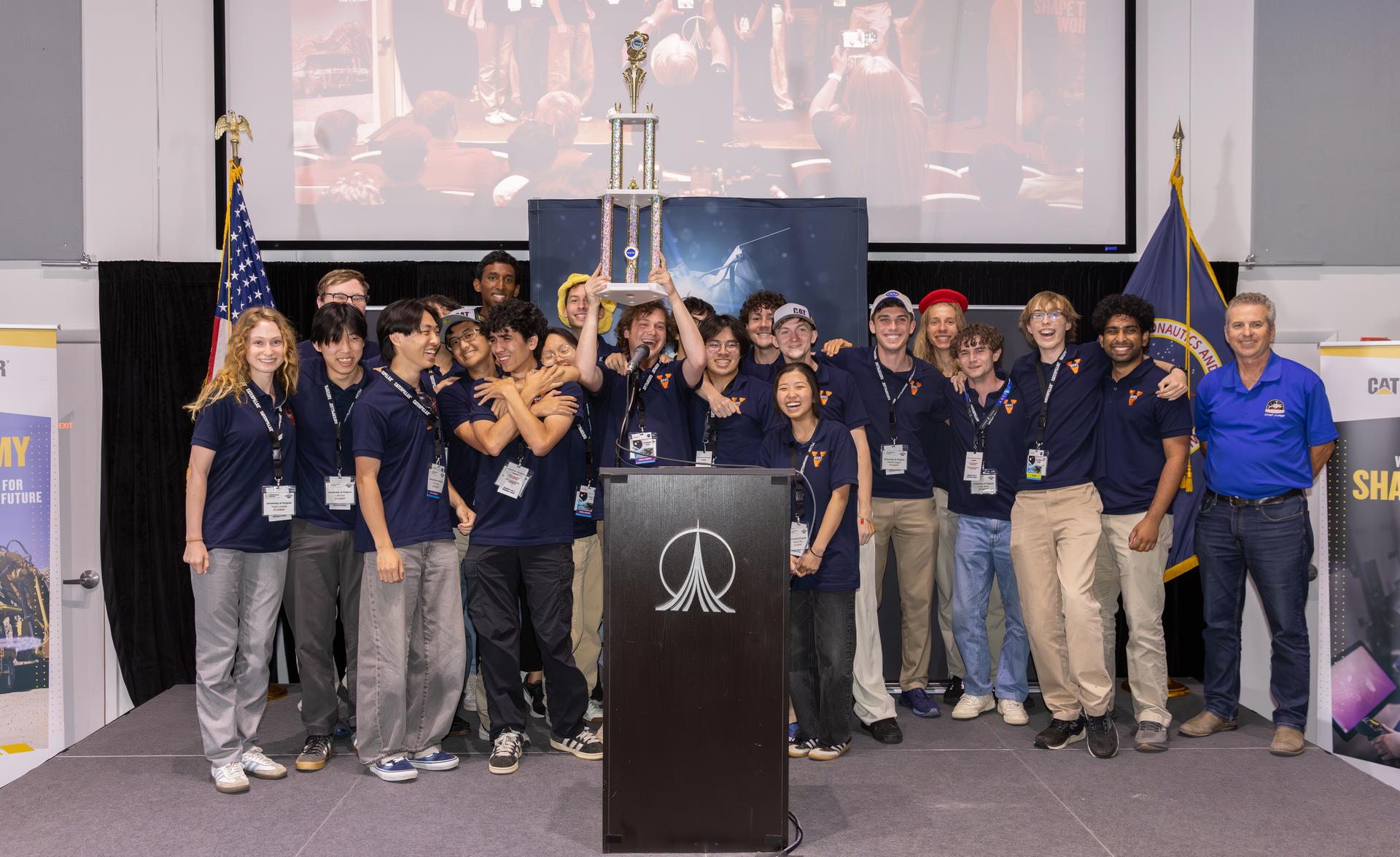
Resilient. Efficient. Autonomous. These are qualities NASA demands of its hardware, especially as the agency accelerates plans for a permanent Moon Base. NASA’s 2026 Lunabotics Challenge put those traits on full display, as college student engineers from across the country gathered at the Astronauts Memorial Foundation’s Center for Space Education at the Kennedy Space Center Visitor Complex in Florida to demonstrate robotic technologies and systems engineering expertise that could build and sustain long‑term lunar infrastructure.
When the simulated lunar dust settled, the University of Virginia earned the Off World Grand Prize for completing all events and achieving the highest overall score.
“The Off World Grand Prize is really about everything,” said Robert Mueller, senior technologist at NASA Kennedy’s Swamp Works, lead judge, and co‑founder of the original Lunabotics robotic mining challenge. “It’s a difficult prize to win, and it’s not obvious, because the team that built the biggest berm didn’t win. But on an actual lunar mission, it’s not just one thing that matters — it’s everything in the system.”
Student test bed for lunar construction challengesThe agency’s annual Lunabotics Challenge is a two‑semester competition in which higher‑education students design, build, and test prototype lunar construction robots using NASA systems engineering principles. The 2026 competition opened last September, with teams submitting industry plans, engineering reports, and robot specifications. Judges selected 47 teams to advance to a qualifying round at the University of Central Florida’s Exolith Lab in Orlando, where the robots faced their first tests.
The goal during the qualifying round was straightforward: excavate and collect simulated lunar soil, transport it across challenging terrain, and construct a berm, or a raised mound of soil used to provide structure, support, or protection. Performance was evaluated across several criteria, and the top 10 teams moved on to the three‑day final round held May 19 to 21 at NASA Kennedy.
Judges assessed far more than berm size. Robot weight, communications performance, energy use, and level of autonomy all contributed to scores across four main criteria: a science, technology, engineering, and math (STEM) industry plan; a systems engineering paper; presentations and demonstrations; and robotic construction.
The University of Virginia team excelled not only in measurable metrics but also in preparation and resilience. When a wheel detached during their first finals run, the team reconfigured the robot to operate on three wheels and kept digging.
“When we saw the wheel break in the arena, we thought that was it,” said Craig Kalkwarf, a fourth‑year aerospace engineering and astronomy major and mechanical lead of the 22‑member team. “But we came so prepared. We had metal wheels ready to swap out. We had a plan. We ultimately got the win, and part of that was planning for anything — and it worked out.”
Students from the University of Virginia prepare their prototype lunar robot for its turn during the finals for NASA’s 2026 Lunabotics Challenge competition on Wednesday, May 20, 2026, inside the Astronauts Memorial Foundation’s Center for Space Education at the Kennedy Space Center Visitor Complex in Florida. NASA/Cory S Huston Engineering NASA’s lunar future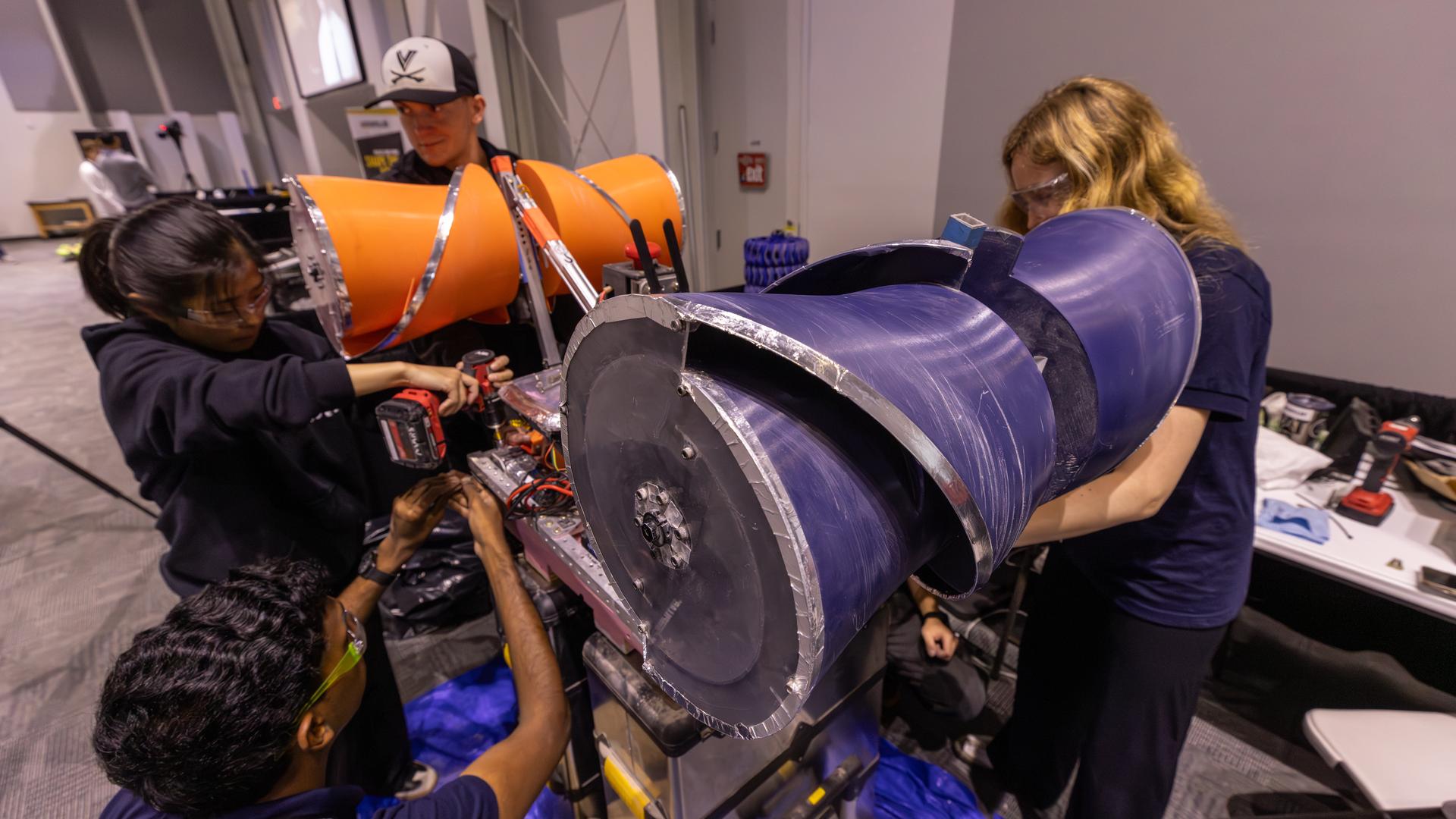
A key part of the Lunabotics Challenge is students employing NASA’s Systems Engineering Process, a multidisciplinary, mission‑driven approach that integrates hardware, software, people, and procedures to create complex, high‑reliability systems.
Competition judges noted that the systems engineering prowess on display this year was among the strongest in the challenge’s 17‑year history. Teams and their robots demonstrated remarkable adaptability in the face of obstacles. Multiple teams overcame wheel issues, robots stuck in rough terrain managed to break free, and one team pressed on after its digger blades damaged their robot, but only after it successfully deposited enough material to create an impressive berm.
By the competition’s close, event organizers praised how teams built upon previous robotic designs, as several teams were veterans of the competition, and marveled at the number of fully autonomous robots that competed in the qualifying and final rounds. Last year, there were 12 fully autonomous robots, while this year the number grew to 27. This led to tighter competition, as well as more efficiency during the runs inside the Center for Space Education’s Artemis Arena – the large, engineered test bed filled with lunar soil simulant, designed to mimic the loose, uneven terrain robots will encounter on the Moon.
“Teams excavated much more material than we anticipated,” said Rich Johanboeke, project manager for the competition and longtime Lunabotics organizer. “This speaks to how teams have evolved previous design iterations and how much innovation we’re seeing from these students. It’s an exciting time!”
The University of Utah team’s prototype lunar robot performs during the finals for NASA’s 2026 Lunabotics Challenge competition on Thursday, May 21, 2026, inside the Astronauts Memorial Foundation’s Center for Space Education at the Kennedy Space Center Visitor Complex in Florida.NASA/Kim Shiflett Challenge designed for the Artemis era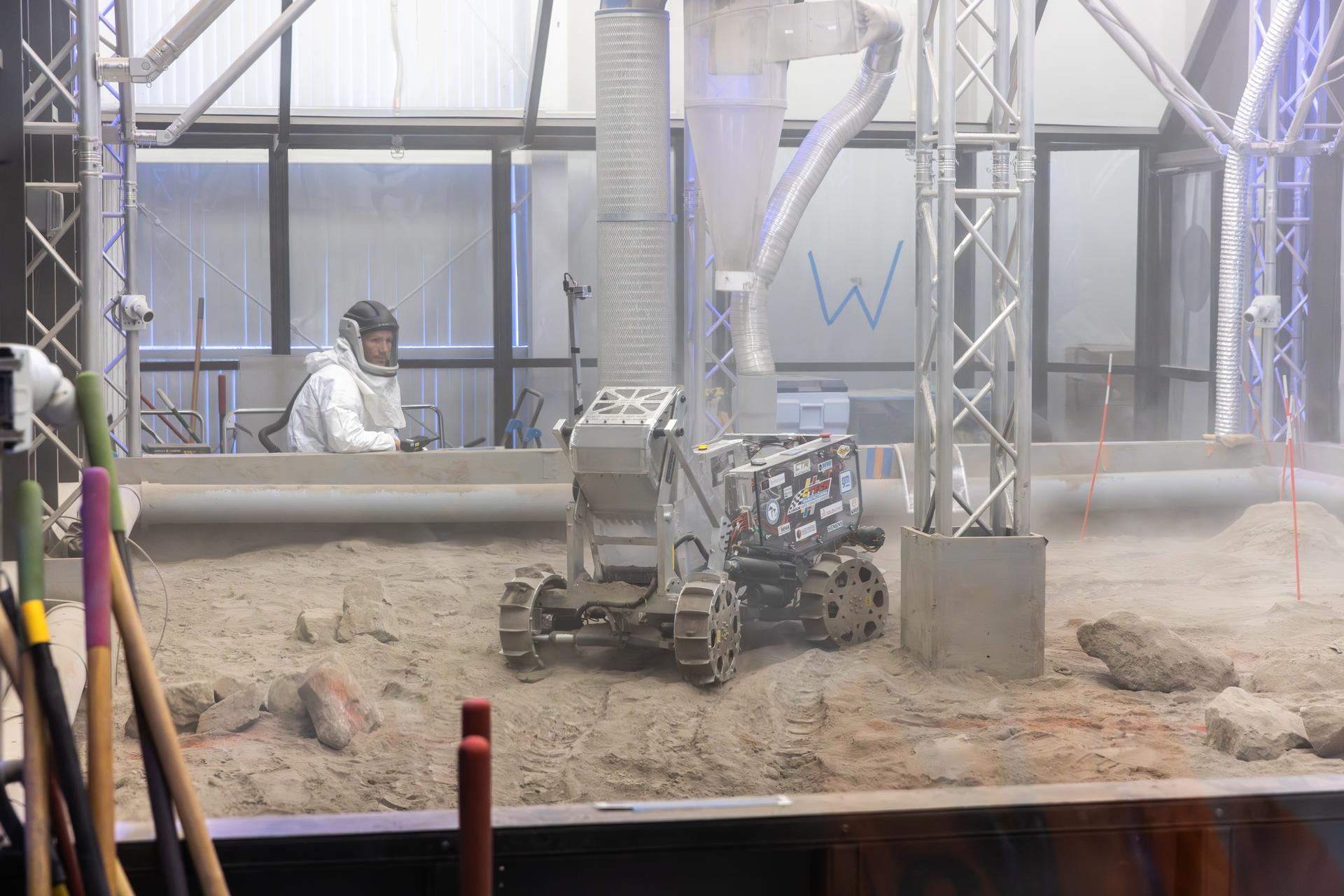
Coming just weeks after the success of NASA’s Artemis II mission, Lunabotics highlights some of the next steps toward establishing a sustainable human presence on the Moon. Autonomous robots capable of shaping lunar soil into berms will play a vital role in protecting landing sites, supporting power systems, and forming the building blocks of future lunar outposts.
“This might be the first thing NASA does on the Moon Base — robotically building a berm using a local resource, the lunar soil,” Mueller said. “We are watching and learning from these teams in preparation for a real mission launching in a few years, which is IPEx.”
Developed at Kennedy’s Swamp Works, IPEx, or Infrastructure Pilot Excavator, is poised to launch to the lunar surface through NASA’s CLPS (Commercial Lunar Payload Services) initiative. Acting as both excavator and hauler, IPEx is designed to dig and transport lunar regolith efficiently, which are critical capabilities for supporting human exploration and making the most of lunar resources.
Building engineering pipeline to NASAThis year’s Lunabotics Challenge didn’t just celebrate student ingenuity — it helped advance the technologies and engineering approaches that will define the next era of lunar exploration.
For students, Lunabotics provides an immersive engineering experience that mirrors industry‑level problem‑solving. For NASA, the competition, like the agency’s other Student Design Challenges, is helping to find novel solutions to technical challenges currently faced by the agency, while also helping recruit the next generation of engineers, technologists, and innovators to NASA.
Alumni from the College of DuPage in Glen Ellyn, Illinois, accept the Lunabotics Construction Award on behalf of the team for building the largest berm during NASA’s 2026 Lunabotics Challenge competition on Thursday, May 21, 2026, inside the Astronauts Memorial Foundation’s Center for Space Education at the Kennedy Space Center Visitor Complex in Florida.NASA/Kim Shiflett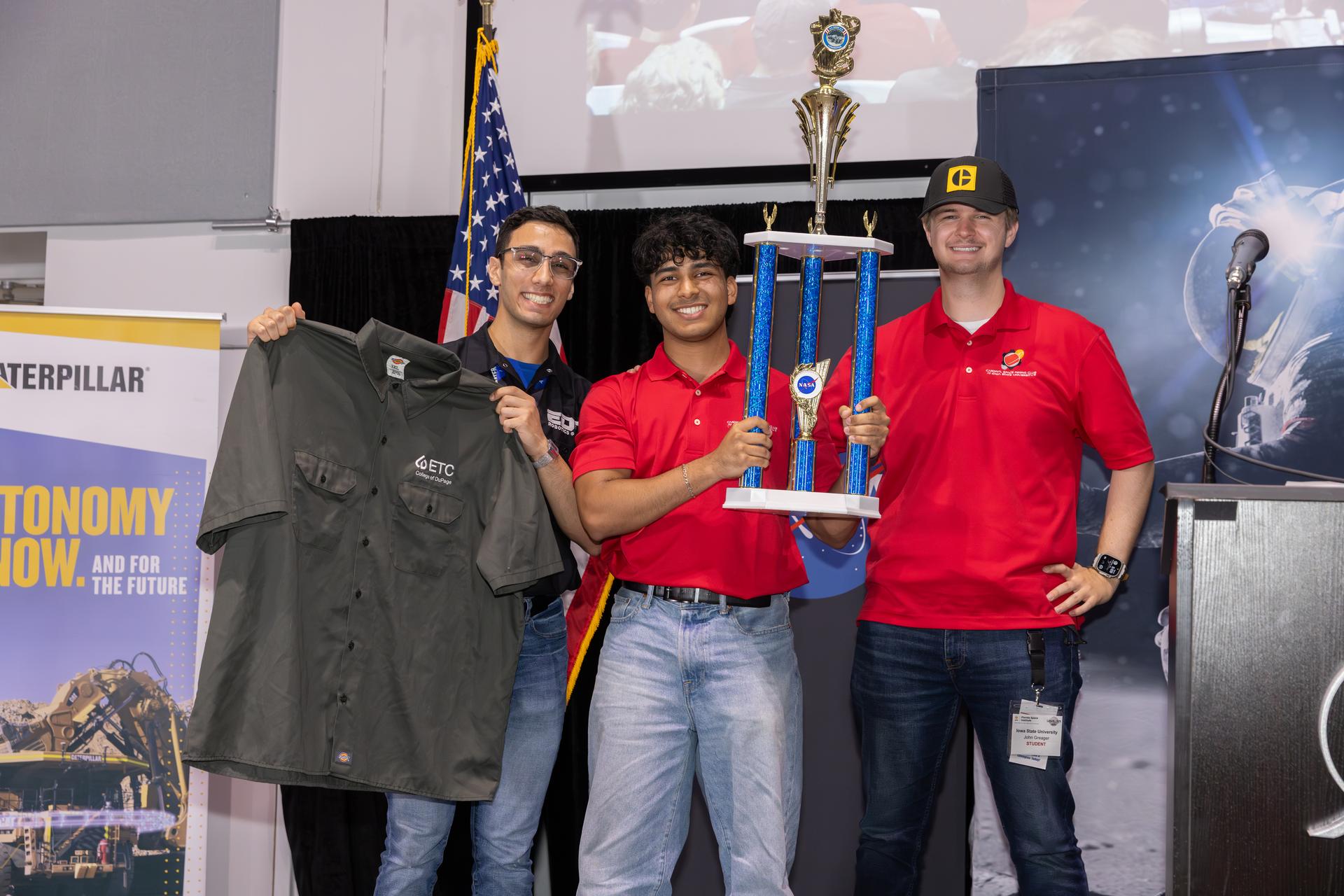
“I think it’s everyone’s dream to come work at NASA,” said Andrew Ebert, a mechanical engineering student at the College of DuPage in Glen Ellyn, Illinois, whose team took home the prize for building the biggest berm. “It’s always pushing the boundaries of what has ever been done by humans. In my opinion, it’s the coolest thing you can do in engineering.”
The creativity, resilience, and technical mastery demonstrated by these teams are directly shaping NASA’s path toward a sustainable Moon Base. When Americans begin lunar construction in a few years, the experience and expertise gained by the young engineers through Lunabotics becomes even more meaningful and potentially impactful for NASA.
“These students might be working for NASA by the time we start building on the Moon,” said Mueller.
To learn more about NASA’s Lunabotics Challenge visit:
https://www.nasa.gov/learning-resources/lunabotics-challenge
2026 Lunabotics Challenge WinnersOff World Grand Prize – Overall Excellence
University of Virginia in Charlottesville
Lunabotics Construction Award
1st place: College of DuPage in Glen Elyn, Illinois
2nd place: University of Virginia
3rd place: Michigan Technological University in Houghton, Michigan
Caterpillar Autonomy Award
1st place: The University of Alabama in Huntsville
2nd place: University of Virginia
3rd place: University of Utah in Salt Lake City
4th place: Purdue University in West Lafayette, Indiana
5th place: Iowa State University in Ames
6th place: College of DuPage
Lunabotics Efficient Use of Communications Power Award
Iowa State University
Systems Engineering Paper
1st place: The University of Alabama
2nd place: University of Virginia
3rd place: University of Illinois in Chicago
Nova Award for Stellar Systems Engineering by a First Year School
Laredo College in Laredo, Texas
Northwestern University in Evanston, Illinois
Systems Engineering Leaps & Bounds Award
University of Virginia
Rocket Award for Accelerating Systems Engineering Mastery
University of Illinois in Urbana-Champaign
Presentations and Demonstrations
1st place: New Mexico Institute of Mining and Technology in Socorro, New Mexico
2nd place: The University of Alabama
3rd place: Colorado School of Mines in Golden, Colorado
Honorable Mention: Michigan Technological University
Presentations and Demonstrations First Steps Awards
Carnegie Mellon University in Pittsburg, Pennsylvania
Hubble Spies Faint Irregular Galaxy
- Hubble Home
- Overview
- Impact & Benefits
- Science
- Observatory
- Team
- Multimedia
- News
- More
1 min read
Hubble Spies Faint Irregular Galaxy This NASA Hubble Space Telescope image captures the faint glow of the dwarf irregular galaxy ESO 490-017. NASA, ESA, R. Tully (University of Hawaii); Image Processing: G. Kober (NASA/Catholic University of America)This NASA Hubble Space Telescope image features the dwarf irregular galaxy ESO 490-017, roughly 12,000 light-years in diameter and some 23 million light-years away in the constellation Canis Major. The galaxy’s low surface brightness makes it appear as a faint, starry swarm behind brighter foreground stars that are easily recognized by their diffraction spikes. Numerous red, orange, and beige dots are distant galaxies peppering the black background, many exhibiting distinct spiral structure.
The data in this image of ESO 490-017 was part of a Hubble observing program that looked at the movement of galaxies and galaxy clusters through space. Matter in the universe is distributed unevenly, and the gravitational influence of that matter drives the “cosmic flow” or movement of large-scale structures in the universe.
Hubble is uniquely capable of providing distances to nearby galaxies like ESO 490-017 by measuring the luminosities of low-mass red giant stars as “standard candles”. The observing program also provided a legacy archive of the types of stars in local galaxies.
Facebook logo @NASAHubble @NASAHubble Instagram logo @NASAHubbleMedia Contact:
Claire Andreoli
NASA’s Goddard Space Flight Center, Greenbelt, MD
claire.andreoli@nasa.gov
Since its 1990 launch, the Hubble Space Telescope has changed our fundamental understanding of the universe.
Hubble’s Galaxies
Hubble Science Highlights
Hubble Images
Tiny quantum computers could help create giant telescopes
Advances in quantum technology might allow astronomers to circumvent age-old issues that limit the size of optical observatories