
Feed aggregator
Planets aplenty may lurk around supermassive black holes
Planets might exist in the least likely place you’d imagine—around the outskirts of supermassive black holes
How breast cancer screening can predict heart disease risk
AI analysis of mammograms could provide a “bonus finding” for heart disease
PCOS is now PMOS: What went behind renaming the common condition
A physician involved in the long push to change the name PCOS to PMOS takes us behind the scenes of this subtle yet consequential change
This Week's Sky at a Glance, June 5 – 14
Bright Venus and Jupiter pass through conjunction in twilight this week, while Mercury, Pollux, and Castor watch them from nearby.
The post This Week's Sky at a Glance, June 5 – 14 appeared first on Sky & Telescope.
The maths meme that has been distracting mathematicians for a century
The maths meme that has been distracting mathematicians for a century
Webb unveils young stars across every stage of formation
Earth from Space: Baku, Azerbaijan
Proposed U.S. Grant Funding Rules Spark Worry, Backlash in Astronomy
The Office of Management and Budget envisions diminishing peer review and international collaborations.
The post Proposed U.S. Grant Funding Rules Spark Worry, Backlash in Astronomy appeared first on Sky & Telescope.
Fighting Fire With Fire
- Earth
- Earth Observatory
- Image of the Day
- EO Explorer
- Topics
- More Content
- About
Fighting Fire With Fire
- Earth
- Earth Observatory
- Image of the Day
- EO Explorer
- Topics
- More Content
- About
Chance of Aurora Extends to Friday Night, June 5th
A geomagnetic storm expected June 4th arrived late. But there's still at chance of seeing auroras Friday night, June 5th.
The post Chance of Aurora Extends to Friday Night, June 5th appeared first on Sky & Telescope.
New Cloud-Detecting Method Will Help Astronomers Characterize Exoplanets
Astronomers have developed a technique that allows them to detect cloud cycles on distant exoplanets. Using data from the James Webb Sapce Telescope (JWST), the astronomers found that mornings and evenings on the gas giant WASP-94A b have extremely different weather patterns: mornings are riddled with sand clouds, while the skies are clear in the early evenings. By isolating the clouds, researchers can more accurately measure a planet’s atmosphere and provide a clearer picture of the planet’s composition. WASP-94A b, for example, has much less oxygen and carbon than astronomers perviously calculated, making its atmosphere much more like Jupiter than they had originally thought.
Trump invokes Defense Production Act to keep U.S. coal plants running
Coal is the most significant fossil fuel contributor to climate change
NASA Hosts 2026 Review on Advanced Composite Manufacturing
2 min read
Preparations for Next Moonwalk Simulations Underway (and Underwater) Boeing assembles a composite aircraft fuselage section in one of its production facilities. Composite materials are used in major portions of modern aircraft, including sections of the fuselage and wings on aircraft such as the Boeing 787. NASA’s HiCAM project aims to help accelerate manufacturing processes for future composite aircraft. Boeing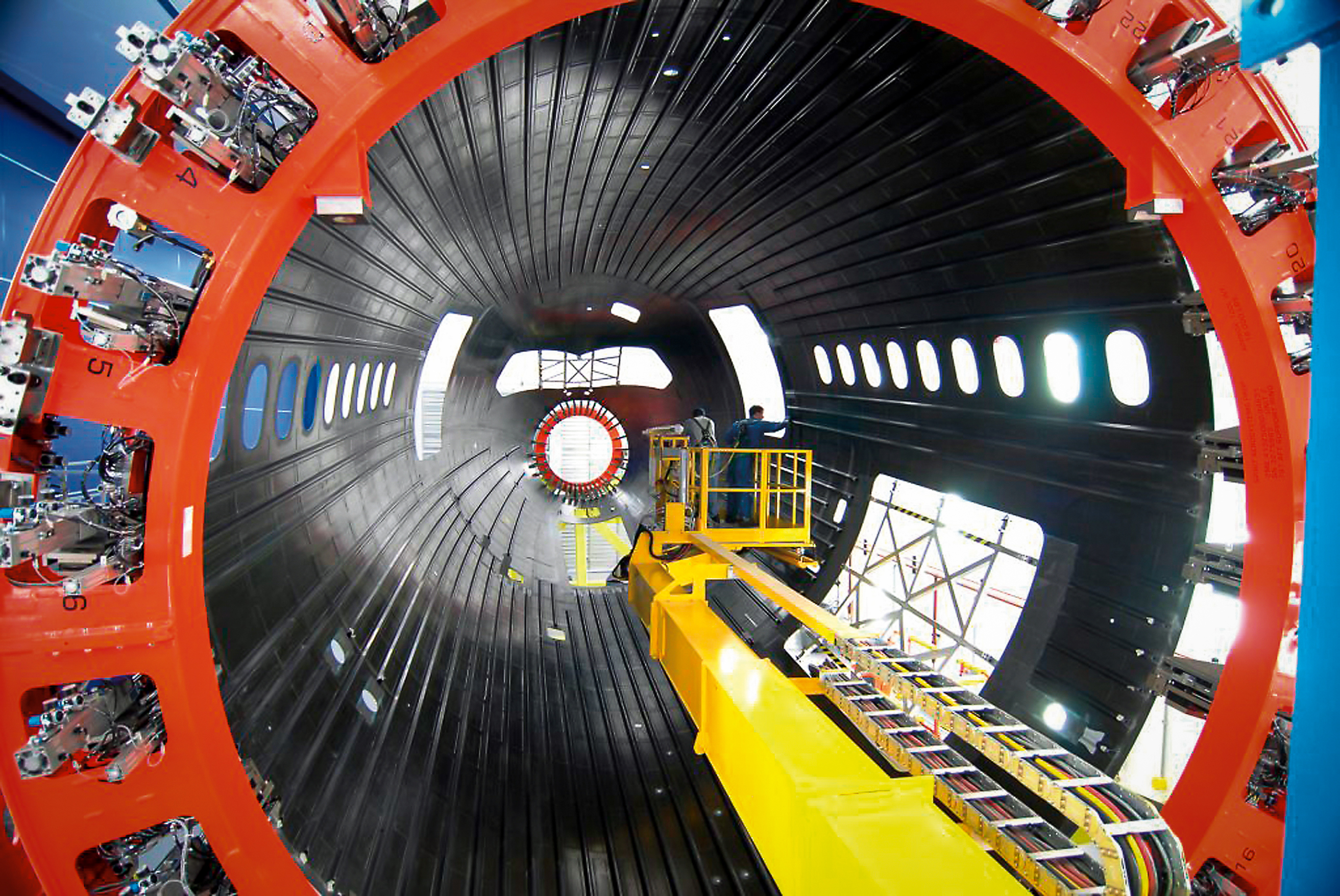
NASA’s Hi-Rate Composite Aircraft Manufacturing (HiCAM) project brought together its full team of Advanced Composites Consortium partners for a 2026 spring review at NASA’s Langley Research Center in Hampton, Virginia.
The meeting took place May 5-7, bringing together about 150 people from the consortium, a 22-member public-private partnership.
The review gave NASA and industry partners a chance to look at recent progress and plan for the work ahead. NASA announced recent portfolio decisions, selecting technologies that can have the greatest impact on manufacturing rate for the next airplane program.
During the meeting, teams reviewed the latest results from the project’s Development Phase and discussed early progress under Phase 2, known as the Demonstration Phase. This phase will scale up key manufacturing technologies in the coming years.
A major part of the event included full-day workshops focused on assembly demonstrations of two large aircraft structures: the wing and fuselage. These sessions brought together NASA researchers, industry engineers, and partners to share updates, exchange ideas, and discuss long-term plans. Many teams said they noticed stronger collaboration and coordination across the group this year.
That collaboration supports HiCAM’s goal of large-scale manufacturing demonstrations of a composite fuselage barrel and wing box in 2028 and 2029. These demonstrations represent major project milestones and will help show how advanced composite materials and processes could support faster, lower cost aircraft production.
NASA and its partners continue to make steady progress toward the project’s goals. The project’s work could help pave the way for new manufacturing methods for lightweight composite structures that make future aircraft easier to build and more efficient to operate.
Kimiko Booker
NASA Langley Research Center
NASA Hosts 2026 Review on Advanced Composite Manufacturing
2 min read
Preparations for Next Moonwalk Simulations Underway (and Underwater) Boeing assembles a composite aircraft fuselage section in one of its production facilities. Composite materials are used in major portions of modern aircraft, including sections of the fuselage and wings on aircraft such as the Boeing 787. NASA’s HiCAM project aims to help accelerate manufacturing processes for future composite aircraft. BoeingNASA’s Hi-Rate Composite Aircraft Manufacturing (HiCAM) project brought together its full team of Advanced Composites Consortium partners for a 2026 spring review at NASA’s Langley Research Center in Hampton, Virginia.
The meeting took place May 5-7, bringing together about 150 people from the consortium, a 22-member public-private partnership.
The review gave NASA and industry partners a chance to look at recent progress and plan for the work ahead. NASA announced recent portfolio decisions, selecting technologies that can have the greatest impact on manufacturing rate for the next airplane program.
During the meeting, teams reviewed the latest results from the project’s Development Phase and discussed early progress under Phase 2, known as the Demonstration Phase. This phase will scale up key manufacturing technologies in the coming years.
A major part of the event included full-day workshops focused on assembly demonstrations of two large aircraft structures: the wing and fuselage. These sessions brought together NASA researchers, industry engineers, and partners to share updates, exchange ideas, and discuss long-term plans. Many teams said they noticed stronger collaboration and coordination across the group this year.
That collaboration supports HiCAM’s goal of large-scale manufacturing demonstrations of a composite fuselage barrel and wing box in 2028 and 2029. These demonstrations represent major project milestones and will help show how advanced composite materials and processes could support faster, lower cost aircraft production.
NASA and its partners continue to make steady progress toward the project’s goals. The project’s work could help pave the way for new manufacturing methods for lightweight composite structures that make future aircraft easier to build and more efficient to operate.
Kimiko Booker
NASA Langley Research Center
Even Without A Magnetosphere, Mars Can Still Deflect Some Solar Wind
New research shows how unmagnetized worlds like Mars can still deflect some of the Sun's solar wind. Unlike magnetospheres that form around planet's like Earth, this effect takes place in Mars' ionosphere. It's called the Zwan-Wolf effect, and it's not clear how deep into the atmosphere it operates.