
Feed aggregator
NASA’s Fermi Glimpses Power Source of Supercharged Supernovae
5 min read
NASA’s Fermi Glimpses Power Source of Supercharged SupernovaeAn international team studying data from NASA’s Fermi Gamma-ray Space Telescope concludes the mission detected a rare, unusually luminous supernova. The researchers say it likely received its power-up from a supermagnetized neutron star born in the stellar collapse that triggered the explosion.
Gamma rays detected by NASA’s Fermi Gamma-ray Space Telescope gave scientists a look under the hood of a rare supernova that produced much more light than normal.NASA’s Goddard Space Flight Center
Download high-resolution video and images from NASA’s Scientific Visualization Studio
The Fermi mission is part of NASA’s fleet of observatories monitoring the changing cosmos to help humanity better understand how the universe works.
“For nearly 20 years, astronomers have searched Fermi data for gamma-ray signals from thousands of supernovae, and while a few intriguing hints have been reported, none were definitive until now,” study lead Fabio Acero at the French National Centre for Scientific Research (CNRS) and the University of Paris-Saclay.
A paper describing the findings published Wednesday in the journal Astronomy & Astrophysics.
This composite image shows two views of SN 2017egm, in visible light (inset) and gamma rays (background). The optical image shows the supernova — the brightest object in the scene — and its host galaxy on July 1, 2017. The background map shows a wide area of the sky surrounding the supernova’s position. Brighter colors indicate greater statistical likelihood that gamma rays are associated with the explosion. The map includes gamma rays detected by Fermi’s Large Area Telescope from July 5, 2017, to Oct. 25, 2017, or from 43 to 155 days after the supernova was discovered. Background, NASA/DOE/Fermi LAT Collaboration and Acero et. al. 2026; inset, NOT+ALFSOC/Bose et al. 2020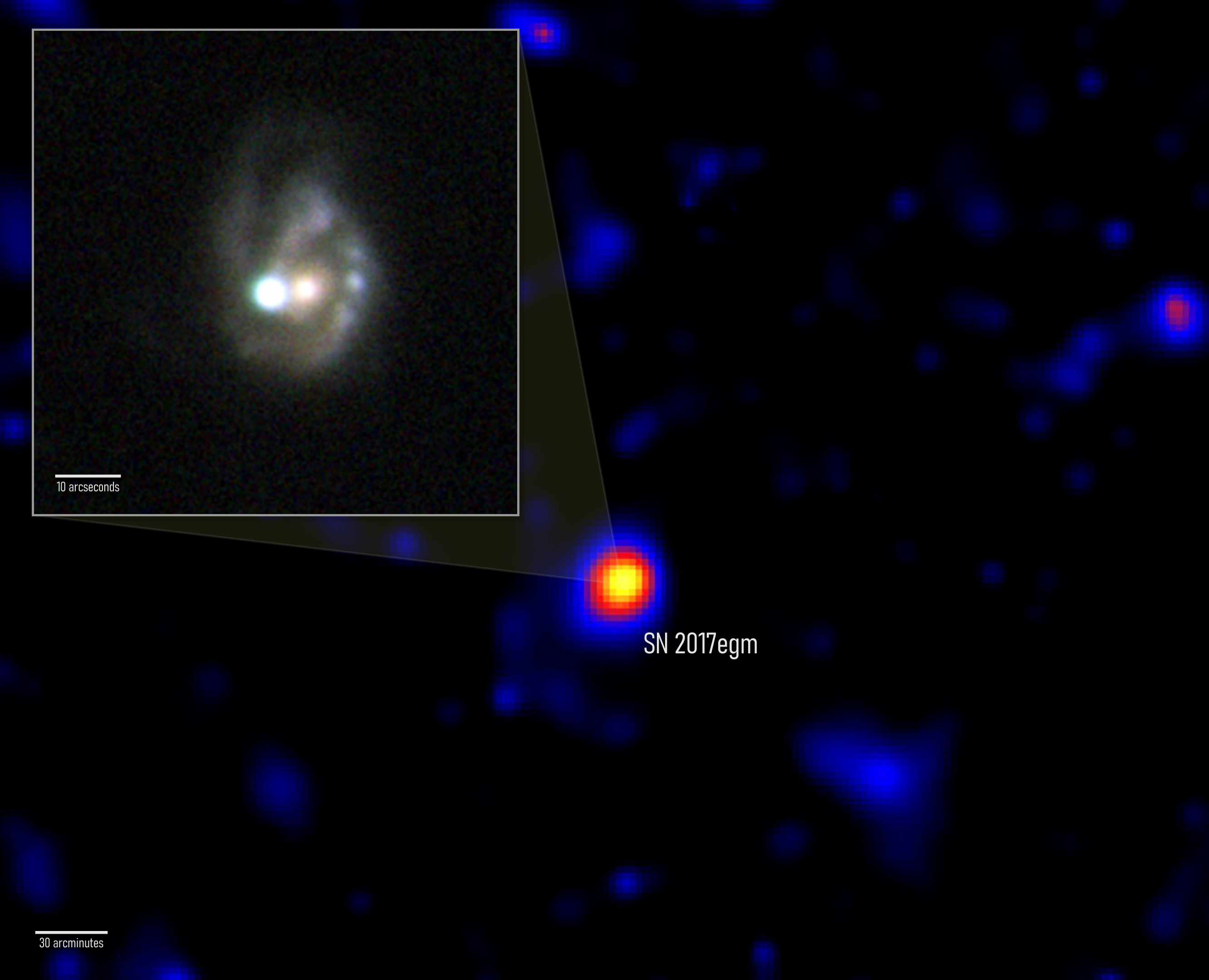
Core-collapse supernovae occur when the energy-producing center of a star many times our Sun’s mass runs out of fuel, collapses under its own weight, and explodes. During the collapse, a city-sized neutron star or an even smaller black hole may form. A blast wave blows away the rest of the star, which rapidly expands as a hot, dense cloud of ionized gas.
In the last couple of decades, nearly 400 exceptional core-collapse supernovae have been identified. Each of these events, dubbed superluminous supernovae, produced 10 or more times the amount of visible light normally seen.
In 2024, a study led by Li Shang at Anhui University in Hefei, China, noted that Fermi’s Large Area Telescope may have seen gamma rays — the most energetic form of light — from a superluminous supernova that occurred years earlier.
Dubbed SN 2017egm, this supercharged outburst occurred in galaxy NGC 3191, located about 440 million light-years away in the constellation Ursa Major. Even at this distance, the explosion remains one of the closest of its type to us on Earth.
The superluminous supernova SN 2017egm was discovered by the European Space Agency’s Gaia mission on May 23, 2017. It exploded in a massive barred spiral galaxy known as NGC 3191, shown on the left before the eruption. The image at right, taken on July 1, 2017, shows the supernova outshining the entire galaxy. Left, SDSS and PS1; right, NOT+ALFSOC/Bose et al. 2020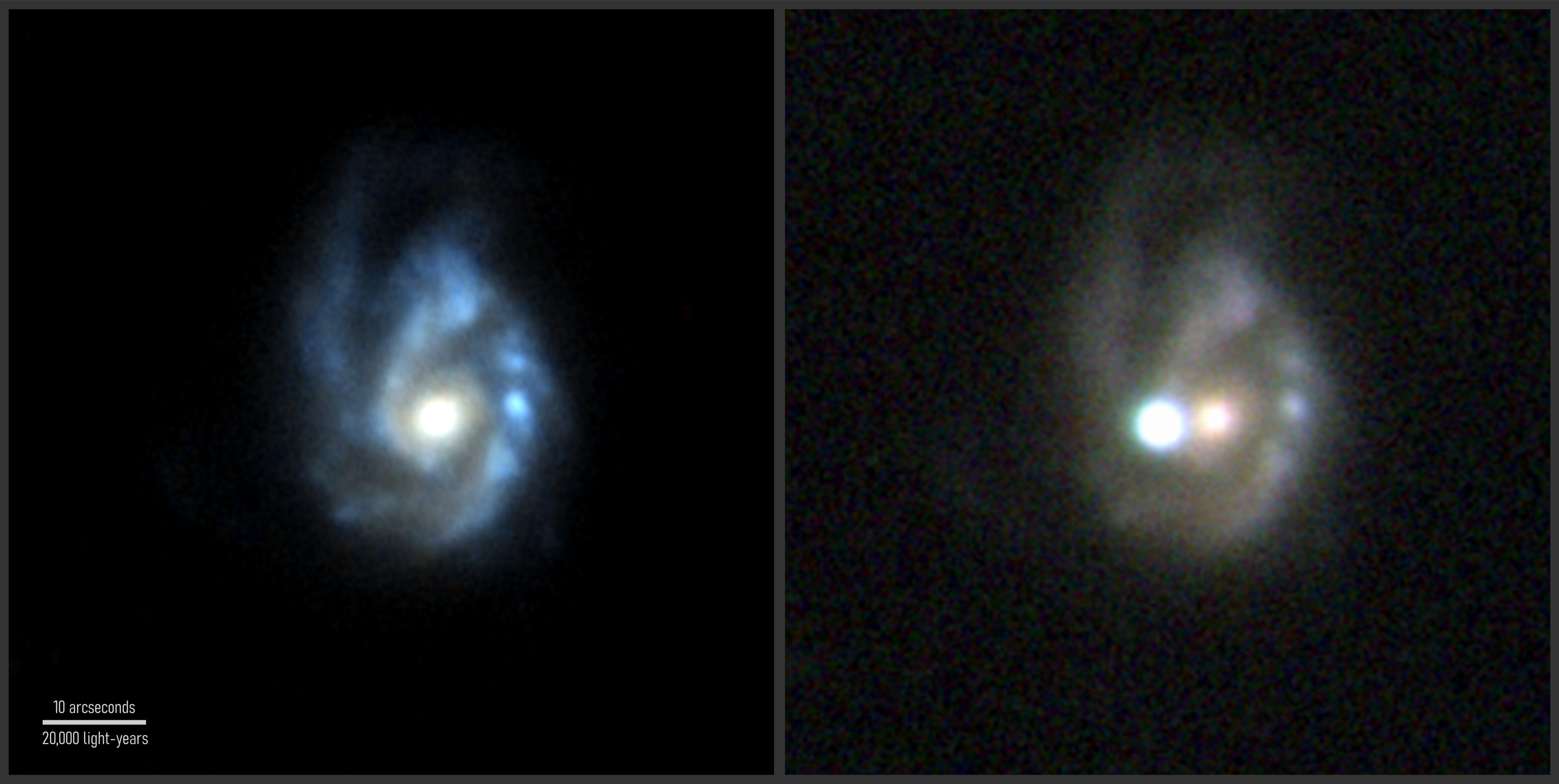
“We searched for gamma rays from the six nearest superluminous supernovae seen during the first 16 years of Fermi’s mission,” said Guillem Martí-Devesa, a researcher previously at the University of Trieste in Italy and now a fellow at the Institute of Space Sciences in Barcelona, Spain. “Only SN 2017egm shows evidence for gamma rays, confirming earlier hints that some supernovae can be as luminous in gamma rays as they are in visible light. This opens up a new window for studying these fascinating events.”
Theorists have debated the possible energy sources that give these explosions their extra punch. High on the list has been the formation of a magnetar, a type of neutron star with the strongest magnetic fields known — up to 1,000 times the intensity of typical neutron stars. That’s 10 trillion times stronger than a refrigerator magnet.
The team undertook a deeper analysis of the supernova’s observed optical and gamma-ray features to compare how well different theoretical models reproduced them. A model developed by co-authors Indrek Vurm at the University of Tartu in Estonia and Brian Metzger at Columbia University in New York City traced how light and particles produced by a newborn magnetar would move outward and interact with the supernova’s expanding debris.
Scientists expect a newly formed magnetar to spin a few hundred times a second. This rapid rotation produces a strong outflow of electrons and positrons, their antimatter counterparts, that forms a vast cloud of energetic particles.
The Crab Nebula formed in a supernova explosion observed in 1054. At its heart lies an isolated neutron star, the crushed core of the original star. It spins about 30 times a second, sweeping a beam of radiation toward Earth with every rotation, lighthouse style, which classifies the neutron star as a pulsar. This rapid spin powers X-ray jets (elongated blue-white feature near center) and a high-speed outflow of electrons and other particles. The particles collect in a vast cloud-like structure called a pulsar wind nebula, which also forms around magnetars, the pulsar’s supermagnetized cousin. This emission gradually slows the neutron star’s spin. These images combine X-ray data from NASA’s Chandra X-ray Observatory (bluish white) and infrared data from NASA’s James Webb Space Telescope. X-ray, Chandra: NASA/CXC/SAO; Infrared, Webb: NASA/STScI; Image Processing: NASA/CXC/SAO/J. Major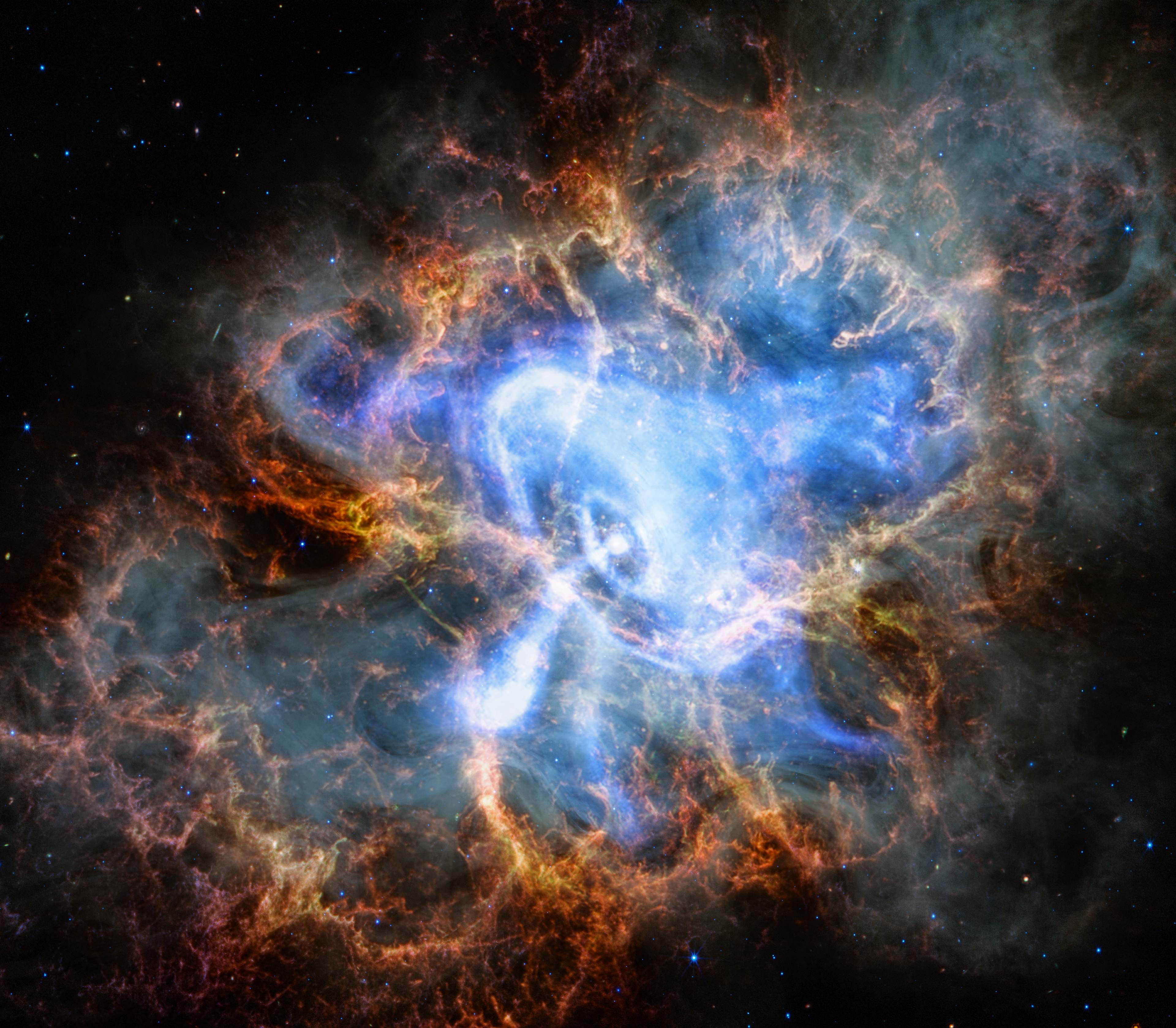
Within this cloud — called a magnetar wind nebula — various interactions fuel the production and absorption of gamma rays. For example, an electron and a positron can annihilate into a pair of gamma-ray photons, or two gamma rays can collide and produce the particles. In these and other ways, gamma rays interact with the supernova debris. Unable to escape directly, they become reprocessed, downshifted into lower-energy visible light that provides the supernova with its extra boost in luminosity.
“About three months after the collapse, as the supernova debris expands and cools, the gamma rays can begin to leak out,” Acero said. “This magnetar model best reproduces the supernova’s luminosity and the arrival time of its gamma rays during the first months, but we see room for improvement at later times, when the visible light fades quite irregularly.”
Acero and his colleagues suggest that additional processes likely played contributing roles during SN 2017egm’s long fade-out. These include debris falling back onto the magnetar and interactions between the blast wave and matter ejected by the star in the centuries prior to its demise.
The X-ray glow associated with a source known as Swift J1834.9-0846, located near the center of the W41 supernova remnant, comes from the first magnetar wind nebula identified (outline). ESA/XMM-Newton and Younes et al. 2016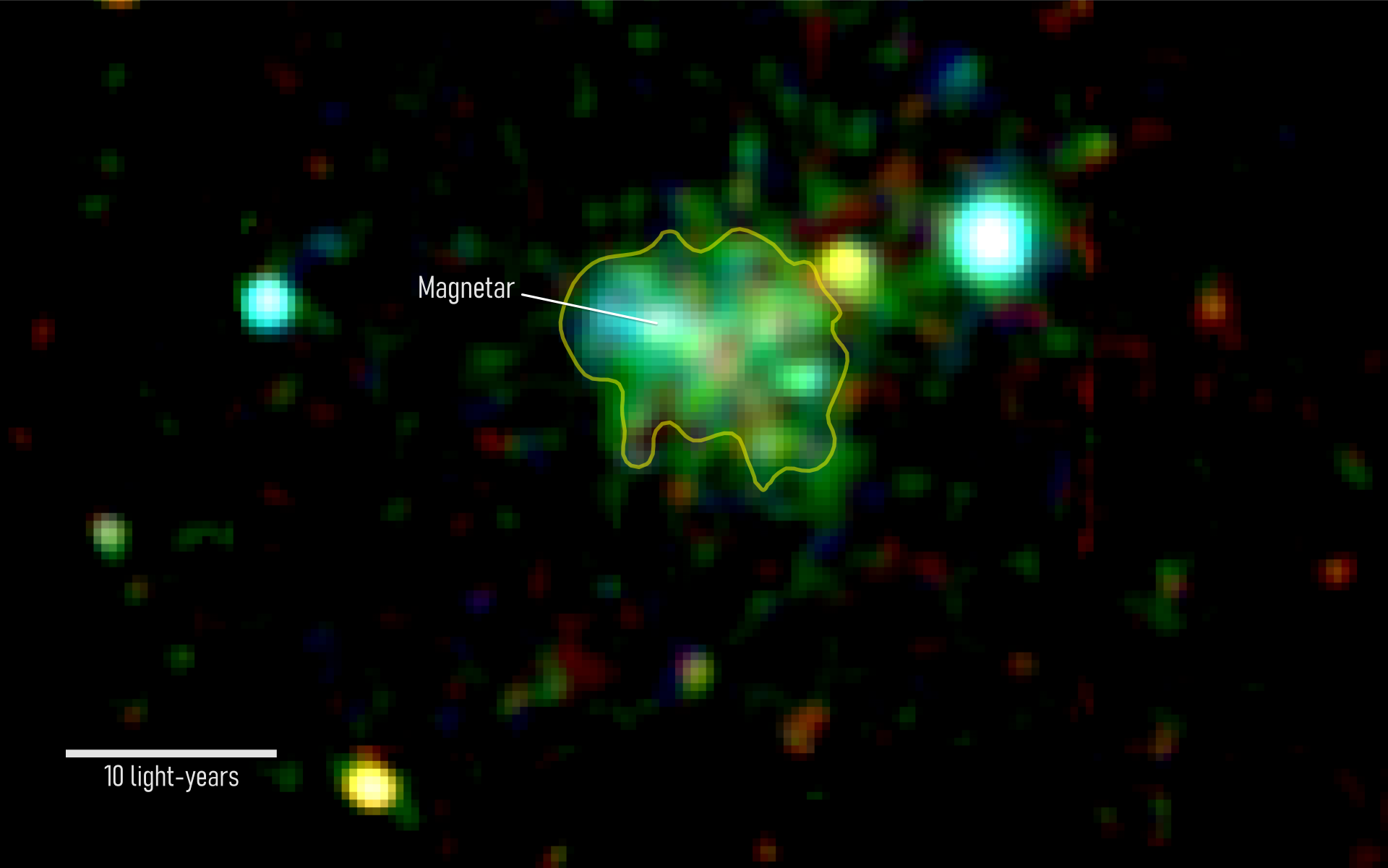
The team also examined how well a new ground-based gamma-ray facility, the Cerenkov Telescope Array Observatory, might detect events like SN 2017egm. With about 50 hours of observing time, they say, a similar supernova could be detected out to about 500 million light-years. Our understanding of phenomena like SN 2017egm will improve thanks to cooperation between such facilities and NASA’s fleet of space-based observatories that watch for rapid changes in the universe.
“The magnetar central engine mechanism discussed in this paper builds upon a lot of observational and theoretical advances in magnetars over the last 20 years,” said Judy Racusin, a deputy project scientist for the Fermi mission at NASA’s Goddard Space Flight Center in Greenbelt, Maryland. “Observing gamma rays from supernovae will give us a new way to explore their inner workings.”
By Francis Reddy
NASA’s Goddard Space Flight Center, Greenbelt, Md.
Media Contact:
Claire Andreoli
301-286-1940
claire.andreoli@nasa.gov
NASA’s Goddard Space Flight Center, Greenbelt, Md.
Stonehenge and the Geometry of the Sky
For most of human history, the sky was not something we studied — it was something we lived with.
The post Stonehenge and the Geometry of the Sky appeared first on Sky & Telescope.
NASA’s plan for a nuclear reactor on the moon could change space exploration forever—if it works
Nuclear power could enable long-term lunar missions, but NASA’s timeline may be too ambitious
Did the last common ancestor of humans and apes walk like a gorilla? A new study offers a clue
Some extinct human ancestors and modern-day apes appear to share wrist traits that raise the question of whether our last common ancestor walked on its knuckles
Fire Chars Santa Rosa Island
- Earth
- Earth Observatory
- Image of the Day
- EO Explorer
- Topics
- More Content
- About
Fire Chars Santa Rosa Island
- Earth
- Earth Observatory
- Image of the Day
- EO Explorer
- Topics
- More Content
- About
We may finally know why dinosaurs like T. rex evolved tiny arms
We may finally know why dinosaurs like T. rex evolved tiny arms
A Brief-ish History of SETI. Part VI: The Great Silence and the Great Filter
In the closing decades of the 20th century, several proposed explanations were put forward for why humanity has not yet found evidence of extraterrestrial intelligence in the cosmos.
Extreme heat is breaking records in the East. Here’s why
A Bermuda high parked over the western Atlantic is pulling sweltering air up from the south, challenging records in parts of the eastern U.S.
NASA’s Psyche Mission Images Mars’ Huygens Crater
NASA/JPL-Caltech/ASU Photojournal Navigation Downloads NASA’s Psyche Mission Images Mars’ Huygens Crater
PNG (3.47 MB)
Description
Captured by the multispectral imager instrument on NASA’s Psyche mission, this is an enhanced-color view of the large double-ring crater Huygens (upper right; about 290 miles, or 470 kilometers, in diameter) and the surrounding heavily cratered southern highlands near 15 degrees south latitude. The various colors in this dramatic scene are likely due to differences in the compositional properties of dust, sand, and bedrock in this ancient terrain. The image scale is around 2,200 feet (670 meters) per pixel.
The image was acquired with Imager A on May 15, 2026, at about 1:18 p.m. PDT, shortly after closest approach with the planet. The images have been processed into an enhanced-color view (to bring out color details beyond what the human eye can see) using red, green, and blue data from imager filters.
For more information about NASA’s Psyche mission, visit:
https://science.nasa.gov/mission/psyche/
Keep Exploring Discover More Topics From Photojournal
Photojournal
Search Photojournal
Photojournal’s Latest Content
Feedback
NASA’s Psyche Mission Images Mars’ Huygens Crater
NASA/JPL-Caltech/ASU Photojournal Navigation Downloads NASA’s Psyche Mission Images Mars’ Huygens Crater
PNG (3.47 MB)
Description
Captured by the multispectral imager instrument on NASA’s Psyche mission, this is an enhanced-color view of the large double-ring crater Huygens (upper left; about 290 miles, or 470 kilometers, in diameter) and the surrounding heavily cratered southern highlands near 15 degrees south latitude. The various colors in this dramatic scene are likely due to differences in the compositional properties of dust, sand, and bedrock in this ancient terrain. The image scale is around 2,200 feet (670 meters) per pixel.
The image was acquired with Imager A on May 15, 2026, at about 1:18 p.m. PDT, shortly after closest approach with the planet. The images have been processed into an enhanced-color view (to bring out color details beyond what the human eye can see) using red, green, and blue data from imager filters.
For more information about NASA’s Psyche mission, visit:
https://science.nasa.gov/mission/psyche/
Keep Exploring Discover More Topics From Photojournal
Photojournal
Search Photojournal
Photojournal’s Latest Content
Feedback
NASA’s Psyche Mission Spies Mars’ Wind-Blown Craters During Close Approach
NASA/JPL-Caltech/ASU Photojournal Navigation Downloads NASA’s Psyche Mission Spies Mars’ Wind-Blown Craters During Close Approach
PNG (1.78 MB)
Description
This view of the Martian surface, captured by NASA’s Psyche spacecraft on May 15, 2026, shows streaks that have formed due to wind blowing over impact craters in the Syrtis Major region. The image scale is nearly 1,200 feet (360 meters) per pixel. The wind streaks extend to about 30 miles (50 kilometers) long, and the large craters near center-bottom of the scene average around 30 miles in diameter.
The images have been processed into a natural-color view (approximating what the human eye would see) using red, green, and blue data from imager filters.
For more information about NASA’s Psyche mission, visit:
https://science.nasa.gov/mission/psyche/
Keep Exploring Discover More Topics From Photojournal
Photojournal
Search Photojournal
Photojournal’s Latest Content
Feedback
NASA’s Psyche Mission Spies Mars’ Wind-Blown Craters During Close Approach
NASA/JPL-Caltech/ASU Photojournal Navigation Downloads NASA’s Psyche Mission Spies Mars’ Wind-Blown Craters During Close Approach
PNG (1.78 MB)
Description
This view of the Martian surface, captured by NASA’s Psyche spacecraft on May 15, 2026, shows streaks that have formed due to wind blowing over impact craters in the Syrtis Major region. The image scale is nearly 1,200 feet (360 meters) per pixel. The wind streaks extend to about 30 miles (50 kilometers) long, and the large craters near center-bottom of the scene average around 30 miles in diameter.
The images have been processed into a natural-color view (approximating what the human eye would see) using red, green, and blue data from imager filters.
For more information about NASA’s Psyche mission, visit:
https://science.nasa.gov/mission/psyche/
Keep Exploring Discover More Topics From Photojournal
Photojournal
Search Photojournal
Photojournal’s Latest Content
Feedback
Psyche’s High-Resolution View of Mars’ South Pole
NASA/JPL-Caltech/ASU Photojournal Navigation Downloads Psyche’s High-Resolution View of Mars’ South Pole
PNG (1.09 MB)
Description
This is the highest-resolution view of the water ice-rich south polar cap of Mars captured by NASA’s Psyche mission after it made its close approach with the planet for a gravity assist. The image scale is around 0.7 miles per pixel (1.14 kilometers per pixel). The cap itself extends across more than 430 miles (700 kilometers). The image was acquired with Imager A on May 15, 2026, at about 1:53 p.m. PDT.
With Mars in the rearview mirror, the spacecraft will soon resume use of its solar-electric propulsion system to make a beeline to the main asteroid belt, between the orbits of Mars and Jupiter. When it arrives in August 2029, it will insert itself into orbit around the asteroid Psyche, which is thought to be the partial core of a planetesimal, a building block of an early planet.
For more information about NASA’s Psyche mission, visit:
https://science.nasa.gov/mission/psyche/
Keep Exploring Discover More Topics From Photojournal
Photojournal
Search Photojournal
Photojournal’s Latest Content
Feedback
Psyche’s High-Resolution View of Mars’ South Pole
NASA/JPL-Caltech/ASU Photojournal Navigation Downloads Psyche’s High-Resolution View of Mars’ South Pole
PNG (1.09 MB)
Description
This is the highest-resolution view of the water ice-rich south polar cap of Mars captured by NASA’s Psyche mission after it made its close approach with the planet for a gravity assist. The image scale is around 0.7 miles per pixel (1.14 kilometers per pixel). The cap itself extends across more than 430 miles (700 kilometers). The image was acquired with Imager A on May 15, 2026, at about 1:53 p.m. PDT.
With Mars in the rearview mirror, the spacecraft will soon resume use of its solar-electric propulsion system to make a beeline to the main asteroid belt, between the orbits of Mars and Jupiter. When it arrives in August 2029, it will insert itself into orbit around the asteroid Psyche, which is thought to be the partial core of a planetesimal, a building block of an early planet.
For more information about NASA’s Psyche mission, visit:
https://science.nasa.gov/mission/psyche/
Keep Exploring Discover More Topics From Photojournal
Photojournal
Search Photojournal
Photojournal’s Latest Content
Feedback
NASA’s Psyche Mission Sees Mars’ South Pole After Flyby
NASA/JPL-Caltech/ASU Photojournal Navigation Downloads NASA’s Psyche Mission Sees Mars’ South Pole After Flyby
PNG (423.28 KB)
Description
This is Psyche’s first view of a nearly “full Mars” seen shortly after the spacecraft’s closest approach to the planet on May 15, 2026. The view extends from the south polar cap northwards to the Valles Marineris canyon system and beyond.
With Mars in the rearview mirror, the spacecraft will soon resume use of its solar-electric propulsion system to make a beeline to the main asteroid belt, between the orbits of Mars and Jupiter. When it arrives in August 2029, it will insert itself into orbit around the asteroid Psyche, which is thought to be the partial core of a planetesimal, a building block of an early planet.
For more information about NASA’s Psyche mission, visit:
https://science.nasa.gov/mission/psyche/
Keep Exploring Discover More Topics From Photojournal
Photojournal
Search Photojournal
Photojournal’s Latest Content
Feedback
NASA’s Psyche Mission Sees Mars’ South Pole After Flyby
NASA/JPL-Caltech/ASU Photojournal Navigation Downloads NASA’s Psyche Mission Sees Mars’ South Pole After Flyby
PNG (423.28 KB)
Description
This is Psyche’s first view of a nearly “full Mars” seen shortly after the spacecraft’s closest approach to the planet on May 15, 2026. The view extends from the south polar cap northwards to the Valles Marineris canyon system and beyond.
With Mars in the rearview mirror, the spacecraft will soon resume use of its solar-electric propulsion system to make a beeline to the main asteroid belt, between the orbits of Mars and Jupiter. When it arrives in August 2029, it will insert itself into orbit around the asteroid Psyche, which is thought to be the partial core of a planetesimal, a building block of an early planet.
For more information about NASA’s Psyche mission, visit:
https://science.nasa.gov/mission/psyche/
Keep Exploring Discover More Topics From Photojournal
Photojournal
Search Photojournal
Photojournal’s Latest Content
Feedback
NASA’s Psyche Mission Images the Crescent of Mars
NASA/JPL-Caltech/ASU Photojournal Navigation Downloads NASA’s Psyche Mission Images the Crescent of Mars
PNG (251.49 KB)
Description
This view of a crescent Mars was captured on May 15, 2026, at about 5:03 a.m. PDT by NASA’s Psyche mission as it approached the planet for a gravity assist. Captured by the spacecraft’s multispectral imager instrument, this was the last view of the whole planet before it began to overfill the field of view of the camera.
Because Psyche approached Mars from a high phase angle, the planet appeared as a thin crescent in the days running up to the close approach, lit by sunlight reflecting off its surface. In observations from the spacecraft’s multispectral imagers, the crescent appeared brighter and extended farther around the planet’s disk than anticipated because of the strong scattering of sunlight through the planet’s dusty atmosphere.
The image was acquired with Imager A. It has been processed into a natural-color view (approximating what the human eye would see) using red, green, and blue data from imager filters.
For more information about NASA’s Psyche mission, visit:
https://science.nasa.gov/mission/psyche/
Keep Exploring Discover More Topics From Photojournal
Photojournal
Search Photojournal
Photojournal’s Latest Content
Feedback